Tag Archives: Asia

The end of South Korea`s economic miracle

The Korean Peninsula was inhabited as early as the Lower Paleolithic period. Its first kingdom was noted in Chinese records in the early 7th century BCE. The succeeding Korean Empire (1897 – 1910) was annexed in 1910 into the Empire of Japan.

Japanese rule ended following Japan`s surrender in World War II, after which Korea was divided into two zones: a northern zone, which was occupied by the Soviet Union, and a southern zone, which was occupied by the United States.

After negotiations on reunification failed, the southern zone became the Republic of Korea in August 1948, while the northern zone became the communist Democratic People`s Republic of Korea the following month.

In 1950, a North Korean invasion began the Korean War, which ended in 1953 after extensive fighting involving the American-led United Nations Command and the People`s Volunteer Army from China with Soviet assistance.

The war left 3 million Koreans dead and the economy in ruins.
The May 16 coup of 1961 led by Park Chung Hee put an end to the Second Republic, signaling the start of the Third Republic in 1963.

South Korea`s devastated economy began to soar under Park`s leadership, recording one of the fastest rises in average GDP per capita.

Despite lacking natural resources, the nation rapidly developed to become one of the Four Asian Tigers based on international trade and economic globalization, integrating itself within the world economy with export-oriented industrialization.

The Fourth Republic was established after the October Restoration of 1972, in which Park wielded absolute power.

The Yushin Constitution declared that the president could suspend basic human rights, and appoint a third of the parliament.

Suppression of the opposition and human rights abuse by the government became more severe in this period

South Korea has since then had a huge economic success. They have big companies like Samsung (which is the biggest company in South Korea), LG Energy Solution, Hyundai, and Kia to name a few.

On top of that, they also have BTS which is a boyband from South Korea. According to the Hyundai Research Institute, BTS was estimated to generate around $3,6 billion annually for the South Korean economy.

In some years, their direct and indirect contribution has been as high as $4,6 billion, which is comparable to major multinational corporations. BTS has been estimated to contribute around 0,3% to 0,5% of South Korea`s GDP in recent years.

This is a remarkable figure for a single music group, considering the country`s GDP was around $1,63 trillion in 2020.

South Korea`s economic success is well known all around the world, and they has become an economic powerhouse. But right now, it seems like their economic model is running out of steam. The economy has been slowing for years. It has basically stopped.

The economy in South Korea is on the way to be like Japan. What in the world is going on?

It all started in the 1950`s. Their economic growth was 10%, and it reached the top in the 1980`s. Then it began to slow. Growth in the 90`s declined to around 7%. Ten years later, the growth went down to 4%. In 2010, their growth was only 3%.

But something has happened in the last five years. The growth has been slowing year by year. This is what’s happening with the economy as they get richer. It happens in all rich countries. But, in South Korea, it seems like this is not temporary. It seems to be a new normal.

Bank of Kora (BOK) has warned that South Korea`s economy may enter negative territory in the next decade. The country is on a declining trajectory. Unless this is going to change, the next generation will be worse off than their parents.

But, how is it possible that a successful country like South Korea with so many high-tech companies can decline like this? Well, it has its own explanation. We need to look at their economic model, and how it came to be, and how it operates today.

The core of the South Korean economy is made up of something called «Chaebols». «Chae» stands for wealth or property, while «Bol» stands for clan or group.

«Chaebols» refers to large, family-owned business conglomerates in South Korea that wield significant influence over the country`s economy.

The influence of chaebols is often cited as a contributing factor to some of South Korea`s economic challenges, but they are not the sole reason for any economic decline. Several factors, including chaebols’ dominance, are at play when examining South Korea`s economic issues.

This is what we see in the U.S., but also in many other places in the West. They blame big corporations, wealthy entrepreneurs, and investors.

It is the concentration of economic power. Chaebols control a large portion of South Korea`s economy, leading to less competition. Their dominance can stifle small and medium-sized enterprises (SMEs), limiting innovation and growth in other sectors.

Chaebols have also been involved in corruption scandals, often using their power to influence political decisions. This has led to inefficiency in governance and public discontent, undermining economic reforms.

Over-reliance on Export-driven Growth is also considered to be a challenge. Chaebols are heavily focused on industries like electronics, shipbuilding, and automobiles, which are export-driven. This makes the South Korean economy vulnerable to global economic shifts and trade disputes, especially in a world where the diversification of industries is increasingly important.

They also face succession and corporate governance issues. Since chaebols are family-controlled, they often face challenges with leadership transitions between generations. This can lead to inefficiencies and financial mismanagement within these conglomerates.

Strong and independent entrepreneurs have made the wealth you and I have today. They have created products that made our lives better, and their companies have grown to be multi-billion corporations. If this is a problem for countries around the world, well, what can we say? If so, this is not the only reason why the growth is slowing.

We see the same going on in South Korea as well as in Japan and many other places. Broader factors are leading to economic challenges, and one of them is the aging population. South Korea has one of the lowest birth rates in the world, leading to a shrinking working-age population.

This demographic challenge puts pressure on economic growth and social welfare systems. This is not only happening in Japan and South Korea. It`s happening in many other places around the world.

We also have a global economic slowdown. South Korea`s heavy reliance on exports means it is susceptible to the global economic downturn. Trade tensions, especially between the U.S., and China, impact South Korea`s major industries.

On top of all that, we have technological disruption. Even though chaebols have driven much of South Korea`s technological advancements, their scale makes them slow to adapt to new digital trends and innovations compared to more agile startups.

So, what is South Korea doing to address these issues? The South Korean government has been working to implement reforms aimed at reducing chaebols’ influence, promoting transparency, encouraging innovation, and supporting small and medium enterprises (SMEs).

While chaebols have contributed significantly to South Korea`s rapid industrialization and growth, their outsized role can create imbalances in the economy, making reforms crucial for long-term, sustainable growth.

In conclusion, while chaebols are not the sole cause of South Korea`s economic challenges, their dominance and related issues do play a role in creating an environment that can hinder broader economic diversification and reform. As we can clearly see, successful entrepreneurs and large corporations can be both beneficial and problematic for an economy.

Unfortunately, we very often see that successful entrepreneurs are attacked. Especially by socialists. But we have to ask ourselves what we should do without them? Because they are the ones that are creating wealth in the long run. No socialism without capitalism. The socialists need money for the welfare system, and that money comes from entrepreneurs who make goods and services.

Entrepreneurs drive innovation, create new industries, and develop new technologies that can improve productivity. Successful businesses, especially startups, can grow into larger companies, and boost economic growth.

Large corporations provide millions of jobs and stimulate related industries (e.g., supply chains, and service providers). For example, companies like Apple Amazon, or South Korea`s Samsung employ a large global workforce and indirectly create additional jobs in the ecosystem surrounding their businesses.

We can see time and time again, that entrepreneurs are often the source of disruptive innovation, bringing new products and services to the market. Successful entrepreneurs can help transform entire industries.

Large corporations often have the resources to invest in research and development (R&D), leading to technological advancements. For example, tech giants like Google and Microsoft invest heavily in artificial intelligence, cloud computing, and other areas that push technological boundaries.

Multinational corporations make a country more competitive on the global stage. For example, South Korea`s chaebols (Samsung, Hyundai) or the U.S. tech giants, like Google and Apple, enhance their countries’ global influence. They also attract foreign investment and contribute to the trade balance through exports.

Successful entrepreneurs and large corporations are not inherently bad for the economy. In fact, they can drive growth, innovation, and global competitiveness. However, their dominance can lead to economic and social imbalances that harm the broader population if left unchecked. Balancing their power with fair regulations, competition, and equitable policies can be essential for sustainable economic development.

Disclaimer: The views expressed in this article are those of the author and may not reflect those of Shinybull.com. The author has made every effort to ensure the accuracy of the information provided; however, neither Shinybull.com nor the author can guarantee such accuracy. This article is strictly for informational purposes only. It is not a solicitation to make any exchange in precious metal products, commodities, securities, or other financial instruments. Shinybull.com and the author of this article do not accept culpability for losses and/ or damages arising from the use of this publication.

Leave a comment

Filed under Politics

Economic globalization is the trend of the times. Though countercurrents are sure to exist in a river, none could stop it from flowing to the sea

World Economic Forum (WEF) started its annual meeting yesterday, and it will continue till Thursday this week. This is the first global in-person leadership event since the start of the Covid-19 pandemic, and this time their theme is; «Working Together, and restoring Trust.»

But the annual meeting has never been confronted with so many unprecedented global issues as it is now in 2022. The WEF`s annual meeting is coming at a crucial time. The most crucial in its 50-year history.

The world is recovering from a global pandemic, struggling with a war in Ukraine, and facing huge challenges from climate change. On top of that, monkeypox is coming, and so are inflation and famine.

One of the topics is globalization, and as we all know, globalization is dead right now. But, I think it`s only set on «pause.»

Chinese President Xi Jinping visited WEF in 2017, and on his first trip he said; «Whether you like it or not, the global economy is a big ocean that you cannot escape from.»

This time, in 2022, Xi said; «Economic globalization is the trend of the times. Though countercurrents are sure to exist in a river, none could stop it from flowing to the sea.»

Xi is also the founder of the Belt and Road Initiative (BRI), which is the 21st Century Maritime Silk Road. The Silk Road has always been important to the trade in the world. It was an ancient trade route that linked the Western world with the Middle East and Asia.

It was a major conduit for trade between the Roman Empire and China and later between medieval European kingdoms and China.

Established when the Han Dynasty in China officially opened trade with the West in 130 B.C., the Sild Road routes remained in use until 1453 A.D., when the Ottoman Empire boycotted trade with China and closed them.

Although it`s been nearly 600 years since the Silk Road has been used for international trade, the routes had a lasting impact on commerce, culture, and history that resonates even today.

I find it very interesting to see that Venetian explorer Marco Polo famously used the Silk Road to travel from Italy to China, which was then under the control of the Mongolian Empire, where they arrived in 1275.

Notably, they did not travel by boat, but rather by camel following overland routes. They arrived at Xanadu, the lavish summer palace of the Mongolian emperor Kublai Khan. (You can see the film about that relationship on Netflix. I think you will like it a lot).

In all, the explorer spent 24 years in Asia, working in Kublai Khan`s court, perhaps as a tax collector.

Marco Polo returned to Venice, again via the Silk Road routes, in 1295, just as the Mongolian Empire was in decline. His journeys across the Silk Road became the basis for his book, «The Travels of Marco Polo,” which gave Europeans a better understanding of Asian commerce and culture.

Khan`s Empire is gone. So are the Roman and the Ottoman Empire. Some historians say the start of the British Empire started around the 1490s, while others say the early 1600`s, but it all ended in the years after World War 2, with most of Britain`s colonies ruling themselves independently by the late 1960s. But what about the American Empire?

A New World Order started after World War 2, and the U.S became the leading Empire in the World. Now, we are all facing a revolution. A New World Order. Again. Globalization is dead, but it will come back, because as Xi said: «Economic globalization is the trend of the times. Though countercurrents are sure to exist in a river, none could stop it from flowing to the sea.»

On Friday, the S&P 500 briefly fell into a bear market, and the inflation in the UK hit a 40-year high in April. We are into a vicious cycle, and the WEF`s Chief Economists Outlook has warned of lower economic activity, higher inflation, lower real wages, and greater food insecurity globally in 2022.

They warn that this could have devastating human consequences as the global economy fragments.

As Saadia Zahidi, Head of the Centre for New Economy and Society and a Managing Director at the World Economic Forum explained:

«We are at the cusp of a vicious cycle that could impact societies for years. The pandemic and war have fragmented the global economy and created far-reaching consequences that risk wiping out the gains of the last thirty years.

Leaders face difficult choices and trade-offs domestically when it comes to debt, inflation, and investment. Yet business and government leaders must also recognize the absolute necessity of global cooperation to prevent economic misery for millions around the world.

The WEF`s Annual Meeting this week will provide a starting point for such collaboration.»

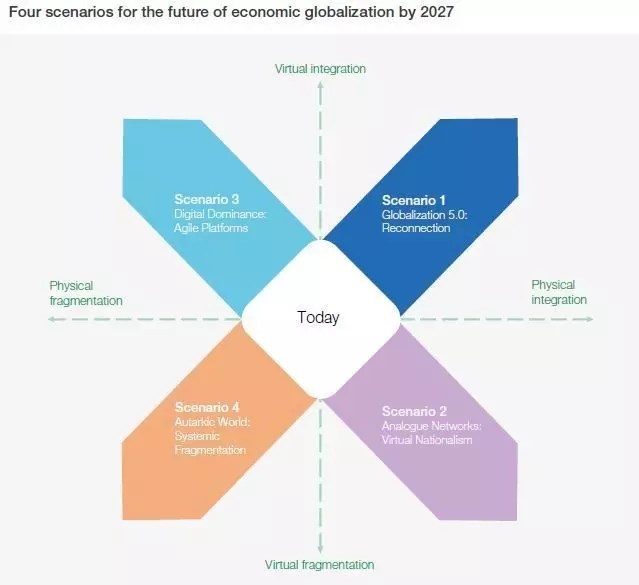
Four Futures for economic Globalization: Scenarios and their implications:

Globalization has created significant opportunities and lifted millions out of poverty, while also driving inequality and economic disruption. With many countries turning inward in search of new strategies to increase security and resilience, the convergence of physical and virtual forms of economic globalization is no longer a given.

As the traditional drivers of globalization have reached a critical juncture, we are entering a new phase of increased economic volatility, polarization, and structural reset of the global system. Ever-accelerating digitalization, however, means that the rivalry between global centers is rapidly expanding from the physical to virtual space, where competition over the control of technology and information networks is growing. How different economic centers of gravity will choose between physical and virtual integration, fragmentation or isolation will shape the fate of economic globalization in the years to come.

This White Paper outlines how the nature of globalization may shift as economic powers choose between fragmentation or isolation in both physical and virtual integration. The report calls for “no-regret actions” by policymakers: global cooperation on the climate crisis; investment in human capital to prepare populations for a range of economic futures, and returning to developing resilience through greater economic integration, knowledge-sharing, and diversification.

Globalization is at crossroads. It`s changing, but it isn`t ending.

Disclaimer: The views expressed in this article are those of the author and may not reflect those of Shinybull.com. The author has made every effort to ensure the accuracy of the information provided; however, neither Shinybull.com nor the author can guarantee such accuracy. This article is strictly for informational purposes only. It is not a solicitation to make any exchange in precious metal products, commodities, securities, or other financial instruments. Shinybull.com and the author of this article do not accept culpability for losses and/ or damages arising from the use of this publication.

Leave a comment

Filed under Politics

The communist party coup took place in Kabul on April 28, 1978

Afghanistan is a beautiful country, and only a few decades ago, people in Kabul were singing and dancing to live music and had fun. Kabul was probably much better than European countries. So, what in the world went wrong in Afghanistan?

Afghanistan had cinemas, restaurants and hotels, and people who lived in Kabul four decades ago describes it as romantic and better than Europe. They have high mountains and the weather is often sunny. It`s one of the best countries in Asia.

But something happened. Someone took the country.

In the 1960`s the King and the Queen opened up the country to the world after centuries of isolation. They also enabled women to partisipate in public life. They became feminists without even knowing what it was all about.

In 1964, according to the constitution, women also got the right to wote. Everything was fine and there was no segregation between men and women. Kabul was a modern city. People were dressed like Western people. They were listening to Western music and thought the Western style was the right thing for them.

People were poor but very happy, but then a lot of tourists came in to Kabul. And suddenly, it was time for a «hippy» era. Just like the West. Hippy music. Hippy fitness. A hippy style society. Tourists went to historical places to see Buddah.

But then, something happened.

A Western-style protest movement started in Afghanistan. Students began talking about Revolution. They talked about Communism and women`s rights. They said it should be more equality between men and women. Nor should it be discrimination.

Kabul became more and more like the Western world, but some people didn`t like that. And that was people in Pedesaan were 80 percent of the population live. Afghanistan had a conflict going on.

Pedesaan was way ahead of the modern city Kabul, and people didn`t like the changes. People in Pedesaan was more conservative and people were following tribal traditions and the teachings of Islam.

Women were isolated and could be forced to mirrage with someone they didn`t love. The Muslims were worried about the progress in Kabul. The problem at that time is that people were sleeping. They didn`t see the real problem. And the problem was their own «class difference.»

In the early 70`s, the first Islamic organisation was founded. Their goal was to protect their traditional lifestyle. It was the birth of the political Islamism in Afghanistan. This is the era were people in Afghanistan became divided in two groups.

Left and Right.

Communists on the left side, and Islamists on the right side.

The Islamist movement were blaming Communists, and Communists were blaming Islamists and the problems escalated. No one were able to guide the people and a blamegame started istead of keeping the great value of national unity among the people.

To everybody`s surprise; the communists managed to take power. First in 1973. It was a coup and they overthrow the monarchy. And now, the country became a republic with its first ever president.

Mohammed Daoud Khan became a President of Afghanistan from 1973 to 1978. Mohammed was a cusine of the former King, but in 1978, the communists desided that their time has come and seized power for themselves.

In just one night, they killed Daoud Khan and 23 members of his family. The communists called the bloody take over «april revolution.» (this is the same mindset as the Leninist communist in Soviet when they killed the Romanov family in their communist revolution).

The communist party coup took place in Kabul on April 28, 1978.

The new government tried to form the country into a new communist country thru radical reforms. People in Kabul had red flags and the communists took all oppositions. The communists first target were Muslims. (this is similar to the CCP today).

The communists arrested you if you were praying. You would also go to jail. This time was the most brutal time of the history of the country. Thousands of people was taken and all of the disappeared.

The communists took teachers that talked about religion. Many of them were dropped by a plane. Isamic activists started to build activist groups in 1979 and one of them was a group called Mujahideen (fighters of the holy was).

This revolution is an Islamic revolution, Islamist Party Leader Gulbuddin Hekmatyar said. Their goal was to establish a pure Islamic system in Afghanistan. Freedom and liberation of Afghanistan.

In Moscow, former Second Secretary of the Communist Party of the Soviet Union, Leonid Brezhnev was worried. Afghanistan was a nabouring communist state, and a successful Islamic revolution could send a dangerous message to the 50 million Muslims in the USSR.

Brezhnev dicided to send in troops in December 27, 1979. and that was the beginning of a long and expensive war that led to bankruptsy.

10,000 prisoners were released in one day. For some it was hard to find back to their own family members. Afghanistan was under forign occupation.

Afghanistan changed like never before. People were leaving because it was not their country anymore. Others were chanting «allahu akbar» at night, and thousands were protesting on the streets.

The Communists in Soviet Union supported the brutal communist regime in Afghanistan and that wasn`t music for the people. The resistance among the people were growing and they distrubuted papers at night and wrote on the walls; Long live Islam.

In the United States, they were quick to react to the Soviet offensive.

Afghanistan became the new epicenter of the Cold War.

US President Jimmy Carter said in a speech that the Soviet invation was an extremely threat to peace. Carter also said that Soviet now can control much of the world`s oil supply.

Washington started to support Mujahideen with money and weapons.

US National Security Advisor Zbigniew Brezezinski appeared to Afghanistan`s religion pride in 1980 when he visited Pakistan. One day, he said, you will take your country back because God is on your side.

The communists had big problems to fight back against the Mujahideen guerillas. The only place the communist had control was in Kabul. The communist government said no to women education. No freedom for women. So, women was used as a political tool. But people didn`t like it at all.

The Mujahdin used terrorist attacks in Kabul to destabilise the society. It was too dangerous to be there, so 3 million went to Pakistan or Iran to join their Muslim brothers. Peshawar near Islamabad in Pakistan became a hotspot of resistance.

They got the weapons they needed in Pakistan. And a Sudi also set up a camp there. His name was Osama Bin Laden. He recruited and supported all foriegn fighters from all over the Arab world to join the Afghan jihad. Radical Islam spread in the refugee camp. They started to brainwash the children and they are the one who became Taliban.

The countries that were involved trained conservative people and made monsters to get rid of the USSR. But the biggest problems was to know who the civilians and who the enemies was.

The war in Afghanistan was very expensive for the USSR, and in 1986, Mikhail Gorbachev desiced to withraw his troops. He said; «Counterrevolution and imperialism have turned Afghanistan into a bleeding wound.

We should like, in the nearest future, to withdraw the Soviet troops stationed in Afghanistan.» They took the troops out of Afghanistan in 1989.

People in Afghanistan were so happy. Finally, the USSR are going back home. And the people was feeling free. They won the war.

But, a lot of things happened. It wasn`t over.

The communist government still had control over Kabul, and was the final obstacle to become an Islamic republic. In other words; the war was not yet over. On April 24, 1992, The Mujahideen took control over Kabul.

It was a critical moment were the Mujahideen took over the presidential palace. The dream to become an independent Isamist state was on the way to be fulfilled. But instead, other groups of people started to fight against each other to take back the control. A new civil war started. Everybody was fighting against everybody.

Instead of confronting each other, they used civil women and child as tools in a brutal war. The fighters could have killed each other but they killed civilans instead.

Now, Kabul was stigmatized. Isolated from the rest of the world. Deserted by Westerners. The British embassy was closed. The US embassy was closed. The French embassy was also closed.

«My feeling is that the UN and the Western powers were interested in Afghanistan as long as we fought against the USSR. Against communism. It was a common enemy. Then their interest completely disappeared. They abandoned us,» Mujahideen Commander Ahmad Shah Massoud said back then.

Many different groups of people were fighting against each other but nobody knew why they were fighting. It`s between commanders they said. They attacked civilians and especially woman. They raped them and cut of their breasts.

In 1994, a new force emerged; The Taliban. An Arabic name for «students.» many of them came from Quran-schools. The Taliban promised to restore peace, order and morality. They had massive support from Pakistan. Many of them were grown up in refugee camps in Pakistan.

When Taliban came, they were welcomed by the people in Afghanistan. Finally, someone who wants to restore peace, order and morality. People thought that Taliban will take over the country and everything will be fine again. People supported them.

The Taliban took Kabul on September 27, 1996.

The Taliban changed Afghanistan repidly. The banned alcohol, films and all forms for entertainment. They smashed all Televisions on the streets. The Taliban ended the civil war and made peace.

But, they also took people`s freedom. What is peace without freedom?

Women suffered the most. They were fobidden to study or work. Girls were banned from school. They closed all the schools after the Islamic revolution. It was very sad for the kids, because the couldn`t learn to read and write.

The Taliban send people to the mosque and ban people from going out because these all are Islamic laws. They hunted all the women in Afghanistan. Why are you doing this? Why are you doing that? And so on. If someone say it is extremist, so be it, Taliban said.

Afghanistan became a hotpad for Islamic fundamentalism and it was under the Taliban protection that Osama Bin Laden returned to the country after a long war against the USSR. Osama Bin Laden founded the terrorist network Al-Qaeda to carry out a global jihad.

One of the attacks is said to be September 11. President Bush started a new war in Afghanistan. A few weeks after the attack on twin towers, the British and US soldiers attacked Al Quada leaders and their training camps.

The end of the Taliban regime ended on November 13, 2001.

People in Afghanistan was happy. Now, they are free. Taliban is gone and the United States will bring peace and freedom to Kabul and Afghanistan. Finally. People could go back to school again. Women could start to work again. They were free.

On a NATO command, 52 countries were placed in Afghanistan and in 2003, people voted for a new government. They tried to establish a new democracy. They were working hard to develop a new constitution.

December 17, 2003 – Constitutional Convention.

Millions of dollars were sent to Afghanistan to rebuild the country and establish a new democracy. But the money came into the pockets of the war lords who had, once again, returned to power. Rich people built supermarkets and houses like the one in Europe. Poor people remained poor.

Corruption started to emerge and new conflicts was rising. Corruption to access education, health care, jobs and justice. That alone has huge impact on the election and the politics.

Taliban recruited new members and prepared a new comeback. Despite the escalating violence, 2014 saw the withdrawal of most international coalition troops. Many aid organizations likewise left the country.

In February 2020, the US signed a peace agreement with the Taliban and announced the complete withdrawl of its troops within 14 months. But the Taliban have subsequently taken advantage of the resulting vacuum and the fragility of Afghan democracy to overrun the country.

The future and security of Afghanistan and its women is once again in jeoparady.

In August 2021, the Taliban overruns nearly all major Afghan cities in just 10 days. On 15 August, they enter Kabul. The Afghan government hands over power to the Taliban.

Afghanistan is the land of endless wars. They fought against Alexander the Great, Djengis Khan and Britain. Now, they are fighting against Taliban. 80 percent of the population is depressed. They have lost their hope and dreams. Does it stop here, and what is the next chapter?

To contact the author: post@shinybull.com

Disclaimer: The views expressed in this article are those of the author and may not reflect those of Shinybull.com. The author has made every effort to ensure the accuracy of the information provided; however, neither Shinybull.com nor the author can guarantee such accuracy. This article is strictly for informational purposes only. It is not a solicitation to make any exchange in precious metal products, commodities, securities, or other financial instruments. Shinybull.com and the author of this article do not accept culpability for losses and/ or damages arising from the use of this publication.

Leave a comment

Filed under Politics, Uncategorized

Chinese President Xi Jinping said President Donald Trump`s state visit is a successful and historic visit

President Donald Trump visited Asia and China last week, and what a visit it was. We all know that Mr Trump want to Make America great again, but the relationship between China and America will not only Make America great again, but also the world.

China treated Mr Trump like a pop star with red carpets, military bands, a goose-steppping honor guard of soldiers and a twenty-one gun salute to name a few. Kids were jumping up and down with American flags as Trump`s motorcade passed. They also dined with Chinese president Xi Jinping in the Forbidden City.

Mr Trump is the first foreign leader accorded that honor since the founding of the Peoples Republic in 1949. Wow!

Xi Jinping said at the end of his speech that Trump`s state visit is a successful and historic visit. What did they do?

President Donald Trump is a business man. He colaborates with a lot of business people in China and have negotiated with Chinese businesses for a long time, so he know this game. In addition; he is a great negotiator.

Before he was leaving China, he and Xi Jinping announced business deals worth $250 billion. This deal is by many called Trump “miracle” deals.

Mr Trump is trying to correct the $350 billion trade deficit between China and the U.S, and he is on the way.

President Trump withdrew the United States from the Trans Pacific Partnership (TPP) in January this year and called it a bad deal. It seems like Mr Trump is trying to make a better deal and he is doing it for the American people.

They try to better protect labor and intellectual property rights. One TPP chapter spelled out commitments on environmental issues such as illegal wildlife trade and marine fishery protection.

Many of the other countries were not enthusiastic about the intellectual property rights and labor clauses in the original TPP agreement, because it tended to favor U.S interests.

Washington pushed for the labor, environmental and intellectual property commitments to save its own companies. Workers get paid more and treated better on average in the U.S compared to developing countries on the TPP roster.

They`re required to follow environmental laws at home, and American courts protect their trademarks, patents and copyrights. If equivalent firms in other countries avoid these practices, they can cut costs, or snag an outside trademark without paying.

This is very important for Mr Trump and the White House, and they will probably be patient and continue with its meetings regarding the best agreement possible. In the meantime, the other countries will continue its agreement without the U.S.

Mr Trump is the first foreign diplomat to be given a rare tour and private dinner in the Forbidden City since the People`s Republic of China was founded in 1949.

Donald and Melania Trump shared an afternoon tea with Xi Jinping and his wife Peng Liyuan at the Forbidden Palace Hall, and it was intentionally chosen for its historical and cultural significance that underscores cooperation between the two countries.

Mr Trump is doing everything he can to make America great again. Since he was elected a year ago, the stock market have gone straight up. Up, up, up and up. The stock market is up in all months so far this year, and that hasn`t happened in many decades. It is unbelievable.

People in America is also beginning to be very positive about the U.S economy. Consumer Confidence has gone straight up in months after months. That too, is unbelievable.

If Trumpism is the policies advocated by Donald Trump, especially those involving a rejection of the current political establishment and the vigorous pursuit of American national interests, and a controversial or outrageous statement attributed to Donald Trump, this is what it is;

TRUMPISM.

brand

Disclaimer: The views expressed in this article are those of the author and may not reflect those of Shiny bull. The author has made every effort to ensure accuracy of information provided; however, neither Shiny bull nor the author can guarantee such accuracy. This article is strictly for informational purposes only. It is not a solicitation to make any exchange in precious metal products, commodities, securities or other financial instruments. Shiny bull and the author of this article do not accept culpability for losses and/ or damages arising from the use of this publication.

———————————————–advertisement——————————————————-

Polo-banner-spotlight

Polo Shirt

High quality Polo shirt with Shinybull logo. This version is made from breathable 100% cotton. Short sleeves and ribbed armbands.

$125.00

Polo Shirt

High quality Polo shirt with Shinybull logo. This version is made from breathable 100% cotton. Short sleeves and ribbed armbands.

$125.00

Leave a comment

Filed under Politics

Emerging markets

It`s all green and it`s all up in the European markets today. It`s mixed in Asia. Today, everyone has their eyes on the Twitter IPO. A very risky investment for investors right now. You all know what went wrong with Facebook. Twitter is about 50% more risky than Facebook.

Befor the Twitter IPO I will write about the Emerging Markets. Three new investment opportunities today:

Turkey

GDP growth, 2013 to 2017: 21.2%.

Inflation rate: 5.4%.

Government debt as % of GDP: 36.3.

Thailand

GDP growth, 2013 to 2017: 25.9%.

Inflation rate: 2.7%.

Government debt as % of GDP: 49.4.

South Korea

GDP growth, 2013 to 2017: 22.9%.

Inflation rate: 2.9%.

Government debt as % of GDP: 27.3.

South Korea, together with Mexico and Czech Republic are among the most attractive countries. That`s because they are less reliant on foreign finance. That`s good news for investors because they don`t know what`s gonna happen in Capitol Hill and the White house.

Some of the nations in the EM`s will see more capital outflows in the next months as the investors starts to break it down to good EM`s and bad EM`s. The prospect of the Fed reducing its stimulus is a “persistent” external risk, South Korea Finance Minister Hyun Oh Seok said.

I look forward to write about Twitter tomorrow. A risky stock, and I am just waching the trading session now. News today: Crude oil inventories at 10:30am. Forecast: 1,7M.

emerging-markets-sign

Disclaimer: The views expressed in this article are those of the author and may not reflect those of Shiny bull. The author has made every effort to ensure accuracy of information provided; however, neither Shiny bull nor the author can guarantee such accuracy. This article is strictly for informational purposes only. It is not a solicitation to make any exchange in precious metal products, commodities, securities or other financial instruments. Shiny bull and the author of this article do not accept culpability for losses and/ or damages arising from the use of this publication.

Leave a comment

Filed under Emerging markets