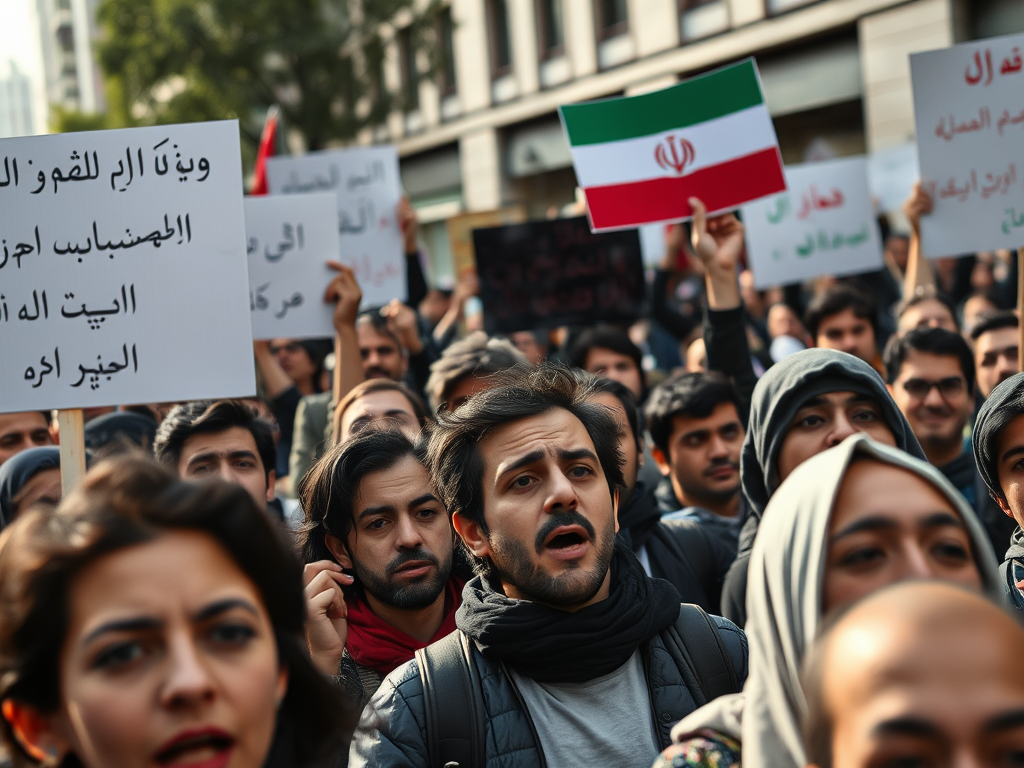
Iran is entering a period of heightened political risk as economic collapse, environmental stress, and elite defection converge in ways not seen for decades. The latest wave of unrest, which began on December 28 in Tehran’s Grand Bazaar, has spread across more than 100 cities, evolving from local economic protest into a broader challenge to the Islamic Republic’s authority.
While demonstrations are not new in Iran, the participation of the bazaar merchant class marks a potentially decisive shift. In Iran’s modern political history, the withdrawal of support by the bazaaris has tended to occur at moments of acute regime vulnerability and has coincided with major political realignments — most notably in 1978–79.
The Bazaar as a Political Barometer
The Grand Bazaar is the backbone of Iran’s domestic economy. Its dense networks of traders, wholesalers and importers connect supply chains, liquidity and social influence across the country. Historically, bazaar merchants have not functioned as a permanent opposition force. Instead, they have acted as pragmatic political actors, aligning themselves with whichever system appeared capable of guaranteeing stability, access and predictability.
In 1979, they withdrew support from the Shah and aligned with the clerical opposition. For more than four decades thereafter, they formed part of the Islamic Republic’s core economic coalition.
That coalition now appears to be fracturing.
When bazaar merchants close their shops, the impact goes far beyond symbolism. Commercial shutdowns disrupt distribution networks, freeze working capital and send a powerful signal that confidence in the state’s economic management has eroded. In Iran’s political system, such signals matter — not because they immediately bring down governments, but because they indicate that the regime’s traditional mechanisms of consent are weakening.
Economic Breakdown as the Catalyst
The immediate driver of unrest is economic collapse.
Over the past year:
The Iranian currency has lost approximately 60 per cent of its value
Food prices have risen by around 72 per cent
Medicine costs have increased by roughly 50 per cent
Inflation is estimated to be near 50 per cent
For many households, life savings have been effectively erased. For merchants dependent on imports, business has become unviable. The government’s decision to abolish subsidised exchange rates, combined with higher taxes, has sharply increased costs while currency volatility has made price-setting nearly impossible.
Compounding the crisis is a breakdown in basic infrastructure. Water reservoirs in several regions are reportedly at critically low levels, electricity supply is unreliable, and public services are deteriorating. The state is increasingly unable to provide core public goods: water, power, food security or employment.
In practical terms, the implicit social contract between state and society has collapsed.
From Economic Stress to Political Exposure
The scale and composition of the protests suggest that this is no longer a narrow economic dispute. Demonstrations now include merchants, workers and middle-class families, while confrontations with security forces have intensified. Dozens have reportedly been killed in clashes with the Revolutionary Guard.
The government’s response has oscillated between repression and improvised economic concessions. One widely reported offer — a small monthly payment to encourage protesters to disperse — was interpreted less as relief than as an admission of fiscal exhaustion.
Externally, the regime also faces heightened geopolitical pressure. Former US president Donald Trump has publicly warned of retaliation should violence against protesters continue. While such statements should be interpreted cautiously, Tehran remains acutely aware of Washington’s capacity to escalate economic and strategic pressure.
Political Realignment and the Search for Alternatives
As confidence in the Islamic Republic erodes, political symbols long considered marginal are resurfacing. Reza Pahlavi, the exiled son of Iran’s last Shah, has declared that the current system is approaching the end of the road and has called 2026 “the year of change”.
There is no clear evidence that monarchist forces are directing the protests. But the re-emergence of such figures reflects a deeper vacuum: a growing search for legitimacy outside the clerical system itself. In moments of systemic stress, Iranian politics has historically gravitated toward realignment rather than reform.
Even within elite circles, unease is evident. Persistent reports of contingency planning by senior figures underscore the perception that the current unrest represents more than a temporary disturbance.
A Regime Under Structural Pressure
The Islamic Republic retains formidable coercive capacity, and regime change is far from inevitable. But the convergence of economic collapse, environmental stress and elite defection suggests that Iran has entered a phase of structural instability.
The withdrawal of bazaar support does not in itself determine political outcomes. Historically, however, it has signalled moments when existing power arrangements were no longer sustainable.
Iran may now be approaching such a moment.
Disclaimer: The views expressed in this article are those of the author and may not reflect those of Shinybull.com. The author has made every effort to ensure the accuracy of the information provided; however, neither Shinybull.com nor the author can guarantee the accuracy of this information. This article is strictly for informational purposes only. It is not a solicitation to make any exchange in precious metal products, commodities, securities, or other financial instruments. Shinybull.com and the author of this article do not accept culpability for losses and/ or damages arising from the use of this publication.
Do you remember when Vladimir Putin invited many world leaders to Russia`s annual Victory Day parade in Red Square on May 9, 2015? Do you remember that all the western leaders were boycotting that event because of the crisis in Ukraine?
Vladimir Putin said at that time that the U.S is trying to create a «unipolar world». Putin and Russia have used an address commemorating the 70th anniversary of victory over Nazi Germany to accuse the U.S of attempting to dominate the world.
I wrote an article about it on June 3, 2015, and you can read that article here. Cuba`s Fidel Castro shares Putin`s worldview. He released a new book called «Cold War – A warning for a unipolar world» on September 1, 2003. Castro said; «To endure the global struggle between the superpowers is bad. To live under the total hegemony of one of them is worse».
That`s exactly what the war in Ukraine is about. A world order. World dominance. But Putin stopped this big dream, which means we will go from a Unipolar world to a Multipolar world.
The U.S President, Barack Obama, and Germany`s Angela Merkel didn`t come. Neither did other Western leaders like UK`s Prime Minister David Cameron and French President Francois Hollande. Moscow has increasingly appeared to pivot away from Europe and focus more on developing relations with China, I wrote in the article at that time in 2015.
The Chinese leader, Xi Jinping, was the most high-profile guest on the podium next to Putin. Other presidents in attendance included India`s Pranab Mukherjee, Presiden Abdel Fatah al-Sisi of Egypt, Raul Castro of Cuba, Nicolas Maduro of Venezuela, Robert Mugabe of Zimbabwe, and Jacob Zuma of South Africa.
«The boycott illustrates the depth and breadth of the chasm now separating Russia and the West,» said Dmitri Trenin, head of the Carnegie Moscow Center.
But what is Putin trying to say when he claims that the U.S is trying to create a «Unipolar World?»
Unipolarity in international politics is a distribution of power in which one state exercises most of the cultural, economic, and military influence. Unipolarity is an interstate system and not an Empire. Unipolarity implies the existence of many juridically equal non-states, something that an empire denies.
Unipolarity is anarchical. Anarchy results from the incomplete power preponderance of the Unipole. Kenneth Waltz, argues that great power cannot «exert a positive control everywhere in the world.» Therefore, relatively weaker countries have the freedom to pursue policy preferences independent of the Unipol.
Unipolar systems possess only one great power and face no competition. If a competitor emerges, the international system is no longer unipolar. Kenneth Waltz maintains that the United States is the only «pole» to possess global interests.
So, here we are. We knew at that time that Russia appeared to pivot away from Europe and focus more on developing relations with China.
Russia in bed with China, India, and Africa means a new world order, and that coalition is powerful. Keep in mind that 50% of the world population lives in China and India alone. In terms of business; that is a huge market.
The unipolar world has come to an end.
The modern international order, system, and relations developed after the end of the Thirty Years’ War in 1618 – 1648, and the conclusion of the Westphalia Treaty in 1648. Raymond Aaron studied international relations and he said: «I call the international system a set of political entities that maintain constant relations and can be involved in a large-scale war».
It`s all a part of an evolution, and there are four types of structural organization of the international system: the Westphalian system (1648-1789) as a system of classical European balance, the Vienna system (1814-1914) the system of European concert, the Versailles-Washington system (1919-1939) with the main conquest, the League of Nations and the Yalta-Potsdam system (1945-1991), the crown of which is the creation of the United Nations.
There are three types of world order: unipolar, bipolar, and multipolar. The unipolar world order presupposes the domination of a single super-power that is ahead of all other states by its combined power.
The bipolar world order is transformed into a multipolar one when economic and military power comparable to the power of the two states is reached by other powers. In an equilibrium system, several large states maintain roughly the same influence on the course of the events, restricting each other`s excessive claims.
At the beginning of the twentieth century, the world was multipolar, but by the middle of the century, two World Wars and many smaller conflicts had created a bipolar model.
With the end of the cold war and the collapse of the Soviet Union, bipolarity was replaced by unipolarity. The United States began to play a major role. But that has come to an end.
Recent facts and events show that the United States cannot cope with the role of being the only pole in the current world order. They were unable to balance forces in the Middle East. Neither with their troops nor with the support of groups that tried to seize power. Therefore; the troops withdraw from the war in Afghanistan.
The old world order is gone forever. Now, the world has entered a period of uncertainty and increased risks, exacerbated by the inability of the United States and its allies to solve the global problems of our time.
Former Barack Obama adviser, President of the Council on Foreign Relations Richard Haas introduced the concept of a world without states or a multipolar world in his book «A World in Disarray: America Foreign Policy and the Crisis of the Old Order.»
Nations must be prepared to surrender independence to world structures. The unipolar system has ended, and International relations in the 21st century will determine the situation of polarity. The power would be blurred rather than concentrated, and the importance of nation-States would diminish as non-state actors strengthened.
A multipolar system complicates diplomatic activity. it`s not just that they’re more actors in the polar world. It lacks the predictable fixed structures and systems of relations that characterize unipolar, bipolar, and multipolar structures.
The multipolar system will be difficult and dangerous, and international relations are undergoing a powerful transformation in the 21st century that changes the nature, structure, and essence of the international order.
A formation of a new model of international relations will be very painful and costly, and the entire world order will have to go through an era of turbulence. We had the pandemic. Now, we have a war, but there is more pain to come. There will be more economic and social hardships and it`s time for more world chaos.
The British philosopher and sociologist Sigmund Bauman said: «No one can consider themselves truly indispensable. Even the most privileged status can be temporary and suddenly change».
Disclaimer: The views expressed in this article are those of the author and may not reflect those of Shinybull.com. The author has made every effort to ensure the accuracy of the information provided; however, neither Shinybull.com nor the author can guarantee such accuracy. This article is strictly for informational purposes only. It is not a solicitation to make any exchange in precious metal products, commodities, securities, or other financial instruments. Shinybull.com and the author of this article do not accept culpability for losses and/ or damages arising from the use of this publication.
PM Trudeau and the Canadian government is invoking the Emergencies Act for the first time, and he will use it against a peaceful Freedom Convoy. PM Trudeau can provide for the use of the military, but he said it may not necessarily lead to that.
What he can do is temporarily suspend citizens’ rights to free movement or assembly. And the government is taking steps to stop the financial support of illegal protests.
The Emergencies Act is a law passed by the Parliament of Canada in 1988 which authorizes the federal government to take extraordinary temporary measures to respond to public welfare emergencies, public order emergencies, international emergencies, and war emergencies.
The law repeals the War Measures Act passed in 1914. It asserts that any government action continues to be subject to the Canadian Charter of Rights and Freedoms on the bill of rights.
Under the Emergencies Act, the federal Cabinet may declare a national emergency in response to an urgent and critical situation that cannot be dealt with by any existing law, and either is beyond the capability of a province to deal with it or threatens the sovereignty of Canada.
Before declaring a national emergency, the federal Cabinet must consult with provincial cabinets. In the case of a public welfare or public order emergency where the effects of the emergency are confined to, or occur principally in, one province, the Emergencies Act cannot be used in the provincial cabinet does not indicate that the situation is beyond the capacity of the province to deal with it.
The Emergencies Act lists several «public welfare emergencies» which result or may result, in danger to life or property, services, or resources, so serious as to be a national emergency. Public welfare emergencies include natural hazards such as fire, flood, drought, storm, or earthquakes, biological hazards including disease affecting humans, animals, or plants; and man-made hazards such as accidents or pollution.
The Canadian Security Intelligence Act, includes espionage, sabotage, detrimental foreign influences, activities that support the threat or use of violence for a political, religious, or ideological objective; or those activities which threaten to undermine or otherwise destroy, or overthrow the Government of Canada.
The Canadian Security Intelligence Act specifically notes that «lawful advocacy, protest or dissent» do not constitute «threats to the security of Canada».
After two years of lockdowns and restrictions, PM Trudeau said this; «This is about keeping Canadians safe, protecting people`s jobs, and restoring faith in our institutions.»
Trudeau is not preventing protesters to exercise their right to protest legally, but the news comes after the Ambassador Bridge, which is North America`s busiest land border crossing, reopened Sunday.
The Freedom protesters protested against the tyranny and Trudeau called them Nazis and threatened them with the Emergency Act and declared Canada to be a disgusting dictatorship. His popularity is at an all-time low of 16.
Narcissists are a big problem in the world today, and very often we see them in politics and the Mainstream Media. Their favorite weapon is always to gaslight their enemies. We saw it right after 9/11, and then after January 6th, and now in Ottawa in Canada. All peaceful protesters are considered to be domestic terrorists. But that is a big lie.
The truth is this; many of them are «targeted individuals.»
Trudeau will also regulate all crowdfunding and cryptocurrency under the terrorist financing act. Banks can temporarily freeze the personal and corporate bank accounts without a court order if these accounts are suspected of being used to support blockades, are protected from civil litigation if they chose to do so.
I talked with a friend of mine and he said something similar have happened to him. I told him that this has happened to me as well. At the beginning of April 2009, the stock market was at the bottom, I logged into my trading account and tried to buy some shares, but then, suddenly, something happened. They closed my account. Why?
I called the company and asked why they have closed my trading account. They said I need to sign a letter about money laundry and the terrorist financing act. Not only that. They also wanted to know my income, what my job is, who I`m working for, where I live, who I live together with, what interest I have in politics, if I know someone who is a politician, if someone in my family is engaged in politics, and so on.
What the heck is this? Do they want all this because I`m buying stocks? Come on maaaaaan.
I didn`t answer all the questions and I have never traded on that platform since then. It`s 13 years ago. I repeatedly ask myself; why did this come when we were at the bottom in the stock market? Is that a coincidence? Of course not.
According to Hanne Nabinu Heland, the Nobel Peace prize country in Norway is the worst country in Europe. Many people agree.
There is no doubt where this idea is coming from. I have seen this and many other disgusting things for years now. And there is no doubt that these people are collaborating. It`s a global network of crazy people that is gaslighting their enemies, which is ordinary people, or «we the people».
The New World Order elite have amassed wealth during Covid-19.
It seems like Canada, along with Australia, Italy, Austria and France are some of the nations that are most infiltrated by the globalists.
They attack Christian identity, more precisely the Catholic identity of these countries. We all remember when Notre Dame burned down in 2019. Was that a coincidence?
The global coup that in these two years of psycho-pandemic farce has been carried out by the globalist elite appears most clearly if we do not limit ourselves to considering what happened in individual Nations, but broaden our gaze to what has happened everywhere, writes his Excellence, Archbishop Carlo Maria Viganò at Global Research.
Various elite networks, transnational, financial, and governmental are working toward a common agenda. It`s the elite versus «we the people», and you are considered to be a domestic terrorist. This is how they are gaslighting you.
Most Americans and Europeans are left in the dark and have no idea that day by day their lives come under more control in order to clear the way for agendas of which they are unaware.
Disclaimer: The views expressed in this article are those of the author and may not reflect those of Shinybull.com. The author has made every effort to ensure the accuracy of the information provided; however, neither Shinybull.com nor the author can guarantee such accuracy. This article is strictly for informational purposes only. It is not a solicitation to make any exchange in precious metal products, commodities, securities, or other financial instruments. Shinybull.com and the author of this article do not accept culpability for losses and/ or damages arising from the use of this publication.
Once the Covid-19-vaccine was developed, many different companies launched their version at the same time, and the authorities started with the elderly because they were in the risk zone. First, you got one shot. But then, they said you needed a new one. And then a third one, and maybe four shots before you need to top it all with a booster.
Not only that. On top of that, you need to buy a test for you and your family. If everybody around the world can do that, and continue to do that for some time, I think it will be good business for the Big Pharma industry.
Big Pharma is doing a great job. They make medicines and vaccines that save lives. This is good. But, there is another side of the coin, and that isn`t good at all.
We all understand that corporations like Apple wants to sell as many phones as they can to the whole world. But what if Big Pharma does the same? The more sick people are, the more they earn. And investors like it and want more.
Many of the Covid-19-vaccines are paid by «We the people.» What they got in return is a vaccine, and the more they sell, and the higher the prices are, the more they earn. So, sick people are a great business.
Pfizer came out with an earnings report yesterday (Feb 8), and CEO Alberta Bourla said it expects 2022 sales of its Covid-19 vaccine and antiviral pill to top $54 billion, according to Reuters. Sales for its oral Covid-19 antiviral, Paxlovid, could be «way bigger» than Pfizer has to forecast.
Pfizer executives said the company is in active discussions with over 100 countries about Paxlovid and has the capacity to top 120 million courses if needed. Pfizer developed the covid-19 vaccine with Germanys BioNTech SE.
According to Peoples Vaccine Alliance, the companies behind two of the most successful Covid-19 vaccines (Pfizer, BioNTech, and Moderna) are making combined profits of $65,000 every minute.
That`s about $1,000 every second.
Overall, Pfizer expects 2022 sales of $98 billion to $102 billion. By comparison, the commercial recorded music industry grew by 7,4% to a total value of $31,6 billion in 2021.
So, if you want to invest your money for a big profit, you should invest in corporations that earn money on sick people. Not corporations that make people happy. The music industry.
According to Peoples Vaccine Alliance, Big Pharma earn money thanks to their patent monopolies for successful vaccines against the coronavirus, development of which was supported by $100 billion in public funding from taxpayers in the U.S, Germany, and other countries, the three corporations earned more than $26 billion in revenue in the first half of the year, at least two-thirds of it as pure profit in the case of Moderna and BioNTech.
According to Fortune, Germany funded the development of Pfizer`s Covid vaccine. Not U.S`s Operation Warp Speed.
The Alliance also estimates that the three corporations are over-charging, pricing vaccines by as much as $41 billion above the estimated cost of production.
Big Pharma`s business model is clear; receive billions in public investments, charge exorbitant prices for life-saving medicines and pay little tax.
This is gold dust for wealthy investors and corporate executives but devastating for global public health.
Instead of partnering with governments and other qualified manufacturers to make sure that we have enough vaccine doses for everyone, these pharmaceutical companies prioritize their own profits by enforcing their monopolies and selling to the highest bidder.
Profits before people.
In the first half of 2021, Moderna paid a 7% US tax rate and Pfizer paid a 15% tax rate, well below the US statutory rate of 21%. BioNTech which is a German startup that produced the recipe for the Pfizer vaccine paid a significantly higher tax rate of 31% tax rate in Germany.
New estimates of the cost of production for the successful mRNA covid vaccines suggest they can be produced for as little as $1,18 a dose of COVAX. Available reported prices to suggest that governments worldwide are paying between 4 and 24 times more than they could be for Covid-19 vaccines.
In other words; the cost of vaccinating the world against Covid-19 could be at least five times cheaper if pharmaceutical companies weren`t profiting from their monopolies on Covid vaccines. This is money you could spend on education and happiness.
The world is now talking about booster shots and realizing how much power has been vested in the hands of vaccine makers. They can hold the government hostage. They can force people to pay through their nose.
The CEO of Pfizer has suggested potential future prices of as much as $175 per dose. That`s 148 times more than the potential cost of production. If you need a booster shot every single year of the foreseeable future, vaccine companies can dictate every single line and clause in their top-secret contract to the governments around the world. It sounds like a vaccine robbery.
There is no doubt; Big Pharma is dangerously powerful. They decide who`s gonna live and die, and governments around the world are the only ones to do something about it. They should be there for the people.
Truckers and other people around the world are protesting against the government and their vaccine mandates and the crowd are growing bigger and bigger. Journalists and MSM say; «Take the vaccine!» «Take the vaccine!»
Leftist Marxist media and the governments are dividing people, claiming that the protesters are unvaccinated, fringe minority, misogynist, extremist, Trump-supporters, Nazis, Domestic terrorists, QAnon supporters, White supremacists, Homofob, Sexist, Racist, and so on. This is how they always smear the right side. This is how they always demonize people on the right side. This is a classical “we” versus “them.” Tell me; Is this how you unite people?
Pfizer is accused by a former senior US health official of «war profiteering» during the pandemic. Tom Friedman, who was director of the US Centers for Disease Control (CDC) and Prevention under Barrack Obama, said: «If you`re focusing on maximizing your profit and you`re a vaccine manufacturer, you are war profiteering.»
Disclaimer: The views expressed in this article are those of the author and may not reflect those of Shinybull.com. The author has made every effort to ensure the accuracy of the information provided; however, neither Shinybull.com nor the author can guarantee such accuracy. This article is strictly for informational purposes only. It is not a solicitation to make any exchange in precious metal products, commodities, securities, or other financial instruments. Shinybull.com and the author of this article do not accept culpability for losses and/ or damages arising from the use of this publication.
Afghanistan is a beautiful country, and only a few decades ago, people in Kabul were singing and dancing to live music and had fun. Kabul was probably much better than European countries. So, what in the world went wrong in Afghanistan?
Afghanistan had cinemas, restaurants and hotels, and people who lived in Kabul four decades ago describes it as romantic and better than Europe. They have high mountains and the weather is often sunny. It`s one of the best countries in Asia.
But something happened. Someone took the country.
In the 1960`s the King and the Queen opened up the country to the world after centuries of isolation. They also enabled women to partisipate in public life. They became feminists without even knowing what it was all about.
In 1964, according to the constitution, women also got the right to wote. Everything was fine and there was no segregation between men and women. Kabul was a modern city. People were dressed like Western people. They were listening to Western music and thought the Western style was the right thing for them.
People were poor but very happy, but then a lot of tourists came in to Kabul. And suddenly, it was time for a «hippy» era. Just like the West. Hippy music. Hippy fitness. A hippy style society. Tourists went to historical places to see Buddah.
But then, something happened.
A Western-style protest movement started in Afghanistan. Students began talking about Revolution. They talked about Communism and women`s rights. They said it should be more equality between men and women. Nor should it be discrimination.
Kabul became more and more like the Western world, but some people didn`t like that. And that was people in Pedesaan were 80 percent of the population live. Afghanistan had a conflict going on.
Pedesaan was way ahead of the modern city Kabul, and people didn`t like the changes. People in Pedesaan was more conservative and people were following tribal traditions and the teachings of Islam.
Women were isolated and could be forced to mirrage with someone they didn`t love. The Muslims were worried about the progress in Kabul. The problem at that time is that people were sleeping. They didn`t see the real problem. And the problem was their own «class difference.»
In the early 70`s, the first Islamic organisation was founded. Their goal was to protect their traditional lifestyle. It was the birth of the political Islamism in Afghanistan. This is the era were people in Afghanistan became divided in two groups.
Left and Right.
Communists on the left side, and Islamists on the right side.
The Islamist movement were blaming Communists, and Communists were blaming Islamists and the problems escalated. No one were able to guide the people and a blamegame started istead of keeping the great value of national unity among the people.
To everybody`s surprise; the communists managed to take power. First in 1973. It was a coup and they overthrow the monarchy. And now, the country became a republic with its first ever president.
Mohammed Daoud Khan became a President of Afghanistan from 1973 to 1978. Mohammed was a cusine of the former King, but in 1978, the communists desided that their time has come and seized power for themselves.
In just one night, they killed Daoud Khan and 23 members of his family. The communists called the bloody take over «april revolution.» (this is the same mindset as the Leninist communist in Soviet when they killed the Romanov family in their communist revolution).
The communist party coup took place in Kabul on April 28, 1978.
The new government tried to form the country into a new communist country thru radical reforms. People in Kabul had red flags and the communists took all oppositions. The communists first target were Muslims. (this is similar to the CCP today).
The communists arrested you if you were praying. You would also go to jail. This time was the most brutal time of the history of the country. Thousands of people was taken and all of the disappeared.
The communists took teachers that talked about religion. Many of them were dropped by a plane. Isamic activists started to build activist groups in 1979 and one of them was a group called Mujahideen (fighters of the holy was).
This revolution is an Islamic revolution, Islamist Party Leader Gulbuddin Hekmatyar said. Their goal was to establish a pure Islamic system in Afghanistan. Freedom and liberation of Afghanistan.
In Moscow, former Second Secretary of the Communist Party of the Soviet Union, Leonid Brezhnev was worried. Afghanistan was a nabouring communist state, and a successful Islamic revolution could send a dangerous message to the 50 million Muslims in the USSR.
Brezhnev dicided to send in troops in December 27, 1979. and that was the beginning of a long and expensive war that led to bankruptsy.
10,000 prisoners were released in one day. For some it was hard to find back to their own family members. Afghanistan was under forign occupation.
Afghanistan changed like never before. People were leaving because it was not their country anymore. Others were chanting «allahu akbar» at night, and thousands were protesting on the streets.
The Communists in Soviet Union supported the brutal communist regime in Afghanistan and that wasn`t music for the people. The resistance among the people were growing and they distrubuted papers at night and wrote on the walls; Long live Islam.
In the United States, they were quick to react to the Soviet offensive.
Afghanistan became the new epicenter of the Cold War.
US President Jimmy Carter said in a speech that the Soviet invation was an extremely threat to peace. Carter also said that Soviet now can control much of the world`s oil supply.
Washington started to support Mujahideen with money and weapons.
US National Security Advisor Zbigniew Brezezinski appeared to Afghanistan`s religion pride in 1980 when he visited Pakistan. One day, he said, you will take your country back because God is on your side.
The communists had big problems to fight back against the Mujahideen guerillas. The only place the communist had control was in Kabul. The communist government said no to women education. No freedom for women. So, women was used as a political tool. But people didn`t like it at all.
The Mujahdin used terrorist attacks in Kabul to destabilise the society. It was too dangerous to be there, so 3 million went to Pakistan or Iran to join their Muslim brothers. Peshawar near Islamabad in Pakistan became a hotspot of resistance.
They got the weapons they needed in Pakistan. And a Sudi also set up a camp there. His name was Osama Bin Laden. He recruited and supported all foriegn fighters from all over the Arab world to join the Afghan jihad. Radical Islam spread in the refugee camp. They started to brainwash the children and they are the one who became Taliban.
The countries that were involved trained conservative people and made monsters to get rid of the USSR. But the biggest problems was to know who the civilians and who the enemies was.
The war in Afghanistan was very expensive for the USSR, and in 1986, Mikhail Gorbachev desiced to withraw his troops. He said; «Counterrevolution and imperialism have turned Afghanistan into a bleeding wound.
We should like, in the nearest future, to withdraw the Soviet troops stationed in Afghanistan.» They took the troops out of Afghanistan in 1989.
People in Afghanistan were so happy. Finally, the USSR are going back home. And the people was feeling free. They won the war.
But, a lot of things happened. It wasn`t over.
The communist government still had control over Kabul, and was the final obstacle to become an Islamic republic. In other words; the war was not yet over. On April 24, 1992, The Mujahideen took control over Kabul.
It was a critical moment were the Mujahideen took over the presidential palace. The dream to become an independent Isamist state was on the way to be fulfilled. But instead, other groups of people started to fight against each other to take back the control. A new civil war started. Everybody was fighting against everybody.
Instead of confronting each other, they used civil women and child as tools in a brutal war. The fighters could have killed each other but they killed civilans instead.
Now, Kabul was stigmatized. Isolated from the rest of the world. Deserted by Westerners. The British embassy was closed. The US embassy was closed. The French embassy was also closed.
«My feeling is that the UN and the Western powers were interested in Afghanistan as long as we fought against the USSR. Against communism. It was a common enemy. Then their interest completely disappeared. They abandoned us,» Mujahideen Commander Ahmad Shah Massoud said back then.
Many different groups of people were fighting against each other but nobody knew why they were fighting. It`s between commanders they said. They attacked civilians and especially woman. They raped them and cut of their breasts.
In 1994, a new force emerged; The Taliban. An Arabic name for «students.» many of them came from Quran-schools. The Taliban promised to restore peace, order and morality. They had massive support from Pakistan. Many of them were grown up in refugee camps in Pakistan.
When Taliban came, they were welcomed by the people in Afghanistan. Finally, someone who wants to restore peace, order and morality. People thought that Taliban will take over the country and everything will be fine again. People supported them.
The Taliban took Kabul on September 27, 1996.
The Taliban changed Afghanistan repidly. The banned alcohol, films and all forms for entertainment. They smashed all Televisions on the streets. The Taliban ended the civil war and made peace.
But, they also took people`s freedom. What is peace without freedom?
Women suffered the most. They were fobidden to study or work. Girls were banned from school. They closed all the schools after the Islamic revolution. It was very sad for the kids, because the couldn`t learn to read and write.
The Taliban send people to the mosque and ban people from going out because these all are Islamic laws. They hunted all the women in Afghanistan. Why are you doing this? Why are you doing that? And so on. If someone say it is extremist, so be it, Taliban said.
Afghanistan became a hotpad for Islamic fundamentalism and it was under the Taliban protection that Osama Bin Laden returned to the country after a long war against the USSR. Osama Bin Laden founded the terrorist network Al-Qaeda to carry out a global jihad.
One of the attacks is said to be September 11. President Bush started a new war in Afghanistan. A few weeks after the attack on twin towers, the British and US soldiers attacked Al Quada leaders and their training camps.
The end of the Taliban regime ended on November 13, 2001.
People in Afghanistan was happy. Now, they are free. Taliban is gone and the United States will bring peace and freedom to Kabul and Afghanistan. Finally. People could go back to school again. Women could start to work again. They were free.
On a NATO command, 52 countries were placed in Afghanistan and in 2003, people voted for a new government. They tried to establish a new democracy. They were working hard to develop a new constitution.
December 17, 2003 – Constitutional Convention.
Millions of dollars were sent to Afghanistan to rebuild the country and establish a new democracy. But the money came into the pockets of the war lords who had, once again, returned to power. Rich people built supermarkets and houses like the one in Europe. Poor people remained poor.
Corruption started to emerge and new conflicts was rising. Corruption to access education, health care, jobs and justice. That alone has huge impact on the election and the politics.
Taliban recruited new members and prepared a new comeback. Despite the escalating violence, 2014 saw the withdrawal of most international coalition troops. Many aid organizations likewise left the country.
In February 2020, the US signed a peace agreement with the Taliban and announced the complete withdrawl of its troops within 14 months. But the Taliban have subsequently taken advantage of the resulting vacuum and the fragility of Afghan democracy to overrun the country.
The future and security of Afghanistan and its women is once again in jeoparady.
In August 2021, the Taliban overruns nearly all major Afghan cities in just 10 days. On 15 August, they enter Kabul. The Afghan government hands over power to the Taliban.
Afghanistan is the land of endless wars. They fought against Alexander the Great, Djengis Khan and Britain. Now, they are fighting against Taliban. 80 percent of the population is depressed. They have lost their hope and dreams. Does it stop here, and what is the next chapter?
To contact the author: post@shinybull.com
Disclaimer: The views expressed in this article are those of the author and may not reflect those of Shinybull.com. The author has made every effort to ensure the accuracy of the information provided; however, neither Shinybull.com nor the author can guarantee such accuracy. This article is strictly for informational purposes only. It is not a solicitation to make any exchange in precious metal products, commodities, securities, or other financial instruments. Shinybull.com and the author of this article do not accept culpability for losses and/ or damages arising from the use of this publication.






 Ket Garden
 Business, Politics, Finans