
Tag Archives: Technology

Will AI Destroy Capitalism? What Marx Predicted, and Why It Feels Relevant Today

Artificial intelligence is advancing so fast that some economists, technologists, and futurists believe we are heading toward a historic breaking point. Predictions range from 300 million jobs being automated to AI systems replacing everything from lawyers and teachers to software developers and journalists.

This raises a fundamental question:

If AI takes over most labor, where will people get money from, and can capitalism survive?

Interestingly, this debate echoes ideas written more than 150 years ago by Karl Marx, who warned that capitalism might ultimately be undermined by its own technological progress. Today, his predictions are being pulled back into the spotlight.

This article breaks down what Marx said, what AI is doing, and what the future of labor, and money, might look like.
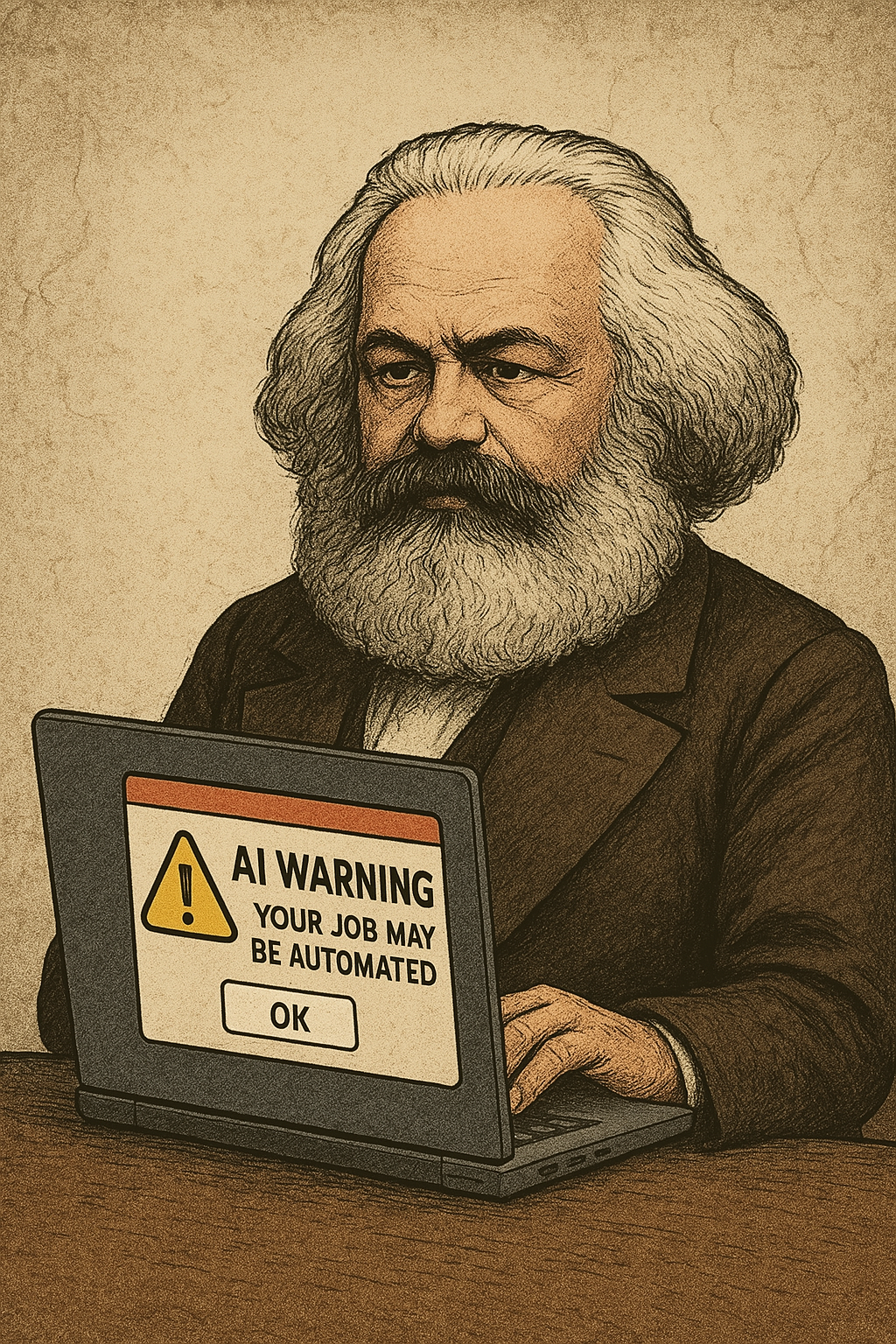
1. What Marx Actually Predicted

Karl Marx believed capitalism had a built-in conflict:
the drive to replace human workers with machines.

He argued two key points:

A) The “Tendency of the Rate of Profit to Fall”

Marx said that profit comes from human labor.
But capitalists constantly try to replace human labor with machines because machines:

  • don’t get tired
  • don’t strike
  • don’t demand wages or rights

The more companies automate, the fewer workers they need.

But the paradox is:

If you replace too many workers, you remove the source of profit — human labor.

This, Marx believed, would eventually destabilize capitalism from within.

B) Automation makes workers “superfluous”

Marx predicted a future where technology becomes so advanced that:

  • masses of workers become unnecessary
  • unemployment grows
  • inequality rises
  • social tensions explode

For most of history, this sounded theoretical.
Today, with AI able to perform cognitive work, Marx suddenly feels more contemporary than ever.

2. The AI Shock: Why This Time Is Different

In the past, automation replaced muscle:

  • factory robots
  • tractors
  • machinery

Those technologies eliminated many physical jobs but created others.

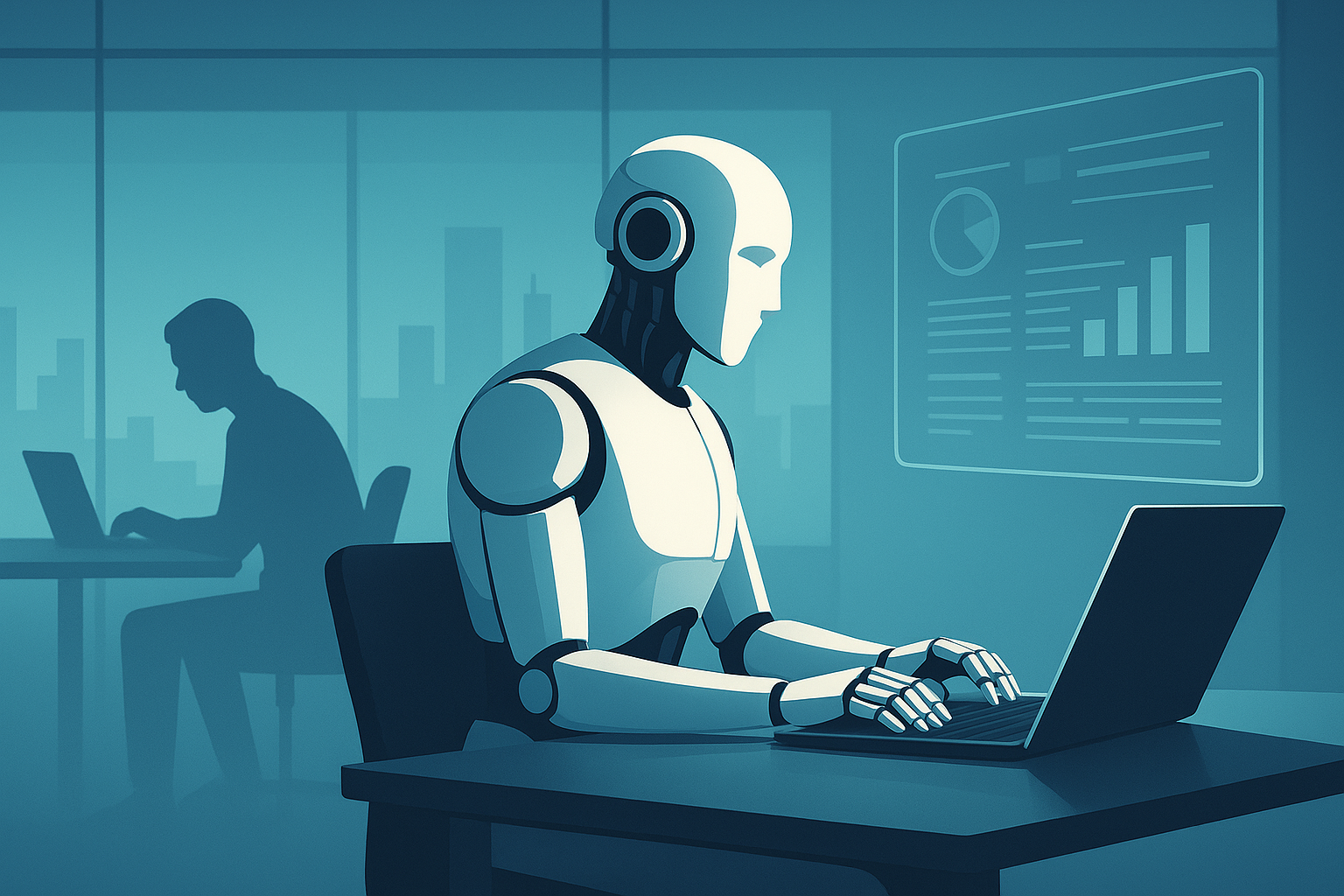
AI replaces the brain:

  • analysts
  • accountants
  • teachers
  • programmers
  • designers
  • writers
  • marketers
  • customer support
  • even medical diagnosis

White-collar workers, once considered “safe”, are now at risk.

Reports from groups like Goldman Sachs estimate that 300–800 million jobs worldwide could be automated in the coming years.

For capitalism, this is enormous.
Capitalism is built on two pillars:

  1. Labor → creates value
  2. Wages → let people buy things

If AI replaces too much labor, wages disappear, and the system loses its customers.

This is what worries economists.

3. The Core Economic Problem: No Jobs = No Money = No Capitalism

Here’s the simple logic:

  • Companies automate work → fewer workers
  • Fewer workers → less income
  • Less income → less spending
  • Less spending → companies lose customers
  • Companies lose customers → profits fall
  • Profits fall → economic system breaks

Capitalism needs consumers.
Consumers need wages.
Wages come from labor.
Labor is disappearing.

This is the exact contradiction Marx warned about.

4. What Happens to Society if AI Wipes Out Jobs?

Three major scenarios are being discussed in global economic circles:

A) Capitalism survives but transforms

Governments introduce:

  • Universal Basic Income (UBI)
  • AI and robot taxes
  • redistribution policies
  • national “AI wealth funds”
  • profit-sharing models

This keeps consumers alive even without traditional jobs.

B) Extreme inequality + political instability

If nothing is done:

  • wealth concentrates into a few tech giants
  • middle class collapses
  • consumer markets shrink
  • social unrest rises
  • governments face pressure for reform or revolution

This is the scenario many analysts fear.

C) A transition to “post-capitalism”

This idea doesn’t mean communism. Instead, it means a system where:

  • machines produce most wealth
  • humans work less or not at all
  • value is redistributed through society
  • the wage-labor system becomes obsolete

Some predict a peaceful shift.
Others see a turbulent transition.

5. Will New Jobs Replace the Old Ones?

Historically, technological revolutions created more jobs than they destroyed.

But AI is different for three reasons:

  1. It automates thinking, not just physical effort
  2. New jobs may require skills most people don’t have
  3. AI learns faster than humans can retrain

For the first time, technology is competing with humans in creativity, reasoning, and decision-making.

This makes the future less predictable than any previous industrial revolution.

6. Will AI Destroy Capitalism?

There are three main schools of thought:

1) AI will reshape capitalism, not kill it

The system adapts by creating safety nets like UBI, or by shifting focus to new industries.

2) AI will create “hyper-capitalism”

A handful of mega-corporations control all the AI models and extract enormous profits, leading to an extreme concentration of power.

3) AI will push us beyond capitalism

If machines produce nearly all value, the traditional logic of:

work → wages → consumption

falls apart.

In that case, capitalism as we know it would need to evolve or be replaced.

7. The Short Answer

If AI eliminates hundreds of millions of jobs and nothing is done, capitalism collapses because consumers vanish.

If governments and companies adapt, we enter a new economic era. Perhaps capitalism 2.0.

Marx didn’t predict AI, but he did predict the danger of a system that depends on labor while simultaneously trying to eliminate it. That contradiction is now the central question of the coming decade.

In the end, nobody truly knows where this collision between AI, labor, and capitalism will lead. Some predict unprecedented prosperity, others foresee economic collapse, and many warn that the transition itself may be chaotic.

Even politicians in several countries have started telling people to “buckle up,” hinting that families should keep basic supplies like food and water on hand. Not because disaster is guaranteed, but because the pace of disruption is now faster than society’s ability to adapt.

One thing is sure: we are crossing a threshold into unknown territory, where the old rules may no longer apply. The question is not whether change is coming, but how prepared we are for the world on the other side.

Disclaimer: The views expressed in this article are those of the author and may not reflect those of Shinybull.com. The author has made every effort to ensure the accuracy of the information provided; however, neither Shinybull.com nor the author can guarantee the accuracy of this information. This article is strictly for informational purposes only. It is not a solicitation to make any exchange in precious metal products, commodities, securities, or other financial instruments. Shinybull.com and the author of this article do not accept culpability for losses and/ or damages arising from the use of this publication.
Leave a comment

Filed under Politics

Jobs Will Become “Optional”

When Elon Musk took the stage at the U.S.–Saudi Arabia Investment Forum, he delivered one of his boldest predictions yet:
In 10 to 20 years, having a job may no longer be necessary. It may simply be a choice.

This statement didn’t come out of nowhere. It reflects Musk’s long-standing view that rapid progress in artificial intelligence and humanoid robotics, especially projects like Tesla’s Optimus robot, will fundamentally transform the global job market.

But what does “optional work” actually mean? What happens to CEOs, creativity, money, and everyday life in such a world?


Let’s break it all down.

What Exactly Did Elon Musk Say?

At the forum, Musk explained that technological progress will push society into an era where:

  • Most jobs are automated
  • Human labor is no longer required for economic survival
  • People will work only if they want to, not because they must.

He said that future “jobs” might feel more like hobbies, similar to playing a sport or a video game.

He also suggested that money itself could become less relevant:

“Money will stop being significant. The real constraints will be physical resources like energy and mass.”

Musk compared future work to gardening:
You can grow vegetables yourself, even though it’s easier to buy them at a store. You do it because you enjoy it, not because you must.
That’s his vision for the job market. A world where work is done for passion, not necessity.

A World Where Work Is Optional: What Would That Look Like?

If Musk is right, then the next two decades could reshape society in five significant ways:

1. Automation Takes Over Routine Work

Humanoid robots and advanced AI systems will be capable of doing nearly all physical and cognitive labor.
Everything from manufacturing to accounting to logistics could be automated.

2. Creativity Becomes the New Currency

When machines handle all basic tasks, the only irreplaceable human skill will be imagination.
Art, innovation, design, storytelling, and leadership will matter more than ever.

3. New Purpose Beyond Employment

If people no longer need to work for survival, society must redefine purpose, identity, and meaning.
Work will become a hobby, a passion project, or a personal mission.

4. The CEO Role Will Transform

Future CEOs may lead companies where the entire workforce is digital or robotic.
Their role shifts from:

  • personnel management
    to
  • vision-setting, ethics, coordination, and long-term strategy.

CEOs become more like chief philosophers and architects of systems than traditional managers.

5. Economic Models Must Evolve

If work becomes optional, new systems must support human welfare:

  • universal basic income
  • shared ownership of AI systems
  • new forms of value distribution
  • new definitions of wealth

This brings us to Musk’s most controversial idea:
A future where money itself becomes less meaningful.

Musk’s Claim: Money Could Become “Irrelevant”

This may sound like science fiction, but Musk is pointing toward a post-scarcity economic model:

  • AI and robotics produce unlimited goods and services
  • Energy becomes cheap due to breakthroughs in solar, batteries, and possibly fusion
  • Productivity skyrockets far beyond what human labor can achieve
  • The cost of producing essentials approaches zero

In that world, your livelihood isn’t tied to your paycheck.
Wealth isn’t about dollars. It’s about access to resources and control over energy, materials, and computing power.

Musk referenced Iain M. Banks’ Culture novels as inspiration:
a society where scarcity is gone, AI handles most functions, and humans focus on exploration, creativity, and self-development.

Will This Actually Happen?

Experts disagree. Some believe Musk’s timeline (10–20 years) is too optimistic.
Others argue that AI progress is moving faster than expected, and he may even be conservative.

What’s clear is this:

  • Jobs will change
  • Many roles will disappear
  • New creative and emotional roles will emerge
  • The global economic structure will need deep reform
  • The concept of the “CEO” will adapt dramatically

Whether Musk’s vision becomes reality or remains a theoretical future, the direction is unmistakable:
AI will reshape human work more than any technology in history.

Disclaimer: The views expressed in this article are those of the author and may not reflect those of Shinybull.com. The author has made every effort to ensure the accuracy of the information provided; however, neither Shinybull.com nor the author can guarantee the accuracy of this information. This article is strictly for informational purposes only. It is not a solicitation to make any exchange in precious metal products, commodities, securities, or other financial instruments. Shinybull.com and the author of this article do not accept culpability for losses and/ or damages arising from the use of this publication.

Leave a comment

Filed under Curiosity

Are Humans Still Fit to Govern Themselves?

The Case for AI and the Future of Governance

“For centuries, humans have tried to build fair systems, and failed repeatedly.”

The Human Struggle with Complexity

History shows that people have always struggled to manage complex systems. In ancient Rome, Caesar’s rise exposed deep divisions in society and the limits of human judgment. In 1848, France, King Louis Philippe I faced a population burdened by taxes and inequality, a system too rigid and tangled for leaders to reform.

Today, millions face similar struggles: cost-of-living crises, housing shortages, and economic instability. The pattern is clear; the system often overwhelms human capacity.

Partisanship, emotion, and limited attention make it nearly impossible for humans alone to optimize society’s resources fairly and efficiently.

“If history teaches us anything, it’s that no human institution, however well-intentioned, can keep up with the complexity of modern life.”

Enter AI: A New Kind of Leadership

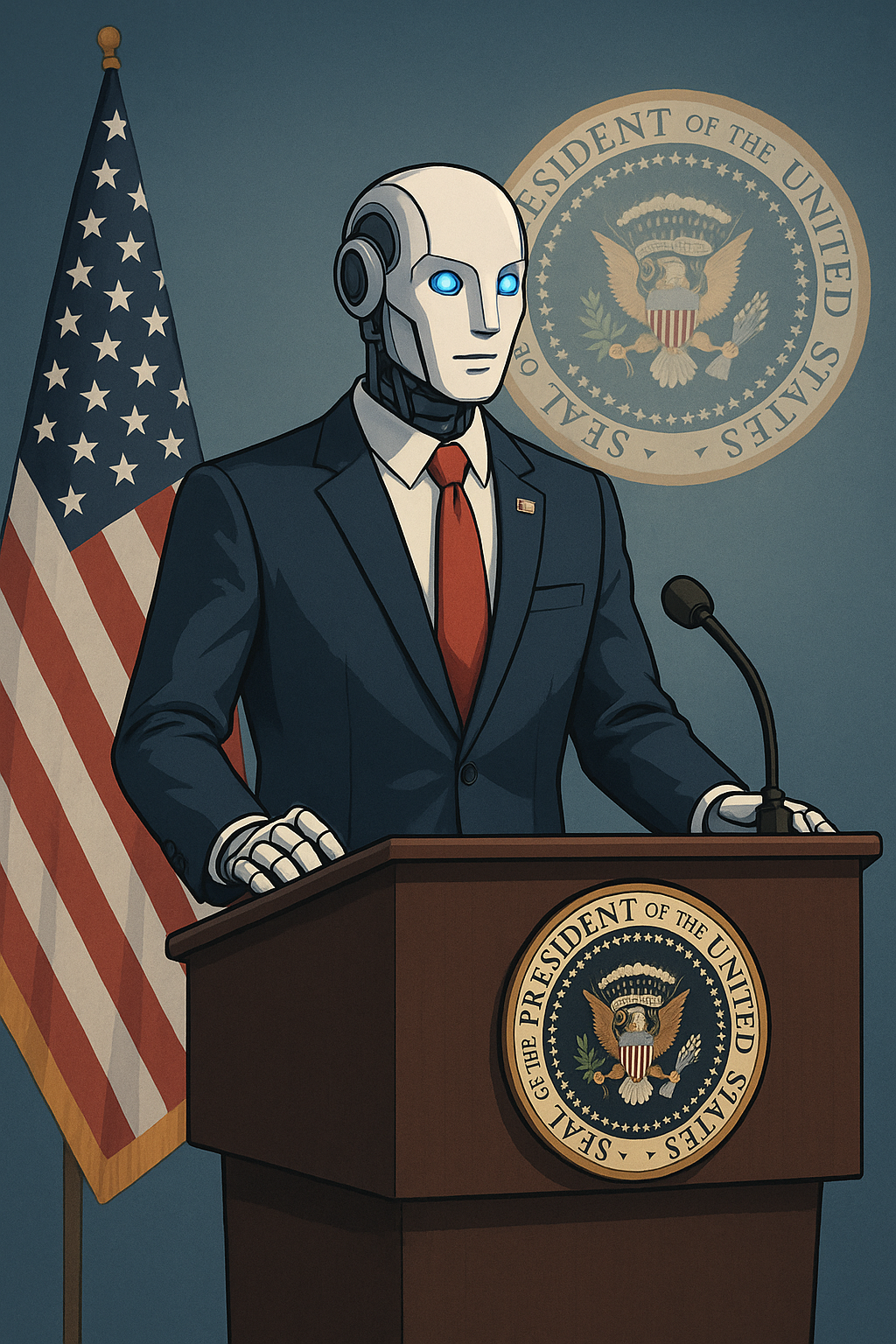
Maybe the solution isn’t left, right, or even one-party systems. Maybe the solution is AI.

Thousands of human beings, with all their emotions, biases, and limited perspectives, can’t compete with a system that can analyze all available information simultaneously. Just look at chess or Go. AI doesn’t just play well; it plays beyond the limits of human imagination.

Take a simple real-world example: an elderly woman paying more for her apartment than she receives in pension. Who is to blame? No single person. It’s the system. This isn’t a moral failure; it’s mathematical.

AI doesn’t suffer from those human limits. It can process enormous amounts of data, detect patterns, optimize allocations, and predict problems before they occur.

“Maybe the next stage of democracy isn’t about choosing leaders. It’s about choosing the algorithms that lead us.”

A Vision of AI-Guided Society

Imagine a world where decisions about economics, healthcare, infrastructure, or the cost of living are guided by AI. No feelings, no personal interests, no corporate agendas, no short-term political games.

Decisions would be based purely on data, evidence, and long-term outcomes, optimizing for the well-being of everyone rather than the loudest voices or the wealthiest lobbyists.

Humans would still define the ethical framework. AI can calculate the best moves, but society must decide what “good” means: fairness, sustainability, equality, or prosperity.

“Compared to the endless bickering and short-term thinking of politics, AI could be the most rational and forward-looking leader humanity has ever known.”

Balancing Hope and Caution

AI governance isn’t without risks; bias in data, lack of transparency, and accountability must be addressed. But unlike human flaws, these can be debugged. Systems can be retrained, improved, and held to measurable standards of performance.

The question, then, is no longer about political parties or ideologies. The real question is:
Are we ready to let reason, not emotion, guide the future?

Author’s Note

As technology continues to evolve, the debate over AI in governance is no longer a matter of science fiction. It’s a question of readiness, trust, and design. Whether we like it or not, the age of algorithmic leadership is approaching. The choice before us isn’t if AI will play a role in decision-making, but how we’ll ensure it serves humanity, not replaces it.

Disclaimer: The views expressed in this article are those of the author and may not reflect those of Shinybull.com. The author has made every effort to ensure the accuracy of the information provided; however, neither Shinybull.com nor the author can guarantee the accuracy of this information. This article is strictly for informational purposes only. It is not a solicitation to make any exchange in precious metal products, commodities, securities, or other financial instruments. Shinybull.com and the author of this article do not accept culpability for losses and/ or damages arising from the use of this publication.

Leave a comment

Filed under Politics

The global economy is more globalized today than during the peak of the early 20th century but will the open global economic order endure?

Globalization is one of the main reasons why President Trump was elected. He is now a President in the U.S because he often talked about their existing trade agreements, threatened to slap taxes on U.S companies investing overseas, renegotiate or withdraw from NAFTA, abandon support for the TPP, label China a currency manipulator and establish tariffs to name a few things.

President Trump did a lot of important things on his first 100 days and there is more to come. Welcome to the new world. A new era started when Mr Trump was elected.

The U.S is the world`s largest economy measured in market dollars. It is also the third most populated. Therefore, a withdrawal from the global economy is measurable, but America is not as globally integrated as we might think.

The U.S is the third biggest exporter, yet exports account only 13% of GDP. Main exports are capital goods (39%) and industrial supplies (28%). Others include: consumer goods (12%); %).automotive vehicles, parts and engines (10,5%); foods, feeds and beverages (7%).

Main exports partners are: Canada (19%), Mexico (14%), China (7%), Japan (4%), Germany (3%) and the United Kingdom (3%).

Exports of goods and services rose to an all-time high of USD 200,2 billion in November 2017.

The United States is also the world`s second largest importer. Main imports are; capital goods (29%) and consumer goods (26%). Others include: Industrial supplies (24%); automotive vehicles, parts and engines (15%); foods, feeds and beverages (5%).

Main Import partners are: China (19%), Canada (14,5%), Mexico (12%), Japan (6%) and Germany (5%).

Imports of goods and services rose to an all-time high of USD 250,7 billion in November 2017.

The United States has been running consistent trade deficits since 1976 du to high imports of oil and consumer products. The biggest trade deficits were recorded with China.

The U.S recorded a current account deficit of -2,60% of the country`s GDP in 2016. It reached an all-time high of 0,20% when Former President Ronald Reagan was inaugurated in 1981, but it declined all the years under his presidency.


Other countries can retaliate against Trump`s protectionist policies and that can start a trade war. But so far, so good. With an all-time high in Exports and Imports, Mr Trump must be doing something right.

If other countries don`t like the U.S liberal economic order, they can repudiate global norms and institutions that underpin the globalized economy. There is no doubt that emerging markets have benefited most from the open global economy, and we can clearly see members of the TPP seek to patch together the deal without the U.S.

But what happened to the first wave of globalization? The historical origins of globalization are the subject of ongoing debate. Let`s take a look at the globalization in the modern era. There are three epochs characterised by greatly increased international integration.

Europe and North-America were strongly affected by internationalization from 1860 to 1914. The flow of goods accelerated and capital moved freely between countries. Financial integration was more pronounced that it is today. Even international migrants was greater than it is today.

60 million people left Europe to seek their fortunes in the New World.

Important drivers behind the first wave of globalization were both the new technology and the fact that many countries began to embrace liberal trade policy after years of protectionism.

During the period 1500 – 1800, world trade increased by about 1% per year. After 1820 it increased by 3,5% and during the nineteenth century as a whole, trade in Europe increased by 40%. Great Britain was the world`s leading economy and the basis for the European free trade system was 1860 free trade pact between Great Britain and France.

Many other European countries subsequently aligned themselves with this free trade system.

Great Britain had introduced the gold standard in 1816 and during the nineteenth century the English pound sterling was the generally accepted currency of international business and many other countries introduced the gold standard.

Great Britain was the economic leader, but that Empire ended after World War II. The second wave og globalization started at the end of World War II and the new economic leader was USA. The American Empire started.

In the first wave we saw innovation of telegraph, steam engine, electricity and internal combustion engine. In the second wave jet plane was introduced. So was television, communication, satellites and container traffic.

The third wave started around 1980. It was a digital revolution and it refers to the advancement of technology from analog electric and mechanical devices to the digital technology available today. Advancements during the Third wave include the personal computer, the internet, and information and communications technology (ICT).

Now, we are here: the Fourth Industrial Revolution.

The fourth wave builds on the Digital Revolution, representing new ways in which technology becomes embedded within societies and even human body. It is marked by emerging technology breakthroughs in a number of fields, including robotics, artificial intelligence, nanotechnology, quantum computing, biotechnology, the Internet of Things, #D printing and autonomous vehicles.

The founder of WEF (World Economic Forum) Klaus Schwab is expected to see the heavy implementation of several emerging technologies with highly potential of disruptive effects.

Globalization collapsed after World War I, but resurgent after World War II. The breaking of globalization`s first wave a century ago is proof that the forces of global economic integration are neither irresistible nor irreversible.

Americas view on globalizations future has changed. For all I know, maybe Trump and his team are much less assured that the open global economic order will endure. The global economy is more globalized today than during the peak of the early 20th century.

Whether that implies globalization has reached unsustainable levels, or that no such levels exist, remains to be seen.

International trade has grown faster than total production. Ben Bernanke once said that he can do something with the monetary policy but he cannot do something with the productivity.

We are now living in a truly exciting phase of global economic development.

Disclaimer: The views expressed in this article are those of the author and may not reflect those of Shiny bull. The author has made every effort to ensure accuracy of information provided; however, neither Shiny bull nor the author can guarantee such accuracy. This article is strictly for informational purposes only. It is not a solicitation to make any exchange in precious metal products, commodities, securities or other financial instruments. Shiny bull and the author of this article do not accept culpability for losses and/ or damages arising from the use of this publication.

———————————————–advertisement——————————————————-

Polo Shirt

High quality Polo shirt with Shinybull logo. This version is made from breathable 100% cotton. Short sleeves and ribbed armbands.

$125.00

Polo Shirt

High quality Polo shirt with Shinybull logo. This version is made from breathable 100% cotton. Short sleeves and ribbed armbands.

$125.00

Leave a comment

Filed under Politics