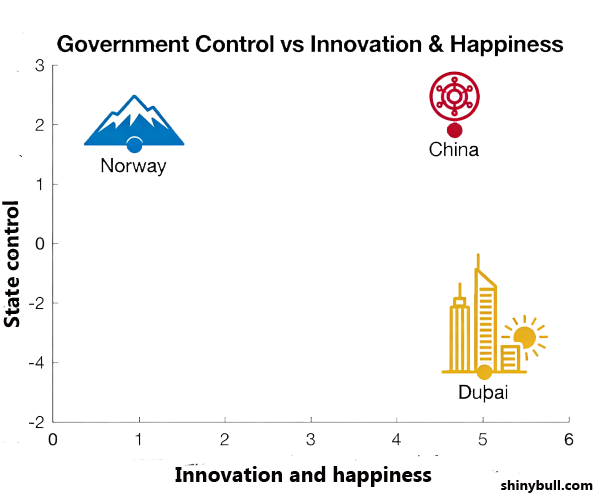
Norway is often celebrated as a rich, democratic, and socially just country. Yet, beneath the surface, many citizens feel economic pressure, high stress, and limited freedom. Meanwhile, countries like Dubai and even authoritarian regimes like China sometimes achieve outcomes that appear more “effective” for their people. This article explores the intricate relationships between wealth, freedom, democracy, innovation, and happiness, and why Norway’s oil and gas revenues are both a blessing and a constraint.
The Housing Market: Who Really Controls Prices?
In Norway, the housing market is described as “superheated,” yet homebuyers ultimately decide prices through bidding wars. The real superstars among the best entrepreneurs are the superheroes called “Real Estate Agents.” They often justify high commissions by claiming they can maximize the seller’s price, but in practice, a desirable location alone drives up bids.
Are real estate agents really working for the people? No, they are working for the seller so the people need to buy as much as possible. Are politicians on the people`s side? No.
The fact is that politicians, not buyers or agents, have the true power to influence the market through zoning, building approvals, and regulations, yet often they are not on the people’s side. What democracy is that?
Contrast with China: Are the communists in China on the people`s side? Yes. China’s government directly builds massive cities to increase housing supply, effectively controlling availability. Result: demand is met faster, homes are more accessible, and prices stabilize.
Key Insight: Democracy on paper does not guarantee results for citizens if politicians fail to act effectively.
Democracy vs Results
Democracy is often measured by free elections and political rights, but these do not guarantee that citizens get what they want. Examples in Norway:
Road tolls (bompenger) implemented despite public opposition. The people doesn`t want it, but politicians do not listen to the people.
High taxes and property regulations limiting economic freedom. The people doesn`t want high taxes, but politicians do not listen to the people. Hundreds of rich people are fleeing rich countries like Norway. They move to Dubai and Switzerland.
In China, the government may act efficiently to provide outcomes like housing, but citizens have little direct influence. Observation: Norway excels in democratic process, while China sometimes outperforms in results, at least in targeted areas.
Freedom, Wealth, and Economic Dynamism
If citizens have access to affordable housing, low taxes, and minimal fees:
They retain more disposable income
They spend more, boosting businesses
High consumption attracts talent, entrepreneurship, and innovation
This creates a self-reinforcing cycle: wealth → consumption → business growth → jobs → higher wages → innovation → productivity → more wealth.
Contrast with Norway:
High housing costs, taxes, and fees suppress consumption and slow economic growth.
Oil and gas revenues act as a safety net, allowing citizens to live comfortably without driving productivity or innovation in many sectors.
Key Insight: Norway has wealth and stability, but its reliance on oil reduces the pressure to innovate. A luxury few countries can afford.
Socialist Policies vs Individual Freedom
Norwegian socialists often prioritize redistribution and state control to ensure equality. However, this can limit the economic potential of individuals and reduce incentives for innovation.
Contrast with Dubai:
Low or zero income tax
Citizens retain wealth and spend freely
Government collects revenue via targeted consumption taxes
Result: citizens enjoy wealth and freedom, while the state still funds infrastructure and public services. Strategic taxation allows both individual prosperity and state revenue, without stifling innovation or happiness. A lot of rich people in socialist countries are moving to Dubai now.
They`re doing it because of the great zero tax system, but also for happiness.
Oil, Innovation, and Norway’s Advantage
Norway’s wealth is largely underpinned by oil and gas revenues, which act as an economic shield. This allows:
High living standards
Collaboration with neighboring countries without the fear of losing competitiveness
Reduced pressure to innovate, because the country is already rich
Consequence: Norway can enjoy the best of both worlds; resources and stability, while still pursuing innovation in selected sectors, without risking national survival. Most citizens may not even realize this structural advantage.
Norway’s wealth is partly supported by extraordinary revenues from oil and gas. This has allowed the country to build a strong welfare system and maintain high living standards. However, it also raises an important question: how dynamic would the broader economy be without this resource advantage?
Wealth vs Happiness
Norway is wealthy on paper, but high stress, depression, and widespread use of medications like painkillers and antidepressants indicate that wealth alone does not create happiness.
Dubai and other low-tax, high-freedom societies show that wealth combined with economic freedom produces higher perceived happiness, especially for those who can thrive in the system.
Conclusion: Happiness requires both resources and freedom, not just wealth or social safety nets.
The Snowball Effect: How Freedom Drives Growth
Free citizens with disposable income → high consumption → thriving businesses → more jobs → innovation → higher productivity → increased wealth.
Contrast with Norway: Regulatory and tax pressures slow this cycle, suppressing growth and individual wealth, even though oil and gas keep the country rich.
Snowball model:
Lower taxes / affordable housing
↓
More disposable income
↓
Higher investment and entrepreneurship
↓
Innovation and new technology
↓
Higher productivity
↓
More goods and services produced
↓
Economic growth WITHOUT strong inflation
Final Thought: Norway’s Paradox
Norway is rich, democratic, and socially advanced, yet citizens often feel economically constrained. Its oil and gas revenues provide comfort, stability, and collaboration opportunities, but also reduce the need for widespread innovation.
True prosperity and happiness require not just wealth, but freedom, opportunity, and the courage to innovate. Norway may have the resources to be free and happy, but the question remains: will its citizens feel the pressure to truly flourish before the oil runs out?
Disclaimer: The views expressed in this article are those of the author and may not reflect those of Shinybull.com. The author has made every effort to ensure the accuracy of the information provided; however, neither Shinybull.com nor the author can guarantee the accuracy of this information. This article is strictly for informational purposes only. It is not a solicitation to make any exchange in precious metal products, commodities, securities, or other financial instruments. Shinybull.com and the author of this article do not accept culpability for losses and/ or damages arising from the use of this publication.
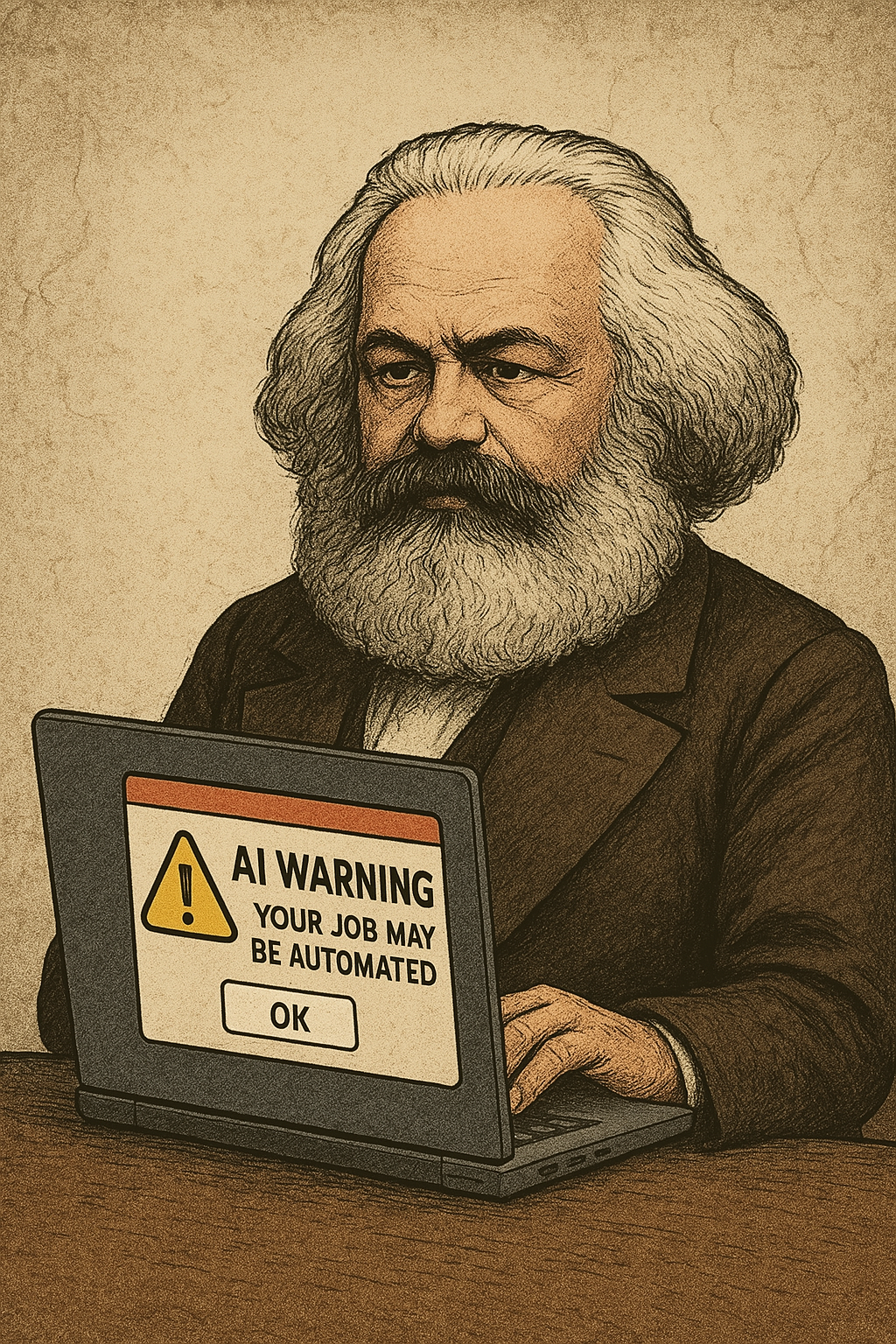
Artificial intelligence is advancing so fast that some economists, technologists, and futurists believe we are heading toward a historic breaking point. Predictions range from 300 million jobs being automated to AI systems replacing everything from lawyers and teachers to software developers and journalists.
This raises a fundamental question:
If AI takes over most labor, where will people get money from, and can capitalism survive?
Interestingly, this debate echoes ideas written more than 150 years ago by Karl Marx, who warned that capitalism might ultimately be undermined by its own technological progress. Today, his predictions are being pulled back into the spotlight.
This article breaks down what Marx said, what AI is doing, and what the future of labor, and money, might look like.
1. What Marx Actually Predicted
Karl Marx believed capitalism had a built-in conflict: the drive to replace human workers with machines.
He argued two key points:
A) The “Tendency of the Rate of Profit to Fall”
Marx said that profit comes from human labor. But capitalists constantly try to replace human labor with machines because machines:
don’t get tired
don’t strike
don’t demand wages or rights
The more companies automate, the fewer workers they need.
But the paradox is:
If you replace too many workers, you remove the source of profit — human labor.
This, Marx believed, would eventually destabilize capitalism from within.
B) Automation makes workers “superfluous”
Marx predicted a future where technology becomes so advanced that:
masses of workers become unnecessary
unemployment grows
inequality rises
social tensions explode
For most of history, this sounded theoretical. Today, with AI able to perform cognitive work, Marx suddenly feels more contemporary than ever.
2. The AI Shock: Why This Time Is Different
In the past, automation replaced muscle:
factory robots
tractors
machinery
Those technologies eliminated many physical jobs but created others.
AI replaces the brain:
analysts
accountants
teachers
programmers
designers
writers
marketers
customer support
even medical diagnosis
White-collar workers, once considered “safe”, are now at risk.
Reports from groups like Goldman Sachs estimate that 300–800 million jobs worldwide could be automated in the coming years.
For capitalism, this is enormous. Capitalism is built on two pillars:
Labor → creates value
Wages → let people buy things
If AI replaces too much labor, wages disappear, and the system loses its customers.
This is what worries economists.
3. The Core Economic Problem: No Jobs = No Money = No Capitalism
Here’s the simple logic:
Companies automate work → fewer workers
Fewer workers → less income
Less income → less spending
Less spending → companies lose customers
Companies lose customers → profits fall
Profits fall → economic system breaks
Capitalism needs consumers. Consumers need wages. Wages come from labor. Labor is disappearing.
This is the exact contradiction Marx warned about.
4. What Happens to Society if AI Wipes Out Jobs?
Three major scenarios are being discussed in global economic circles:
A) Capitalism survives but transforms
Governments introduce:
Universal Basic Income (UBI)
AI and robot taxes
redistribution policies
national “AI wealth funds”
profit-sharing models
This keeps consumers alive even without traditional jobs.
B) Extreme inequality + political instability
If nothing is done:
wealth concentrates into a few tech giants
middle class collapses
consumer markets shrink
social unrest rises
governments face pressure for reform or revolution
This is the scenario many analysts fear.
C) A transition to “post-capitalism”
This idea doesn’t mean communism. Instead, it means a system where:
machines produce most wealth
humans work less or not at all
value is redistributed through society
the wage-labor system becomes obsolete
Some predict a peaceful shift. Others see a turbulent transition.
5. Will New Jobs Replace the Old Ones?
Historically, technological revolutions created more jobs than they destroyed.
But AI is different for three reasons:
It automates thinking, not just physical effort
New jobs may require skills most people don’t have
AI learns faster than humans can retrain
For the first time, technology is competing with humans in creativity, reasoning, and decision-making.
This makes the future less predictable than any previous industrial revolution.
6. Will AI Destroy Capitalism?
There are three main schools of thought:
1) AI will reshape capitalism, not kill it
The system adapts by creating safety nets like UBI, or by shifting focus to new industries.
2) AI will create “hyper-capitalism”
A handful of mega-corporations control all the AI models and extract enormous profits, leading to an extreme concentration of power.
3) AI will push us beyond capitalism
If machines produce nearly all value, the traditional logic of:
work → wages → consumption
falls apart.
In that case, capitalism as we know it would need to evolve or be replaced.
7. The Short Answer
If AI eliminates hundreds of millions of jobs and nothing is done, capitalism collapses because consumers vanish.
If governments and companies adapt, we enter a new economic era. Perhaps capitalism 2.0.
Marx didn’t predict AI, but he did predict the danger of a system that depends on labor while simultaneously trying to eliminate it. That contradiction is now the central question of the coming decade.
In the end, nobody truly knows where this collision between AI, labor, and capitalism will lead. Some predict unprecedented prosperity, others foresee economic collapse, and many warn that the transition itself may be chaotic.
Even politicians in several countries have started telling people to “buckle up,” hinting that families should keep basic supplies like food and water on hand. Not because disaster is guaranteed, but because the pace of disruption is now faster than society’s ability to adapt.
One thing is sure: we are crossing a threshold into unknown territory, where the old rules may no longer apply. The question is not whether change is coming, but how prepared we are for the world on the other side.
Disclaimer: The views expressed in this article are those of the author and may not reflect those of Shinybull.com. The author has made every effort to ensure the accuracy of the information provided; however, neither Shinybull.com nor the author can guarantee the accuracy of this information. This article is strictly for informational purposes only. It is not a solicitation to make any exchange in precious metal products, commodities, securities, or other financial instruments. Shinybull.com and the author of this article do not accept culpability for losses and/ or damages arising from the use of this publication.
People in the West like to think that democracy in the West is much better than autocracy in Russia and China. But, what if China`s «one rule» party, the CCP (China Communist Party) is a better solution than the democratic mess (according to Vladimir Putin) in the West?
Democracy is one of mankind`s greatest achievements. But, for democracy to thrive and grow it must also adapt. We need to know what a democracy is.
The word democracy comes from the Greek words «demos», meaning people, and «Kratos» meaning power, so democracy can be thought of as «power of the people». A way of governing which depends on the will of the people.
It is a system of government by the whole population or all the eligible members of a state, typically through elected representatives. A state governed under a system of democracy.
People in the West vote for their president, political parties, politicians, and prime ministers. In other words: a democratic process. But what about China? They are ruled by one party, and that is CCP. China`s Communist Party. Is it a democracy?
The answer is yes. But it`s more sophisticated than we like to think. People in China call it «Whole-process people`s democracy, which is a Chinese Communist Party (CCP) political concept describing the people`s participation in, and relationship to, governance under socialism with Chinese characteristics.
The term «whole-process democracy» was used to describe existing governance practices such as Chinese experiments with democratic elements in the legislative process and in local government activities.
CCP general secretary Xi Jinping first used the term publicly on November 2, 2019, while visiting Shanghai, and he stated:
«China`s people`s democracy is a type of whole-process democracy» in which legislation is enacted «after going through procedures and democratic deliberations to ensure that decision-making is sound and democratic.»
On July 1, 2021, Xi incorporated the word «people`s» into the concept during his speech at the 100th Anniversary of the Chinese Communist Party, coining the concept’s current name «whole-process people`s democracy.»
Xi tied the concept to «common prosperity.»
The addition of «people`s to the concept emphasizes the Maoist practice of the mass line.
Xi describes four components of whole-process people`s democracy, expressed as pairs relationships:
Process democracy and achievements democracy
Procedural democracy and substantive democracy
Direct democracy and indirect democracy
People`s democracy and the will of the state
According to Xi, this results in «real and effective socialist democracy.»
The concept`s emphasis on «whole-process» is intended to further distinguish the CCP approach to democracy from the procedural qualities of liberal democracy. It includes primarily consequentialist criteria for evaluating claims of democracy`s success. In this view, the most important criterion is whether democracy can «solve the people`s real problems,» while a system in which «the people are awakened only for voting» is not truly democratic.
Liberal democracy or Western democracy is the combination of a liberal political ideology that operates under a representative democratic form of government. It is characterized by-elections between multiple distinct political parties, a separation of powers into different branches of government, the rule of law in everyday life as part of an open society, a market economy with private property, and the equal protection of human rights, civil rights, civil liberties, and political freedoms for all people.
To define the system in practice, liberal democracies often draw upon a constitution, either codified or uncodified, to delineate the powers of government and enshrine the social contract.
Whole-process people`s democracy also serves as a political tool to both defend the Chinese government`s governance practices and criticize liberal democracy.
In the CCP`s view, whole-process people`s democracy is «more extensive, more genuine, and more effective» than American democracy.
The CCP uses the concept of whole-process people`s democracy as a means to participate in global discourses on democracy, seeking to deflect criticism and improve its foreign relations. This ties into the government`s larger efforts to promote its global leadership.
In that regard, the Chinese government`s 2021 white paper China: «A Democracy that Works» emphasizes the whole-process people`s democracy perspective in an effort to demonstrate the country`s «institutional self-confidence.»
The white paper argues that the whole-process people`s democracy is the impetus behind China`s development and growth.
Qin Gang is a Chinese diplomat and politician, and he stated this. «Isn`t it obvious that both China`s people-center philosophy and President Lincoln`s «of the people, by the people, for the people», are for the sake of the people? Shall we understand China`s socialist whole-process democracy as this: from the people to the people, with the people, for the people?»
China practices the whole-process people`s democracy, which not only means that people engage in democratic elections, but they`re also involved in consultations, decision-making, management, and oversight.
According to CCP, people`s democracy is the lifeblood of socialism, and it is integral to China`s efforts to build a modern socialist country in all respects.
If we compare Chinese Democracy with American Democracy or Western Democracy, the key difference is that China focuses far more on substantial democracy. Western Democracy places more emphasis on procedural democracy. A Democracy in the West is equivalent to «one person, one vote, universal suffrage, and a multi-party system.»
China`s democracy focuses far more on the purpose and objectives of democracy. Especially good governance, and what they can deliver to the people.
Whole-process democracy encourages the expansion of democratic channels, and diversifies the forms of democracy, so as to ensure that people can participate in the management of State, economic, cultural, and social affairs.
It also ensures that people`s congresses at all levels are formed through democratic elections, and guarantees that people`s congresses and their standing committees lawfully exercise the powers of enacting laws, conducting oversight, making decisions, appointing, and removing officials.
It improves the working mechanisms for drawing on public opinion and pulling the wisdom of the people. And these are not only words. When Chinese leaders say something, they mean it and take action to turn that into reality.
The Chinese people`s political consultative conference (CPPCC), is China`s highest advisory body and plays a vital role in China`s consultative democracy. It encourages active participation in the deliberation, and administration of state affairs, promoting the democratic, and scientific decision-making process of the party, and the state.
The CPCC has more than 3,200 organizations at four administrative levels. National, provincial, city, and country, with more than 600,000 CPPCC members from 34 areas, including 8 other political parties, and representatives from Science and technology, literature and art, economics, sports, religion, and other areas.
According to Chair Professor at Soochow University, Victor Gao Zhikai, few people in Western countries want to acknowledge that the Communist Party of China is not the only political party at all. In addition to the CPC, there are 8 other democratic parties;
The Communist Party of China
The Revolutionary Committee of the Chinese Kuomintang
The China Democratic League
The China Democratic National Constitution Association
The China Association for Promoting Democracy
The Chinese Peasants and Workers Democratic Party
The China Zhi Gong Party
The Jiu San Society
The Taiwan Democratic Self-government League
In addition to this, there is a large Chamber of Commerce, which caters to business owners, private business owners, etc, and on top of that, there is a larger group of people called people without political affiliations.
This is the only way China has achieved such explosive productivity, efficiency, and economic, and political transformation over a short period of only about 43 years.
The legislative information offices not only promote China`s rule of law, but also practice whole-process people`s democracy by listening to the public and gathering the wisdom of the people for efficient, and high-quality National legislation.
The small grassroots legislative information office has become a significant democratic platform.
It`s all a part of a Chinese evolution. In November 1931, before the People`s Republic of China was established, the first national people`s Congress of the Soviet Republic of China was held in Zhangshi province.
In caves along the northern Shanxi Plateau, they used soybeans to cast their votes to elect the cadres. In September 1954, the first session of the first national people`s Congress was held. Marking the official establishment of the people`s Congress system as the fundamental political system in China.
After decades of practice, and exploration, China has been continually improving the people`s Congress system. People accessing their voting rights is an important manifestation of people being the masters of the country, which is the essence of democracy.
Among the nearly 3,000 deputies to the 14th NPC, 16,69% are workers and farmers. Besides the Communist Party, there are 8 other political parties that all have representation in the NPC. There are also a sizable proportion of delegates without any stated political affiliation. The 55 ethnic minorities hold 14,85% of the NPC seats.
For many people in the West, democracy means the right for each person to vote for their leaders. This is basically why they reject the idea that China has a democracy. But what people in the West don’t understand is that Chinese people are deeply involved in the elections of leaders of various levels.
Millions of urban and rural citizens do in fact directly vote for the representatives who govern their daily lives, who then make decisions that accurately reflect the needs, and desires of the people from the most fundamental level.
It`s normal for more than 90% of Chinese voters to turn out in the village, and Community elections all across China, which is much higher than in most Western democracies.
There are now over 2,7 million deputies in the people`s Congress across the country. More than 1 million registered voters have participated in county, and Township level elections.
The ultimate goal of elections is to choose the virtuous, and the capable who can solve today`s most urgent problems, and lead the country toward development.
China`s political system guarantees the rights of its people to elect their representatives, but more importantly, it guarantees that those representatives will be held accountable to the people.
The CPC leadership regards democratic supervision by the people as one of the highest priorities. Article 3 of the Constitution of the people`s Republic of China states:
«All administrative, judicial, and procuratorial organs of the state are created by the people`s congress to which they are responsible, and under whose supervision they operate.»
Democratic supervision refers to consultative supervision carried out by means of opinions, suggestions, and criticism. China has implemented several channels of democratic supervision. Today, democratic supervision is part of everyone`s daily life. People can monitor, and supervise how authorities exercise power at any place, and at any time through many kinds of democratic channels, and platforms.
China has a 1,2,3,4,5 citizen hotline service center, and that has been going on since 1987. When you call 1,2,3,4,5 to file a complaint, an operator will put you through to the right department to talk to. In 2019, the hotline was upgraded with time-sensitive feedback services.
In 2021, the mechanism was further improved and upgraded. They selected the most common issues that people called about that were hard to solve. They dedicated special task forces to focus on these issues.
About 350 cities have these hotlines, and they provide first-hand information about public opinions and concerns that City officials could hardly get in other ways.
Since the founding of New China, people have expressed their opinions on state affairs, both large and small, and party leadership has been relentlessly exploring appropriate, convenient, and diversified forms of supervision by the people.
Satisfying the public need for information, and the need to speak out is no easy task for a country of 1,4 billion people. Undeterred by this daunting task, the country`s leadership has emphasized democratic supervision throughout the whole process of performing duties.
The only litmus test of a democracy is whether it can generate real benefits. Making the country a better place to live, and making the lives of its people better.
Democracy has always been cherished by China, and its people, and it will continue to evolve in China with its own Chinese characteristics. China has lifted nearly 99 million out of poverty. It has built the world`s largest social security system, and health care system, covering more than 1,3 billion people. More than 10 million jobs have been created each year for 15 consecutive years.
China`s success is caused by one major thing: capitalism. It doesn`t matter what system you have if you don`t earn money. Even the Soviets would have succeeded if they earned money. The editor’s opinion is that the difference between democracy, autocracy, or dictatorship is very tiny. It`s all about money. It`s money that matters. Money comes first.
Disclaimer: The views expressed in this article are those of the author and may not reflect those of Shinybull.com. The author has made every effort to ensure the accuracy of the information provided; however, neither Shinybull.com nor the author can guarantee such accuracy. This article is strictly for informational purposes only. It is not a solicitation to make any exchange in precious metal products, commodities, securities, or other financial instruments. Shinybull.com and the author of this article do not accept culpability for losses and/ or damages arising from the use of this publication.
Vladimir Putin is doing exactly what Boris Johnson and Joe Biden are doing; «Building back better.» Putin is working very hard to fix all the problems that the communist Bolsheviks made during their revolution: October Revolution.
The Russian Revolution was a period of political and social revolution that took place in the former Russian Empire which began during World War I. The Bolsheviks killed the Royal family Romanov that has ruled Russia for 302 years.
This period saw Russia abolish its monarchy and adopt a socialist form of government following two successive revolutions and bloody civil war. This socialist revolution ended the Russian monarchy and Tsar Nicholas II abdicated and stepped down, ushering in a new government led by the Russian Duma (parliament) which became the Russian Provisional Government. This government was dominated by the interests of prominent capitalists, as well as the Russian nobility and aristocracy.
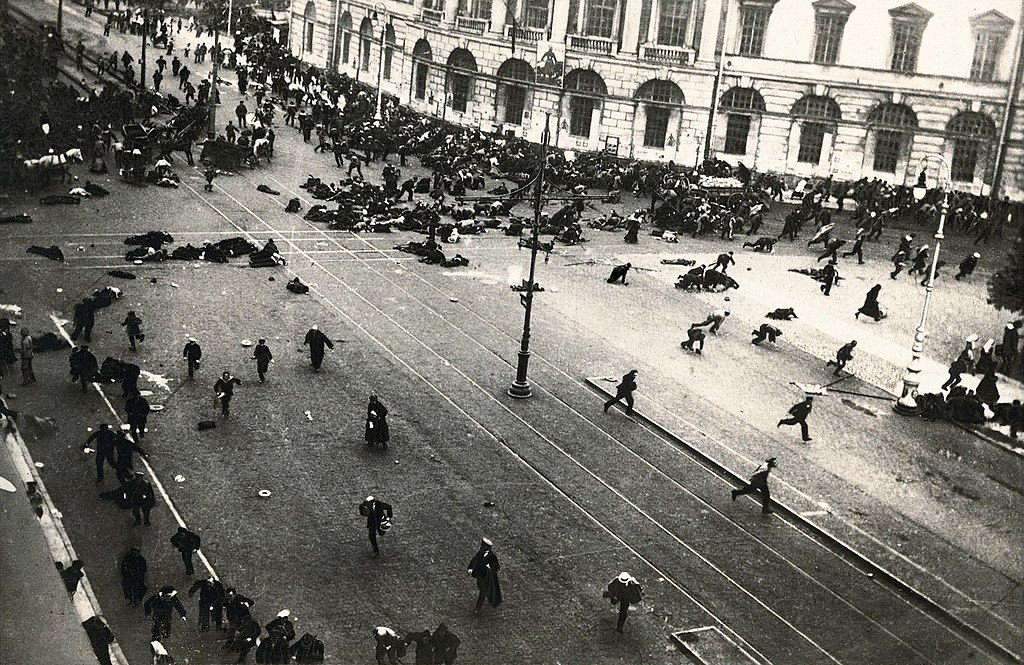
People were killed by The Provisional Government, with the support of Socialist-Revolutionary Party-Menshevik leaders of the All-Russian Executive Committee of the Soviets, in Petrograd in a peaceful demonstration.
During this chaotic period, there were frequent mutinies, protests, and strikes. Many socialist and other leftist political organizations were engaged in daily struggle and vied for influence within the Provisional Government and the Soviets.
One such faction was the Bolsheviks («Ones of the Majority») led by Vladimir Lenin. The Bolsheviks gained support by campaigning on a slogan of peace, land, and bread which promised to cease war with Germany, give land to the peasantry, and end the famine caused by Russia`s involvement in WWI. These slogans had a direct effect on the growing Bolshevik popularity.
Under pressure from German military offensives, the Bolsheviks soon relocated the national capital to Moscow. The Bolsheviks had secured a strong base of support within the Soviets and, as the supreme governing party, established their own government, the Russian Soviet Federative Socialist Republic (RSFSR).
The RSFSR began the process of reorganizing the former empire into the world`s first socialist state, to practice soviet democracy on a national and international scale.
The Great October Socialist Revolution under the Soviet Union, also known as the Bolshevik Revolution (1917 – 1923), almost destroyed Russia as we know it today. This is why Putin is working hard to restore what the Bolsheviks destroyed.
This is where the problems in Ukraine and Crimea start. it`s also called the Soviet-Ukrainian War, or Ukrainian Civil War, which is the term commonly used in post-Soviet Ukraine for the events taking place between 1917 – 1921, nowadays regarded essentially as a war between the Ukrainian People`s Republic and the Bolsheviks. The war ensued soon after the October Revolution when Lenin dispatched Antonov`s expeditionary group to Ukraine and Southern Russia.
Soviet historical tradition viewed it as an occupation of Ukraine by military forces of Western and Central Europe, including the Polish Republic`s military, the Bolshevik victory constituting Ukraine`s liberation from these forces.
Conversely, modern Ukrainian historians consider it a failed war of independence by the Ukrainian People`s Republic against the Bolsheviks.
In Soviet historiography and terminology, the armed conflict is depicted as part of the greater Russian Civil War in Ukraine, this war was fought between the national government and the Bolshevik government (led by Lenin).
The war may be divided into three phases:
December 1917 – April 1918: Revolutionary days, Bolshevik uprisings, invasion of the Red Guards formations, signing of protectorate treaty, and liberation from bolsheviks.
December 1918 – December 1919: Civil war in Ukraine, invasion of the Red Army, unification of Ukraine, anti-Soviet peasant uprisings, Denikin’s Volunteer Army and the Allied intervention, loss of West Ukraine to Poland.
Spring 1920 – Autumn 1921: Polish-Soviet War (Treaty of Warsaw), Russian Civil War (between Bolsheviks armies and the armed Forces of South Russia), Ukrainian guerrilla operations (First and Second Winter Campaigns), government in exile.
In October 1917 the government of Ukraine denounced the Bolshevis’ armed revolt and declared it would decisively fight against any attempted coup in Ukraine. The Kyiv Military District command tried to prevent a Bolshevik coup, leading to street fights and eventually surrendering of pro-Bolshevik troops in the city.
On November 20, 1917, the Rada declared Ukraine the Ukrainian People`s Republic as an autonomous part of the Russian Republic and scheduled on January 9, 1918, elections to a Ukrainian Constituent Assembly.
The Russo-Ukrainian War is an ongoing war primarily involving Russia, Belarus, and pro-Russian forces on one side, and Ukraine on the other. The war we see today isn`t a new one. It has been going on since February 2014 in the wake of the Revolution of Dignity and focused on the status of Crimea and parts of the Donbas, which are internationally recognized as part of Ukraine.
Nikita Khruschev gave Crimea to Ukraine for free in 1954. That transfer was illegal under Soviet law and violated both the Constitution of the Soviet Union and the Constitution of the Russian Soviet Federative Socialist Republic. This is how Putin and Russia now are building back better.
They want to have Crimea and Ukraine back again because it has been a part of Russia. How legitimate is it that Crimea is given to Ukraine by a drunken Nikita Khruschev? It is also given to Ukraine that is also stolen during the Bolshevik revolution in 1917. The communists have done so damage to Russia, and Putin is trying to fix it. By diplomatic solutions or by war and bombs.
In a speech live on TV, on 24 February, Putin said; «The goal is to protect people who have been subjected to bullying and genocide by the Kyiv regime for eight years. And for this, we will strive for the demilitarisation and denazification of Ukraine, as well as bringing to justice those who committed numerous, bloody crimes against civilians, including citizens of the Russian Federation.»
Volodymyr Zelenskyy is the first Jewish President of Ukraine. He is a former actor and comedian. Another puppet on the scene with a lot of neo-Nazis hiding behind the scenes. A trick to make people blindsided.
Zelenskyy is a populist. He has also positioned himself as an anti-establishment, and anti-corruption figure. He became a President in 2019, promised to end Ukraine`s protracted conflict with Russia as part of his presidential campaign, and attempted to engage in dialogue with Russian President Vladimir Putin.
The US government has alluded to intelligence indicating that the Kremlin is preparing lists of Ukrainians to be killed or put in camps. The alleged lists include journalists.
So, what Putin is talking about is what NATO and the West don`t want to talk about; Azov Battalion, which is a group of a neo-Nazi unit of the National Guard of Ukraine. Azov initially formed as a volunteer militia on 5 May 2014 during the Odessa clashes. On 12 November 2014, Azov was incorporated into the National Guard of Ukraine, and since then all members are contract soldiers serving in the National Guard of Ukraine.
According to The Daily Telegraph, the Azov Battalion`s extremist politics and professional English social media pages have attracted foreign fighters, including people from Brazil, Italy, the United Kingdom, France, the United States, Greece, Scandinavia, Spain, Slovakia, Czech Republic, and Russia.
About 50 Russian nationals are members of the Azov regiment. The group has used Facebook to recruit far-right individuals from other countries within Europe. In 2019, under Facebook`s Dangerous Individuals and Organizations policy, support for the group was not allowed, although this was temporarily relaxed during the 2022 Russian invasion of Ukraine.
Reports published by the Office of the United Nations High Commissioner for Human Rights (OHCHR) have connected the Azov Battalion to war crimes such as mass looting, unlawful detention, and torture.
An OHCHR report from March 2016 stated that the organization had «collected detailed information about the conduct of hostilities by Ukrainian armed forces and the Azov regiment in and around Shyrockyne from the summer of 2014 to date.
Mass looting of civilians’ homes was documented, as well as targeting of civilian areas between September 2014 and February 2015.
MSM doesn`t talk about this. What they talk about is people supporting Ukraine and that some people are moving to Ukraine to join the Nazi forces. We also see that many countries like Germany are supporting Ukraine with weapons.
This war is also a war against the European globalists.
The U.K is out of the EU with a Brexit slam dunk, and PM Boris Johnson is building back better. Biden is also building back better, but what happens if the U.S is pulling out as a leader from the West? If so, and Europe is building its own weapon arsenal, then this world will become even more dangerous, and Europe will be changed forever.
Disclaimer: The views expressed in this article are those of the author and may not reflect those of Shinybull.com. The author has made every effort to ensure the accuracy of the information provided; however, neither Shinybull.com nor the author can guarantee such accuracy. This article is strictly for informational purposes only. It is not a solicitation to make any exchange in precious metal products, commodities, securities, or other financial instruments. Shinybull.com and the author of this article do not accept culpability for losses and/ or damages arising from the use of this publication.
He is the richest man in the world and does not own a house. He also has the biggest robot company in the world. He drives a car he created that uses no gas and barely needs a driver. He is the man behind SpaceX and dreams of Mars.
He`s a player in robots and solar, cryptocurrency and climate, brain-computer implants to stave off the menace of artificial intelligence, and underground tunnels to move people and freight at super speeds.
He is criticized by socialists and especially Elizabeth Warren who tweeted this on December 13; «Let`s change the rigged tax code so The Person of the Year will actually pay taxes and stop freeloading off everyone else.»
Musk tweeted this on Wednesday; «And if you opened your eyes for 2 seconds, you would realize I will pay more taxes than any American in history this year.» The fact is that Musk must pay a record-breaking $15 billion tax bill.
This is money that goes straight into the pocket of the Socialists who very often claim to «take the bill.» for something. But as you clearly can see, the money comes from entrepreneurs like Elon Musk.
The tax bill is probably the real reason he`s selling a large chunk of Tesla shares. But he can afford to do it because $15 billion in taxes is just a small part of his wealth. According to Bloomberg Billionaire Index, his net worth is $255 billion. In other words; he is on top of that list.
Elon Musk is the man who aspires to save our planet and get us a new one to inhabit; clown, genius, edgelord, visionary, industrialist, showman, cad; a madcap hybrid of Thomas Edison, P.T. Barnum, Andrew Carnegie, and Watchmen`s Doctor Manhattan, the brooding, blue-skinned man-god who invents electric cars and moves to Mars.
Tesla controls two-thirds of the multibillion-dollar electric vehicle market it pioneered and is valued at a cool $1 trillion. That has made Musk the richest private citizen in history, at least on paper.
The tech entrepreneur Elon Musk revealed earlier this year that he has Asperger`s syndrome while appearing on the US comedy sketch series Saturday Night Live (SNL). But Musk has spent a lifetime defying the haters, now, it seems, he`s finally in a position to put them in their place.
Many people are described as larger than life, but few deserve it.
How many of us truly exceed our life span? How many will make it into the digital textbooks our spacefaring descendants will study?
As Shakespeare observed in Julius Caesar, it`s far easier to be remembered for doing evil than doing good. How many will leave a mark on the world – much less the universe – for their contributions rather than their crimes?
A few short years ago, Musk was roundly mocked as a crazy con artist on the verge of going broke. Now, this shy South African with Asperger`s syndrome, who escaped a brutal childhood and overcome personal tragedy bends governments and industry to the force of his ambition.
To Musk, his vast fortune is a mere side effect of his ability not just to see but to do things others cannot, in arenas where the stakes are existential. «He was raised in a tough environment and born with a very special brain,» says Antonio Gracias, Musk`s close friend of two decades, who have held seats on the boards of Tesla and Space X.
99% of people in that situation don`t come out of it. Some small percentage come out of it with the ability he has to make great decisions under extraordinary pressure and the never-ending drive to change the course of humanity.
Disclaimer: The views expressed in this article are those of the author and may not reflect those of Shinybull.com. The author has made every effort to ensure the accuracy of the information provided; however, neither Shinybull.com nor the author can guarantee such accuracy. This article is strictly for informational purposes only. It is not a solicitation to make any exchange in precious metal products, commodities, securities, or other financial instruments. Shinybull.com and the author of this article do not accept culpability for losses and/ or damages arising from the use of this publication.







 Ket Garden
 Business, Politics, Finans