Tag Archives: Growth

Germany enjoyed the so-called «Wirtschaftswunder,» (economic miracle) but that has come to an end

For decades, Germany was synonymous with economic strength. Ever since World War II, it enjoyed the so-called «Wirtschaftswunder,» or economic miracle that followed the postwar recovery, which blessed Germany with almost four decades of high growth.

High growth thanks to German engineering, and manufacturing industries. The economic growth eventually slowed down, but Germany had established itself as the industrial heart of Europe, fueled by exports of products with large margins like cars machinery, and chemicals.

Companies like Volkswagen, BMW, Siemens, and BASF became global leaders with German products seen as pinnacles of quality and reliability. As a result of all that, people in Germany enjoyed high salaries, and high quality of life.

Their economic model was built on a few key pillars; strong manufacturing base. A highly skilled workforce, commitment to quality, and very strong exports. But this has come to an end. Last year, Germany was the only G-7 economy to shrink. It`s also the group`s slowest-growing economy with a growth to GDP at -0.1%.

It goes up and down. Down -0,5, up 0,1, down, 0,1, up 0,2, down -0,4, up 0,2, and then down again to -0,1.

Picture: Old economy vs New economies

Germany, long considered the economic engine of Europe, is currently facing significant challenges, leading to concerns that its economy may be stalling or «broken.» What in the world is happening in Germany, and what are the key factors that are affecting their economy right now?

It`s an energy crisis. Germany was dependent on Russian Gas. Germany relied heavily on Russian natural gas before the war in Ukraine. The subsequent sanctions and supply disruptions have led to a severe energy crisis, pushing up prices and harming energy-intensive industries like chemicals, manufacturing, and heavy machinery.

They also have a green transition challenge. Germany is trying to transition to renewable energy, but the shift away from nuclear and coal has left the country vulnerable during this energy crunch. This has increased costs for businesses and households, causing slower growth.

Germany`s economy is heavily reliant on exports, especially in industries like automotive and machinery. Global demand has softened, and supply chain disruptions from the COVID-19 pandemic continue to affect production.

The German auto industry, in particular, has been slow to transition to electric vehicles compared to competitors like Tesla, and Chinese manufacturers. This lag is putting pressure on a key pillar of the country`s economy.

Germany`s economy narrowly avoided recession in early 2023, but growth remains sluggish. High inflation and low consumer spending have contributed to weak economic activity. The combination of rising wages, energy prices, and inflationary pressures has increased production costs, leading to reduced profitability for businesses.

On top of that, you have an aging population. Germany`s population is aging rapidly, and the working-age population is shrinking. This is leading to labor shortages in key sectors and higher social welfare costs, creating long-term economic challenges.

In addition; they have migration struggles. While the country has relied on immigration to fill gaps in the labor market, recent shifts in public sentiment and policy restrictions have made it harder to sustain this approach.

Their biggest companies have been there for about 100 years, but there is a shift in the market. Germany has been criticized for lagging behind in digitalization and innovation, particularly in fields like AI and tech start-ups. This is reducing its competitiveness in the global economy.

Another problem is Germany`s heavily regulated business environment and complex bureaucracy. This can stifle innovation and make it harder for new businesses to scale up.

Like many others, Germany has trade challenges and the global demand is weak. As the global economy faces uncertainty, especially with China`s slowing growth, demand for Germany`s exports has dropped.

Germany`s economic model has long been dependent on strong export markets, so this is a major issue!

At least; EU Tension. Economic divergence within the European Union, especially between northern, and southern European economies, adds another layer of complexity, affecting Germany`s trade relations within the bloc.

It all started in France. Yellow Vest protesters went to the streets for months and years and protested against higher oil prices, electricity bills, and expensive toll stations. Their standard of living was shrinking.

This happened at a time when Donald Trump was cutting taxes and made the best economy in the U.S. ever. People in France asked for a Trump-like figure, but everything has gone straight up since then, and now we see severe problems in Germany and other places.

Picture: Yellow Vest protesters against high oil prices and low standard of living

This is happening at a time were productivity in the U.S. is great. Germany`s productivity is down -0,1%, while the productivity in the U.S. is up 3%. They are the best. They are at the top of the list! Even better than China! And the stock market goes up. Wow!

Germany`s economy is not «broken,» but it is facing severe challenges. Energy costs, inflation, global demand weakness, and structural issues in key industries like manufacturing are causing slower growth.

Long-term concerns like demographic changes and lagging investment in innovation also threaten future competitiveness. While these challenges are significant, Germany has strong economic fundamentals and could recover with strategic reforms and investments.

However, the current climate is tough, and the country is at a critical point in addressing these issues. Germany is in trouble.

Disclaimer: The views expressed in this article are those of the author and may not reflect those of Shinybull.com. The author has made every effort to ensure the accuracy of the information provided; however, neither Shinybull.com nor the author can guarantee such accuracy. This article is strictly for informational purposes only. It is not a solicitation to make any exchange in precious metal products, commodities, securities, or other financial instruments. Shinybull.com and the author of this article do not accept culpability for losses and/ or damages arising from the use of this publication.

Leave a comment

Filed under Politics

The war on successful people

There is no doubt that Trump created growth and jobs. But that was before the virus came in and destroyed the growth. Now, there is a different mindset in the White House. The Biden administration wants to increase the taxes.

The democrats tax hike plan is to increase the taxes on top individual of 39,6%. Top corporate rate will jump to 26,5% and 3% surtax on income over $5 million. This is a typical socialist agenda among socialists.

We know from history that Communism doesn`t work. We know that socialism isn`t Communism, but it`s Communism light if you will. Cutting the head of successful antrepreneurs has never worked in the long run.

Photo by Karolina Grabowska on Pexels.com

What people and socialists around the world should understand is that you are dependent of creative antrepreneurs. They are the reason why you have so much wealth and health right now. They gave you a luxury car, a smart phone and lots of internet of things.

They created products a lot of people around the world demanded. That demand was great business for the antrepreneurs and their businesses, and that is were the money to the socialists comes from. You cannot run a country without socialism, but you are dead without capitalism which comes first.

Tax foundation president Scott Hodge said the Biden tax plan will shrink the size of the economy by 1%. It will also cost the economy about 165,000 jobs. Shrink wages and capital stock. So, it will fewer jobs and the growth will be slower.

The tax on induviduals in New York will increase over 60% and that will make many people to leave Manhatten and flee to for example Florida were they treat people much better than any other places in the U.S.

Corporations will do the same. They will run as fast as they can to other places with a better tax plan. We also know from history that places with rich people and big corporations will have bigger growth than places with higher taxes and slower growth.

A research study found that about 51% of the economic burden on the corporate income tax falls on workers through lower wages. We saw the opposite happened under Trump. Growth went up and so did the wages.

The groups that are most harmed by the tax hike are women, low-skilled workers and younger workers The most marginal workers in the workforce.

So what we`re going to see from raising corporate taxes is a shrinkage of those kinds of jobs for the most vulnerable people in America.

House Democrats aim to raise a $2 trillion in tax revenue, and that is a very agressive tax plan.

To contact the author: post@shinybull.com

Disclaimer: The views expressed in this article are those of the author and may not reflect those of Shinybull.com. The author has made every effort to ensure the accuracy of the information provided; however, neither Shinybull.com nor the author can guarantee such accuracy. This article is strictly for informational purposes only. It is not a solicitation to make any exchange in precious metal products, commodities, securities, or other financial instruments. Shinybull.com and the author of this article do not accept culpability for losses and/ or damages arising from the use of this publication.
Leave a comment

Filed under Politics

The Eurozone has entered a steep recession and face the biggest drop in GDP on record in Q2

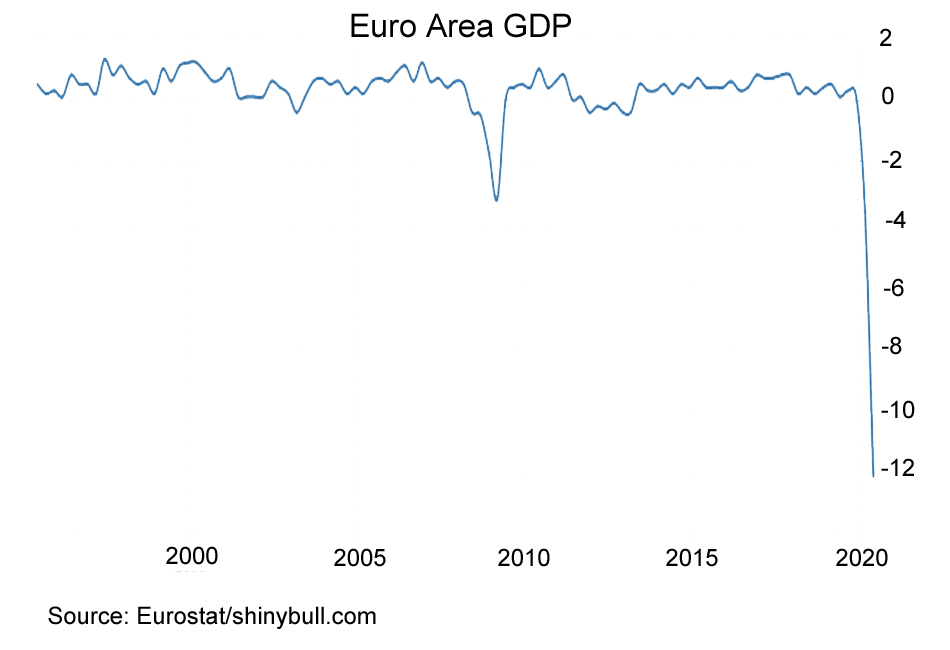
It is now confirmed. The Eurozone saw the biggest drop in GDP on record in Q2. The Eurozone economy dropped 12,1 percent in the three months to June 2020. But this is not as bad as the UK, which is the worst country in Europe.

COVID-19 hit the economy hard in Europe. The invisible enemy also hit the demand for services and goods. As you can see from the chart below, the Eurozone has entered a steep recession and a new wave of viruses can push the Eurozone into depression.

Poland`s GDP deopped 8,2 percent YoY in Q2 of 2020, and that is the biggest decline on record. The Dutch economy shrank 8,5 percent on quarter in the three months to June 2020, and that is the biggest pace of contraction since comparable records began in 1988.

The United States started a New World Order right after World War II, but that system is now broken. Donald Trump is making new trade deals and Brexit makes the UK Boris Johnson to do the same. They are rebuilding the system.

Looking at the growth around the world is funny. Singapore is suffering with a drop of 42,9 percent in GDP QoQ 2020. Next on the list is the US; down 32,90 percent.

But here is the funny thing; before the UK which is down 20,40 percent, communist country Venezuela`s growth dropped 23,70 percent. So, Venezuela is in the middle of the United States and the United Kingdom.

On the other end, China`s growth QoQ is up 11,50 percent, followed by Bangladesh (8,20%), Vietnam (6,88%) and Pakistan (5,79%).

The coronavirus is a threat, but a wave of corporate bankruptcies is a much bigger threat. The world is sitting on a bankruptcy time bomb.

To contact the author: post@shinybull.com

Disclaimer: The views expressed in this article are those of the author and may not reflect those of Shiny bull. The author has made every effort to ensure accuracy of information provided; however, neither Shiny bull nor the author can guarantee such accuracy. This article is strictly for informational purposes only. It is not a solicitation to make any exchange in precious metal products, commodities, securities or other financial instruments. Shiny bull and the author of this article do not accept culpability for losses and/ or damages arising from the use of this publication.

Leave a comment

Filed under Politics

The US unemployment go straight up while the pending home sales go straight down

China`s growth plummeted -6,8 YoY in Q1. The growth in the U.S is still on the right side, coming in at 0,3 percent YoY in Q1. But if you look at the quarter, the growth in China is down -9,8 percent, while the U.S growth is down -4,8 percent.

The annulized 4,8 percent drop in Q1 of 2020 markes the end of the longest period of expansion in America`s history. The drop is the steepest pace of contraction in GDP since the last quarter of 2008 (financial crisis).

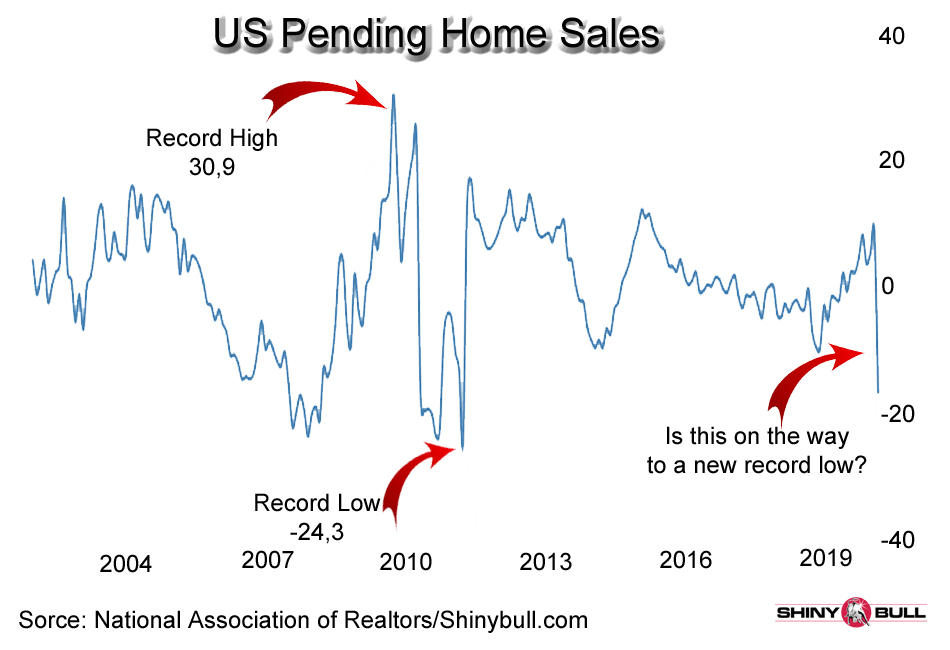
The Covid-19 pandemic forced several states to impose lockdown measures in mid-March and that pushed millions of people out of work. The unemployment rate go straight up while the pending home sales go straight down.

Contracts to buy previously owned homes in the US dropped 16,3 percent YoY earlier in March this year, and that is the biggest annual decline since April 2011, amid the Covid-19 crisis. On a monthly basis, pending home sales went down 20,8 percent, which is the largest drop since May 2010.

Unfortunately, it seems like this is just the beginning.

The next quarter can be very ugly, while the unemployment rate can go straight up to Great Depression levels. The growth in the US can plunge more than 30 percent. If that is happening, what do you thing will happen to the pending home sales?

The numbers are expected to get even worse in April as the government surveyed businesses and housholds for the report in mid-March, before majority of people was under some form of a lockdown.

Trump`s economic adviser Kevin Hassett said unemployment in the US can soar to 17 percent. In March the unemployment rate was 4,4 percent in the US.

During the financial crisis, the US lost about 9 million jobs, but now the US is losing that many jobs about every 10 days, Hassett told ABC on Sunday.

This is sad, because all the jobs created since the Great Recession (2008) have been wiped out. So far, we are talking about 26 million and it can be worse. Hassett told ABC the unemployment will surge to levels not seen since the Grat Depression (1929).

During the Great Depression, about 15 million jobs were lost.

So, we know what`s coming. People without job and money will not buy a house.

Pending home contracts generally are seen as a forward-looking indicator of the health of the housing market because they become sales one to two months later. This summer holiday will be very special.

To contact the author of this story: Ket Garden at post@shinybull.com

Disclaimer: The views expressed in this article are those of the author and may not reflect those of Shiny bull. The author has made every effort to ensure accuracy of information provided; however, neither Shiny bull nor the author can guarantee such accuracy. This article is strictly for informational purposes only. It is not a solicitation to make any exchange in precious metal products, commodities, securities or other financial instruments. Shiny bull and the author of this article do not accept culpability for losses and/ or damages arising from the use of this publication.
Leave a comment

Filed under Politics, Uncategorized

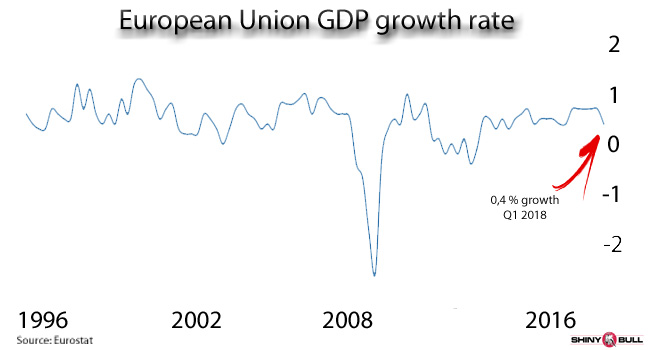
The European Union rose “only” 0,4 percent in Q1 of 2018

Last week I talked about America`s fantastic growth of 4,1 percent on quarter in Q2 of 2018, and this is only the beginning. It is no doubt; President Trump must be doing something right. But, what about the European Union?

GDP in the European Union rose «only» 0,4 percent on quarter in the first three months of 2018. Not much to write home about. But the growth have never been above 1 percent since the financial crisis in 2008.

The European Union reached an all time high of 1,30 percent in 1999 and that is right before the tech bubble burst. Since then it has been a dead fish, reaching an all time low of -2,60 percent in the first quarter of 2009.

At the same time we can see that the unemployment rate reached a record low of 6,80 percent in February of 2008, and that`s right before the financial crisis. It reached an all time high of 11 percent in February 2013, but in May this year it fall down to 7 percent again.

This isn`t good enough if we are living in a capitalistic world.

The European Union in Brussels are nothing more than unelected bureaucrats. Draghi and the ECB have, just like Japan and the U.S «printed» a lot of money, and will continue to do so. If they can`t turn around the ship, they need to consider a strong cheerleader.

European Commission President Jean-Claude Juncker had a meeting with President Trump last week. They were talking about trade, free trade and tariffs. Mr Trump`s goal is to make better deals so both the U.S and the EU can take more profit and prosper.

I think that the EU should be glad for that and they need to hurry up. The U.S is the world`s third biggest exporter, yet exports account «only» for 13 percent on GDP. Exports in the U.S reached an all time high of 215328 USD million in May this year, which is pretty impressive.

The EU has 28 member states and the biggest among them all is Germany (21 percent of total GDP), the United Kingdom (15 percent), and France (15 percent).

Exports of goods and services account for 46 percent of GDP while imports account for 42 percent, adding 4 percent of total GDP. But this is about to change. If the UK contribute with 15 percent of the total GDP in the EU, then what will happen to their growth after Brexit?

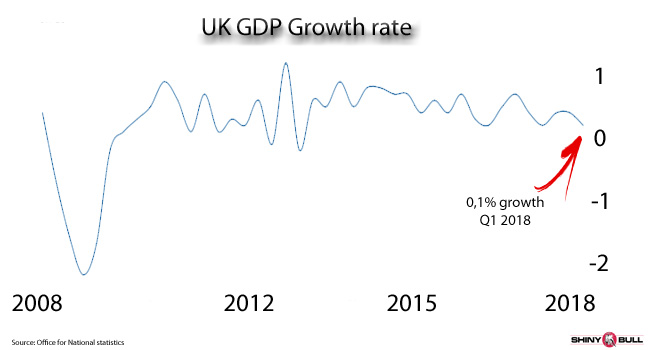
That being said; nor is the UK a success story. The British economy grew by 0,1 percent in the first three months of 2018 and well below 0,4 percent in the previous period. It is the lowest growth rate since a 0,1 percent contraction in Q4 2012.

The largest contribution to growth in the UK was from household spending at 0,2 percentage points. From the production side, the service industries made the largest contribution to GDP growth, followed by production.

Agriculture, the smallest component within the output approach of GDP made no contribution to growth to one decimal place, while construction deducted from GDP growth. The service industries increased by 0,3 percent.

Positive growth was recorded within all sub-sectors of the services industries; distribution, hotels and restaurants (0,1 percent vs -0,1 percent).

President Trump have repeatedly said that the EU have treated the US very bad. I have written many articles about that long before Mr Trump`s inauguration. The European Commission has fined Google €4,34 billion for breaching EU antitrust rules this month.

In May 2009, Intel was imposed with a 1,06 billion euro fined for abusing its market dominance on central processing units. Microsoft has been in trouble with the Commission on several occasions. In 2004, the Commission ruled that Microsoft had abused its market dominance.

In 208, the Commission fined Microsoft nearly 900 million euros for charging «unreasonable» royalty fees. In 2013, another fine of 561 million euros was imposed on Microsoft. This time for failing to comply with the Commission`s ruling that it had to allow users to more easily choose a prefered web browser.

The European Commission fined Facebook for 110 million euros in May this year in relation to its takeover of WhatsApp. Facebook acquired the messaging service in 2014 for $19 billion, but provided the Commission with misleading information about the acquisition.

In August 2016, the Commission ruled that tech giant Apple had received illegal tax benefits from Ireland worth up to 13 billion euros. Ireland was ordered to recover the unpaid tax from Apple, plus interest.

As early as 1966, British Politician Tony Benn said that «Communism run by commissars from Moscow did not work, and nor will capitalism run by commissioners in Brussels. Both deny people their right to develop in their own way.»

Now, under President Donald Trump, big companies like Apple are moving home to the United States with billions of dollars. Apple alone, are bringing in $230 billion. They will build new plants and a magnificent campus.

They will spend their money wisely and the money will be in the U.S. All this is possible because of Trump`s tax cuts and reforms. This is how you make growth.


Leave a comment

Filed under Politics