Tag Archives: France

The cost of living and the blame game

People are angry, and that’s why they voted for Mamdani as the next Mayor of New York.
People are sick and tired of struggling to make ends meet. In his victory speech, Mamdani said:

“We choose hope over tyranny. Hope over big money and small ideas. Hope over despair. Tonight, we have stepped out from the old into the new.”

His supporters are already marching in the streets, saying they don’t want Trump as a king or a dictator.

Hmm… I think I’ve heard this before.
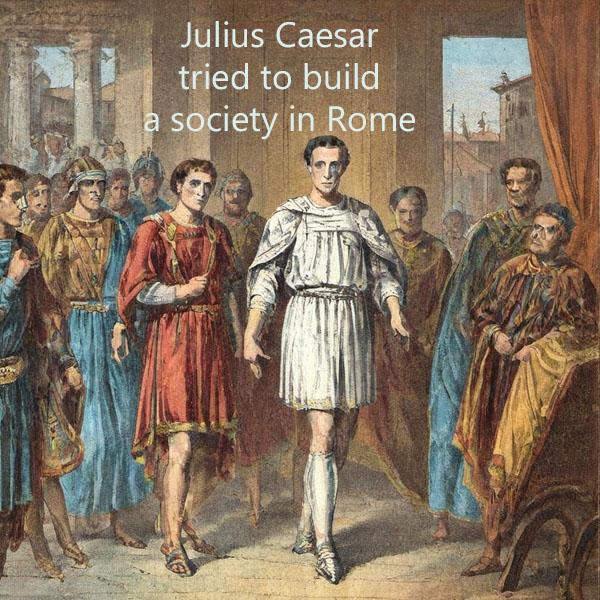
More than two thousand years ago, in Rome, another man was accused of wanting to be king.
His name was Julius Caesar.

A group of Roman senators assassinated Caesar out of fear that his growing power and titles, especially dictator for life, would destroy the Roman Republic.
They claimed they were saving democracy, but their actions plunged Rome into chaos and civil war.

It was a betrayal that changed history, and a reminder of how fear, power, and instability often go hand in hand.

History Repeats Itself

Fast forward to France, 1848. The people were exhausted. Food prices were soaring, unemployment was rising, and inequality had reached unbearable levels.
King Louis Philippe I, once known as the Citizen King, had promised a fairer, more modern France. But over time, his government became detached from ordinary people’s struggles.

One of the main sources of anger was the tax system. The poor and working class bore a heavy burden through indirect taxes on essentials like food, salt, and fuel, while wealthy landowners and property owners paid relatively little. Voting rights were also tied to property ownership, meaning most citizens had no political voice. When food prices spiked in the late 1840s, ordinary people were paying high taxes on top of already expensive necessities. Economic frustration reached a tipping point.

People in New York voted for Mamdani, who wants to raise taxes and, at the same time, give people fast and free buses. How is that going to be?

When protests erupted in February 1848, the king tried to silence them. Instead, the anger exploded.
Barricades filled the streets of Paris, and after just a few bloody days, Louis Philippe abdicated the throne and fled to England in disguise.

The monarchy collapsed. The Second Republic was born.
But what came next? A new leader. Louis-Napoleon Bonaparte, nephew of Napoleon I, rose to power, promising to restore stability and hope. Within four years, he declared himself Emperor.

Sound familiar?

It’s the same old story: people rise up against a system they believe is unjust, only to end up under a new one that looks strangely similar.
Each era has its slogans: “liberty,” “hope,” “change,” “the people’s revolution”, yet the same problems remain. Prices go up. Ordinary citizens struggle. The rich adapt and survive.
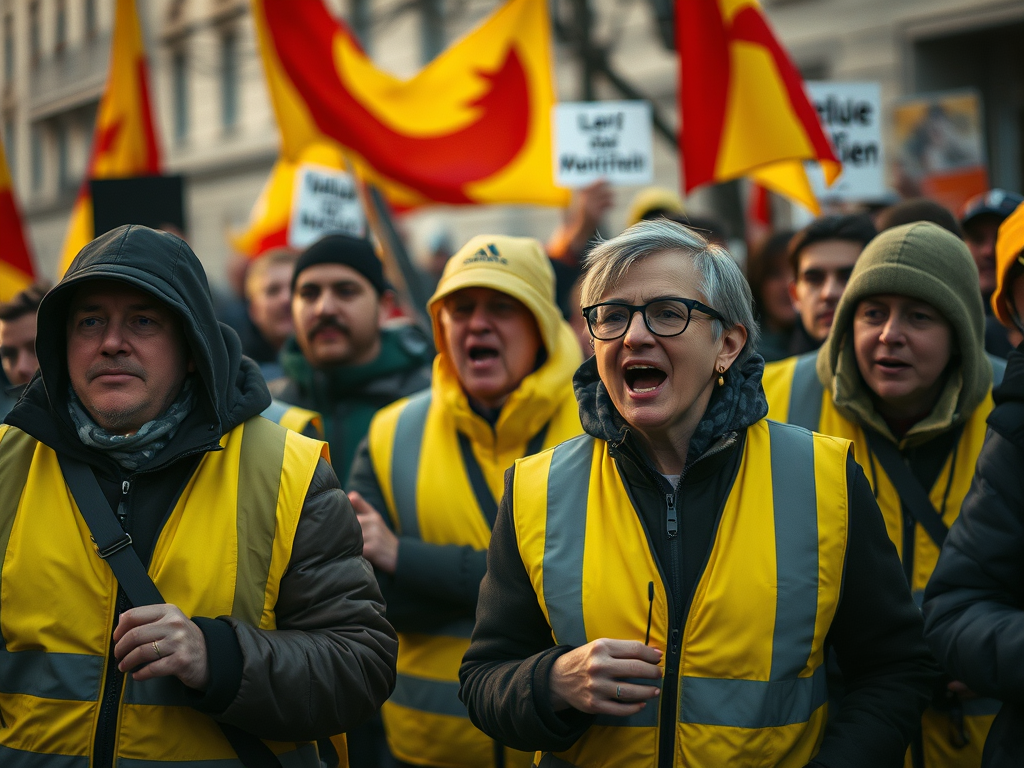
Take a look at France today with its Yellow Vest protesters. People are struggling with their cost of living. I wrote an article about that for the first time, many years ago. And who is to blame now? The King? Napoleon? No, it`s Macron.

So, Why Are Prices Rising Again?

The cost of living has become the defining issue of our time. Food, housing, and energy prices are rising faster than wages. Families feel squeezed, not just in New York or Paris, but across the Western world.

But who is to blame?

It’s tempting to point the finger at politicians, corporations, or billionaires. Yet the truth is more complex. The problem isn’t one person. It’s the system itself.

A mix of factors drives today’s inflation:

  • Global supply chain disruptions from the pandemic and wars.
  • Energy shocks as the world shifts away from fossil fuels.
  • Corporate pricing power in markets where competition has shrunk.
  • Decades of easy money and debt have inflated asset prices but left wages behind.

Governments print money to stimulate the economy, corporations raise prices to protect profits, and central banks hike interest rates to cool inflation, all while ordinary people pay the price.

It’s a cycle that keeps repeating, no matter the century. In ancient Rome, it was grain shortages. In 1848, in France, it was bread and taxes. Today, it’s rent and electricity.

The Real Lesson

Historically, when people struggle, they often look for someone to blame, such as a king, a tyrant, or a president. Get rid of Trump, and everything will be fine. Get rid of Macron, and the sun will shine. They think removing the person will fix the system. But as history shows us, that rarely works.

Trump isn’t the cause of America’s problems. He’s a symptom of them.
Just as Caesar wasn’t the reason Rome was collapsing, but rather the outcome of deep divisions and economic inequality that had built up for years.

When the cost of living becomes unbearable, people revolt. Sometimes at the ballot box, sometimes in the streets.

But unless we learn from history, each “revolution” just sets the stage for the next crisis.

In the end, it’s not about kings or dictators. It’s about systems.
And if we don’t fix the system, the anger, fear, and struggle will continue. Just as it has for more than 2,000 years.

Disclaimer: The views expressed in this article are those of the author and may not reflect those of Shinybull.com. The author has made every effort to ensure the accuracy of the information provided; however, neither Shinybull.com nor the author can guarantee the accuracy of this information. This article is strictly for informational purposes only. It is not a solicitation to make any exchange in precious metal products, commodities, securities, or other financial instruments. Shinybull.com and the author of this article do not accept culpability for losses and/ or damages arising from the use of this publication.

Leave a comment

Filed under Politics

French Income tax would be scrapped for everyone under 30, and interest-free loans of up to €100,000 would be offered to younger families under Marine Le Pen

It`s time for the final round of the presidential battle in France, and Wednesday 20th will be critical for both, Macron and Le Pen. Those who win the war on words on Wednesday can end up as the next president in France.

But many people in France don`t know what to vote for this time. Le Pen is a far-right politician, and she and her party are in a good position to win this time. Opinion polls show that 47% of French voters want Le Pen to win.

Marine Le Pen sent shockwaves through Europe with her latest comments on NATO.

Le Pen said in a press conference that France will leave NATO if she wins the presidency. In 2019, Macron warned Europe and said; NATO is becoming brain-dead. He also said that Europe can no longer rely on America to defend NATO allies.

Macron said on October 21, 2019, that it is high time for Europe to «wake up».

Le Pen also suggested a strategic reconciliation between NATO and Russia once the war is over. On top of that, she wants to reform the EU from the inside. This is why Europe and NATO are so nervous over the French election on Sunday.

Le Pen believes that France can be useful in the resolution of the world`s great disorders, if and only if it is independent. What protesters don`t like is that Le Pen will start an alliance with Putin if she wins the election.

This election is crucial not just for France, but for the whole of Europe, and this is why investors should care. Le Pen is opposed to globalization, and she believes that it is a threat to French society. She proposed the replacement of the world trade organization. And the abolition of the IMF.

Le Pen is also against immigration and considers it a tool of Islamic extremism. Her party is best known for immigration issues, but less known for its economic policies. But she has changed since 2017, and she`s more focused on people`s cost of living.

She wants to eliminate VAT on a basket of foods while cutting the rate from 20 to 5 percent on electricity and petrol. She is more protectionist, and nationalist than Macron who is considered to be a man with a business-friendly agenda.

«Give the French their money back», is Le Pen`s slogan, and she has proposed big tax cuts and new spending. Income tax would be scrapped for everyone under 30, and interest-free loans of up to €100,000 would be offered to younger families, with the debt forgiven if they had three children.

This is good news for yellow vest protesters that started the «Gilets Jaunes» movement in France in 2018, originally a protest against a tax rise on petrol and diesel.

A French sovereign wealth fund would be created to promote an economy focused on what she calls «localism» as opposed to Macron`s «globalism».

People in France believe that Macron is a «president of the rich», and younger voters are angry mostly because of the nationwide cost of living crisis. Younger voters are also angry because of the lost years of their life due to the Covid pandemic and government lockdowns. This has also made an anti-establishment group against the French government.

Marine Le Pen knows this, and that`s why she is focusing on younger voters. The inflation in the eurozone is at its highest ever, and purchasing power and the cost of living is the single most important issue for 58% of voters and a clear majority within every age group except for those 18 to 24, for whom the environment ranks first.

Marine Le Pen is anti-NATO and anti-EU, friendly with Russia`s Vladimir Putin, and she doesn`t want a Frexit, and that has come under scrutiny.

Last Sunday was a good day for Mèlenchon, who finished close behind Le Pen. Polls suggest 30% of Mèlenchon voters might vote for Macron, and 23% for Le Pen. The rest is expected to abstain or vote blank next Sunday.

Macron made history in 2017 when he became the youngest president in France at the age of 39. He promotes democracy and liberalism, and he`s a globalist. He is a favorite to win the election, and 53% want him to be re-elected.

But, it can also be a close race, while 40% of the French voters are still undecided, so the outcome is uncertain. If Macron wins again, it would be a symbolic moment as he will be the first president for 20 years to win a second term.

Four years ago, the man behind Brexit, Nigel Farage, predicted that Marine Le Pen will win the French presidential election in 2022. Time will show.

Disclaimer: The views expressed in this article are those of the author and may not reflect those of Shinybull.com. The author has made every effort to ensure the accuracy of the information provided; however, neither Shinybull.com nor the author can guarantee such accuracy. This article is strictly for informational purposes only. It is not a solicitation to make any exchange in precious metal products, commodities, securities, or other financial instruments. Shinybull.com and the author of this article do not accept culpability for losses and/ or damages arising from the use of this publication.

Leave a comment

Filed under Politics

The biggest welfare state in the world is France

I need to follow up my recent article about tax, GDP, a free lunch and big governments. The Biden administration is calling for a tax hike and a much bigger government. Is the United States on the way to be a socialist country like France? If so, how would that be?

Let`s take a look at France. The biggest welfare state in the world. No other coutries in the world spend more money on welfare than the French government. No other coutries has higher taxes either.

But who is protesting a lot? No other countries in the world are protesting more than the people of France, and the yellow vest protesters showed us that. There were multiple reasons for all the protests in France. What they all had in common is that they were all dissatisfied.

Does the people of the United States really want to be a socialist state like France?

Photo by Alex Azabache on Pexels.com

First of all; lets talk about tax. No other countries in the world have higher taxes than France. Personal income tax has dropped to 45%, down from 59,6% about twenty years ago. In other words; half of your hard earned money goes to the government.

Corporate tax rate in France dropped to 28% under president Macron. Do doubt that Macron is doing something right. A Trump strategy that is boosting the economy with lower taxes (but that was before the covid attack).

In the early 80`s, the corporate tax rate in France was at a record high with 50%. All that happened under President Fracois Mitterand who served as a President of France from 1981 to 1995, the longest time in office in the history of France.

Mitterand started political life on the Catholic nationalist right, but joined the resistance and moved to the left. He opposed Charles de Gaulle`s establishment of the Fifth Republic.

He invited the Communist Party into his first government, which was a controversial decision at the time. In the event, the Communists were boxed in as junior partners and, rather than taking advantage, saw their support erode. The left the cabinet in 1984.

Interestingly, right after that, the taxes started to decline. Mitterand followed a radical left-wing economic agenda, including nationalisation of key firms, but after two years, with the economy in crisis, he reversed course.

He pushed a socially liberal agenda with reforms such as the 39-hour week, and the end of a government monopoly in radio and television broadcasting.

His partnership with German Chancellor Hermut Kohl advanced European integration via the Maastricht Treaty, but he reluctantly accepted German reunification. By the way; he was also the only French President to ever have named a female Prime Minister; Edith Cresson.

Beyond making the French left electable, Mitterand presided over the rise of the Socialist Party to dominance of the left, and the decline of the once-mighty Communist Party (as a share of the popular vote in the first presidential round, the Communists shrank from a peak of 21,27% in 1969 to 8,66% in 1995, at the end of Mitterand`s second term).

As you can see, the popularity of the Communist Party declined from about 21% to 8%, but so did the corporate tax rate under Mitterand too.

But taxes need to come from someone, and that is the people. How is that going to work out if millions are unemployed? In France, the unemployment rate has always been high. It dropped to 8% in December of 2020, down from 9,1% in the previous period.

The number of unemployed people decreased by 340 thousand to 2,4 million. That sounds expensive. Someone has to pay for it.

France spend nearly one third of their GDP on social welfare, according to OECD. France are on top of the list (27,5) while the U.S is number 22 with 14,3% (as a percentage of GDP).

If we look at total net social spending, France is still at the top with 31,7%, but interestingly, the U:S is second with 30%. Total net social spending takes into account public and private social expenditure, and also includes the effect of direct taxes (income tax and social security contributions), indirect taxation of consumption on cash benefits, as well as tax breaks for social purposes.

Top 20 list of all the countries with tax revenue as a percent of GDP from 40% to 50% are all from Europe. except one; Cuba, at number 8 on the list. A communist country among all the European countries.

The debt in France is skyrocketing. Under Mitterand, the debt to GDP was about 20. Now, under Macron it has increased to 115,70 percent in 2020 from 97,60 percent in 2019.

At the same time, Government Budget in France decreased to -9,20 percent of GDP in 2020 from -3,10 percent in 2019. In other words; the government spends more money than it takes in from taxes and other fees.

So, socialist welfare state France has more debt than the United States. Devt to GDP in the U.S increased to 107,60 percent in 2020, up from 106,90 percent in 2019.

The unemployment rate is also lower in the U.S. The unemployment rate fell to 6 percent in March of 2021. The U.S government is also spending more money than they have. In 2019, the U.S recorded a government budget deficit equal to 4,60 percent of the GDP, but it`s expected to be about 13 percent in 2020.

On top of all the taxes, people in France also need to pay for the roads. A typical socialist country has toll roads. From Boreaux to Paris, you need to pay 55,60 euros for Classe A and 85,60 euros for Classe B.

All the money you earn from Janury to June goes to the government. The govenment will give the money you give them to sick people who ask for free healthcare. State healthcare insurance is available to everyone staying in France for more than three months.

The French Social Security system runs this insurance (called PUMA), and this insurance covers about 70% of the medical costs, and in some cases, even 100% of the costs. The state also pays for every child`s education from 6 to 16 years old.

So, if you pay nearly half of your hard earned money to your welfare state, and drive a car from Boreaux to Paris often, you have to ask yourself what your real tax actually is?

To contact the author: post@shinybull.com

Disclaimer: The views expressed in this article are those of the author and may not reflect those of Shinybull.com. The author has made every effort to ensure the accuracy of the information provided; however, neither Shinybull.com nor the author can guarantee such accuracy. This article is strictly for informational purposes only. It is not a solicitation to make any exchange in precious metal products, commodities, securities, or other financial instruments. Shinybull.com and the author of this article do not accept culpability for losses and/ or damages arising from the use of this publication.

Leave a comment

Filed under Politics, Uncategorized

Far-right populist movements making a last desperate stand for liberalism and democracy against a rising tide of progressivism and globalism

Donald Trump is still popular. In 2018, Republicans used to call Ronald Reagan the best president in US history, but now, in 2021, it`s Donald Trump, according to the latest Economist/YouGov poll. Trump is at the top (36%), while Ronald Reagan is second (18%), followed by Abraham Lincoln (13%).

Among all Americans, Donald Trump comes in third at 13% with Barrack Obama on top of the list at 18%, followed by Abraham Lincoln at 17%. President Joe Biden is not on the list at all, as he had served less than 20 days when the survey began.

I support all the presidents no matter what side they are on, but that doesn`t mean I agree with all they do and say. Right now, Biden is the president, and he has a lot of things to fix. And Trump talked about it in his speech at CPAC.

«We`re in the middle of a historic struggle for America`s future, America`s culture, and America`s institutions. Our very identity as Americans is at stake, like perhaps at no other time, so no matter how much the Washington establishment and the powerful special interests may want to silence us, let there be no doubt; we will be victorious and America will be stronger and greater than ever before,» Trump said in the speech.

Much of the crazy ideas are coming from the left side. Ideas like language are violent, don`t practice yoga or cook Chinese food, there is no such thing as biological sex and only white people can be racist. Many people are confused by these ideas.

Do you wonder how some people on the left side have managed so quickly to challenge the very logic of Western society?

What`s going on in America is not unique. It`s the same playbook in Europe as well. President Macron talked about it a few days ago and said he doesn`t want all these crazy ideas from the left in France. Sorry Macron, but it all started there; in France.

It`s an evolution from French postmodernism to its refinement within activist academic fields. Today we can recognize it by its effects, such as cancel culture and social-media dogpiles, as by its tenets, which are all too often embraced as axiomatic in mainstream media:

knowledge is a social construct; science and reason are tools of oppression; all human interactions are sites of oppressive power play, and language is dangerous. As they warn, the unchecked proliferation of these anti-Enlightenment beliefs presents a threat not only to liberal democracy but also to modernity itself.

This is what authors Helen Pluckrose and James Lindsay talk about in their book; «cynical theories.» While acknowledging the need to challenge the complacency of those who think a just society has been fully achieved, Pluchrose and Lindsay break down how this often-radical activist scholarship does far more harm than good, not least to those marginalized communities it claims to champion.

They also detail its alarmingly inconsistent and illiberal ethics. Only through a proper understanding of the evolution of these ideas, they conclude, can those who value science, reason, and consistently liberal ethics successfully challenge this harmful and authoritarian orthodoxy, in the academy, in culture, and beyond.

During the modern period in the last two centuries in most Western countries, there has been developed a broad consensus in favor of the political philosophy known as «liberalism.»

The main tenets of liberalism are political democracy, limitations on the powers of government, the development of universal human rights, legal equality for all adult citizens, freedom of expression, respect for the value of viewpoint diversity and honest debate, respect for evidence and reason, the separation of church and state, and freedom of religion.

These liberal values developed as ideas and it has taken centuries of struggle against theocracy, slavery, patriarchy, colonialism, fascism, and many other forms of discrimination to honor them as much as we do, still imperfectly today, Pluckrose and Lindsay said.

But the struggle for social justice has always been strongest when it has cast itself as the defender of liberal values universally, insisting that they are applied to all individuals, not just to wealthy white males.

It must be noted that the general philosophical position that we call «liberalism» is compatible with a wide range of positions on political, economic, and social questions, including both what Americans call «liberal» (and Europeans call «social-democratic») and modern forms of what people in all countries call «conservative.»

This philosophical liberalism is opposed to authoritarian movements of all types, be they left-wing or right-wing, secular of theocratic.

Liberalism is thus best thought of as a shared common ground, providing a framework for conflict resolution and one within which people with a variety of views on political, economic, and social questions can rationally debate the options for public policy.

However, we have reached a point in history where liberalism and modernity at the heart of Western civilization are at great risk on the level of the ideas that sustain them.

The precise nature of this threat is complicated, as it arises from at least two overwhelming pressures, one revolutionary and the other reactionary, that are waging war with each other over which illiberal direction our societies should be dragged.

Far-right populist movements claiming to be making a last desperate stand for liberalism and democracy against a rising tide of progressivism and globalism are on the rise around the world.

Trump said in the speech that his movement is successful. «We began it together four years ago and it is far from being over,» he said.

To contact the author: post@shinybull.com

Disclaimer: The views expressed in this article are those of the author and may not reflect those of Shinybull.com. The author has made every effort to ensure the accuracy of the information provided; however, neither Shinybull.com nor the author can guarantee such accuracy. This article is strictly for informational purposes only. It is not a solicitation to make any exchange in precious metal products, commodities, securities, or other financial instruments. Shinybull.com and the author of this article do not accept culpability for losses and/ or damages arising from the use of this publication.

Leave a comment

Filed under Politics

The Euro area “is facing an economic contraction of a magnitude and speed that are unprecedented in peacetime”

Europe is in trouble. The growth is plummeting. The Euro area «is facing an economic contraction of a magnitude and speed that are unprecedented in peacetime», the ECB president Christine Lagarde said on a news conference in Frankfurt, Germany earlier today.

The Eurozone economy shrank by 3,8 percent on quarter in Q1, and that was the steepest contraction since comparable records began in 1995 as a coronavirus lockdown from mid-March forced businesses to close and consumers to stay at home.

And this is just the beginning. Ms Lagarde suggested euro area GDP could fall by between 5 and 12 percent this year. I repeat: 12 percent!

Not only the euro area came out with the GDP news today. France came out with their bad news today. The French economy shrank 5,8 percent on quarter in the three months to March 2020. And you know what; they are entering a technical recession. I repeat; recession!

This is ugly. This is the steepest decline in GDP on record, as the Covid-19 outbreaks stopped the economy. Household consuption plummeted -6,1 percent, led by falls in spending on both goods and service, fixed investment; -11,8 percent. Foreign demand contributed negatively as both exports and imports fell.

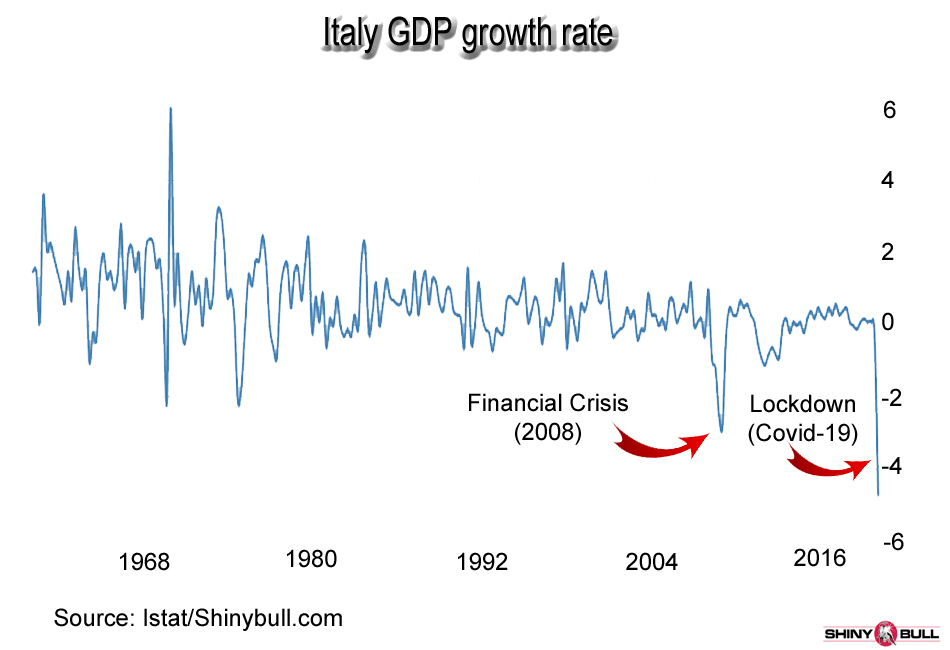
Italy is also in a technical recession. Italy`s GDP shrank 4,7 percent on quarter in the three months to March of 2020. It was the steepest contraction since comparable records began in 1995, as the country was severely hurt by the coronavirus pandemic during March.

The domestic and external demand contributed negatively to the GDP in Italy.

Spain is in the same club. Their economy shrank 5,2 percent on quarter in the first three months of 2020. That is the steepest contraction since the series began in 1995, as the Covid-19 pandemic forced the government to impose lockdown measures in mid-March.

Years of economic growth is wiped out at a pace never seen before. Not only in Europe but also in the United States. The unemployment rate go straight up and the personal spending go straight down.

Personal spending in the US dropped 7,5 percent month-over-month in March 2020, and that was the largest decline in personal spending on record, as the coronavirus crisis hit households’ demand.

Within services, the leading contributor to the decrease was spending on health care.

What`s interesting to see is that France has the highest personal income tax rate in Europe, which is 45 percent. At the same time they have a very high unemployment rate; 8,1 percent. Not only that; their Dept to GDP is 98,10 percent.

Unemployment rate in Italy is 8,4. Personal income tax rate is 43 percent. Both very similar to France, but Italy`s Debt to GDP is 134,8 percent.

Government Debt to GDP in Spain is 95,5 percent with an unemployment rate of 14,41 percent. Personal income tax rate is similar to France and Italy; 45 percent.

France, Italy and Spain has also a lot of problems with the coronavirus. They are all on top of the debt burden list, but they are also on top when it comes to covid-19.

It seems like it is a correlation between debt, high unemployment rate, personal tax income and coronavirus deaths. In comparison; the US debt to GDP is 107 percent as of December 2019. Experts say it will be worse.

To contact the author of this story: Ket Garden at post@shinybull.com

Leave a comment

Filed under Politics