Tag Archives: ECB

Economists expected slower growth, but these numbers indicate that the U.S. economy continues to perform well

YouTubers are full of negativity. Recession is near! Be ready! This is scary! Sell your stocks! The economy is bad! Well, everything isn`t good, but the growth in the U.S. is still very good. Just take a look at the numbers.

More good news came out earlier today. The U.S. job market in October 2024 has shown surprising strength, with 254,000 new jobs added in September. Far exceeding expectations. This strong growth brings the unemployment rate down to 4.1% (which is relatively low historically), and hourly wages are growing at an annual rate of 4%.

Economists expected slower growth, but these numbers indicate that the U.S. economy continues to perform well, and there’s optimism about avoiding a recession. However, voter sentiment still lags, as many remain concerned about inflation and the broader economic outlook

Not only the U.S. stock market is going up. Take a look at the China Stock Market. The China Stock Market has gone down and sideways for about 18 months but took back that downturn within a couple of weeks. This is amazing.

The recent surge in China’s stock market over the past two weeks is likely driven by several factors, including improved investor sentiment, government stimulus measures, and better-than-expected economic data. China’s government has implemented policies to stabilize the property sector, cut interest rates, and support industries, encouraging domestic investment.

Additionally, optimism about easing geopolitical tensions and a potential economic rebound is fueling this upward momentum. However, concerns remain about long-term growth and regulatory uncertainties, which could influence future market performance.

But China is not alone. ECB is doing the same. BOJ is doing the same, and so is the FED among many others. New money is coming into the stock market, and the stock market continues to climb higher.
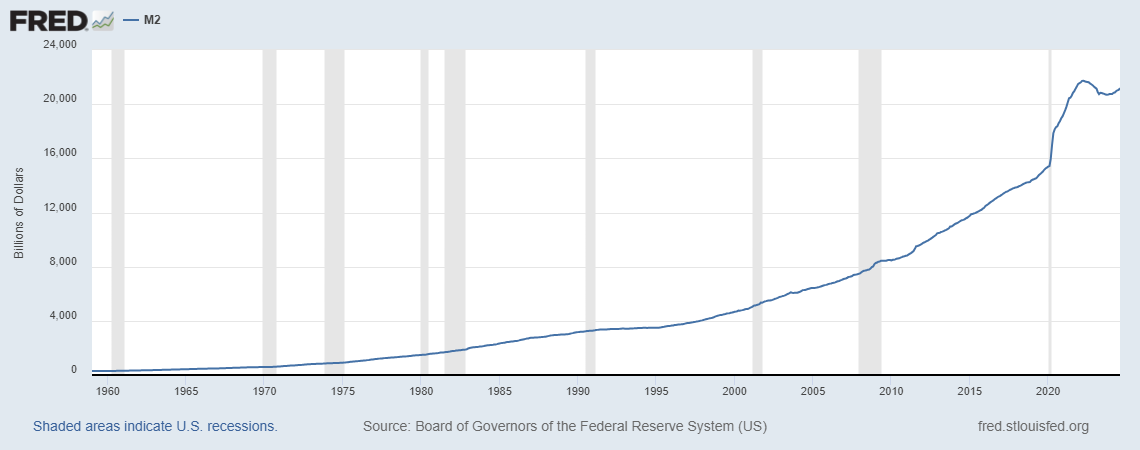
The massive printing of $21.17 trillion by the U.S. and other central banks, mainly in response to crises like the pandemic, significantly increased liquidity in the global financial system. This money printing was aimed at stimulating economies, propping up financial markets, and providing emergency relief. However, it also led to inflationary pressures as too much money chased too few goods.

The excess liquidity fueled asset bubbles raised debt levels and forced central banks to later tighten policies to combat the resultant inflation. Balancing liquidity while avoiding hyperinflation remains challenging.

The U.S. most recently engaged in significant money printing during the COVID-19 pandemic, particularly in 2020 and 2021, through measures such as the Federal Reserve’s Quantitative Easing (QE) program.

As of July 2024, the M1 money supply (monthly supply) in the United States stood at approximately 18 trillion dollars, marking a significant decrease from the previous year. This decline followed a notable contraction in the M1 money supply during the latter half of 2022 and the first six months of 2023.

The Fed injected trillions of dollars into the economy by purchasing government bonds and mortgage-backed securities to maintain liquidity, lower interest rates, and stimulate growth. By mid-2021, the Fed had expanded its balance sheet by over $4 trillion. However, exact figures for ongoing or current printing efforts are often adjusted depending on economic conditions.

Disclaimer: The views expressed in this article are those of the author and may not reflect those of Shinybull.com. The author has made every effort to ensure the accuracy of the information provided; however, neither Shinybull.com nor the author can guarantee such accuracy. This article is strictly for informational purposes only. It is not a solicitation to make any exchange in precious metal products, commodities, securities, or other financial instruments. Shinybull.com and the author of this article do not accept culpability for losses and/ or damages arising from the use of this publication.

Leave a comment

Filed under Politics, Stock market

The Euro area “is facing an economic contraction of a magnitude and speed that are unprecedented in peacetime”

Europe is in trouble. The growth is plummeting. The Euro area «is facing an economic contraction of a magnitude and speed that are unprecedented in peacetime», the ECB president Christine Lagarde said on a news conference in Frankfurt, Germany earlier today.

The Eurozone economy shrank by 3,8 percent on quarter in Q1, and that was the steepest contraction since comparable records began in 1995 as a coronavirus lockdown from mid-March forced businesses to close and consumers to stay at home.

And this is just the beginning. Ms Lagarde suggested euro area GDP could fall by between 5 and 12 percent this year. I repeat: 12 percent!

Not only the euro area came out with the GDP news today. France came out with their bad news today. The French economy shrank 5,8 percent on quarter in the three months to March 2020. And you know what; they are entering a technical recession. I repeat; recession!

This is ugly. This is the steepest decline in GDP on record, as the Covid-19 outbreaks stopped the economy. Household consuption plummeted -6,1 percent, led by falls in spending on both goods and service, fixed investment; -11,8 percent. Foreign demand contributed negatively as both exports and imports fell.

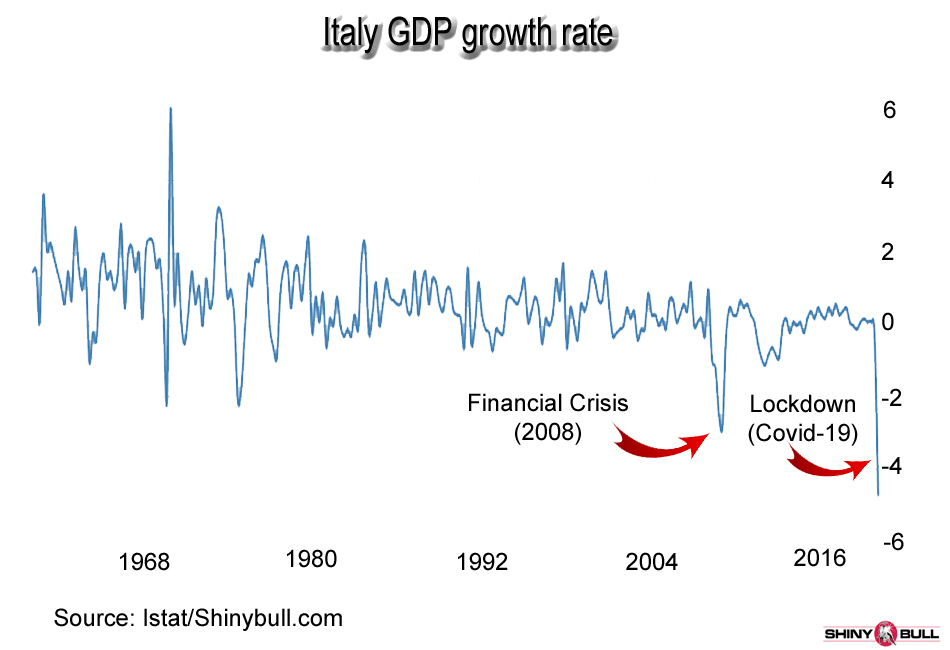
Italy is also in a technical recession. Italy`s GDP shrank 4,7 percent on quarter in the three months to March of 2020. It was the steepest contraction since comparable records began in 1995, as the country was severely hurt by the coronavirus pandemic during March.

The domestic and external demand contributed negatively to the GDP in Italy.

Spain is in the same club. Their economy shrank 5,2 percent on quarter in the first three months of 2020. That is the steepest contraction since the series began in 1995, as the Covid-19 pandemic forced the government to impose lockdown measures in mid-March.

Years of economic growth is wiped out at a pace never seen before. Not only in Europe but also in the United States. The unemployment rate go straight up and the personal spending go straight down.

Personal spending in the US dropped 7,5 percent month-over-month in March 2020, and that was the largest decline in personal spending on record, as the coronavirus crisis hit households’ demand.

Within services, the leading contributor to the decrease was spending on health care.

What`s interesting to see is that France has the highest personal income tax rate in Europe, which is 45 percent. At the same time they have a very high unemployment rate; 8,1 percent. Not only that; their Dept to GDP is 98,10 percent.

Unemployment rate in Italy is 8,4. Personal income tax rate is 43 percent. Both very similar to France, but Italy`s Debt to GDP is 134,8 percent.

Government Debt to GDP in Spain is 95,5 percent with an unemployment rate of 14,41 percent. Personal income tax rate is similar to France and Italy; 45 percent.

France, Italy and Spain has also a lot of problems with the coronavirus. They are all on top of the debt burden list, but they are also on top when it comes to covid-19.

It seems like it is a correlation between debt, high unemployment rate, personal tax income and coronavirus deaths. In comparison; the US debt to GDP is 107 percent as of December 2019. Experts say it will be worse.

To contact the author of this story: Ket Garden at post@shinybull.com

Leave a comment

Filed under Politics

The Fed kept the interest rate unchanged at 1,75 – 2% while Switzerland have negative interest rate at -0,75

Federal Reserve Board Chairman Jerome Powell announced on Wednesday that it kept the benchmark interest rate unchanged. The statement comes after a two-day meeting of the FOMC, which decides on monetary policy.

Powell said the job market would remain strong and inflation would stay around the 2 percent target for “several years.” This is great for the U.S because it gives the Fed some tools to use if the trouble are coming back. But what about the rest of the world? Are they healthy?

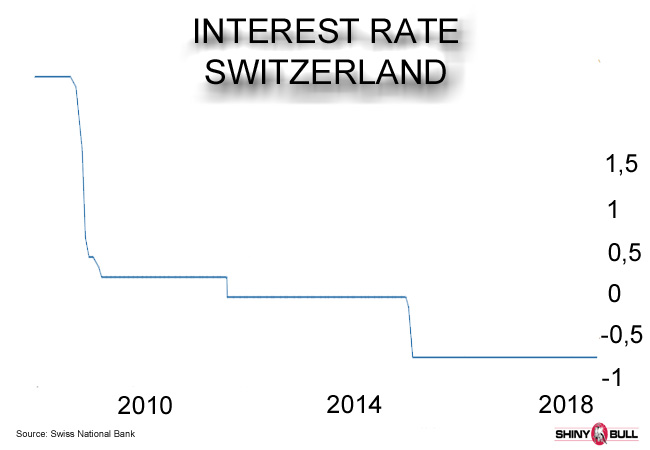
The picture is different in Switzerland. The Swiss National Bank kept its benchmark three-month Libor at -0,75 percent on June 21st, 2018. Interest rate in Switzerland reached an all time low of -0,75 percent in January of 2015, and it`s still at the same low-level. But they are not alone.

Denmark followed Switzerland in 2015 and dropped the interest rate to -0,75 only a month after them. The Danish central bank follows the path set by the ECB and the key rate will be raised or lowered when the ECB changes the refinance rate.

The Danish central bank`s main policy aim to hold the euro`s exchange rate within 2,25 percent either above or below 7,46038 kroner in an effort to keep inflation low and provide stability for exporter. Now the Danish rate is -0,65.

Sweden joined the negative interest club, and the central bank of Sweden held its benchmark interest rate at -0,5 percent on July 3rd, as widely expected, saying monetary policy needs to continue to be expansionary for inflation to remain close to target despite strong economic activity.

Japan is the last country in the world to have negative interest rate. They reached an all time low of -0,1 percent in July this year. The BOJ vowed to keep rate extremely low for extended period of time and opted for flexible bond buying at its July 2018 meeting.

In addition, Japan`s policymakers left its key short-term interest rate unchanged at -0,1 percent and kept its 10-year government bond yield target around 0 percent.

In other words; you are lending your money to governments and you are paying them interest for that, which mean it`s cheaper to put your money under your mattress. But that strategy can be very risky.

The goal is to make people spend money rather than pay a fee to keep it safe. This is intended to incentivize banks to lend money more freely and businesses and individuals to invest. This is how you make growth.

During deflationary periods, people and businesses hoard money instead of spending and investing. The result is a collapse in aggregate demand, which leads to prices falling even further. This again will lead to a slowdown in production and output which means higher unemployment.

Negative interest rates can be considered a last-ditch effort to boost economic growth, which means when all else has proved ineffective and may have failed. 21 countries like Spain, Italy, Greece, France, Finland and Malta to name a few, are holding its interest rate at 0,00. The Euro zone is joining the club.

In 2014, the ECB instituted a negative interest rate that only applied to bank deposits intended to prevent the Euro zone from falling into a deflationary spiral.

The ECB held its benchmark refinancing rate at 0 percent on July 26th and reiterated that the monthly pace of the net asset purchase will be reduced to €15 billion from September to December 2018, and will then end.

The ECB expect the interest rate to remain at their present levels at least through the summer of 2019, and in any case for as long as necessary to ensure the continued sustained convergence of inflation to levels that are below, but close to 2 percent over the medium term.

The risk surrounding the euro area growth outlook can still be assessed as broadly balanced. Uncertainties related to global factors, notably the threat of protectionism, remain prominent.

Disclaimer: The views expressed in this article are those of the author and may not reflect those of Shiny bull. The author has made every effort to ensure accuracy of information provided; however, neither Shiny bull nor the author can guarantee such accuracy. This article is strictly for informational purposes only. It is not a solicitation to make any exchange in precious metal products, commodities, securities or other financial instruments. Shiny bull and the author of this article do not accept culpability for losses and/ or damages arising from the use of this publication.

 

Leave a comment

Filed under Politics

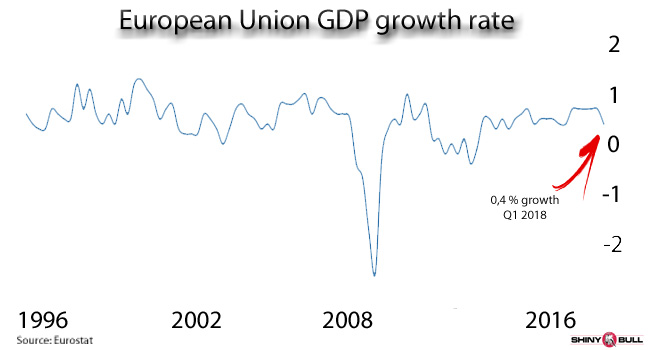
The European Union rose “only” 0,4 percent in Q1 of 2018

Last week I talked about America`s fantastic growth of 4,1 percent on quarter in Q2 of 2018, and this is only the beginning. It is no doubt; President Trump must be doing something right. But, what about the European Union?

GDP in the European Union rose «only» 0,4 percent on quarter in the first three months of 2018. Not much to write home about. But the growth have never been above 1 percent since the financial crisis in 2008.

The European Union reached an all time high of 1,30 percent in 1999 and that is right before the tech bubble burst. Since then it has been a dead fish, reaching an all time low of -2,60 percent in the first quarter of 2009.

At the same time we can see that the unemployment rate reached a record low of 6,80 percent in February of 2008, and that`s right before the financial crisis. It reached an all time high of 11 percent in February 2013, but in May this year it fall down to 7 percent again.

This isn`t good enough if we are living in a capitalistic world.

The European Union in Brussels are nothing more than unelected bureaucrats. Draghi and the ECB have, just like Japan and the U.S «printed» a lot of money, and will continue to do so. If they can`t turn around the ship, they need to consider a strong cheerleader.

European Commission President Jean-Claude Juncker had a meeting with President Trump last week. They were talking about trade, free trade and tariffs. Mr Trump`s goal is to make better deals so both the U.S and the EU can take more profit and prosper.

I think that the EU should be glad for that and they need to hurry up. The U.S is the world`s third biggest exporter, yet exports account «only» for 13 percent on GDP. Exports in the U.S reached an all time high of 215328 USD million in May this year, which is pretty impressive.

The EU has 28 member states and the biggest among them all is Germany (21 percent of total GDP), the United Kingdom (15 percent), and France (15 percent).

Exports of goods and services account for 46 percent of GDP while imports account for 42 percent, adding 4 percent of total GDP. But this is about to change. If the UK contribute with 15 percent of the total GDP in the EU, then what will happen to their growth after Brexit?

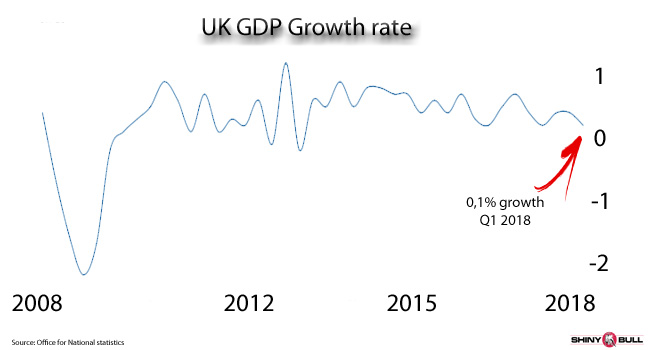
That being said; nor is the UK a success story. The British economy grew by 0,1 percent in the first three months of 2018 and well below 0,4 percent in the previous period. It is the lowest growth rate since a 0,1 percent contraction in Q4 2012.

The largest contribution to growth in the UK was from household spending at 0,2 percentage points. From the production side, the service industries made the largest contribution to GDP growth, followed by production.

Agriculture, the smallest component within the output approach of GDP made no contribution to growth to one decimal place, while construction deducted from GDP growth. The service industries increased by 0,3 percent.

Positive growth was recorded within all sub-sectors of the services industries; distribution, hotels and restaurants (0,1 percent vs -0,1 percent).

President Trump have repeatedly said that the EU have treated the US very bad. I have written many articles about that long before Mr Trump`s inauguration. The European Commission has fined Google €4,34 billion for breaching EU antitrust rules this month.

In May 2009, Intel was imposed with a 1,06 billion euro fined for abusing its market dominance on central processing units. Microsoft has been in trouble with the Commission on several occasions. In 2004, the Commission ruled that Microsoft had abused its market dominance.

In 208, the Commission fined Microsoft nearly 900 million euros for charging «unreasonable» royalty fees. In 2013, another fine of 561 million euros was imposed on Microsoft. This time for failing to comply with the Commission`s ruling that it had to allow users to more easily choose a prefered web browser.

The European Commission fined Facebook for 110 million euros in May this year in relation to its takeover of WhatsApp. Facebook acquired the messaging service in 2014 for $19 billion, but provided the Commission with misleading information about the acquisition.

In August 2016, the Commission ruled that tech giant Apple had received illegal tax benefits from Ireland worth up to 13 billion euros. Ireland was ordered to recover the unpaid tax from Apple, plus interest.

As early as 1966, British Politician Tony Benn said that «Communism run by commissars from Moscow did not work, and nor will capitalism run by commissioners in Brussels. Both deny people their right to develop in their own way.»

Now, under President Donald Trump, big companies like Apple are moving home to the United States with billions of dollars. Apple alone, are bringing in $230 billion. They will build new plants and a magnificent campus.

They will spend their money wisely and the money will be in the U.S. All this is possible because of Trump`s tax cuts and reforms. This is how you make growth.


Leave a comment

Filed under Politics

Banks are in focus this week and ECB could change its forward guidance

The FED is expected to increase the short-term interest rate by 25 basis points this week. If the FED does not raise rates at he March FOMC meeting, it will be a big surprise for many investors. Two things to look for is unemployment and inflation.

The FED is not the only one to have a look at the rates this month. BOJ and ECB is also looking at the rate. All this is headed for an exiting week.


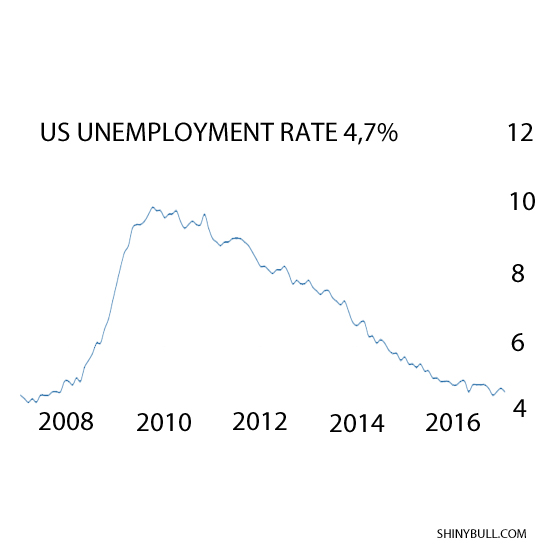
The U.S unemployment rate fell to 4,7 percent last month which is in line with market expectations. Labor force participation rate increased by 0,1 percentage point to 63 percent, and the number of unemployment persons was almost unchanged at 7,5 million.

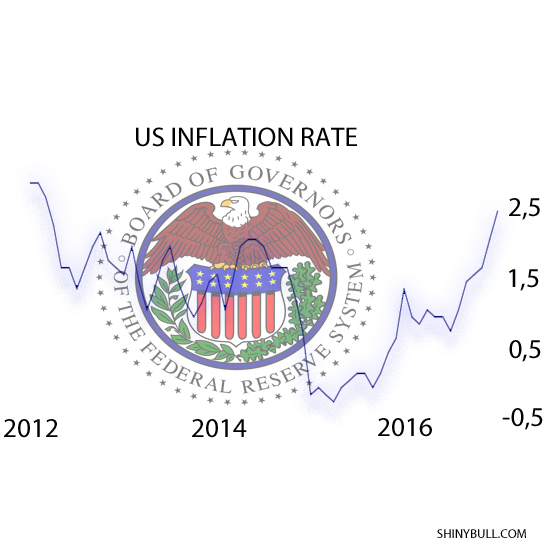
Inflation rate is at near 5-year high of 2,5 percent, which is the highest since March of 2012. The inflation rate accelerated for the sixth consecutive month, mainly boosted by gasoline prices. Energy prices jumped 10,8 percent YoY and food prices declined 0,2 percent.


Watch out for inflation in February 2017 on Wednesday 15 at 12:30 PM. forecast is 2,5%.

Mario Draghi and ECB discussed whether rates can rise before QE ends. A big surprise for many analysts. Why are they doing that? The fact is that they are not satisfied with negative interest rates. This negative rates is squeezing banks’ profit margins because they are not matching the cost, and that will make if difficult for banks to lend to households and companies.

BNP Paribas has predicted the deposit rate will be increased this September, and QE is intended to run until at least the end of 2017. Some people said at least mid-2018. Anyway; analysts will scrutinize the ECB statement on Thursday to look for any changes.

BOJ will have an Interest rate decision on Thursday 16th at 03:00 AM. Forecast is -0,1 percent, which is the same as its January 2017 meeting. In January, policymakers also decided to maintain its 10-years government bond yield target around zero percent.

Economic growth forecast is 1,5 percent for 2017 fiscal year from an earlier projection of a 1,3 percent growth.

Banks are in focus this week and ECB could change its forward guidance.


trump100_b


Disclaimer: The views expressed in this article are those of the author and may not reflect those of Shiny bull. The author has made every effort to ensure accuracy of information provided; however, neither Shiny bull nor the author can guarantee such accuracy. This article is strictly for informational purposes only. It is not a solicitation to make any exchange in precious metal products, commodities, securities or other financial instruments. Shiny bull and the author of this article do not accept culpability for losses and/ or damages arising from the use of this publication.
Leave a comment

Filed under Politics, Quantitative Easing