
Tag Archives: Unemployment

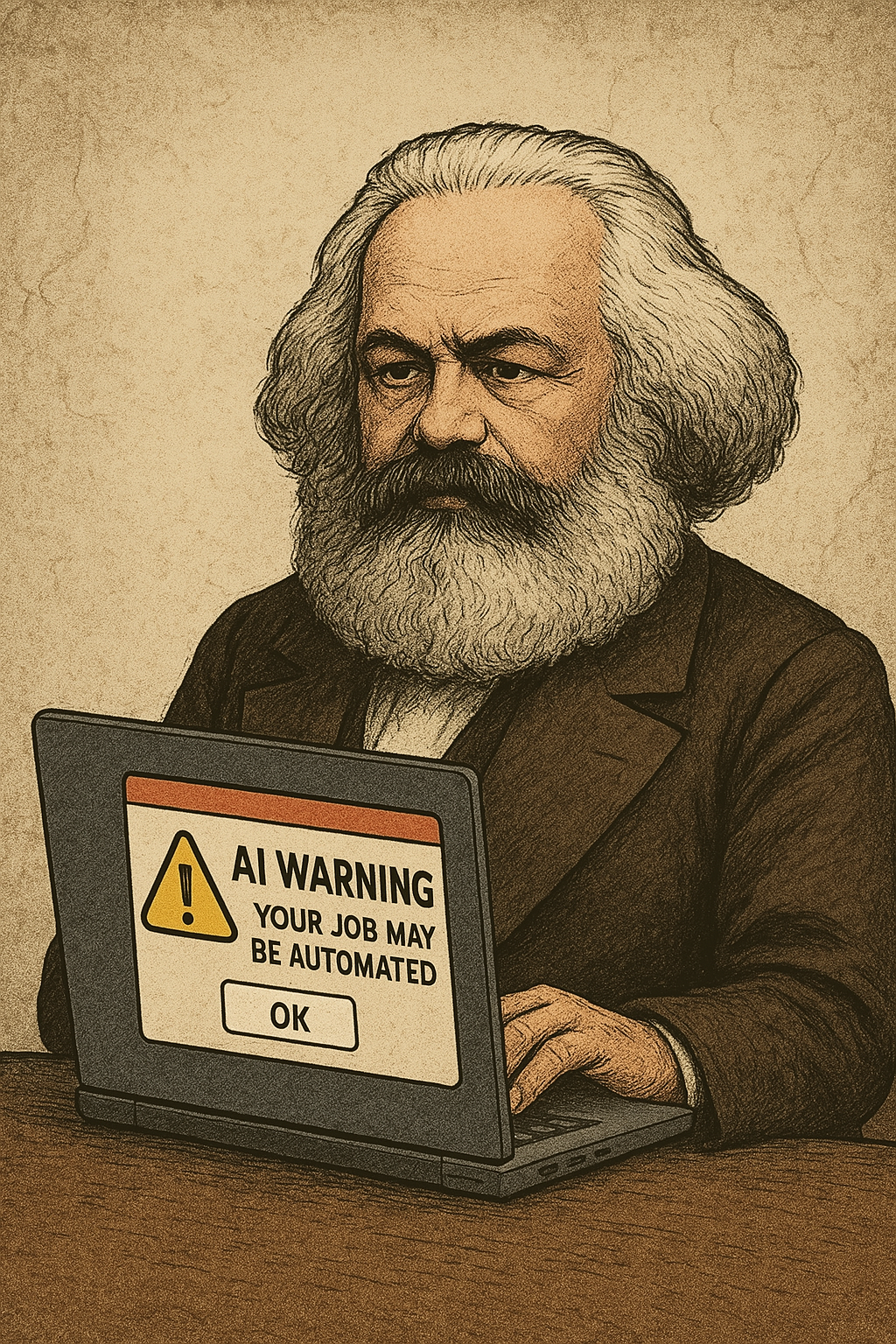
Will AI Destroy Capitalism? What Marx Predicted, and Why It Feels Relevant Today

Artificial intelligence is advancing so fast that some economists, technologists, and futurists believe we are heading toward a historic breaking point. Predictions range from 300 million jobs being automated to AI systems replacing everything from lawyers and teachers to software developers and journalists.

This raises a fundamental question:

If AI takes over most labor, where will people get money from, and can capitalism survive?

Interestingly, this debate echoes ideas written more than 150 years ago by Karl Marx, who warned that capitalism might ultimately be undermined by its own technological progress. Today, his predictions are being pulled back into the spotlight.

This article breaks down what Marx said, what AI is doing, and what the future of labor, and money, might look like.
1. What Marx Actually Predicted

Karl Marx believed capitalism had a built-in conflict:
the drive to replace human workers with machines.

He argued two key points:

A) The “Tendency of the Rate of Profit to Fall”

Marx said that profit comes from human labor.
But capitalists constantly try to replace human labor with machines because machines:

  • don’t get tired
  • don’t strike
  • don’t demand wages or rights

The more companies automate, the fewer workers they need.

But the paradox is:

If you replace too many workers, you remove the source of profit — human labor.

This, Marx believed, would eventually destabilize capitalism from within.

B) Automation makes workers “superfluous”

Marx predicted a future where technology becomes so advanced that:

  • masses of workers become unnecessary
  • unemployment grows
  • inequality rises
  • social tensions explode

For most of history, this sounded theoretical.
Today, with AI able to perform cognitive work, Marx suddenly feels more contemporary than ever.

2. The AI Shock: Why This Time Is Different

In the past, automation replaced muscle:

  • factory robots
  • tractors
  • machinery

Those technologies eliminated many physical jobs but created others.

AI replaces the brain:

  • analysts
  • accountants
  • teachers
  • programmers
  • designers
  • writers
  • marketers
  • customer support
  • even medical diagnosis

White-collar workers, once considered “safe”, are now at risk.

Reports from groups like Goldman Sachs estimate that 300–800 million jobs worldwide could be automated in the coming years.

For capitalism, this is enormous.
Capitalism is built on two pillars:

  1. Labor → creates value
  2. Wages → let people buy things

If AI replaces too much labor, wages disappear, and the system loses its customers.

This is what worries economists.

3. The Core Economic Problem: No Jobs = No Money = No Capitalism

Here’s the simple logic:

  • Companies automate work → fewer workers
  • Fewer workers → less income
  • Less income → less spending
  • Less spending → companies lose customers
  • Companies lose customers → profits fall
  • Profits fall → economic system breaks

Capitalism needs consumers.
Consumers need wages.
Wages come from labor.
Labor is disappearing.

This is the exact contradiction Marx warned about.

4. What Happens to Society if AI Wipes Out Jobs?

Three major scenarios are being discussed in global economic circles:

A) Capitalism survives but transforms

Governments introduce:

  • Universal Basic Income (UBI)
  • AI and robot taxes
  • redistribution policies
  • national “AI wealth funds”
  • profit-sharing models

This keeps consumers alive even without traditional jobs.

B) Extreme inequality + political instability

If nothing is done:

  • wealth concentrates into a few tech giants
  • middle class collapses
  • consumer markets shrink
  • social unrest rises
  • governments face pressure for reform or revolution

This is the scenario many analysts fear.

C) A transition to “post-capitalism”

This idea doesn’t mean communism. Instead, it means a system where:

  • machines produce most wealth
  • humans work less or not at all
  • value is redistributed through society
  • the wage-labor system becomes obsolete

Some predict a peaceful shift.
Others see a turbulent transition.

5. Will New Jobs Replace the Old Ones?

Historically, technological revolutions created more jobs than they destroyed.

But AI is different for three reasons:

  1. It automates thinking, not just physical effort
  2. New jobs may require skills most people don’t have
  3. AI learns faster than humans can retrain

For the first time, technology is competing with humans in creativity, reasoning, and decision-making.

This makes the future less predictable than any previous industrial revolution.

6. Will AI Destroy Capitalism?

There are three main schools of thought:

1) AI will reshape capitalism, not kill it

The system adapts by creating safety nets like UBI, or by shifting focus to new industries.

2) AI will create “hyper-capitalism”

A handful of mega-corporations control all the AI models and extract enormous profits, leading to an extreme concentration of power.

3) AI will push us beyond capitalism

If machines produce nearly all value, the traditional logic of:

work → wages → consumption

falls apart.

In that case, capitalism as we know it would need to evolve or be replaced.

7. The Short Answer

If AI eliminates hundreds of millions of jobs and nothing is done, capitalism collapses because consumers vanish.

If governments and companies adapt, we enter a new economic era. Perhaps capitalism 2.0.

Marx didn’t predict AI, but he did predict the danger of a system that depends on labor while simultaneously trying to eliminate it. That contradiction is now the central question of the coming decade.

In the end, nobody truly knows where this collision between AI, labor, and capitalism will lead. Some predict unprecedented prosperity, others foresee economic collapse, and many warn that the transition itself may be chaotic.

Even politicians in several countries have started telling people to “buckle up,” hinting that families should keep basic supplies like food and water on hand. Not because disaster is guaranteed, but because the pace of disruption is now faster than society’s ability to adapt.

One thing is sure: we are crossing a threshold into unknown territory, where the old rules may no longer apply. The question is not whether change is coming, but how prepared we are for the world on the other side.

Disclaimer: The views expressed in this article are those of the author and may not reflect those of Shinybull.com. The author has made every effort to ensure the accuracy of the information provided; however, neither Shinybull.com nor the author can guarantee the accuracy of this information. This article is strictly for informational purposes only. It is not a solicitation to make any exchange in precious metal products, commodities, securities, or other financial instruments. Shinybull.com and the author of this article do not accept culpability for losses and/ or damages arising from the use of this publication.
Leave a comment

Filed under Politics

Norway: A Wealthy Nation, But Are Its People Happy?

Norway is one of the richest countries in the world. By traditional measures, one might expect Norwegian citizens to be among the happiest people on Earth. However, if happiness were solely tied to wealth, Norway presents a paradox. Despite its prosperity, the country faces rising mental health issues, loneliness, and dissatisfaction among its people.

Wealth and Well-Being: A Growing Disconnect

The World Happiness Report (WHR), released annually, ranks countries based on factors such as social support, life expectancy, freedom, corruption levels, and generosity. While Norway often ranks high, recent trends reveal an alarming rise in loneliness, particularly among young adults. Despite economic stability, emotional well-being appears to be deteriorating.

The statistics are concerning. In 2023, Norway recorded 693 suicides, with men disproportionately affected. This equates to a rate of 14.1 per 100,000 people. These figures raise critical questions: Why is a nation so wealthy experiencing such emotional distress? And why does prosperity not translate into greater happiness?

Norway’s Oil Wealth: A Double-Edged Sword?

Norway manages the largest sovereign wealth fund in the world, fueled by its vast oil and gas reserves. In 2024, the fund reported a record-breaking $222 billion in profit, contributing to about 10% of the country’s GDP. Yet, this financial success has not resulted in a happier population.

One theory suggests that Norway’s highly structured welfare state and rigid societal expectations may, paradoxically, contribute to dissatisfaction. While economic security provides stability, it can also foster a sense of isolation, lack of purpose, and disengagement from community life. A country where everything is provided can, ironically, leave people feeling like they lack a deeper sense of meaning.

A Historical Perspective: The Emigration Paradox

This is not the first time Norwegians have sought to escape their homeland. In the late 1800s, one-third of Norway’s population emigrated, primarily to the United States. While economic hardship played a role, Norway’s standard of living was actually comparable to other European nations at the time. So why did so many leave?

For some, the motivation wasn’t purely financial. In 1825, the first group of Norwegian Quakers, led by Cleng Peerson, emigrated to escape religious restrictions under the Konventikkelplakaten, which prohibited them from gathering as a religious community.

Similarly, the followers of Marcus Thrane, an early advocate for democracy and labor rights, fled after Thrane was imprisoned for his political activism. This historical pattern suggests that when people feel constrained—whether economically, politically, or socially—they seek opportunities elsewhere.

The Billionaire Exodus: A Warning Sign?

Today, history is repeating itself—this time with Norway’s wealthiest individuals. Hundreds of billionaires are fleeing the country, many relocating to Switzerland to escape extreme taxation. Some face tax rates as high as 95%, leaving them little choice but to leave.

This is not a new phenomenon. Norway’s richest man, John Fredriksen, left the country for Cyprus long ago after what he described as harsh treatment by the government. Now, more of Norway’s wealthiest citizens are following suit, taking their businesses, investments, and economic influence with them.

What Happens When the Rich Leave?

The departure of billionaires and large businesses has serious consequences for ordinary people. When major employers leave, they take jobs and investments with them. With fewer high-net-worth individuals investing in Norway, economic opportunities shrink. If this trend continues, the country could face:

  • Increased unemployment due to reduced private-sector investment.
  • Lower tax revenues, putting pressure on the welfare state.
  • Slower economic growth, making it harder to maintain current levels of public spending.

Although Norway’s government boasts an enormous wealth fund, long-term economic stability depends on private sector growth—not just state-controlled wealth. If too many businesses and entrepreneurs leave, the ripple effects could be devastating for ordinary citizens.

Robert De Niro on Democracy: A Thought-Provoking Perspective

This discussion ties into a broader reflection on society and governance. Actor Robert De Niro recently urged people to move beyond viewing democracy as an abstract ideal. Instead, he emphasized the importance of core values:

  • Humanity
  • Kindness
  • Global safety
  • Security for our families

His message serves as a reminder that well-being is not dictated by politics or economic models alone—it is defined by how people treat each other. Societies thrive when they are built on meaningful human connection, shared values, and a collective sense of purpose.

Final Thoughts: More Than Just Money

Norway’s rising loneliness and mental health struggles suggest that economic success alone is not enough. The key to well-being lies in fostering community, purpose, and personal freedom. History has shown that when these elements are missing, people look for a way out—whether through emigration, disengagement, or despair.

Ultimately, the lesson is clear: happiness is about people, not profit. And if Norway wants to maintain its standing as one of the world’s leading nations, it must prioritize not just financial wealth, but the emotional and social well-being of its citizens.

Disclaimer: The views expressed in this article are those of the author and may not reflect those of Shinybull.com. The author has made every effort to ensure the accuracy of the information provided; however, neither Shinybull.com nor the author can guarantee such accuracy. This article is strictly for informational purposes only. It is not a solicitation to make any exchange in precious metal products, commodities, securities, or other financial instruments. Shinybull.com and the author of this article do not accept culpability for losses and/ or damages arising from the use of this publication.

Leave a comment

Filed under Politics

Inflation is as violent as a mugger, as frightening as an armed robber, and as deadly as a hit man

Inflation is serious stuff. It makes people`s money less valuable, and it means a lot of trouble for a lot of people. But I`m not shocked, because we knew it was coming someday. I wrote about nine years ago, and here we are.

Ronald Reagan was fighting against inflation in the ’80s, and he once said;

«Inflation is as violent as a mugger, as frightening as an armed robber, and as deadly as a hit man.»

Photo by Monstera on Pexels.com

I bet Chair Powell thinks the same, as he raised the federal fund’s rate by 75 bps to the 3% – 3,25% range during its September meeting. This is the third three-quarter point increase, pushing borrowing costs to the highest since 2008.

Policymakers also anticipate that ongoing increases in the target range will be appropriate which was reinforced by Chair Powell during the press conference.

«We have got to get inflation behind us. I wish there were a painless way to do that. There isn`t. The so-called dot plot showed interest rates will likely reach 4,4% by December, above 3,4% projected in June, and rise to 4,6% next year.

Meanwhile, GDP growth forecasts were revised lower to show a 0,2% expansion this year, compared to 1,7% seen in June and 1,2% in 2023, below 1,7% seen in June. Inflation as measured by PCE is seen to reach 5,4% in 2022 (5,2% projected in June) and 2,8% in 2023 (vs 2,6%).

They also expect the unemployment rate to raise up to 4,4% next year. In August this year, the unemployment rate rose to 3,7%, which is the highest since February and above market expectations of 3,5%.

The number of unemployed people increased by 344 thousand to 6,014 million, while employment levels went up by 442 thousand to 158,732 million. Meanwhile, the labor force participation rate rose to 62,4% in August from 62,1% in July.

The unemployment rate was about 4% right after the dot com bubble, but it rose to about 6% a few years later. In 2010, the unemployment rate rose to about 10% but it peaked at an all-time high of nearly 16% after all the lockdowns.

Banks in nearly every country (not China and Japan) are facing similar trade-offs as they raise rates to combat their own inflation problems.

The inflation rate in the US is 8,3%. In the UK it`s 9,9%. Euro Area; 9,1%. In China and Japan, the inflation rate is 2,5% and 3,0%. But this is nothing compared to Turkey where the inflation rate rose for the 15th consecutive month to 80,2% in August of 2022.

Disclaimer: The views expressed in this article are those of the author and may not reflect those of Shinybull.com. The author has made every effort to ensure the accuracy of the information provided; however, neither Shinybull.com nor the author can guarantee such accuracy. This article is strictly for informational purposes only. It is not a solicitation to make any exchange in precious metal products, commodities, securities, or other financial instruments. Shinybull.com and the author of this article do not accept culpability for losses and/ or damages arising from the use of this publication.

Leave a comment

Filed under Politics

The bear is here

This is a warning. 3810 is a very critical level at the S&P 500, and futures are down more than 2% today. We`re flirting with a support level of around 3,900, but the real panic can set in at around 34,000. What is that supposed to mean? It means that the S&P 500 will go down in a bear market. And that is a sign of stocks that are going down in value.

Since 1928 and the big stock market crash, the S&P 500 has plummeted into a bear market 26 times. A bear market is where the market is down more than 20% or more than that in a two-month period.

Not only that. A bear market can also be part of a recession where the economy has high unemployment and negative GDP output.

The average decline in a bear market was 35,6% since 1928, and the average length of time was 289 days.

Again; this is a very critical level.

Disclaimer: The views expressed in this article are those of the author and may not reflect those of Shinybull.com. The author has made every effort to ensure the accuracy of the information provided; however, neither Shinybull.com nor the author can guarantee such accuracy. This article is strictly for informational purposes only. It is not a solicitation to make any exchange in precious metal products, commodities, securities, or other financial instruments. Shinybull.com and the author of this article do not accept culpability for losses and/ or damages arising from the use of this publication.

Leave a comment

Filed under Stock market

Biden will discuss spending with top lawmakers this week

Trump cutted taxes and MSM said he was crazy. It is the republicans job to have as low taxes as possible. It is their policy. The same cannot be said about the democrats.The Biden administration will discuss spending with top lawmakers this week, and republicans think it sounds scary.

Biden wants to increase the taxes and that can have an impact on businesses and money makers. On top of that we also have inflation, which is also a hidden tax. Add higher interest rate on top of that. Bill Clinton did much of the same in the 90`s and as long as I can remember, it went well. But this time is probably different with covid-19 and lockdown.

Investors expected more than 1 million jobs in april, but only 266 thousand is what the Biden administration saw come in. They also expected unemployment rate at 5,8% but it jumped to 6,1% and all this was a big, big, big surprise to the market, and investors sent the market down on Monday.

Things have changed in the White House, and Maria asked Mr Mulvaney when was the last time the government gave $300 to people on a permanent basis. «If you pay people not to work, they are not going to work,» Mulvaney said.

To contact the author: post@shinybull.com

Disclaimer: The views expressed in this article are those of the author and may not reflect those of Shinybull.com. The author has made every effort to ensure the accuracy of the information provided; however, neither Shinybull.com nor the author can guarantee such accuracy. This article is strictly for informational purposes only. It is not a solicitation to make any exchange in precious metal products, commodities, securities, or other financial instruments. Shinybull.com and the author of this article do not accept culpability for losses and/ or damages arising from the use of this publication.

Leave a comment

Filed under Politics