
Tag Archives: Google

Who is Sergey Brin?

Sergey Mikhaylovich Brin is an American business magnate and computer scientist who, with Larry Page co-founded Google, which is one of the most profitable Internet companies. As of June 2014, his personal wealth was estimated to be $30 billion, and together, Brin and Page own about 16 percent of Google.

sergeybrin

(Picture: Sergey Brin, Google Inc)


Brin was born in Moscow in the Soviet Union to Russian Jewish parents, Michael Brin and Eugenia Brin, both graduates of Moscow State University. His father is a mathematics professor at the University of Maryland, and his mother a researcher at NASA`s Goddard Space Flight Center.

The economist newspaper referred to Brin as an «Enlightenment Man», and someone who belive that «knowledge is always good, and certainly always better than ignorance», a philosophy that is summed up by Google`s motto «Organize the world`s information and make it universally accessible and usesful» and «Don`t be evil».

When Brin was 6 years (1976) old, his family felt compelled to emigrate to the United States. Sergey`s father has earlier told that he was «forced to abandon his dream of becoming an astronomer even before he reached college».

He claims Communist Party heads barred Jews from upper professional ranks by denying them entry to universities, as Jews excluded from the physics departments in particular. Michael Brin therefore changed his major to mathematics where he received nearly straight A`s.

He said; «Nobody would even consider me for graduate school because I was Jewish. At Moscow State University, Brin said, Jews were required to take their entrance exams in different rooms from non-Jewish applicants and they were marked on a harsher scale.

In 1977, after his father returned from a mathematics conference in Warsaw, Poland, he announced that it was tome for the family to emigrate. «We cannot stay here anymore», he told his wife and mother. At the conference, he was able to «mingle freely with colleagues from the United States, France, England and Germany and discovered that his intellectual brethren in the West were not «monsters». He said; «I was the only one in the family who decided it was really important to leave».

Sergey`s mother was less willing to leave their home in Moscow, where they had spent their entire lives, but the decision ultimately came down to Sergey. In May 1979, they were granted their official exit visas and were allowed to leave the country. «I know the hard times that my parents went through their and am very thankful that I was brought to the States», Sergey said in an interview in October 2000.

A few weeks before Sergey`s 17th birthday (1990), his father led a group og high school math students, including Sergey, on a two-week exchange program to the Soviet Union. As Brin recalls, the trip awakened his childhood fear of authority and he remembered that «his first impulse on confronting Soviet oppression had been to throw pebbles at a police car».

On the second day of the trip, while the group toured a sanatorium in the countryside near Moscow, Brin took his father aside, looked him in the eye and said; «Thank you for taking us all out of Russia.»

Brin attended grade school at Paint Branch Montessori School in Adelphi, Maryland, but he received further education at home; his father, a professor in the department of mathematics at the University of Maryland, encouraged him to learn mathematics.

He attended Eleanor Roosevelt High School in Greenbelt, Maryland. In 1990, Brin enrolled in the University of Maryland to study computer science and mathematics, where he received his Bachelor of science in May 1993 with honors.

Brin began his graduate study in computer science at Stanford University on a graduate fellowship from the National Science Foundation. In 1993, he interned at Wolfram Research, who were the developers of Mathematica. As of 2008, he is on leave from his PhD studies at Stanford.

He met Larry Page at Stanford. Brin jokingly said; «We`re both kind of obnoxious». They seemed to disagree on most subjects, but after spending time together, they became intellectual soul-mates and close friends. Together, the pair authored a paper titled «The Anatomy of a Large-Scale Hypertextual Web Search Engine».

They both realized they had succeeded in creating a superior engine for searching the web and suspended their PhD studies to work more on their system. Mark Malseed, the co-founder of «The Google story», wrote; «Soliciting funds from faculty members, family and friends, Brin and Page scraped together enough to buy some servers and rent that famous garage in Menlo Park.

Sun Microsystems co-founder Andy Bechtolsheim wrote a $100,000 check to Google Inc, but the problem was that Google Inc did not yet exist. The company hadn`t yet been incorporated. For two weeks, as they handled the paperwork, the young men had nowhere to deposit the money.

Google logo

The Economist magazine describes Brin`s approach to life, like Page`s, as based on a vision summed up by Google`s motto; «of making all the world`s information universally accessible and useful».

Others have compared their vision to the impact of Johannes Gutenberg, the inventor of modern printing:

In 1440, Johannes Gutenberg introduced Europe to the mechanical printing press, printing Bibles for mass consumption. The technology allowed for books and manuscripts – originally replicated by hand – to be printed at a much faster rate, thus spreading knowledge and helping to usher in the European Renaissance. Google has done a similar job.

The authors of «The Google Story» wrote; «Not since Gutenberg…has any new invention empowered individuals, and transformed access to information, as profoundly as Google. Also not long after the two «cooked up their new engine for web searches, they began thinking about information that is today beyond the web», such as digitizing books, and expanding health information.

Sergey Brin married biotech analyst and entrepreneur Anne Wojcicki in the Bahamas in May 2007. She has an active interest in health information, and they have brainstormed with leading researchers about the human genome project. Brin instinctively regards genetics as a database and computing problem. So does his wife, who co-founded the firm, http://www.23andme.com, which lets people analyze and compare their own genetic makeup (consisting of 23 pairs of chromosomes).

Together they have a son, born in December 2008, and a daughter, born in late 2011. In August 2013, it was announced Brin and Anne were living separately. Brin`s mother, Eugenia, has been diagnosed with Parkinson`s disease.

Brin used the services of 23andme and discovered that although Parkinson`s is generally not hereditary, both he and his mother possess a mutation of the LRRK2 gene (G2019S) that puts the likelihood of him developing Parkinson`s in later years between 20 and 80 percent.

An editorial in The Economist magazine states that «Mr Brin regards his mutation of LRRK2 as a bug in his personal code, and thus as no different from the bugs in computer code that Google`s engineers fix every day. By helping himself, he can therefore help others as well. He consider himself lucky, but Mr. Brin was making a much bigger point. Isn`t knowledge always good, and certainly always better than ignorance?

Sergey Brin is an investor in Tesla Motors, which has developed the Tesla Roadster, a 244-mile (393 km) range battery electric vehicle as well as the Tesla Model S, a 265-mile (426 km) range battery electric vehicle.

In 2008, he invested $4,5 million in Space Adventures, the Virginia-based space tourism company. Space Adventures, the only company that sends tourists to space, has sent five of the so far. He and Page are also trying to help solve the world`s energy and climate problems at Google philanthropic arm Google.org, which invests in the alternative energy industry to find wider sources of renewable energy.

Brin was also involved in the Google driverless car project, and in September 2012, at the signing of the California Driverless Vehicle Bill, Brin predicted that within five years, robotic cars will be available to the general public. Wow, we will wait for that car. What a great story!

Disclaimer: The views expressed in this article are those of the author and may not reflect those of Shiny bull. The author has made every effort to ensure accuracy of information provided; however, neither Shiny bull nor the author can guarantee such accuracy. This article is strictly for informational purposes only. It is not a solicitation to make any exchange in precious metal products, commodities, securities or other financial instruments. Shiny bull and the author of this article do not accept culpability for losses and/ or damages arising from the use of this publication.


Leave a comment

Filed under Uncategorized

What is a stock split?


You probably know that Google had a stock split a while ago, and now, Apple is headed for the same on June 9. But what is a stock split and is it good or bad for the stockholders? Let`s take a closer look at a stock split and what it is.


A stock split is a corporate action in which a company divides its existing shares into multiple shares. The number of shares outstanding increases by a specific multiple, the total dollar value of the shares remains the same compared to pre-split amounts, because the split did not add any real value.
Apple

The most common split ratio is 2-for-1. This is called «forward stock split», which means that the stockholder will have two shares for every share held earlier. Apple have a 7-for-1 split, but there are number of «groups» impacted by the split.


Let`s take an example: Company A has 10 million shares outstanding and the stock price is $100. The Company A`s market cap is $1 billion. But the board of directors want to split the stock 2-for-1. The new number of stocks will double to 20 million, but the market cap is still $1 billion, as the stock price drops down to $50. Market cap is unchanged.


So, what is the point of doing that? They might have other things to do. Well, first of all, a split is usually undertaken when the stock price is quite high, making it pricey for investors to acquire a standard board lot of 100 shares.


If Company A`s price per share was $100 each, you would need to pay $10,000 to own 100 shares. If the share price was only half of that ($50), then you need to pay $5,000 for 100 shares. Second, the more shares a company have, the greater the liquidity for the stock, which facilitates trading and may narrow the bid-ask spread.


As you can see, the market cap is unchanged, but a split can often results in renewed investor interest, and that can have a positive impact on the stock price. Stock splits in blue chips companies like for example Apple and Google are a great way for the average investor to accumulate an increasing number of shares.


Many of the best companies routinely exceed the price level at which they had previously split their stock, causing them to undergo a stock split yet again. I have been following Amazon.com since its start in late 90`s.


I see three splits in the Amazon.com stock split history database. The first split for Amazon took place on June 02, 1998. This was a classical 2-for-1 split. It means for each share of Amazon owned presplit, you now owned 2 shares. For example; a 1000 share position pre-split, became a 2000 position following the split.


The second Amazon split took place on January 05, 1999. This was a 3-for-1 split. For each share of Amazon owned pre-split, you now owned 3 shares. For example; a 2000 share position pre-split, became a 6000 position following the split.


The third split took place on September 02, 1999. This was a classical 2-for-1 split, meaning for each share of Amazon owned pre-split, you now owned 2 shares. For example; a 6000 share position pre-split, became a 12000 position following the split. I remember all the splits very good.


It was exiting and it was in the beginning of a new era in the tech stock history. Keep in mind that when they split the stocks, the market cap is the same, but the number of stocks is changed, which means you own more shares, but the shares are valued at a lower price per share. Very often, we that a lower price for a stock can attract a wider range of buyers. And here is the interesting thing; when the stock price goes down, the demand for the stock is increasing. This means of course that the market cap will rise which is good for the company.


As always in the stock market; you can`t only look at only one metrics. You have to look at the underlying fundamentals of the business. Looking at the history of Amazon, an original position size of 1000 shares would have turned into 12000 shares today.


Google made its split because they want more control over the company and shares. You have different share classes in Google, and all of them have different prices. You can see Google, Google A and Google C when you search for the stock.


Many investors are wondering if Apple`s split will mark a peak in its shares as both Google and MasterCard declined after its two share classes split. You can`t compare Apple`s split to Google`s split, because of its different share classes, as one of which had no voting rights, so each class really became its own separate trading vehicle.


Right after the split in Google, the shares declined, but that was because of a poor earnings report and not because of the A class shares in Google. I just wonder if Apple will move into the Dow after this split?


Apple has three splits in the Apple stock split history. The first one took place on June 16, 1987. This was a 2-for-1 split. The second split took place on June 21, 2000. Also a 2-for-1 split, and the second split took place in February 28, 2005, with a 2-for-1 split. Apple`s 7-for-1 split is approaching and will take place on June 9, 2014.


Other key dates:


The record date: June 2, 2014 – determines which shareholders are entitled to receive additional shares due to the split.


The split date: June 6, 2014 – shareholders are due split shares after the close of business on this date.


The Ex date: June 9, 2014 – the date determined by Nasdaq when Apple common shares will trade at the new split-adjusted price.


This split means that six additional shares of stock are issued for each share in existence on the Record date, June 2, 2014. The number of shares outstanding will be multiplied by seven and earnings per share will be divided by seven.


Reports today:


08:30 a.m EST Core Durable Goods Orders m/m

08:30 a.m EST Durable Goods Orders m/m

09:00 a.m EST S&P/CS Composite-20 HPI y/y

09:00 a.m EST HPI m/m

09:30 a.m EST ECB President Draghi Speaks

10:00 a.m EST CB Consumer Confidence


Disclaimer: The views expressed in this article are those of the author and may not reflect those of Shiny bull. The author has made every effort to ensure accuracy of information provided; however, neither Shiny bull nor the author can guarantee such accuracy. This article is strictly for informational purposes only. It is not a solicitation to make any exchange in precious metal products, commodities, securities or other financial instruments. Shiny bull and the author of this article do not accept culpability for losses and/ or damages arising from the use of this publication.


Leave a comment

Filed under Stock market, Stocks

Alibaba IPO


I wrote about the company last year and now it is time to do it again. Alibaba Group Holding Ltd is a big fish which is preparing to launch perhaps the largest U.S stock listing ever of a Chinese company.

alibaba logo

Personally, I have been dealing with Alibaba for many years now, but most of the people don`t have a clue of what it is. Alibaba is a mix of Amazon, Ebay, Paypal and Google. The difference between Amazon and Alibaba is that Alibaba is connecting buyers and sellers, while Amazon buy from suppliers and sell the products to the customers.

Alibaba is more like Ebay Inc. Their role is more like a middleman role and does not operate like an auction. Taobao is Alibaba`s biggest website. It is a gigantic Chinese bazar with about 760 million product listings from 7 million sellers.

Merchants pay Alibaba for advertising and other services from Alibaba. They do not pay them to sell their own products. The no-fee model is part of Taobao`s appeal in China. Just like Google, the ads from merchants appear with Taobao`s product-search results.

Taobao is designed for small businesses, but Alibaba`s Tmall is another shopping site that is designed for bigger brands like Nike and Apple. Tmall has about 70.000 merchants. They charges each seller a deposit and an annual fee, as well as a commission on each transaction.

Taobao and Tmall accounts for more than half of all parcel deliveries in China. In 2012, the combined transaction volume of Taobao and Tmall topped $163 billion. That is more than Amazon and eBay combined!

Alibaba`s revenue is 1/10 of Amazon`s. The Chinese company doesn`t sell products like Amazon on its site. Alibaba`s revenue rose 51% (third quarter) to $1,78 billion, while Amazon posted revenue of $17,09 billion and a loss of $41 million in the same quarter.

Alibaba`s profit margin is 44,6% and net profit was $792 million. They could raise about $15 billion from their U.S IPO. This can move another stock; Yahoo, which own a stake of 24% in Alibaba.

It can move Yahoo before and after the IPO. Like the Facebook IPO, they may «suck the air» of the markets. Yahoo has a market cap of $36 billion. It`s early in the process, but it is estimated that the IPO range is about $160 billion.

Alibaba remains by far the biggest player in China`s fast growing e-commerce market. Their biggest competitor Tenchent Holdings Ltd is a powerful competitor because of their popular WeChat mobile-messaging application.

Going public will keep Alibaba in the race in the global market. Yahoo is down -2,0% today and -11,2% YTD. This can change because Yahoo is a takeover candidate. This is one of the pioneers of the web.

Yahoo is a great success story of the Net. The stock has returned 21% annually since early trading in 1996. The company have survived two bear markets to date, and was one of the tech companies in the tech bubble in the late 1990`s.

Report today:

08:30 AM ET Core Durable Goods Orders m/m
08:30 AM ET Durable Goods Orders m/m
09:45 AM ET Flash Services PMI
10:30 AM ET Crude Oil Inventories

Disclaimer: The views expressed in this article are those of the author and may not reflect those of Shiny bull. The author has made every effort to ensure accuracy of information provided; however, neither Shiny bull nor the author can guarantee such accuracy. This article is strictly for informational purposes only. It is not a solicitation to make any exchange in precious metal products, commodities, securities or other financial instruments. Shiny bull and the author of this article do not accept culpability for losses and/ or damages arising from the use of this publication.


Leave a comment

Filed under Stocks

M&A (merger and acquisition)

As I wrote about earlier, you must look for small cap stocks in the Russell 2000 now. It is risky, but high risk means high gain, and you have to spend money you can afford to lose. So why small cap stocks?

You see, America is for sale and that is for the highest bidder. What I am talking about is really good companies out there. The companies that no one is talking about. The cheap one. The innovative one.

There is a lot of money out there waiting for good investments. Many of the great companies are searching for the right small cap stocks. Why? They simply want to thrive by purchasing growth.

Take a look at Google. For example, they expanded and bought Youtube.com. Everyone is afraid of Google. They are a great example of a model for what a media company needs to be in order to be competitive in the future.

Cisco was smart enough to buy companies with great talents instead of developing them themselves. Cisco have done this over 140 times since 1993. They are infusing new ideas and new ways of thinking by doing it like this. It makes them strong and competitive. Google seems to do exactly the same thing and that makes them stay ahead of a rapidly changing competitive landscape on internet.

The really biggest day in e-commerce in history is Cyber Monday. $10 billion was spent from about 70 million online shoppers. That`s an increase of 18%. 30% of the purchases came from a mobile device. 80% of those came from an Iphone or iPad. unbelievable!

And here is the catch: Social sites generated only around 1% of the e-commerce sales on that day. An increase of only 2%. So, E-commerce is the real big thing. It`s business. 17% of the sales came from Email. That`s pretty nice.

Facebook, Twitter, Instagram and Pinterest are popular sites and people still think that social media is a marketing must. The numbers are falling and the money is not in here. Social media is better for branding, networking and community building, but direct sales is better other ways than social media. Will we see any M&A in this sector in 2014? Are those big ones looking for small caps?

This is a tremendous investment opportunity and you as an aggressive investor need to play on it. But how? I expect next year to be a takeover boom! You have probably seen it before and know that nothing jolts a stock higher than an unsolicited takeover offer. The stock prices skyrocket on rumors like that.

Who say no to a single-day return of 50% or more? I have many new and exciting companies on the radar, but I can`t tell you what stocks it is. It is a lot of research behind the work of finding the best stocks, so this is what I get paid for.

But I can tell what sectors you should look for. It is technology and healthcare. I expect a lot of action in those sectors next year. I really look forward to 2014. It`s gonna be a funny year. So, I am still bullish!

News today: PPI m/m at 8.30am.

mergers-acquisitions-2-300x286

Disclaimer: The views expressed in this article are those of the author and may not reflect those of Shiny bull. The author has made every effort to ensure accuracy of information provided; however, neither Shiny bull nor the author can guarantee such accuracy. This article is strictly for informational purposes only. It is not a solicitation to make any exchange in precious metal products, commodities, securities or other financial instruments. Shiny bull and the author of this article do not accept culpability for losses and/ or damages arising from the use of this publication.

Leave a comment

Filed under Stock market, Stocks

Hi Tech Earnings

VIX have plummeted, and are now trading at 13,04. It simply tells us that there is no fear out there. Indices are setting new ATH, but Dow seems to be a little bit calm. Asian markets are up today. Nikkei rose to a three-week high and added 0,9% to 14,693,57. The highest since Sept. 27. The Topix advanced 0,6% to 1,212,36.

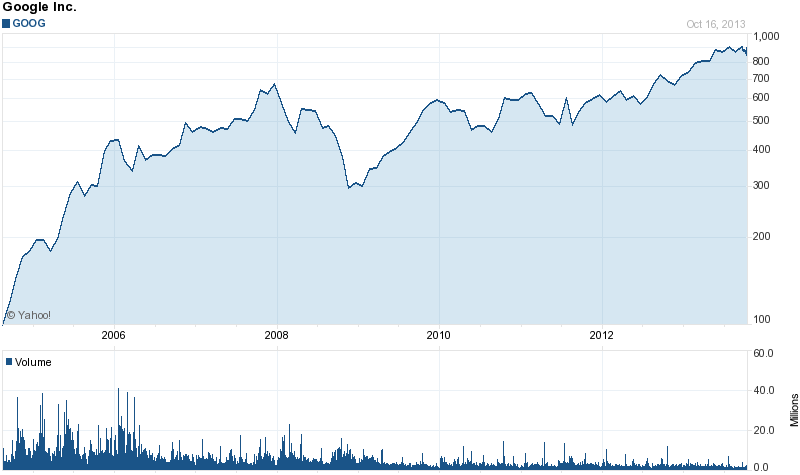
Google is for the fist time above 1000 dollars. Shares gained 13,8% and ended the trading session at $1011,41. Google`s earnings rised the S&P technology sector to outperform all other sectors. It rose 1,8%. Now it is time for Netflix and Apple. I look forward to see their earnings. This is money machines and they should beat the numbers, and that will make the momentum to continue this week.

U.S debt is now $17.075 trillion. That`s a lot of money, but I`m glad we can focus on the earnings now and not the debt. 62,2% of the 98 companies that have reportet earnings so far on S&P 500 have topped Wall Street`s earnings expectations. I look forward to the earnings this week.

5,57 billion shares was traded on friday and that is slightly above the average. Gold is back above the support level at $1300. If gold is not the safe heaven, VIX should be the new one. Right now VIX is closed at 13,04. News today: Existing Home Sales at 10:00am.

Apple

Disclaimer: The views expressed in this article are those of the author and may not reflect those of Shiny bull. The author has made every effort to ensure accuracy of information provided; however, neither Shiny bull nor the author can guarantee such accuracy. This article is strictly for informational purposes only. It is not a solicitation to make any exchange in precious metal products, commodities, securities or other financial instruments. Shiny bull and the author of this article do not accept culpability for losses and/ or damages arising from the use of this publication.

Leave a comment

Filed under Stock market