This is a historic moment, but should not be a surprise for someone, because Thatcher and May did the same. They all survived a confidence vote, but only for a short period of time. And now, Prime Minister Boris Johnson is doing it. To resign. A series of ethical scandals forced PM Boris Johnson to step down. Even his most stalwart supporters abandoned him.
Margaret Thatcher resigned in 1990. Tony Blair stepped down in 2007. David Cameron in 2016, and Theresa May in 2019, and they`re all part of intense political drama. Theresa May was tearful as she expressed her gratitude for being able to serve the UK she loved.
In December 2019, Boris Johnson won a landslide victory on the promise of delivering a Brexit deal and leading the UK to a bright future outside the European Union. But Brexit and Covid-19 made it very difficult for Johnson and the UK.
Johnson described the job as a PM as the best job in the world, and he wanted to continue. But after nearly 60 members of his government stepped down, he was forced to do the same.
He had a speech in front of the famous 10 Downing Street door on Thursday and said that he would be stepping down. Just like his predecessors Thatcher and May when they delivered their own resignation addresses.
«It is clear now the will of the parliamentary Conservative Party that there should be a new leader of that party and therefore, a new prime minister,» Boris Johnson said.
His opponents said it was good news for Great Britain that Johnson decided to resign. They also believe that it should have happened long ago.
He was responsible for lies, scandals, and fraud on an industrial scale, Stamer said on Twitter.
Former British Prime Minister John Major said it would be «unwise and may be unsustainable» for Johnson to remain in the office of prime minister for long while a new Conservative leader is chosen. He too suggested Raab could serve as the acting prime minister.
The last thing PM Boris Johnson said in his speech on Thursday was that «the future together is golden».
Disclaimer: The views expressed in this article are those of the author and may not reflect those of Shinybull.com. The author has made every effort to ensure the accuracy of the information provided; however, neither Shinybull.com nor the author can guarantee such accuracy. This article is strictly for informational purposes only. It is not a solicitation to make any exchange in precious metal products, commodities, securities, or other financial instruments. Shinybull.com and the author of this article do not accept culpability for losses and/ or damages arising from the use of this publication.
Vladimir Putin is doing exactly what Boris Johnson and Joe Biden are doing; «Building back better.» Putin is working very hard to fix all the problems that the communist Bolsheviks made during their revolution: October Revolution.
The Russian Revolution was a period of political and social revolution that took place in the former Russian Empire which began during World War I. The Bolsheviks killed the Royal family Romanov that has ruled Russia for 302 years.
This period saw Russia abolish its monarchy and adopt a socialist form of government following two successive revolutions and bloody civil war. This socialist revolution ended the Russian monarchy and Tsar Nicholas II abdicated and stepped down, ushering in a new government led by the Russian Duma (parliament) which became the Russian Provisional Government. This government was dominated by the interests of prominent capitalists, as well as the Russian nobility and aristocracy.
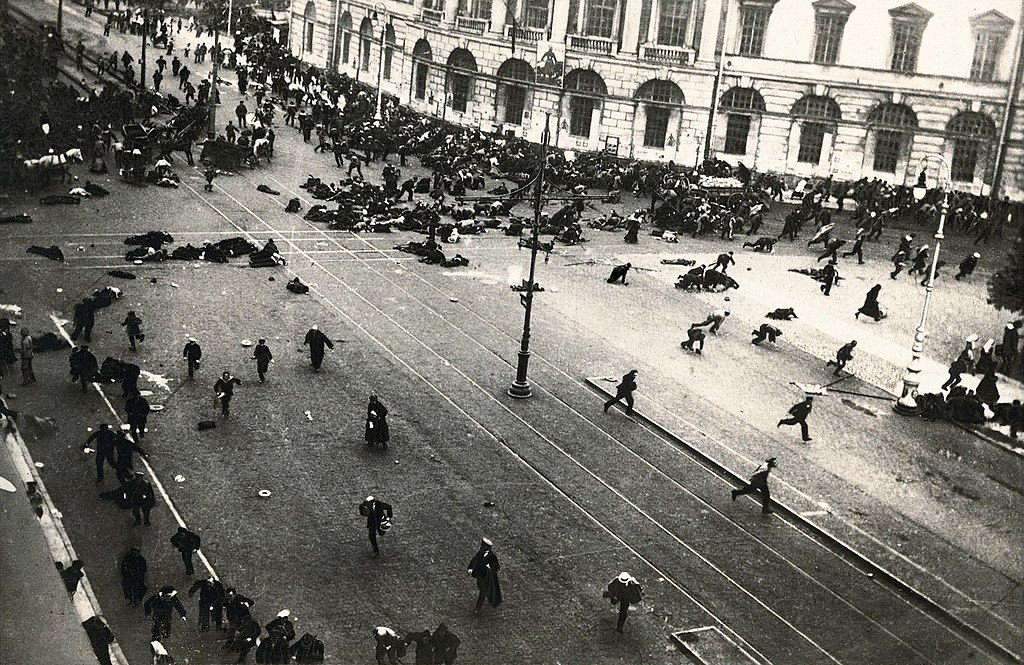
People were killed by The Provisional Government, with the support of Socialist-Revolutionary Party-Menshevik leaders of the All-Russian Executive Committee of the Soviets, in Petrograd in a peaceful demonstration.
During this chaotic period, there were frequent mutinies, protests, and strikes. Many socialist and other leftist political organizations were engaged in daily struggle and vied for influence within the Provisional Government and the Soviets.
One such faction was the Bolsheviks («Ones of the Majority») led by Vladimir Lenin. The Bolsheviks gained support by campaigning on a slogan of peace, land, and bread which promised to cease war with Germany, give land to the peasantry, and end the famine caused by Russia`s involvement in WWI. These slogans had a direct effect on the growing Bolshevik popularity.
Under pressure from German military offensives, the Bolsheviks soon relocated the national capital to Moscow. The Bolsheviks had secured a strong base of support within the Soviets and, as the supreme governing party, established their own government, the Russian Soviet Federative Socialist Republic (RSFSR).
The RSFSR began the process of reorganizing the former empire into the world`s first socialist state, to practice soviet democracy on a national and international scale.
The Great October Socialist Revolution under the Soviet Union, also known as the Bolshevik Revolution (1917 – 1923), almost destroyed Russia as we know it today. This is why Putin is working hard to restore what the Bolsheviks destroyed.
This is where the problems in Ukraine and Crimea start. it`s also called the Soviet-Ukrainian War, or Ukrainian Civil War, which is the term commonly used in post-Soviet Ukraine for the events taking place between 1917 – 1921, nowadays regarded essentially as a war between the Ukrainian People`s Republic and the Bolsheviks. The war ensued soon after the October Revolution when Lenin dispatched Antonov`s expeditionary group to Ukraine and Southern Russia.
Soviet historical tradition viewed it as an occupation of Ukraine by military forces of Western and Central Europe, including the Polish Republic`s military, the Bolshevik victory constituting Ukraine`s liberation from these forces.
Conversely, modern Ukrainian historians consider it a failed war of independence by the Ukrainian People`s Republic against the Bolsheviks.
In Soviet historiography and terminology, the armed conflict is depicted as part of the greater Russian Civil War in Ukraine, this war was fought between the national government and the Bolshevik government (led by Lenin).
The war may be divided into three phases:
December 1917 – April 1918: Revolutionary days, Bolshevik uprisings, invasion of the Red Guards formations, signing of protectorate treaty, and liberation from bolsheviks.
December 1918 – December 1919: Civil war in Ukraine, invasion of the Red Army, unification of Ukraine, anti-Soviet peasant uprisings, Denikin’s Volunteer Army and the Allied intervention, loss of West Ukraine to Poland.
Spring 1920 – Autumn 1921: Polish-Soviet War (Treaty of Warsaw), Russian Civil War (between Bolsheviks armies and the armed Forces of South Russia), Ukrainian guerrilla operations (First and Second Winter Campaigns), government in exile.
In October 1917 the government of Ukraine denounced the Bolshevis’ armed revolt and declared it would decisively fight against any attempted coup in Ukraine. The Kyiv Military District command tried to prevent a Bolshevik coup, leading to street fights and eventually surrendering of pro-Bolshevik troops in the city.
On November 20, 1917, the Rada declared Ukraine the Ukrainian People`s Republic as an autonomous part of the Russian Republic and scheduled on January 9, 1918, elections to a Ukrainian Constituent Assembly.
The Russo-Ukrainian War is an ongoing war primarily involving Russia, Belarus, and pro-Russian forces on one side, and Ukraine on the other. The war we see today isn`t a new one. It has been going on since February 2014 in the wake of the Revolution of Dignity and focused on the status of Crimea and parts of the Donbas, which are internationally recognized as part of Ukraine.
Nikita Khruschev gave Crimea to Ukraine for free in 1954. That transfer was illegal under Soviet law and violated both the Constitution of the Soviet Union and the Constitution of the Russian Soviet Federative Socialist Republic. This is how Putin and Russia now are building back better.
They want to have Crimea and Ukraine back again because it has been a part of Russia. How legitimate is it that Crimea is given to Ukraine by a drunken Nikita Khruschev? It is also given to Ukraine that is also stolen during the Bolshevik revolution in 1917. The communists have done so damage to Russia, and Putin is trying to fix it. By diplomatic solutions or by war and bombs.
In a speech live on TV, on 24 February, Putin said; «The goal is to protect people who have been subjected to bullying and genocide by the Kyiv regime for eight years. And for this, we will strive for the demilitarisation and denazification of Ukraine, as well as bringing to justice those who committed numerous, bloody crimes against civilians, including citizens of the Russian Federation.»
Volodymyr Zelenskyy is the first Jewish President of Ukraine. He is a former actor and comedian. Another puppet on the scene with a lot of neo-Nazis hiding behind the scenes. A trick to make people blindsided.
Zelenskyy is a populist. He has also positioned himself as an anti-establishment, and anti-corruption figure. He became a President in 2019, promised to end Ukraine`s protracted conflict with Russia as part of his presidential campaign, and attempted to engage in dialogue with Russian President Vladimir Putin.
The US government has alluded to intelligence indicating that the Kremlin is preparing lists of Ukrainians to be killed or put in camps. The alleged lists include journalists.
So, what Putin is talking about is what NATO and the West don`t want to talk about; Azov Battalion, which is a group of a neo-Nazi unit of the National Guard of Ukraine. Azov initially formed as a volunteer militia on 5 May 2014 during the Odessa clashes. On 12 November 2014, Azov was incorporated into the National Guard of Ukraine, and since then all members are contract soldiers serving in the National Guard of Ukraine.
According to The Daily Telegraph, the Azov Battalion`s extremist politics and professional English social media pages have attracted foreign fighters, including people from Brazil, Italy, the United Kingdom, France, the United States, Greece, Scandinavia, Spain, Slovakia, Czech Republic, and Russia.
About 50 Russian nationals are members of the Azov regiment. The group has used Facebook to recruit far-right individuals from other countries within Europe. In 2019, under Facebook`s Dangerous Individuals and Organizations policy, support for the group was not allowed, although this was temporarily relaxed during the 2022 Russian invasion of Ukraine.
Reports published by the Office of the United Nations High Commissioner for Human Rights (OHCHR) have connected the Azov Battalion to war crimes such as mass looting, unlawful detention, and torture.
An OHCHR report from March 2016 stated that the organization had «collected detailed information about the conduct of hostilities by Ukrainian armed forces and the Azov regiment in and around Shyrockyne from the summer of 2014 to date.
Mass looting of civilians’ homes was documented, as well as targeting of civilian areas between September 2014 and February 2015.
MSM doesn`t talk about this. What they talk about is people supporting Ukraine and that some people are moving to Ukraine to join the Nazi forces. We also see that many countries like Germany are supporting Ukraine with weapons.
This war is also a war against the European globalists.
The U.K is out of the EU with a Brexit slam dunk, and PM Boris Johnson is building back better. Biden is also building back better, but what happens if the U.S is pulling out as a leader from the West? If so, and Europe is building its own weapon arsenal, then this world will become even more dangerous, and Europe will be changed forever.
Disclaimer: The views expressed in this article are those of the author and may not reflect those of Shinybull.com. The author has made every effort to ensure the accuracy of the information provided; however, neither Shinybull.com nor the author can guarantee such accuracy. This article is strictly for informational purposes only. It is not a solicitation to make any exchange in precious metal products, commodities, securities, or other financial instruments. Shinybull.com and the author of this article do not accept culpability for losses and/ or damages arising from the use of this publication.
The tension in the South China Sea is very high, and the main reason for that is the CCP. They claim it`s their territory. China`s claim to the sea is based both on the law of the Sea Convention and its so-called «nine-dash» line.
This line extends for 2,000 kilometers from the Chinese mainland, encompassing over half of the sea. This consept is important: it means that by definition, the South China Sea is a shared maritime space.
But why is South China Sea so dangerous? The area is poorly charted, making it exceptionally dangerous to navigate. The major Singapore-to-Hong-Kong routes go well to the west and east of the area, and this is one of the reasons why the South China Sea is so important for the U.S, but also for the Global UK.
The Carrier Strike Group 2021 is a potent demonstration of the UK’s formidable naval and air power, and the physical embodiment of the UK’s ambitions on the global stage.
Maintaining freedom of navigation is a fundamental interest of the U.S. Unhindered navigation by all ships and aircraft in the South China Sea is essential for the peace and prosperity of the entire Asia-Pasific region, including the United States.
Since the two-day clash of arms between China and the former Republic of Vietnam (South) in January 1974, the Paracels have been firmly in Chinese control, while the Philippines, Taiwan, and Vietnam are each holding a part of the Spratlies.
This is a dangerous global conflict, and China`s sweeping claims of soverignty over the sea, and the sea`s estimated 11 billion barrels of untapped oil and 190 trillion cubic feet of natural gas, have antogonized competing claimants Brunei, Indonesia, Malaysia, the Philippines, Taiwan and Vietnam.
Philippine President Rodrigo Duterte is warning; if the the South China Sea dispute with China escalates, «it will be bloody.»
President Duterte has said he is prepared to send military ships to «stake a claim» over oil and mineral resources in the South China Sea, while noting that challenging Beijing in the disputed waters will only lead to violence.
«If we go there to assert our jurisdiction, it will be bloody,» Duterte said in a televised briefing, his first remarks after hundreds of Chinese vessels were spotted at a disputed reef in March.
Not only the U.S marines are one the way to the South China Sea. So are Britain, with a huge naval force. The war-drums is also a wake-up call for Australia.
The largest naval flotilla assembled by Britain in recent years will set sail in May on a months long voyage through tha Pacific, the country`s Defence Ministry said.
«When our Carrier Strike Group (CSG) sets sail next month, it will be flying the flag for Global Britain, projecting our influence, signaling our power, engaging with our friends and reaffirming our commitment to addressing the security challenges of today and tomorrow,» UK Defence Secretary Ben Wallace said on Monday.
«The UK is not stepping back but sailing forth to play an active role in shaping the international system of the 21 century,» Mr Wallace said.
To contact the author: post@shinybull.com
Disclaimer: The views expressed in this article are those of the author and may not reflect those of Shinybull.com. The author has made every effort to ensure the accuracy of the information provided; however, neither Shinybull.com nor the author can guarantee such accuracy. This article is strictly for informational purposes only. It is not a solicitation to make any exchange in precious metal products, commodities, securities, or other financial instruments. Shinybull.com and the author of this article do not accept culpability for losses and/ or damages arising from the use of this publication.
The growth in the UK has been almost flat for a very long time, but an invisible enemy called COVID-19 made it worse for the UK. The UK GDP plummeted 20,4 percent in Q2 of 2020, and that drop is the biggest since the records began in 1955.
The drop means that the UK, like the US, is officially in a recession. People were told to stay at home and that is expensive. Private consumption accounted for more than 70 percent of the decline in the GDP in the UK, and that is down by 23,1 percent. Fixed capital formation also plummeted -25,5 percent.
At the same time, there is good news from the UK. Industrial production skyrocketed 9,3 percent month-over-month in June 2020. That is the biggest jump in industrial output since March 1972. The jump came after the lockdown due to the coronavirus pandemic.
More good news; manufacturing grew 11 percent, and that is the largest increase since records began in January 1968.
The unemployment rate in the UK came in yesterday, and it stood at 3,9 percent in Q2 of 2020. The unemployment rate is unchanged from the previous three-month period and below market ecpectations of 4,2 percent, as many people gave up looking for a job and who were therefore not considered to be unemployed.
Approximately 7,5 million workers were away from work in the UK in June with over 3 million of these being away for three months or more.
The UK is in a recession and hard times are here to stay for a while. I will not be surpriced if the unemployment rate rice in the future.
To contact the author: post@shinybull.com
Disclaimer: The views expressed in this article are those of the author and may not reflect those of Shiny bull. The author has made every effort to ensure accuracy of information provided; however, neither Shiny bull nor the author can guarantee such accuracy. This article is strictly for informational purposes only. It is not a solicitation to make any exchange in precious metal products, commodities, securities or other financial instruments. Shiny bull and the author of this article do not accept culpability for losses and/ or damages arising from the use of this publication.
MEP`s (Members og the European Parlieament) voted overwhelmingly to approve the withdrawal agreement today. MEP`s ratified the Brexit Withdrawel Agreement by 621 votes to 49 following an emotional debate in Brussels today.
The UK will leave the EU on Friday night this week, and Nigel Farage is the happiest man in the world right now.
Nigel Farage had a speech in the parliament today and said the EU is anti-democratic, while most British MEP`s who spoke expressed deep sadness about Brexit. Many of them predicted that the UK will return to EU some times in the future.
Picture: The UK out of the EU
The Brexit party leader said this earlier today: «I`m hoping this begins the end of this project. It`s a bad project, it isn`t just undemocratic it`s anti-democratic…..
There is a historic battle going on now across the West. In Europe, America and elswhere. It is globalism against populism. And you may loathe populism, but I`ll tell you a funny thing – it`s becoming very popular.
And it has great benefits. No more financial contributions, no more European Court of Justice, no more common fisheries policy, no more being talked down to, no more being bullied, no more Guy Verhofstadt.»
Guy Verhofstadt is a Belgian politician who was the leader of the Allicance of Liberals and Democrats for Europe from 2009 to 2019. He has been a MEP from Belgium since 2009. He was also a Prime Minister of Beligium from 1999 to 2008.
He led the Allicance of Liberals and Democrats for Europe Group (ALDE) from 2009 to 2019, and founded the inter-parliamentarian federalist Spinelli Group. He has been the European Parliament`s Brexit Coordinator and Chair of the Brexit Steering Group since 2016.
Verhofstadt is an advocate for federalisation of the European Union, and earlier today he said this; «What is in fact threatening Britain`s sovereignty most – the rules of our single market or the fact that tomorrow they may be planting Chinese 5G masts in the British islands?…..
It is sad to see a country leaving that twice liberated us, has twice given its blood to liberate Europe…
In the last couple of days I have received hundreds of mails from British citizens saying they desperately want to stay or return….. So this vote is not an adieu, this vote, in my opinion, is only an au revoir.»
Verhofstadt and Farage know the history of the United Kingdom. What`s happening today is similar to the era of Henry VIII who broke England`s ties with the Roman Catholic Church, becoming the sole head of the English Church. It was time for the English Reformation.
The English Reformation was a series of events in 16th – century England by which the Church of England broke away from the authority of the Pope and the Roman Catholic Church.
These events were, in part, associated with the wider European Protestant Reformation, a religious and political movement that affected the practice of Christianity across western and central Europe.
Caused included the invention of the printing press and increased circulation of the Bible, and the transmission of new knowledge and ideas among scholars, the upper and middle classes and readers in general.
However, the various phases of the English Reformation, which also covered Wales and Ireland, were largely driven by changes in government policy, to which public opinion gradually accommodated itself.
The English Reformation was at the outset more of a political affair than a theological dispute. The reality of political differences between Rome and England allowed growing theological disputes to come to the force.
Until the break with Rome, it was the Pope and general councils of the church that declared doctrine. Church law was governed by canon law with final jurisdiction in Rome. Church taxes were paid straight to Rome, and the Pope had the final word in the appointment of bishops.
The break with Rome was effected by a series of acts of Parliament passed between 1532 and 1534, among the 1534 Act of Supremacy, which declared that Henry was the «Supreme Head on earth of the Church of England».
But this title was renounced by Mary I in 1553. Under Mary, the whole process was reversed and the Church of England was again placed under papal jurisdiction. Soon after, Elizabeth reintroduced the Protestant faith but in a more moderate manner.
The structure and theology of the church was a matter of fierce dispute for generations.
Picture: The Pope
The violent aspect of these disputes, manifested in the English Civil Wars, ended when the last Roman Catholic monarch, James II was desposed, and Parliament asked William III and Mary II to rule jointly in conjunction with the English Bill of Rights in 1688 (in the «Glorious Revolution»), from which emerged a church polity with an establshed church and a number of non-conformist churches whose members at first suffered various civil disabilities that were removed ove time.
The legacy of the previous Roman Catholic heritage and establishment as the state church remained an issue for some time and still exists today. A Substantial but dwindling minority from the late 16th to early 19th centuries remained Roman Catholic in England. Their chuch organisation remained illegal until the Relief Act of 1829.
The Reformation was a clash of two opposed schemes of salvation. The Catholic Church taught that the contrite person could cooperate with God towards their salvation by performing good works. Medieval Catholic worship was centered on the Mass, the church’s offering of the sacrifice of Christ’s body and blood.
The Mass was also an offering of prayer by which the living could help souls in purgatory. Protestants taught that fallen humanity was helpless and under condemnation until gien the grace of God trhough faith.
They believed the Chatholic emphasis on purgatory was an obstacle to true faith in God and the identification of the Mass with Christ’s sacrifice a blasphemous perversion of the Eucharist. In place of the Mass, Protestant worship was centered on the Bible, to them the only road to faith in Christ, either read or presented in sermons.
More calls for reform came from Renaissance humanists, such as Erasmus. Humanists downplayed the role of rites and ceremonies in achieving salvation and criticised the superstitious veneration of relics.
Erasmus and John Colet emphasised a simple, personal piety and a return ad fones («back to the sources») of Christian faith. Colet’s commentaries on the Pauline epistles emphasized double predestination and the worthlessness of human works.
Anne Boleyn’s own religious views were shaped by French humanists such as Jacques Lefèvre d’Étaples, whose 1512 commentaries on Paul’s epistles stated that human works were irrelevant to salvation five years before Luther publiched the same views.
Jacques Lefèvre d’Étaples was a French theologian and humanist. He was a precursor of the Protestant movement in France, and a friend of Erasmus. He anticipated some ideas that were important to the Protestant Reformation.
Jacques Lefèvre d’Étaples remained a Roman Catholic throughout his life, and sought to reform the Church without seperating from it. Several of his books were condemned as heretical, and he spent some time in exile. He was, however, a favorite of the king of France, Francis I, and enjoyed his protection.
Picture: Martin Luther (Protestant)
By the early 1520’s, the views of German reformer Martin Luther were known and disputed in England. The main plank of Luther’s theology was justification by faith alone rather than by good works. In this view, only faith, itself a gift from God, can secure the grace of God.
Justfication by faith alone threatened the whole basis of the Roman Catholic penitential system with its doctrine of purgatory, prayer for the death, indulgences, and the sacrifice character of the Mass.
Early Protestans portrayed Catholic practices such as confession to priests, clerical celibacy, and requirements to fast and kepp vows as burdensome and spiritually oppressive. Not only did purgatory lack any biblical basis according to Protestants, but the clergy were accused of using fear of purgatory to makke money from prayers and masses.
Catholics countered that justification by faith alone was a «licence to sin».
English Catholicism was strong and popular in the early 1500’s, and those who held Protestant sympathies would remain a religious minority until political events intervened. Protestant ideas were popular among some parts of the English population, especially among academics and merchants with connections to continental Europe.
Martin Luther was a German professor of theology, composer, priest, monk, and a ceminal figure in the protestant Reformation. Another word is the European Reformation, and it was a movement within Western Christianity in the sixteenth-century Europe that posed a religious and political challenge to the Roman Catholic Church and papal authority in particuar.
It started with Luther’s Ninety-five Thesis in 1517. About 500 years ago. There was no schism between the Catholic Church and the nascent Luther until the 1521 Edict of Worms. The edict condemned Luther and officially banned citizens of the Holy Roman Empire from defending or prpagating his ideas.
The end of the Reformation era is disputed: it could be considered to end with the enactment of the confessions of faith which began the Age of Orthodoxy.
Other suggested ending years relate to the Counter-Reformation, the Peace of Westphalia, or that it never ende since there are still Protesters today.
Those who identify with Luther`s wider teachings, are called Lutherans, though Luther insisted on Christian or Evangelical as the only acceptable names for individuals who professed Christ.
In two of his later works, Martin Luther expressed antagonistic, violent views toward Jews, and called for the burning of their synagogues and their deaths. His rhetoric was not directed at Jews alone, but also towards Roman Catholics, Anabaptists, and nontrinitarian Christians.
Luther was the most widely read author of his generation, and within Germany he acquired the status of a prophet. According to the prevailing opinion among historians, his anti-Jewish rhetoric contributed significantly to the development of antisemitism in Germany, and in the 1930’s and 1940’s provided an «ideal underpinning» for the Nazis’ attacks on Jews.
Reinhold Lewin writes that anybody who «wrote against the Jews for whatever reason believed he had the right to justify himself by triumphantly referring to Luther.»
According to Michael, just about every anti-Jewish book printed in the Third Reich contained references to and quotations from Luther.
Picture: Books printed in the Third Reich contained references to and quotations from Martin Luther
The leading member of the Nazi Party of Germany, Heinrich Himmler was one of the most powerful men in Nazi Germany and a main architect of the Holocaust. He formed the Einsatzgruppen and built extermination camps.
Himmler directed the killing of some six million Jews, between 200,000 and 500,000 Romani people, and other victims. The total number of civilians killed by the Nazi regime is estimated at eleven to fourteen million people Most of them Polish and Soviet citizens.
Heinrich Himmler (albeit never a Lutheran, having been brought up Catholic) wrote admiringly of his writing and sermons on the Jews in 1940. Professor Richard Geary noted, based on his research, that the Nazi Party received disproportionately more votes from Protestants than Catholic areas of Germany.
Chruch historian Martin Brecht said; «There is a world of difference between his belief in salvation and a racial ideology. Neverthless, his misguided agitation had the evil result that Luther fatefully became one of the «church fathers» of anti-semitism and thus provided material for the modern hatred of the Jews, cloaking it with the authority of the Reformer.»
Luther saw the Turks as a scourgge sent by God to punish Christians, as agents of the Biblical apocalypse that would destroy the Antichrist, whom Luther believed to be the papacy, and the Roman Church.
He went on to produce several critical pamphlets on Islam, which he called «Mohammedanism» or «the Turk». Though Luther saw the Muslim faith as a tool of the devil, he was indifferent to its practice: «Let the Turk believe and live as he will, just as one lets the papacy and others false Christians live».
Henry VIII broke England`s ties with the Pope and the Roman Catholic Church hundreds of year ago and said goodbye. Church taxes were paid straight to Rome, but not anymore. The Pope had the final word in the appointment of bishops, but that also came to an end. So is it today. The UK will no longer pay to the EU, and the EU has nothing they can say.
But they didn`t say goodbye to Europe, and so is it today. Prime Minister Boris Johnson and the United Kingdom is leaving the club European Union, but they are still a part of Europe.
The UK isn`t leaving Europe but a trading club that provides several non-rival but excludable goods to its members. Now, they want free trade and to be a member of another club like EU. We can assume the United States is on top of that list.
This is the end of the relationship with EU, but it is also the beginning of a new era for those who are building Europe. The UK is leaving the EU because EU is the problem. Not the UK. Therefore, the European Union must change.
The old European model is dead. So is the globalisation as we know it. It`s tragic for those in charge of building Europe not to see that this is a great opportunity to build a new one.
Disclaimer: The views expressed in this article are those of the author and may not reflect those of Shiny bull. The author has made every effort to ensure accuracy of information provided; however, neither Shiny bull nor the author can guarantee such accuracy. This article is strictly for informational purposes only. It is not a solicitation to make any exchange in precious metal products, commodities, securities or other financial instruments. Shiny bull and the author of this article do not accept culpability for losses and/ or damages arising from the use of this publication.



 Ket Garden
 Business, Politics, Finans