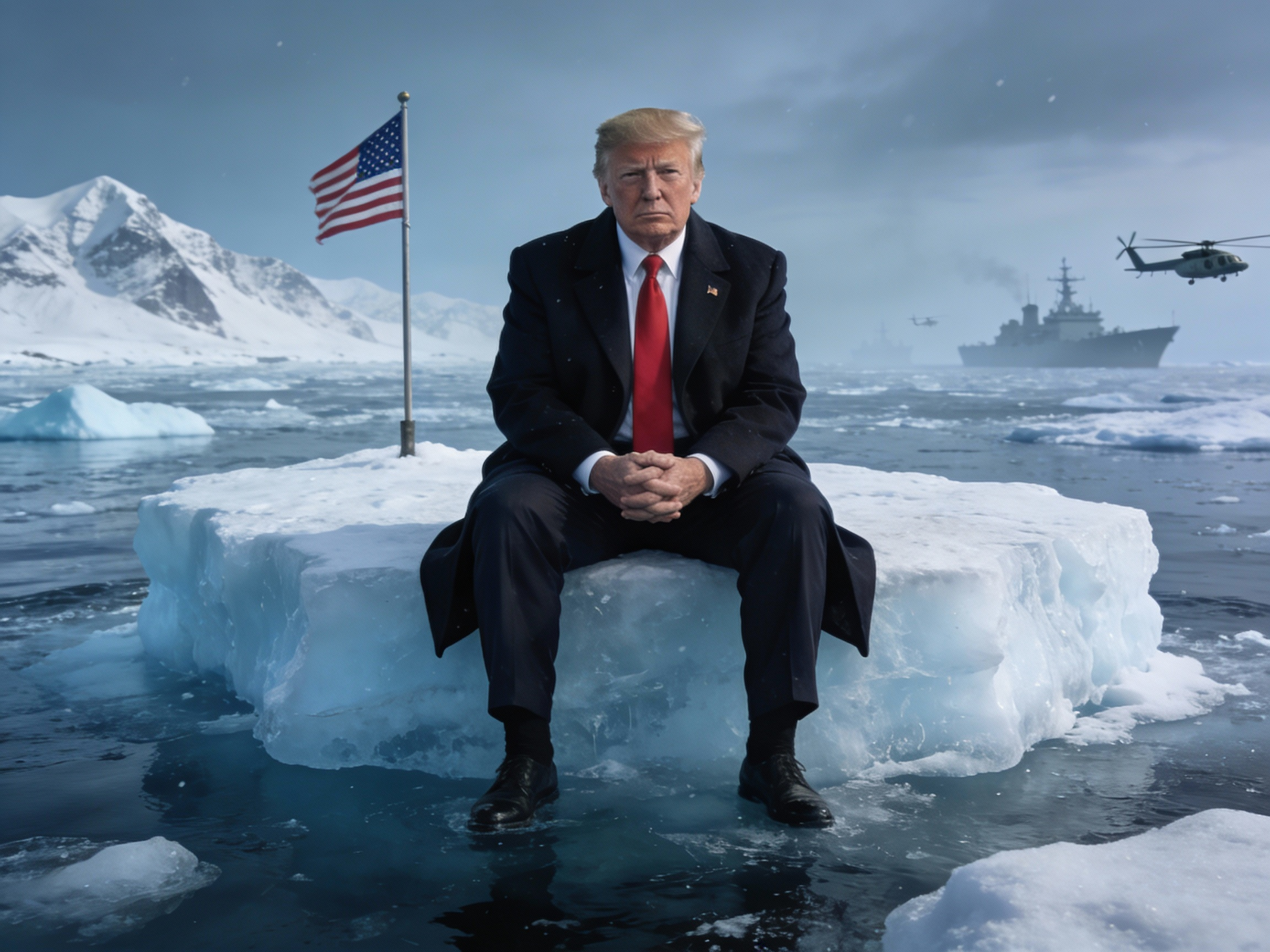
For decades, the United States has viewed Greenland as a strategically vital territory. Since World War II, American military planners and policymakers have understood its importance for Arctic security, global defense systems, and access to critical resources. What previous administrations discussed quietly behind closed doors, Donald Trump chose to say openly.
Trump said he wanted Greenland.
The reaction from legacy media was immediate and furious. Denmark was outraged. European leaders, including Emmanuel Macron, criticized the idea. Headlines mocked Trump, calling the proposal absurd, imperialistic, even dangerous. Once again, the familiar narrative returned: Trump the dictator, Trump the destabilizer, Trump the man destroying NATO and threatening the world order.
But while the media screamed, Trump stayed calm. Smiling. Stoic.
Behind the scenes, something very different was happening.
This week, President Donald Trump arrived in Davos, Switzerland, to attend the World Economic Forum (WEF). Surrounded by the world’s global elites—the very same figures who openly despise him—Trump showed up with a large delegation and a clear agenda: make deals.
And one of the biggest deals was Greenland.
After a high-level meeting with NATO Secretary General Mark Rutte, Trump announced that a framework agreement concerning Greenland—and the wider Arctic region—had been reached. An outcome many in the legacy media had declared impossible.
In a statement released earlier today, Trump wrote:
“Based upon a very productive meeting that I have had with the Secretary General of NATO, Mark Rutte, we have formed the framework of a future deal with respect to Greenland and, in fact, the entire Arctic Region.
This solution, if consummated, will be a great one for the United States of America, and all NATO Nations. Based upon this understanding, I will not be imposing the tariffs that were scheduled to go into effect on February 1st.
Additional discussions are being held concerning the Golden Dome as it pertains to Greenland. Further information will be made available as discussions progress. Vice President JD Vance, Secretary of State Marco Rubio, Special Envoy Steve Witkoff, and others will lead the negotiations and report directly to me.”
In simple terms: Trump made a deal.
Greenland matters because it is one of the most strategic territories on Earth. As Arctic ice melts, new shipping routes open and access to vast mineral reserves becomes possible. China and Russia have both aggressively positioned themselves in the Arctic, seeking influence, infrastructure, and control over rare-earth minerals critical to modern technology, defense systems, and energy.
China already holds a near-monopoly on many of these minerals.
Greenland changes that.
According to Trump, the framework agreement includes mineral rights, defense cooperation, and integration into a broader NATO security architecture—including the proposed “Golden Dome” defense system. With American capital, technology, and expertise, Greenland’s resources can be developed responsibly, reducing Western dependence on China and strengthening collective security across Europe and North America.
This is not just a win for the United States. It is a win for the West.
For years, Europe has depended on American security while criticizing American leadership. Trump reversed that dynamic. He forced allies to negotiate seriously, share responsibility, and think strategically about the future of the Arctic.
The backlash from globalists is predictable. Trump does not speak their language. He does not respect their rituals. He does not submit to unelected institutions or consensus-driven politics. Instead, he negotiates power, territory, resources, and security—openly.
What we are witnessing is not chaos. It is a transition.
The old world order is fading. Globalism as an ideology is losing credibility. In its place, a new era is emerging—what some describe as civilizationism: a worldview that recognizes distinct civilizations, national sovereignty, cultural identity, and strategic self-interest.
Trump’s Greenland deal is not just about land or minerals. It is about redefining power in a multipolar world.
And despite what the legacy media claims, Trump didn’t lose control.
He won Greenland.
Disclaimer: The views expressed in this article are those of the author and may not reflect those of Shinybull.com. The author has made every effort to ensure the accuracy of the information provided; however, neither Shinybull.com nor the author can guarantee the accuracy of this information. This article is strictly for informational purposes only. It is not a solicitation to make any exchange in precious metal products, commodities, securities, or other financial instruments. Shinybull.com and the author of this article do not accept culpability for losses and/ or damages arising from the use of this publication.
People are angry, and that’s why they voted for Mamdani as the next Mayor of New York. People are sick and tired of struggling to make ends meet. In his victory speech, Mamdani said:
“We choose hope over tyranny. Hope over big money and small ideas. Hope over despair. Tonight, we have stepped out from the old into the new.”
His supporters are already marching in the streets, saying they don’t want Trump as a king or a dictator.
Hmm… I think I’ve heard this before.
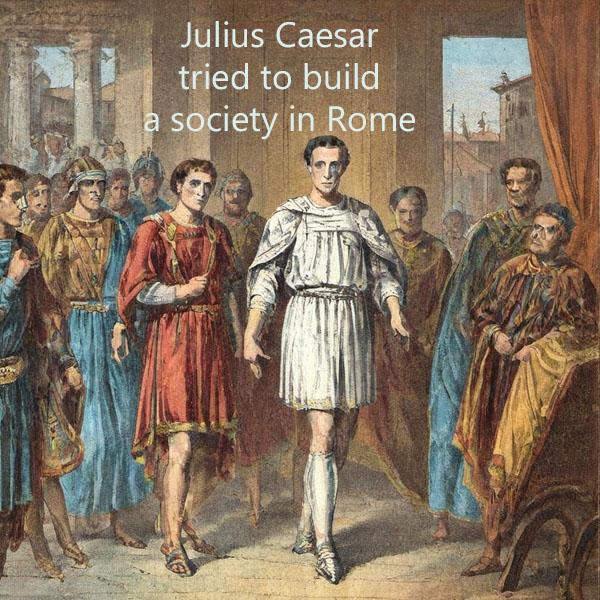
More than two thousand years ago, in Rome, another man was accused of wanting to be king. His name was Julius Caesar.
A group of Roman senators assassinated Caesar out of fear that his growing power and titles, especially dictator for life, would destroy the Roman Republic. They claimed they were saving democracy, but their actions plunged Rome into chaos and civil war.
It was a betrayal that changed history, and a reminder of how fear, power, and instability often go hand in hand.
History Repeats Itself
Fast forward to France, 1848. The people were exhausted. Food prices were soaring, unemployment was rising, and inequality had reached unbearable levels. King Louis Philippe I, once known as the Citizen King, had promised a fairer, more modern France. But over time, his government became detached from ordinary people’s struggles.
One of the main sources of anger was the tax system. The poor and working class bore a heavy burden through indirect taxes on essentials like food, salt, and fuel, while wealthy landowners and property owners paid relatively little. Voting rights were also tied to property ownership, meaning most citizens had no political voice. When food prices spiked in the late 1840s, ordinary people were paying high taxes on top of already expensive necessities. Economic frustration reached a tipping point.
People in New York voted for Mamdani, who wants to raise taxes and, at the same time, give people fast and free buses. How is that going to be?
When protests erupted in February 1848, the king tried to silence them. Instead, the anger exploded. Barricades filled the streets of Paris, and after just a few bloody days, Louis Philippe abdicated the throne and fled to England in disguise.
The monarchy collapsed. The Second Republic was born. But what came next? A new leader. Louis-Napoleon Bonaparte, nephew of Napoleon I, rose to power, promising to restore stability and hope. Within four years, he declared himself Emperor.
Sound familiar?
It’s the same old story: people rise up against a system they believe is unjust, only to end up under a new one that looks strangely similar. Each era has its slogans: “liberty,” “hope,” “change,” “the people’s revolution”, yet the same problems remain. Prices go up. Ordinary citizens struggle. The rich adapt and survive.
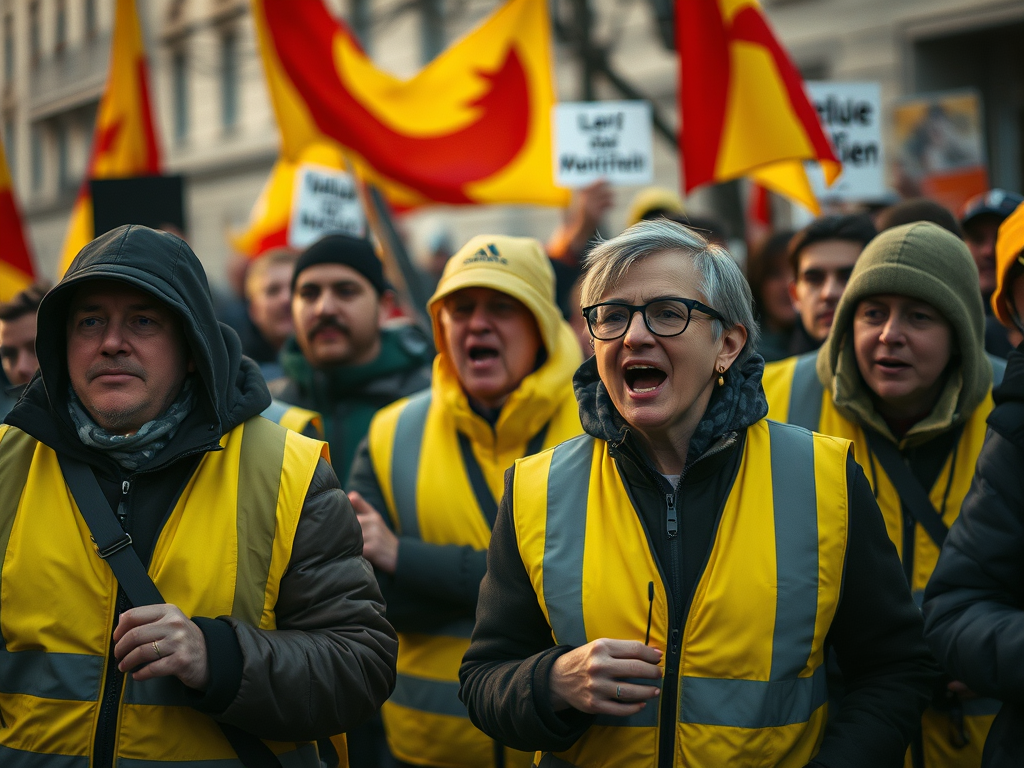
Take a look at France today with its Yellow Vest protesters. People are struggling with their cost of living. I wrote an article about that for the first time, many years ago. And who is to blame now? The King? Napoleon? No, it`s Macron.
So, Why Are Prices Rising Again?
The cost of living has become the defining issue of our time. Food, housing, and energy prices are rising faster than wages. Families feel squeezed, not just in New York or Paris, but across the Western world.
But who is to blame?
It’s tempting to point the finger at politicians, corporations, or billionaires. Yet the truth is more complex. The problem isn’t one person. It’s the system itself.
A mix of factors drives today’s inflation:
Global supply chain disruptions from the pandemic and wars.
Energy shocks as the world shifts away from fossil fuels.
Corporate pricing power in markets where competition has shrunk.
Decades of easy money and debt have inflated asset prices but left wages behind.
Governments print money to stimulate the economy, corporations raise prices to protect profits, and central banks hike interest rates to cool inflation, all while ordinary people pay the price.
It’s a cycle that keeps repeating, no matter the century. In ancient Rome, it was grain shortages. In 1848, in France, it was bread and taxes. Today, it’s rent and electricity.
The Real Lesson
Historically, when people struggle, they often look for someone to blame, such as a king, a tyrant, or a president. Get rid of Trump, and everything will be fine. Get rid of Macron, and the sun will shine. They think removing the person will fix the system. But as history shows us, that rarely works.
Trump isn’t the cause of America’s problems. He’s a symptom of them. Just as Caesar wasn’t the reason Rome was collapsing, but rather the outcome of deep divisions and economic inequality that had built up for years.
When the cost of living becomes unbearable, people revolt. Sometimes at the ballot box, sometimes in the streets.
But unless we learn from history, each “revolution” just sets the stage for the next crisis.
In the end, it’s not about kings or dictators. It’s about systems. And if we don’t fix the system, the anger, fear, and struggle will continue. Just as it has for more than 2,000 years.
Disclaimer: The views expressed in this article are those of the author and may not reflect those of Shinybull.com. The author has made every effort to ensure the accuracy of the information provided; however, neither Shinybull.com nor the author can guarantee the accuracy of this information. This article is strictly for informational purposes only. It is not a solicitation to make any exchange in precious metal products, commodities, securities, or other financial instruments. Shinybull.com and the author of this article do not accept culpability for losses and/ or damages arising from the use of this publication.
Ordinary people in Gaza hate Hamas and want to get rid of it. But how easy is that when we all know they rule Gaza with an iron fist? If you disagree with them, they will simply silence you. Or kill you. And that’s what’s happening in Gaza right now.
Once Hamas claims to seek peace with Israel, it soon turns its weapons on its own people. Who, then, is Hamas, and what are they really doing?
Origins of Hamas
Hamas (Ḥarakat al-Muqāwamah al-ʾIslāmiyyah — “Islamic Resistance Movement”) was founded in 1987 during the First Intifada. It grew out of the Egyptian Muslim Brotherhood, promoting a radical Islamist ideology that rejects Israel’s right to exist.
Its 1988 charter openly called for Israel’s destruction and the creation of an Islamic state over all of historical Palestine. From the beginning, Hamas mixed social welfare with terrorism, using religious faith and nationalism to recruit followers and strengthen control.
Brainwashing and Indoctrination
We can ask ourselves where all this hate comes from. But it’s not hard to understand when you see how Hamas uses propaganda and fear to shape generations.
The Nazis once said that a lie repeated enough times becomes the truth. The same can be said about Hamas.
In schools, mosques, and media, they constantly repeat messages of hatred against Jews and Israel. Children are taught that dying as a “martyr” is the greatest honor. The organization glorifies violence and uses religion as a tool of manipulation. This is how the terrorist organization Hamas is recruiting suicide bombers to attack innocent people in Israel.
The Years of Terror
Before Israel built its security barrier (the wall) along the Gaza border, Hamas repeatedly sent young suicide bombers into Israel, especially during the Second Intifada (2000–2005). Civilians were the main targets. People on buses, in cafés, markets, and restaurants.
Some of the worst attacks included:
Jerusalem Sbarro Restaurant bombing (2001): 15 killed, over 100 injured.
Dolphinarium disco bombing (2001): 21 young people killed.
Hebrew University bombing (2002): 9 killed, including U.S. citizens.
Even before Israel’s withdrawal from Gaza in 2005, militants in Gaza, including Hamas, began firing rockets and mortars into southern Israel. Towns like Sderot and Ashkelon have lived under constant threat ever since.
In 2006, Hamas fighters kidnapped Israeli soldier Gilad Shalit, holding him captive for over five years before finally releasing him in exchange for over 1,000 Palestinian prisoners, many of whom had blood on their hands.
Hamas’s Control Over Gaza
Since taking full control of Gaza in 2007, Hamas has turned the area into both a fortress and a prison. They suppress political opponents, control the media, and punish anyone who dares to speak against them.
Billions in international aid meant for rebuilding homes and hospitals have instead been used to build tunnels, buy rockets, and train new fighters.
Ordinary Gazans are the real victims. Trapped between Hamas’s authoritarian rule and the consequences of its endless wars.
What`s disappointing about this case is the legacy media`s unbalanced reports from the conflict. We often hear from poor civilians in Gaza. They usually lie, and sometimes they say people have no home and that it’s cold in Gaza. The fact is that the weather is hot.
The Hidden Face of Hate: When “Support for Gaza” Becomes Antisemitism
In the weeks and months following every escalation in Gaza, television screens, social media feeds, and newspaper headlines fill with global protests and statements of “solidarity with Gaza.” Many of these come from people who genuinely care about the suffering of civilians, and compassion is vital. But somewhere along the way, something darker has mixed in: a growing wave of disguised antisemitism, hate hidden beneath the surface of supposed “support.”
From Sympathy to Scapegoating
It begins with empathy. People reacting to images of destruction, mourning the deaths of children, and demanding peace. But in protest slogans and online comments, empathy often turns into something else:
“Zionists” becomes a code word for “Jews.”
Calls for “Free Palestine” are twisted into chants like “From the river to the sea,” which deny Israel’s right to exist.
Jewish students, shops, and synagogues in Europe and the U.S. face vandalism or threats, even though they have nothing to do with the Israeli government.
This isn’t solidarity. It’s scapegoating. The line between political protest and racial or religious hate has blurred.
How Hate Disguises Itself
Modern antisemitism rarely looks like the open hatred of the 1930s. Today, it hides behind political and moral language, calling itself “anti-Zionism,” “human rights activism,” or “decolonization.” But the pattern is the same: blame all Jews for the actions of a few, question their right to safety, and deny their history.
In some university protests, Jewish students have been told to “go back to Poland.”
Online, “pro-Gaza” threads are flooded with conspiracy theories about Jews controlling governments or media.
In demonstrations, Israeli flags are burned alongside slogans calling for “intifada” or “death to the occupiers.”
These aren’t calls for justice. They’re echoes of history, and they’re dangerous.
A Moral Test for the West
True solidarity with Palestinians means demanding an end to terror and manipulation. Not cheering for those who fire rockets from schoolyards. Genuine peace means condemning antisemitism wherever it appears, even when it hides behind fashionable activism.
The West now faces a moral test: Can we support innocent people in Gaza without reviving one of humanity’s oldest hatreds? Can we tell the difference between compassion and hate?
The answer depends on honesty and courage. Because antisemitism doesn’t vanish when it changes its name. It only grows stronger in the shadows.
The Media’s Blind Spot
Mainstream media often amplifies this confusion. In their effort to highlight humanitarian crises, many journalists avoid distinguishing between legitimate criticism of Israeli policy and antisemitic rhetoric. As a result, the public conversation becomes one-sided: Israeli military actions are headline news, while Hamas’s use of human shields, executions of civilians, and years of rocket attacks barely make the front page.
This selective storytelling doesn’t just distort reality. It feeds resentment. It reinforces the false idea that Jews are “the oppressors” and Palestinians “the victims,” without showing that both societies suffer under extremists like Hamas.
The Echo of Lies: How Hate Survives Through Propaganda
Hate rarely starts as hate. It begins as a whisper — a repeated story, a single narrative told again and again until it becomes a kind of truth. History has shown us this pattern many times before. The Nazis understood it all too well: “Repeat a lie often enough, and it becomes the truth.” That same dark psychology is alive today, in new forms and new places.
We see it in Gaza, where Hamas indoctrinates generations through education, media, and religion. Not to seek peace, but to preserve conflict. From childhood, people are taught not only to distrust but to despise. Over time, these beliefs stop feeling like opinions and start feeling like identity. When that happens, reason and compassion disappear.
But this manipulation doesn’t end there. Across the world, much of what we see in legacy media now echoes a similar distortion — not always intentional, but often biased. The story becomes simplified: one side good, one side evil. Complex truths are ignored because they don’t fit the headline. And beneath this imbalance, something ancient and dangerous grows, a modern form of antisemitism disguised as “support for the oppressed.”
People march in the streets, believing they are standing for justice, yet their chants echo the slogans of those who would destroy, not build. Sympathy for innocent civilians in Gaza, which is both human and necessary, is twisted into hatred toward Jews as a whole. It’s a trap of perception, built by years of selective narratives and emotional manipulation.
Meanwhile, Hamas continues to spend vast sums on weapons and tunnels instead of schools and hospitals. Iran and other foreign actors feed this machine of destruction, funding the tools of war while ordinary people suffer in poverty. And still, the cameras turn, the slogans spread, and the lie grows louder.
Propaganda doesn’t only distort the truth. It divides humanity. It turns empathy into anger, and understanding into fear. To fight it, we must learn to question what we’re told. We must see beyond the headlines, beyond the slogans, beyond the images carefully designed to provoke outrage.
The path forward isn’t found in hate, but in clarity. In seeing the difference between the innocent and the manipulative, between compassion and deception. Because if lies can echo, so can truth.
As Plato warned: “Those who are able to see beyond the shadows and lies of their culture will never be understood, let alone believed, by the masses.” That is why seeking truth is never easy, but it is always necessary.
Conclusion: The Real Enemy of Gaza’s People
Hamas is more than a militant group. They are the ruling power in Gaza with a dual role: political/social authority, and armed resistance. But their priorities often harm the people they claim to represent.
If peace or justice is ever to come, Gaza’s people need rules that protect them, accountability, transparency, and a governing power that places civilian needs above military ambition.
When the world watches the suffering in Gaza, it’s easy to blame Israel. But behind every destroyed building and every tragic image, there’s a more profound truth: Hamas has built its power on the suffering of its own people.
It’s not Israel that keeps Gaza poor and oppressed. It’s Hamas. Until they are gone, peace and freedom will remain out of reach for both Palestinians and Israelis.
Disclaimer: The views expressed in this article are those of the author and may not reflect those of Shinybull.com. The author has made every effort to ensure the accuracy of the information provided; however, neither Shinybull.com nor the author can guarantee the accuracy of this information. This article is strictly for informational purposes only. It is not a solicitation to make any exchange in precious metal products, commodities, securities, or other financial instruments. Shinybull.com and the author of this article do not accept culpability for losses and/ or damages arising from the use of this publication.
Russia`s President Vladimir Putin gave a speech today. He delivered his Address to the Federal Assembly. The ceremony took place in Gostiny Dvor in Moscow.
«The so-called West, with its colonial practices, and penchant for inciting ethnic conflicts around the world, not only seeks to impede our progress, but also envisions a Russia that is a dependent, declining, and dying space where they can do as they please.
In fact, they want to replicate in Russia what they have done in numerous other countries, including Ukraine: sowing discord in our home, and weakening us from within. But they were wrong, which has become abundantly clear now that they ran up against the firm resolve, and determination of our multi-ethnic people», Putin said in the speech.
«Together, as citizens of Russia, we will stand united in defense of our freedom, and our right to a peaceful, and dignified existence», Putin added.
Furthermore, Putin said; «We were not the ones who started the war in Donbas, but as I have already said many times, we will do everything to put an end to it, eradicate Nazism, and fulfill all the objectives of the special military operation, as well as defend sovereignty, and ensure that our people are safe».
«Here is a good example of their hypocrisy. They have recently made unfounded allegations, in particular against Russia, regarding plans to deploy nuclear weapons in space. Such fake narratives and this story is unequivocally false, are designed to involve us in negotiations on their conditions, which will only benefit the United States,» he said.
«There are reasons to suspect that the current US administration`s professed interest in discussing strategic stability with us is merely demagoguery.
They simply want to show to their citizens, and the world, especially in the lead-up to the presidential election that they continue to rule the world, that they would talk with the Russians when it will benefit them, and that there is nothing to talk about, and they will try to inflict defeat on us otherwise. Business as usual, as they say.»
«But this is unacceptable, of course. Our position is clear: if you want to discuss security and stability issues that are critical for the entire planet, this must be done as a package including, of course, all aspects that have to do with our national interests, and have a direct bearing on the security of our country, the security of Russia,» Putin said.
Putin also talked about a potential nuclear war, which would be the end of our civilization. He also said that the West is declining. This is what he said:
«We are also aware of the Western attempts to draw us into an arms race, thereby exhausting us, mirroring the strategy they successfully employed with the Soviet Union in the 1980s.
Let me remind you that in 1981 – 1988, the Soviet Union`s military spending amounted to 13 percent of GDP.
We need to shore up the forces in the Western strategic theatre in order to counteract the threats posed by NATO’s further eastward expansion, with Sweden, and Finland joining the alliance.
The West has provoked conflicts in Ukraine, the Middle East, and other regions around the world while consistently propagating falsehoods. Now they have the audacity to say that Russia harbors intentions of attacking Europe.
Can you believe it?
We all know that their claims are utterly baseless.
And at the same time, they are selecting targets to strike on our territory, and contemplating the most efficient means of destruction. Now they have started talking about the possibility of deploying NATO military contingents to Ukraine.»
«But we remember what happened to those who sent their contingents to the territory of our country once before. Today, any potential aggressors will face far graver consequences.»
«Everything they are inventing now, spooking the world with the threat of a conflict involving nuclear weapons, which potentially means the end of our civilization. Don`t they realize this?
«Indeed, just like any other ideology promoting racism, national superiority, or exceptionalism, Russophobia is blinding, and stupefying.
The United States and its satellites have, in fact, dismantled the European security system which has created risks for everyone.»
«Clearly, a new equal, and indivisible security framework must be created in Eurasia in the foreseeable future. We are ready for a substantive discussion on this subject with all countries, and associations that may be interested in it.
What Putin said next is very important to understand. He talked about Russia as a sovereign country. That is very different from a Russia controlled by the EU. What Putin talks about is very similar to what President Najib Bukele in El Salvador talks about.
It is their own sovereignty and freedom. Bukele said that globalization in El Salvador is dead. They want to rule their own country and have their own freedom. Out with the globalists, he said.
Putin talks about the same, but when it comes to Russia, he talks about the «balance of Power.» If the EU takes over Russia, it can fall into a gigantic dictatorship, and everyone in Europe will end up like slaves and losers. This is what Putin said in his speech:
«At the same time, I would like to reiterate (I think this is important for everyone) that no enduring international order is possible without a strong, and sovereign Russia.»
«We strive to unite the global majority`s efforts to respond to international challenges, such as the turbulent transformation of the world economy, trade, finance, and technology markets, when former monopolies, and stereotypes associated with them are collapsing.»
Europe has throughout history tried to take control of other countries, and they have earned a lot of money on it. But that era is coming to an end. Now, it is different. Europe is declining, and Putin talked about it in his speech today. He said:
«For example, in 2028, the BRICS countries with account taken of the new members will create about 37 percent of global GDP, while the G7 numbers will fall below 28 percent.
These figures are quite telling because the situation was completely different just 10 or 15 years ago. You have heard me say it publicly before. These are the trends, you see.
Look, the G7 countries’ share in global GDP in terms of PPP stood at 45,7 percent in 1992, while the BRICS countries (this association did not exist in 1992) accounted for only 16,5 percent.
In 2022, though, the G7 accounted for 30.3 percent, while BRICS had 31,5 percent.
By 2028, the percentage will shift even more in favor of BRICS, with 36,6 percent, and the projected figure for the G7 is 27,8 percent.
(Editor: The Group of Seven is an intergovernmental political and economic forum consisting of Canada, France, Germany, Italy, Japan, the United Kingdom, and the United States; additionally, the European Union is a “non-enumerated member).
There is no getting away from this objective reality, and it will remain that way no matter what happens next, including even in Ukraine,» Putin said.
Disclaimer: The views expressed in this article are those of the author and may not reflect those of Shinybull.com. The author has made every effort to ensure the accuracy of the information provided; however, neither Shinybull.com nor the author can guarantee such accuracy. This article is strictly for informational purposes only. It is not a solicitation to make any exchange in precious metal products, commodities, securities, or other financial instruments. Shinybull.com and the author of this article do not accept culpability for losses and/ or damages arising from the use of this publication.
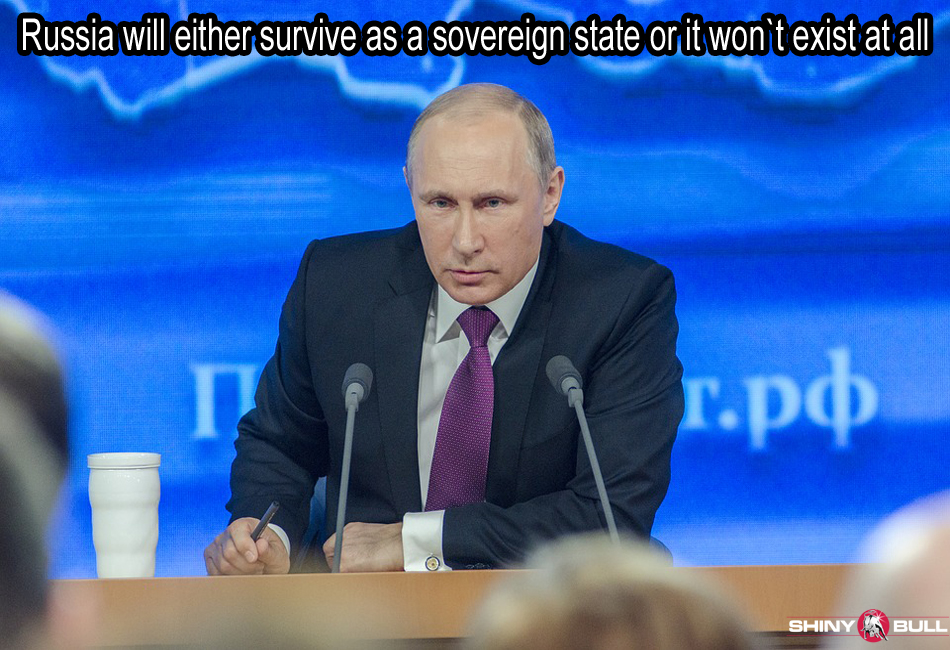
President of Russia Vladimir Putin had a major speech at the 25th St Petersburg International Economic Forum on Friday. This speech is a long speech, but a speech we should pay attention to. Read the transcript below (some of it) and make up your mind:
President of Russia Vladimir Putin: Thank you very much. President Tokayev, friends and colleagues,
I welcome all participants and guests of the 25th St Petersburg International Economic Forum.
It is taking place at a difficult time for the international community when the economy, markets, and the very principles of the global economic system have taken a blow. Many trades, industrial, and logistics chains, which were dislocated by the pandemic, have been subjected to new tests. Moreover, such fundamental business notions as business reputation, the inviolability of property, and trust in global currencies have been seriously damaged. Regrettably, they have been undermined by our Western partners, who have done this deliberately, for the sake of their ambitions and in order to preserve obsolete geopolitical illusions.
Today, our – when I say “our,” I mean the Russian leadership – our own view of the global economic situation. I would like to speak in greater depth about the actions Russia is taking in these conditions and how it plans to develop in these dynamically changing circumstances.
When I spoke at the Davos Forum a year and a half ago, I also stressed that the era of unipolar world order has come to an end. I want to start with this, as there is no way around it. This era has ended despite all the attempts to maintain and preserve it at all costs. Change is a natural process of history, as it is difficult to reconcile the diversity of civilizations and the richness of cultures on the planet with political, economic, or other stereotypes – these do not work here, they are imposed by one center in a rough and no-compromise manner.
The flaw is in the concept itself, as the concept says there is one, albeit strong, power with a limited circle of close allies, or, as they say, countries with granted access, and all business practices and international relations, when it is convenient, are interpreted solely in the interests of this power. They essentially work in one direction in a zero-sum game. A world built on a doctrine of this kind is definitely unstable.
After declaring victory in the Cold War, the United States proclaimed itself to be God’s messenger on Earth, without any obligations and only interests which were declared sacred. They seem to ignore the fact that in the past decades, new powerful and increasingly assertive centers have been formed. Each of them develops its own political system and public institutions according to its own model of economic growth and, naturally, has the right to protect them and secure national sovereignty.
These are objective processes and genuinely revolutionary tectonic shifts in geopolitics, the global economy, and technology, in the entire system of international relations, where the role of dynamic and potentially strong countries and regions is substantially growing. It is no longer possible to ignore their interests.
To reiterate, these changes are fundamental, groundbreaking, and rigorous. It would be a mistake to assume that at a time of turbulent change, one can simply sit it out or wait it out until everything gets back on track and becomes what it was before. It will not.
However, the ruling elite of some Western states seems to be harboring this kind of illusion. They refuse to notice obvious things, stubbornly clinging to the shadows of the past. For example, they seem to believe that the dominance of the West in global politics and the economy is an unchanging, eternal value. Nothing lasts forever.
Our colleagues are not just denying reality. More than that; they are trying to reverse the course of history. They seem to think in terms of the past century. They are still influenced by their own misconceptions about countries outside the so-called “golden billion”: they consider everything a backwater, or their backyard. They still treat them like colonies, and the people living there, like second-class people, because they consider themselves exceptional. If they are exceptional, that means everyone else is second-rate.
Thereby, the irrepressible urge to punish, to economically crush anyone who does not fit with the mainstream, does not want to blindly obey. Moreover, they crudely and shamelessly impose their ethics, their views on culture, and ideas about history, sometimes questioning the sovereignty and integrity of states, and threatening their very existence. Suffice it to recall what happened in Yugoslavia, Syria, Libya, and Iraq.
If some “rebel” state cannot be suppressed or pacified, they try to isolate that state, or “cancel” it, to use their modern term. Everything goes, even sports, the Olympics, bans on culture, and art masterpieces just because their creators come from the “wrong” country.
This is the nature of the current round of Russophobia in the West, and the insane sanctions against Russia. They are crazy and, I would say, thoughtless. They are unprecedented in the number of them or the pace the West churns them out at.
The idea was clear as day – they expected to suddenly and violently crush the Russian economy, to hit Russia’s industry, finance, and people’s living standards by destroying business chains, forcibly recalling Western companies from the Russian market, and freezing Russian assets.
This did not work. Obviously, it did not work out; it did not happen. Russian entrepreneurs and authorities have acted in a collected and professional manner, and Russians have shown solidarity and responsibility.
Step by step, we will normalize the economic situation. We have stabilized the financial markets, the banking system, and the trade network. Now we are busy saturating the economy with liquidity and working capital to maintain the stable operation of enterprises and companies, employment, and jobs.
The dire forecasts for the prospects of the Russian economy, which were made in early spring, have not materialized. It is clear why this propaganda campaign was fuelled and all the predictions of the dollar at 200 rubles and the collapse of our economy were made. This was and remains an instrument in an information struggle and a factor of psychological influence on Russian society and domestic business circles.
Incidentally, some of our analysts gave in to this external pressure and based their forecasts on the inevitable collapse of the Russian economy and a critical weakening of the national currency – the ruble.
Real-life has belied these predictions. However, I would like to emphasize that to continue being successful, we must be explicitly honest and realistic in assessing the situation, be independent in reaching conclusions, and of course, have a can-do spirit, which is very important. We are strong people and can deal with any challenge. Like our predecessors, we can resolve any task. The entire thousand-year history of our country bears this out.
Within just three months of the massive package of sanctions, we have suppressed inflation rate spikes. As you know, after peaking at 17.8 percent, inflation now stands at 16.7 percent and continues to drop. This economic dynamic is being stabilized, and state finances are now sustainable. I will compare this to other regions further on. Yes, even this figure is too much for us – 16.7 percent is high inflation. We must and will work on this and, I am sure, we will achieve a positive result.
After the first five months of this year, the federal budget has a surplus of 1.5 trillion rubles, and the consolidated budget – has a surplus of 3.3 trillion rubles. In May alone, the federal budget surplus reached almost half a trillion rubles, surpassing the figure for May 2021 more than four times over.
Today, our job is to create conditions for building up production and increasing supply in the domestic market, as well as restoring demand and bank financing in the economy commensurately with the growth in supply.
I mentioned that we have taken measures to reestablish the floating assets of companies. In most sectors, businesses have received the right to suspend insurance premiums for the second quarter of the year. Industrial companies have even more opportunities – they will be able to delay them through the third quarter as well. In effect, this is like getting an interest-free loan from the state.
In the future, companies will not have to pay delayed insurance premiums in a single payment. They will be able to pay them in equal installments over 12 months, starting in June next year.
Next. As of May, the subsidized mortgage rate has been reduced. It is now 9 percent, while the program has been extended till the end of the year. As I have mentioned, the program is aimed at helping Russians improve their housing situation, while supporting the home building industry and related industries that employ millions of people.
Following a spike this spring, interest rates have been gradually coming down, as the Central Bank lowers the key rate. I believe that this allows the subsidized mortgage rate to be further cut to 7 percent.
What is important here? The program will last until the end of the year without change. It means that our fellow Russians seeking to improve their living conditions should take advantage of the subsidy before the end of the year.
The lending cap will not change either, at 12 million roubles for Moscow and St Petersburg and 6 million for the rest of Russia.
I should add that we must make long-term loans for businesses more accessible. The focus must shift from budget subsidies for businesses to bank lending as a means to spur business activity.
We need to support this. We will allocate 120 billion rubles from the National Wealth Fund to build up the capacity of the VEB Project Financing Factory. This will provide for additional lending to much-needed initiatives and projects worth around half a trillion roubles.
Colleagues,
Once again, the economic blitzkrieg against Russia was doomed to fail from the beginning. Sanctions as a weapon have proved in recent years to be a double-edged sword damaging their advocates and architects just as much, if not more.
I am not talking about the repercussions we see clearly today. We know that European leaders informally, so to say, furtively, discuss the very concerning possibility of sanctions being leveled not at Russia, but at any undesirable nation, and ultimately anyone including the EU and European companies.
So far this is not the case, but European politicians have already dealt their economies a serious blow all by themselves. We see social and economic problems worsening in Europe, and in the US as well, food, electricity, and fuel prices rising, with quality of life in Europe falling and companies losing their market edge.
According to experts, the EU’s direct, calculable losses from the sanctions fever could exceed $400 billion this year. This is the price of the decisions that are far removed from reality and contradict common sense.
This outlay falls directly on the shoulders of people and companies in the EU. The inflation rate in some Eurozone countries has exceeded 20 percent. I mentioned inflation in Russia, but the Eurozone countries are not conducting special military operations, yet the inflation rate in some of them has reached 20 percent. Inflation in the United States is also unacceptable, the highest in the past 40 years.
Of course, inflation in Russia is also in the double digits so far. However, we have adjusted social benefits and pensions to inflation, and increased the minimum and subsistence wages, thereby protecting the most vulnerable groups of the population. At the same time, high-interest rates have helped people keep their savings in the Russian banking system.
Businesspeople know, of course, that a high key rate clearly slows economic development. But it is a boon for the people in most cases. They have reinvested a substantial amount of money in banks due to higher interest rates.
This is our main difference from the EU countries, where rising inflation is directly reducing the real incomes of the people and eating up their savings, and the current manifestations of the crisis are affecting, above all, low-income groups.
The growing outlays of European companies and the loss of the Russian market will have lasting negative effects. The obvious result of this will be the loss of global competitiveness and a system-wide decline in the European economies’ pace of growth for years to come.
Taken together, this will aggravate the deep-seated problems of European societies. Yes, we have many problems as well, yet I have to speak about Europe now because they are pointing the finger at us although they have enough of their own problems. I mentioned this at Davos. A direct result of the European politicians’ actions and events this year will be the further growth of inequality in these countries, which will, in turn, split their societies still more, and the point at issue is not only the well-being but also the value orientation of various groups in these societies.
Indeed, these differences are being suppressed and swept under the rug. Frankly, the democratic procedures and elections in Europe and the forces that come to power look like a front, because almost identical political parties come and go, while deep down things remain the same. The real interests of people and national businesses are being pushed further and further to the periphery.
Such a disconnect from reality and the demands of society will inevitably lead to a surge in populism and extremist and radical movements, major socioeconomic changes, degradation, and a change of elites in the short term. As you can see, traditional parties lose all the time. New entities are coming to the surface, but they have little chance for survival if they are not much different from the existing ones.
The attempts to keep up appearances and the talk about allegedly acceptable costs in the name of pseudo-unity cannot hide the main thing: the European Union has lost its political sovereignty, and its bureaucratic elites are dancing to someone else’s tune, doing everything they are told from on high and hurting their own people, economies, and businesses.
There are other critically important matters here. The worsening of the global economic situation is not a recent development. I will now go over things that I believe are extremely important. What is happening now does not stem from what happened during recent months, of course not. Moreover, it is not the result of the special military operation carried out by Russia in Donbas. Saying so is an unconcealed, deliberate distortion of the facts.
Surging inflation in product and commodity markets had become a fact of life long before the events of this year. The world has been driven into this situation, little by little, by many years of irresponsible macroeconomic policies pursued by the G7 countries, including uncontrolled emission and accumulation of unsecured debt. These processes intensified with the onset of the coronavirus pandemic in 2020 when supply and demand for goods and services drastically fell on a global scale.
This begs the question: what does our military operation in Donbas have to do with this? Nothing whatsoever.
Because they could not or would not devise any other recipes, the governments of the leading Western economies simply accelerated their money-printing machines. Such a simple way to make up for unprecedented budget deficits.
I have already cited this figure: over the past two years, the money supply in the United States has grown by more than 38 percent. Previously, a similar rise took decades, but now it grew by 38 percent or 5.9 trillion dollars in two years. By comparison, only a few countries have a bigger gross domestic product.
The EU’s money supply has also increased dramatically over this period. It grew by about 20 percent or 2.5 trillion euros.
Lately, I have been hearing more and more about the so-called – please excuse me, I really would not like to do this here, even mention my own name in this regard, but I cannot help it – we all hear about the so-called ‘Putin inflation’ in the West. When I see this, I wonder who they expect would buy this nonsense – people who cannot read or write, maybe. Anyone literate enough to read would understand what is actually happening.
Russia, our actions to liberate Donbas have absolutely nothing to do with this. The rising prices, accelerating inflation, shortages of food and fuel, petrol, and problems in the energy sector are the result of system-wide errors the current US administration and European bureaucracy have made in their economic policies. That is where the reasons are, and only there.
I will mention our operation, too: yes, it could have contributed to the trend, but the root cause is precisely this – their erroneous economic policies. In fact, the operation we launched in Donbas is a lifeline they are grabbing at to be able to blame their own miscalculations on others, in this case, on Russia. But everyone who has at least completed primary school would understand the true reasons for today’s situation.
So, they printed more money, and then what? Where did all that money go? It was obviously used to pay for goods and services outside Western countries – this is where the newly-printed money flowed. They literally began to clean out, to wipe out global markets. Naturally, no one thought about the interests of other states, including the poorest ones. They were left with scraps, as they say, and even that at exorbitant prices.
While at the end of 2019, imports of goods to the United States amounted to about 250 billion dollars a month, by now, it has grown to 350 billion. It is noteworthy that the growth was 40 percent – exactly in proportion to the unsecured money supply printed in recent years. They printed and distributed money, and used it to wipe out goods from third countries’ markets.
This is what I would like to add. For a long time, the United States was a big food supplier in the world market. It was proud, and with good reason, of its achievements, its agriculture, and farming traditions. By the way, this is an example for many of us, too. But today, America’s role has changed drastically. It has turned from a net exporter of food into a net importer. Loosely speaking, it is printing money and pulling commodity flows its way, buying food products all over the world.
The European Union is building up imports even faster. Obviously, such a sharp increase in demand that is not covered by the supply of goods has triggered a wave of shortages and global inflation. This is where this global inflation originates. In the past couple of years, practically everything – raw materials, consumer goods, and particularly food products – has become more expensive all over the world.
Yes, of course, these countries, including the United States continue importing goods, but the balance between exports and imports has been reversed. I believe imports exceed exports by some 17 billion. This is the whole problem.
According to the UN, in February 2022, the food price index was 50 percent higher than in May 2020, while the composite raw materials index doubled over this period.
Under the cloud of inflation, many developing nations are asking a good question: why exchange goods for dollars and euros that are losing value right before our eyes? The conclusion suggests itself: the economy of mythical entities is inevitably being replaced by the economy of real values and assets.
According to the IMF, global currency reserves are at $7.1 trillion and 2.5 trillion euros now. These reserves are devalued at an annual rate of about 8 percent. Moreover, they can be confiscated or stolen at any time if the United States dislikes something in the policy of the states involved. I think this has become a very real threat for many countries that keep their gold and foreign exchange reserves in these currencies.
According to analyst estimates, and this is an objective analysis, conversion of global reserves will begin just because there is no room for them with such shortages. They will be converted from weakening currencies into real resources like food, energy commodities, and other raw materials. Other countries will be doing this, of course. Obviously, this process will further fuel global dollar inflation.
As for Europe, their failed energy policy, blindly staking everything on renewables and spot supplies of natural gas, which have caused energy price increases since the third quarter of last year – again, long before the operation in Donbas – have also exacerbated price hikes. We have absolutely nothing to do with this. It was due to their own actions that prices have gone through the roof, and now they are once again looking for somebody to blame.
Not only did the West’s miscalculations affect the net cost of goods and services but they also resulted in decreased fertilizer production, mainly nitrogen fertilizers made from natural gas. Overall, global fertilizer prices have jumped by over 70 percent from mid-2021 through February 2022.
Unfortunately, there are currently no conditions that can overcome these pricing trends. On the contrary, aggravated by obstacles to the operation of Russian and Belarusian fertilizer producers and disrupted supply logistics, this situation is approaching a deadlock.
It is not difficult to foresee coming developments. A shortage of fertilizer means a lower harvest and a higher risk of an undersupplied global food market. Prices will go even higher, which could lead to hunger in the poorest countries. And it will be fully on the conscience of the US administration and the European bureaucracy.
I want to emphasize once again: that this problem did not arise today or in the past three or four months. And certainly, it is not Russia’s fault as some demagogues try to declare, shifting the responsibility for the current state of affairs in the world economy to our country.
Maybe it would even be nice to hear that we are so powerful and omnipotent that we can blow up inflation in the West, in the United States, and Europe, or that we can do things to throw everything into disorder. Maybe it would be nice to feel this power, if only there were truth in it. This situation has been brewing for years, spurred by the short-sighted actions of those who are used to solving their problems at somebody else’s expense and who have relied and still rely on the mechanism of financial emission to outbid and draw trade flows, thus escalating deficits and provoking humanitarian disasters in certain regions of the world. I will add that this is essentially the same predatory colonial policy as in the past, but of course in a new iteration, a more subtle and sophisticated edition. You might not even recognize it at first.
The current priority of the international community is to increase food deliveries to the global market, notably, to satisfy the requirements of the countries that need food most of all.
While ensuring its domestic food security and supplying the domestic market, Russia is also able to scale up its food and fertilizer exports. For example, our grain exports in the next season can be increased to 50 million tonnes.
As a priority, we will supply the countries that need food most of all, where the number of starving people could increase, first of all, African countries and the Middle East.
At the same time, there will be problems there, and not through our fault either. Yes, on paper Russian grain, food, and fertilizers… Incidentally, the Americans have adopted sanctions on our fertilizers, and the Europeans followed suit. Later, the Americans lifted them because they saw what this could lead to. But the Europeans have not backed off. Their bureaucracy is as slow as a flour mill in the 18th century. In other words, everyone knows that they have done a stupid thing, but they find it difficult to retrace their steps for bureaucratic reasons.
As I have said, Russia is ready to contribute to balancing global markets of agricultural products, and we see that our UN colleagues, who are aware of the scale of the global food problem, are ready for dialogue. We could talk about creating normal logistical, financial, and transport conditions for increasing Russian food and fertilizer exports.
As for Ukrainian food supplies to global markets – I have to mention this because of numerous speculations – we are not hindering them. They can do it. We did not mine the Black Sea ports of Ukraine. They can clear the mines and resume food exports. We will ensure the safe navigation of civilian vessels. No problem.
But what are we talking about? According to the US Department of Agriculture, the matter concerns 6 million tonnes of wheat (we estimate it at 5 million tonnes) and 7 million tonnes of maize. This is it, altogether. Since global production of wheat stands at 800 million tonnes, 5 million tonnes make little difference for the global market, as you can see.
Anyway, Ukrainian grain can be exported, and not only via Black Sea ports. Another route is via Belarus, which is, incidentally, the cheapest way. Or via Poland or Romania, whichever you prefer. In fact, there are five or six export routes.
The problem is not with us, the problem is with the adequacy of the people in control in Kyiv. They can decide what to do, and, at least in this particular case, they should not take their lead from their foreign bosses, their masters across the ocean.
But there is also the risk that grain will be used as payment for arms deliveries. This would be regrettable.
Friends,
Once again, the world is going through an era of drastic change. International institutions are breaking down and faltering. Security guarantees are being devalued. The West has made a point of refusing to honor its earlier commitments. It has simply been impossible to reach any new agreements with them.
Given these circumstances and against the backdrop of mounting risks and threats, Russia was forced to go ahead with the special military operation. It was a difficult but necessary decision, and we were forced to make it.
This was the decision of a sovereign country, which has еру unconditional right to uphold its security, which is based on the UN Charter. This decision was aimed at protecting our people and the residents of the people’s republics of Donbas who for eight long years were subjected to genocide by the Kyiv regime and the neo-Nazis who enjoyed the full protection of the West.
The West not only sought to implement an “anti-Russia” scenario but also engaged in the active military development of Ukrainian territory, flooding Ukraine with weapons and military advisers. And it continues to do so now. Frankly, no one is paying any attention to the economy or well-being of the people living there, they just do not care about it at all, but they have never spared money to create a NATO foothold in the east that is directed against Russia and to cultivate aggression, hatred, and Russophobia.
Today, our soldiers and officers, as well as the Donbas militia, are fighting to protect their people. They are fighting for Russia’s future as a large, free, and secure multiethnic country that makes its own decisions, determines its own future, relies on its history, culture, and traditions, and rejects any and all outside attempts to impose pseudo-values steeped in dehumanization and moral degradation.
No doubt, our special military operation goals will be fulfilled. The key to this is the courage and heroism of our soldiers, consolidated Russian society, whose support gives strength and confidence to the Russian Army and Navy, and a deep understanding of the truth and historical justice of our cause which is to build and strengthen Russia as a strong sovereign power.
My point is that sovereignty cannot be segmented or fragmented in the 21st century. The components of sovereignty are equally important, and they reinvigorate and complement each other.
So, what matters to us is not only the defense of our political sovereignty and national identity, but also strengthening everything that determines our country’s economic, financial, professional, and technological independence.
The very structure of Western sanctions rested on the false premise that economically Russia is not sovereign and is critically vulnerable. They got so carried away spreading the myth of Russia’s backwardness and its weak positions in the global economy and trade that apparently, they started believing it themselves.
While planning their economic blitzkrieg, they did not notice, and simply ignored the real facts of how much our country had changed in the past few years.
These changes are the result of our planned efforts to create a sustainable macroeconomic structure, ensure food security, implement import substitution programs and create our own payment system, to name a few.
Of course, sanction restrictions created many challenges for the country. Some companies continue having problems with spare parts. Our companies have lost access to many technological solutions. Logistics are in disarray.
But, on the other hand, all this opens up new opportunities for us – we often talk about this but it really is so. All this is an impetus to build an economy with full rather than partial technological, production, human and scientific potential, and sovereignty.
Naturally, it is impossible to resolve such a comprehensive challenge instantly. It is necessary to continue working systematically with an eye to the future. This is exactly what Russia is doing by implementing its long-term plans for the development of branches of the economy and strengthening the social sphere. The current trials are merely resulting in adjustments and modifications of the plans without changing their strategic orientation.
Today, I would like to talk about the key principles on which our country and our economy will develop.
The first principle is openness. Genuinely sovereign states are always interested in equal partnership and in contributing to global development. On the contrary, weak and dependent countries are usually looking for enemies, fuelling xenophobia or losing the last remnants of their identity and independence, blindly following in the wake of their suzerain.
Russia will never follow the road of self-isolation and autarky although our so-called Western friends are literally dreaming about this. Moreover, we are expanding cooperation with all those who are interested in it, who want to work with us, and will continue to do so. There are many of them. I will not list them at this point. They make up the overwhelming majority of people on Earth. I will not list all these countries now. It is common knowledge.
I will say nothing new when I remind you that everyone who wants to continue working or is working with Russia is subjected to blatant pressure from the United States and Europe; it goes as far as direct threats. However, this kind of blackmail means little when it comes to countries headed by true leaders who know the difference between their own national interests, the interests of their people – and someone else’s.
Russia will build up economic cooperation with these states and promote joint projects. At the same time, we will certainly continue to cooperate with Western companies that have remained in the Russian market despite the unprecedented arm-twisting – such companies exist, too.
We believe the development of convenient and independent payment infrastructure in national currencies is a solid and predictable basis for deepening international cooperation. To help companies from other countries develop logistical and cooperation ties, we are working to improve transport corridors, increase the capacity of railways, transshipment capacity at ports in the Arctic, and in the eastern, southern, and other parts of the country, including in the Azov-Black Sea and Caspian basins – they will become the most important section of the North-South Corridor, which will provide stable connectivity with the Middle East and Southern Asia. We expect freight traffic along this route to begin growing steadily in the near future.
But foreign trade is not our only priority. Russia intends to increase scientific, technological, cultural, humanitarian, and sports cooperation based on equality and mutual respect between partners. At the same time, our country will strive for responsible leadership in all these areas.
The second principle of our long-term development is a reliance on entrepreneurial freedom. Every private initiative aimed at benefiting Russia should receive maximum support and space for implementation.
The pandemic and the more recent events have confirmed how important flexibility and freedom are in the economy. Russian private businesses – in tough conditions, amid attempts to restrain our development by any means – have proved they can compete in global markets. Private businesses should also be credited for Russia’s adaptation to rapidly changing external conditions. Russia needs to ensure the dynamic development of the economy – naturally, relying on private business.
We will continue to reduce administrative hurdles. For example, in 2016–2018, we imposed a moratorium on routine audits of small businesses. Subsequently, it was extended through 2022. In 2020, this moratorium was extended to cover mid-sized companies. Also, the number of unscheduled audits decreased approximately fourfold.
We did not stop at that, and last March, we canceled routine audits for all entrepreneurs, regardless of the size of their businesses, provided their activities do not put people or the environment at high risk. As a result, the number of routine audits has declined sixfold compared to last year.
Why am I giving so many details? The point is that after the moratorium on audits was imposed, the number of violations by entrepreneurs – this was the result – has not increased, but rather it has gone down. This testifies to the maturity and responsibility of Russian businesses. Of course, they should be offered motivation rather than being forced to observe regulations and requirements.
So, there is every reason to take another radical step forward, that is, to abandon, for good and on a permanent basis, the majority of audits for all Russian businesses, except on risky or potentially dangerous activities. Everyone has long since understood that there was no need to check on everyone without exception. A risk-oriented approach should be at work. I ask the Government to develop the specific parameters of such a reform in the next few months.
There is another very sensitive topic for business, which has also become important today for our national security and economic resilience. To reduce and bring to a minimum all sorts of abuse and loopholes to exert pressure on entrepreneurs, we are consistently removing loose regulations from criminal law that are applied to economic crimes.
Last March, a law was signed, under which tax-related criminal cases against entrepreneurs shall only be brought before a court by the tax service – there is no other way. Soon a draft law will be passed on reducing the statute of limitations for tax-related crimes and on rejecting lawsuits to initiate criminal proceedings after-tax arrears have been paid off.
Working comprehensively, although prudently, we need to decriminalize a wide range of economic offenses, for instance, those that punish businesses without a license or accreditation. This is a controversial practice today because our Western partners illegitimately refuse to provide such licenses.
Our own agencies must not single-handedly make our businesses criminally liable for actually doing nothing wrong. The problem is this, and small businesses understand it very well – if a license has expired, and Western partners refuse to extend it, what are businesses to do, wrap up operations? By no means, let them work. State oversight should continue, but there should be no undue interference in business.
It also makes sense to think about raising the threshold of criminal liability for unpaid customs duties and other such taxes. Additionally, we have not for a long time reconsidered the parameters of the terms ‘large’ and ‘very large’ economic loss for the purposes of economic offenses despite inflation accruing 50 percent since 2016. The law now fails to reflect the current realities and needs to be corrected.
We need to reconsider the conditions for detaining entrepreneurs and for extending preliminary investigations. It is no secret that these practices have long been used inappropriately.
Businesses have been forced to cease operations or go bankrupt even before the investigation is over. The reputation of the owners and of the brand name suffers, as a result, not to mention the direct financial loss, loss of market share, and jobs.
I want to ask law enforcement to put an end to these practices. I also ask the Government and the Supreme Court to draft appropriate legislation before October 1 of this year.
In addition, at the Security Council, special instruction was given to look into criminal cases being opened without later proceeding to court. The number of such cases has grown in recent years. We know the reasons. A case is often opened without sufficient grounds or to put pressure on individuals. We will discuss this in autumn to take legislative action and change the way our law enforcement agencies work.
It goes without saying that regional governments play a major role in creating a modern business environment. As is customary during the St Petersburg Forum, I highlight the regions that have made significant progress in the National Investment Climate Rankings compiled by the Agency for Strategic Initiatives.
There have been changes in the top three. Moscow and Tatarstan have remained at the top and were joined by the Moscow Region which, in a span of one year, went from eighth place to the top three. The leaders of the rankings also include the Tula, Nizhny Novgorod, Tyumen, Novgorod, and Sakhalin regions, St Petersburg and Bashkortostan.
Separately, I would like to highlight the regions that have made the greatest strides such as the Kurgan Region, which moved up 36 spots; the Perm Territory and the Altai Territory, up 26 spots; Ingushetia, up 24 spots; and the Ivanovo Region which moved up 17 spots.
I want to thank and congratulate our colleagues in the regions for their good work.
The federal government and regional and municipal governments should focus on supporting individual business initiatives in small towns and remote rural communities. We are aware of such stories of success. That includes developing popular software and marketing locally produced organic food and environmentally friendly products nationwide using domestic websites.
It is important to create new opportunities, to introduce modern retail formats, including e-commerce platforms, as I mentioned above, and to cut the logistics, transportation, and other costs, including by using upgraded Russian Post offices.
It is also important to help small business employees, self-employed individuals, and start-up entrepreneurs acquire additional skills and competencies. Please include corresponding measures tailored specifically to small towns and rural and remote areas as a separate line in the national project for promoting small and medium-sized businesses.
Today I would like to address our officials, owners of large companies, business leaders, and executives.
Colleagues, friends,
Real, stable success and a sense of dignity and self-respect only come when you link your future and the future of your children with your Fatherland. We have maintained ties with many people for a long time, and I am aware of the sentiments of many of the heads and owners of our companies. You have told me many times that business is much more than just making a profit, and I fully agree. It is about changing life around you, and contributing to the development of your home cities, regions, and the country as a whole, which is extremely important for self-fulfillment. There is nothing like serving the people and society. This is the meaning of your life and work.
Recent events have reaffirmed what I have always said: it is much better at home. Those who refused to hear that clear message have lost hundreds of millions, if not billions of dollars in the West, in what looked like a safe haven for their assets.
I would like to once again say the following to our colleagues, those who are both in this audience and those who are not here: please, do not fall into the same trap again. Our country has huge potential, and there are more than enough tasks that need your contribution. Invest here, in the creation of new enterprises and jobs, in the development of the tourism infrastructure, and support schools, universities, healthcare, and the social sphere, culture, and sport. I know that many of you are doing this. I know this, but I wanted to say it again.
This is how the Bakhrushin, Morozov, Shchukin, Ryabushinsky, Akchurin, Galeyev, Apanayev, Matsiyev, Mamontov, Tretyakov, Arsanov, Dadashev, and Gadzhiyev families understood their noble mission. Many Russian, Tatar, Buryat, Chechen, Daghestani, Yakutian, Ossetian, Jewish, Armenian, and other merchant, and entrepreneurial families did not deprive their heirs of their due share, and at the same time, they etched their names in the history of our country.
Incidentally, I would like to note once again that it remains to be seen what is more important for potential heirs: money and property or their forefathers’ good name and service to the country. The latter is something that cannot be squandered or, pardon my language, wasted on drink.
A good name is something that will always belong to your descendants, to future generations. It will always be part of their lives, going from one generation to another, helping them and making them stronger than the money or property they might inherit can make them.
Colleagues,
A responsible and well-balanced macroeconomic policy is the third guiding principle of our long-term development. In fact, this policy has largely enabled us to withstand the unprecedented pressure brought on by sanctions. Let me reiterate that this is an essential policy in the long term, not just for responding to the current challenges. We will not follow in the footsteps of our Western colleagues by replicating their bitter experience setting off an inflation spiral and disrupting their finances.
Our goal is to ensure robust economic growth for years to come, reducing the inflation burden on our people and businesses and achieving the mid-and long-term target inflation rate of four percent. Inflation was one of the first things I mentioned during my remarks, so let me tell you this: we remain committed to this target of a four-percent inflation rate.
I have already instructed the Government to draft proposals regarding the new budget guidelines. They must ensure that our budget policy is predictable and enables us to make the best use of the external economic conditions. Why do we need all this? To put economic growth on a more stable footing, while also delivering on our infrastructure and technological objectives, which provide a foundation for improving the wellbeing of our people.
True, some international reserve currencies have set themselves on a suicidal path lately, which is an obvious fact. In any case, they clearly have suicidal intentions. Of course, using them to ‘sterilize’ our money supply does not make any sense. Still, the principle of planning one’s spending based on how much you earn remains relevant. This is how it works, and we understand this.
Social justice is the fourth principle underpinning our development. There must be a powerful social dimension when it comes to promoting economic growth and business initiatives. This development model must reduce inequality instead of deepening it, unlike what is happening in other countries. To be honest, we have not been at the forefront when it comes to delivering on these objectives. We have yet to resolve any issues and problems in this regard.
Reducing poverty and inequality is all about creating demand for Russian-made products across the country, bridging the gap between regions in terms of their capabilities, and creating new jobs where they are needed the most. These are the core economic development drivers.
Let me emphasize that generating positive momentum in terms of household income growth and poverty reduction are the main performance indicators for government agencies and the state in general. We need to achieve tangible results in this sphere already this year, despite all the objective challenges we face. I have already assigned this task to the Government.
Again, we provide targeted support to the most vulnerable groups – pensioners, families with children, and people in difficult life situations.
Pensions are indexed annually at a rate higher than inflation. This year, they have been raised twice, including by another 10 percent on June 1.
The minimum wage was also increased by 10 percent at the same time, and so was the subsistence minimum – a reference figure used to calculate many social benefits and payments – accordingly, these benefits should also grow, increasing the incomes of about 15 million people.
In recent years, we have built a holistic system to support low-income families with children. Women are entitled to state support from the early stages of pregnancy until the child reaches the age of 17.
People’s living standards and prosperity are the most important demographic factors; the current situation is quite challenging due to several negative demographic waves that have recently overlapped. In April, less than a hundred thousand children were born in Russia, almost 13 percent less than in April 2020.
I ask the Government to continue to keep the development of additional support measures for families with children under review. They must be far-reaching and commensurate with the magnitude of the extraordinary demographic challenge we are facing.
Russia’s future is ensured by families with two, three, and more children. Therefore, we need to do more than provide direct financial support – we need to target and direct the healthcare system, education, and all areas that determine the quality of people’s lives towards the needs of families with children.
This problem is addressed, among other approaches, by the national social initiatives, which regional teams and the Agency for Strategic Initiatives are implementing together. This autumn, we will assess the results of their work, and review and rank the Russian regions by the quality of life in order to apply the best experiences and practices as widely as possible throughout the country.
To be continued.
Disclaimer: The views expressed in this article are those of the author and may not reflect those of Shinybull.com. The author has made every effort to ensure the accuracy of the information provided; however, neither Shinybull.com nor the author can guarantee such accuracy. This article is strictly for informational purposes only. It is not a solicitation to make any exchange in precious metal products, commodities, securities, or other financial instruments. Shinybull.com and the author of this article do not accept culpability for losses and/ or damages arising from the use of this publication.





 Ket Garden
 Business, Politics, Finans