Tag Archives: Protectionism

Trump, Tariffs, and the Hidden Tax We Don’t Talk About

Who Pays, Who Profits – and What New Zealand Taught the World

Tariffs have returned to the center of economic debate, largely driven by the resurgence of protectionist thinking in the United States. Under Donald Trump, tariffs were framed as a tool to restore American strength: protect domestic jobs, rebuild industry, and rebalance trade.

And on the surface, the story seems compelling. U.S. growth has outperformed much of Europe in recent years. Employment has remained strong. Manufacturing investment has picked up in selected sectors. To many observers, tariffs appear to “work.”

But economics has a habit of asking an uncomfortable question: who actually pays?
The Hidden Tax on Consumers

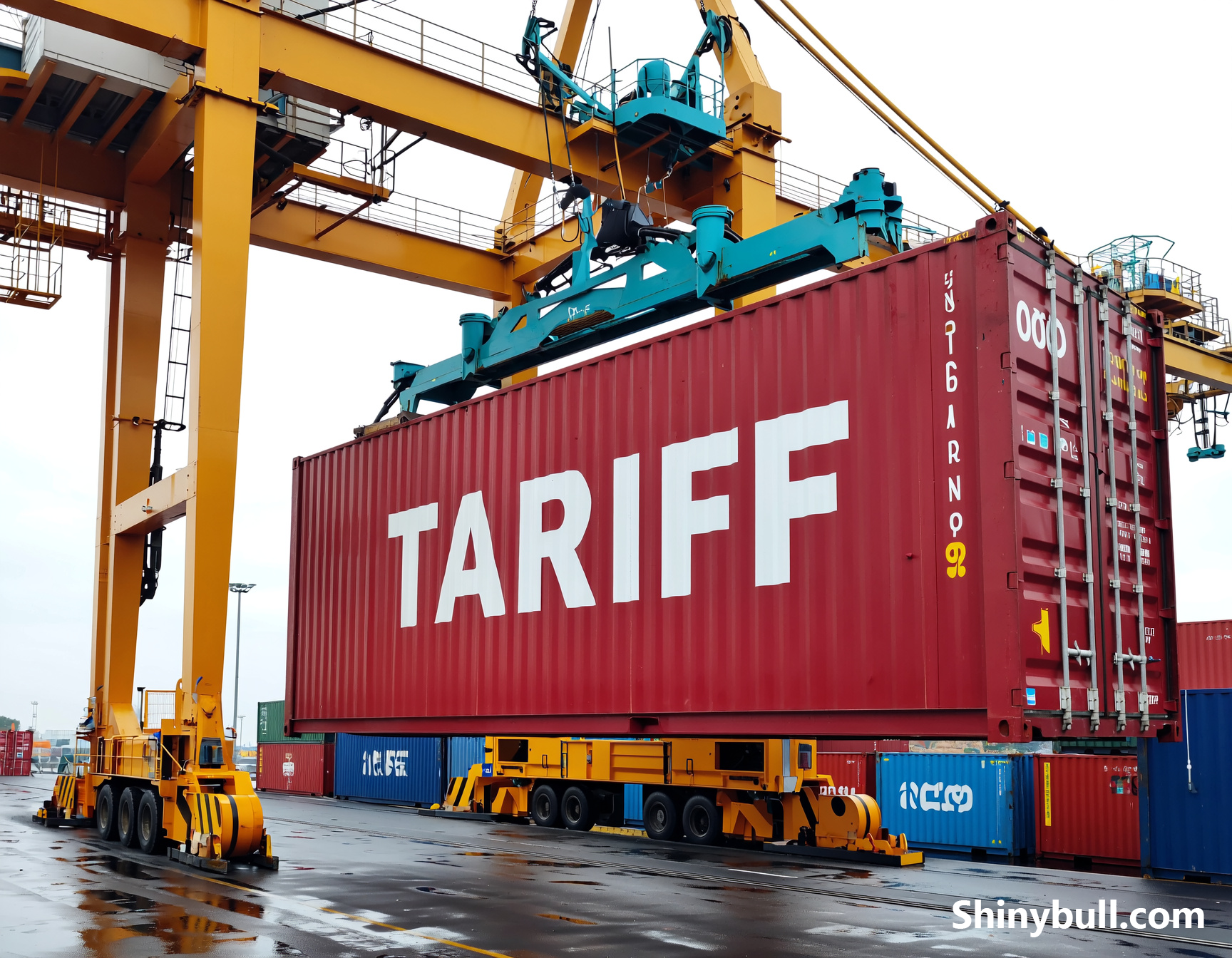
A tariff is often described as a tax on foreign producers. In practice, it is far more accurately described as a consumption tax paid at home.

When the U.S. imposes tariffs, import prices rise. Those costs are passed through supply chains and land, quietly, on consumers. There is no line on the receipt saying “tariff paid,” but the effect is real: higher prices, less choice, reduced purchasing power.

Tariffs are politically attractive precisely because they are invisible. Unlike income tax or VAT, they do not trigger a clear political backlash. Everyone pays a little more, spread across millions of transactions. The burden is diffuse; the beneficiaries are concentrated.

Who Actually Benefits?

Tariffs do not benefit “the economy” in general. They benefit specific, protected groups.

  • Domestic producers shielded from foreign competition.
  • Firms with political influence or strategic importance.
  • Workers in protected industries — at least in the short to medium term.

This is why tariffs persist. The winners know who they are. The losers rarely do.

From a political economy perspective, tariffs function as a solidarity mechanism: many consumers pay slightly higher prices so a smaller group can maintain jobs, income, and market position. In that sense, protectionism is not the opposite of redistribution — it is redistribution, just without calling it that.

One could even argue, somewhat ironically, that Trump’s tariff policy resembles a form of nationalist social democracy: collective sacrifice in the name of domestic stability.

Does It Work?

In the short term, yes — sometimes.

Protection can stabilize industries, preserve employment, and support investment during periods of adjustment or geopolitical stress. The U.S. growth story cannot be dismissed outright.

But the long-term risk is structural. Tariffs reduce competitive pressure. They reward incumbency over innovation. Over time, protected sectors may survive — but become less dynamic, less efficient, and more politically dependent.

History shows that protection rarely remains temporary.

A Natural Experiment: New Zealand

If tariffs and subsidies are a form of hidden solidarity, New Zealand offers a rare counterexample.

In the mid-1980s, New Zealand abruptly removed almost all agricultural subsidies — one of the most radical policy shifts ever attempted in a developed economy. At the time, farming was heavily protected. Many believed the sector would collapse.

The short-term pain was real. Some farms failed. Debt and distress followed. Politically, it was deeply unpopular.

But then something unexpected happened.

Farmers adapted. Productivity rose sharply. Inefficient practices disappeared. Innovation, specialization, and export competitiveness surged. Today, New Zealand’s agricultural sector is among the most efficient in the world — with virtually no subsidies.

The system did not preserve every producer. It preserved the outcome.

The Trade-Off We Rarely Admit

Tariffs and subsidies are not free. They are paid for – quietly – by consumers. They protect jobs, but they also lock in structures. They buy stability today at the cost of flexibility tomorrow.

New Zealand chose volatility and adaptation. Many countries choose protection and continuity. Neither path is costless.

But one lesson stands out:
When markets are shielded too long, the bill does not disappear – it grows.

Final Thought

Tariffs are not an economic mistake. They are a political choice.

They ask many to pay a little so a few can earn a lot. They feel painless — until inflation, stagnation, or fiscal pressure exposes the invoice.

New Zealand showed that removing protection does not destroy an economy. It forces it to grow up.

And in the end, that may be the most expensive lesson of all.

If you want the full picture, deeper analysis, and insights you won’t find in the headlines, Shiny bull is here to guide you. Subscribe and stay ahead of the curve.
Disclaimer: The views expressed in this article are those of the author and may not reflect those of Shinybull.com. The author has made every effort to ensure the accuracy of the information provided; however, neither Shinybull.com nor the author can guarantee the accuracy of this information. This article is strictly for informational purposes only. It is not a solicitation to make any exchange in precious metal products, commodities, securities, or other financial instruments. Shinybull.com and the author of this article do not accept culpability for losses and/ or damages arising from the use of this publication.

Leave a comment

Filed under Politics

U.S steel production is booming due to Trump admin`s steel tariffs

Coalition For A Prosperous America chief economist Jeff Ferry said to Fox that the Trump administration`s tariffs have a positive impact on the steel industry. This is one of the reasons why Trump is so popular in the United States.

Jeff Ferry said; «…..even as some pundits and economists say America`s steel industry is in decline…… for those who understand the steel industry, it`s clear that the Trump administration`s steel tariffs have generated a boom in steel investment and a shift to newer technologies that are creating high-paying jobs for thousands of new steelworkers.

Steel prices last year were lower than they were in 2017, before Trump`s tariffs. Donald Trump and Wilbur Ross did this because they know the steel industry. They did it because they knew that Communist China subsidized the steel and dumped the prices.

This kind of protectionism is good for Communist China, but it made it difficult for the United States to compete, and this is exactly here where Trump`s «America First» agenda comes in. He protects the U.S steel industry, its workers, and America.

The U.S steel industry is healthy, and steel consumers are better off because they pay the same price for steel now as they did a few years ago. Before the tariffs. Now, the U.S steel industry can invest in new technology, and grow and meet their need much better than before.

This is the difference between Biden who has been in politics for the last 47 years and Trump who is one of the few to stand up against Communist China.

To contact the author: post@shinybull.com

Disclaimer: The views expressed in this article are those of the author and may not reflect those of Shinybull.com. The author has made every effort to ensure the accuracy of the information provided; however, neither Shinybull.com nor the author can guarantee such accuracy. This article is strictly for informational purposes only. It is not a solicitation to make any exchange in precious metal products, commodities, securities, or other financial instruments. Shinybull.com and the author of this article do not accept culpability for losses and/ or damages arising from the use of this publication.

Leave a comment

Filed under Commodities, Emerging markets, Energy, Stock market

Pinterest is ready to go public but the “catalogue of ideas” is still blocked in China

I wrote about an upcoming Pinterest IPO on January 12, 2015. I said it was probably to early for them to go public at that time, but now four years later Pinterest has confidentially filed paperwork with the SEC for an IPO.

The photo-posting app firm Pinterest has chosen Goldman Sachs and JPMorgan Chase to lead its IPO, and shares will be available later on this summer. They have begun interviewing bankers and could raise $1,5B.


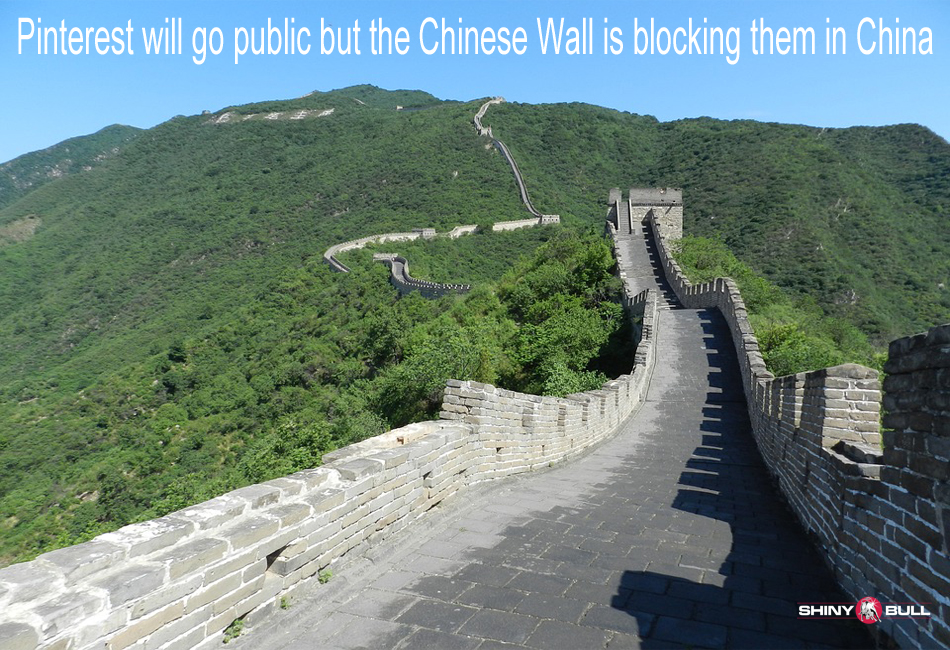
(Picture: Chinese Wall)


The company was launched in March 2010, so this is a young start-up that will follow many other start ups to go public this year. They have 250 million MAUs as of October 2018, and they have 800+ employees that is working with «catalogue of ideas.»

In 2012, Pinterest was valued at $1,5 billion. Two years later the company was valued at $3,8 billion. A few year later (June 2015) Pinterest was valued at $11 billion. The same year, Fortune Magazine listed Pinterest in the 8th position on its Unicorn list.

Since its inception, it has developed into a well-funded site financially supported by a group of successful entrepreneurs, and in 2011, the company secured a US$10 million Series A financing led by Jeremy Levine and Sarah Tavel of Bessemer Venture Partners.

Later on the same year, Pinterest secured US$27 million in funding from Anderssen Horowitz, which valued the company at US$200 million. Now, a few years later, the value of the company is 60 times higher.

Internet service provider in populist India had blocked Pinterest following a Madreas High Court order in July 2016 but the block was temporary. It`s even worse in Communist China. In 2017, Chinese authorities blocks Pinterest and the website is still blocked after Two Sessions in 2017.

No response has given, but some media guess that the blocks was related to the Two sessions. Huaban, Duitang and 30 more websites has many similaarities to Pinterest, so they are not alone on the market. However, they are not blocked in Hong Kong.

The same happened to Google in China. Once a popular search engine in China with a market share of 36,2 percent in 2009, but they blocked the web site and Google`s search market share dropped to only 1,7 percent.

Communist China is authoritarian and authorities was scared and stopped Google and this is what protectionism and Nationalism works. Most services offered by Google China were blocked by the Great Firewall in the People`s Republic of China.

In 2010, searching via all Google search sites, including Google Mobile, were moved from mainland China to Hong Kong. The same year, Google announced that, in response to a Chinese-originated hacking attack on them and other US tech companies, they were no longer willing to censor searches in China and would pull out of the country completely if necessary. Is this really fair trade?

Four year earlier, co-founder Sergey Brin said that virtually all of Googles customers were using the non-censored version of their website. Google critics in the United States claimed that Google China is a flagrant violation of the Google motto: «Dont be evil.»

On 13 January 2010, the news agency AHN reported that the U.S Congress planned to investigate Googles allegations that the Chinese government used the companys service to spy on human rights activists.

The US Secretary of State Hillary Clinton said at that time that analogies were drawn between the Berlin Wall and the free and unfree internet. Chinese articles came back saying that the United States uses the internet as a means to create worldwide hegemony based on Western values.

The issue of Google`s policy toward China was cited as a potentially major development in world affairs, marking a split between authoritarian socialism and the Western model of free capitalism and internet access.

China and America are two of the biggest economies in the world, so it is important for companies to have access to the market in both countries. A year ago, president Trump announced trade war with China, but now seems like a seven-month trade war is coming to an end.

The U.S has accused Beijing of forcing U.S companies doing business in China to share their technology with local partners and hand over intellectual property secrets, but China denies it engages in such practices.

Trump administration is looking at non-tariff barriers in China, including industrial subsidies, regulations, business licensing procedures, product standards reviews and other practices that keep U.S goods out of China or give an unfair advantage to domestic firms.

Visa and MasterCard have waited years to have access in China and Steve Mnuchin has pushed for China to open its market for them. But the clock is ticking and time is running short of the March 1 deadline to resolve the dispute or see U.S tariffs on $200 billion worth of Chinese goods rise from 10 percent to 25 percent.

Access to the Chinese market will help companies like Pinterest and other companies a lot. 50 percent of the world’s population live in Asia but it wont help if they spend most of their time on protectionism, nationalism, authoritarian behaviour, censorship, socialism and communism.

Disclaimer: The views expressed in this article are those of the author and may not reflect those of Shiny bull. The author has made every effort to ensure accuracy of information provided; however, neither Shiny bull nor the author can guarantee such accuracy. This article is strictly for informational purposes only. It is not a solicitation to make any exchange in precious metal products, commodities, securities or other financial instruments. Shiny bull and the author of this article do not accept culpability for losses and/ or damages arising from the use of this publication.
 

Leave a comment

Filed under Stocks

President Emmanual Macron criticized President Donald Trump for being a Nationalist but should take a lesson from him

French President Emmanuel Macron criticized the U.S President Donald Trump a few weeks ago. Macron said Trump was a Nationalist, and Mainstream Media (MSM) followed up to say that Hitler was also a Nationalist. Wow, what a comparison.

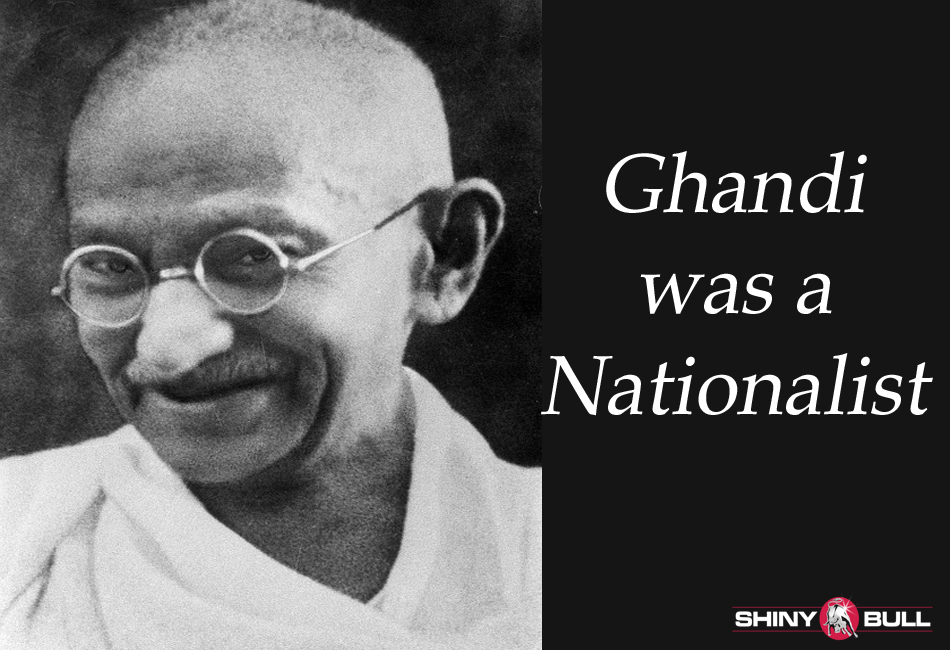
What journalists in the MSM is not telling people is that even Mahatma Ghandi was a Nationalist. The National Movement in India and the role of Mahatma Ghandi and Non-Violence is an example. Employing nonviolent nationalist movements as his weapon, Ghandii stirred Indian men and woman to «fight» for independence without shedding blood. But Ghandi was also a populist. Just like Trump.

Ghandi considered himself one, and his mission was primarily the establishment of a free, independent, culturally distinct Indian nation. He used to say that “nonviolent nationalism is a necessary condition of corporate or civilized life.” (As opposed to violent nationalism).

In the book “Autobigraphy of a Yogi” the writer, Paramahansa Yogananda, quotes Ghandi`s own words on nationalism:

“I call myself a nationalist but my natioanlism is as wide as the universe; it embraces all nations. My nationalism includes the prosperity of all nations. I do not want my India to raise on from the ashes of other nations. I do not want India to ever exploit any human. I want a strong India able to transfuse its strength to other nations.Today, none of the European countries does this; they do not transfer power to other nations.”

Ghandi was also a populist. Who know that? Populist rule is bad for democracy, but despite that, we can see that populists are being voted into office in country after country. Narendra Modi win elections when the institutionalized ties between non-populist parties and voters decay.

But there is a big difference between the populism we see outside of the U.S than inside. Trumps populism is good populism while many of the other populists are bad. Trumps plan is “America First,” and that`s why he is cutting taxes, made a lot of reforms and negotiated better trade deals.

There is no doubt that European Union is important, but at what cost? Take a look at President Macron. The man who talked about Trump`s Nationalism in his speech while MSM followed up with Nazi stories.

But who is in real trouble here? Rebels in Paris blasts Mr Macron for his gas tax hikes. The opposite of what Trump did. He cuted the taxes and the U.S economy is booming. The U.S unemployment is low while it remain high in France.

This is not the fist time I`m writing about the protesters in France. This is something that has been going on for years and decades. France need to do something to make a change, but do Macron have something to learn from Trump? It remains to see.

But it seems like Macron is doing the opposite of Trump who are a Nationalist and a Patriot. Trumpis doing what he can to protect his own citizens. Its all about "America First" and he wants to Make America Great again. Whats wrong with that?

President Macron is a part of the European Union which is driven by faceless bureaucrats. A collaboration the United Kingdom wants to leave. A collaboration that communist Jeremy Corbyn want to join again. Done by a second referendum.

But Paris rioters steal police rifle and torch cars while they are protesting fuel taxes, but the demonstrations are also an indication of growing animosity toward Macron. President Trump is on his own people`s side but President Macron seems to be against his own people with bad decisions.

People in France believe that Macron is serving the interest of the EU and not the French workers. A President should represent the people, “We the People,” but the French protest movement, known as jilets jaunes (yellow vests), are protesting against its own President and the state of France`s economy as well.

President Macrons popularity is low and will be so for quite some time, because he has given no indication he will bend to the peoples demand. This will give Macron`s political competitors like Marine Le Pen a huge advantage.

Disclaimer: The views expressed in this article are those of the author and may not reflect those of Shiny bull. The author has made every effort to ensure accuracy of information provided; however, neither Shiny bull nor the author can guarantee such accuracy. This article is strictly for informational purposes only. It is not a solicitation to make any exchange in precious metal products, commodities, securities or other financial instruments. Shiny bull and the author of this article do not accept culpability for losses and/ or damages arising from the use of this publication.


Leave a comment

Filed under Politics

We are now standing at a crossroad were two different visions of humanity`s future compete

Former President Barack Obama had a speech in Johannesburg on Tuesday. In an address Tuesday in honor of the late Nelson Mandela ahead of the 100th anniversary of his birth, Obama criticized populist movements toward authoritarianism around the world.

He was warning against protectionism, climate change and closed borders. Obama said “The politics of fear and resentment and retrenchment began to appear. And that kind of politics is now on the move. It`s on the move at a pace that would have seemed unimaginable just a few years ago.”

“I can`t find common ground if somebody says that climate change just isn`t happening, when almost all the world`s scientists tell us it is. I don`t know where to start talking to you about this. If you say it`s an elaborate hoax, where do we start?”, Obama said in the speech.

Strong man politics is on the rise. In the west you have far right parties that are based on closed borders, protectionism and nationalism. Many developed countries are now looking at China`s model of a totalitarian control combined with capitalism.

The free press is under attack. Censorship and state control of the media is on the rise. Social media once seen as a mechanism to promote knowledge, understanding and solidarity, has proved to be just as effective promoting hatred, paranoia, propaganda and conspiracy theories.

We are now standing at a crossroad. A moment in time in which two very different visions of humanity`s future compete. Two different stories and two different narratives. About who we are and who we should be.

Disclaimer: The views expressed in this article are those of the author and may not reflect those of Shiny bull. The author has made every effort to ensure accuracy of information provided; however, neither Shiny bull nor the author can guarantee such accuracy. This article is strictly for informational purposes only. It is not a solicitation to make any exchange in precious metal products, commodities, securities or other financial instruments. Shiny bull and the author of this article do not accept culpability for losses and/ or damages arising from the use of this publication.


Leave a comment

Filed under Politics