Tag Archives: UN

The end of South Korea`s economic miracle

The Korean Peninsula was inhabited as early as the Lower Paleolithic period. Its first kingdom was noted in Chinese records in the early 7th century BCE. The succeeding Korean Empire (1897 – 1910) was annexed in 1910 into the Empire of Japan.

Japanese rule ended following Japan`s surrender in World War II, after which Korea was divided into two zones: a northern zone, which was occupied by the Soviet Union, and a southern zone, which was occupied by the United States.

After negotiations on reunification failed, the southern zone became the Republic of Korea in August 1948, while the northern zone became the communist Democratic People`s Republic of Korea the following month.

In 1950, a North Korean invasion began the Korean War, which ended in 1953 after extensive fighting involving the American-led United Nations Command and the People`s Volunteer Army from China with Soviet assistance.

The war left 3 million Koreans dead and the economy in ruins.
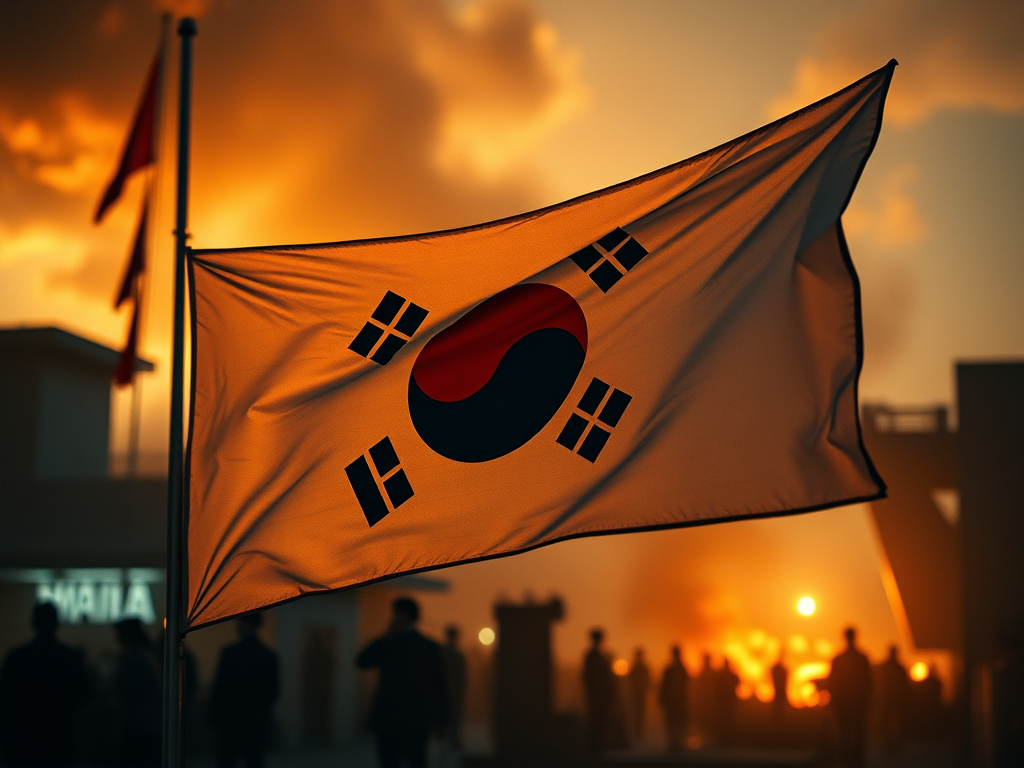
The May 16 coup of 1961 led by Park Chung Hee put an end to the Second Republic, signaling the start of the Third Republic in 1963.

South Korea`s devastated economy began to soar under Park`s leadership, recording one of the fastest rises in average GDP per capita.

Despite lacking natural resources, the nation rapidly developed to become one of the Four Asian Tigers based on international trade and economic globalization, integrating itself within the world economy with export-oriented industrialization.

The Fourth Republic was established after the October Restoration of 1972, in which Park wielded absolute power.

The Yushin Constitution declared that the president could suspend basic human rights, and appoint a third of the parliament.

Suppression of the opposition and human rights abuse by the government became more severe in this period

South Korea has since then had a huge economic success. They have big companies like Samsung (which is the biggest company in South Korea), LG Energy Solution, Hyundai, and Kia to name a few.

On top of that, they also have BTS which is a boyband from South Korea. According to the Hyundai Research Institute, BTS was estimated to generate around $3,6 billion annually for the South Korean economy.

In some years, their direct and indirect contribution has been as high as $4,6 billion, which is comparable to major multinational corporations. BTS has been estimated to contribute around 0,3% to 0,5% of South Korea`s GDP in recent years.

This is a remarkable figure for a single music group, considering the country`s GDP was around $1,63 trillion in 2020.

South Korea`s economic success is well known all around the world, and they has become an economic powerhouse. But right now, it seems like their economic model is running out of steam. The economy has been slowing for years. It has basically stopped.

The economy in South Korea is on the way to be like Japan. What in the world is going on?

It all started in the 1950`s. Their economic growth was 10%, and it reached the top in the 1980`s. Then it began to slow. Growth in the 90`s declined to around 7%. Ten years later, the growth went down to 4%. In 2010, their growth was only 3%.

But something has happened in the last five years. The growth has been slowing year by year. This is what’s happening with the economy as they get richer. It happens in all rich countries. But, in South Korea, it seems like this is not temporary. It seems to be a new normal.

Bank of Kora (BOK) has warned that South Korea`s economy may enter negative territory in the next decade. The country is on a declining trajectory. Unless this is going to change, the next generation will be worse off than their parents.

But, how is it possible that a successful country like South Korea with so many high-tech companies can decline like this? Well, it has its own explanation. We need to look at their economic model, and how it came to be, and how it operates today.

The core of the South Korean economy is made up of something called «Chaebols». «Chae» stands for wealth or property, while «Bol» stands for clan or group.

«Chaebols» refers to large, family-owned business conglomerates in South Korea that wield significant influence over the country`s economy.

The influence of chaebols is often cited as a contributing factor to some of South Korea`s economic challenges, but they are not the sole reason for any economic decline. Several factors, including chaebols’ dominance, are at play when examining South Korea`s economic issues.

This is what we see in the U.S., but also in many other places in the West. They blame big corporations, wealthy entrepreneurs, and investors.

It is the concentration of economic power. Chaebols control a large portion of South Korea`s economy, leading to less competition. Their dominance can stifle small and medium-sized enterprises (SMEs), limiting innovation and growth in other sectors.

Chaebols have also been involved in corruption scandals, often using their power to influence political decisions. This has led to inefficiency in governance and public discontent, undermining economic reforms.

Over-reliance on Export-driven Growth is also considered to be a challenge. Chaebols are heavily focused on industries like electronics, shipbuilding, and automobiles, which are export-driven. This makes the South Korean economy vulnerable to global economic shifts and trade disputes, especially in a world where the diversification of industries is increasingly important.

They also face succession and corporate governance issues. Since chaebols are family-controlled, they often face challenges with leadership transitions between generations. This can lead to inefficiencies and financial mismanagement within these conglomerates.

Strong and independent entrepreneurs have made the wealth you and I have today. They have created products that made our lives better, and their companies have grown to be multi-billion corporations. If this is a problem for countries around the world, well, what can we say? If so, this is not the only reason why the growth is slowing.

We see the same going on in South Korea as well as in Japan and many other places. Broader factors are leading to economic challenges, and one of them is the aging population. South Korea has one of the lowest birth rates in the world, leading to a shrinking working-age population.

This demographic challenge puts pressure on economic growth and social welfare systems. This is not only happening in Japan and South Korea. It`s happening in many other places around the world.

We also have a global economic slowdown. South Korea`s heavy reliance on exports means it is susceptible to the global economic downturn. Trade tensions, especially between the U.S., and China, impact South Korea`s major industries.

On top of all that, we have technological disruption. Even though chaebols have driven much of South Korea`s technological advancements, their scale makes them slow to adapt to new digital trends and innovations compared to more agile startups.

So, what is South Korea doing to address these issues? The South Korean government has been working to implement reforms aimed at reducing chaebols’ influence, promoting transparency, encouraging innovation, and supporting small and medium enterprises (SMEs).

While chaebols have contributed significantly to South Korea`s rapid industrialization and growth, their outsized role can create imbalances in the economy, making reforms crucial for long-term, sustainable growth.

In conclusion, while chaebols are not the sole cause of South Korea`s economic challenges, their dominance and related issues do play a role in creating an environment that can hinder broader economic diversification and reform. As we can clearly see, successful entrepreneurs and large corporations can be both beneficial and problematic for an economy.

Unfortunately, we very often see that successful entrepreneurs are attacked. Especially by socialists. But we have to ask ourselves what we should do without them? Because they are the ones that are creating wealth in the long run. No socialism without capitalism. The socialists need money for the welfare system, and that money comes from entrepreneurs who make goods and services.

Entrepreneurs drive innovation, create new industries, and develop new technologies that can improve productivity. Successful businesses, especially startups, can grow into larger companies, and boost economic growth.

Large corporations provide millions of jobs and stimulate related industries (e.g., supply chains, and service providers). For example, companies like Apple Amazon, or South Korea`s Samsung employ a large global workforce and indirectly create additional jobs in the ecosystem surrounding their businesses.

We can see time and time again, that entrepreneurs are often the source of disruptive innovation, bringing new products and services to the market. Successful entrepreneurs can help transform entire industries.

Large corporations often have the resources to invest in research and development (R&D), leading to technological advancements. For example, tech giants like Google and Microsoft invest heavily in artificial intelligence, cloud computing, and other areas that push technological boundaries.

Multinational corporations make a country more competitive on the global stage. For example, South Korea`s chaebols (Samsung, Hyundai) or the U.S. tech giants, like Google and Apple, enhance their countries’ global influence. They also attract foreign investment and contribute to the trade balance through exports.

Successful entrepreneurs and large corporations are not inherently bad for the economy. In fact, they can drive growth, innovation, and global competitiveness. However, their dominance can lead to economic and social imbalances that harm the broader population if left unchecked. Balancing their power with fair regulations, competition, and equitable policies can be essential for sustainable economic development.

Disclaimer: The views expressed in this article are those of the author and may not reflect those of Shinybull.com. The author has made every effort to ensure the accuracy of the information provided; however, neither Shinybull.com nor the author can guarantee such accuracy. This article is strictly for informational purposes only. It is not a solicitation to make any exchange in precious metal products, commodities, securities, or other financial instruments. Shinybull.com and the author of this article do not accept culpability for losses and/ or damages arising from the use of this publication.
Leave a comment

Filed under Politics

Putin and Xi Jinping are “dear friends” and they are both working on a New World Order

Xi Jinping visited Vladimir Putin today, and they both called each other «dear friends.» Xi says China is ready with Russia to stand guard over world order based on international law, on Moscow visit earlier today. Xi added that with Russia, China was ready to defend the UN-centric international system.

Xi pushes China to play a more dominant role in managing global affairs. China`s New World Order is on the way.

This is what the war in Ukraine is about: the new world order. The war in Ukraine is set to fundamentally transform the International order, and some people call it the world`s «de-Westernization».

A World Order is an impressive work that focuses on the geopolitical distribution of power, Henry Kissinger wrote in his book World Order.

During the 20th century, political figures such as Woodrow Wilson and Winston Churchill used the term «new world order» to refer to a new period of history characterized by a dramatic change in world political thought and in the global balance of power after World War I and World War II.

Photo by Markus Spiske on Pexels.com

The interwar and post-World War II periods were seen as opportunities to implement idealistic proposals for global governance by collective efforts to address worldwide problems that go beyond the capacity of individual nation-states to resolve while nevertheless respecting the right of nations to self-determination.

Such collective initiatives manifested in the formation of intergovernmental organizations such as the League of Nations in 1920, the United Nations (UN) in 1945, and the North Atlantic Treaty Organization (NATO) in 1949, along with international regimes such as the Bretton Woods system and the General Agreement on Tariffs and Trade (GATT), implemented to maintain a cooperative balance of power and facilitate reconciliation between nations to prevent the prospect of another global conflict.

After World War II, they all said; «Never again», and the winners, led by America, drafted conventions that defined unpardonable crimes against humanity, and sought to impose costs on those committing them.

Recalling the economic disasters and human miseries that paved the way to world war, the framers of this order built the UN and other international institutions to promote cooperation and development.

Progressives welcomed international organizations and regimes such as the United Nations in the aftermath of the two World Wars but argued that these initiatives suffered from a democratic deficit and were therefore inadequate not only to prevent another world war but to foster global justice, as the UN was chartered to be a free association of sovereign nation-states rather than a transition to democratic world government.

British writer and futurist H.G. Wells went further than progressives in the 1940s by appropriating and redefining the term «new world order» as a synonym for the establishment of a technocratic world state, and of a planned economy, garnering popularity in state socialist circles.

Right-wing populist John Birch Society claimed in the 1960s that the governments of both the United States and the Soviet Union were controlled by a cabal of corporate internationalists, «greedy» bankers, and corrupt politicians who were intent on using the UN as the vehicle to create a «One World Government».

This anti-globalist conspiracism fueled the campaign for U.S. withdrawal from the UN.

In his speech, Toward a New World Order, delivered on 11 September 1990 during a joint session of the US Congress, President George H.W. Bush described his objectives for post-Cold War global governance in cooperation with post-Soviet states. He stated:

«Until now, the world we`ve known has been a world divided – a world of barbed wire and concrete block, conflict, and the cold war. Now, we can see a new world coming into view. A world in which there is the genuine prospect of new world order.

In the words of Winston Churchill, a «world order» in which «the principles of justice and fair play …. protect the weak against the strong…..»A world where the United Nations, freed from cold war stalemate, is poised to fulfill the historic vision of its founders. A world in which freedom and respect for human rights find a home among all nations.»

The New York Times observed that progressives were denouncing this new world order as a rationalization of American imperial ambitions in the Middle East at the time.

And now, everything has changed. Again. China`s New World Order is coming.

We are moving from a Unipolar world to a Multipolar world where Europe and the U.S. are less influential. The war in Ukraine is dividing opinions between people in Western nations, and those in countries like China, India, and Turkey, a new poll suggests.

The war in Ukraine has laid bare the «sharp geographical divides in global attitudes» on «conceptions of democracy, and the composition of the future international order,» according to a new survey from the European Council on Foreign Relations (ECFR).

While Western allies have «regained their sense of purpose on the global stage,» the gulf between their perspective and the «rest» has grown wider, the ECFR added.

There are different views about the general role the West will play in the future world order. Some people expect a new bipolar world of two blocks led by the U.S. and China, whereas there were signs that most people in major non-Western countries see the future in more multipolar terms.

China has always been in front. The silk road is known for all the roads from China to Europe, and nobody knows how old it is, but it can be as old as ten thousand years. The silk road was popular because the Chinese sold silk to Europe.

Today, China is still in front as they are considered to be the factory of the world. But this is probably not a surprise for people in China. Why?

For more than two millennia, nomarchs who ruled China proper saw their country as one of the dominant actors in the world. The concept of Zhongguo (the Middle Kingdom, as China, calls itself), is not simply geographic.

It implies that China is the cultural, political, and economic center of the world.

This Sino-centrist worldview has in many ways shaped China`s outlook on global governance. The rules, norms, and institutions that regulate international cooperation. The decline and collapse of imperial China in the 1800s and early 1900s, however, diminished Chinese influence on the global stage for more than a century.

But China is back. China has reemerged as a major power in the past two decades, with the world`s second-largest economy and a world-class military. It increasingly asserts itself, seeking to regain its centrality in the international system, and over global governance institutions.

These institutions, created mostly by Western powers after World War II, include the World Bank, which provides loans and grants to developing states, the International Monetary Fund, which works to secure the stability of the global monetary system; and the United Nations, among others.

President Xi Jinping, the most powerful Chinese leader since Mao Zedong, has called for China to «lead the reform of the global governance system,» transforming institutions and norms in ways that will reflect Beijing`s values and priorities.

For over two thousand years, beginning with the Qin dynasty (221-226 BCE) and ending with the collapse of the Qing (1636-1911 BCE), monarchs who ruled China proper invoked a mandate of heaven to legitimate their own rule and rhetorically assert their own centrality to global order, even though they never built a truly global empire.

Even when China`s influence collapsed in the nineteenth and twentieth centuries, Chinese elites dreamed of regaining global influence.

At the end of World War II, China became an initial member of the United Nations and seemed poised to play a larger role in the new international order. But after the Communist Party won the civil war and took power in 1949, China rejected the international system and tried to help create an alternative global governance order.

Frustrated with the existing international system, the Republic of China (Taiwan) remained seated on the UN Security Council, instead of the People`s Republic of China, Beijing promoted alternative values and institutions.

In 1953, Premier Zhou Enlai enunciated «The Five Principles of Peaceful Coexistence», mutual respect for sovereignty, territorial integrity, mutual nonaggression, noninterference in each other`s international affairs, equality, mutual benefit, and peaceful coexistence.

Endorsed by leaders of many newly independent former colonies, these principles formed a basis for the nonaligned movement (NAM) of the 1960s. NAM became a counterweight to Western-dominated global governance.

China returned to the international system in the early 1970s and rebuilt its ties with the United States. It accepted a weaker international role and sought to participate in the institutions and rules set up after World War II.

After the end of the Mao era, China opened up in the 1980s and 1990s, reformed its economy, and increased its role in global governance, including by cooperating with international institutions. During this time, China adapted many domestic laws to conform to those of other countries.

Deng Xiaoping, who ultimately succeeded Mao, oversaw major economic reforms in the late 1970s and early 1980s, which launched China`s growth and ultimately increased its global reach. Deng introduced market reforms, and encouraged inflows of foreign capital and technology, among other steps.

During this period, China also joined more global financial and trade institutions, including the International Monetary Fund (IMF), the World Intellectual Property Organization, and the Asian Development Bank.

In 1989, the Chinese government violently cracked down on democracy protestors in Beijing`s Tiananmen Square, and elsewhere in the country, which resulted in widespread international condemnation.

To help rebuild its reputation and ties with other countries, beginning in the early 1990s, Beijing increasingly embraced multilateralism and integration with global governance institutions. Beijing signed multilateral agreements it had previously been reluctant to join.

In the first decade of the twenty-first century, China often proved willing to play by international rules and norms. As its economy grew, however, Beijing assumed a more active role in global governance, signaling its potential to lead and challenge existing institutions and norms.

The country boosted its power in four ways; it took on a bigger role in international institutions, advertised its increasing influence, laid the groundwork to create some of its own organizations, and sometimes subverted global governance rules.

In 2010, China surpassed Japan to become the world`s second-biggest economy and earned the third-greatest percentage of votes in the World Bank, and the International Monetary Fund (IMF). It also created its own Multilateral Organizations.

China started to create its own Beijing-dominated institutions. A process that would expand in the 2010s. In the previous decade, Beijing had established the Shanghai Cooperation Organization (SCO), which built on the earlier Shanghai 5 group, and brought together China, Russia, and Central Asian states.

In the 2010s, the SCO would become a vehicle for China to challenge existing global norms, such as pushing its idea of closed internet controlled by governments, rather than one global, open internet.

Under President Bush and Obama, Washington generally accepted that Beijing would increasingly support global governance norms and institutions. In 2005, U.S. Deputy Secretary of State Robert Zoellick publicly urged China to become a «responsible stakeholder» in the international system.

The Donald J. Trump administration, by contrast, has expressed greater concern over Chinese efforts to subvert existing norms and has pushed back against Beijing`s efforts to use international institutions to promote Chinese foreign policies and programs like the Belt and Road Initiatives.

But China challenges International norms and rules. Under Jiang Zemin`s successor Hu Jintao, China more openly challenged international norms. Beijing asserted that its sovereignty over disputed areas of the South China Sea was a «core interest,» and «non-negotiable, « despite participating in negotiations with other claimants.

Beijing also expanded its footprint in the South China Sea; it built military facilities on disputed islands and artificial features. And it expanded its aid around the world.

Since the early 2010s, as China`s economic and military power has grown, so too has its ambition and capability to reform the global governance system to reflect Beijing`s priorities and values.

Some of the priorities Beijing promotes in global governance are defensive in nature and reflect long-standing. Chinese aims: preventing criticism of China`s human rights practices, keeping Taiwan from assuming an independent role in international institutions, and protecting Beijing from compromises to its sovereignty.

Yet China also now seeks to shape the global governance system more offensively, to advance its model of political and economic development. This development model reflects extensive state control over politics and society and a mix of both market-based practices and statism in core sectors of the economy.

Xi Jinping has called for more shared control of global governance. He has declared that China needs to «lead the reform of the global governance system with the concepts of fairness and justice».

The terms fairness and justice signal a call for a more multipolar world, one potentially with a smaller U.S. role in setting international rules. The Donald J. Trump administration`s retreat from global leadership has added to China`s opportunity to fill the void and promote multipolar global governance.

China is now pushing for a bigger role in International agencies. Chinese officials lead four of the fifteen UN specialized agencies. They are also creating alternative institutions. Beijing is building its own, China-centered institutions.

In 2013, Beijing launched the Belt and Road Initiatives. A vast plan to use Chinese assistance to fund infrastructure, and boost ties with, other countries, like their neighbor Russia. Beijing`s more proactive global strategy serves the Xi administration`s dream of returning China to its past glory.

China`s evolving global governance strategy is most apparent in four major issues; global health, internet governance, climate change, and development finance.

China seeks to become a leader in global internet governance and to promote the idea of «cyber sovereignty». That a state should exert control over the internet within its borders. In October 2017, Xi Jinping unveiled his plans to make China a «cyber superpower.»

Globally, Beijing promotes its domestic cyber sovereignty approach to internet governance, which hinges on Communist Party control and censorship. Xi`s administration uses increasingly advanced technology to dominate the domestic internet and social media, blocking global search engines, and social media sites, and promoting domestic versions.

China`s domestic internet offers an alternative to existing, freer models of internet governance, and Beijing also uses its influence at the United Nations, and other forums to push countries to adopt a more closed internet.

Meanwhile, Chinese corporations such as Huawei, and CloudWalk have supplied repressive governments in Venezuela and Zimbabwe with surveillance tools like facial recognition technology.

And the Belt and Road Initiative (BRI) contains a «Digital Silk Road Initiative» that includes inviting foreign officials to participate in workshops on information technology policy, including controlling the internet.

If China and Russia can set the standards for internet governance, they could pave the way for other countries to embrace cyber sovereignty, sparking a divided world with two internets. One is generally open, and the other is closed and favored by autocracies.

The world has become less democratic in recent years. Democracy is in decline. The number of people that have democratic rights has recently plummeted: between 2016 and 2022, this number fell from 3,9 billion to 2,3 billion people.

The world underwent phases of autocratization in the 1930s and again in the 1960s and 1970s. Back then, people fought to turn the tide and pushed democratic rights to unprecedented heights. But what now? Can we do the same again?

A new Chinese world order is coming, and they are not democratic.

Disclaimer: The views expressed in this article are those of the author and may not reflect those of Shinybull.com. The author has made every effort to ensure the accuracy of the information provided; however, neither Shinybull.com nor the author can guarantee such accuracy. This article is strictly for informational purposes only. It is not a solicitation to make any exchange in precious metal products, commodities, securities, or other financial instruments. Shinybull.com and the author of this article do not accept culpability for losses and/ or damages arising from the use of this publication.

Leave a comment

Filed under Politics

The military junta in Myanmar (Burma) has committed genocide against the Rohingya minority

Peaceful Buddhist monks without any weapons can demonstrate on the streets in Myanmar, but the military junta government with weapons can kill them if they want, and that have happened. What`s even worse is their systemic killings of the Rohingya minorities. That’s Genocide.

For most of its independent years, Myanmar has been engrossed in rampant ethnic strife and its myriad ethnic groups have been involved in one of the world`s longest-running ongoing civil wars. Myanmar is an ethnically diverse nation with 135 distinct ethnic groups officially recognized by the Burmese military Government.

The UN and several other organizations have reported consistent and systemic human rights violations in the country.

Picture: A refugee camp in Myanmar (Burma), By John Owens (VOA) – Source article (direct source), Public Domain, https://commons.wikimedia.org/w/index.php?curid=58873776

In 2011, the military junta was officially dissolved following a 2010 general election, and a nominally civilian government was installed. This, along with the release of Aung San Suu Kyi and political prisoners and successful elections in 2015, had improved the country`s human rights record and foreign relations and had led to the easing of trade and other economic sanctions, although the country`s treatment of its ethnic minorities, particularly in connection with the Rohingya conflict, continued to be condemned by international organizations and many nations.

Following the 2020 Myanmar general election, in which Aung San Suu Kyi`s won a clear majority in both houses, the Burmese military again seized power in a coup d’etat.

The coup, which was widely condemned, led to widespread protests in Myanmar and has been marked by a violent response by the military.

The military junta also arrested Aung San Suu Kyi and charged her with crimes ranging from corruption to the violation of Covid protocols, all of which have been labeled «politically motivated» by independent observers.

Aung San Suu Kyi is a Burmese politician, diplomat, author, and a 1991 Nobel Peace Prize laureate who served as State Counsellor of Myanmar and Minister of Foreign Affairs from 2016 to 2021.

The Rohingya people have consistently faced human rights abuses by the Burmese regime that has refused to acknowledge them as Burmese citizens, despite the fact that some of them have lived in Burma for over three generations.

The Rohingya have been denied Burmese citizenship since the enactment of a 1982 citizenship law.

The law created three categories of citizenship:

  • citizenship
  • associate citizenship, and
  • naturalised citizenship

Citizenship is given to those who belong to one of the national races such as Kachin, Kayah (Karenni), Karen, Chin, Burman, Mon, Rakhine, Shan, Kaman, or Zebedee.

Associate citizenship is given to those who cannot prove their ancestors settled in Myanmar before 1823 but can prove they have one grandparent, or pre-1823 ancestor, who was a citizen of another country, as well as people who applied for citizenship in 1948 and qualified then by those laws.

Naturalized citizenship is only given to those who have at least one parent with one of these types of Burmese citizenship or can provide «conclusive evidence» that their parents entered and resided in Burma prior to independence in 1948.

The Burmese regime has attempted to forcibly expel Rohingya and bring in non-Rohingya to replace them.

This policy has resulted in the expulsion of approximately half of the 800,000 Rohingya from Burma, while the Rohingya people have been described as «among the world`s least wanted», and «one of the world`s most persecuted minorities».

But the origin of the «most persecuted minority» statement is unclear.

Rohingya are not allowed to travel without official permission, are banned from owning land, and are required to sign a commitment to have no more than two children.

As of July 2012, the Myanmar government does not include the Rohingya minority group, classified as stateless Bengali Muslims from Bangladesh since 1982, on the government`s list of more than 130 ethnic races and, therefore, the government states that they have no claim to Myanmar citizenship.

In 2007, German professor Bassam Tibi suggested that the Rohingya conflict may be driven by an Islamist political agenda to impose religious laws, while non-religious causes have also been raised, such as a lingering resentment over the violence that occurred during the Japanese occupation of Burma in World War II.

During this time period, the British allied themselves with the Rohingya and fought against the puppet government of Burma (composed mostly by Bamar Japanese) that helped to establish the Tatmadaw military organization that remains in power for a 5-year lapse in 2016 – 2021.

Since the democratic transition began in 2011, there has been continuous violence in Myanmar. A UN envoy reported in March 2013 that unrest had re-emerged between Myanmar`s Buddhist and Muslim communities.

Yesterday, the Biden administration declared that the military junta in Myanmar has committed genocide against the Rohingya minority. The Biden administration has enough evidence to say that the junta has a clear intent to destroy the Rohingya.

The evidence of killings is mass rape and arson, Secretary of State Antony Blinken said on Monday.

Antony Blinken had a speech at the United States Holocaust Memorial Museum in Washington DC, and he said that the killings of the Rohingya minority were «widespread and systematic». Hundreds of thousands of Rohingya Muslims have fled Myanmar since the military crackdown that began in 2017.

Mr. Blinken announced the US would provide $1 million in new funding for the Independent Investigative Mechanism for Myanmar, which continues to examine atrocities. A case against Myanmar, also called Burma, was opened at the International Court of Justice in 2019.

«The day will come when those responsible for these appalling acts will have to answer for them», Mr. Blinken said.

Disclaimer: The views expressed in this article are those of the author and may not reflect those of Shinybull.com. The author has made every effort to ensure the accuracy of the information provided; however, neither Shinybull.com nor the author can guarantee such accuracy. This article is strictly for informational purposes only. It is not a solicitation to make any exchange in precious metal products, commodities, securities, or other financial instruments. Shinybull.com and the author of this article do not accept culpability for losses and/ or damages arising from the use of this publication.

Leave a comment

Filed under Politics

Taiwan officially known as Republic of China has been self-ruled since 1950, but China considers Taiwan part of its land that must be reunited with mainland even by force

Tsai-Ing-Wen and the Democratic Progressive Party has won a historic landslide victory in the Taiwan election. They defeated the much more Pro China rival Han Kuo-Yu and the KMT. This is a big surprise and no one would have expected this outcome a year ago.

This is a clear message to the one rule Communist Party in Beijing. The people in Taiwan rejects China`s plan for reunification with the island. It`s a remarkable turnaround for the president, whose party suffered major losses in local elections just a year ago.

I believe that the rise of the party started when Pro Democracy protesters in Hong Kong took to the streets last year. People are more awake today than only a few months ago. Months of ant-govenment protests in nearby Hong Kong boosted Wen`s campaign, and scenes of police cracking down on demonstrators appear to have galvanised younger voters.

Tsai warned that Taiwan`s democratic rights must be preserved, and the country has its own military, currency and a passport accepted in most countries. But, Taiwan does not have a seat at the United Nations, and only 15 countries officially recognise Taiwan`s democratic government. United States is not one of them.

Tsai said that the people in Taiwan reject the one country, two systems model. We respect democracy and our sovereign rights, she said. Huh, it sounds like Trump who is fighting against the globalists in Europe.

On the other side; Washington is Taiwan`s most important ally and trading partner. It will be interesting to see how far the U.S will go to defend Taiwan and what will Xi and the Communists in Beijing do in respond to Tsai Ing-Wen`s win, which gives her a second term in office? The Communists have ramped up pressure on Taiwan and cut off official communication with Tsai in the past.

Tsai Ing-Wen said peace means that China must abondon threats of force against Taiwan. She also said she hope Beijing understands that democratic Taiwan will not concede to threats. China says it will not change position that Taiwan is part of it after Tsai`s re-election.

China claims Taiwan is part of its territory under its “One China Principle”.

We now see a similar situation in Taiwan is it is in Hong Kong. One Country, two systems. Taiwan, officially the Republic of China (ROC), is a state in East Asia.

Taiwanese indigenous peoples settled the island of Taiwan around 6,000 years ago. In the 17th century, Dutch rule opened the island to mass Han immigration. After the brief Kingdom of Tungning in parts of the southern and western areas of the island, the island was annexed in 1683 by the Qing dynastry of China, and ceded to the Empire of Japan in 1895.

Following the surrender of Japan in 1945, the Republic of China, which had overthrown and succeeded the Qing in 1911, took control of Taiwan on behalf of thw World War II Allies.

The resumption of the Chinese Civil War led to the loss of the mainland to the Communist Party of China (CPP) and the flight of the ROC government to Taiwan in 1949. although the ROC government continued to claim to be the legitimate representative of China, since 1950 its effective jurisdiction has been limited to Taiwan and numerous smaller islands.

In the early 1960`s, Taiwan entered a period of rapid economic growth and industrialisation called the «Taiwan Miracle». In the late 1980`s and early 1990`s, the ROC transitioned from a one-party military dictatorship to a multi-party democracy with a semi-presidential system.

Taiwan`s export-oriented industrial economy is the 21st-largest in the world, with major contributions from steel, machinery, electronics and chemicals manufacturing. Taiwan is a developed country, ranking 15th in GDP per capita. It is ranked highly in terms of political and civil liberties, education, health care and human developments.

The political status of Taiwan remains uncertain.

The ROC is no longer a member of the UN, having been replaced by the PRC in 1971. Taiwan is claimed by the PRC, which refuses diplomatic relations with countries that recognise the ROC. International organisations in which the PRC participates either refuses to grant membership to Taiwan or allow it to particitpate only on a non-state basis.

Taiwan is a member of the World Trade Organization, Asia-Pacific Economic Cooperation and Asian Development Bank under various offices and institutions that function as de facto embassies and consulates.

Domesticay, the major political division is between parties fvouring eventual Chinese unification and promoting a Chinese identity contrasted with those aspiring to independence and promoting Taiwanese identity, although both sides have moderated their positions to broaden their appeal.

Taiwan officially known as Republic of China has been self-ruled since 1950, but China considers Taiwan part of its land that must be reunited with mainland even by force.

The U.S hailed Tsai`s victory as demonstration of Taiwan`s robust Democratic system. Taiwan`s president Tsai Ing-Wen secures second term in office with 57,1% of votes. The vote is seen as a choice between moving closer to China or resisting push for reunification.

Tsai Ing-Wen told the supporters “today we have defended our democracy and freedom”.

Leave a comment

Filed under Politics

Global call to Protect Religious Freedom

President Trump often says America is a nation of faith and America will always stand for the freedom of religion of every person of every race and every creed. America is very religious and christianity stands very strong.

“The United States founded on the principle that our rights do not come from Government. They come from God. This immortal truth is proclaimed in our Declaration of Independence and enshrined in the First Amendment to our Constitutions Bill of Rights.”

“Our founders understood that no right is more fundamental to a peaceful prosperous and virtous society than the right to follow one`s religious convictions,” Trump said in a speech at the U.N earlier today, Monday.

Approximately 80% of the worlds population live in countries where religious liberty is threatened, restricted or even banned. Jews, Christians, Muslims, Buddhists, Hindus, Sikhs, Yazidis and many other people of faith are being jailed, sanctioned, tortured and even murdered. Often at the hands of their own government.

This is hard to believe. Jailed, tortured or killed simply for expressing their deeply held religious believes. President Trump spoke with a clear voice to the United Nations on Monday. He said the United States of America calls upon the nations of the world to end religious persecution. With big applause.

All this words came from a president who recently said he is «the chosen one.» Some people claim he is sent from God. The family behind him are conservative right-wing christians who are trying to build a great America and a great world, but their World Order is disrupted by people with a different World Order. World Order I is competing with World Order II.

Disclaimer: The views expressed in this article are those of the author and may not reflect those of Shiny bull. The author has made every effort to ensure accuracy of information provided; however, neither Shiny bull nor the author can guarantee such accuracy. This article is strictly for informational purposes only. It is not a solicitation to make any exchange in precious metal products, commodities, securities or other financial instruments. Shiny bull and the author of this article do not accept culpability for losses and/ or damages arising from the use of this publication.

Leave a comment

Filed under Politics