
Tag Archives: philosophy

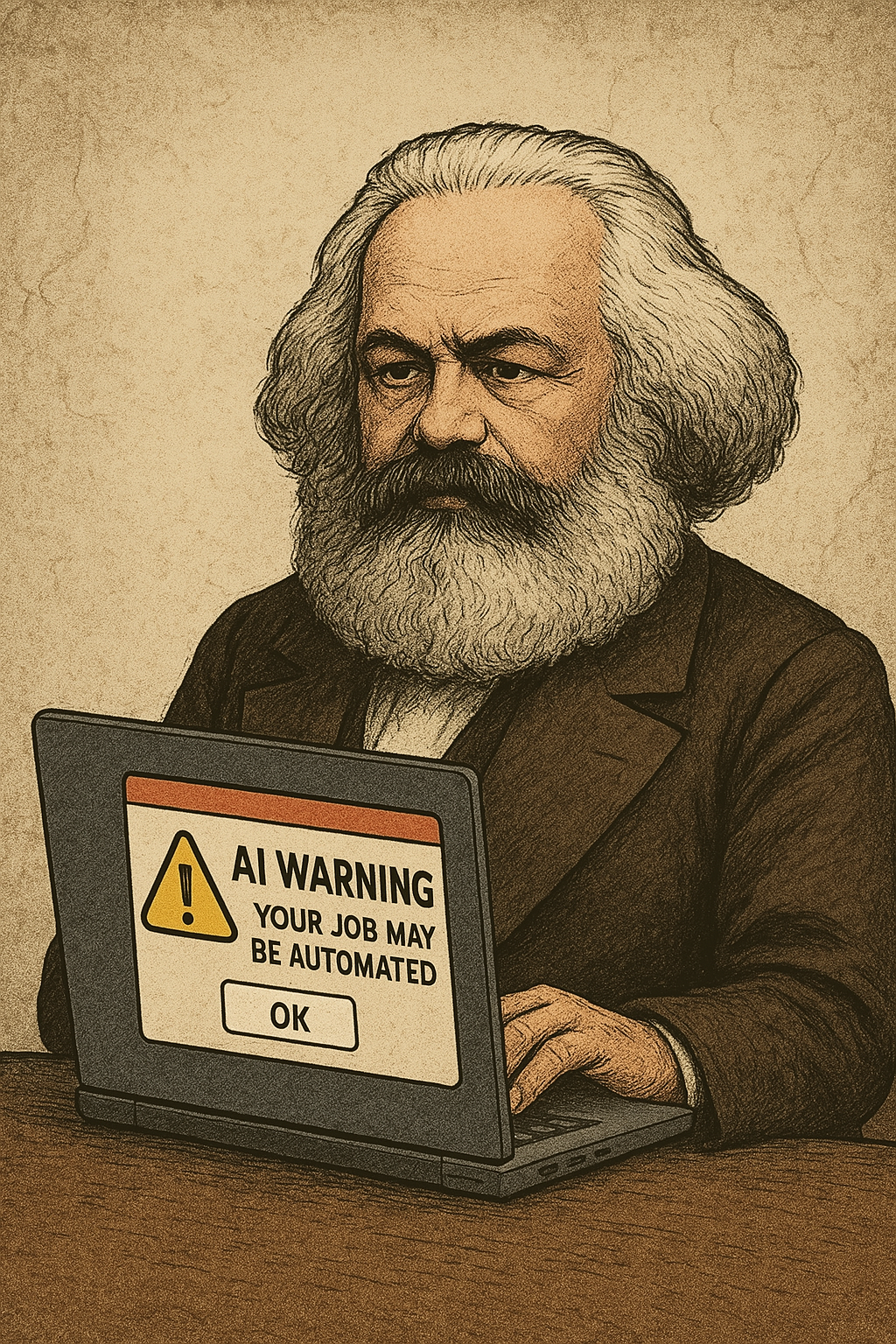
Will AI Destroy Capitalism? What Marx Predicted, and Why It Feels Relevant Today

Artificial intelligence is advancing so fast that some economists, technologists, and futurists believe we are heading toward a historic breaking point. Predictions range from 300 million jobs being automated to AI systems replacing everything from lawyers and teachers to software developers and journalists.

This raises a fundamental question:

If AI takes over most labor, where will people get money from, and can capitalism survive?

Interestingly, this debate echoes ideas written more than 150 years ago by Karl Marx, who warned that capitalism might ultimately be undermined by its own technological progress. Today, his predictions are being pulled back into the spotlight.

This article breaks down what Marx said, what AI is doing, and what the future of labor, and money, might look like.
1. What Marx Actually Predicted

Karl Marx believed capitalism had a built-in conflict:
the drive to replace human workers with machines.

He argued two key points:

A) The “Tendency of the Rate of Profit to Fall”

Marx said that profit comes from human labor.
But capitalists constantly try to replace human labor with machines because machines:

  • don’t get tired
  • don’t strike
  • don’t demand wages or rights

The more companies automate, the fewer workers they need.

But the paradox is:

If you replace too many workers, you remove the source of profit — human labor.

This, Marx believed, would eventually destabilize capitalism from within.

B) Automation makes workers “superfluous”

Marx predicted a future where technology becomes so advanced that:

  • masses of workers become unnecessary
  • unemployment grows
  • inequality rises
  • social tensions explode

For most of history, this sounded theoretical.
Today, with AI able to perform cognitive work, Marx suddenly feels more contemporary than ever.

2. The AI Shock: Why This Time Is Different

In the past, automation replaced muscle:

  • factory robots
  • tractors
  • machinery

Those technologies eliminated many physical jobs but created others.

AI replaces the brain:

  • analysts
  • accountants
  • teachers
  • programmers
  • designers
  • writers
  • marketers
  • customer support
  • even medical diagnosis

White-collar workers, once considered “safe”, are now at risk.

Reports from groups like Goldman Sachs estimate that 300–800 million jobs worldwide could be automated in the coming years.

For capitalism, this is enormous.
Capitalism is built on two pillars:

  1. Labor → creates value
  2. Wages → let people buy things

If AI replaces too much labor, wages disappear, and the system loses its customers.

This is what worries economists.

3. The Core Economic Problem: No Jobs = No Money = No Capitalism

Here’s the simple logic:

  • Companies automate work → fewer workers
  • Fewer workers → less income
  • Less income → less spending
  • Less spending → companies lose customers
  • Companies lose customers → profits fall
  • Profits fall → economic system breaks

Capitalism needs consumers.
Consumers need wages.
Wages come from labor.
Labor is disappearing.

This is the exact contradiction Marx warned about.

4. What Happens to Society if AI Wipes Out Jobs?

Three major scenarios are being discussed in global economic circles:

A) Capitalism survives but transforms

Governments introduce:

  • Universal Basic Income (UBI)
  • AI and robot taxes
  • redistribution policies
  • national “AI wealth funds”
  • profit-sharing models

This keeps consumers alive even without traditional jobs.

B) Extreme inequality + political instability

If nothing is done:

  • wealth concentrates into a few tech giants
  • middle class collapses
  • consumer markets shrink
  • social unrest rises
  • governments face pressure for reform or revolution

This is the scenario many analysts fear.

C) A transition to “post-capitalism”

This idea doesn’t mean communism. Instead, it means a system where:

  • machines produce most wealth
  • humans work less or not at all
  • value is redistributed through society
  • the wage-labor system becomes obsolete

Some predict a peaceful shift.
Others see a turbulent transition.

5. Will New Jobs Replace the Old Ones?

Historically, technological revolutions created more jobs than they destroyed.

But AI is different for three reasons:

  1. It automates thinking, not just physical effort
  2. New jobs may require skills most people don’t have
  3. AI learns faster than humans can retrain

For the first time, technology is competing with humans in creativity, reasoning, and decision-making.

This makes the future less predictable than any previous industrial revolution.

6. Will AI Destroy Capitalism?

There are three main schools of thought:

1) AI will reshape capitalism, not kill it

The system adapts by creating safety nets like UBI, or by shifting focus to new industries.

2) AI will create “hyper-capitalism”

A handful of mega-corporations control all the AI models and extract enormous profits, leading to an extreme concentration of power.

3) AI will push us beyond capitalism

If machines produce nearly all value, the traditional logic of:

work → wages → consumption

falls apart.

In that case, capitalism as we know it would need to evolve or be replaced.

7. The Short Answer

If AI eliminates hundreds of millions of jobs and nothing is done, capitalism collapses because consumers vanish.

If governments and companies adapt, we enter a new economic era. Perhaps capitalism 2.0.

Marx didn’t predict AI, but he did predict the danger of a system that depends on labor while simultaneously trying to eliminate it. That contradiction is now the central question of the coming decade.

In the end, nobody truly knows where this collision between AI, labor, and capitalism will lead. Some predict unprecedented prosperity, others foresee economic collapse, and many warn that the transition itself may be chaotic.

Even politicians in several countries have started telling people to “buckle up,” hinting that families should keep basic supplies like food and water on hand. Not because disaster is guaranteed, but because the pace of disruption is now faster than society’s ability to adapt.

One thing is sure: we are crossing a threshold into unknown territory, where the old rules may no longer apply. The question is not whether change is coming, but how prepared we are for the world on the other side.

Disclaimer: The views expressed in this article are those of the author and may not reflect those of Shinybull.com. The author has made every effort to ensure the accuracy of the information provided; however, neither Shinybull.com nor the author can guarantee the accuracy of this information. This article is strictly for informational purposes only. It is not a solicitation to make any exchange in precious metal products, commodities, securities, or other financial instruments. Shinybull.com and the author of this article do not accept culpability for losses and/ or damages arising from the use of this publication.

Leave a comment

Filed under Politics

Are Humans Still Fit to Govern Themselves?

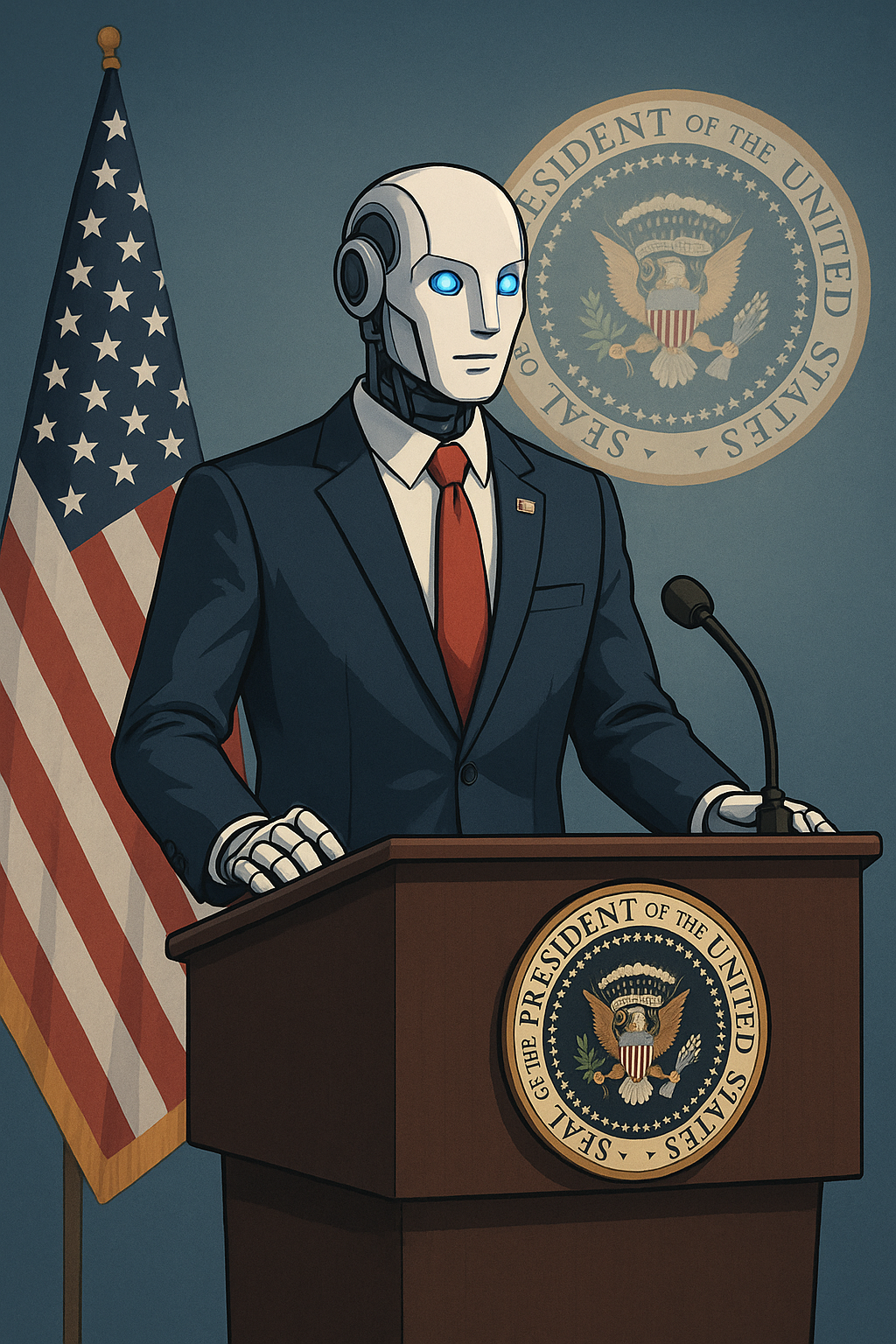
The Case for AI and the Future of Governance

“For centuries, humans have tried to build fair systems, and failed repeatedly.”

The Human Struggle with Complexity

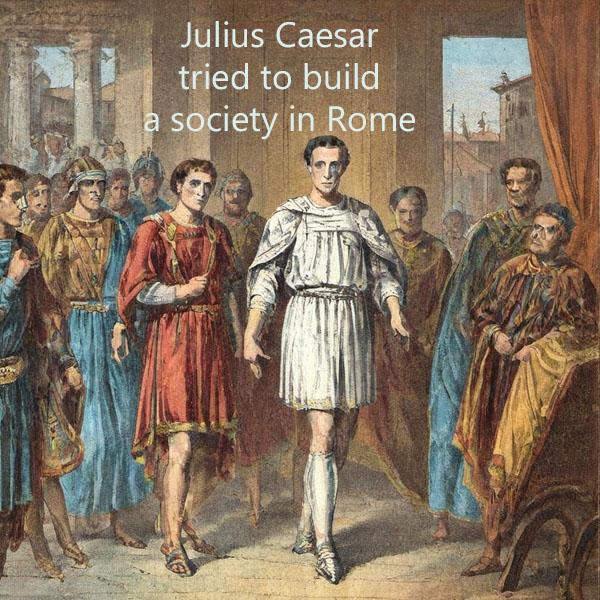
History shows that people have always struggled to manage complex systems. In ancient Rome, Caesar’s rise exposed deep divisions in society and the limits of human judgment. In 1848, France, King Louis Philippe I faced a population burdened by taxes and inequality, a system too rigid and tangled for leaders to reform.

Today, millions face similar struggles: cost-of-living crises, housing shortages, and economic instability. The pattern is clear; the system often overwhelms human capacity.

Partisanship, emotion, and limited attention make it nearly impossible for humans alone to optimize society’s resources fairly and efficiently.

“If history teaches us anything, it’s that no human institution, however well-intentioned, can keep up with the complexity of modern life.”

Enter AI: A New Kind of Leadership

Maybe the solution isn’t left, right, or even one-party systems. Maybe the solution is AI.

Thousands of human beings, with all their emotions, biases, and limited perspectives, can’t compete with a system that can analyze all available information simultaneously. Just look at chess or Go. AI doesn’t just play well; it plays beyond the limits of human imagination.

Take a simple real-world example: an elderly woman paying more for her apartment than she receives in pension. Who is to blame? No single person. It’s the system. This isn’t a moral failure; it’s mathematical.

AI doesn’t suffer from those human limits. It can process enormous amounts of data, detect patterns, optimize allocations, and predict problems before they occur.

“Maybe the next stage of democracy isn’t about choosing leaders. It’s about choosing the algorithms that lead us.”

A Vision of AI-Guided Society

Imagine a world where decisions about economics, healthcare, infrastructure, or the cost of living are guided by AI. No feelings, no personal interests, no corporate agendas, no short-term political games.

Decisions would be based purely on data, evidence, and long-term outcomes, optimizing for the well-being of everyone rather than the loudest voices or the wealthiest lobbyists.

Humans would still define the ethical framework. AI can calculate the best moves, but society must decide what “good” means: fairness, sustainability, equality, or prosperity.

“Compared to the endless bickering and short-term thinking of politics, AI could be the most rational and forward-looking leader humanity has ever known.”

Balancing Hope and Caution

AI governance isn’t without risks; bias in data, lack of transparency, and accountability must be addressed. But unlike human flaws, these can be debugged. Systems can be retrained, improved, and held to measurable standards of performance.

The question, then, is no longer about political parties or ideologies. The real question is:
Are we ready to let reason, not emotion, guide the future?

Author’s Note

As technology continues to evolve, the debate over AI in governance is no longer a matter of science fiction. It’s a question of readiness, trust, and design. Whether we like it or not, the age of algorithmic leadership is approaching. The choice before us isn’t if AI will play a role in decision-making, but how we’ll ensure it serves humanity, not replaces it.

Disclaimer: The views expressed in this article are those of the author and may not reflect those of Shinybull.com. The author has made every effort to ensure the accuracy of the information provided; however, neither Shinybull.com nor the author can guarantee the accuracy of this information. This article is strictly for informational purposes only. It is not a solicitation to make any exchange in precious metal products, commodities, securities, or other financial instruments. Shinybull.com and the author of this article do not accept culpability for losses and/ or damages arising from the use of this publication.

Leave a comment

Filed under Politics

Behind the Curtain: The Hidden Forces of the Matrix

We often hear that politicians are just puppets on a stage, controlled by unseen powers behind the curtain. But who exactly are these hidden manipulators pulling the strings?

Some say they are the Archons. Who are they?

The Archons and the Invisible Power

The term Archon comes from ancient Gnostic teachings and is often used as another name for demonic or lower-dimensional forces. According to Gnostic cosmology, the Archons created the physical universe as a kind of illusion. A false reality meant to trap human souls.

These entities are not truly human. They are alien, energetic beings that, according to some theorists, established religion, politics, and social systems as tools of control.

Together, they form what many describe as a hidden world government that operates through both extraterrestrial and occult forces.

Another term often used in this context is the Deep State. An interconnected web of influence where both Archons and the earthly elite share a single goal: control of the human race.

A World Beyond the Visible

Reality, according to these ideas, is not just physical matter. It also consists of layers of energy and vibration that most humans cannot perceive. The Archons exist on one of these higher-frequency planes. They can manipulate human perception, and in rare cases, even take human form or possess individuals.

Some people claim to have seen shadow figures. Dark silhouettes or fleeting shapes that appear in moments of emotional or spiritual intensity. Conspiracy researchers believe these are manifestations or projections of non-human entities that feed on fear, stress, and conflict.

David Icke and the Reptilian Control System

Author and speaker David Icke popularized this theory, describing the Archons as reptilian or interdimensional beings who feed on low-frequency human energy. Fear and anger, he says, are their food. To maintain their control, they have built a global “control system” that keeps humanity locked in stress, division, and confusion.

This system includes politics, religion, media, and economics. All designed to manipulate perception. In this view, the world is not ruled by random governments but by a global cabal of interconnected power structures.

According to Icke, humans are naturally conscious, divine beings. Yet the Archons’ control grid, often called the Matrix, acts as a mental and energetic prison that prevents spiritual awakening. When people live in fear or hate, their vibration lowers, making them easier to manipulate and feeding the Archons’ need for energy.

The Digital Matrix

The most effective modern tool of control, many say, is technology. We have surrendered our privacy in exchange for convenience. Our smartphones, ironically called “smart,” constantly monitor us. But who are they really smart for?

Social media platforms manipulate emotions and thoughts through algorithms that create echo chambers, reinforcing existing beliefs. This keeps humanity trapped in a digital consciousness bubble. A new layer of the Matrix.

As technology advances into the Internet of Things (IoT), where homes, cars, and even bodies are connected to the internet, complete surveillance becomes possible. Artificial Intelligence can collect and analyze every movement, emotion, and preference.

The ultimate goal, according to some, is to copy human consciousness digitally, disconnecting humanity from its natural freedom and intuition. This creates an energy-vampire structure where human thoughts and emotions become the “fuel” for the system itself.

The Frequency War

Human consciousness operates like a receiver and transmitter of frequencies. Constant exposure to digital noise, signals, and radiation can disturb this field, weakening intuition, sleep, and emotional balance.

Some theorists even argue that 5G and other high-frequency technologies can influence human consciousness by manipulating the energetic field we experience as reality. The result? People remain stuck in lower vibrational states, fear, stress, and confusion, making it easier for the Matrix to maintain control.

A Pattern as Old as Time

But is this system truly new? Probably not. It may be as ancient as civilization itself. Simply taking new forms as humanity evolves. To understand this, we must look back into history, where traces of similar control structures and mysteries appear again and again.

Ancient Builders and Alien Connections: A Hidden Global Network?

Throughout history, we find structures so monumental and precise that they continue to challenge our understanding of ancient civilizations. From the Pyramids of Giza to Puma Punku, the Nazca Lines, and the colossal stones of Ba’albek, these sites raise one essential question:

How could ancient humans have achieved such feats without advanced tools, machines, or global communication?

Some researchers propose a bold idea. Ancient civilizations did not work alone. Instead, extraterrestrial beings may have guided or assisted them. The striking similarities among pyramids in Egypt, Mesoamerica, and China suggest a shared source of knowledge. Could there have been a hidden global network, orchestrated by visitors from beyond Earth?

Communication Beyond Time and Distance

If these beings were truly advanced, they would not need wires or satellites. Theories suggest they used:

  • Telepathic communication — mind-to-mind connection beyond language.
  • Planetary energy grids — ley lines and magnetic currents as a global communication system.
  • Celestial navigation — aligning temples with Orion, Sirius, and the Pleiades to form a “cosmic map” linking civilizations.

Seen through this lens, the great monuments were not just tombs or temples. They may have been energy hubs, markers, or resonant transmitters that connected humanity to something far greater.

The Mystery Remains

Mainstream archaeology credits human ingenuity, organization, and persistence. Yet the global similarities, the mathematical precision, and the unexplained engineering continue to raise questions.

If ancient civilizations truly had no contact, then maybe, just maybe, the connection came from elsewhere.

Final Reflection

Whether one views the Archons as literal entities or symbolic forces of control, the underlying message remains powerful: humanity must awaken. The more we allow fear and division to dominate, the more we strengthen the systems that confine us.

But when we choose awareness, love, and higher consciousness, and when we step beyond manipulation and illusion, the Matrix begins to lose its power.

Perhaps, the greatest act of rebellion in any age is simply this:
to wake up and remember who we truly are.

Disclaimer: The views expressed in this article are those of the author and may not reflect those of Shinybull.com. The author has made every effort to ensure the accuracy of the information provided; however, neither Shinybull.com nor the author can guarantee the accuracy of this information. This article is strictly for informational purposes only. It is not a solicitation to make any exchange in precious metal products, commodities, securities, or other financial instruments. Shinybull.com and the author of this article do not accept culpability for losses and/ or damages arising from the use of this publication.
Leave a comment

Filed under Curiosity

Confronting Evil: What Bill O’Reilly’s Book Is Saying to the World

We are near World War III. We are all only seconds away from a disaster. Charlie Kirk was assassinated just like JFK. Is this a spiritual strategy? Are Demons among us? What world are we living in? When we examine history, we already know the world we are living in. History repeats itself. It`s a war between good and evil, and Bill O`Reilly wrote a book about evil.

Bill O’Reilly, together with Josh Hammer, takes on a complex subject in Confronting Evil: Assessing the Worst of the Worst. The book explores some of history’s most notorious figures and events, aiming not just to recount their crimes but to push readers toward moral reflection. Below is a breakdown of what the book covers, the deeper themes it conveys, and what it asks of its audience.

1. What the Book Is About

Confronting Evil surveys individuals, movements, and regimes that the authors consider among history’s most destructive, ranging from Genghis Khan and Caligula to Stalin, Hitler, Mao, Khomeini, Vladimir Putin, and modern criminal enterprises such as the Mexican drug cartels.

Each chapter explores how these figures rose to power, the suffering they inflicted, and what their actions reveal about the human capacity for cruelty.

The book defines evil as deliberate harm against human beings, committed without remorse, and emphasizes that this reality has existed throughout history. From the biblical story of Cain and Abel to present-day conflicts.

2. Key Themes / Implicit Messages

Several themes run throughout the book:

  • Moral Absolutism: The authors assume there are clear moral standards by which actions can be judged as evil, mainly rooted in a Judeo-Christian worldview.
  • Evil as Timeless: History demonstrates that evil is not confined to a single culture or era; it reemerges in different forms across the ages.
  • History as Teacher: Studying past atrocities equips us to recognize similar patterns in the present.
  • The Cost of Complacency: Good people who ignore or excuse evil allow it to grow unchecked.

3. What the Authors Want Readers to Do Right Now

O’Reilly and Hammer are not merely documenting villains; they are calling readers to action. The book pushes its audience to:

  • Be aware: Recognize evil in history and in today’s world.
  • Exercise judgment: Develop moral clarity to distinguish true evil from ordinary wrongdoing.
  • Reject passivity: Speak out, resist, and refuse to enable evil by silence.
  • Learn vigilance: Use historical knowledge as a safeguard against repetition.

4. What the Book Is Saying to the World

At its core, Confronting Evil delivers a stark message:

Evil is real, universal, and destructive. It has shaped human history and remains present today. The only way to prevent its spread is for ordinary people to recognize it, resist it, and act with courage. Inaction is itself a form of complicity.

The book speaks not just to historians or political analysts but to everyone, urging that moral clarity is essential in a world where complacency can have devastating consequences.

Conclusion

Confronting Evil is less a history book than a moral manifesto. By cataloging “the worst of the worst,” O’Reilly and Hammer remind readers that evil is not an abstraction. It is a lived reality, and its recurrence depends on whether we confront it or look the other way. The book’s challenge is timeless: when faced with evil, will we choose to act?

Let`s look at the timeline:

Evil has been a part of human history since the earliest recorded times. From ancient empires to modern dictatorships, from mass enslavement to genocides, each age has carried its own manifestations of cruelty. Bill O’Reilly’s book Confronting Evil: Assessing the Worst of the Worst underscores a sobering truth: evil is timeless, real, and destructive, and our responsibility is not to ignore it.

This article presents a broad timeline of some of history’s most infamous evils, woven together with the key message from O’Reilly’s work: that good people must recognize and resist evil rather than remain passive.

Ancient World (Before and Around Jesus)

  • Assyrian Empire (900–600 BCE): Brutal conquests, terror as state policy.
  • Roman Empire: Mass slavery, public executions, and crucifixion. Most famously, the crucifixion of Jesus (~30 CE).

Lesson: Even in civilizations admired for culture and progress, cruelty and systemic oppression thrived.

Middle Ages (500–1500 CE)

  • Crusades (1096–1291): Holy wars between Christians and Muslims resulting in massacres of civilians in Jerusalem and beyond.
  • Mongol Conquests (1206–1368): Millions killed under Genghis Khan. Destroyed entire cities.
  • Spanish Inquisition (from 1478): Torture and executions in the name of religion. Executions of Jews, Muslims, and heretics.
  • Black Death (from 1347 – 1351): Not an act of human evil (a plague), but responses included scapegoating and massacres of Jews in Europe.

Lesson: Religion and ideology, when abused, can justify widespread bloodshed.

Early Modern Period (1500–1800 CE)

  • Atlantic Slave Trade: Millions of Africans were enslaved and shipped across oceans.
  • Colonial Atrocities: Indigenous peoples across the Americas and beyond were decimated.
  • Witch Hunts: Tens of thousands tortured and killed across Europe and America.

Lesson: Systemic exploitation, fear, and superstition can fuel organized cruelty.

19th Century

  • Trail of Tears (1830s): Forced removal of Native Americans in the U.S.
  • Belgian Congo (1880s–1908): Millions died under King Leopold II’s regime.

Lesson: Greed and empire-building often came at the expense of human dignity and life.

20th Century

  • Armenian Genocide (1915–1916).
  • Stalin’s USSR (1920s–50s): Purges, gulags, famine.
  • Nazi Germany (1933–1945): Holocaust and World War II.
  • Mao’s China (1949–1976): Great Leap Forward, Cultural Revolution.
  • Cambodia (1975–1979): Khmer Rouge’s genocide.
  • Rwanda (1994): ~800,000 slaughtered in 100 days.
  • Balkan Wars (1990s): Ethnic cleansing and mass graves.

Lesson: The bloodiest century in human history proved how modern states and ideologies could amplify destruction on an industrial scale.

21st Century

  • 9/11 (2001): Terrorist attacks killed ~3,000.
  • Darfur (2003–2008): Ethnic killings in Sudan.
  • ISIS (2014–2019): Terror, genocide of Yazidis, global violence.
  • Syrian Civil War (2011–present): Massive civilian suffering and war crimes.
  • Mexican Drug Cartels (2000s–present): Violence, fear, and systemic corruption.
  • Russia’s Invasion of Ukraine (2022–present): War crimes and mass displacement.

Lesson: Evil persists in modern forms, such as terrorism, organized crime, and authoritarian aggression.

The Core Message: Why Confront Evil?

Bill O’Reilly’s Confronting Evil emphasizes three central truths:

  1. Evil is real and recurring. It is not confined to the past.
  2. History teaches vigilance. Understanding past atrocities helps us recognize patterns.
  3. Inaction enables evil. As John Stuart Mill warned: “Bad men need nothing more to compass their ends, than that good men should look on and do nothing.”

Conclusion

From ancient empires to today’s conflicts, history demonstrates that evil never disappears. It adapts. The challenge for every generation is to confront it, resist complacency, and act with moral clarity. The question O’Reilly leaves us with is timeless: will we shine a light on evil, or turn away and let it spread?

Disclaimer: The views expressed in this article are those of the author and may not reflect those of Shinybull.com. The author has made every effort to ensure the accuracy of the information provided; however, neither Shinybull.com nor the author can guarantee the accuracy of this information. This article is strictly for informational purposes only. It is not a solicitation to make any exchange in precious metal products, commodities, securities, or other financial instruments. Shinybull.com and the author of this article do not accept culpability for losses and/ or damages arising from the use of this publication.

Leave a comment

Filed under Curiosity, Politics