
Tag Archives: Karl Marx

Will AI Destroy Capitalism? What Marx Predicted, and Why It Feels Relevant Today

Artificial intelligence is advancing so fast that some economists, technologists, and futurists believe we are heading toward a historic breaking point. Predictions range from 300 million jobs being automated to AI systems replacing everything from lawyers and teachers to software developers and journalists.

This raises a fundamental question:

If AI takes over most labor, where will people get money from, and can capitalism survive?

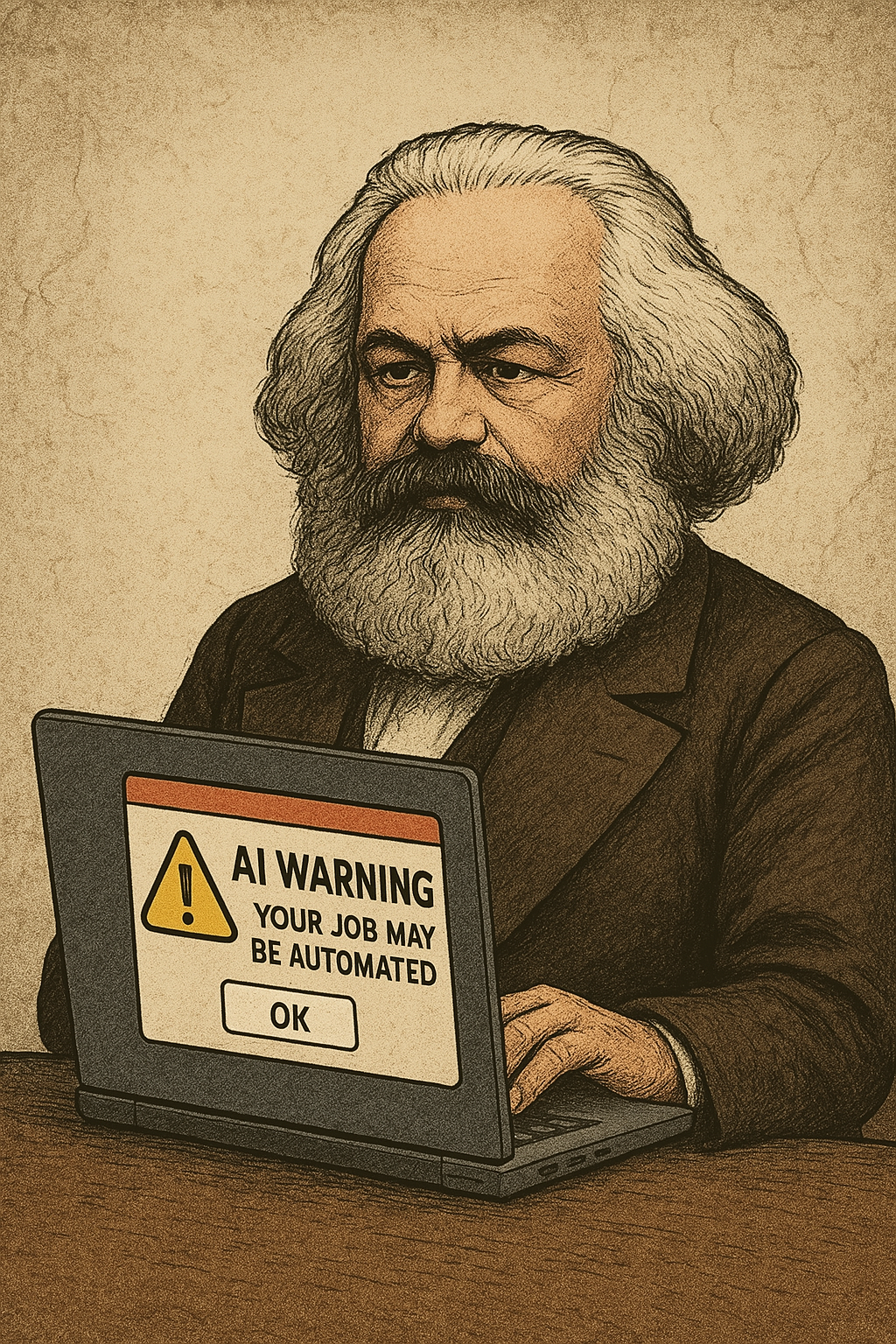
Interestingly, this debate echoes ideas written more than 150 years ago by Karl Marx, who warned that capitalism might ultimately be undermined by its own technological progress. Today, his predictions are being pulled back into the spotlight.

This article breaks down what Marx said, what AI is doing, and what the future of labor, and money, might look like.
1. What Marx Actually Predicted

Karl Marx believed capitalism had a built-in conflict:
the drive to replace human workers with machines.

He argued two key points:

A) The “Tendency of the Rate of Profit to Fall”

Marx said that profit comes from human labor.
But capitalists constantly try to replace human labor with machines because machines:

  • don’t get tired
  • don’t strike
  • don’t demand wages or rights

The more companies automate, the fewer workers they need.

But the paradox is:

If you replace too many workers, you remove the source of profit — human labor.

This, Marx believed, would eventually destabilize capitalism from within.

B) Automation makes workers “superfluous”

Marx predicted a future where technology becomes so advanced that:

  • masses of workers become unnecessary
  • unemployment grows
  • inequality rises
  • social tensions explode

For most of history, this sounded theoretical.
Today, with AI able to perform cognitive work, Marx suddenly feels more contemporary than ever.

2. The AI Shock: Why This Time Is Different

In the past, automation replaced muscle:

  • factory robots
  • tractors
  • machinery

Those technologies eliminated many physical jobs but created others.

AI replaces the brain:

  • analysts
  • accountants
  • teachers
  • programmers
  • designers
  • writers
  • marketers
  • customer support
  • even medical diagnosis

White-collar workers, once considered “safe”, are now at risk.

Reports from groups like Goldman Sachs estimate that 300–800 million jobs worldwide could be automated in the coming years.

For capitalism, this is enormous.
Capitalism is built on two pillars:

  1. Labor → creates value
  2. Wages → let people buy things

If AI replaces too much labor, wages disappear, and the system loses its customers.

This is what worries economists.

3. The Core Economic Problem: No Jobs = No Money = No Capitalism

Here’s the simple logic:

  • Companies automate work → fewer workers
  • Fewer workers → less income
  • Less income → less spending
  • Less spending → companies lose customers
  • Companies lose customers → profits fall
  • Profits fall → economic system breaks

Capitalism needs consumers.
Consumers need wages.
Wages come from labor.
Labor is disappearing.

This is the exact contradiction Marx warned about.

4. What Happens to Society if AI Wipes Out Jobs?

Three major scenarios are being discussed in global economic circles:

A) Capitalism survives but transforms

Governments introduce:

  • Universal Basic Income (UBI)
  • AI and robot taxes
  • redistribution policies
  • national “AI wealth funds”
  • profit-sharing models

This keeps consumers alive even without traditional jobs.

B) Extreme inequality + political instability

If nothing is done:

  • wealth concentrates into a few tech giants
  • middle class collapses
  • consumer markets shrink
  • social unrest rises
  • governments face pressure for reform or revolution

This is the scenario many analysts fear.

C) A transition to “post-capitalism”

This idea doesn’t mean communism. Instead, it means a system where:

  • machines produce most wealth
  • humans work less or not at all
  • value is redistributed through society
  • the wage-labor system becomes obsolete

Some predict a peaceful shift.
Others see a turbulent transition.

5. Will New Jobs Replace the Old Ones?

Historically, technological revolutions created more jobs than they destroyed.

But AI is different for three reasons:

  1. It automates thinking, not just physical effort
  2. New jobs may require skills most people don’t have
  3. AI learns faster than humans can retrain

For the first time, technology is competing with humans in creativity, reasoning, and decision-making.

This makes the future less predictable than any previous industrial revolution.

6. Will AI Destroy Capitalism?

There are three main schools of thought:

1) AI will reshape capitalism, not kill it

The system adapts by creating safety nets like UBI, or by shifting focus to new industries.

2) AI will create “hyper-capitalism”

A handful of mega-corporations control all the AI models and extract enormous profits, leading to an extreme concentration of power.

3) AI will push us beyond capitalism

If machines produce nearly all value, the traditional logic of:

work → wages → consumption

falls apart.

In that case, capitalism as we know it would need to evolve or be replaced.

7. The Short Answer

If AI eliminates hundreds of millions of jobs and nothing is done, capitalism collapses because consumers vanish.

If governments and companies adapt, we enter a new economic era. Perhaps capitalism 2.0.

Marx didn’t predict AI, but he did predict the danger of a system that depends on labor while simultaneously trying to eliminate it. That contradiction is now the central question of the coming decade.

In the end, nobody truly knows where this collision between AI, labor, and capitalism will lead. Some predict unprecedented prosperity, others foresee economic collapse, and many warn that the transition itself may be chaotic.

Even politicians in several countries have started telling people to “buckle up,” hinting that families should keep basic supplies like food and water on hand. Not because disaster is guaranteed, but because the pace of disruption is now faster than society’s ability to adapt.

One thing is sure: we are crossing a threshold into unknown territory, where the old rules may no longer apply. The question is not whether change is coming, but how prepared we are for the world on the other side.

Disclaimer: The views expressed in this article are those of the author and may not reflect those of Shinybull.com. The author has made every effort to ensure the accuracy of the information provided; however, neither Shinybull.com nor the author can guarantee the accuracy of this information. This article is strictly for informational purposes only. It is not a solicitation to make any exchange in precious metal products, commodities, securities, or other financial instruments. Shinybull.com and the author of this article do not accept culpability for losses and/ or damages arising from the use of this publication.


Leave a comment

Filed under Politics

Zohran Mamdani is the next New York City Mayor and the storm is coming

Zohran Mamdani is the next New York City Mayor. He is a muslim, anti-Trump, Anti-capitalist, and will make free buses for the people in New York. At the same time, he will tax the rich. Trump moved out of New York long ago. So do many other wealthy people in New York.

Not only that. More than 1 million Orthodox Jews have escaped New York. Maybe we will see more jews escape New York as a muslim is their new Mayor. Time will show. But, there is no doubt; A massive storm is coming! Put your steel helmet on and fasten your seatbelt.

On the other hand, what we see today is not something new. This is how the system works. It goes, and then it goes down again, and again, and again. The crisis in New York has nothing to do with the Mayor. This is happening all over in the West. It is the system. Not the Mayor.

The Returning Storm: Capitalism’s Crisis & the Echoes of 1848

We hear it again and again: that the system is failing large numbers of people. The working class is struggling, costs are skyrocketing, and the ladder of opportunity seems broken. That’s why many vote for socialists: they look at the system not as a solution, but as the problem. But why does capitalism still persist when it doesn’t work for everyone?

Karl Marx saw it clearly: capitalism is built on the exploitation of workers (the proletariat) by those who own and control the means of production (the bourgeoisie). The extraction of surplus value, alienation of labour, cycles of boom and bust, and rising inequality. He argued that all of it spells eventual collapse, ushering in a socialist revolution.

Maybe what we’re witnessing now is not a violent revolution with barricades and guillotines, but a democratic and social one: a shift in consciousness, a call for new economic arrangements.

A Story That Shows What’s Wrong

Imagine an old woman in Spain who has lived in her apartment for seventy years. Her home is her past, her memories, her identity. Now, an American hedge fund buys the building. Her rent shoots up far beyond what her pension covers. She’s told: “Move out or pay the price.”


What kind of capitalism is this? Where the place you’ve lived your entire life, the neighbourhood you know, becomes a profit asset to someone else, and you, the tenant, are simply a cost-to-be-cut or revenue-to-be-raised.


This isn’t small-scale displacement; it’s systemic.

According to research, private equity firms now own a significant share of the U.S. housing stock, and their business model often involves raising rents, cutting maintenance, and treating homes as profit centres.


When individuals who’ve paid their dues, who’ve worked and saved, are pushed aside so someone else can “monetize” their roof, the legitimacy of the system is damaged.

1848 and the Warning from History

Nine years ago, I wrote an article about the French Revolution, and I need to get back to that story once again. Back in February 1848 in France, the blueprint of revolt was laid bare. The monarchy of Louis Philippe, once hailed as a “Citizen King,” had drifted away from the people. Wages collapsed, food prices soared, and despair turned to anger. When the government repressed the protests, Paris erupted in barricades. The king fled, and a second French Republic was proclaimed.

The lesson is clear: when a system fails the many and protects the few, the many find a voice. When inequality is visible, persistent, and reinforced by institutions that claim neutrality, resistance builds. The revolution of 1848 was not just about a king dying. It was about legitimacy dissolving.

So, Why Do We Still Have Capitalism?

Because it works. For some.
Because markets deliver dynamism, innovation, and wealth. If measured for the few.
Because institutions decide the rules and often shield the winners.
Because alternatives are messy, unproven, and intimidating for those who benefit now.

Yet the crisis is also structural. The logic of profit demands cost-cutting, evictions, rent hikes, financialization of housing, and commodification of basic needs. When a woman who’s lived somewhere for 70 years is priced out overnight, that’s not a bug. It’s a feature of the system.

Are We on the Edge of a New Revolution?

Perhaps. Not in the storm-and-fury sense, but in the long, accumulating demand for change. When politicians like Zohran Mamdani win with promises of free buses, rent freezes, and groceries for all, the message is: the old order is brittle. The working class has been squeezed too long. The vote is a signal.

But the storm won’t vanish just with promises. The funding model matters. The rents, taxes, business flight, and investment flows. All these determine whether change can be real or become another wave of disappointment.

The Elderly Woman and the Bigger Question

When you see her story. 70 years of life, on a fixed income, facing eviction because of global capital chasing returns, you understand what’s at stake. It’s not just housing. It’s dignity. It’s the promise of stability. It’s the belief that society isn’t only for the rich.

And when capitalism no longer delivers that promise for large swathes of people, then the logic of Marx begins to look less like ideology and more like prophecy.

In 1848 they overthrew a king.
In 2025 they may overthrow the illusion. The illusion that capitalism still works for everyone.

The storm is coming

It might be messy. It might be uncomfortable. But history shows us that when systems stop working for most people, change happens.
So ask yourself:

Are we watching the death of the promise of capitalism as we knew it?
Or are we witnessing its evolution — into something fairer, more inclusive, more human?

Closing thought

In 1848, they forced the king to abdicate. Today, maybe we don’t need to kill a king. We need to kill the illusion that this system works for everyone. Change isn’t coming tomorrow. It’s already knocking at the door.

Disclaimer: The views expressed in this article are those of the author and may not reflect those of Shinybull.com. The author has made every effort to ensure the accuracy of the information provided; however, neither Shinybull.com nor the author can guarantee the accuracy of this information. This article is strictly for informational purposes only. It is not a solicitation to make any exchange in precious metal products, commodities, securities, or other financial instruments. Shinybull.com and the author of this article do not accept culpability for losses and/ or damages arising from the use of this publication.
Leave a comment

Filed under Politics

The United States are growing faster than China

The world`s biggest economy is the United States followed by China, and sooner or later, China will replace the locomotive and be the biggest economy in the world. You can delay it, but it will happen in this century anyway.

They are both in conflict with each other with tariff tensions and a trade war. A strategy that is bad for both of them in the long run. The U.S is waiting for China to come to the table and make a fair deal. Today is the first day of talks to renegotiate the trade dispute between them. A deal that President Donald Trump repudiated.

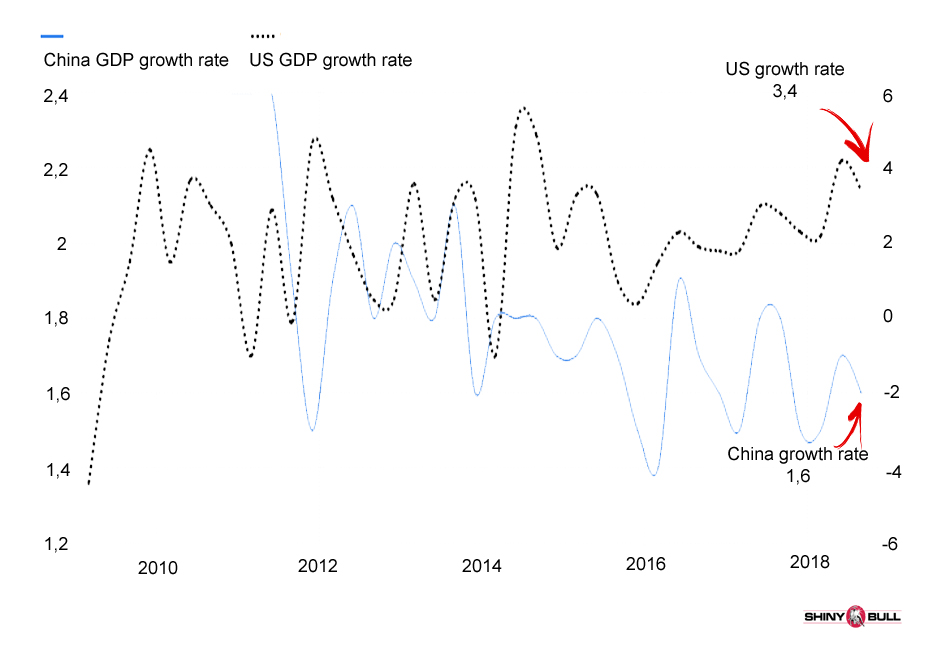
Take a look at the chart above. Surprisingly, the U.S is more productive than China. Twice as much. The US economy advanced an annualized 3,4 percent on quarter in the third quarter of 2018 while the Chinese economy grew by “only” 1,6 percent quarter-on-quarter in the three months to September last year.

The Chinese economy is slowing and this has been going on for a while. But it`s not because of the trade war. China obviously have some problems and the China-U.S tension is one of them, but this is not the first time China and the U.S are in conflict with each other.

Deng Xiaoping and President Jimmy Carter signed a historic accord in 1979 and then reversed decades of China-U.S tension. Deng Xiaoping was a Chinese revolutionary and veteran of the Communist Party and he was eager to adopt capitalist methods and reforms in order to stimulate economic growth and restore confidence in the party.

Today, China has embraced capitalism but remains Leninist at heart. The founder of the Soviet Union, and his Bolshevik revolution, Vladimir Lenin changed China`s economic and political landscape.

Lenins Russian revolution in 1917 have a causal relationship with the birth of Chinas Communist Party in 1921 and the founding of the People`s Republic of China in 1949. As Mao Zedong once said: “The salvoes of the October revolution brought Marxism-Leninism to China.”

Lenin has played a much bigger role in China than Karl Marx and Friedrich Engels. The wholesale execution of enemies inspired Mao`brutal dictatorship and his launch of the Cultural Revolution under the theory of “continuous revolution under the dictatorship of the proletariat.”

Now, China has changed dramatically since Deng Xiaopings free-market reforms and Maos terrifying Leninist experiment in utopia. Now, China is the world`s second largest economy. 70 percent of the “socialist” economy is privately owned and nobody have more billionaires than China right now.

China is more a Leninist capitalist state than a Marxist socialist one. 800 million people in the middle class has jumped on the consumerism train in only a couple of decades under the stewardship of communist totalitarianism. Leninism`s lasting legacy.

On the other side, China has a debt crisis and a real estate bubble, so the question is; when will China collapse, and will it cause a global crisis? China is declining and it will continue to do so. Lending money to Kenya or Venezuela to name a few, are putting them all in a debt trap and it remain to see that Beijing can afford it. I`m in doubt.

Xi Jinping and his leaders know that they are in a very weak position, so they have to come to the table and make a deal with the U.S.

The stock market is in a correction territory at the moment. Investors have priced in two rate hikes this year and some U.S-China tension fear, but Trump reports “Big Progress” in trade talks with China were top trained negotiators came to the table earlier today.

Disclaimer: The views expressed in this article are those of the author and may not reflect those of Shiny bull. The author has made every effort to ensure accuracy of information provided; however, neither Shiny bull nor the author can guarantee such accuracy. This article is strictly for informational purposes only. It is not a solicitation to make any exchange in precious metal products, commodities, securities or other financial instruments. Shiny bull and the author of this article do not accept culpability for losses and/ or damages arising from the use of this publication.


Leave a comment

Filed under Politics