
Tag Archives: Julius Caesar

The cost of living and the blame game

People are angry, and that’s why they voted for Mamdani as the next Mayor of New York.
People are sick and tired of struggling to make ends meet. In his victory speech, Mamdani said:

“We choose hope over tyranny. Hope over big money and small ideas. Hope over despair. Tonight, we have stepped out from the old into the new.”

His supporters are already marching in the streets, saying they don’t want Trump as a king or a dictator.

Hmm… I think I’ve heard this before.
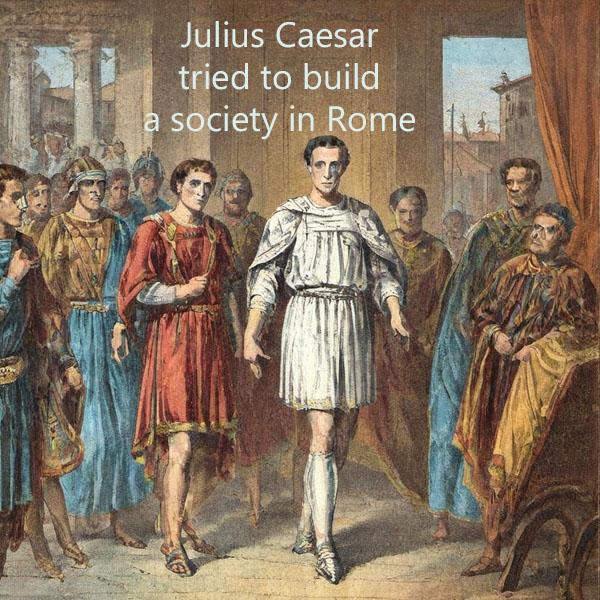
More than two thousand years ago, in Rome, another man was accused of wanting to be king.
His name was Julius Caesar.

A group of Roman senators assassinated Caesar out of fear that his growing power and titles, especially dictator for life, would destroy the Roman Republic.
They claimed they were saving democracy, but their actions plunged Rome into chaos and civil war.

It was a betrayal that changed history, and a reminder of how fear, power, and instability often go hand in hand.

History Repeats Itself

Fast forward to France, 1848. The people were exhausted. Food prices were soaring, unemployment was rising, and inequality had reached unbearable levels.
King Louis Philippe I, once known as the Citizen King, had promised a fairer, more modern France. But over time, his government became detached from ordinary people’s struggles.

One of the main sources of anger was the tax system. The poor and working class bore a heavy burden through indirect taxes on essentials like food, salt, and fuel, while wealthy landowners and property owners paid relatively little. Voting rights were also tied to property ownership, meaning most citizens had no political voice. When food prices spiked in the late 1840s, ordinary people were paying high taxes on top of already expensive necessities. Economic frustration reached a tipping point.

People in New York voted for Mamdani, who wants to raise taxes and, at the same time, give people fast and free buses. How is that going to be?

When protests erupted in February 1848, the king tried to silence them. Instead, the anger exploded.
Barricades filled the streets of Paris, and after just a few bloody days, Louis Philippe abdicated the throne and fled to England in disguise.

The monarchy collapsed. The Second Republic was born.
But what came next? A new leader. Louis-Napoleon Bonaparte, nephew of Napoleon I, rose to power, promising to restore stability and hope. Within four years, he declared himself Emperor.

Sound familiar?

It’s the same old story: people rise up against a system they believe is unjust, only to end up under a new one that looks strangely similar.
Each era has its slogans: “liberty,” “hope,” “change,” “the people’s revolution”, yet the same problems remain. Prices go up. Ordinary citizens struggle. The rich adapt and survive.

Take a look at France today with its Yellow Vest protesters. People are struggling with their cost of living. I wrote an article about that for the first time, many years ago. And who is to blame now? The King? Napoleon? No, it`s Macron.

So, Why Are Prices Rising Again?

The cost of living has become the defining issue of our time. Food, housing, and energy prices are rising faster than wages. Families feel squeezed, not just in New York or Paris, but across the Western world.

But who is to blame?

It’s tempting to point the finger at politicians, corporations, or billionaires. Yet the truth is more complex. The problem isn’t one person. It’s the system itself.

A mix of factors drives today’s inflation:

  • Global supply chain disruptions from the pandemic and wars.
  • Energy shocks as the world shifts away from fossil fuels.
  • Corporate pricing power in markets where competition has shrunk.
  • Decades of easy money and debt have inflated asset prices but left wages behind.

Governments print money to stimulate the economy, corporations raise prices to protect profits, and central banks hike interest rates to cool inflation, all while ordinary people pay the price.

It’s a cycle that keeps repeating, no matter the century. In ancient Rome, it was grain shortages. In 1848, in France, it was bread and taxes. Today, it’s rent and electricity.

The Real Lesson

Historically, when people struggle, they often look for someone to blame, such as a king, a tyrant, or a president. Get rid of Trump, and everything will be fine. Get rid of Macron, and the sun will shine. They think removing the person will fix the system. But as history shows us, that rarely works.

Trump isn’t the cause of America’s problems. He’s a symptom of them.
Just as Caesar wasn’t the reason Rome was collapsing, but rather the outcome of deep divisions and economic inequality that had built up for years.

When the cost of living becomes unbearable, people revolt. Sometimes at the ballot box, sometimes in the streets.

But unless we learn from history, each “revolution” just sets the stage for the next crisis.

In the end, it’s not about kings or dictators. It’s about systems.
And if we don’t fix the system, the anger, fear, and struggle will continue. Just as it has for more than 2,000 years.

Disclaimer: The views expressed in this article are those of the author and may not reflect those of Shinybull.com. The author has made every effort to ensure the accuracy of the information provided; however, neither Shinybull.com nor the author can guarantee the accuracy of this information. This article is strictly for informational purposes only. It is not a solicitation to make any exchange in precious metal products, commodities, securities, or other financial instruments. Shinybull.com and the author of this article do not accept culpability for losses and/ or damages arising from the use of this publication.

Leave a comment

Filed under Politics

Elon Musk is “person of the year” 2021

He is the richest man in the world and does not own a house. He also has the biggest robot company in the world. He drives a car he created that uses no gas and barely needs a driver. He is the man behind SpaceX and dreams of Mars.

He`s a player in robots and solar, cryptocurrency and climate, brain-computer implants to stave off the menace of artificial intelligence, and underground tunnels to move people and freight at super speeds.

He is criticized by socialists and especially Elizabeth Warren who tweeted this on December 13; «Let`s change the rigged tax code so The Person of the Year will actually pay taxes and stop freeloading off everyone else.»

Musk tweeted this on Wednesday; «And if you opened your eyes for 2 seconds, you would realize I will pay more taxes than any American in history this year.» The fact is that Musk must pay a record-breaking $15 billion tax bill.

This is money that goes straight into the pocket of the Socialists who very often claim to «take the bill.» for something. But as you clearly can see, the money comes from entrepreneurs like Elon Musk.

The tax bill is probably the real reason he`s selling a large chunk of Tesla shares. But he can afford to do it because $15 billion in taxes is just a small part of his wealth. According to Bloomberg Billionaire Index, his net worth is $255 billion. In other words; he is on top of that list.

Elon Musk is the man who aspires to save our planet and get us a new one to inhabit; clown, genius, edgelord, visionary, industrialist, showman, cad; a madcap hybrid of Thomas Edison, P.T. Barnum, Andrew Carnegie, and Watchmen`s Doctor Manhattan, the brooding, blue-skinned man-god who invents electric cars and moves to Mars.

Tesla controls two-thirds of the multibillion-dollar electric vehicle market it pioneered and is valued at a cool $1 trillion. That has made Musk the richest private citizen in history, at least on paper.

The tech entrepreneur Elon Musk revealed earlier this year that he has Asperger`s syndrome while appearing on the US comedy sketch series Saturday Night Live (SNL). But Musk has spent a lifetime defying the haters, now, it seems, he`s finally in a position to put them in their place.

Many people are described as larger than life, but few deserve it.

How many of us truly exceed our life span? How many will make it into the digital textbooks our spacefaring descendants will study?

As Shakespeare observed in Julius Caesar, it`s far easier to be remembered for doing evil than doing good. How many will leave a mark on the world – much less the universe – for their contributions rather than their crimes?

A few short years ago, Musk was roundly mocked as a crazy con artist on the verge of going broke. Now, this shy South African with Asperger`s syndrome, who escaped a brutal childhood and overcome personal tragedy bends governments and industry to the force of his ambition.

To Musk, his vast fortune is a mere side effect of his ability not just to see but to do things others cannot, in arenas where the stakes are existential. «He was raised in a tough environment and born with a very special brain,» says Antonio Gracias, Musk`s close friend of two decades, who have held seats on the boards of Tesla and Space X.

99% of people in that situation don`t come out of it. Some small percentage come out of it with the ability he has to make great decisions under extraordinary pressure and the never-ending drive to change the course of humanity.

Disclaimer: The views expressed in this article are those of the author and may not reflect those of Shinybull.com. The author has made every effort to ensure the accuracy of the information provided; however, neither Shinybull.com nor the author can guarantee such accuracy. This article is strictly for informational purposes only. It is not a solicitation to make any exchange in precious metal products, commodities, securities, or other financial instruments. Shinybull.com and the author of this article do not accept culpability for losses and/ or damages arising from the use of this publication.

Leave a comment

Filed under Stocks, Uncategorized

A nation can survive its fools, and even the ambitious, but it cannot survive  treason from within

Marcus Tullius Cicero is considered one of Rome`s greatest orators and prose stylists. He was a Roman statesman, orator, lawyer and philosopher, who served as consul in the year 63 BC. According to Michael Grant, “the influence of Cicero upon the history of European literature and ideas greatly exceeds that of any other prose writer in any language.”

His works rank among the most influential in European culture, and today still constitute one of the most important bodies of primary material for the writing and revision of Roman history, especially the last days of Roman Republic.

Cicero believed his political career was his most important achievement. It was during his consulship that the second Catilinarian conspiracy attempted to overthrow the government through an attack on the city by outside forces, and Cicero suppressed the revolt by summarily and controversially executed five conspirators.

During the chaotic latter half of the 1st century BC marked by civil wars and Julius Caesar, Cicero championed a return to the traditional republican government. Living in Rome at that time gave Cicero an idea of how the real traitor act. Cicero said:

“A nation can survive its fools, and even the ambitious, but it cannot survive treason from within. An enemy at the gates is less formidable, for he is known and carries his banner openly. But the traitor moves amongst those within the gate freely, his sly whispers rustling through all the alleys, heard in the very halls of government itself.

For the traitor appears not a traitor; he speaks in accents familiar to his victims, and he wears their face and their arguments, he appeals to the baseness that lies deep in the heart of all men. He rots the soul of a nation, he works secretly and unknown in the night to undermine the pillars of the city, he infects the body politic so that it can no longe resist. A murderer is less to fear.”

Disclaimer: The views expressed in this article are those of the author and may not reflect those of Shiny bull. The author has made every effort to ensure accuracy of information provided; however, neither Shiny bull nor the author can guarantee such accuracy. This article is strictly for informational purposes only. It is not a solicitation to make any exchange in precious metal products, commodities, securities or other financial instruments. Shiny bull and the author of this article do not accept culpability for losses and/ or damages arising from the use of this publication.

Leave a comment

Filed under Politics

The Ides of March and the European Union

Dont forget March 15, and what happened 44 BC. The founder of the Roman Republic, Julius Caesar was assassinated and killed by members of the Roman Senate. It is the worlds most famous political murders.

The problem was that they didn`t know what to do after Caesars death, so they went from a republican system of government and became an empire. This is actual today. The democracy is under attack.


It should be understood that the Optimate and the Populare were not political parties in conflict with each other but, rather, political ideologies which many people shifted toward and from, regardless of class in society.

Caesar was assassinated by a group of rebellious senators, and a new civil war broke out. The constitutional government of the Republic was never fully restored, and the Roman Empire began. Rome finally became an empire at the end of the 1th century BC.

British historian Edward Gibbon argued in The History of the Decline and Fall of the Roman Empire» (1776) that the Romans had become decadent, they had lost civic virtue.

Glen W. Bowersock has remarked; “We have been obsessed with the fall: it has been valued as an archetype for every perceived decline, and, hence, as a symbol for our own fears.” It remains one of the greatest historical questions, and has a tradition rich in scholarly interest.

Europe has since the fall of Rome been, not only Euro Zone, but Danger Zone. Are you able to count all the wars in Europe since the fall of Rome? I wrote about the Revolution of 1848 on May 6th last year. We now see many similarities in Europe today.

The Revolution of 1848 was also known as the Spring of Nations or Springtime of the Peoples. It was a series of political upheavals throughout Europe in 1848. It remains the most widespread revolutionary wave in European history.

The revolution was essentially democratic in nature, with the aim of removing the old feudal structure and creating independent national states. Over 50 countries were affected, and important factors were widespread dissatisfaction with political leadership and the upspring of nationalism to name a few.

Now, it is 2017, and many of the same things going on. Political turmoil, Populism and Nationalism.

Britain voted to leave the European Union last summer, and Netherland can be the next country to follow. But how?

The blond populist Geert Wilders must win the election in Netherland. He is the anti-Islam leader of the Dutch far-right Party for Freedom (PVV) and he is riding high on a wave of populism. Geert Wilders has pledged to close the Netherlands’ borders, shut down mosques and leave the euro and EU if he gets into power.

Wilder`s problem is that no one is willing to form a coalition with him, and that will result in a political mess after the election. There are very few, if any parties, that will go into Parliament with him.

A triumph for Wilders would emboden French voters to back far-right Presidential candidate Marine Le Penn in elections beginning next month. Le Penn will also withdraw France from the Eurozone, and that would be a big threat to the euro.

Latest polls tell us that Mark Rutte will win and Wilders will get about 19 out of 150 seats in Netherland. In France, Le Penn leads the first poll, but she is widely expected to lose in the second round.

We are living in a critical moment right now.


Disclaimer: The views expressed in this article are those of the author and may not reflect those of Shiny bull. The author has made every effort to ensure accuracy of information provided; however, neither Shiny bull nor the author can guarantee such accuracy. This article is strictly for informational purposes only. It is not a solicitation to make any exchange in precious metal products, commodities, securities or other financial instruments. Shiny bull and the author of this article do not accept culpability for losses and/ or damages arising from the use of this publication.

Leave a comment

Filed under Politics

The 400th anniversary of William Shakespare`s death

Tomorrow, it is 400 years since William Shakespeare died on 23 April 1616. He is interesting because he is considered to be the greatest writer in the English language and the world`s pre-eminent dramatist.

He was an English poet, playwright, and actor, and he is often called England`s national poet, and the «Bard of Avon». I wrote about Julius Caesar on March 15 earlier this year, and this is a date to remember thanks to William Shakespeare.

«Beware the ides of March», William Shakespeare said, and that is why people around the world always remember the assassination on Julius Caesar on March 15. This year, the 400th anniversary of the playwright`s death, celebrations will commence in the United Kingdom and across the world to honour Shakespeare and his work.


williamshakespeare


Shakespeare was born in Stratford-upon-Avon, Warwickshire, in 1564. He wrote at least 37 plays and collaborated on several more. His 17 comedies include A Midsummer Nights Dream and The Merry Wives of Windsor. Among his 10 plays are Henry V and Richard III. The most famous among his 10 tragedies are Hamlet, Othello, and King Lear. Shakespeares best-known poems are The Sonnets, first published in 1609.

Shakespeare produced most of his work between 1589 and 1613, and his early plays were primarily comedians and histories, and these are regarded as some of the best work ever produced in these genres.

He then wrote mainly tragedies until about 1608, including Hamlet, Othello, King Lear, and Macbeth, considered some of the finest works in the English language.

In the 20th and 21th centuries, his works have been repeatedly adopted and rediscovered by new movements in scholarship and performance. His plays remain highly popular, and are constantly studied, performed, and reinterpreted in diverse cultural and political contexts throughout the world.

Shakespeare signed his last will and testament on 25 March 1616, the following day his new son-in-law, Thomas Quiney was found guilty of fathering an illegitimate son by Margaret Wheeler, who had died during childbirth.

Thomas was ordered by the church court to do public penance, which would have caused much shame and embarrassment for the Shakespeare family. Shakespeare died on 23 April 1616, at the age of 52.

He died within a month of signing his will, a document which he begins by describing himself as being in «perfect health».

No extant contemporary source explains how or why he died.

Shakespeare was buried in the chancel of the Holy Trinity Church two days after his death. The epitaph carved into the stone slab covering his grave includes a curse against moving his bones, which was carefully avoided during restoration of the church in 2008:

Good frend for Iesvs sake forbeare,
To digg the dvst encloased heare.
Bleste be  man  spares thes stones,
And cvrst be he  moves my bones.

(Modern spelling: Good friend, for Jusus’ sake forbear,/ To dig the dust enclosed here. / Blessed be the man who spares these stones,/ And cursed be he that moves my bones.)


hamlet-62850_960_720


Sometimes before 1623, a funerary monument was erected in his memory on the north wall, with a half-effigy of him in the act of writing. Its plague compares him to Nestor, Socrates and Virgil. In 1623, in conjunction with the publication of the First Folio, the Droeshout engraving was published.

Shakespeare has been commemorated in many statues and memorials around the world, including funeral monuments in Southwark Cathedral and Poets’ Corner in Westminster Abbey.

Shakespear`s romantic Merchant of Venice, contains a portrayal of the vengeful Jewish moneylender Shylock, which reflects Elizabethan views but may appear derogatory to modern audiences.

After the lyrical Richard II, written almost entirely in verse, Shakespeare introduced prose comedy into the histories of the late 1590`s, Henry IV, parts 1, and Henry V. His characters become more complex and tender as he switches deftly between comic and serious scenes, prose and poetry, and achieves the narrative variety of his mature work.

This period begins and ends with two tragedies: Romeo and Juliet, the famous romantic tragedy of sexually charged adolescence, love, and death, and Julius Caesar (based on Sir Thomas Norths 1579 translation of Plutarchs Parallel Lives) which introduced a new kind of drama.

according to Shakespearean scholar James Shapiro, in Julius Caesar «the various strands of politics, character, inwardness, contemporary events, even Shakespeare`s own reflections on the act of writing, began to infuse each other.

Many critics belive that Shakespeares greatest tragedies represent the peak of his art. The titular hero of one of Shakespeares most famous tragedies, Hamlet, has probably been discussed more than any other Shakespearean character, especially for his famous soliloquy which begins «To be or not to be; that is the question».

Unlike the introverted Hamlet, whose fatal flaw is hesitation, the heroes, of the tragedies that followed, Othello and King Lear, are undone by hasty errors of judgement. The plot of Shakespear`s tragedies often hinge on such fatal errors or flows, which overturn order and destroy the hero and those he loves.

In Othello, the villain Iago stokes Othellos sexual jealousy to the point where he murders the innocent wife who loves him. In King Lear, the old king commits the tragic error of giving up his powers, initiating the events which lead to the torture and blinding of the Earl of Gloucester and the murder of Lears youngest daughter Cordelia.


mcbeth


In Macbeth, the shortest and most compressed of Shakespear`s tragedies, uncontrollable ambition incites Macbeth and his wife, Lady Macbeth, to murder the rightful king and usurp the throne, until their own guilt destroys them in turn.

In this play, Shakespeare adds a supernatural element to the tragic structure.

Shakespeare was not revered in his lifetime, but he received a large amount of praise. In 1598, the cleric and author Francis Meres singled him out from a group of English writers as «the most excellent» in both comedy and tragedy.

By 1800, Shakespeare was firmly enshrined as the national poet. In the 18th and 19th centuried, his reputation also spread abroad. Among those who championed him were writers like Voltaire, Goethe, Stendhal and Victor Hugo.


skjold5

Disclaimer: The views expressed in this article are those of the author and may not reflect those of Shiny bull. The author has made every effort to ensure accuracy of information provided; however, neither Shiny bull nor the author can guarantee such accuracy. This article is strictly for informational purposes only. It is not a solicitation to make any exchange in precious metal products, commodities, securities or other financial instruments. Shiny bull and the author of this article do not accept culpability for losses and/ or damages arising from the use of this publication.

Leave a comment

Filed under Uncategorized