
The Tyler Robinson case sends a chilling message to the world — when punishment fades, chaos rises.
Prosecutors are seeking the death penalty for Tyler Robinson, the man accused of assassinating conservative activist Charlie Kirk in Utah. Robinson could face one of the harshest punishments in U.S. law: death by firing squad.
Utah is one of only two U.S. states — along with South Carolina — that still allow this method of execution. The last person to be executed by firing squad in the United States was Ronnie Lee Gardner, who faced the same punishment in Utah in 2010. Robinson could be next.
This case has sharply divided the public. Some are celebrating Kirk’s death, while others are furious and see Robinson as a symbol of evil. The contrast reveals a deep fracture in society — one side applauding the act, the other demanding justice.
Yet beyond politics, this case carries a powerful lesson for the world: if someone chooses to commit a senseless and destructive act, they must pay the price. In many places, punishments have grown so lenient that they no longer scare anyone. And when people feel they have little to lose, they are more likely to take reckless risks. Weak justice systems can actually make the criminal more criminal, emboldening those who believe they will escape serious consequences.
This is why some argue that punishment must be strong enough to deter, not just to punish. The death penalty, while controversial, is seen by many as a way to send an unmistakable message:
“If you destroy lives, you will lose your own freedom — or your life.”
Whether or not Robinson is ultimately executed, this case has already become more than just a trial — it has become a warning to the world.
Justice must be clear. Consequences must be real. Because if they aren’t, chaos will grow.
Dr. Hannah Cole, a criminal psychologist, summarized it clearly:
“When punishment becomes uncertain or too soft, high-risk individuals feel they have nothing to lose. That’s when society becomes most dangerous — when people stop fearing consequences. Deterrence isn’t about cruelty. It’s about protecting the innocent.”
And there is evidence supporting that view. Nations such as the United Arab Emirates and Qatar, which maintain strict penalties for violent crimes, have some of the lowest murder rates in the world. Meanwhile, many countries with softer penalties have seen rising violent crime. This contrast highlights a harsh truth: leniency can invite lawlessness, but strong deterrence can preserve peace.
Disclaimer: The views expressed in this article are those of the author and may not reflect those of Shinybull.com. The author has made every effort to ensure the accuracy of the information provided; however, neither Shinybull.com nor the author can guarantee the accuracy of this information. This article is strictly for informational purposes only. It is not a solicitation to make any exchange in precious metal products, commodities, securities, or other financial instruments. Shinybull.com and the author of this article do not accept culpability for losses and/ or damages arising from the use of this publication.
The Korean Peninsula was inhabited as early as the Lower Paleolithic period. Its first kingdom was noted in Chinese records in the early 7th century BCE. The succeeding Korean Empire (1897 – 1910) was annexed in 1910 into the Empire of Japan.
Japanese rule ended following Japan`s surrender in World War II, after which Korea was divided into two zones: a northern zone, which was occupied by the Soviet Union, and a southern zone, which was occupied by the United States.
After negotiations on reunification failed, the southern zone became the Republic of Korea in August 1948, while the northern zone became the communist Democratic People`s Republic of Korea the following month.
In 1950, a North Korean invasion began the Korean War, which ended in 1953 after extensive fighting involving the American-led United Nations Command and the People`s Volunteer Army from China with Soviet assistance.
The war left 3 million Koreans dead and the economy in ruins.
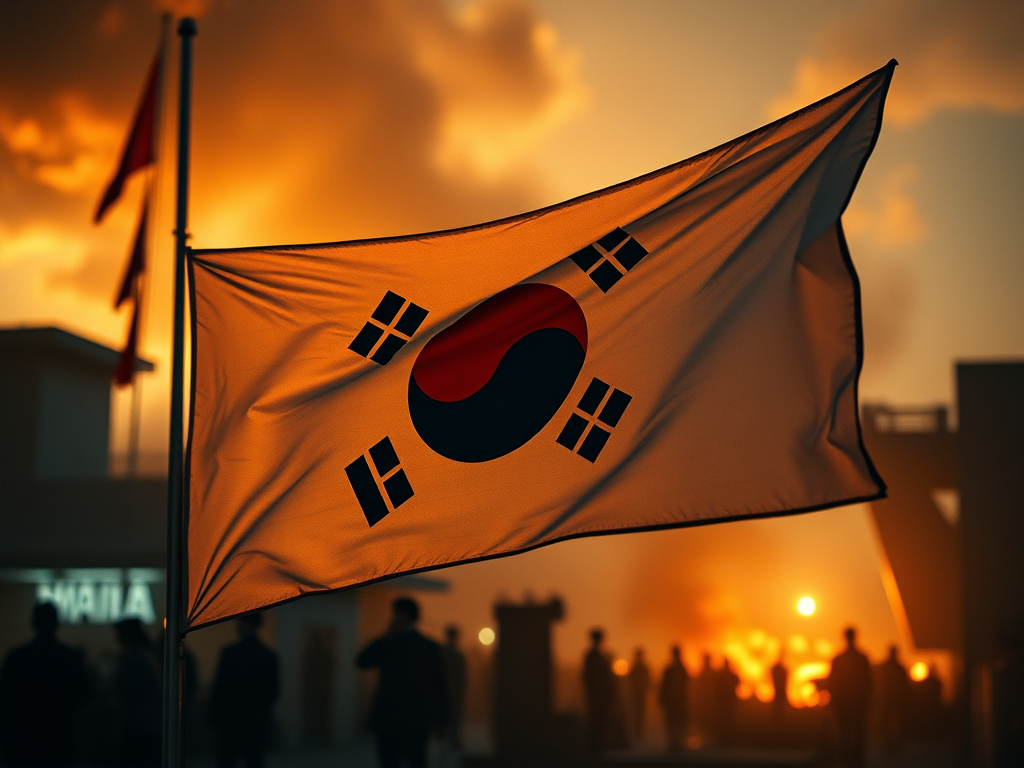
The May 16 coup of 1961 led by Park Chung Hee put an end to the Second Republic, signaling the start of the Third Republic in 1963.
South Korea`s devastated economy began to soar under Park`s leadership, recording one of the fastest rises in average GDP per capita.
Despite lacking natural resources, the nation rapidly developed to become one of the Four Asian Tigers based on international trade and economic globalization, integrating itself within the world economy with export-oriented industrialization.
The Fourth Republic was established after the October Restoration of 1972, in which Park wielded absolute power.
The Yushin Constitution declared that the president could suspend basic human rights, and appoint a third of the parliament.
Suppression of the opposition and human rights abuse by the government became more severe in this period
South Korea has since then had a huge economic success. They have big companies like Samsung (which is the biggest company in South Korea), LG Energy Solution, Hyundai, and Kia to name a few.
On top of that, they also have BTS which is a boyband from South Korea. According to the Hyundai Research Institute, BTS was estimated to generate around $3,6 billion annually for the South Korean economy.
In some years, their direct and indirect contribution has been as high as $4,6 billion, which is comparable to major multinational corporations. BTS has been estimated to contribute around 0,3% to 0,5% of South Korea`s GDP in recent years.
This is a remarkable figure for a single music group, considering the country`s GDP was around $1,63 trillion in 2020.
South Korea`s economic success is well known all around the world, and they has become an economic powerhouse. But right now, it seems like their economic model is running out of steam. The economy has been slowing for years. It has basically stopped.
The economy in South Korea is on the way to be like Japan. What in the world is going on?
It all started in the 1950`s. Their economic growth was 10%, and it reached the top in the 1980`s. Then it began to slow. Growth in the 90`s declined to around 7%. Ten years later, the growth went down to 4%. In 2010, their growth was only 3%.
But something has happened in the last five years. The growth has been slowing year by year. This is what’s happening with the economy as they get richer. It happens in all rich countries. But, in South Korea, it seems like this is not temporary. It seems to be a new normal.
Bank of Kora (BOK) has warned that South Korea`s economy may enter negative territory in the next decade. The country is on a declining trajectory. Unless this is going to change, the next generation will be worse off than their parents.
But, how is it possible that a successful country like South Korea with so many high-tech companies can decline like this? Well, it has its own explanation. We need to look at their economic model, and how it came to be, and how it operates today.
The core of the South Korean economy is made up of something called «Chaebols». «Chae» stands for wealth or property, while «Bol» stands for clan or group.
«Chaebols» refers to large, family-owned business conglomerates in South Korea that wield significant influence over the country`s economy.
The influence of chaebols is often cited as a contributing factor to some of South Korea`s economic challenges, but they are not the sole reason for any economic decline. Several factors, including chaebols’ dominance, are at play when examining South Korea`s economic issues.
This is what we see in the U.S., but also in many other places in the West. They blame big corporations, wealthy entrepreneurs, and investors.
It is the concentration of economic power. Chaebols control a large portion of South Korea`s economy, leading to less competition. Their dominance can stifle small and medium-sized enterprises (SMEs), limiting innovation and growth in other sectors.
Chaebols have also been involved in corruption scandals, often using their power to influence political decisions. This has led to inefficiency in governance and public discontent, undermining economic reforms.
Over-reliance on Export-driven Growth is also considered to be a challenge. Chaebols are heavily focused on industries like electronics, shipbuilding, and automobiles, which are export-driven. This makes the South Korean economy vulnerable to global economic shifts and trade disputes, especially in a world where the diversification of industries is increasingly important.
They also face succession and corporate governance issues. Since chaebols are family-controlled, they often face challenges with leadership transitions between generations. This can lead to inefficiencies and financial mismanagement within these conglomerates.
Strong and independent entrepreneurs have made the wealth you and I have today. They have created products that made our lives better, and their companies have grown to be multi-billion corporations. If this is a problem for countries around the world, well, what can we say? If so, this is not the only reason why the growth is slowing.
We see the same going on in South Korea as well as in Japan and many other places. Broader factors are leading to economic challenges, and one of them is the aging population. South Korea has one of the lowest birth rates in the world, leading to a shrinking working-age population.
This demographic challenge puts pressure on economic growth and social welfare systems. This is not only happening in Japan and South Korea. It`s happening in many other places around the world.
We also have a global economic slowdown. South Korea`s heavy reliance on exports means it is susceptible to the global economic downturn. Trade tensions, especially between the U.S., and China, impact South Korea`s major industries.
On top of all that, we have technological disruption. Even though chaebols have driven much of South Korea`s technological advancements, their scale makes them slow to adapt to new digital trends and innovations compared to more agile startups.
So, what is South Korea doing to address these issues? The South Korean government has been working to implement reforms aimed at reducing chaebols’ influence, promoting transparency, encouraging innovation, and supporting small and medium enterprises (SMEs).
While chaebols have contributed significantly to South Korea`s rapid industrialization and growth, their outsized role can create imbalances in the economy, making reforms crucial for long-term, sustainable growth.
In conclusion, while chaebols are not the sole cause of South Korea`s economic challenges, their dominance and related issues do play a role in creating an environment that can hinder broader economic diversification and reform. As we can clearly see, successful entrepreneurs and large corporations can be both beneficial and problematic for an economy.
Unfortunately, we very often see that successful entrepreneurs are attacked. Especially by socialists. But we have to ask ourselves what we should do without them? Because they are the ones that are creating wealth in the long run. No socialism without capitalism. The socialists need money for the welfare system, and that money comes from entrepreneurs who make goods and services.
Entrepreneurs drive innovation, create new industries, and develop new technologies that can improve productivity. Successful businesses, especially startups, can grow into larger companies, and boost economic growth.
Large corporations provide millions of jobs and stimulate related industries (e.g., supply chains, and service providers). For example, companies like Apple Amazon, or South Korea`s Samsung employ a large global workforce and indirectly create additional jobs in the ecosystem surrounding their businesses.
We can see time and time again, that entrepreneurs are often the source of disruptive innovation, bringing new products and services to the market. Successful entrepreneurs can help transform entire industries.
Large corporations often have the resources to invest in research and development (R&D), leading to technological advancements. For example, tech giants like Google and Microsoft invest heavily in artificial intelligence, cloud computing, and other areas that push technological boundaries.
Multinational corporations make a country more competitive on the global stage. For example, South Korea`s chaebols (Samsung, Hyundai) or the U.S. tech giants, like Google and Apple, enhance their countries’ global influence. They also attract foreign investment and contribute to the trade balance through exports.
Successful entrepreneurs and large corporations are not inherently bad for the economy. In fact, they can drive growth, innovation, and global competitiveness. However, their dominance can lead to economic and social imbalances that harm the broader population if left unchecked. Balancing their power with fair regulations, competition, and equitable policies can be essential for sustainable economic development.
Disclaimer: The views expressed in this article are those of the author and may not reflect those of Shinybull.com. The author has made every effort to ensure the accuracy of the information provided; however, neither Shinybull.com nor the author can guarantee such accuracy. This article is strictly for informational purposes only. It is not a solicitation to make any exchange in precious metal products, commodities, securities, or other financial instruments. Shinybull.com and the author of this article do not accept culpability for losses and/ or damages arising from the use of this publication.
Peaceful Buddhist monks without any weapons can demonstrate on the streets in Myanmar, but the military junta government with weapons can kill them if they want, and that have happened. What`s even worse is their systemic killings of the Rohingya minorities. That’s Genocide.
For most of its independent years, Myanmar has been engrossed in rampant ethnic strife and its myriad ethnic groups have been involved in one of the world`s longest-running ongoing civil wars. Myanmar is an ethnically diverse nation with 135 distinct ethnic groups officially recognized by the Burmese military Government.
The UN and several other organizations have reported consistent and systemic human rights violations in the country.
In 2011, the military junta was officially dissolved following a 2010 general election, and a nominally civilian government was installed. This, along with the release of Aung San Suu Kyi and political prisoners and successful elections in 2015, had improved the country`s human rights record and foreign relations and had led to the easing of trade and other economic sanctions, although the country`s treatment of its ethnic minorities, particularly in connection with the Rohingya conflict, continued to be condemned by international organizations and many nations.
Following the 2020 Myanmar general election, in which Aung San Suu Kyi`s won a clear majority in both houses, the Burmese military again seized power in a coup d’etat.
The coup, which was widely condemned, led to widespread protests in Myanmar and has been marked by a violent response by the military.
The military junta also arrested Aung San Suu Kyi and charged her with crimes ranging from corruption to the violation of Covid protocols, all of which have been labeled «politically motivated» by independent observers.
Aung San Suu Kyi is a Burmese politician, diplomat, author, and a 1991 Nobel Peace Prize laureate who served as State Counsellor of Myanmar and Minister of Foreign Affairs from 2016 to 2021.
The Rohingya people have consistently faced human rights abuses by the Burmese regime that has refused to acknowledge them as Burmese citizens, despite the fact that some of them have lived in Burma for over three generations.
The Rohingya have been denied Burmese citizenship since the enactment of a 1982 citizenship law.
The law created three categories of citizenship:
citizenship
associate citizenship, and
naturalised citizenship
Citizenship is given to those who belong to one of the national races such as Kachin, Kayah (Karenni), Karen, Chin, Burman, Mon, Rakhine, Shan, Kaman, or Zebedee.
Associate citizenship is given to those who cannot prove their ancestors settled in Myanmar before 1823 but can prove they have one grandparent, or pre-1823 ancestor, who was a citizen of another country, as well as people who applied for citizenship in 1948 and qualified then by those laws.
Naturalized citizenship is only given to those who have at least one parent with one of these types of Burmese citizenship or can provide «conclusive evidence» that their parents entered and resided in Burma prior to independence in 1948.
The Burmese regime has attempted to forcibly expel Rohingya and bring in non-Rohingya to replace them.
This policy has resulted in the expulsion of approximately half of the 800,000 Rohingya from Burma, while the Rohingya people have been described as «among the world`s least wanted», and «one of the world`s most persecuted minorities».
But the origin of the «most persecuted minority» statement is unclear.
Rohingya are not allowed to travel without official permission, are banned from owning land, and are required to sign a commitment to have no more than two children.
As of July 2012, the Myanmar government does not include the Rohingya minority group, classified as stateless Bengali Muslims from Bangladesh since 1982, on the government`s list of more than 130 ethnic races and, therefore, the government states that they have no claim to Myanmar citizenship.
In 2007, German professor Bassam Tibi suggested that the Rohingya conflict may be driven by an Islamist political agenda to impose religious laws, while non-religious causes have also been raised, such as a lingering resentment over the violence that occurred during the Japanese occupation of Burma in World War II.
During this time period, the British allied themselves with the Rohingya and fought against the puppet government of Burma (composed mostly by Bamar Japanese) that helped to establish the Tatmadaw military organization that remains in power for a 5-year lapse in 2016 – 2021.
Since the democratic transition began in 2011, there has been continuous violence in Myanmar. A UN envoy reported in March 2013 that unrest had re-emerged between Myanmar`s Buddhist and Muslim communities.
Yesterday, the Biden administration declared that the military junta in Myanmar has committed genocide against the Rohingya minority. The Biden administration has enough evidence to say that the junta has a clear intent to destroy the Rohingya.
The evidence of killings is mass rape and arson, Secretary of State Antony Blinken said on Monday.
Antony Blinken had a speech at the United States Holocaust Memorial Museum in Washington DC, and he said that the killings of the Rohingya minority were «widespread and systematic». Hundreds of thousands of Rohingya Muslims have fled Myanmar since the military crackdown that began in 2017.
Mr. Blinken announced the US would provide $1 million in new funding for the Independent Investigative Mechanism for Myanmar, which continues to examine atrocities. A case against Myanmar, also called Burma, was opened at the International Court of Justice in 2019.
«The day will come when those responsible for these appalling acts will have to answer for them», Mr. Blinken said.
Disclaimer: The views expressed in this article are those of the author and may not reflect those of Shinybull.com. The author has made every effort to ensure the accuracy of the information provided; however, neither Shinybull.com nor the author can guarantee such accuracy. This article is strictly for informational purposes only. It is not a solicitation to make any exchange in precious metal products, commodities, securities, or other financial instruments. Shinybull.com and the author of this article do not accept culpability for losses and/ or damages arising from the use of this publication.
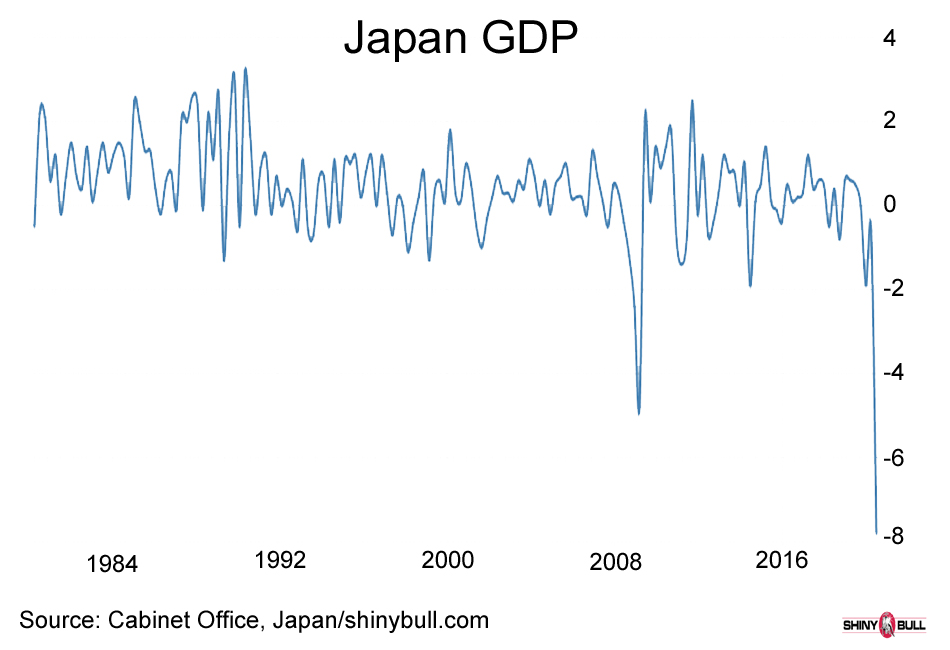
The Japanese economy shrank -7,8 percent in Q2 and that is the steepest decline ever. This was the third straight quarter of contraction which means Japan is in a deep recession amid the severe impact of the COVID-19 crisis.
Private consumption fell -8,2 percent vs -0,8 percent in Q1. Exports plummet -18,5 percent which is the most since Q1 2009. The economy collapsed 27,8 percent in the June quarter, and that is the deepest on record.
Japan was the tech darling in the 80`s. Their consumer electronics industry was once considered the strongest in the world. But now the tech giant is in a state of decline as consumption arises in countries like China, the United States, and South Korea.
However, video gaming in Japan remains a major industry. Japan became a major exporter of video games during the golden age of arcade video games, an era that began with the release of Taito`s Space Invaders in 1978 and ended around the mid-1980s.
Japan dominated the industry until Microsoft`s Xbox consoles began challenging Sony and Nintendo in the 2000s. That being said; Japan is now the world`s largest market for mobile games.
Japan`s strong economic growth ended with a big crash in the late ’80s and early ’90s. In the late 1980s, abnormalities within the Japanese economic system had fueled a speculative asset price bubble of a massive scale.
The bubble was caused by the excessive loan growth mechanism known as the «window guidance». As economist Paul Krugman explained; «Japan`s banks lent more, with less regard for quality of the borrower, than anyonw else`s. In doing so they helped inflate the bubble economy to grotesque proportions.»
Trying to deflate speculation and keep inflation in check, the Bank of Japan sharply raised inter-bank lending rates in late 1989. This sharp policy caused the bursting of the bubble and the Japanese stock market crashed.
Equity and asset prices fell, leaving overly leveraged Japanese banks and insurance companies with books full of bad debt. The financial institutions were bailed out through capital infusions from the government, loans and cheap credit from the central bank, and the ability to postpone the recognition of losses, ultimately turning them into zombie banks.
The Japanese asset price bubble was an economic bubble in Japan from 1986 to 1991 in which real estate and stock market prices were greatly inflated. In early 1992, this price bubble burst and Japan`s economy stagnated.
The bubble was characterized by the rapid acceleration of asset prices and overheated economic activity, as well as uncontrolled money supply and credit expansion. More specifically, over-confidence and speculation regarding asset and stock prices were closely associated with excessive monetary easing policy at the time.
As a result of all this mess, Japan started to «print money» like never before, and now Japan recorded a government debt equivalent to 236,60 percent of the country`s GDP in 2019. Someone has to pay for this, but who? The people of course.
The Personal Income Tax Rate in Japan stands at 55,95 percent, which means more than half of the people`s hard-earned money goes to the Government in Japan. On top of that; their interest rate is negative at -0,1 percent which means people have to pay money to the bank and not otherwise if they have money stored in the bank account.
Policymakers noted that the outlook for economic activity and prices are extremely unclear, depending on the consequences of the virus and the magnitude of their impacts on domestic and overseas economics.
To contact the author: post@shinybull.com
Disclaimer: The views expressed in this article are those of the author and may not reflect those of Shiny bull. The author has made every effort to ensure the accuracy of the information provided; however, neither Shiny bull nor the author can guarantee such accuracy. This article is strictly for informational purposes only. It is not a solicitation to make any exchange in precious metal products, commodities, securities, or other financial instruments. Shiny bull and the author of this article do not accept culpability for losses and/ or damages arising from the use of this publication.
Tsai-Ing-Wen and the Democratic Progressive Party has won a historic landslide victory in the Taiwan election. They defeated the much more Pro China rival Han Kuo-Yu and the KMT. This is a big surprise and no one would have expected this outcome a year ago.
This is a clear message to the one rule Communist Party in Beijing. The people in Taiwan rejects China`s plan for reunification with the island. It`s a remarkable turnaround for the president, whose party suffered major losses in local elections just a year ago.
I believe that the rise of the party started when Pro Democracy protesters in Hong Kong took to the streets last year. People are more awake today than only a few months ago. Months of ant-govenment protests in nearby Hong Kong boosted Wen`s campaign, and scenes of police cracking down on demonstrators appear to have galvanised younger voters.
Tsai warned that Taiwan`s democratic rights must be preserved, and the country has its own military, currency and a passport accepted in most countries. But, Taiwan does not have a seat at the United Nations, and only 15 countries officially recognise Taiwan`s democratic government. United States is not one of them.
Tsai said that the people in Taiwan reject the one country, two systems model. We respect democracy and our sovereign rights, she said. Huh, it sounds like Trump who is fighting against the globalists in Europe.
On the other side; Washington is Taiwan`s most important ally and trading partner. It will be interesting to see how far the U.S will go to defend Taiwan and what will Xi and the Communists in Beijing do in respond to Tsai Ing-Wen`s win, which gives her a second term in office? The Communists have ramped up pressure on Taiwan and cut off official communication with Tsai in the past.
Tsai Ing-Wen said peace means that China must abondon threats of force against Taiwan. She also said she hope Beijing understands that democratic Taiwan will not concede to threats. China says it will not change position that Taiwan is part of it after Tsai`s re-election.
China claims Taiwan is part of its territory under its “One China Principle”.
We now see a similar situation in Taiwan is it is in Hong Kong. One Country, two systems. Taiwan, officially the Republic of China (ROC), is a state in East Asia.
Taiwanese indigenous peoples settled the island of Taiwan around 6,000 years ago. In the 17th century, Dutch rule opened the island to mass Han immigration. After the brief Kingdom of Tungning in parts of the southern and western areas of the island, the island was annexed in 1683 by the Qing dynastry of China, and ceded to the Empire of Japan in 1895.
Following the surrender of Japan in 1945, the Republic of China, which had overthrown and succeeded the Qing in 1911, took control of Taiwan on behalf of thw World War II Allies.
The resumption of the Chinese Civil War led to the loss of the mainland to the Communist Party of China (CPP) and the flight of the ROC government to Taiwan in 1949. although the ROC government continued to claim to be the legitimate representative of China, since 1950 its effective jurisdiction has been limited to Taiwan and numerous smaller islands.
In the early 1960`s, Taiwan entered a period of rapid economic growth and industrialisation called the «Taiwan Miracle». In the late 1980`s and early 1990`s, the ROC transitioned from a one-party military dictatorship to a multi-party democracy with a semi-presidential system.
Taiwan`s export-oriented industrial economy is the 21st-largest in the world, with major contributions from steel, machinery, electronics and chemicals manufacturing. Taiwan is a developed country, ranking 15th in GDP per capita. It is ranked highly in terms of political and civil liberties, education, health care and human developments.
The political status of Taiwan remains uncertain.
The ROC is no longer a member of the UN, having been replaced by the PRC in 1971. Taiwan is claimed by the PRC, which refuses diplomatic relations with countries that recognise the ROC. International organisations in which the PRC participates either refuses to grant membership to Taiwan or allow it to particitpate only on a non-state basis.
Taiwan is a member of the World Trade Organization, Asia-Pacific Economic Cooperation and Asian Development Bank under various offices and institutions that function as de facto embassies and consulates.
Domesticay, the major political division is between parties fvouring eventual Chinese unification and promoting a Chinese identity contrasted with those aspiring to independence and promoting Taiwanese identity, although both sides have moderated their positions to broaden their appeal.
Taiwan officially known as Republic of China has been self-ruled since 1950, but China considers Taiwan part of its land that must be reunited with mainland even by force.
The U.S hailed Tsai`s victory as demonstration of Taiwan`s robust Democratic system. Taiwan`s president Tsai Ing-Wen secures second term in office with 57,1% of votes. The vote is seen as a choice between moving closer to China or resisting push for reunification.
Tsai Ing-Wen told the supporters “today we have defended our democracy and freedom”.
Disclaimer: The views expressed in this article are those of the author and may not reflect those of Shiny bull. The author has made every effort to ensure accuracy of information provided; however, neither Shiny bull nor the author can guarantee such accuracy. This article is strictly for informational purposes only. It is not a solicitation to make any exchange in precious metal products, commodities, securities or other financial instruments. Shiny bull and the author of this article do not accept culpability for losses and/ or damages arising from the use of this publication.