Tag Archives: Inflation

Financial dissatisfaction hits a 50-year high in the United States of America

President Joe Biden tweeted this on Monday: «At the time I took office about 16 months ago, the economy had stalled and COVID was out of control. Today, thanks to the economic plan and the vaccination plan that my Administration put into action, America has achieved the most robust recovery in modern history.»

At the same time, we see that 83% of Americans describe the state of the economy as poor or not so good, according to a poll by Wall Street Journal. Biden`s poll numbers are also below those of Donald Trump. Not only that.

Another poll shows that 35% of Americans are not satisfied with their financial situation, which is the worst result in 50 years.

Photo by cottonbro on Pexels.com

Biden often said that Trump was the worst president in history and an existential threat to the nation`s democracy. I wonder what he is saying about himself right now? It must be a bitter pill for an anti-Trump politician like Biden to be outclassed by the 45th president.

On April 2, Biden`s approval rating was 40% while Trump`s was at 50% the same day in 2018. Instead of gaslighting voters, Biden should clean up the messes and fix the inflation asap.

Trump`s vision was lower taxes, but president Joe Biden turned that upside down. People are paying more tax under Biden, than under Trump. On top of that, people must pay more money for their products, which is a hidden tax and makes people`s money less valuable.

Higher gas prices are good for oil companies but very bad for people and the economy. In the long run, it could kill the economy, and today, gas prices in the U.S hit a new record high of $4,91 a gallon (average price). In California, the price is $6,37 a gallon. People don`t like it, but Biden says everything is fine.

Something must be wrong here because there is a huge disconnect between president Biden and the people. And that isn`t good for the democrats at all. If this continues, GOP can win big in the mid-term election in November.

Another poll shows that the GOP is in the best midterm position in 80 years (2 pts lead), according to CNN.

Not even Liberal Media is ignoring Biden`s crisis anymore. They are also lukewarm on his potential second term.

Earlier today, Biden tweeted this: «The fact is America is in a stronger economic position today than just about any other country in the world. Independent experts have even projected that the U.S economy could grow faster than China`s economy this year. That hasn`t happened since 1976».

People`s lives are worse under Biden than under Trump. But people voted for Biden. They asked for it. They got what they asked for. Higher taxes, and inflation. President Joe Biden is the most popular president in U.S history. He got more votes than Obama and Clinton.

On the day he was inaugurated, Biden said; «Today, we celebrate the triumph not of a candidate, but of cause, the cause of democracy. The will of the people has been heard and the will of the people has been heeded.»

The love for Joe Biden was huge in the Hate Trump Media, on the day Biden was inaugurated. «The reason Biden has to do this is that he`s just so incredibly popular,» Don Lemon said on CNN at that time. «The lights from Lincoln Memorial were like Joe Biden`s arms stretching out to all American,» CNN said.

Axios said at that time in January 2021, Biden is charting an economic policy that was visible to the left of Bill Clinton and Barrack Obama. Biden proposed a $1,9 trillion economic stimulus plan and a $15 minimum wage at that time, and employers, employees, and economists warned it will kill millions of jobs.

We are living in times with a lot of challenges, and more trouble is on the way. Famine is probably the most serious one. Chairman and Chief Executive of JPMorgan Chase & Co, Jamie Dimon, said a few days ago that we all must brace for U.S economic «hurricane» due to inflation. Earlier he said storm clouds looming over the U.S economy, but he has changed the rhetoric.

Right now, it`s kind of sunny, and things are doing fine, but the hurricane is right out there down the road coming our way, Dimon said. We just don`t know if it`s a minor one or Superstorm Sandy, he added.

The Fed is under pressure with inflation that is more than three times its 2% target, and that has caused a jump in the cost of living for Americans. It faces the difficult task of dampening demand enough to curb inflation while not causing a recession.

Dimon urged the Fed to take forceful measures to avoid tipping the world`s biggest economy into a recession.

Disclaimer: The views expressed in this article are those of the author and may not reflect those of Shinybull.com. The author has made every effort to ensure the accuracy of the information provided; however, neither Shinybull.com nor the author can guarantee such accuracy. This article is strictly for informational purposes only. It is not a solicitation to make any exchange in precious metal products, commodities, securities, or other financial instruments. Shinybull.com and the author of this article do not accept culpability for losses and/ or damages arising from the use of this publication.

Leave a comment

Filed under Politics

Inflation soared to 4,2% in April of 2021

Inflation soared to 4,2% in April of 2021, and that`s a big jump from 2,6% in March. The stock market declined while the inflation rate came in well above market forecast of 3,6%, and this is the highest reading since September 2008.

The biggest increases were recorded for gasoline (49,6% vs 22,5% in March), fuel oil (37,3% vs 20,2%) and used car and trucks (21% vs 9,4%). It`s interesting to see the inflation slowed for food (2,4% vs 3,5%).

The jump in inflation is the highest in 13 years, and Wall Street sent the stock down on Wednesday in a broad market sell-off. Tech stock were hit hard as higher interest rates are threatening to undermine the valuations of those companies.

Nasdaq is down about -5% so far this week, but the European markets ended higher on Wednesday as stocks in Europe recovered from a global sell-off sparked by concerns that rising inflation will prompt central banks to tighten monetary policy sooner and more abruptly than expected.

Federal Reserve`s vice chair, Richard Clarida, had some dovish comments, and that helped calm nervous markets. He said that the twin shocks of a disappointing payroll report and higher inflation in April hadn`t changed the central bank`s view on maintaining its current ultra-accomodative policy.

To contact the author: post@shinybull.com

Disclaimer: The views expressed in this article are those of the author and may not reflect those of Shinybull.com. The author has made every effort to ensure the accuracy of the information provided; however, neither Shinybull.com nor the author can guarantee such accuracy. This article is strictly for informational purposes only. It is not a solicitation to make any exchange in precious metal products, commodities, securities, or other financial instruments. Shinybull.com and the author of this article do not accept culpability for losses and/ or damages arising from the use of this publication.

Leave a comment

Filed under Politics, Stock market

Officials said the appropriate path for the FED`s funds rate over the next few years would likely be slightly steeper than they had previously expected

The Interest Rate are increasing while the outlook for the economy are getting stronger and the inflation is expected to follow the rate in the coming months. The FED, meeting for the first time under Chairman Jerome Powell, raised the funds rate to 1,5 – 1,75 percent during its March meeting.

FOMC holds eight regularly scheduled meetings during the year and other meetings as needed. Their next meeting is May 1 – 2, 2018, and GDP, Interest Rate and Inflation is on the table. The economic outlook is improving and the FED officials has recently projected a steeper path of hikes next year and 2020.

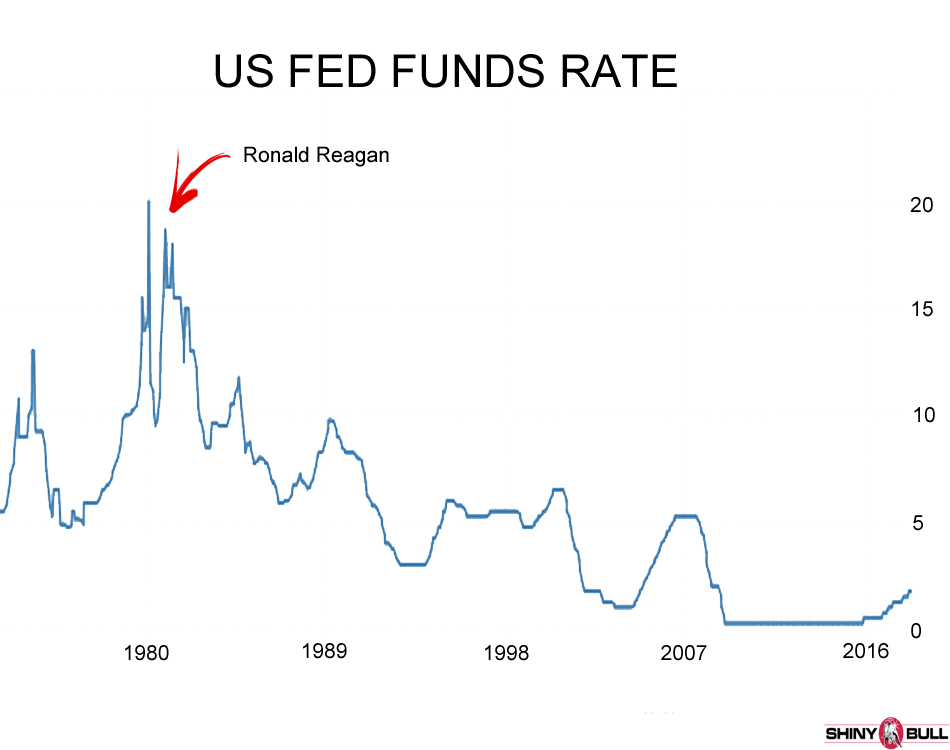
The FEDs funds rate was extremely volatile when Ronald Reagan entered the White House in 1981. In the early 80s the rate peaked at 20 percent and plummeted to about 10 percent and then back to nearly 20 percent again. That`s what I call action.

During the period of Ronald Reagan, the rate went from 20 percent and down to 10 percent in 1989, when Ronald Reagan said welcome to the next president; George Bush. He succeeded to push down the rate even more, but it hit a record low of 0,25 percent in 2008. That time is for now over.

The increase in March was the sixth rise since the central bank began a tightening cycle back in December 2015. As the economy has strengthened, the FED has upped the pace of hikes.

After the FOMC meeting in March, officials said the economy looks good and that the inflation is expected to move up. Almost all of the officials agreed that a gradual tightening remains appropriate.

The FED also said that the prospect of retaliatory trade actions by other countries as well as other issues and uncertainties associated with trade policies as downside risks for the economy.

Some people are concerned among their business contracts about the possible ramifications of the recent imposition of tariffs on imported steel and aluminium. They didn`t see the steel and aluminium tariffs, by themselves, to have significant effect on the national economic outlook.

Contracts in the agricultural sector reported feeling particularly vulnerable to retaliation.

The stance of monetary policy will remain accommodative, supporting strong labor market conditions and a sustained return to 2 percent inflation.

Some of the participants in the March meeting said that the stronger outlook for economic activity, along with their increased confidence that inflation would return to 2 percent, implied that the appropriate path for the FED`s funds rate over the next few years would likely be slightly steeper than they had previously expected.

It is expected to see the rate unchanged after the meeting on Wednesday, but another hike is imminent at the following one in mid June.

The next FOMC meeting took place on Tuesday this week and will end on Wednesday with any changes to monetary policy announced immediately after the meeting.

Disclaimer: The views expressed in this article are those of the author and may not reflect those of Shiny bull. The author has made every effort to ensure accuracy of information provided; however, neither Shiny bull nor the author can guarantee such accuracy. This article is strictly for informational purposes only. It is not a solicitation to make any exchange in precious metal products, commodities, securities or other financial instruments. Shiny bull and the author of this article do not accept culpability for losses and/ or damages arising from the use of this publication.

Leave a comment

Filed under Politics

Brazil`s Auto Sales jumped 39,4 percent to 189 vehicles last month

Brazil has been struggling for a while now. First of all with Dilma Rousseff and her corruption scandal involving the state-controlled oil company Petrobras. All this on top af a terrible recession. Since the Workers’ Party came to power in 2003, there has been a series of corruption scandals in Brazil.

Operation Car Wash has uncovered a widening corruption scandal with dozens of political accused of paying or receiving kickbacks. Former President Luiz Inacio Lula da Silva has been named in connection with the investigation. Let`s take a look at some positive things in Brazil right now.

Auto sales in Brazil jumped 39,4 percent to 189 vehicles last month. Sales rebounded for passenger cars (39 percent vs -8 percent in February). Compared to a year ago, auto sales fell 5,6 percent. Brazil had an all-time high of 420 thousand in 2012.


Brazil had an all-time high trade surplus in March this year. Brazil recorded a USD 7,145 million trade surplus, which is higher than a USD 4,435 million surpluses in 2016. Exports jumped 25,6 percent YoY and imports rose at a slower 11,9 percent.

Inflation in Brazil is also going the right direction. It rose by 4,76 percent in the year to February 2017, which is down from an increase of 5,35 percent in previous month. It`s also lower than a year ago at 9,39 percent.

Brazil is the largest country in both South America and Latin America. Its the worlds fifth largest country by both area and population of 200,4 million citizens. Unfortunately, the unemployment rate is going the wrong direction.

It reached an all-time high of 13,2 percent in the quarter ended February this year. Brazil has been the largest producer of coffee for the last 150 years. Can they fix the problems? Their economy has not been growing since 2014.

The Brazilians economy shrank 2,5 percent YoY in the fourth quarter of 2016. GDP has been negative for eleven straight quarters and they face a sharp drop in both household consumption and fixed investment.

You can clearly see how bad economy are going hand in hand with crime and frustration. Everybody blame each other for everything and politicians are always a target.

A jump in their auto sales is music in samba ears.


Disclaimer: The views expressed in this article are those of the author and may not reflect those of Shiny bull. The author has made every effort to ensure accuracy of information provided; however, neither Shiny bull nor the author can guarantee such accuracy. This article is strictly for informational purposes only. It is not a solicitation to make any exchange in precious metal products, commodities, securities or other financial instruments. Shiny bull and the author of this article do not accept culpability for losses and/ or damages arising from the use of this publication.

Leave a comment

Filed under Emerging markets, Politics

Hyper inflation of 231,150,888,87 percent in July

Janet Yellen and the FED raised the rates and its expected to see them raise the rates at least a couple of times before the end of this year. In addition; they are planning to raise the rates three times next year. Wow. What about the inflation? Let`s take a look at Japan, Venezuela and Zimbabwe.

Nikkei reach its all-time high on December 29th 1989. The stock market plummeted and did never come back. Japan started to grow after world war II and was among the first in the world to use robots in the 70s and 80s.

Japan used robots especially in the auto and techno industry. The optimism went to be a huge euphoria og Nikkei reached 38.957.44 and ended the day at 38.915.87 on December 29th 1989. As you may know; Japan started to «print» money. But what happened to the inflation?

As you can see from the chart above, Japans inflation increased the early 90s and then it started to decline again. You can see from the chart that it went up again in the late 90`s, but not for a long time. It drops every time it goes up.

Consumer prices increased 0,4 percent YoY in January this year. Transportation cost posted the first annual gain since March of 2015 and prices went up faster for clothing and footwear and recreation and culture.

Inflation rate reached an all-time high of 24,9 percent in February of 1974 and a record low of -2,5 percent in October of 2009. It`s a different and more scary story in Venezuela.

It`s not getting better in Venezuela and it goes from bad to extremely bad right now. What in the world is going on? Venezuela has the highest inflation rate in the world right now. Economic turmoil in Venezuela has made the bolivar go straight up to heaven.

Some analysts say it could reach 2000 percent in 2017. No, I`m not kidding; 2000 percent. President Nicolàs Maduro who is elected after the death of socialist firebrand Hugo Chàvez explained the shock move by accusing US-backed «mafias» of conspiring to destabilize his country’s economy by hoarding bank notes.

Take a good look at the chart above. Consumer prices in Venezuela jumped 800 percent YoY in 2016, following a 180,9 percent rise in 2015. It is the highest inflation rate on record after the slump in oil prices led to a severe recession and food shortages.

Venezuela reached an all-time high of 800 percent in December of 2016 and a record low of 3,22 percent in February of 1973. You think 800 percent is much? Take a look at Zimbabwe.

The worst of the inflation occurred in 2008, leading to the abandonment of the currency. The peak month of hyperinflation occurred in mid-November 2008 with a rate estimated at 79,600,000% per month. That is what I call hyper-inflation.

This resulted in US$1 becoming equivalent to the staggering sum of Z$2,621,228. The rate went up 585,84 percent in 2005. 1,281,11 percent in 2006 and 66,212,3 percent in 2007. And then it exploded; Up 231,150,888,87 percent in July of 2008. Wow.

Hyper-inflation like that mean that the price can jump when you are sitting on the bus. That can be problematic for some customers but also for business owners.

Any Zimbabwean dollars acquired needed to be exchanged for foreign currency on the parallel market immediately, or the holder would suffer a significant loss of value.

For example, a mini-bus driver charged riders in Zimbabwean dollars, but different rates throughout the day. The evening commute was highest-priced. He sometimes exchanged money three times a day, not in banks but in back office rooms and parking lots.

Lack of confidence in government to practice fiscal restraint feeds on itself. In Zimbabwe, neither the issuance of banknotes of higher denominations nor proclamation of new currency regimes led holders of the currency to expect that the new money would be more stable than the old.

Remedies announced by the government never included a believable basis for monetary stability. Thus, one reason the currency continued to lose value, causing hyperinflation, is that so many people expected it to.

What about a hyper-inflation in the U.S? Is it possible? What can go wrong, and what will happen? I will write more about that later on this week.


Disclaimer: The views expressed in this article are those of the author and may not reflect those of Shiny bull. The author has made every effort to ensure accuracy of information provided; however, neither Shiny bull nor the author can guarantee such accuracy. This article is strictly for informational purposes only. It is not a solicitation to make any exchange in precious metal products, commodities, securities or other financial instruments. Shiny bull and the author of this article do not accept culpability for losses and/ or damages arising from the use of this publication.

Leave a comment

Filed under Politics, Stock market