Tag Archives: Globalization

The end of South Korea`s economic miracle

The Korean Peninsula was inhabited as early as the Lower Paleolithic period. Its first kingdom was noted in Chinese records in the early 7th century BCE. The succeeding Korean Empire (1897 – 1910) was annexed in 1910 into the Empire of Japan.

Japanese rule ended following Japan`s surrender in World War II, after which Korea was divided into two zones: a northern zone, which was occupied by the Soviet Union, and a southern zone, which was occupied by the United States.

After negotiations on reunification failed, the southern zone became the Republic of Korea in August 1948, while the northern zone became the communist Democratic People`s Republic of Korea the following month.

In 1950, a North Korean invasion began the Korean War, which ended in 1953 after extensive fighting involving the American-led United Nations Command and the People`s Volunteer Army from China with Soviet assistance.

The war left 3 million Koreans dead and the economy in ruins.
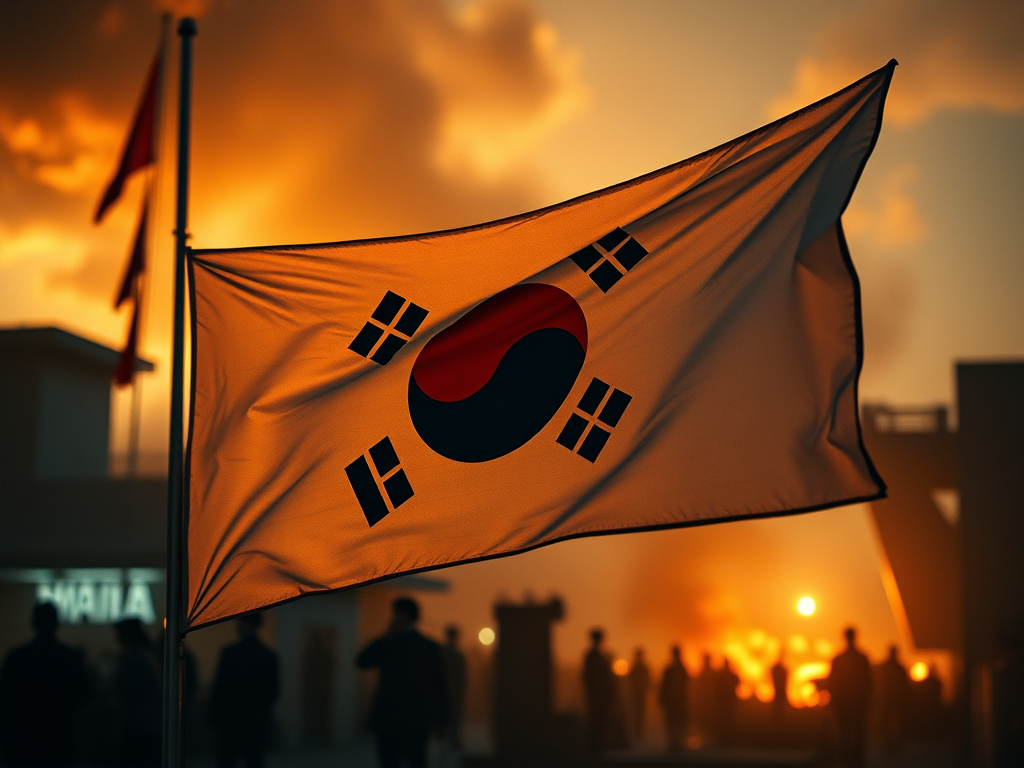
The May 16 coup of 1961 led by Park Chung Hee put an end to the Second Republic, signaling the start of the Third Republic in 1963.

South Korea`s devastated economy began to soar under Park`s leadership, recording one of the fastest rises in average GDP per capita.

Despite lacking natural resources, the nation rapidly developed to become one of the Four Asian Tigers based on international trade and economic globalization, integrating itself within the world economy with export-oriented industrialization.

The Fourth Republic was established after the October Restoration of 1972, in which Park wielded absolute power.

The Yushin Constitution declared that the president could suspend basic human rights, and appoint a third of the parliament.

Suppression of the opposition and human rights abuse by the government became more severe in this period

South Korea has since then had a huge economic success. They have big companies like Samsung (which is the biggest company in South Korea), LG Energy Solution, Hyundai, and Kia to name a few.

On top of that, they also have BTS which is a boyband from South Korea. According to the Hyundai Research Institute, BTS was estimated to generate around $3,6 billion annually for the South Korean economy.

In some years, their direct and indirect contribution has been as high as $4,6 billion, which is comparable to major multinational corporations. BTS has been estimated to contribute around 0,3% to 0,5% of South Korea`s GDP in recent years.

This is a remarkable figure for a single music group, considering the country`s GDP was around $1,63 trillion in 2020.

South Korea`s economic success is well known all around the world, and they has become an economic powerhouse. But right now, it seems like their economic model is running out of steam. The economy has been slowing for years. It has basically stopped.

The economy in South Korea is on the way to be like Japan. What in the world is going on?

It all started in the 1950`s. Their economic growth was 10%, and it reached the top in the 1980`s. Then it began to slow. Growth in the 90`s declined to around 7%. Ten years later, the growth went down to 4%. In 2010, their growth was only 3%.

But something has happened in the last five years. The growth has been slowing year by year. This is what’s happening with the economy as they get richer. It happens in all rich countries. But, in South Korea, it seems like this is not temporary. It seems to be a new normal.

Bank of Kora (BOK) has warned that South Korea`s economy may enter negative territory in the next decade. The country is on a declining trajectory. Unless this is going to change, the next generation will be worse off than their parents.

But, how is it possible that a successful country like South Korea with so many high-tech companies can decline like this? Well, it has its own explanation. We need to look at their economic model, and how it came to be, and how it operates today.

The core of the South Korean economy is made up of something called «Chaebols». «Chae» stands for wealth or property, while «Bol» stands for clan or group.

«Chaebols» refers to large, family-owned business conglomerates in South Korea that wield significant influence over the country`s economy.

The influence of chaebols is often cited as a contributing factor to some of South Korea`s economic challenges, but they are not the sole reason for any economic decline. Several factors, including chaebols’ dominance, are at play when examining South Korea`s economic issues.

This is what we see in the U.S., but also in many other places in the West. They blame big corporations, wealthy entrepreneurs, and investors.

It is the concentration of economic power. Chaebols control a large portion of South Korea`s economy, leading to less competition. Their dominance can stifle small and medium-sized enterprises (SMEs), limiting innovation and growth in other sectors.

Chaebols have also been involved in corruption scandals, often using their power to influence political decisions. This has led to inefficiency in governance and public discontent, undermining economic reforms.

Over-reliance on Export-driven Growth is also considered to be a challenge. Chaebols are heavily focused on industries like electronics, shipbuilding, and automobiles, which are export-driven. This makes the South Korean economy vulnerable to global economic shifts and trade disputes, especially in a world where the diversification of industries is increasingly important.

They also face succession and corporate governance issues. Since chaebols are family-controlled, they often face challenges with leadership transitions between generations. This can lead to inefficiencies and financial mismanagement within these conglomerates.

Strong and independent entrepreneurs have made the wealth you and I have today. They have created products that made our lives better, and their companies have grown to be multi-billion corporations. If this is a problem for countries around the world, well, what can we say? If so, this is not the only reason why the growth is slowing.

We see the same going on in South Korea as well as in Japan and many other places. Broader factors are leading to economic challenges, and one of them is the aging population. South Korea has one of the lowest birth rates in the world, leading to a shrinking working-age population.

This demographic challenge puts pressure on economic growth and social welfare systems. This is not only happening in Japan and South Korea. It`s happening in many other places around the world.

We also have a global economic slowdown. South Korea`s heavy reliance on exports means it is susceptible to the global economic downturn. Trade tensions, especially between the U.S., and China, impact South Korea`s major industries.

On top of all that, we have technological disruption. Even though chaebols have driven much of South Korea`s technological advancements, their scale makes them slow to adapt to new digital trends and innovations compared to more agile startups.

So, what is South Korea doing to address these issues? The South Korean government has been working to implement reforms aimed at reducing chaebols’ influence, promoting transparency, encouraging innovation, and supporting small and medium enterprises (SMEs).

While chaebols have contributed significantly to South Korea`s rapid industrialization and growth, their outsized role can create imbalances in the economy, making reforms crucial for long-term, sustainable growth.

In conclusion, while chaebols are not the sole cause of South Korea`s economic challenges, their dominance and related issues do play a role in creating an environment that can hinder broader economic diversification and reform. As we can clearly see, successful entrepreneurs and large corporations can be both beneficial and problematic for an economy.

Unfortunately, we very often see that successful entrepreneurs are attacked. Especially by socialists. But we have to ask ourselves what we should do without them? Because they are the ones that are creating wealth in the long run. No socialism without capitalism. The socialists need money for the welfare system, and that money comes from entrepreneurs who make goods and services.

Entrepreneurs drive innovation, create new industries, and develop new technologies that can improve productivity. Successful businesses, especially startups, can grow into larger companies, and boost economic growth.

Large corporations provide millions of jobs and stimulate related industries (e.g., supply chains, and service providers). For example, companies like Apple Amazon, or South Korea`s Samsung employ a large global workforce and indirectly create additional jobs in the ecosystem surrounding their businesses.

We can see time and time again, that entrepreneurs are often the source of disruptive innovation, bringing new products and services to the market. Successful entrepreneurs can help transform entire industries.

Large corporations often have the resources to invest in research and development (R&D), leading to technological advancements. For example, tech giants like Google and Microsoft invest heavily in artificial intelligence, cloud computing, and other areas that push technological boundaries.

Multinational corporations make a country more competitive on the global stage. For example, South Korea`s chaebols (Samsung, Hyundai) or the U.S. tech giants, like Google and Apple, enhance their countries’ global influence. They also attract foreign investment and contribute to the trade balance through exports.

Successful entrepreneurs and large corporations are not inherently bad for the economy. In fact, they can drive growth, innovation, and global competitiveness. However, their dominance can lead to economic and social imbalances that harm the broader population if left unchecked. Balancing their power with fair regulations, competition, and equitable policies can be essential for sustainable economic development.

Disclaimer: The views expressed in this article are those of the author and may not reflect those of Shinybull.com. The author has made every effort to ensure the accuracy of the information provided; however, neither Shinybull.com nor the author can guarantee such accuracy. This article is strictly for informational purposes only. It is not a solicitation to make any exchange in precious metal products, commodities, securities, or other financial instruments. Shinybull.com and the author of this article do not accept culpability for losses and/ or damages arising from the use of this publication.
Leave a comment

Filed under Politics

US and EU boycotted SPIEF, but Putin will talk about it in a major speech on Friday

Russian Davos started yesterday, and Ushakov said high-level delegations from more than 40 nations were expected to come. 1,244 Russian and 265 foreign companies had confirmed they would be there, including China. Companies from US and EU were not on the list for the SPIEF.

The St.Petersburg International Economic Forum (SPIEF) is an annual Russian business event for the economic sector, which has been held in St.Petersburg since 1997, and under the auspices of the Russian President since 2005. They celebrate their 25th anniversary this year.

Each year, more than 10,000 people from over 120 different countries take part. The Forum brings together the chief executives of major Russian and international companies, heads of state, political leaders, prime ministers, deputy prime ministers, departmental ministers, and governors.

The key purpose of the Forum is to provide a practical tool for business, helping to overcome geographical and informational barriers dividing Russia and other countries. But the global financial elite has boycotted Russia and SPIEF, and isolated Moscow with sanctions over Russia`s actions in Ukraine.

The head of the American Chamber of Commerce in Russia along with French and Italian counterparts will speak at a session on Thursday called «Western Investors in Russia: New Reality.»

President Vladimir Putin will give a major speech on Friday. This is a speech we should pay attention to. He will be focusing on the international economic situation and Russia`s tasks in the near future, Yuri Ushakov said.

McDonald`s is out of business in Russia, and other Western companies are doing the same, while domestic corporations are rushing to take over businesses that are left behind in Russia. As we can see; globalization, as we know it, has ended.

New world order is on the way, with new opportunities in a new world.

I bet Putin will talk about that in his speech on Friday. A new way for Russia to make growth. The war seems to make the relationship with China better, but also the relationship with BRIC countries.

SWIFT banned Russia, but the Central Bank of Russia made its own, called SPFS (System for Transfer of Financial Messages). Russian equivalent of the SWIFT financial transfer system.

China did the same. They developed CIPS (Cros-Border Interbank Payment System), which processes payments in Chinese yuan. It has the potential to replace SWIFT.

The SWIFT ban on Russia has boosted the development of the non-US dollar and non-SWIFT transactions, including CIPS. It has also stimulated the e-yuan, which is China`s official digital currency. The development of the e-yuan is also a catalyst for CHIPS, and both will play an important role in the internationalization of the Chinese currency.

As we can see, Russia, China, and BRIC countries are on the way to developing their own system. If this continues, we will probably end up with two blocs; The West, and the rest.

Disclaimer: The views expressed in this article are those of the author and may not reflect those of Shinybull.com. The author has made every effort to ensure the accuracy of the information provided; however, neither Shinybull.com nor the author can guarantee such accuracy. This article is strictly for informational purposes only. It is not a solicitation to make any exchange in precious metal products, commodities, securities, or other financial instruments. Shinybull.com and the author of this article do not accept culpability for losses and/ or damages arising from the use of this publication.

Leave a comment

Filed under Politics

Economic globalization is the trend of the times. Though countercurrents are sure to exist in a river, none could stop it from flowing to the sea

World Economic Forum (WEF) started its annual meeting yesterday, and it will continue till Thursday this week. This is the first global in-person leadership event since the start of the Covid-19 pandemic, and this time their theme is; «Working Together, and restoring Trust.»

But the annual meeting has never been confronted with so many unprecedented global issues as it is now in 2022. The WEF`s annual meeting is coming at a crucial time. The most crucial in its 50-year history.

The world is recovering from a global pandemic, struggling with a war in Ukraine, and facing huge challenges from climate change. On top of that, monkeypox is coming, and so are inflation and famine.

One of the topics is globalization, and as we all know, globalization is dead right now. But, I think it`s only set on «pause.»

Chinese President Xi Jinping visited WEF in 2017, and on his first trip he said; «Whether you like it or not, the global economy is a big ocean that you cannot escape from.»

This time, in 2022, Xi said; «Economic globalization is the trend of the times. Though countercurrents are sure to exist in a river, none could stop it from flowing to the sea.»

Xi is also the founder of the Belt and Road Initiative (BRI), which is the 21st Century Maritime Silk Road. The Silk Road has always been important to the trade in the world. It was an ancient trade route that linked the Western world with the Middle East and Asia.

It was a major conduit for trade between the Roman Empire and China and later between medieval European kingdoms and China.

Established when the Han Dynasty in China officially opened trade with the West in 130 B.C., the Sild Road routes remained in use until 1453 A.D., when the Ottoman Empire boycotted trade with China and closed them.

Although it`s been nearly 600 years since the Silk Road has been used for international trade, the routes had a lasting impact on commerce, culture, and history that resonates even today.

I find it very interesting to see that Venetian explorer Marco Polo famously used the Silk Road to travel from Italy to China, which was then under the control of the Mongolian Empire, where they arrived in 1275.

Notably, they did not travel by boat, but rather by camel following overland routes. They arrived at Xanadu, the lavish summer palace of the Mongolian emperor Kublai Khan. (You can see the film about that relationship on Netflix. I think you will like it a lot).

In all, the explorer spent 24 years in Asia, working in Kublai Khan`s court, perhaps as a tax collector.

Marco Polo returned to Venice, again via the Silk Road routes, in 1295, just as the Mongolian Empire was in decline. His journeys across the Silk Road became the basis for his book, «The Travels of Marco Polo,” which gave Europeans a better understanding of Asian commerce and culture.

Khan`s Empire is gone. So are the Roman and the Ottoman Empire. Some historians say the start of the British Empire started around the 1490s, while others say the early 1600`s, but it all ended in the years after World War 2, with most of Britain`s colonies ruling themselves independently by the late 1960s. But what about the American Empire?

A New World Order started after World War 2, and the U.S became the leading Empire in the World. Now, we are all facing a revolution. A New World Order. Again. Globalization is dead, but it will come back, because as Xi said: «Economic globalization is the trend of the times. Though countercurrents are sure to exist in a river, none could stop it from flowing to the sea.»

On Friday, the S&P 500 briefly fell into a bear market, and the inflation in the UK hit a 40-year high in April. We are into a vicious cycle, and the WEF`s Chief Economists Outlook has warned of lower economic activity, higher inflation, lower real wages, and greater food insecurity globally in 2022.

They warn that this could have devastating human consequences as the global economy fragments.

As Saadia Zahidi, Head of the Centre for New Economy and Society and a Managing Director at the World Economic Forum explained:

«We are at the cusp of a vicious cycle that could impact societies for years. The pandemic and war have fragmented the global economy and created far-reaching consequences that risk wiping out the gains of the last thirty years.

Leaders face difficult choices and trade-offs domestically when it comes to debt, inflation, and investment. Yet business and government leaders must also recognize the absolute necessity of global cooperation to prevent economic misery for millions around the world.

The WEF`s Annual Meeting this week will provide a starting point for such collaboration.»

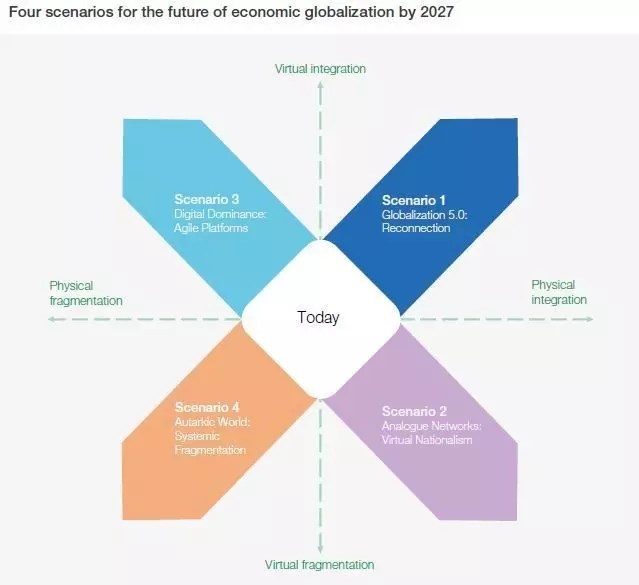
Four Futures for economic Globalization: Scenarios and their implications:

Globalization has created significant opportunities and lifted millions out of poverty, while also driving inequality and economic disruption. With many countries turning inward in search of new strategies to increase security and resilience, the convergence of physical and virtual forms of economic globalization is no longer a given.

As the traditional drivers of globalization have reached a critical juncture, we are entering a new phase of increased economic volatility, polarization, and structural reset of the global system. Ever-accelerating digitalization, however, means that the rivalry between global centers is rapidly expanding from the physical to virtual space, where competition over the control of technology and information networks is growing. How different economic centers of gravity will choose between physical and virtual integration, fragmentation or isolation will shape the fate of economic globalization in the years to come.

This White Paper outlines how the nature of globalization may shift as economic powers choose between fragmentation or isolation in both physical and virtual integration. The report calls for “no-regret actions” by policymakers: global cooperation on the climate crisis; investment in human capital to prepare populations for a range of economic futures, and returning to developing resilience through greater economic integration, knowledge-sharing, and diversification.

Globalization is at crossroads. It`s changing, but it isn`t ending.

Disclaimer: The views expressed in this article are those of the author and may not reflect those of Shinybull.com. The author has made every effort to ensure the accuracy of the information provided; however, neither Shinybull.com nor the author can guarantee such accuracy. This article is strictly for informational purposes only. It is not a solicitation to make any exchange in precious metal products, commodities, securities, or other financial instruments. Shinybull.com and the author of this article do not accept culpability for losses and/ or damages arising from the use of this publication.
Leave a comment

Filed under Politics

The global economy is more globalized today than during the peak of the early 20th century but will the open global economic order endure?

Globalization is one of the main reasons why President Trump was elected. He is now a President in the U.S because he often talked about their existing trade agreements, threatened to slap taxes on U.S companies investing overseas, renegotiate or withdraw from NAFTA, abandon support for the TPP, label China a currency manipulator and establish tariffs to name a few things.

President Trump did a lot of important things on his first 100 days and there is more to come. Welcome to the new world. A new era started when Mr Trump was elected.

The U.S is the world`s largest economy measured in market dollars. It is also the third most populated. Therefore, a withdrawal from the global economy is measurable, but America is not as globally integrated as we might think.

The U.S is the third biggest exporter, yet exports account only 13% of GDP. Main exports are capital goods (39%) and industrial supplies (28%). Others include: consumer goods (12%); %).automotive vehicles, parts and engines (10,5%); foods, feeds and beverages (7%).

Main exports partners are: Canada (19%), Mexico (14%), China (7%), Japan (4%), Germany (3%) and the United Kingdom (3%).

Exports of goods and services rose to an all-time high of USD 200,2 billion in November 2017.

The United States is also the world`s second largest importer. Main imports are; capital goods (29%) and consumer goods (26%). Others include: Industrial supplies (24%); automotive vehicles, parts and engines (15%); foods, feeds and beverages (5%).

Main Import partners are: China (19%), Canada (14,5%), Mexico (12%), Japan (6%) and Germany (5%).

Imports of goods and services rose to an all-time high of USD 250,7 billion in November 2017.

The United States has been running consistent trade deficits since 1976 du to high imports of oil and consumer products. The biggest trade deficits were recorded with China.

The U.S recorded a current account deficit of -2,60% of the country`s GDP in 2016. It reached an all-time high of 0,20% when Former President Ronald Reagan was inaugurated in 1981, but it declined all the years under his presidency.


Other countries can retaliate against Trump`s protectionist policies and that can start a trade war. But so far, so good. With an all-time high in Exports and Imports, Mr Trump must be doing something right.

If other countries don`t like the U.S liberal economic order, they can repudiate global norms and institutions that underpin the globalized economy. There is no doubt that emerging markets have benefited most from the open global economy, and we can clearly see members of the TPP seek to patch together the deal without the U.S.

But what happened to the first wave of globalization? The historical origins of globalization are the subject of ongoing debate. Let`s take a look at the globalization in the modern era. There are three epochs characterised by greatly increased international integration.

Europe and North-America were strongly affected by internationalization from 1860 to 1914. The flow of goods accelerated and capital moved freely between countries. Financial integration was more pronounced that it is today. Even international migrants was greater than it is today.

60 million people left Europe to seek their fortunes in the New World.

Important drivers behind the first wave of globalization were both the new technology and the fact that many countries began to embrace liberal trade policy after years of protectionism.

During the period 1500 – 1800, world trade increased by about 1% per year. After 1820 it increased by 3,5% and during the nineteenth century as a whole, trade in Europe increased by 40%. Great Britain was the world`s leading economy and the basis for the European free trade system was 1860 free trade pact between Great Britain and France.

Many other European countries subsequently aligned themselves with this free trade system.

Great Britain had introduced the gold standard in 1816 and during the nineteenth century the English pound sterling was the generally accepted currency of international business and many other countries introduced the gold standard.

Great Britain was the economic leader, but that Empire ended after World War II. The second wave og globalization started at the end of World War II and the new economic leader was USA. The American Empire started.

In the first wave we saw innovation of telegraph, steam engine, electricity and internal combustion engine. In the second wave jet plane was introduced. So was television, communication, satellites and container traffic.

The third wave started around 1980. It was a digital revolution and it refers to the advancement of technology from analog electric and mechanical devices to the digital technology available today. Advancements during the Third wave include the personal computer, the internet, and information and communications technology (ICT).

Now, we are here: the Fourth Industrial Revolution.

The fourth wave builds on the Digital Revolution, representing new ways in which technology becomes embedded within societies and even human body. It is marked by emerging technology breakthroughs in a number of fields, including robotics, artificial intelligence, nanotechnology, quantum computing, biotechnology, the Internet of Things, #D printing and autonomous vehicles.

The founder of WEF (World Economic Forum) Klaus Schwab is expected to see the heavy implementation of several emerging technologies with highly potential of disruptive effects.

Globalization collapsed after World War I, but resurgent after World War II. The breaking of globalization`s first wave a century ago is proof that the forces of global economic integration are neither irresistible nor irreversible.

Americas view on globalizations future has changed. For all I know, maybe Trump and his team are much less assured that the open global economic order will endure. The global economy is more globalized today than during the peak of the early 20th century.

Whether that implies globalization has reached unsustainable levels, or that no such levels exist, remains to be seen.

International trade has grown faster than total production. Ben Bernanke once said that he can do something with the monetary policy but he cannot do something with the productivity.

We are now living in a truly exciting phase of global economic development.

Disclaimer: The views expressed in this article are those of the author and may not reflect those of Shiny bull. The author has made every effort to ensure accuracy of information provided; however, neither Shiny bull nor the author can guarantee such accuracy. This article is strictly for informational purposes only. It is not a solicitation to make any exchange in precious metal products, commodities, securities or other financial instruments. Shiny bull and the author of this article do not accept culpability for losses and/ or damages arising from the use of this publication.

———————————————–advertisement——————————————————-

Polo Shirt

High quality Polo shirt with Shinybull logo. This version is made from breathable 100% cotton. Short sleeves and ribbed armbands.

$125.00

Polo Shirt

High quality Polo shirt with Shinybull logo. This version is made from breathable 100% cotton. Short sleeves and ribbed armbands.

$125.00

Leave a comment

Filed under Politics

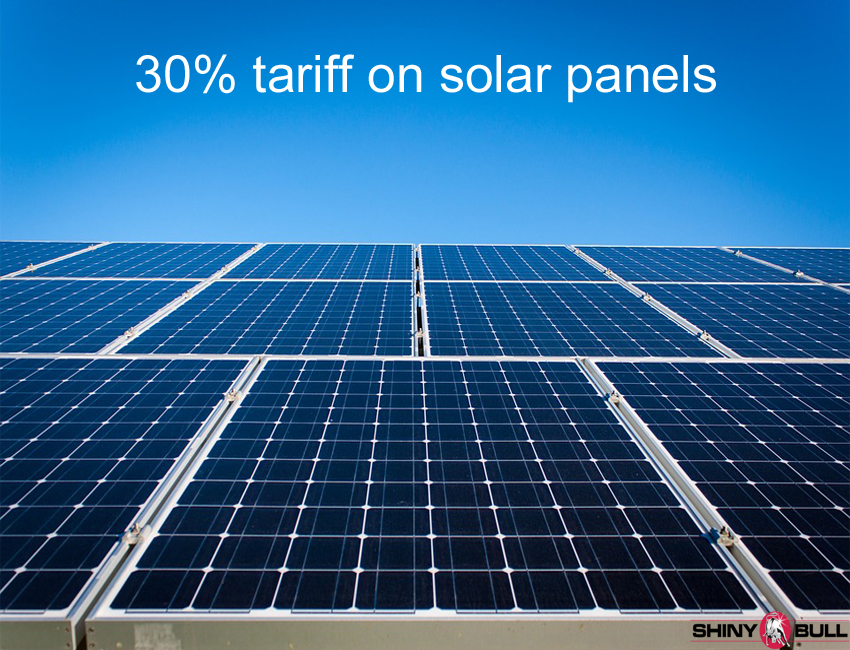
President Donald Trump will impose duties of as much as 30% on solar panels made abroad

Globalization is the word. All the world leaders in the Swiss ski resort of Davos are talking about it. And most of the worlds political and corporate elite defend globalization. But President Trump did something on Monday that some other leaders dont like.

He slapped 30% tariff on imported solar panels and washing machines, and that is his first step towards his campaign promise to get tough on China. Critics say that this step can slow down a fast-growing industry and destroy thousands of domestic manufacturing jobs.

President Emmanuel Macron will have speech in the Swiss ski resort of Davos on Wednesday. One of the most important things he will talk about is Globalization. On Friday, Mr Trump will also have a speech in Davos, and he will talk about his «America first» strategy.

Why in the world is Mr Trump doing this if it is bad for the solar industry and its jobs? Relax. This is not a new case and we have heard about this in many years. Former President Barrack Obama did the same in 2012.

In May, 2012, the Obama administration called for hefty tariffs on Chinese-made solar panels and cells. They were arguing China has been illegally «dumping» under-priced products on the U.S market.

In December 2014, The Commerce Department began closing a chapter in a protracted trade conflict with China over solar equipments, approving a collection of steep tariffs on importers from Taiwan and China.

They found that the companies were selling products below the cost of manufacture. On top of that they found that the Chinese companies were benefiting from unfair subsidies from their government.

The department announced anti-dumping duties of up to about 80% on imports made in China, and rates up to about 30% on imports of solar cells made in Taiwan. Some experts in the solar industry say this tariff will return to fair trade.

This is what all this is about: fair trade. This trade conflict has its roots in a flood of inexpensive Chinese solar products. This Chinese strategy pushed many American manufacturers out of business because of their reduced prices on solar panels.

Leaders are split over the case, and this long-simmering conflict has now ended with a 30% tax on Chinese solar panels. Mr Trump has promised to boost manufacturing jobs by cracking down on Chinese imports. It will create jobs and build or expand factories on U.S soil.

President Trump is doing this because he will defend American workers. He will defend American farmers and their ranchers. He will also defend all other businesses. He will «Make Amerian Great Again.»

Some people do not agree with Mr Trump. They said yesterday that Trump`s decision will kill American manufacturing jobs, not create them.

The Solar Energy Association has projected tens of thousands of job losses in the $28 billion industry.

Disclaimer: The views expressed in this article are those of the author and may not reflect those of Shiny bull. The author has made every effort to ensure accuracy of information provided; however, neither Shiny bull nor the author can guarantee such accuracy. This article is strictly for informational purposes only. It is not a solicitation to make any exchange in precious metal products, commodities, securities or other financial instruments. Shiny bull and the author of this article do not accept culpability for losses and/ or damages arising from the use of this publication.

———————————————–advertisement——————————————————-

Polo Shirt

High quality Polo shirt with Shinybull logo. This version is made from breathable 100% cotton. Short sleeves and ribbed armbands.

$125.00

Polo Shirt

High quality Polo shirt with Shinybull logo. This version is made from breathable 100% cotton. Short sleeves and ribbed armbands.

$125.00

Leave a comment

Filed under Energy, Politics