For decades, Germany was synonymous with economic strength. Ever since World War II, it enjoyed the so-called «Wirtschaftswunder,» or economic miracle that followed the postwar recovery, which blessed Germany with almost four decades of high growth.
High growth thanks to German engineering, and manufacturing industries. The economic growth eventually slowed down, but Germany had established itself as the industrial heart of Europe, fueled by exports of products with large margins like cars machinery, and chemicals.
Companies like Volkswagen, BMW, Siemens, and BASF became global leaders with German products seen as pinnacles of quality and reliability. As a result of all that, people in Germany enjoyed high salaries, and high quality of life.
Their economic model was built on a few key pillars; strong manufacturing base. A highly skilled workforce, commitment to quality, and very strong exports. But this has come to an end. Last year, Germany was the only G-7 economy to shrink. It`s also the group`s slowest-growing economy with a growth to GDP at -0.1%.
It goes up and down. Down -0,5, up 0,1, down, 0,1, up 0,2, down -0,4, up 0,2, and then down again to -0,1.
Picture: Old economy vs New economies
Germany, long considered the economic engine of Europe, is currently facing significant challenges, leading to concerns that its economy may be stalling or «broken.» What in the world is happening in Germany, and what are the key factors that are affecting their economy right now?
It`s an energy crisis. Germany was dependent on Russian Gas. Germany relied heavily on Russian natural gas before the war in Ukraine. The subsequent sanctions and supply disruptions have led to a severe energy crisis, pushing up prices and harming energy-intensive industries like chemicals, manufacturing, and heavy machinery.
They also have a green transition challenge. Germany is trying to transition to renewable energy, but the shift away from nuclear and coal has left the country vulnerable during this energy crunch. This has increased costs for businesses and households, causing slower growth.
Germany`s economy is heavily reliant on exports, especially in industries like automotive and machinery. Global demand has softened, and supply chain disruptions from the COVID-19 pandemic continue to affect production.
The German auto industry, in particular, has been slow to transition to electric vehicles compared to competitors like Tesla, and Chinese manufacturers. This lag is putting pressure on a key pillar of the country`s economy.
Germany`s economy narrowly avoided recession in early 2023, but growth remains sluggish. High inflation and low consumer spending have contributed to weak economic activity. The combination of rising wages, energy prices, and inflationary pressures has increased production costs, leading to reduced profitability for businesses.
On top of that, you have an aging population. Germany`s population is aging rapidly, and the working-age population is shrinking. This is leading to labor shortages in key sectors and higher social welfare costs, creating long-term economic challenges.
In addition; they have migration struggles. While the country has relied on immigration to fill gaps in the labor market, recent shifts in public sentiment and policy restrictions have made it harder to sustain this approach.
Their biggest companies have been there for about 100 years, but there is a shift in the market. Germany has been criticized for lagging behind in digitalization and innovation, particularly in fields like AI and tech start-ups. This is reducing its competitiveness in the global economy.
Another problem is Germany`s heavily regulated business environment and complex bureaucracy. This can stifle innovation and make it harder for new businesses to scale up.
Like many others, Germany has trade challenges and the global demand is weak. As the global economy faces uncertainty, especially with China`s slowing growth, demand for Germany`s exports has dropped.
Germany`s economic model has long been dependent on strong export markets, so this is a major issue!
At least; EU Tension. Economic divergence within the European Union, especially between northern, and southern European economies, adds another layer of complexity, affecting Germany`s trade relations within the bloc.
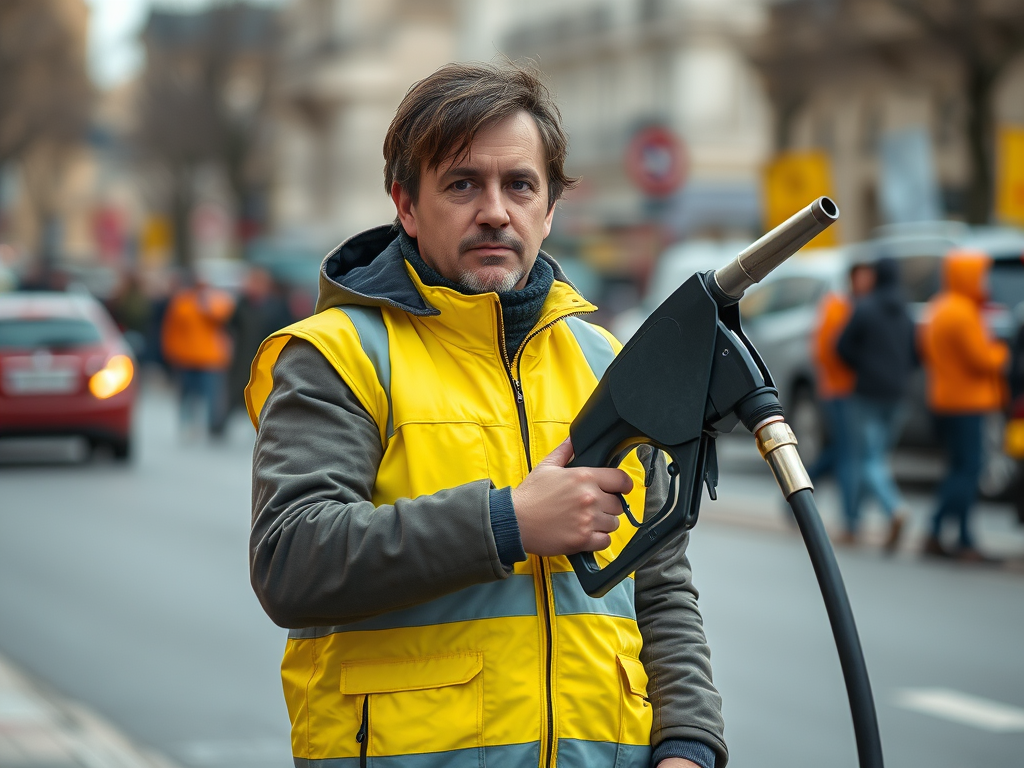
It all started in France. Yellow Vest protesters went to the streets for months and years and protested against higher oil prices, electricity bills, and expensive toll stations. Their standard of living was shrinking.
This happened at a time when Donald Trump was cutting taxes and made the best economy in the U.S. ever. People in France asked for a Trump-like figure, but everything has gone straight up since then, and now we see severe problems in Germany and other places.
Picture: Yellow Vest protesters against high oil prices and low standard of living
This is happening at a time were productivity in the U.S. is great. Germany`s productivity is down -0,1%, while the productivity in the U.S. is up 3%. They are the best. They are at the top of the list! Even better than China! And the stock market goes up. Wow!
Germany`s economy is not «broken,» but it is facing severe challenges. Energy costs, inflation, global demand weakness, and structural issues in key industries like manufacturing are causing slower growth.
Long-term concerns like demographic changes and lagging investment in innovation also threaten future competitiveness. While these challenges are significant, Germany has strong economic fundamentals and could recover with strategic reforms and investments.
However, the current climate is tough, and the country is at a critical point in addressing these issues. Germany is in trouble.
Disclaimer: The views expressed in this article are those of the author and may not reflect those of Shinybull.com. The author has made every effort to ensure the accuracy of the information provided; however, neither Shinybull.com nor the author can guarantee such accuracy. This article is strictly for informational purposes only. It is not a solicitation to make any exchange in precious metal products, commodities, securities, or other financial instruments. Shinybull.com and the author of this article do not accept culpability for losses and/ or damages arising from the use of this publication.
Russia`s President Vladimir Putin gave a speech today. He delivered his Address to the Federal Assembly. The ceremony took place in Gostiny Dvor in Moscow.
«The so-called West, with its colonial practices, and penchant for inciting ethnic conflicts around the world, not only seeks to impede our progress, but also envisions a Russia that is a dependent, declining, and dying space where they can do as they please.
In fact, they want to replicate in Russia what they have done in numerous other countries, including Ukraine: sowing discord in our home, and weakening us from within. But they were wrong, which has become abundantly clear now that they ran up against the firm resolve, and determination of our multi-ethnic people», Putin said in the speech.
«Together, as citizens of Russia, we will stand united in defense of our freedom, and our right to a peaceful, and dignified existence», Putin added.
Furthermore, Putin said; «We were not the ones who started the war in Donbas, but as I have already said many times, we will do everything to put an end to it, eradicate Nazism, and fulfill all the objectives of the special military operation, as well as defend sovereignty, and ensure that our people are safe».
«Here is a good example of their hypocrisy. They have recently made unfounded allegations, in particular against Russia, regarding plans to deploy nuclear weapons in space. Such fake narratives and this story is unequivocally false, are designed to involve us in negotiations on their conditions, which will only benefit the United States,» he said.
«There are reasons to suspect that the current US administration`s professed interest in discussing strategic stability with us is merely demagoguery.
They simply want to show to their citizens, and the world, especially in the lead-up to the presidential election that they continue to rule the world, that they would talk with the Russians when it will benefit them, and that there is nothing to talk about, and they will try to inflict defeat on us otherwise. Business as usual, as they say.»
«But this is unacceptable, of course. Our position is clear: if you want to discuss security and stability issues that are critical for the entire planet, this must be done as a package including, of course, all aspects that have to do with our national interests, and have a direct bearing on the security of our country, the security of Russia,» Putin said.
Putin also talked about a potential nuclear war, which would be the end of our civilization. He also said that the West is declining. This is what he said:
«We are also aware of the Western attempts to draw us into an arms race, thereby exhausting us, mirroring the strategy they successfully employed with the Soviet Union in the 1980s.
Let me remind you that in 1981 – 1988, the Soviet Union`s military spending amounted to 13 percent of GDP.
We need to shore up the forces in the Western strategic theatre in order to counteract the threats posed by NATO’s further eastward expansion, with Sweden, and Finland joining the alliance.
The West has provoked conflicts in Ukraine, the Middle East, and other regions around the world while consistently propagating falsehoods. Now they have the audacity to say that Russia harbors intentions of attacking Europe.
Can you believe it?
We all know that their claims are utterly baseless.
And at the same time, they are selecting targets to strike on our territory, and contemplating the most efficient means of destruction. Now they have started talking about the possibility of deploying NATO military contingents to Ukraine.»
«But we remember what happened to those who sent their contingents to the territory of our country once before. Today, any potential aggressors will face far graver consequences.»
«Everything they are inventing now, spooking the world with the threat of a conflict involving nuclear weapons, which potentially means the end of our civilization. Don`t they realize this?
«Indeed, just like any other ideology promoting racism, national superiority, or exceptionalism, Russophobia is blinding, and stupefying.
The United States and its satellites have, in fact, dismantled the European security system which has created risks for everyone.»
«Clearly, a new equal, and indivisible security framework must be created in Eurasia in the foreseeable future. We are ready for a substantive discussion on this subject with all countries, and associations that may be interested in it.
What Putin said next is very important to understand. He talked about Russia as a sovereign country. That is very different from a Russia controlled by the EU. What Putin talks about is very similar to what President Najib Bukele in El Salvador talks about.
It is their own sovereignty and freedom. Bukele said that globalization in El Salvador is dead. They want to rule their own country and have their own freedom. Out with the globalists, he said.
Putin talks about the same, but when it comes to Russia, he talks about the «balance of Power.» If the EU takes over Russia, it can fall into a gigantic dictatorship, and everyone in Europe will end up like slaves and losers. This is what Putin said in his speech:
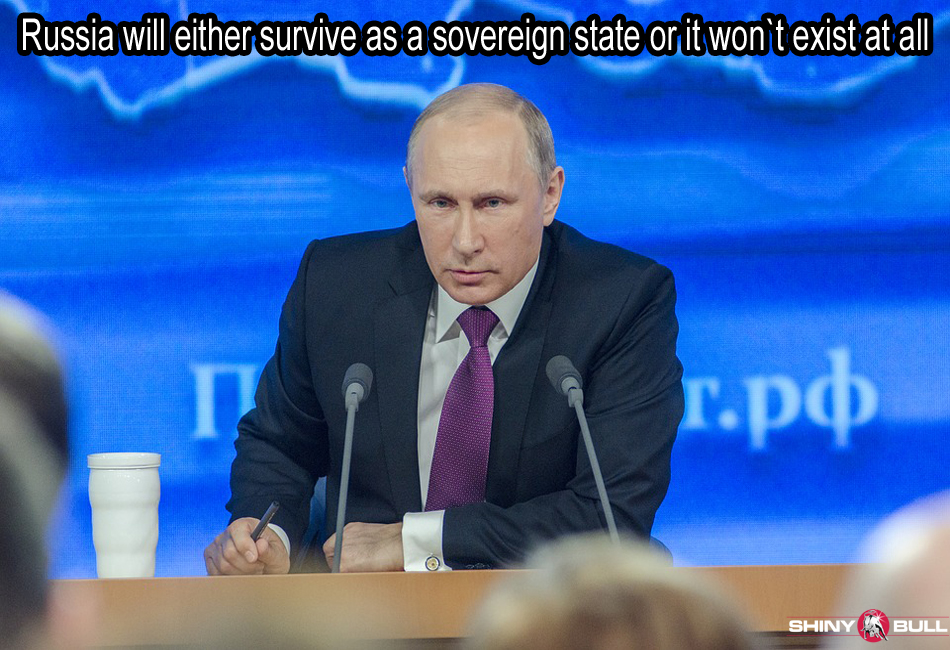
«At the same time, I would like to reiterate (I think this is important for everyone) that no enduring international order is possible without a strong, and sovereign Russia.»
«We strive to unite the global majority`s efforts to respond to international challenges, such as the turbulent transformation of the world economy, trade, finance, and technology markets, when former monopolies, and stereotypes associated with them are collapsing.»
Europe has throughout history tried to take control of other countries, and they have earned a lot of money on it. But that era is coming to an end. Now, it is different. Europe is declining, and Putin talked about it in his speech today. He said:
«For example, in 2028, the BRICS countries with account taken of the new members will create about 37 percent of global GDP, while the G7 numbers will fall below 28 percent.
These figures are quite telling because the situation was completely different just 10 or 15 years ago. You have heard me say it publicly before. These are the trends, you see.
Look, the G7 countries’ share in global GDP in terms of PPP stood at 45,7 percent in 1992, while the BRICS countries (this association did not exist in 1992) accounted for only 16,5 percent.
In 2022, though, the G7 accounted for 30.3 percent, while BRICS had 31,5 percent.
By 2028, the percentage will shift even more in favor of BRICS, with 36,6 percent, and the projected figure for the G7 is 27,8 percent.
(Editor: The Group of Seven is an intergovernmental political and economic forum consisting of Canada, France, Germany, Italy, Japan, the United Kingdom, and the United States; additionally, the European Union is a “non-enumerated member).
There is no getting away from this objective reality, and it will remain that way no matter what happens next, including even in Ukraine,» Putin said.
Disclaimer: The views expressed in this article are those of the author and may not reflect those of Shinybull.com. The author has made every effort to ensure the accuracy of the information provided; however, neither Shinybull.com nor the author can guarantee such accuracy. This article is strictly for informational purposes only. It is not a solicitation to make any exchange in precious metal products, commodities, securities, or other financial instruments. Shinybull.com and the author of this article do not accept culpability for losses and/ or damages arising from the use of this publication.
The days we are living in are historic, and they will go down in history books forever. What we see is a huge shift in the balance of power. A New World Order. The term «New World Order» refers to a new period of history evidencing a dramatic change in world political thought and the balance of power in international relations.
Despite varied interpretations of this term, it is primarily associated with the ideological notion of world governance only in the sense of new collective efforts to identify, understand, or address global problems that go beyond the capacity of individual nation-states to solve.
It started about 100 years ago. The phrase «New World Order» or similar language was used in the period toward the end of the first World War in relation to Woodrow Wilson`s vision for international peace;
Wilson called for a League of Nations to prevent aggression and conflict.
The League of Nations was the first worldwide intergovernmental organization whose principal mission was to maintain world peace. It was founded on 10. January 1920 by the Paris Peace Conference that ended the First World War.
The main organization ceased operations on 20 April 1946 but many of its components were relocated to the new United Nations.
The League`s primary goals were stated in its Covenant. They included preventing wars through collective security and disarmament and settling international disputes through negotiations and arbitration.
Its other concerns included labor conditions, just treatment of native inhabitants, human and drug trafficking, the arms trade, global health, prisoners of war, and protection of minorities in Europe. In 1919, U.S president Woodrow Wilson won the Nobel Peace Prize for his role as the leading architect of the League.
But, the League of Nations failed, and neither Franklin Roosevelt nor Harry S. Truman used the phrase «New World Order» much when speaking publicly on international peace and cooperation. Indeed, in some instances when Roosevelt used the phrase «New World Order» it was to refer to Axis powers for world dominance.
Axis powers, better known as the Rome-Berlin Axis, was a military coalition that initiated World War II and fought against the Allies. The Axis grew out of successive diplomatic efforts by Germany, Italy, and Japan to secure their own specific expansionist interests in the mid-1930s.
The Allies, formally referred to as the United Nations from 1942, was an international military coalition formed during the Second World War (1939-1945) to oppose the Axis powers. Its principal members by the end of 1941 were the United Kingdom, the United States, and the Soviet Union.
Truman’s speeches have phrases such as «better world order», «peaceful world order», «moral world order» and «world order based on law», but not so much «new world order».
The phrase «new world order» was explicitly used in connection with Woodrow Wilson`s global zeitgeist during the period just after World War I during the formation of the League of Nations. «The war to end all wars» had been a powerful catalyst in international politics, and many felt the world could simply no longer operate as it once had.
World War I had been justified not only in terms of U.S. national interest but in moral terms. To «make the world safe for democracy».
After the war, Wilson argued for a new world order which transcended traditional great power politics, instead emphasizing collective security, democracy, and self-determination. However, the United States Senate rejected membership in the League of Nations, which Wilson believed to be the key to a new world order.
Nazi activist and future German leader Adolf Hilter also used the term in 1928. World War II started in 1939, and a year later, H.G. Wells wrote a book entitled «The New World Order.» It addressed the ideal of a world without war in which law and order emanated from a world governing body, and examined various proposals and ideas.
I don`t the Nazis read the book, and World War II continued until 1945. It was goodbye to the United Kingdom, as the United States was the new leader with a new world order. But then the Cold War started. A war that ended in 1989, and believe it or not; that was the beginning of a new world order. Once again.
The principal statement creating the new world order concept came from Mikhail Gorbachev`s December 7, 1988 speech to the United Nations General Assembly. Gorbachev described a phenomenon that could be described as a global political awakening:
«We are witnessing the most profound social change. Whether in the East or the South, the West or the North, hundreds of millions of people, new nations and states, new public movements, and ideologies have moved to the forefront of history.
Broad-based and frequently turbulent popular movements have given expression in a multidimensional and contradictory way, to a longing for independence, democracy, and social justice.
The idea of democratizing the entire world order has become a powerful sociopolitical force. At the same time, the scientific and technological revolution has turned many economic, food, energy, environmental, information, and population problems, which only recently we treated as national or regional ones, into global problems.
Thanks to the advances in mass media, and means of transportation, the world seems to have become more visible and tangible. International communication has become easier than ever before.»
Later on, in June 1990, Gorbachev said: «For a new type of progress throughout the world to become a reality, everyone must change. Tolerance is the alpha and omega of a new world order.»
Former United Kingdom Prime Minister, and British Middle East envoy Tony Blair stated on November 13, 2000, in his Mansion House speech: «There is a new world order like it or not». In 2003, he stated that «the call was for a new world order. But a new order presumes a new consensus. It presumes a shared agenda and a global partnership to do it.»
Former United Kingdom Prime Minister Gordon Brown stated on December 17, 2001: «This is not the first time the world has faced this question. So fundamental and far-reaching. In the 1940s, after the greatest of wars, visionaries in America, and elsewhere looked ahead to a new world and, in their day and for their times, built a new world order.»
Brown also called for a «new world order» in a 2008 speech in New Delhi to reflect the rise of Asia and growing concerns over global warming and finance. Brown said the new world order should incorporate a better representation of «the biggest shift in the balance of economic power in the world in two centuries».
He went on to say: «To succeed now, the post-war rules of the game and the post-war international institutions, fit for the Cold War, and a world of just 50 states, must radically reform to fit our world of globalization.
Iranian President Mahmoud Ahmadinejad has called for a «new world order» based on new ideas, saying the era of tyranny has come to a dead-end. He also said that it is time to propose new ideologies for running the world.
Turkish President Abdullah Gul said: «I don`t think you can control all the world from one center. There are big nations. There are huge populations. There is unbelievable economic development in some parts of the world.
So what we have to do is, instead of unilateral actions, act all together, make common decisions, and have consultations with the world. A new world order, if I can say it, should emerge.
Some scholars of international relations have advanced the thesis that the declining global influence of the U.S., and the rise of largely illiberal powers such as China threaten the established norms, and beliefs of the liberal rule-based world order.
They describe three pillars of the prevailing order that are upheld and promoted by the West, namely peaceful international relations (the Westphalian norm), democratic ideals, and free-market capitalism.
Stewart Patrick suggests that emerging powers, China included, «often oppose the political and economic ground rules of the inherited Western liberal order», and Elizabeth Economy argues that China is becoming a «revolutionary power» that is seeking «to remake global norms, and institutions».
Russian political analyst Leonid Grinin believes that despite all the problems, the U.S. will preserve the leading position within a new world order since no other country is able to concentrate so many leaders’ functions. Yet, he insists that the formation of a new world order will start from an epoch of new coalitions.
Xi Jinping, China`s paramount leader, called for a new world order, in his speech to the Boao Forum for Asia, in April 2021. He criticized U.S. global leadership and its interference in other countries internal affairs. «The rules set by one or several countries should not be imposed on others, and the unilateralism of individual countries should not give the whole world a rhythm,» he said.
U.S President Joe Biden said during a gathering of business leaders at the White House in March 2022 that the recent changes in global affairs caused by the Russian invasion of Ukraine provided an opportunity for a new world order with U.S leadership, stating that this project would have to be carried out in partnership with «the rest of the free world.»
According to Tony Blair`s annual Ditchley lecture in July 2022, China, not Russia, will bring about the most significant geopolitical change of this century. The era of western political, and economic domination is to an end.
The world’s future will be at the very least bipolar, and possibly multipolar.
The east and west can now coexist on equal levels for the first time in contemporary history.
Now, it is March 2023, and a new world is rising. Once again. A new world that is crushing the old Globalist Order. The Globalist order will be replaced with the reawakening of renewed Civilization-States.
The war in Ukraine strengthens the ties between Russia and China as the liberal world order is fading out, while we see a rise in the Civilization States. Putin rips the West and said Biden and the U.S. are trying to hold back the economic development of both Russia and China.
«The crisis in Ukraine, which was provoked and is being diligently fueled by the West, is the most striking, yet not the only, manifestation of its desire to retain its international dominance, and preserve the unipolar world order,» Putin added.
After the fall of the Berlin Wall, political scientist, political economist, international relations scholar, and writer Francis Fukuyama came out with a book called «The End of History, and the Last Man».
He argues that the worldwide spread of liberal democracies, free-market capitalism of the West, and its lifestyle may signal the end point of humanity`s sociocultural evolution and political struggle, and become the final form of human government.
Fukuyama claimed that there is no alternative to liberal democracy, so the unipolar liberal world order started with the invasion of Iraq, and the plan was the democratization of the Middle East. But it was a mistake.
Charles Krauthammer argued that the unipolar moment after the fall of the Berlin Wall made the U.S. a remarkably powerful country and that the U.S. could do a lot of things with that power. Both Fukuyama and Krauthammer admit that the unipolar moment and the end of history is coming to an end.
Fukuyama is now saying that this is the end of the American hegemony. Afghanistan does not mark the end of the American era; the challenge to its global standing is political polarisation at home, he says.
The peak period of American hegemony lasted less than 20 years, from the fall of the Berlin Wall in 1989 to around the financial crisis in 2007-2009. The country was dominant in many domains of power back then.
Military, economic, political, and cultural. The height of American hubris was the invasion of Iraq in 2003 when it hoped to be able to remake not just Afghanistan and Iraq, but the whole of the Middle East, Fukuyama said.
Right after the fall of Kabul back in August of 2021, Fukuyama said it was the end of the neo-liberal era. The end of the neo-globalist era. The end of liberal democracy. The end of leftist wokism, and cultural Marxism.
On that day, exactly 20 years after the invasion of Iraq, Putin and Xi had a three-day meeting, and that marked the end of the liberal globalist world order. Now, we`re seeing a rise of a new world with Russia and China and the rise of the «civilization state».
Civilization states are not united by politics but by culture. The civilization states up-end the old liberal international order that`s centered on the nation-state.
Russia, China, India, Turkey, Iran, Hungary, France, and Poland are all indicators of a rising polycentric world. The liberal world order cares nothing about your culture, except for how it violates liberal woke norms. How it manifests racist, sexist, and phobic tendencies.
Liberal globalists don`t care about your culture, because liberalism is all about imposing a system rather than a civilization on all people`s times and places. It`s about making nations more liberal democracies.
The liberal order tries to incorporate others into common institutions like the WTO and IMF to name a few. They all operate according to the same rules, understandings, and goals. But now it has changed. What we see now is the rise of a world where many populations are returning to culture custom and tradition, and as such the old civilizations are reawakening
A neo-orthodox Russia, neo-confusion China, Shinto-Japan, Hindu India, Neo-Ottoman Turkey, theocratic Iran and Afghanistan, and so on. A civilization world is dawning as the liberal world is coming to an end.
The term «civilization-state» was first used by American political scientist Lucian Pye in 1990 to categorize China as having a distinct sociopolitical character, as opposed to viewing it as a nation-state in the European model.
The use of this new term implies that China was and still is an «empire state» with a unique political tradition and governmental structure, and its proponents asserted that the nation-state model fails to properly describe the evolution of the Chinese state.
Proponents of the label describe China as having a unique historical and cultural unity, derived from a continuous process of cultural syncretism. The term was further popularized by its use in «When China Rules the World» by British political scientist Martin Jacques.
Putin and Xi are crushing the liberal globalist order, and replacing it with «civilization states».
Disclaimer: The views expressed in this article are those of the author and may not reflect those of Shinybull.com. The author has made every effort to ensure the accuracy of the information provided; however, neither Shinybull.com nor the author can guarantee such accuracy. This article is strictly for informational purposes only. It is not a solicitation to make any exchange in precious metal products, commodities, securities, or other financial instruments. Shinybull.com and the author of this article do not accept culpability for losses and/ or damages arising from the use of this publication.
Xi Jinping visited Vladimir Putin today, and they both called each other «dear friends.» Xi says China is ready with Russia to stand guard over world order based on international law, on Moscow visit earlier today. Xi added that with Russia, China was ready to defend the UN-centric international system.
Xi pushes China to play a more dominant role in managing global affairs. China`s New World Order is on the way.
This is what the war in Ukraine is about: the new world order. The war in Ukraine is set to fundamentally transform the International order, and some people call it the world`s «de-Westernization».
A World Order is an impressive work that focuses on the geopolitical distribution of power, Henry Kissinger wrote in his book World Order.
During the 20th century, political figures such as Woodrow Wilson and Winston Churchill used the term «new world order» to refer to a new period of history characterized by a dramatic change in world political thought and in the global balance of power after World War I and World War II.
The interwar and post-World War II periods were seen as opportunities to implement idealistic proposals for global governance by collective efforts to address worldwide problems that go beyond the capacity of individual nation-states to resolve while nevertheless respecting the right of nations to self-determination.
Such collective initiatives manifested in the formation of intergovernmental organizations such as the League of Nations in 1920, the United Nations (UN) in 1945, and the North Atlantic Treaty Organization (NATO) in 1949, along with international regimes such as the Bretton Woods system and the General Agreement on Tariffs and Trade (GATT), implemented to maintain a cooperative balance of power and facilitate reconciliation between nations to prevent the prospect of another global conflict.
After World War II, they all said; «Never again», and the winners, led by America, drafted conventions that defined unpardonable crimes against humanity, and sought to impose costs on those committing them.
Recalling the economic disasters and human miseries that paved the way to world war, the framers of this order built the UN and other international institutions to promote cooperation and development.
Progressives welcomed international organizations and regimes such as the United Nations in the aftermath of the two World Wars but argued that these initiatives suffered from a democratic deficit and were therefore inadequate not only to prevent another world war but to foster global justice, as the UN was chartered to be a free association of sovereign nation-states rather than a transition to democratic world government.
British writer and futurist H.G. Wells went further than progressives in the 1940s by appropriating and redefining the term «new world order» as a synonym for the establishment of a technocratic world state, and of a planned economy, garnering popularity in state socialist circles.
Right-wing populist John Birch Society claimed in the 1960s that the governments of both the United States and the Soviet Union were controlled by a cabal of corporate internationalists, «greedy» bankers, and corrupt politicians who were intent on using the UN as the vehicle to create a «One World Government».
This anti-globalist conspiracism fueled the campaign for U.S. withdrawal from the UN.
In his speech, Toward a New World Order, delivered on 11 September 1990 during a joint session of the US Congress, President George H.W. Bush described his objectives for post-Cold War global governance in cooperation with post-Soviet states. He stated:
«Until now, the world we`ve known has been a world divided – a world of barbed wire and concrete block, conflict, and the cold war. Now, we can see a new world coming into view. A world in which there is the genuine prospect of new world order.
In the words of Winston Churchill, a «world order» in which «the principles of justice and fair play …. protect the weak against the strong…..»A world where the United Nations, freed from cold war stalemate, is poised to fulfill the historic vision of its founders. A world in which freedom and respect for human rights find a home among all nations.»
The New York Times observed that progressives were denouncing this new world order as a rationalization of American imperial ambitions in the Middle East at the time.
And now, everything has changed. Again. China`s New World Order is coming.
We are moving from a Unipolar world to a Multipolar world where Europe and the U.S. are less influential. The war in Ukraine is dividing opinions between people in Western nations, and those in countries like China, India, and Turkey, a new poll suggests.
The war in Ukraine has laid bare the «sharp geographical divides in global attitudes» on «conceptions of democracy, and the composition of the future international order,» according to a new survey from the European Council on Foreign Relations (ECFR).
While Western allies have «regained their sense of purpose on the global stage,» the gulf between their perspective and the «rest» has grown wider, the ECFR added.
There are different views about the general role the West will play in the future world order. Some people expect a new bipolar world of two blocks led by the U.S. and China, whereas there were signs that most people in major non-Western countries see the future in more multipolar terms.
China has always been in front. The silk road is known for all the roads from China to Europe, and nobody knows how old it is, but it can be as old as ten thousand years. The silk road was popular because the Chinese sold silk to Europe.
Today, China is still in front as they are considered to be the factory of the world. But this is probably not a surprise for people in China. Why?
For more than two millennia, nomarchs who ruled China proper saw their country as one of the dominant actors in the world. The concept of Zhongguo (the Middle Kingdom, as China, calls itself), is not simply geographic.
It implies that China is the cultural, political, and economic center of the world.
This Sino-centrist worldview has in many ways shaped China`s outlook on global governance. The rules, norms, and institutions that regulate international cooperation. The decline and collapse of imperial China in the 1800s and early 1900s, however, diminished Chinese influence on the global stage for more than a century.
But China is back. China has reemerged as a major power in the past two decades, with the world`s second-largest economy and a world-class military. It increasingly asserts itself, seeking to regain its centrality in the international system, and over global governance institutions.
These institutions, created mostly by Western powers after World War II, include the World Bank, which provides loans and grants to developing states, the International Monetary Fund, which works to secure the stability of the global monetary system; and the United Nations, among others.
President Xi Jinping, the most powerful Chinese leader since Mao Zedong, has called for China to «lead the reform of the global governance system,» transforming institutions and norms in ways that will reflect Beijing`s values and priorities.
For over two thousand years, beginning with the Qin dynasty (221-226 BCE) and ending with the collapse of the Qing (1636-1911 BCE), monarchs who ruled China proper invoked a mandate of heaven to legitimate their own rule and rhetorically assert their own centrality to global order, even though they never built a truly global empire.
Even when China`s influence collapsed in the nineteenth and twentieth centuries, Chinese elites dreamed of regaining global influence.
At the end of World War II, China became an initial member of the United Nations and seemed poised to play a larger role in the new international order. But after the Communist Party won the civil war and took power in 1949, China rejected the international system and tried to help create an alternative global governance order.
Frustrated with the existing international system, the Republic of China (Taiwan) remained seated on the UN Security Council, instead of the People`s Republic of China, Beijing promoted alternative values and institutions.
In 1953, Premier Zhou Enlai enunciated «The Five Principles of Peaceful Coexistence», mutual respect for sovereignty, territorial integrity, mutual nonaggression, noninterference in each other`s international affairs, equality, mutual benefit, and peaceful coexistence.
Endorsed by leaders of many newly independent former colonies, these principles formed a basis for the nonaligned movement (NAM) of the 1960s. NAM became a counterweight to Western-dominated global governance.
China returned to the international system in the early 1970s and rebuilt its ties with the United States. It accepted a weaker international role and sought to participate in the institutions and rules set up after World War II.
After the end of the Mao era, China opened up in the 1980s and 1990s, reformed its economy, and increased its role in global governance, including by cooperating with international institutions. During this time, China adapted many domestic laws to conform to those of other countries.
Deng Xiaoping, who ultimately succeeded Mao, oversaw major economic reforms in the late 1970s and early 1980s, which launched China`s growth and ultimately increased its global reach. Deng introduced market reforms, and encouraged inflows of foreign capital and technology, among other steps.
During this period, China also joined more global financial and trade institutions, including the International Monetary Fund (IMF), the World Intellectual Property Organization, and the Asian Development Bank.
In 1989, the Chinese government violently cracked down on democracy protestors in Beijing`s Tiananmen Square, and elsewhere in the country, which resulted in widespread international condemnation.
To help rebuild its reputation and ties with other countries, beginning in the early 1990s, Beijing increasingly embraced multilateralism and integration with global governance institutions. Beijing signed multilateral agreements it had previously been reluctant to join.
In the first decade of the twenty-first century, China often proved willing to play by international rules and norms. As its economy grew, however, Beijing assumed a more active role in global governance, signaling its potential to lead and challenge existing institutions and norms.
The country boosted its power in four ways; it took on a bigger role in international institutions, advertised its increasing influence, laid the groundwork to create some of its own organizations, and sometimes subverted global governance rules.
In 2010, China surpassed Japan to become the world`s second-biggest economy and earned the third-greatest percentage of votes in the World Bank, and the International Monetary Fund (IMF). It also created its own Multilateral Organizations.
China started to create its own Beijing-dominated institutions. A process that would expand in the 2010s. In the previous decade, Beijing had established the Shanghai Cooperation Organization (SCO), which built on the earlier Shanghai 5 group, and brought together China, Russia, and Central Asian states.
In the 2010s, the SCO would become a vehicle for China to challenge existing global norms, such as pushing its idea of closed internet controlled by governments, rather than one global, open internet.
Under President Bush and Obama, Washington generally accepted that Beijing would increasingly support global governance norms and institutions. In 2005, U.S. Deputy Secretary of State Robert Zoellick publicly urged China to become a «responsible stakeholder» in the international system.
The Donald J. Trump administration, by contrast, has expressed greater concern over Chinese efforts to subvert existing norms and has pushed back against Beijing`s efforts to use international institutions to promote Chinese foreign policies and programs like the Belt and Road Initiatives.
But China challenges International norms and rules. Under Jiang Zemin`s successor Hu Jintao, China more openly challenged international norms. Beijing asserted that its sovereignty over disputed areas of the South China Sea was a «core interest,» and «non-negotiable, « despite participating in negotiations with other claimants.
Beijing also expanded its footprint in the South China Sea; it built military facilities on disputed islands and artificial features. And it expanded its aid around the world.
Since the early 2010s, as China`s economic and military power has grown, so too has its ambition and capability to reform the global governance system to reflect Beijing`s priorities and values.
Some of the priorities Beijing promotes in global governance are defensive in nature and reflect long-standing. Chinese aims: preventing criticism of China`s human rights practices, keeping Taiwan from assuming an independent role in international institutions, and protecting Beijing from compromises to its sovereignty.
Yet China also now seeks to shape the global governance system more offensively, to advance its model of political and economic development. This development model reflects extensive state control over politics and society and a mix of both market-based practices and statism in core sectors of the economy.
Xi Jinping has called for more shared control of global governance. He has declared that China needs to «lead the reform of the global governance system with the concepts of fairness and justice».
The terms fairness and justice signal a call for a more multipolar world, one potentially with a smaller U.S. role in setting international rules. The Donald J. Trump administration`s retreat from global leadership has added to China`s opportunity to fill the void and promote multipolar global governance.
China is now pushing for a bigger role in International agencies. Chinese officials lead four of the fifteen UN specialized agencies. They are also creating alternative institutions. Beijing is building its own, China-centered institutions.
In 2013, Beijing launched the Belt and Road Initiatives. A vast plan to use Chinese assistance to fund infrastructure, and boost ties with, other countries, like their neighbor Russia. Beijing`s more proactive global strategy serves the Xi administration`s dream of returning China to its past glory.
China`s evolving global governance strategy is most apparent in four major issues; global health, internet governance, climate change, and development finance.
China seeks to become a leader in global internet governance and to promote the idea of «cyber sovereignty». That a state should exert control over the internet within its borders. In October 2017, Xi Jinping unveiled his plans to make China a «cyber superpower.»
Globally, Beijing promotes its domestic cyber sovereignty approach to internet governance, which hinges on Communist Party control and censorship. Xi`s administration uses increasingly advanced technology to dominate the domestic internet and social media, blocking global search engines, and social media sites, and promoting domestic versions.
China`s domestic internet offers an alternative to existing, freer models of internet governance, and Beijing also uses its influence at the United Nations, and other forums to push countries to adopt a more closed internet.
Meanwhile, Chinese corporations such as Huawei, and CloudWalk have supplied repressive governments in Venezuela and Zimbabwe with surveillance tools like facial recognition technology.
And the Belt and Road Initiative (BRI) contains a «Digital Silk Road Initiative» that includes inviting foreign officials to participate in workshops on information technology policy, including controlling the internet.
If China and Russia can set the standards for internet governance, they could pave the way for other countries to embrace cyber sovereignty, sparking a divided world with two internets. One is generally open, and the other is closed and favored by autocracies.
The world has become less democratic in recent years. Democracy is in decline. The number of people that have democratic rights has recently plummeted: between 2016 and 2022, this number fell from 3,9 billion to 2,3 billion people.
The world underwent phases of autocratization in the 1930s and again in the 1960s and 1970s. Back then, people fought to turn the tide and pushed democratic rights to unprecedented heights. But what now? Can we do the same again?
A new Chinese world order is coming, and they are not democratic.
Disclaimer: The views expressed in this article are those of the author and may not reflect those of Shinybull.com. The author has made every effort to ensure the accuracy of the information provided; however, neither Shinybull.com nor the author can guarantee such accuracy. This article is strictly for informational purposes only. It is not a solicitation to make any exchange in precious metal products, commodities, securities, or other financial instruments. Shinybull.com and the author of this article do not accept culpability for losses and/ or damages arising from the use of this publication.
Thursday this week marks the 23rd anniversary of NATO`s bombing of the Federal Republic of Yugoslavia, which began on March 24, 1999, and lasted 78 days, Serbian media reported.
The European security crisis began in 1999 when US/Nato started to bomb Yugoslavia, and that was then erosion of all foundations of the world order, according to Kremlin spokesman Dmitry Peskov in an interview with Russian Tass.
«Back then, these bombs in addition to killing civilians started destroying the system of international relations. It was exactly then that NATO (and when we say «NATO», we mean «Americans») started to bomb the foundation of the world order, which led to the European security crisis, which we are living through today», the spokesman underscored.
This is exactly in line with what I have said in my recent articles. Putin`s war in Ukraine has many sides. Putin is attacking the European globalists, and globalization is dead.
Peskov pointed out that this crisis primarily involves the European continent. Russia and other states are located, most of which are currently unfriendly towards Moscow. «The very Americans, who instigated all this, they suffer from this crisis much less, we must understand it well», he added.
Serbia was attacked as responsible for the humanitarian catastrophe in Kosovo, and the immediate cause was the events in Racak and the failure of negotiations on Kosovo`s future status in Rambouillet and Paris, according to Novinite.
NATO’s air operation began at 7.45 p.m. on 24 March 1999. Nineteen NATO countries began bombing ships in the Adriatic and four air bases in Italy. First, the air defenses and other Yugoslav military sites in Pristina, Batajnica, Belgrade, Mladenovac, and elsewhere were bombed.
According to the Serbian Ministry of Defense, 2,500 civilians were killed during the NATO airstrike, including 89 children and 1,031 members of the army and police. 6,000 civilians were injured, including 2,700 children and 5,173 soldiers and police, and 25 are still missing.
Serbian President Aleksandar Vucic said last night that there was no justification for NATO aggression in 1999 but that if he had been in Slobodan Milosevic’s place, he would have acted differently, Politika reported.
“In a few days, I would have stopped it, either by resigning or something else. 78 days is too long to cripple a country that had no chance to defend itself and wait for someone else to help us, but we knew that no one would,” Vucic said in an interview with RTV.
The president noted that Russia at the time, led by Boris Yeltsin, was weak. Vucic also pointed out that the one who leads the country must take care of how to save his people.
“I am now looking at the conflict in Eastern Europe and wondering why some people are not thinking well about the consequences”, Vucic said.
Serbian President Aleksander Ucic said in an interview on March 24; «“Now, after 23 years, one can see with clarity how despicable, ill-judged, unlawful and immoral this operation by 19 NATO countries was” and how “ridiculous, even stupid, to hear them now blaming Russia for its so-called aggression against Ukraine”, adding that “the morals, principles, and values they constantly talk about do not exist at all”. Does China have any comments?
Wang Wenbin is a Chinese politician diplomat, the spokesperson of the Ministry of Foreign Affairs, deputy director of the Foreign Ministry Information Department, and a member of the Chinese Communist Party (CCP). He had a speech and said this on CCTV:
«On March 24, 1999, US-led NATO forces blatantly bypassed the UN Security Council and began the 78-day incessant bombing of the Federal Republic of Yugoslavia, a sovereign country, in grave violation of relevant international conventions and basic norms governing international relations.
In 12,000 strikes, over 10,000 tonnes of explosives were dropped and more than 3,000 missiles fired, targeting everything from medical facilities to ancient cultural relics, residential buildings, and schools.
Thousands of innocent civilians including three Chinese journalists were killed. During the bombing campaign, NATO even used depleted uranium bombs prohibited by international conventions, causing long-term damage to Serbia’s environment and people’s health.
The people of Serbia will not forget NATO’s aggression, nor will the people of China and the rest of the world.
NATO is convening a summit on Ukraine on the 23rd anniversary of its bombing of the Federal Republic of Yugoslavia. I wonder if the US and other NATO members have asked themselves:
What is the root cause of the Ukraine crisis?
What responsibility should the US and NATO assume?
Before reflecting on their crimes against the people in countries like Serbia, Iraq , and Afghanistan, the US and NATO have neither right nor authority to judge others.
Born out of the Cold War, NATO serves no other purpose than war. It has never contributed to the peace and security of our world and will never do so. All those who truly love peace and are committed to advancing peace will resolutely reject NATO’s continued expansion».
Disclaimer: The views expressed in this article are those of the author and may not reflect those of Shinybull.com. The author has made every effort to ensure the accuracy of the information provided; however, neither Shinybull.com nor the author can guarantee such accuracy. This article is strictly for informational purposes only. It is not a solicitation to make any exchange in precious metal products, commodities, securities, or other financial instruments. Shinybull.com and the author of this article do not accept culpability for losses and/ or damages arising from the use of this publication.



 Ket Garden
 Business, Politics, Finans