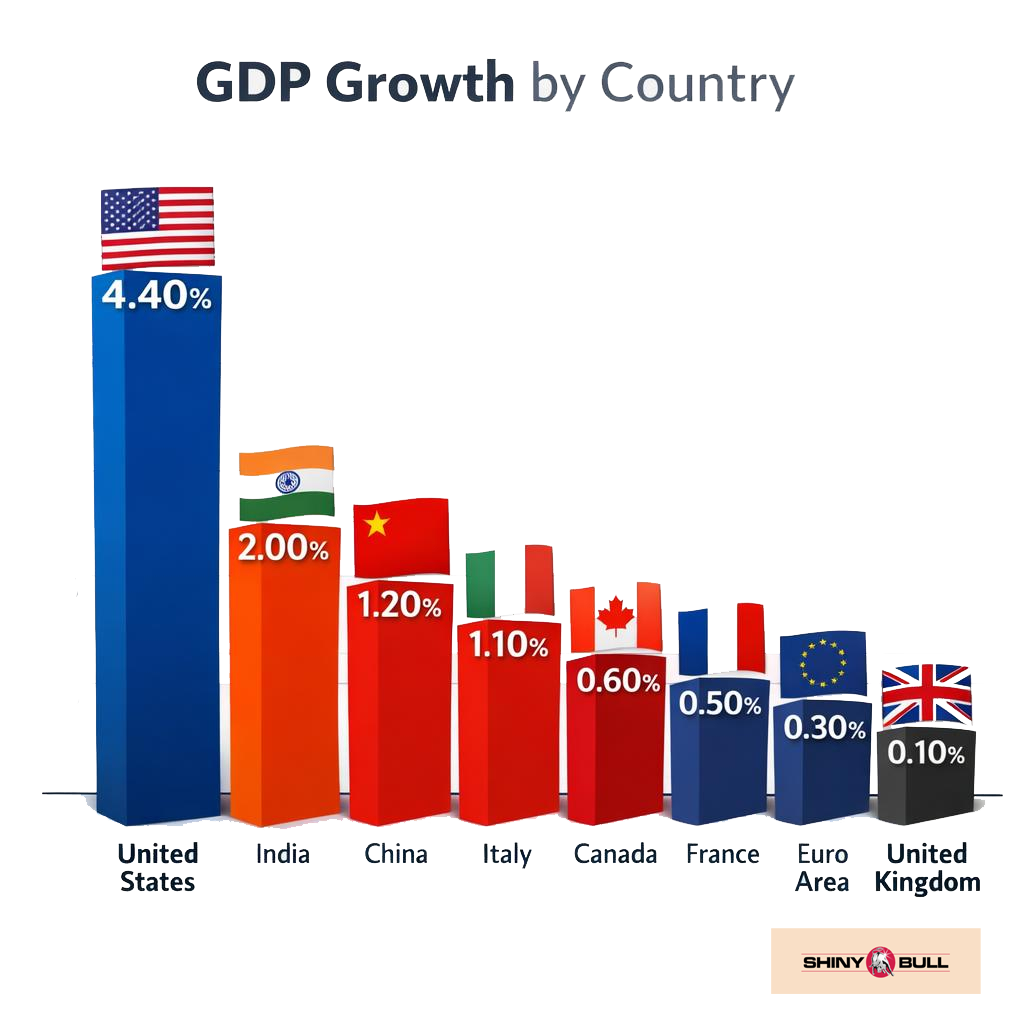
When we look at GDP growth, one thing becomes very clear: the United States is in a league of its own. With growth at 4.4 percent, the U.S. economy is running far ahead of other major economies.
India comes in second — but at less than half the U.S. rate. China, once the global engine of growth, is now barely above one percent. Europe paints a much weaker picture: the euro area, France, and the UK are hovering near stagnation. Italy does a bit better, but still far behind the U.S.
The takeaway is simple: global growth is no longer evenly distributed. The world is increasingly dependent on one dominant economic engine — the United States.
Trumponomics, Taxes, and Tariffs
This dominance is not accidental. Trumponomics — including tax cuts, deregulation, and strategic trade measures — has been designed to strengthen domestic growth. Lower taxes have incentivized investment, increased consumption, and created a multiplier effect across multiple sectors. Simply put: lower taxes mean more growth.
Tariffs have also contributed, protecting key industries and encouraging reshoring. While not the main driver of GDP growth, they amplify the effect of pro-growth policies, keeping production and capital inside the United States.
Crypto and Blockchain: America’s Catalyst
Digital infrastructure, crypto, and blockchain have emerged as powerful catalysts for U.S. economic dominance. While crypto-related activity still represents only a small fraction of U.S. GDP today, it facilitates faster capital flows, scalable services, and innovative financial systems.
Blockchain doesn’t drive the economy on its own — but it reinforces American economic advantage and positions the U.S. to maintain its lead as digital systems expand.
Blockchains are the future, not just for finance, but for the infrastructure of value itself. And America is at the forefront.
Innovation vs. Bureaucracy
A key driver behind continued U.S. economic growth is innovation—particularly in advanced manufacturing and energy technology. Companies like Tesla, led by Elon Musk, have played a pioneering role by pushing battery technology to a new level, giving the U.S. a clear competitive advantage in electric vehicles and energy storage.
In contrast, Europe—and Germany in particular—has been slowed by regulatory complexity and bureaucratic inertia. While innovation in the U.S. is often enabled by speed, scale, and risk-taking, European industry must navigate dense layers of regulation, approval processes, and political compromise.
For Germany, whose economy is deeply tied to the automotive sector, this loss of momentum has broader consequences. And as Germany remains the economic locomotive of the EU, the effects of slower innovation are amplified across Europe—raising the question of whether regulation has begun to outweigh competitiveness.
One Engine, Many Passengers
Put it all together: Trumponomics, smart policy, tariffs, and innovative digital infrastructure. The result? America continues to dominate while Europe struggles with stagnation, and China slows. Emerging markets chase momentum.
Growth today in the United States comes not from soil or oil alone, but from systems designed to turn value into profit. Lower taxes, strategic policy, and innovation create a self-reinforcing cycle — one that keeps the U.S. in the driver’s seat.
Oil once defined power. Today, code, capital, and blockchain define it. And in that world, the United States still owns the refinery.
Disclaimer: The views expressed in this article are those of the author and may not reflect those of Shinybull.com. The author has made every effort to ensure the accuracy of the information provided; however, neither Shinybull.com nor the author can guarantee the accuracy of this information. This article is strictly for informational purposes only. It is not a solicitation to make any exchange in precious metal products, commodities, securities, or other financial instruments. Shinybull.com and the author of this article do not accept culpability for losses and/ or damages arising from the use of this publication.
For decades, Germany was synonymous with economic strength. Ever since World War II, it enjoyed the so-called «Wirtschaftswunder,» or economic miracle that followed the postwar recovery, which blessed Germany with almost four decades of high growth.
High growth thanks to German engineering, and manufacturing industries. The economic growth eventually slowed down, but Germany had established itself as the industrial heart of Europe, fueled by exports of products with large margins like cars machinery, and chemicals.
Companies like Volkswagen, BMW, Siemens, and BASF became global leaders with German products seen as pinnacles of quality and reliability. As a result of all that, people in Germany enjoyed high salaries, and high quality of life.
Their economic model was built on a few key pillars; strong manufacturing base. A highly skilled workforce, commitment to quality, and very strong exports. But this has come to an end. Last year, Germany was the only G-7 economy to shrink. It`s also the group`s slowest-growing economy with a growth to GDP at -0.1%.
It goes up and down. Down -0,5, up 0,1, down, 0,1, up 0,2, down -0,4, up 0,2, and then down again to -0,1.
Picture: Old economy vs New economies
Germany, long considered the economic engine of Europe, is currently facing significant challenges, leading to concerns that its economy may be stalling or «broken.» What in the world is happening in Germany, and what are the key factors that are affecting their economy right now?
It`s an energy crisis. Germany was dependent on Russian Gas. Germany relied heavily on Russian natural gas before the war in Ukraine. The subsequent sanctions and supply disruptions have led to a severe energy crisis, pushing up prices and harming energy-intensive industries like chemicals, manufacturing, and heavy machinery.
They also have a green transition challenge. Germany is trying to transition to renewable energy, but the shift away from nuclear and coal has left the country vulnerable during this energy crunch. This has increased costs for businesses and households, causing slower growth.
Germany`s economy is heavily reliant on exports, especially in industries like automotive and machinery. Global demand has softened, and supply chain disruptions from the COVID-19 pandemic continue to affect production.
The German auto industry, in particular, has been slow to transition to electric vehicles compared to competitors like Tesla, and Chinese manufacturers. This lag is putting pressure on a key pillar of the country`s economy.
Germany`s economy narrowly avoided recession in early 2023, but growth remains sluggish. High inflation and low consumer spending have contributed to weak economic activity. The combination of rising wages, energy prices, and inflationary pressures has increased production costs, leading to reduced profitability for businesses.
On top of that, you have an aging population. Germany`s population is aging rapidly, and the working-age population is shrinking. This is leading to labor shortages in key sectors and higher social welfare costs, creating long-term economic challenges.
In addition; they have migration struggles. While the country has relied on immigration to fill gaps in the labor market, recent shifts in public sentiment and policy restrictions have made it harder to sustain this approach.
Their biggest companies have been there for about 100 years, but there is a shift in the market. Germany has been criticized for lagging behind in digitalization and innovation, particularly in fields like AI and tech start-ups. This is reducing its competitiveness in the global economy.
Another problem is Germany`s heavily regulated business environment and complex bureaucracy. This can stifle innovation and make it harder for new businesses to scale up.
Like many others, Germany has trade challenges and the global demand is weak. As the global economy faces uncertainty, especially with China`s slowing growth, demand for Germany`s exports has dropped.
Germany`s economic model has long been dependent on strong export markets, so this is a major issue!
At least; EU Tension. Economic divergence within the European Union, especially between northern, and southern European economies, adds another layer of complexity, affecting Germany`s trade relations within the bloc.
It all started in France. Yellow Vest protesters went to the streets for months and years and protested against higher oil prices, electricity bills, and expensive toll stations. Their standard of living was shrinking.
This happened at a time when Donald Trump was cutting taxes and made the best economy in the U.S. ever. People in France asked for a Trump-like figure, but everything has gone straight up since then, and now we see severe problems in Germany and other places.
Picture: Yellow Vest protesters against high oil prices and low standard of living
This is happening at a time were productivity in the U.S. is great. Germany`s productivity is down -0,1%, while the productivity in the U.S. is up 3%. They are the best. They are at the top of the list! Even better than China! And the stock market goes up. Wow!
Germany`s economy is not «broken,» but it is facing severe challenges. Energy costs, inflation, global demand weakness, and structural issues in key industries like manufacturing are causing slower growth.
Long-term concerns like demographic changes and lagging investment in innovation also threaten future competitiveness. While these challenges are significant, Germany has strong economic fundamentals and could recover with strategic reforms and investments.
However, the current climate is tough, and the country is at a critical point in addressing these issues. Germany is in trouble.
Disclaimer: The views expressed in this article are those of the author and may not reflect those of Shinybull.com. The author has made every effort to ensure the accuracy of the information provided; however, neither Shinybull.com nor the author can guarantee such accuracy. This article is strictly for informational purposes only. It is not a solicitation to make any exchange in precious metal products, commodities, securities, or other financial instruments. Shinybull.com and the author of this article do not accept culpability for losses and/ or damages arising from the use of this publication.
Tesla`s CEO, and the new owner of Twitter, Elon Musk, is at war with Apple. Musk says Apple threatened to remove Twitter from the App store. Not only that. Apple has also stopped advertising on Twitter.
On Monday, Elon Musk tweeted: «Apple has also threatened to withhold Twitter from its App Store, but won`t tell us why.»
Apple is the world`s most valuable company and has huge power. The company was the top advertiser on Twitter and accounted for more than 4 percent of Twitter`s revenue in the first quarter of this year.
Apple spent nearly $50 million on ads on Twitter, which is a huge loss for a company like Twitter. But if Apple were to block Twitter from its App Store, people would be unable to download the Twitter App on their iPhones, and iPads. It will also be problematic for existing users.
Twitter has warned investors in regulatory filings that the success of its services is dependent on their surviving review for compliance with App Store.
«Such review processes can be difficult to predict and certain decisions may harm our business,» the company wrote in a filing to the SEC last year.
«Failure to adhere to Apple`s and Google`s guidelines would be catastrophic, risking Twitter`s expulsion from their app stores and making it more difficult for billions of potential users to get Twitter`s services,» Yoel Roth, the company`s former head of Trust and Safety, wrote in a New York Times op-ed.
On Monday, Elon Musk also tweeted this: «Apple has mostly stopped advertising on Twitter. Do they hate free speech in America?» But Apple didn`t respond to this.
Musk has attacked Apple in a series of tweets after his takeover. He sought to stoke long-running concerns and political scrutiny over Apple`s market power. He tweeted a link to a parody video that Apple foe Epic Games made in 2020 criticizing the App Store as a «monopoly.»
He also tweeted a yes or no poll, asking his more than 119 million followers whether Apple should «publish all censorship actions it has taken that affect its customers.» In another tweet, Musk said: «Did you know Apple puts a secret 30% tax on everything you buy through their App Store?»
But there are more problems for Musk and Twitter. The EU has raised the prospect of a substantial fine or ban for Twitter after warning that it must «significantly increase» efforts to comply with new online legislation.
Twitter`s new owner, Elon Musk, was told he had «huge work ahead» to comply with the EU`s Digital Services Act, which requires tech firms to tackle problems including abusive posts and disinformation.
«I welcome Elon Musk`s statement of intent to get Twitter 2,0 ready for the DSA,» the EU`s commissioner for the internal market, Thierry Breton said. «I am pleased to hear that he has read it carefully and considers it as a sensible approach to implementing on a worldwide basis. But let`s also be clear that there is still huge work ahead, as Twitter will have to implement transparent user policies, significantly reinforce content moderation and protect freedom of speech.»
The Financial Times reported that Breton reiterated the punishments for breaches of the act, which include fines of up to 6% of global turnover, which would be around $500m in Twitter`s case, or a temporary suspension of the service if refused to comply endangers people`s life and safety. Suspension is described by the EU as a «last resort.»
Musk has fired half of Twitter`s 7,500 staff since buying the company for $44 billion in October. Another 1,200 was leaving the company in November after Musk told the remaining staff to commit to being «hardcore» or leave.
In November last year, I wrote an article about Musk and his potential Tesla phone, the Model Pi Smartphone. A phone that is connected to your Tesla EV which is also connected to the Starlink satellite.
The Tesla smartphone Model Pi is equipped with a quality 4K screen, has four cameras, and is powered by Snapdragon 898 SoC chip. Is this the reason why Apple is threatening Musk and Twitter?
White House press secretary Karine Jean-Pierre told reporters at Monday`s briefing that the White House was «keeping an eye on» Musk`s handling of Twitter.
There is no doubt: Elon Musk is at war with Apple.
Disclaimer: The views expressed in this article are those of the author and may not reflect those of Shinybull.com. The author has made every effort to ensure the accuracy of the information provided; however, neither Shinybull.com nor the author can guarantee such accuracy. This article is strictly for informational purposes only. It is not a solicitation to make any exchange in precious metal products, commodities, securities, or other financial instruments. Shinybull.com and the author of this article do not accept culpability for losses and/ or damages arising from the use of this publication.
We all know that the EU is very often attacking Victor Orban and Hungary. There are a lot of things they don`t like about Orban and his conservative country. But there are also a lot of things that Orban doesn`t like about the EU and Western Europe. He talked about it in Europe`s first Cpac-speech.
Victor Orban formed his fifth conservative, Christian government in Hungary about a month ago, and a couple of days ago, he had a speech at Cpac (Conservative Political Action Conference) Hungary, where he talked about the value of the West and its future.
Orban defeated the communist regime, the liberals, and then, most recently, the international liberal left when they combined their forces against Hungary in the election. In the speech (see transcript below) Orban explained how they defeated them for the first, second, third, fourth, and fifth time, but also how they will defeat them again.
He also talked about how Hungary became a bastion of conservative and Christian values in Europe.
The problem in both America and Western Europe, Orban said, is the domination of public life by progressive liberals. The problem is the fact that they hold the most important positions in the most important institutions, that they occupy the dominant positions in the media, and that they produce all the politically indoctrinating works of high and mass culture.
They, the progressive left, tell us what is the truth and what is not, what is right and what is wrong, Orban said. And as conservatives, our lot is to feel about our nation’s public life as String felt in New York; like a «legal alien».
This was also the situation in Hungary, Orban added. Thirty years ago, the left was also in power here, and there was even a communist dictatorship.
The entire machinery of the state worked to entrench the power of the communists. Strange as it may sound, we – and I – grew up in a “woke world”. Only back then critical race theory was called “scientific socialism”, and was taught at university in the same way that woke is taught in your country. Everyday socialist dictatorship: that is what we grew up in. Political correctness, Orwellian Newspeak, state control of the public square, expropriation of private property, and stigmatization of the Right, Orban said.
In the ’80s, Orban wanted a change, and they decided that enough was enough. They wanted to regain Hungary and their freedom., but the communists did not let this pass without response: police attacks, bans, wiretaps, infiltration by state agents, threats, and blackmail.
But Orban and his friends persevered and won. Soviets out, communists down.
They thought they had finally got what they wanted, but they were wrong: under the dictatorship liberals and conservatives entered into an anti-communist pact, but at the first subsequent opportunity, the liberals sided with the communists. It turned out that in fact, they were natural allies.
If I am not mistaken, this kind of sinful covenant has also been seen in the United States. Summa summarum, public life after the first election (in Hungary after communism) was dominated by post-communists, liberals, and progressives, and the Hungarian right was floored.
When my friend Donald Trump won the US presidential election in 2016, one of his main promises was about the need to «drain the swamp».
President Trump has undeniable merits, but nevertheless, he was not re-elected in 2020. He ended up like our first conservative, Christian government in 2002: we governed outstandingly, after so many years I can perhaps indulge in that much immodesty, but we were dragged down by the swamp of the Hungarian left, Orban said.
And then, between 2002 and 2010, we saw what generally happens in such circumstances: the socialists spent the people`s money. Hungary sank into debt, the economy fell into recession, inflation ran out of control, unemployment rose and people were unable to pay their bills.
Street violence broke out and paramilitary groups were on the march. It was a long time ago, but let us not forget strings of ethnically-motivated murders outraged public sentiment. The left had cut back spending on the police so much that they were unable to maintain even the pretense of order, with the law protecting perpetrators rather than victims.
I think you have seen the likes of this, Victor Orban added. They have made a twelve point formula for Hungary, and you can read more about them in Orban`s speech below:
Speech by Prime Minister Viktor Orbán at the opening of CPAC Hungary
19 May 2022, Budapest
Ladies and Gentlemen, Dear American Friends, and Conservatives from all over the world,
I welcome you all. And a special welcome to my friend Václav Klaus. It is no surprise that he is the most intellectually courageous man in Europe, as he is rich in years; but what is a surprise to us all is that he is still the most youthful and the freshest among us. Dear Klaus, thank you so much for coming and being with us.
I know that you all deserve a better speech than this, but we all know that one cannot swim or run a world record time in the morning. Please bear this in mind as you listen to my thoughts. Anyway, it is great to have you here. The timing is a happy accident: a month ago we scored our fourth election victory in a row, and four days ago I formed my fifth conservative, Christian government; and now I am here with you. It is always good to be able to talk among friends, and it is especially good to have something with which to back up one’s words, and we Hungarians rightly feel that we have something with which to back up our words.
My Friends,
We have come a long way. In the 1980s we read about what was happening in the United States from samizdats illegally distributed in the former Eastern Bloc; and now here we are, with Hungary hosting the most important political gathering of the Republican Party, the Grand Old Party. I clearly remember well how we envied you back then: we envied your culture of democratic debate; the freedom in which you arranged public affairs in America; we envied your President Reagan for his charisma, his drive, his wit, and his policies – and, of course, we rooted for him. All we had were the grey-suited communist functionaries and their political Newspeak, a stifling atmosphere, and hopelessness.
Dear American Friends,
If you have seen the series “Chernobyl”, you may have an idea of what I am talking about. We had forty long years of that. And today we are hosting this great event, for which I would like to thank the organizers – but most of all you, who are honoring us with your presence. On behalf of every Hungarian, I thank our American friends and those from other countries for honoring us and coming here to Budapest.
How can I contribute to today’s gathering? Perhaps if I tell you how we won: how we first defeated the communist regime; then how we defeated the liberals; and then, most recently, how we defeated the international liberal left when they combined their forces against Hungary in the election. I will tell you now how we defeated them for the first, second, third, fourth, and fifth time – and how we will defeat them again. As the supporters of Fradi [Ferencváros soccer club] chant: “More, more, more, there’s still more goals to score!” I will tell you how fervent university students succeeded in dismantling a dictatorship, then in breaking the hegemony over opinions enjoyed by the returning communists and liberals, and how they managed to end the dominance of progressives in public life. I will tell you how Hungary became a bastion of conservative and Christian values in Europe. Instead of my long speech, of course, all this could be done briefly and simply. We learned from General Patton that battle brings out all that is best and removes all that is base. This is also true on the political battlefield. Here, my friends, only the best remain standing – or, in short, the ultimate condition for victory is that we must become the best. You can win if you are the best.
Ladies and Gentlemen,
Let us start by saying that you politicians who love your country face a problem that we Hungarians have already tackled successfully. This problem – if I am not mistaken, both in America and Western Europe – is the domination of public life by progressive liberals. The problem is the fact that they hold the most important positions in the most important institutions, that they occupy the dominant positions in the media, and that they produce all the politically indoctrinating works of high and mass culture. They – the progressive left – tell us what is the truth and what is not, what is right and what is wrong. And as conservatives, our lot is to feel about our nation’s public life as Sting felt in New York: like a “legal alien”.
Dear American Friends,
This was also the situation in Hungary. Thirty years ago, the Left was also in power here – and there was even a communist dictatorship. The entire machinery of the state worked to entrench the power of the communists. Strange as it may sound, we – and I – grew up in a “woke world”. Only back then critical race theory was called “scientific socialism”, and was taught at university in the same way that woke is taught in your country. Everyday socialist dictatorship: that is what we grew up in. Political correctness, Orwellian Newspeak, state control of the public square, expropriation of private property, and stigmatization of the Right.
Dear American Friends and Visitors from Abroad,
Under communism, we had a joke about whether it was possible to joke under communism. And the joke was that a political joke contest was held in the Soviet Union, with the following conditions: the contestant coming third would win an all-inclusive trip to Siberia for two weeks, the runner-up for a year, and the winner for life.
American Friends,
If you feel that this joke is becoming ever more meaningful to you, the time has come to start taking action. At all events, we rose up, and in the late 1980s, we decided that enough was enough. We wanted to regain our country and our freedom; we wanted to regain our country’s freedom. The communists did not let this pass without response: police attacks, bans, wiretaps, infiltration by state agents, threats, and blackmail. But we persevered, and we won. Soviets out, communists down. We thought we had finally got what we wanted, but we were wrong: under the dictatorship liberals and conservatives entered into an anti-communist pact, but at the first subsequent opportunity, the liberals sided with the communists. It turned out that in fact, they were natural allies. If I am not mistaken, this kind of sinful covenant has also been seen in the United States. Summa summarum, public life after the first election [in Hungary after communism] was dominated by post-communists, liberals, and progressives, and the Hungarian right was floored. When my friend Donald Trump won the US presidential election in 2016, one of his main promises was about the need to “drain the swamp”. President Trump has undeniable merits, but nevertheless, he was not re-elected in 2020. He ended up like our first conservative, Christian government in 2002: we governed outstandingly – after so many years I can perhaps indulge in that much immodesty – but we were dragged down by the swamp of the Hungarian left.
And then, between 2002 and 2010, we saw what generally happens in such circumstances: the socialists spent the people’s money. Hungary sank into debt, the economy fell into recession, inflation ran out of control, unemployment rose and people were unable to pay their bills. Street violence broke out and paramilitary groups were on the march. It was a long time ago, but let us not forget: strings of ethnically-motivated murders outraged public sentiment. The Left had cut back spending on the police so much that they were unable to maintain even the pretense of order, with the law protecting perpetrators rather than victims.
Dear American Friends,
I think you have seen the likes of this. The Scriptures say the following: “every tree is known by its own fruit.” Well, the fruit of progressive government speaks for itself: economic ruin and street violence. When a left-wing government comes to power, the story almost always ends in the same way. But, dear Friends, in 2002 we organized a popular movement and intellectual resistance with the troops left to us after our electoral defeat. We did not adopt a defensive attitude, and we did not resign ourselves to our minority status; we played to win and proclaimed the Reconquista.
Dear Friends,
The plan succeeded. In 2010 we came back. We had worked for eight years: step by step, brick by brick, we had fought and we had built. The formula is complete. Hungary is the laboratory in which we tested the antidote to dominance by progressives. We have hung up our lab coats, this spring Hungary has received its fourth dose, and I can report the following: the patient has been completely cured. The medication is open-source, free of charge, and comprises twelve points – which I will share with you now. For the benefit of our foreign friends, twelve is the Hungarian freedom fighters’ lucky number.
The first point in the Hungarian formula is to play by our own rules. The only way to win is to refuse to accept the solutions and the paths offered by others. As Churchill said, having enemies is a sure sign that you are doing something right. This is why we should not be discouraged by being defamed, by being branded as deplorable, or by being treated abroad like troublemakers. In fact, it would be suspicious if none of this happened. Please remember that those who play by their opponents’ rules are certain to lose.
The second point: is national conservatism in domestic politics. The cause of the nation is not a matter of ideology, nor even of tradition. The reason that churches and families must be supported is that they are the building blocks of the nation. This also means that one must remain on the side of the voters. We decided to stop migration and build the wall on our southern border because Hungarians said that they did not want illegal immigrants. They said: “Viktor, build that wall!” Three months later the border barrier was up. The secret is not to overthink things: the Hungarian fence is a simple chain-link structure with motion detectors, watchtowers, and cameras; but this is enough, provided people want to protect their country. The Achilles heel of progressives is precisely that they want to impose their dreams on society. But for us, that danger is also an opportunity, because when it comes to important issues, in reality, people do not like left-wing fever dreams. One must find the issues on which the Left is completely out of touch with reality and highlight them – but in a way that can be understood by people who are not eggheads.
Third point: the national interest in foreign policy. Progressives always think that foreign policy is a battle of ideologies: a battle between good and bad, in which the course of history will be decided once and for all. But as I see it, Dear Friends, there have been at least four such “last great battles” over the past hundred years. Something is wrong with that concept. Our response should be a clear and simple antithesis to the progressives: the Nation First! Hungary First! America First! We need a foreign policy based on our interests. This is not always easy, because the world of foreign policy is often a complicated one.
Take the war in our neighboring country. Russia is the aggressor, and Ukraine is the victim. We condemn the aggressor and help the victim of aggression. But at the same time, we know that Ukraine is not defending Hungary. That is a nonsensical idea! Hungary can be defended by NATO and the Hungarian Defense Forces. As a proportion of our population, we have taken in the largest number of refugees, and the Hungarian people are happy to help. They are glad to help, but they do not want to pay the price of the war, because it is not their war and they will not benefit from it. They know full well that war is accompanied by sanctions, rampant inflation, and economic stagnation; they know that war always impoverishes people. We must not yield to the siren voices, however tempting they may sound. Our aim is to restore peace, not to continue the war, because that is what is in our national interest. Hungary First!
The fourth point, Dear Friends: we must have our own media. We can only show up the insane ideas of the progressive Left if we have media that helps us to do this. Left-wing opinions only appear to be in the majority when the media helps to amplify them. The root of the problem is that the modern Western media aligns itself with the views of the Left. Reporters were taught at university by people with progressive left-wing views. And as soon as a conservative figure appears in the media, they are criticized, attacked, defamed, and vilified. I am familiar with the old ethos of Western democracy, according to which party politics and the press must be separated. That is how it should be. But, dear Friends, the Democrats in the US, for instance, do not obey such rules. Just try to count how many media outlets are in the service of the Democratic Party: CNN, The New York Times, the list goes on – I could carry on into the night. Naturally, the Grand Old Party, too, has allied media outlets, but they are no match for the liberals’ dominance of the media. My friend Tucker Carlson stands alone and immovable. His show has the highest audience figures. What does this mean? It means that there should be shows like his day and night – or, as you say, 24/7.
Fifth point: expose your opponent’s intentions. As a condition for victory, media support is necessary, but not sufficient. We must also break down taboos. Perhaps I do not need to introduce this to my American friends, because what breaker of taboos is greater than President Donald Trump? But one can always raise the bar: we must not only break down today’s taboos, but also tomorrow’s taboos. Here in Hungary, we expose what the Left is preparing before they even take action.
At first, they will deny it, but success is all the sweeter when it emerges that we were right all along. For instance, there is the issue of LGBTQ propaganda targeting children. This is still a new thing over here, but we have already destroyed it. We brought the issue out into the open and held a referendum on it. The overwhelming majority of Hungarians have rejected this form of sensitization of children. By revealing at an early stage what the Left was preparing for, we forced them on the defensive, and when they attacked our initiative they were eventually forced to admit the reality of their plan. Allow me to quote General Patton again: “A good plan, violently executed now, is better than a perfect plan next week.”
Sixth point: economy, economy, economy. We all know that the Left wants to operate the economy according to abstract notions. This is a trap for the Right. Never fall for it! When we came to power, we decided that we must only pursue economic policies that benefit the majority of voters. Here in Hungary, we have a motto about this: “Even those who did not vote for us end up better off.” In this, we are the polar opposite of the progressives: even those who voted for them end up worse off. In the final analysis, people want jobs: people want jobs, not economic theories. People want to take a step forward in life, and people want a better life for their children than the life they have had. If a government of the right is unable to deliver all this, it is doomed to failure.
Our seventh point: do not get pushed to the extreme. I say this because extreme conspiracy theories rear their heads from time to time on the right – just as extreme utopias regularly rear their heads on the left. If we take a deeper look, we see that in fact, people want neither. But, dear Friends, what is the difference between the denial of science by the extreme right and the denial of biology by LGBTQ movements? The answer is simple: there is no difference whatsoever. We must render unto Caesar the things that are Caesar’s, unto God the things that are God’s, and unto Science the things that are Sciences. We may gain immense popularity on internet forums by promoting conspiracy theories – and indeed sometimes there is truth in them; but in reality, we will alienate a large proportion of the electorate, find ourselves pushed to the margins, and eventually, we will lose.
Eighth point: read every day. A book a day keeps the defeat away. I know that this sounds strange. I am not an academic myself, but the fact is that no invention has yet surpassed the book as a vehicle for understanding and conveying ideas. The world is becoming increasingly complex, and we need to dedicate time to understand it. I, for instance, set aside one whole day every week for reading. Reading also helps us to understand what our opponents think and where their thinking is flawed. If we know that, the rest is mere technique. We must translate all this into the language of everyday action and political communication. It is true that the spin doctor is a useful species, but understanding the problem is something that must be done by us as policymakers.
Ninth point: have faith. A lack of faith is dangerous. If you do not believe that there will be a final reckoning and that you will be held to account for your actions before God, you will think that you can do anything that is in your power. So let us encourage prospective young conservative politicians to engage with faith. Initially, I did not see this as a priority, but I learned that if we devote time to our faith, success will come more easily. I have been a Member of Parliament for thirty-two years, and I am beginning my seventeenth year as Prime Minister. I heed the words of Prophet Isaiah, who said: “If you do not stand firm in your faith, you will not stand at all.” In politics, Dear Friends, this is the law.
Tenth point: make friends. Our opponents, the progressive liberals, and neo-Marxists have unlimited unity: they have one another’s backs. By contrast, we conservatives are capable of squabbling with one another over the smallest issue. And then we wonder at how our opponents corner us.
We do indeed possess intellectual sophistication, and we care about intellectual nuance. But if we want to succeed in politics, we should never look at what we disagree on, but instead, look for our common ground. I will give an example. The Vatican is one of our most important European allies. It is an ally as a guardian of Christian values, in the support of families, and together we affirm that a father is a man and a mother is a woman. We stand together for peace and for the refugees from Ukraine. But on illegal migration, our thinking diverges. One should not look at the issues on which we can engage in heated disputes but look for ways in which we can work together. Believe me, if we do not, our opponents will hunt us down one by one.
Eleventh point: build communities. My Friends, over the years I have also learned that there is no conservative political success without functioning communities. The fewer communities there are and the lonelier people are, the more voters go to the liberals; and the more communities there are, the more votes we get. It is as simple as that. I do not need to explain this to you: The United States has the world’s best-functioning clubs, societies, and communities. What we need to understand is that a political entity must encompass such communities.
And finally, the twelfth point: build institutions. For successful politics, one needs institutions and institutes. Whether they are think tanks, educational centers, talent workshops, foreign relations institutes, youth organizations, or whatever, they should have a political aspect. Let us not forget: politicians come and go, but institutions stay with us for generations. They, the institutions, have the capacity to renew politics intellectually. New ideas, new thoughts, and new people are needed again and again. If they run out, we will run out of ammunition, and our opponent will show no mercy in laying us low.
Dear Friends,
The whole world is undergoing huge changes. It is strange but true that the destructive ideologies of fascism and communism originated in the West. We never thought that communists could return not only from the East but also from the West. Now we see that the progressives are threatening the whole of Western civilization, and the true danger is not from without but from within.
You, Dear American Friends, are confronted with this in the United States, while we are confronted with it in the European Union. We are dealing with the same people: faceless, ideologically trained bureaucrats sitting in Washington DC and Brussels. Progressive liberals, neo-Marxists intoxicated by the dream of wokeness, those in the pay of George Soros, the advocates of the open society. They want to abolish the Western way of life that you and we love so much: what your parents fought for during World War II and the Cold War, and what we fought for when we drove the Soviet communists out of Hungary.
My Friends,
We must take up the fight, and in this fight, we can only succeed if we are together and organized. We must take back the institutions in Washington and Brussels. We must find friends and allies in one another. We must coordinate the movement of our troops because we face a great challenge. The decisive year will be 2024: you will have presidential and congressional elections, and we will have elections to the European Parliament.
These two locations will define the two fronts in the battle being fought for Western civilization. Today we hold neither of them. Yet we need both. We have two years to prepare. The Hungarian lesson is that we have no silver bullet. We only have work. We need to do it. Let’s go out and do it! Thanks and good luck!
Disclaimer: The views expressed in this article are those of the author and may not reflect those of Shinybull.com. The author has made every effort to ensure the accuracy of the information provided; however, neither Shinybull.com nor the author can guarantee such accuracy. This article is strictly for informational purposes only. It is not a solicitation to make any exchange in precious metal products, commodities, securities, or other financial instruments. Shinybull.com and the author of this article do not accept culpability for losses and/ or damages arising from the use of this publication.
European Union doesn`t like big companies like Apple. Google, Facebook, and Amazon to name a few. They believe that companies should be small and compete with each other. The more competition, the better.
Now, Apple faces a possible hefty fine and may have to open its mobile payment system to competitors after EU`s antitrust regulators charged the iPhone maker with restricting rivals’ access to its technology used for mobile wallets.
EU`s Executive Vice-President Margrethe Vestager, in charge of competition policy, said on Monday: «Mobile payments play a rapidly growing role in our digital economy. It is important for the integration of European Payments markets that consumers benefit from a competitive and innovative payments landscape.»
«We have indications that Apple restricted third-party access to key technology necessary to develop rival mobile wallet solutions on Apple`s devices. In our Statement of Objections, we preliminarily found that Apple may have restricted competition, to benefit from its own solution Apple Pay. If confirmed, such conduct would be illegal under our competition rules.»
The investigation will now follow into suspected violations of EU antitrust rules. The European Commission and Margrethe Vestager think Apple is violating the block`s antitrust rules with its limits on rival providers of mobile wallets.
They believe that Apple «abused its dominant position» in giving a boost to its own contactless payments system.
I can only speak for myself, and I have an iPhone, but I use my Fitbit to pay with my Visa card. It`s easy, fast, and contactless. So, Apple didn`t have an advantage in my world. But the main reason is that Apple only accepts a Mastercard.
This is not the first time the EU is attacking U.S tech giants. A year ago, they attacked Apple`s handling of rival music apps. They also want major changes to the App Store and iMessage, as well as services from Google and Amazon.
Last year, Amazon was hit by the biggest ever European Union privacy fine after its lead privacy watchdog hit it with a $888 million penalty for violating the bloc`s tough data protection rules. Amazon said the decision is «without merit.»
In November last year, Google lost its appeal against a €2,4 billion EU fine over its shopping service. The Commission argued that Google had unfairly used its dominant search engine to redirect traffic to Google shopping.
Brussels claims Google began to systematically favor its shopping service in the results of its popular search engine, whose market dominance exceeds 90% in most EU countries. Google Shopping now routinely appears at the very top of search results.
Six years ago, I wrote an article about The European Commission, that said Irland had enabled Apple to pay «substantially less tax than other businesses over many years.» But the EU`s general court decided that the commission failed to prove that the Irish government had given the U.S tech giant a tax advantage.
In 2020, Apple won a landmark court case against the European Commission over the dispute concerning $14,9 billion in Irish taxes. And these are some of the few attacks on U.S tech giants.
Over twenty years ago, I can remember that Microsoft was attacked by rumors. Don`t use Windows, because it`s a virus in it. That will kill your computer, they said. Bill Gates was also attacked multiple times. Again and again. Today, we see the Marxist Media Mob use words like Oligarchs about the rich.
Sometimes, the EU should attack the rules. Not the companies.
Disclaimer: The views expressed in this article are those of the author and may not reflect those of Shinybull.com. The author has made every effort to ensure the accuracy of the information provided; however, neither Shinybull.com nor the author can guarantee such accuracy. This article is strictly for informational purposes only. It is not a solicitation to make any exchange in precious metal products, commodities, securities, or other financial instruments. Shinybull.com and the author of this article do not accept culpability for losses and/ or damages arising from the use of this publication.









 Ket Garden
 Business, Politics, Finans