
Tag Archives: Economic growth

Norway: A Wealthy Nation, But Are Its People Happy?

Norway is one of the richest countries in the world. By traditional measures, one might expect Norwegian citizens to be among the happiest people on Earth. However, if happiness were solely tied to wealth, Norway presents a paradox. Despite its prosperity, the country faces rising mental health issues, loneliness, and dissatisfaction among its people.

Wealth and Well-Being: A Growing Disconnect

The World Happiness Report (WHR), released annually, ranks countries based on factors such as social support, life expectancy, freedom, corruption levels, and generosity. While Norway often ranks high, recent trends reveal an alarming rise in loneliness, particularly among young adults. Despite economic stability, emotional well-being appears to be deteriorating.

The statistics are concerning. In 2023, Norway recorded 693 suicides, with men disproportionately affected. This equates to a rate of 14.1 per 100,000 people. These figures raise critical questions: Why is a nation so wealthy experiencing such emotional distress? And why does prosperity not translate into greater happiness?

Norway’s Oil Wealth: A Double-Edged Sword?

Norway manages the largest sovereign wealth fund in the world, fueled by its vast oil and gas reserves. In 2024, the fund reported a record-breaking $222 billion in profit, contributing to about 10% of the country’s GDP. Yet, this financial success has not resulted in a happier population.

One theory suggests that Norway’s highly structured welfare state and rigid societal expectations may, paradoxically, contribute to dissatisfaction. While economic security provides stability, it can also foster a sense of isolation, lack of purpose, and disengagement from community life. A country where everything is provided can, ironically, leave people feeling like they lack a deeper sense of meaning.

A Historical Perspective: The Emigration Paradox

This is not the first time Norwegians have sought to escape their homeland. In the late 1800s, one-third of Norway’s population emigrated, primarily to the United States. While economic hardship played a role, Norway’s standard of living was actually comparable to other European nations at the time. So why did so many leave?

For some, the motivation wasn’t purely financial. In 1825, the first group of Norwegian Quakers, led by Cleng Peerson, emigrated to escape religious restrictions under the Konventikkelplakaten, which prohibited them from gathering as a religious community.

Similarly, the followers of Marcus Thrane, an early advocate for democracy and labor rights, fled after Thrane was imprisoned for his political activism. This historical pattern suggests that when people feel constrained—whether economically, politically, or socially—they seek opportunities elsewhere.

The Billionaire Exodus: A Warning Sign?

Today, history is repeating itself—this time with Norway’s wealthiest individuals. Hundreds of billionaires are fleeing the country, many relocating to Switzerland to escape extreme taxation. Some face tax rates as high as 95%, leaving them little choice but to leave.

This is not a new phenomenon. Norway’s richest man, John Fredriksen, left the country for Cyprus long ago after what he described as harsh treatment by the government. Now, more of Norway’s wealthiest citizens are following suit, taking their businesses, investments, and economic influence with them.

What Happens When the Rich Leave?

The departure of billionaires and large businesses has serious consequences for ordinary people. When major employers leave, they take jobs and investments with them. With fewer high-net-worth individuals investing in Norway, economic opportunities shrink. If this trend continues, the country could face:

  • Increased unemployment due to reduced private-sector investment.
  • Lower tax revenues, putting pressure on the welfare state.
  • Slower economic growth, making it harder to maintain current levels of public spending.

Although Norway’s government boasts an enormous wealth fund, long-term economic stability depends on private sector growth—not just state-controlled wealth. If too many businesses and entrepreneurs leave, the ripple effects could be devastating for ordinary citizens.

Robert De Niro on Democracy: A Thought-Provoking Perspective

This discussion ties into a broader reflection on society and governance. Actor Robert De Niro recently urged people to move beyond viewing democracy as an abstract ideal. Instead, he emphasized the importance of core values:

  • Humanity
  • Kindness
  • Global safety
  • Security for our families

His message serves as a reminder that well-being is not dictated by politics or economic models alone—it is defined by how people treat each other. Societies thrive when they are built on meaningful human connection, shared values, and a collective sense of purpose.

Final Thoughts: More Than Just Money

Norway’s rising loneliness and mental health struggles suggest that economic success alone is not enough. The key to well-being lies in fostering community, purpose, and personal freedom. History has shown that when these elements are missing, people look for a way out—whether through emigration, disengagement, or despair.

Ultimately, the lesson is clear: happiness is about people, not profit. And if Norway wants to maintain its standing as one of the world’s leading nations, it must prioritize not just financial wealth, but the emotional and social well-being of its citizens.

Disclaimer: The views expressed in this article are those of the author and may not reflect those of Shinybull.com. The author has made every effort to ensure the accuracy of the information provided; however, neither Shinybull.com nor the author can guarantee such accuracy. This article is strictly for informational purposes only. It is not a solicitation to make any exchange in precious metal products, commodities, securities, or other financial instruments. Shinybull.com and the author of this article do not accept culpability for losses and/ or damages arising from the use of this publication.

Leave a comment

Filed under Politics

Kamala Harris lied and said Trump will hike the taxes

Vice President Kamala Harris said in a speech at the DNC convention, that Donald Trump doesn`t fight for the middle class people. She said he is fighting for himself, and his rich friends. Instead of a Trump tax hike, we will pass a middle-class tax cut, she said.

When did Trump say he is planning a tax hike? Never. Trump and the Republicans stand for the opposite. They want to cut taxes and it is their core values. It is the Democrats that want to increase the taxes.

Harris’ economic proposal is 28% corporate tax. 44,6% capital gains tax. 25% tax on unrealized gains. Price controls. No tax on tips, and up to $6K Child tax credit.

Many people do not understand politics, and they don`t know the difference between left and right. They don`t understand the difference between the Democrats and Republicans.

The Democrats on the left side want to steal as much money as they can from people. Republicans do the opposite, and tax cuts are very important to Republicans.

Tax cuts are a significant priority for Republicans in the U.S. Tax policy has been a central issue for the Republican Party for many decades, with tax cuts often being at the forefront of their economic agenda. Here are a few key reasons why tax cuts are important to Republicans:

LIMITED GOVERNMENT: Tax cuts are seen as a way to limit the size and scoop of government. By reducing the amount of revenue the government collects, Republicans aim to curb government spending and encourage more efficient use of resources.

SUPPLY-SIDE ECONOMICS: This economic theory, often associated with Republican policy, suggests that lower taxes lead to increased production, investment, and innovation, which in turn can boost overall economic activity and eventually increase government revenue despite the lower tax rates.

INDIVIDUAL FREEDOM: Many Republicans believe that individuals should have the freedom to spend and invest their money as they see fit, rather than having the government take a larger share through taxation. Tax cuts are seen as a way to enhance personal liberty by reducing government intervention in people`s financial lives.

POLITICAL IDENTITY: Tax cuts have become a core part of the Republican Party`s identity. Prominent Republican leaders, such as Ronald Reagan and George W. Bush, have implemented significant tax cuts during their administrations, reinforcing the party`s commitment to this issue.

Harris said she want to cut taxes, and you can see thousands of people at the DNC convention agree with her, but this is a Republican policy. Saying that Trump will hike taxes is a BIG LIE.

You can also see that nearly all the Democrats Freedom banners, but this is a Republican agenda. They are stealing everything that Trump and the Republicans stands for. Why? They don`t have their own agenda. They don`t have a clear vision for the future. This is embarrassing.

Tax cuts are a cornerstone of Republican economic philosophy, reflecting their broader goals of promoting economic growth, limiting government, and enhancing individual freedom.

Disclaimer: The views expressed in this article are those of the author and may not reflect those of Shinybull.com. The author has made every effort to ensure the accuracy of the information provided; however, neither Shinybull.com nor the author can guarantee such accuracy. This article is strictly for informational purposes only. It is not a solicitation to make any exchange in precious metal products, commodities, securities, or other financial instruments. Shinybull.com and the author of this article do not accept culpability for losses and/ or damages arising from the use of this publication.
Leave a comment

Filed under Politics

China`s growth is the weakest since 1992 and the pace of global economic activity remains weak as well

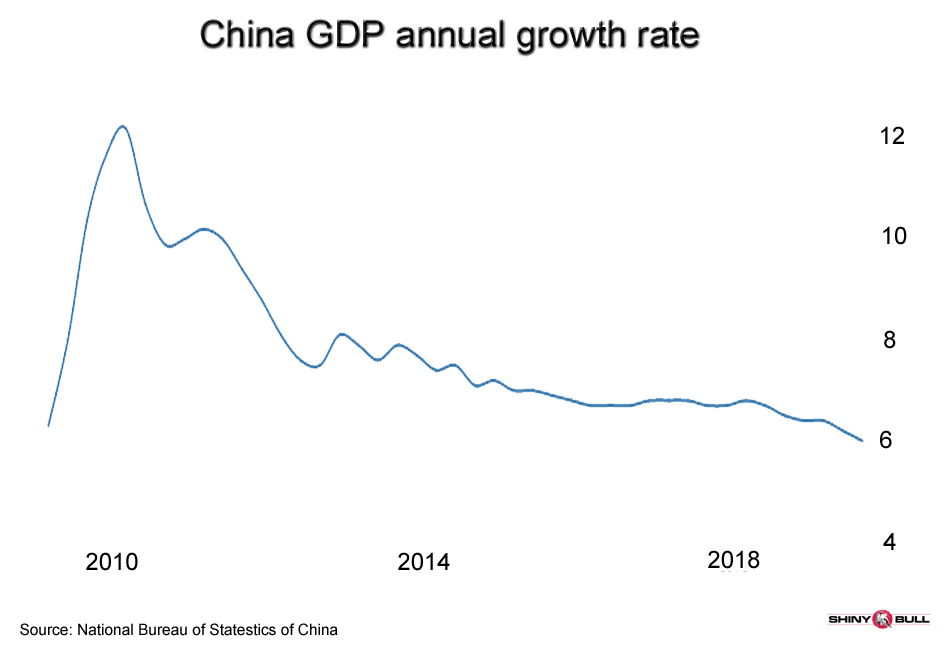
The worlds fastest-growing region is slowing and show sign of a darkening global outlook. Just look at Chinas Q3 growth. It`s the weakest growth in 28 years. The Chinese economy advanced 6% YoY in Q3 2019 and that is the weakest since 1992.

China have a trade tension with the U.S, weakening global demand and alarming off-balance-sheet borrowings by local governments. IMF said on Friday that the growth can get worse, but Japanese Finance Minister Taro Aso said «All policy tools must e used to achieve sustainable growth.»

In its World Economic Outlook report on Tuesday, the IMF cut its economic growth forecast for the Asia-Pacific region to 5,0% for this year and 5,1% for 2020, and that is the slowest pace of expansion since the global financial crisis.

A faster-than-expected slowdown in Chinas economic growth could also generate negative spillovers in the region, as many Asian countries have supply chains closely tied to China, the IMFs Rhee said.

The IMF slashed China`s growth forecast to 6,1% for this year and 5,8% for 2020, pointing to the impact from the trade conflict and tighter regulation to address excess debt. But China is not alone.

The pace of global economic activity remains weak, and after slowing sharply in the last three quarters of 2018, momentum in manufacturing activity, in particular, has weakened substantially, to levels not seen since the global financial crisis.

Rising trade and geopolitical tensions have increased uncertainty about the future of the global trading system and international cooperation more generally, taking a toll on business confidence, investment decisions, and global trade.

A natable shift toward increased monetary policy accommodation, through both action and communication, has cushioned the impact of these tensions on financial market sentiment and activity, while a generally resilient service sector has supported employment growth.

To strengthen resilience, policymakers should address financial vulnerabilities that pose risks to growth in the medium term.

Making growth more inclusive, which is essential for securing better economic prospects for all, should remain an overarching goal.

A positive cheerleader like Trump is the right man to reach that goal. Not the Media-Mob-Clowns talking about recession ever day. What is Trump doing for his country? What about the Media Mob?

Disclaimer: The views expressed in this article are those of the author and may not reflect those of Shiny bull. The author has made every effort to ensure accuracy of information provided; however, neither Shiny bull nor the author can guarantee such accuracy. This article is strictly for informational purposes only. It is not a solicitation to make any exchange in precious metal products, commodities, securities or other financial instruments. Shiny bull and the author of this article do not accept culpability for losses and/ or damages arising from the use of this publication.
Leave a comment

Filed under Emerging markets, Politics

The European Union rose “only” 0,4 percent in Q1 of 2018

Last week I talked about America`s fantastic growth of 4,1 percent on quarter in Q2 of 2018, and this is only the beginning. It is no doubt; President Trump must be doing something right. But, what about the European Union?

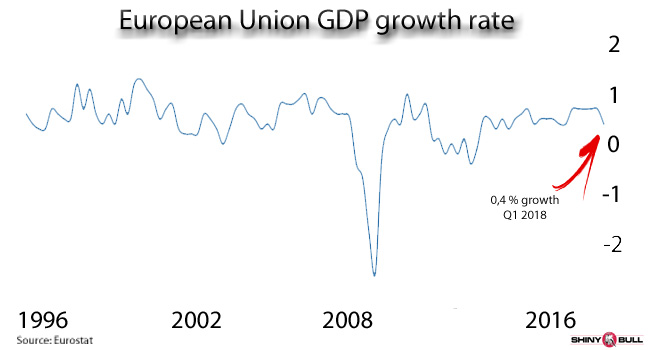
GDP in the European Union rose «only» 0,4 percent on quarter in the first three months of 2018. Not much to write home about. But the growth have never been above 1 percent since the financial crisis in 2008.

The European Union reached an all time high of 1,30 percent in 1999 and that is right before the tech bubble burst. Since then it has been a dead fish, reaching an all time low of -2,60 percent in the first quarter of 2009.

At the same time we can see that the unemployment rate reached a record low of 6,80 percent in February of 2008, and that`s right before the financial crisis. It reached an all time high of 11 percent in February 2013, but in May this year it fall down to 7 percent again.

This isn`t good enough if we are living in a capitalistic world.

The European Union in Brussels are nothing more than unelected bureaucrats. Draghi and the ECB have, just like Japan and the U.S «printed» a lot of money, and will continue to do so. If they can`t turn around the ship, they need to consider a strong cheerleader.

European Commission President Jean-Claude Juncker had a meeting with President Trump last week. They were talking about trade, free trade and tariffs. Mr Trump`s goal is to make better deals so both the U.S and the EU can take more profit and prosper.

I think that the EU should be glad for that and they need to hurry up. The U.S is the world`s third biggest exporter, yet exports account «only» for 13 percent on GDP. Exports in the U.S reached an all time high of 215328 USD million in May this year, which is pretty impressive.

The EU has 28 member states and the biggest among them all is Germany (21 percent of total GDP), the United Kingdom (15 percent), and France (15 percent).

Exports of goods and services account for 46 percent of GDP while imports account for 42 percent, adding 4 percent of total GDP. But this is about to change. If the UK contribute with 15 percent of the total GDP in the EU, then what will happen to their growth after Brexit?

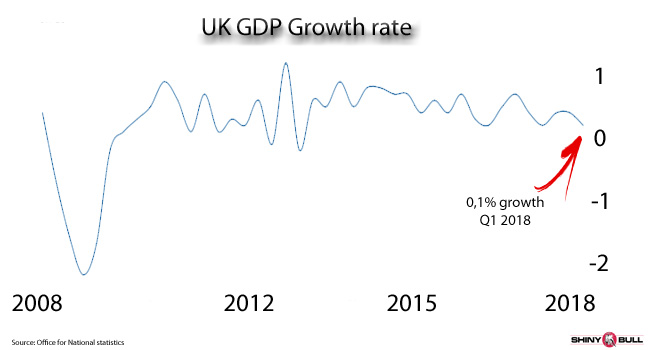
That being said; nor is the UK a success story. The British economy grew by 0,1 percent in the first three months of 2018 and well below 0,4 percent in the previous period. It is the lowest growth rate since a 0,1 percent contraction in Q4 2012.

The largest contribution to growth in the UK was from household spending at 0,2 percentage points. From the production side, the service industries made the largest contribution to GDP growth, followed by production.

Agriculture, the smallest component within the output approach of GDP made no contribution to growth to one decimal place, while construction deducted from GDP growth. The service industries increased by 0,3 percent.

Positive growth was recorded within all sub-sectors of the services industries; distribution, hotels and restaurants (0,1 percent vs -0,1 percent).

President Trump have repeatedly said that the EU have treated the US very bad. I have written many articles about that long before Mr Trump`s inauguration. The European Commission has fined Google €4,34 billion for breaching EU antitrust rules this month.

In May 2009, Intel was imposed with a 1,06 billion euro fined for abusing its market dominance on central processing units. Microsoft has been in trouble with the Commission on several occasions. In 2004, the Commission ruled that Microsoft had abused its market dominance.

In 208, the Commission fined Microsoft nearly 900 million euros for charging «unreasonable» royalty fees. In 2013, another fine of 561 million euros was imposed on Microsoft. This time for failing to comply with the Commission`s ruling that it had to allow users to more easily choose a prefered web browser.

The European Commission fined Facebook for 110 million euros in May this year in relation to its takeover of WhatsApp. Facebook acquired the messaging service in 2014 for $19 billion, but provided the Commission with misleading information about the acquisition.

In August 2016, the Commission ruled that tech giant Apple had received illegal tax benefits from Ireland worth up to 13 billion euros. Ireland was ordered to recover the unpaid tax from Apple, plus interest.

As early as 1966, British Politician Tony Benn said that «Communism run by commissars from Moscow did not work, and nor will capitalism run by commissioners in Brussels. Both deny people their right to develop in their own way.»

Now, under President Donald Trump, big companies like Apple are moving home to the United States with billions of dollars. Apple alone, are bringing in $230 billion. They will build new plants and a magnificent campus.

They will spend their money wisely and the money will be in the U.S. All this is possible because of Trump`s tax cuts and reforms. This is how you make growth.


Leave a comment

Filed under Politics

Rally!

Yesterday, I was sitting in front of the TV…..eh…… in front of my computer, watching live streams with Chairman Ben Bernanke. He did not disappoint the markets. The DOW was up +1,84% and the S&P 500 was up +1,7%. What a rally!!!! Ho ho ho.

They are not going to taper now in December, but plan to start tapering in January next year. There was two good news yesterday: 1. The Fed will cut back it`s bond purchases by $10 billion, and 2. The interest rates could remain low even if unemployment drops below 6,5%. This is music in investors ears!

Gold went in the opposite direction and didn`t like the news from the Fed. Gold is now trading near the critical $1200 level. I have written about this critical level before, and this is the break even level for the mining companies.

The mining companies doesn`t earn money if the price goes below $1200. It will be very exiting to follow the gold price in the future. Watch out for this level and see if this level holds. The news yesterday was bearish for the gold, but bullish for the dollar.

A lot of investors and money makers have lost a lot of money in their gold investments since 2011 and that is because they didn`t recognize and adapt to the changing trend. We are in the same situation right now, where a lot of people don`t really know what is to come in 2014. Will we see a rally in gold?

As you can see from the gold chart, we are at a stage one basing phase. 150 and 200 moving averages is slowing down and start to go sideways. This will go on for about 6-12 months. So, now you know when to expect the gold bull market start again.

In this one phase stage, a market goes both up and down and it looks like it goes nowhere. Many people are getting frustrated and start to give up and others that is not in the market stops paying attention to the market. After a bear market, a stage one basing phase will follow and make a new way for a real bull market.

We have seen many bubbles like the internet bubble, housing bubble and the market crash in 2008. Now, it seems like a new bubble is on the way. The Fed are on the way to build a dangerous federal government debt bubble.

It can be avoided by reducing the Congress spending deficit. But in the budget deal last week, they increased the government spending. All this money printing have been a disaster for the U.S.

In Mars next year, we have seen a bull market lasting for five years. What do you think will happen to QE if the economy slows again? Goldman Sachs predict the domestic GDP growth to hit 3% next year (1,7% in 2013). I hope he has right. I look forward to 2014.

News today: Unemployment Claims at 8:30am, Existing Home Sales & Philly Fed Manufacturing Index at 10:00am.

Markets up

Disclaimer: The views expressed in this article are those of the author and may not reflect those of Shiny bull. The author has made every effort to ensure accuracy of information provided; however, neither Shiny bull nor the author can guarantee such accuracy. This article is strictly for informational purposes only. It is not a solicitation to make any exchange in precious metal products, commodities, securities or other financial instruments. Shiny bull and the author of this article do not accept culpability for losses and/ or damages arising from the use of this publication.
Leave a comment

Filed under Commodities, Stock market