Tag Archives: Capitalism

Will AI Destroy Capitalism? What Marx Predicted, and Why It Feels Relevant Today

Artificial intelligence is advancing so fast that some economists, technologists, and futurists believe we are heading toward a historic breaking point. Predictions range from 300 million jobs being automated to AI systems replacing everything from lawyers and teachers to software developers and journalists.

This raises a fundamental question:

If AI takes over most labor, where will people get money from, and can capitalism survive?

Interestingly, this debate echoes ideas written more than 150 years ago by Karl Marx, who warned that capitalism might ultimately be undermined by its own technological progress. Today, his predictions are being pulled back into the spotlight.

This article breaks down what Marx said, what AI is doing, and what the future of labor, and money, might look like.
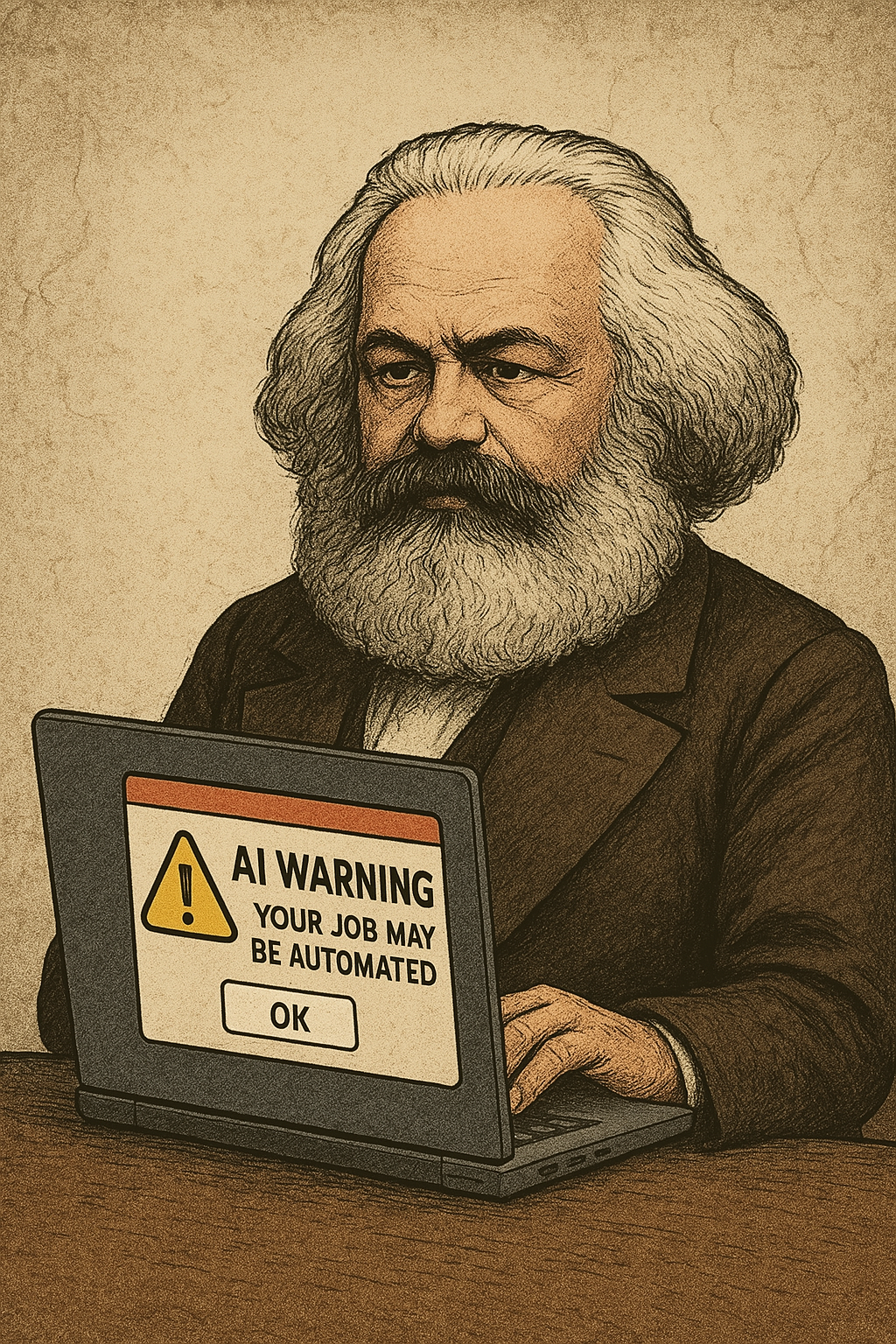
1. What Marx Actually Predicted

Karl Marx believed capitalism had a built-in conflict:
the drive to replace human workers with machines.

He argued two key points:

A) The “Tendency of the Rate of Profit to Fall”

Marx said that profit comes from human labor.
But capitalists constantly try to replace human labor with machines because machines:

  • don’t get tired
  • don’t strike
  • don’t demand wages or rights

The more companies automate, the fewer workers they need.

But the paradox is:

If you replace too many workers, you remove the source of profit — human labor.

This, Marx believed, would eventually destabilize capitalism from within.

B) Automation makes workers “superfluous”

Marx predicted a future where technology becomes so advanced that:

  • masses of workers become unnecessary
  • unemployment grows
  • inequality rises
  • social tensions explode

For most of history, this sounded theoretical.
Today, with AI able to perform cognitive work, Marx suddenly feels more contemporary than ever.

2. The AI Shock: Why This Time Is Different

In the past, automation replaced muscle:

  • factory robots
  • tractors
  • machinery

Those technologies eliminated many physical jobs but created others.

AI replaces the brain:

  • analysts
  • accountants
  • teachers
  • programmers
  • designers
  • writers
  • marketers
  • customer support
  • even medical diagnosis

White-collar workers, once considered “safe”, are now at risk.

Reports from groups like Goldman Sachs estimate that 300–800 million jobs worldwide could be automated in the coming years.

For capitalism, this is enormous.
Capitalism is built on two pillars:

  1. Labor → creates value
  2. Wages → let people buy things

If AI replaces too much labor, wages disappear, and the system loses its customers.

This is what worries economists.

3. The Core Economic Problem: No Jobs = No Money = No Capitalism

Here’s the simple logic:

  • Companies automate work → fewer workers
  • Fewer workers → less income
  • Less income → less spending
  • Less spending → companies lose customers
  • Companies lose customers → profits fall
  • Profits fall → economic system breaks

Capitalism needs consumers.
Consumers need wages.
Wages come from labor.
Labor is disappearing.

This is the exact contradiction Marx warned about.

4. What Happens to Society if AI Wipes Out Jobs?

Three major scenarios are being discussed in global economic circles:

A) Capitalism survives but transforms

Governments introduce:

  • Universal Basic Income (UBI)
  • AI and robot taxes
  • redistribution policies
  • national “AI wealth funds”
  • profit-sharing models

This keeps consumers alive even without traditional jobs.

B) Extreme inequality + political instability

If nothing is done:

  • wealth concentrates into a few tech giants
  • middle class collapses
  • consumer markets shrink
  • social unrest rises
  • governments face pressure for reform or revolution

This is the scenario many analysts fear.

C) A transition to “post-capitalism”

This idea doesn’t mean communism. Instead, it means a system where:

  • machines produce most wealth
  • humans work less or not at all
  • value is redistributed through society
  • the wage-labor system becomes obsolete

Some predict a peaceful shift.
Others see a turbulent transition.

5. Will New Jobs Replace the Old Ones?

Historically, technological revolutions created more jobs than they destroyed.

But AI is different for three reasons:

  1. It automates thinking, not just physical effort
  2. New jobs may require skills most people don’t have
  3. AI learns faster than humans can retrain

For the first time, technology is competing with humans in creativity, reasoning, and decision-making.

This makes the future less predictable than any previous industrial revolution.

6. Will AI Destroy Capitalism?

There are three main schools of thought:

1) AI will reshape capitalism, not kill it

The system adapts by creating safety nets like UBI, or by shifting focus to new industries.

2) AI will create “hyper-capitalism”

A handful of mega-corporations control all the AI models and extract enormous profits, leading to an extreme concentration of power.

3) AI will push us beyond capitalism

If machines produce nearly all value, the traditional logic of:

work → wages → consumption

falls apart.

In that case, capitalism as we know it would need to evolve or be replaced.

7. The Short Answer

If AI eliminates hundreds of millions of jobs and nothing is done, capitalism collapses because consumers vanish.

If governments and companies adapt, we enter a new economic era. Perhaps capitalism 2.0.

Marx didn’t predict AI, but he did predict the danger of a system that depends on labor while simultaneously trying to eliminate it. That contradiction is now the central question of the coming decade.

In the end, nobody truly knows where this collision between AI, labor, and capitalism will lead. Some predict unprecedented prosperity, others foresee economic collapse, and many warn that the transition itself may be chaotic.

Even politicians in several countries have started telling people to “buckle up,” hinting that families should keep basic supplies like food and water on hand. Not because disaster is guaranteed, but because the pace of disruption is now faster than society’s ability to adapt.

One thing is sure: we are crossing a threshold into unknown territory, where the old rules may no longer apply. The question is not whether change is coming, but how prepared we are for the world on the other side.

Disclaimer: The views expressed in this article are those of the author and may not reflect those of Shinybull.com. The author has made every effort to ensure the accuracy of the information provided; however, neither Shinybull.com nor the author can guarantee the accuracy of this information. This article is strictly for informational purposes only. It is not a solicitation to make any exchange in precious metal products, commodities, securities, or other financial instruments. Shinybull.com and the author of this article do not accept culpability for losses and/ or damages arising from the use of this publication.


Leave a comment

Filed under Politics

Zohran Mamdani is the next New York City Mayor and the storm is coming

Zohran Mamdani is the next New York City Mayor. He is a muslim, anti-Trump, Anti-capitalist, and will make free buses for the people in New York. At the same time, he will tax the rich. Trump moved out of New York long ago. So do many other wealthy people in New York.

Not only that. More than 1 million Orthodox Jews have escaped New York. Maybe we will see more jews escape New York as a muslim is their new Mayor. Time will show. But, there is no doubt; A massive storm is coming! Put your steel helmet on and fasten your seatbelt.

On the other hand, what we see today is not something new. This is how the system works. It goes, and then it goes down again, and again, and again. The crisis in New York has nothing to do with the Mayor. This is happening all over in the West. It is the system. Not the Mayor.

The Returning Storm: Capitalism’s Crisis & the Echoes of 1848

We hear it again and again: that the system is failing large numbers of people. The working class is struggling, costs are skyrocketing, and the ladder of opportunity seems broken. That’s why many vote for socialists: they look at the system not as a solution, but as the problem. But why does capitalism still persist when it doesn’t work for everyone?

Karl Marx saw it clearly: capitalism is built on the exploitation of workers (the proletariat) by those who own and control the means of production (the bourgeoisie). The extraction of surplus value, alienation of labour, cycles of boom and bust, and rising inequality. He argued that all of it spells eventual collapse, ushering in a socialist revolution.

Maybe what we’re witnessing now is not a violent revolution with barricades and guillotines, but a democratic and social one: a shift in consciousness, a call for new economic arrangements.

A Story That Shows What’s Wrong

Imagine an old woman in Spain who has lived in her apartment for seventy years. Her home is her past, her memories, her identity. Now, an American hedge fund buys the building. Her rent shoots up far beyond what her pension covers. She’s told: “Move out or pay the price.”


What kind of capitalism is this? Where the place you’ve lived your entire life, the neighbourhood you know, becomes a profit asset to someone else, and you, the tenant, are simply a cost-to-be-cut or revenue-to-be-raised.


This isn’t small-scale displacement; it’s systemic.

According to research, private equity firms now own a significant share of the U.S. housing stock, and their business model often involves raising rents, cutting maintenance, and treating homes as profit centres.


When individuals who’ve paid their dues, who’ve worked and saved, are pushed aside so someone else can “monetize” their roof, the legitimacy of the system is damaged.

1848 and the Warning from History

Nine years ago, I wrote an article about the French Revolution, and I need to get back to that story once again. Back in February 1848 in France, the blueprint of revolt was laid bare. The monarchy of Louis Philippe, once hailed as a “Citizen King,” had drifted away from the people. Wages collapsed, food prices soared, and despair turned to anger. When the government repressed the protests, Paris erupted in barricades. The king fled, and a second French Republic was proclaimed.

The lesson is clear: when a system fails the many and protects the few, the many find a voice. When inequality is visible, persistent, and reinforced by institutions that claim neutrality, resistance builds. The revolution of 1848 was not just about a king dying. It was about legitimacy dissolving.

So, Why Do We Still Have Capitalism?

Because it works. For some.
Because markets deliver dynamism, innovation, and wealth. If measured for the few.
Because institutions decide the rules and often shield the winners.
Because alternatives are messy, unproven, and intimidating for those who benefit now.

Yet the crisis is also structural. The logic of profit demands cost-cutting, evictions, rent hikes, financialization of housing, and commodification of basic needs. When a woman who’s lived somewhere for 70 years is priced out overnight, that’s not a bug. It’s a feature of the system.

Are We on the Edge of a New Revolution?

Perhaps. Not in the storm-and-fury sense, but in the long, accumulating demand for change. When politicians like Zohran Mamdani win with promises of free buses, rent freezes, and groceries for all, the message is: the old order is brittle. The working class has been squeezed too long. The vote is a signal.

But the storm won’t vanish just with promises. The funding model matters. The rents, taxes, business flight, and investment flows. All these determine whether change can be real or become another wave of disappointment.

The Elderly Woman and the Bigger Question

When you see her story. 70 years of life, on a fixed income, facing eviction because of global capital chasing returns, you understand what’s at stake. It’s not just housing. It’s dignity. It’s the promise of stability. It’s the belief that society isn’t only for the rich.

And when capitalism no longer delivers that promise for large swathes of people, then the logic of Marx begins to look less like ideology and more like prophecy.

In 1848 they overthrew a king.
In 2025 they may overthrow the illusion. The illusion that capitalism still works for everyone.

The storm is coming

It might be messy. It might be uncomfortable. But history shows us that when systems stop working for most people, change happens.
So ask yourself:

Are we watching the death of the promise of capitalism as we knew it?
Or are we witnessing its evolution — into something fairer, more inclusive, more human?

Closing thought

In 1848, they forced the king to abdicate. Today, maybe we don’t need to kill a king. We need to kill the illusion that this system works for everyone. Change isn’t coming tomorrow. It’s already knocking at the door.

Disclaimer: The views expressed in this article are those of the author and may not reflect those of Shinybull.com. The author has made every effort to ensure the accuracy of the information provided; however, neither Shinybull.com nor the author can guarantee the accuracy of this information. This article is strictly for informational purposes only. It is not a solicitation to make any exchange in precious metal products, commodities, securities, or other financial instruments. Shinybull.com and the author of this article do not accept culpability for losses and/ or damages arising from the use of this publication.
Leave a comment

Filed under Politics

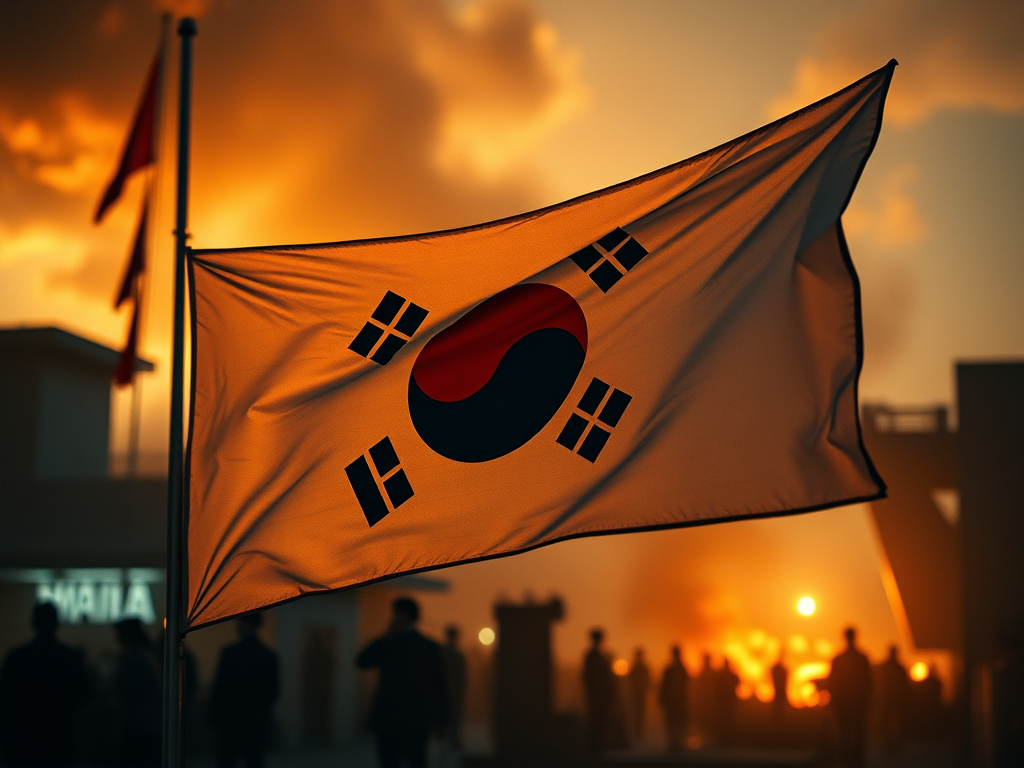
The end of South Korea`s economic miracle

The Korean Peninsula was inhabited as early as the Lower Paleolithic period. Its first kingdom was noted in Chinese records in the early 7th century BCE. The succeeding Korean Empire (1897 – 1910) was annexed in 1910 into the Empire of Japan.

Japanese rule ended following Japan`s surrender in World War II, after which Korea was divided into two zones: a northern zone, which was occupied by the Soviet Union, and a southern zone, which was occupied by the United States.

After negotiations on reunification failed, the southern zone became the Republic of Korea in August 1948, while the northern zone became the communist Democratic People`s Republic of Korea the following month.

In 1950, a North Korean invasion began the Korean War, which ended in 1953 after extensive fighting involving the American-led United Nations Command and the People`s Volunteer Army from China with Soviet assistance.

The war left 3 million Koreans dead and the economy in ruins.

The May 16 coup of 1961 led by Park Chung Hee put an end to the Second Republic, signaling the start of the Third Republic in 1963.

South Korea`s devastated economy began to soar under Park`s leadership, recording one of the fastest rises in average GDP per capita.

Despite lacking natural resources, the nation rapidly developed to become one of the Four Asian Tigers based on international trade and economic globalization, integrating itself within the world economy with export-oriented industrialization.

The Fourth Republic was established after the October Restoration of 1972, in which Park wielded absolute power.

The Yushin Constitution declared that the president could suspend basic human rights, and appoint a third of the parliament.

Suppression of the opposition and human rights abuse by the government became more severe in this period

South Korea has since then had a huge economic success. They have big companies like Samsung (which is the biggest company in South Korea), LG Energy Solution, Hyundai, and Kia to name a few.

On top of that, they also have BTS which is a boyband from South Korea. According to the Hyundai Research Institute, BTS was estimated to generate around $3,6 billion annually for the South Korean economy.

In some years, their direct and indirect contribution has been as high as $4,6 billion, which is comparable to major multinational corporations. BTS has been estimated to contribute around 0,3% to 0,5% of South Korea`s GDP in recent years.

This is a remarkable figure for a single music group, considering the country`s GDP was around $1,63 trillion in 2020.

South Korea`s economic success is well known all around the world, and they has become an economic powerhouse. But right now, it seems like their economic model is running out of steam. The economy has been slowing for years. It has basically stopped.

The economy in South Korea is on the way to be like Japan. What in the world is going on?

It all started in the 1950`s. Their economic growth was 10%, and it reached the top in the 1980`s. Then it began to slow. Growth in the 90`s declined to around 7%. Ten years later, the growth went down to 4%. In 2010, their growth was only 3%.

But something has happened in the last five years. The growth has been slowing year by year. This is what’s happening with the economy as they get richer. It happens in all rich countries. But, in South Korea, it seems like this is not temporary. It seems to be a new normal.

Bank of Kora (BOK) has warned that South Korea`s economy may enter negative territory in the next decade. The country is on a declining trajectory. Unless this is going to change, the next generation will be worse off than their parents.

But, how is it possible that a successful country like South Korea with so many high-tech companies can decline like this? Well, it has its own explanation. We need to look at their economic model, and how it came to be, and how it operates today.

The core of the South Korean economy is made up of something called «Chaebols». «Chae» stands for wealth or property, while «Bol» stands for clan or group.

«Chaebols» refers to large, family-owned business conglomerates in South Korea that wield significant influence over the country`s economy.

The influence of chaebols is often cited as a contributing factor to some of South Korea`s economic challenges, but they are not the sole reason for any economic decline. Several factors, including chaebols’ dominance, are at play when examining South Korea`s economic issues.

This is what we see in the U.S., but also in many other places in the West. They blame big corporations, wealthy entrepreneurs, and investors.

It is the concentration of economic power. Chaebols control a large portion of South Korea`s economy, leading to less competition. Their dominance can stifle small and medium-sized enterprises (SMEs), limiting innovation and growth in other sectors.

Chaebols have also been involved in corruption scandals, often using their power to influence political decisions. This has led to inefficiency in governance and public discontent, undermining economic reforms.

Over-reliance on Export-driven Growth is also considered to be a challenge. Chaebols are heavily focused on industries like electronics, shipbuilding, and automobiles, which are export-driven. This makes the South Korean economy vulnerable to global economic shifts and trade disputes, especially in a world where the diversification of industries is increasingly important.

They also face succession and corporate governance issues. Since chaebols are family-controlled, they often face challenges with leadership transitions between generations. This can lead to inefficiencies and financial mismanagement within these conglomerates.

Strong and independent entrepreneurs have made the wealth you and I have today. They have created products that made our lives better, and their companies have grown to be multi-billion corporations. If this is a problem for countries around the world, well, what can we say? If so, this is not the only reason why the growth is slowing.

We see the same going on in South Korea as well as in Japan and many other places. Broader factors are leading to economic challenges, and one of them is the aging population. South Korea has one of the lowest birth rates in the world, leading to a shrinking working-age population.

This demographic challenge puts pressure on economic growth and social welfare systems. This is not only happening in Japan and South Korea. It`s happening in many other places around the world.

We also have a global economic slowdown. South Korea`s heavy reliance on exports means it is susceptible to the global economic downturn. Trade tensions, especially between the U.S., and China, impact South Korea`s major industries.

On top of all that, we have technological disruption. Even though chaebols have driven much of South Korea`s technological advancements, their scale makes them slow to adapt to new digital trends and innovations compared to more agile startups.

So, what is South Korea doing to address these issues? The South Korean government has been working to implement reforms aimed at reducing chaebols’ influence, promoting transparency, encouraging innovation, and supporting small and medium enterprises (SMEs).

While chaebols have contributed significantly to South Korea`s rapid industrialization and growth, their outsized role can create imbalances in the economy, making reforms crucial for long-term, sustainable growth.

In conclusion, while chaebols are not the sole cause of South Korea`s economic challenges, their dominance and related issues do play a role in creating an environment that can hinder broader economic diversification and reform. As we can clearly see, successful entrepreneurs and large corporations can be both beneficial and problematic for an economy.

Unfortunately, we very often see that successful entrepreneurs are attacked. Especially by socialists. But we have to ask ourselves what we should do without them? Because they are the ones that are creating wealth in the long run. No socialism without capitalism. The socialists need money for the welfare system, and that money comes from entrepreneurs who make goods and services.

Entrepreneurs drive innovation, create new industries, and develop new technologies that can improve productivity. Successful businesses, especially startups, can grow into larger companies, and boost economic growth.

Large corporations provide millions of jobs and stimulate related industries (e.g., supply chains, and service providers). For example, companies like Apple Amazon, or South Korea`s Samsung employ a large global workforce and indirectly create additional jobs in the ecosystem surrounding their businesses.

We can see time and time again, that entrepreneurs are often the source of disruptive innovation, bringing new products and services to the market. Successful entrepreneurs can help transform entire industries.

Large corporations often have the resources to invest in research and development (R&D), leading to technological advancements. For example, tech giants like Google and Microsoft invest heavily in artificial intelligence, cloud computing, and other areas that push technological boundaries.

Multinational corporations make a country more competitive on the global stage. For example, South Korea`s chaebols (Samsung, Hyundai) or the U.S. tech giants, like Google and Apple, enhance their countries’ global influence. They also attract foreign investment and contribute to the trade balance through exports.

Successful entrepreneurs and large corporations are not inherently bad for the economy. In fact, they can drive growth, innovation, and global competitiveness. However, their dominance can lead to economic and social imbalances that harm the broader population if left unchecked. Balancing their power with fair regulations, competition, and equitable policies can be essential for sustainable economic development.

Disclaimer: The views expressed in this article are those of the author and may not reflect those of Shinybull.com. The author has made every effort to ensure the accuracy of the information provided; however, neither Shinybull.com nor the author can guarantee such accuracy. This article is strictly for informational purposes only. It is not a solicitation to make any exchange in precious metal products, commodities, securities, or other financial instruments. Shinybull.com and the author of this article do not accept culpability for losses and/ or damages arising from the use of this publication.

Leave a comment

Filed under Politics

The war on successful people

There is no doubt that Trump created growth and jobs. But that was before the virus came in and destroyed the growth. Now, there is a different mindset in the White House. The Biden administration wants to increase the taxes.

The democrats tax hike plan is to increase the taxes on top individual of 39,6%. Top corporate rate will jump to 26,5% and 3% surtax on income over $5 million. This is a typical socialist agenda among socialists.

We know from history that Communism doesn`t work. We know that socialism isn`t Communism, but it`s Communism light if you will. Cutting the head of successful antrepreneurs has never worked in the long run.

Photo by Karolina Grabowska on Pexels.com

What people and socialists around the world should understand is that you are dependent of creative antrepreneurs. They are the reason why you have so much wealth and health right now. They gave you a luxury car, a smart phone and lots of internet of things.

They created products a lot of people around the world demanded. That demand was great business for the antrepreneurs and their businesses, and that is were the money to the socialists comes from. You cannot run a country without socialism, but you are dead without capitalism which comes first.

Tax foundation president Scott Hodge said the Biden tax plan will shrink the size of the economy by 1%. It will also cost the economy about 165,000 jobs. Shrink wages and capital stock. So, it will fewer jobs and the growth will be slower.

The tax on induviduals in New York will increase over 60% and that will make many people to leave Manhatten and flee to for example Florida were they treat people much better than any other places in the U.S.

Corporations will do the same. They will run as fast as they can to other places with a better tax plan. We also know from history that places with rich people and big corporations will have bigger growth than places with higher taxes and slower growth.

A research study found that about 51% of the economic burden on the corporate income tax falls on workers through lower wages. We saw the opposite happened under Trump. Growth went up and so did the wages.

The groups that are most harmed by the tax hike are women, low-skilled workers and younger workers The most marginal workers in the workforce.

So what we`re going to see from raising corporate taxes is a shrinkage of those kinds of jobs for the most vulnerable people in America.

House Democrats aim to raise a $2 trillion in tax revenue, and that is a very agressive tax plan.

To contact the author: post@shinybull.com

Disclaimer: The views expressed in this article are those of the author and may not reflect those of Shinybull.com. The author has made every effort to ensure the accuracy of the information provided; however, neither Shinybull.com nor the author can guarantee such accuracy. This article is strictly for informational purposes only. It is not a solicitation to make any exchange in precious metal products, commodities, securities, or other financial instruments. Shinybull.com and the author of this article do not accept culpability for losses and/ or damages arising from the use of this publication.

Leave a comment

Filed under Politics

Biden sets out a $2 trillion US infrastructure plan to be funded by corporate tax hike

A once in a generation investment. That`s what president Biden called his $2 billion program of infrastructure spending. Biden said it will create millions of jobs while giving roads, utilities and American industry a badly needed upgrade.

But somebody have to pay for it, but who? «We the people» of course. The corporations. And there is one simple way to do that: TAX. Minimum wages are rising. So are the taxes, and what is that suppose to mean? It means the inflation is coming.

«I`m proposing a plan for the nation that rewards work. Not just rewares wealth. It builds a fair economy that gives everybody a chance to succeed. And it`s going to create the strongest, most resilient innovative economy in the world,» Biden said in a speech a few days ago.

The Biden administration plans on modernizing 32,000 kim of highway, 500,000 charging points for electric autos, and bringing back key industries such as chip production back to the U.S. Chips are still mostly produced in Asia. (Bringing back chip industries sounds like a Trump strategy).

The project is expected to take eight years to complete, and some of the funding will come from a corporate tax hike from 21 to 28 percent. Biden`s supporters say the program will create millions of well.paid jobs, and stregthen America`s ability to compete with China.

2 trillion dollars is a lot of money and there is no doubt that this program will boost the semiconductor industry, but also the EV industry.

Biden said he is not worried about the U.S economy at all. At the same time, Janet Yellen makes a push for global minimum corporate tax. She doesn`t want a race to the bottom, and warns of dangers to the American economy if U.S acts alone in raising corporate tax rates.

When Obama hiked corporate taxes, businesses fled. One of the largest corporations in the world; Apple, ended up in Irland thanks to a great offshore plan, but Trump were bringing the company back to the U.S.

It speaks for itself. The more money corporations pay in tax, the less competetive they are on the world stage.

The time we are living in today, is similar to the 30`s, and Biden`s infrastructure plan is often comparead to Franklin D. Roosevelt`s «New deal».

President Franklin D. Roosevelt

The New Deal was a series of programs, public work projects, financial reforms, and regulations enacted by President Franklin D. Roosevelt in the United States between 1933 and 1939.

The programs focused on what historians refer to as the «3 Rs»; relief for the unemployed and poor, recovery of the economy back to normal levels, and reform of the financial system to prevent a repeat depression ( the stock market crached in 1929).

The first deal (1933 – 1934) dealt with the pressing banking crisis through the Emergency Banking Act and the 1933 Banking Act. The Federal Emergency Relief Administration provided $500 million ($9,88 billion today) for relieft operations by states and cities, while the short-lived CWA gave locals money to operate Make-work projects in 1933 – 1934.

The Securities Act of 1933 was enacted to prevent a repeated stock market crash.

The second New Deal in 1935 – 1936 included the National Labor Relations Act to protect labor organizing, the Works Progress Administration relief program (which made the federal government the largest employer in the nation), the the Social Security Act and new programs to aid tenant farmers and migrant workers.

The final major items of New Deal legislation were the creation of the United States Housing Authority and the FSA, which both occurred in 1937, and the Fair Labor Standards Act of 1938, which set maximum hours and minimum wages for most categories of workers.

Keep in mind that all this happened a few years before the World War II occurred.

The economic downturn of 1937 – 1938 and the bitter split between the American Federation of Labor and Congress of Industrial Organizations labor unions led to major Republican gains in Congress in 1938.

Conservative Republicans and Democratas in Congress joined the informal conservative coalition. By 1942 – 1943, they shut down relief programs such as the WPA and the CCC and blocked major liberal proposals.

Nonetheless, Roosevelt turned his attention to the war effort and won reelection in 1940 – 1944. Furthermore, the Supreme Court declared the NRA and the first version of the Agricultural Adjustment Act unconstitutional, but the AAA was rewritten and then upheld.

Republican president Dwight.D. Eisenhower (1953 – 1961) left the New Deal largely intact, even expanding it in some areas. In the 1960`s, Lydon B. Johnson`s Great Society used the New Deal as inpiration for a dramatic expansion of liberal programs, which Republican Richard Nixon generally retained.

However, after 1974 the call for deregulation of the economy gained bipartisan support. The New Deal regulation of banking (Glass-Steagall Act) lasted until it was suspended in the 1990`s.

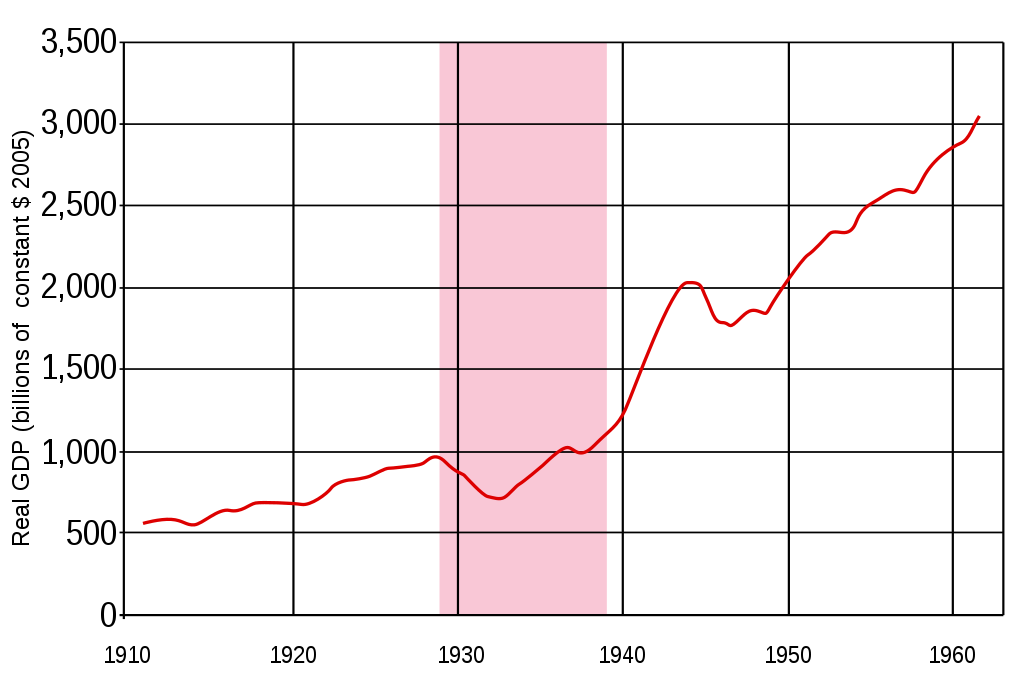
From 1929 to 1933 manufacturing output decreased by one third, which economist Milton Friedman called the Great Contraction. Prices fell by 20%, causing deflation that made repaying debts much harder.

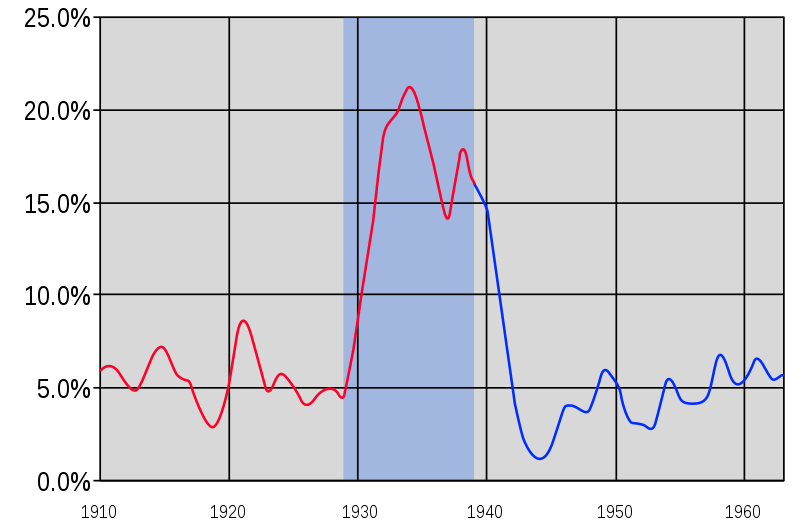
Unemployment rate from 1910 to 1960

Unemployment in the United States increased from 4% to 25%. additionally, one-third of all employed persons were downgraded to working part-time on much smaller paychecks. In the aggregate, almost 50% of the nation`s work-power was going unused.

Before the New Deal, deposits at banks were not insured. When thousands of banks closed, depositors lost their savings as at that time there was no national safety net, no public unemployment insurance and no Social Security.

The depression had devastated the nation. As Roosevelt took the oath of office at noon on March 4, 1933, all state governors had authorized bank holidays or restricted withdrawals. Many Americans had little or no access to their bank accounts.

Farm income had fallen by over 50% since 1929 (stock market crash). An estimated 844,000 non-farm mortgages had been foreclosed between 1930 – 1933, out of five million in all. Political and business leaders feared revolution and anarchy.

Real GDP from 1910 to 1960

In 1935, Roosevelt called for a tax program called the Wealth Tax Act (Revenue Act of 1935) to redistribute wealth. The bill imposed an income tax of 79% on incomes over $5 million. It raised the bitterness of the rich who called Roosevelt «a traitor to his class» and the wealthy tax act a «soak the rich tax».

The Roosevelt administration was under assault during Roosevelt`s second term,which presided over a new dip in the Great Depression in the fall of 1937 that continued through most of 1938. Production and profits declined sharply.

Unemployment jumped from 14,3% in May of 1937 to 19% in June 1938. The downturn was perhaps due to nothing more than the familiar rhythms of the business cycle, but until 1937 Roosevelt had claimed responsibility for the excellent economic performance.

That backfired in the recession and the heated political atmosphere of 1937.

Keynes did not think that the New Deal under Roosevelt ended the Great Depression: «It is, it seems, politically impossible for a capitalistic democracy to organize expenditure on the scale necessary to make the grand experiments which would prove my case, except in war conditions.»

Worldwide, the Great Depression had the most profound impact in Germany and the United States. In both countries the pressure to reform and the perception of the economic crisis were strikingly similar.

When Hitler came to power he was faced with exactly the same task that faced Roosevelt, overcoming mass unemployment and the global Depression. The political responses to the crisis were essensially different; while American democracy remained strong, Germany replaced democracy with fascism, a Nazi dictatorship.

The initial perception of the New Deal was mixed. On the one hand, the eyes of the world were upon the United States because many American and European democrats saw in Roosevelt`s reform program a positive counterweight to the seductive powers of the two great alternative systems, communism and fascism.

As the historian Isaiah Berlin wrote in 1955: «The only light in the darkness was the administration of Mr. Roosevelt and the New Deal in the United States».

By contrast, enemies of the New Deal sometimes called it «fascist», but they meant very different things. Communists denounced the New Deal in 1933 and 1934 as fascist in the sence that it was under the control of big business. They deopped that line of thought when Stalin switched to the «Popular Front» plan of cooperation with liberals.

To contact the author: post@shinybull.com

Disclaimer: The views expressed in this article are those of the author and may not reflect those of Shinybull.com. The author has made every effort to ensure the accuracy of the information provided; however, neither Shinybull.com nor the author can guarantee such accuracy. This article is strictly for informational purposes only. It is not a solicitation to make any exchange in precious metal products, commodities, securities, or other financial instruments. Shinybull.com and the author of this article do not accept culpability for losses and/ or damages arising from the use of this publication.
Leave a comment

Filed under Politics