Category Archives: Politics

Will the Fed raise rates on Thursday?

Do you belive the Fed will hike on Thursday?

If so, you are among economists and strategists that belive so, but traders are betting strongly against it, and that alone is enough to wait at least one month before liftoff, according to Morgan Stanley.

CME FedWatch tool says the probability is at just 21 percent, and Morgan Stanley said its readings on trading show a 30 percent probability that «overstated the chance» of a rate rise.

Lessons learned in 1994 that reverberated into 1999 and 2004 will prelude a rate hike until the futures market prices one in. In 1999 and 2004, the central bank waited for market expectations to exceed 50 percent before moving, learning a lesson from 1994 when it tightened.

CNBC said there is one good reason the Federal Reserve won`t vote to raise interest rates, and that`s History. So, what is all this about?

percentage

Rates have been near zero since the recession, and the Fed have delayed its first-rate hike since 2006. But why is the interest rate so low? See it like this; The lower the rates, the more problems it is in the economy.

When the economy is strong and everything is okay, interest rates are hiked in order to curb inflation, but when we face tough times, the Fed will cut rates to encourage lending and inject money into the economy.

Investors can predict what the Fed (or other central banks) will do by looking at economic indicators such as;

Retail Sales: Consumer spending
The Consumer Price Index (CPI): Inflation, and
Non-farm Payrolls: Employment levels

If these indicators improve and the economy is doing well, rates will be raised, but if the improvement is small, it will be maintained. Drops in these indicators can mean a rate cut in order to encourage borrowing.

Other indicators to foreshadow changes in the economy is building permits, average weekly hours, new orders and the spread between 10-year Treasuries and the Federal Funds Rate, which is published every month by The Conference Board.

Raising rates will have an impact on the markets. Raising interest rates will cause the dollar to appreciate over the Euro, which means the pair EUR/USD will decline, which is good for the U.S dollar.

If Chairwoman Janet Yellen sends out a dowish signal on Thursday, it may help to boost stocks and undermine the dollar. Investors will pay less attention to gold and allocate more of their capital into equities.

A hawkish message, including a rate increase, may help unpin the dollar and undermine stocks and gold. So, the upside will be limited for gold in both scenarios, unless we see a massive selloff in equities and the dollar.

Changes in monetary policy will ultimately cause currency exchange rates to change, and paying close attention to the news and analyzing the actions of the Fed (in this case) is vital for forex traders.

The interest rates impact currencies because the greater the rate of return, the greater the interest accrued on currency invested and the higher the profit. So how can you profit on it? The strategy is very simple, but also very risky. You can simply borrow currencies with a lower interest rate in order to buy currencies that have a higher interest rate, and this strategy is known as carry trade.

The shift in interest rate represent a monetary policy-based response as a result of economic indicators that assess the health of the economy. Most importantly; they possess the power to move the market immediately. So, how healthy is the U.S economy?

Nonfarm Payrolls is up: 215K
May, June Revisions: 14K
Unemployment Rate: 5,3%
Avg. Hourly Wages: 0,2%
Labor Force Participation: 62,6%
Consumer Price Index: -0,1%

A key measure of inflation dropped 0,1% last month for the first time since January due to sliding gasoline costs, and this is something for the FOMC (Federal Open Market Committee) on its policy meeting Wednesday and Thursday this week.

Central bank leaders have said they want to be confident inflation is heading toward their 2 percent target. Low inflation is a sign of economic weakness, and raising rates too soon risks harming the economic expansion.

IMF (International Monetary Fund) and the World Bank have asked the Fed to delay its first-rate hike since 2006.

The world`s financial watchdog is the BIS (the Bank of International Settlement) and are considered the «bank of central banks». BIS has warned that a Fed rate hike could have a huge effect on the global economy and particularly in emerging markets.

According to a BIS report, much of the global financial system remains anchored to U.S borrowing rates, and a rate hike at home tends to have an impact on higher rates in other economies. The enormous amount of debt in the emerging markets has the potential to move the markets even with a small rate hike.

Everybody knows that sooner or later, a rate hike might be necessary. No matter the results in the financial markets will be. Some belive the Fed will hold off on raising rates until December.

I really look forward to Janet Yellen`s speech on Thursday at 2 p.m. Washington time.


shinybull_site_logo-7


Click the link below and check out the Fan Fund

https://www.eventbrite.com/e/fan-fund-tickets-15580655159


Disclaimer: The views expressed in this article are those of the author and may not reflect those of Shiny bull. The author has made every effort to ensure accuracy of information provided; however, neither Shiny bull nor the author can guarantee such accuracy. This article is strictly for informational purposes only. It is not a solicitation to make any exchange in precious metal products, commodities, securities or other financial instruments. Shiny bull and the author of this article do not accept culpability for losses and/ or damages arising from the use of this publication. UA-63539824-1.
Leave a comment

Filed under Commodities, Emerging markets, Politics, Stock market

A big FAT bubble

Have a listen to what Donald Trump say about the stock market.


Click the link below and check out the Fan Fund

https://www.eventbrite.com/e/fan-fund-tickets-15580655159


Disclaimer: The views expressed in this article are those of the author and may not reflect those of Shiny bull. The author has made every effort to ensure accuracy of information provided; however, neither Shiny bull nor the author can guarantee such accuracy. This article is strictly for informational purposes only. It is not a solicitation to make any exchange in precious metal products, commodities, securities or other financial instruments. Shiny bull and the author of this article do not accept culpability for losses and/ or damages arising from the use of this publication. UA-63539824-1.
Leave a comment

Filed under Politics

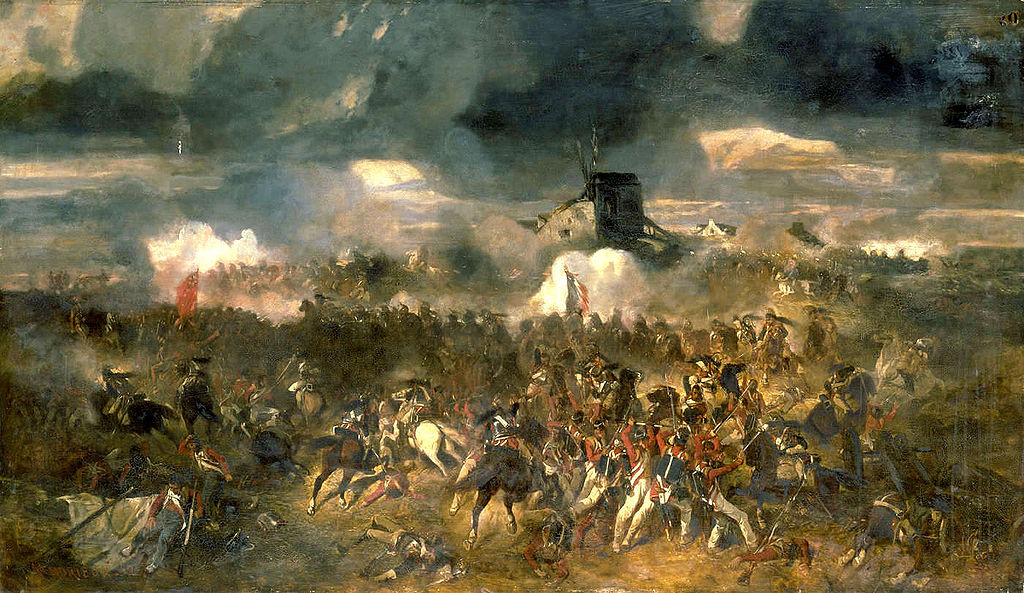
200 years since the battle of Waterloo

People in Europe has hated each other in thousands of years. Today, it is 200 years since the battle of Waterloo. The date was Sunday, 18 June, 1815. Some people say this was the early start of NATO, because allied forces at this time was British, Scottish, Flemish, Irish, Welsh, Walloon, German, Belgium and Dutch soldiers.

After 1815, the norm for the British arms has been coalitions. From Crimea in the 1850`s to the World War I and II, and wars on Iraq, Libya and Afghanistan.

«It`s a historical distortion: Britain could not defeat Napoleon without the aid of continental partners,» Charles Esdaile, a military historian at the University of Liverpool said.


1024px-Andrieux_-_La_bataille_de_Waterloo
(Picture: Clèment-Auguste Andrieux’s 1852 The Battle of Waterloo)


They all thwarted the attempts of European domination by the French general and emperor, Napoleon Bonaparte. The battle in Waterloo was the start of the end of the Napoleonic Wars, which started in 1803 and ended in 1815. 5 million people were killed.

Napoleon`s army consisted of around 69,000 men; 48,000 infantry, 14,000 cavalry, and 7,000 artillery with 250 guns. Welligton`s troops consisted of 67,000 men; 50,000 infantry, 11,000 cavalry, and 6,000 artillery with 150 guns.

The author of Les Miserables, Victor Hugo, said the battle in Waterloo wasn`t a battle. He said: «Waterloo is not a battle; it is the changing face of the universe.»

Historians say Waterloo laid the groundwork for NATO and the United Nations, and only 36% of Welligton`s army were British. Winston Churchill mentioned «united nations» as the famous global organisation and it paved the way for the U.K to become a global power.

Prussia had 50,000 soldiers, and became a part of Germany later on.

French had long been the world`s superpower. Who knows that France have been one out of three to be the world`s superpower in 500 years? The Vienna Treaty started right after the battle of Waterloo, and the U.K got territorial possessions (South Africa, Trinidad and Sri Lanka).

The U.K used this base to control its vast colonial empire.

Britain didn`t have much competition until the U.S emerged as a superpower during the World War II. The demand for American products increased during the Napoleonic Wars, as the European industry was hit hard during the war and their demand for products declined.

The Anglo-American War in 1812 combined with the British and French blockades disrupted the trade, and the battle heralded an age of German nationalism, and later on to World War II. The Prussian state created nationalism which formed the new German Empire after 1870.

The nationalism escalated and led to the hyper-nationalism which again led to the Nazi Party and the Third Reich.

This formed the future of the European Union.

Napoleon wanted a single state in Europe and the battle in Waterloo was a battle between different ideologies. Napoleon wanted to control Europe. He wanted to establish a European empire under his dictatorship since 1804.

But the allies wanted something different. The Allies won over France and Napoleon`s concepts such as Napoleon`s French Revolutionary Empire and Holy Roman Empire before it.

But Napoleon is not the only one to try to take control over Europe, and we can see the same idea of a pan-European state today, which is exactly 200 years since the battle in Waterloo. Many people in Europe doesn`t like the idea and do not buy the new ideology.

The Congress of Vienna declared Napoleon an outlaw on 13 March, 1815. Four days later, the U.K, Russia, Austria and Prussia mobilised armies to defeat Napoleon.

Napoleon attacked the allies in the hope of destroying them before they could join in a coordinated invasion of France with other members of the coalition. Napoleon was defeated after a few hours, and the coalition forces entered France and restored King Louis XVIII to the French throne.

Napoleon abdicated, eventually surrendering to Captain Maitland of HMS Bellerophon, part of the British blockade, and was exiled to Saint Helena where he died in 1821.

About 100 years later (1920), Adolf Hitler came to the power in the German Nazi Party.


Click the link below and check out the Fan Fund

https://www.eventbrite.com/e/fan-fund-tickets-15580655159


Disclaimer: The views expressed in this article are those of the author and may not reflect those of Shiny bull. The author has made every effort to ensure accuracy of information provided; however, neither Shiny bull nor the author can guarantee such accuracy. This article is strictly for informational purposes only. It is not a solicitation to make any exchange in precious metal products, commodities, securities or other financial instruments. Shiny bull and the author of this article do not accept culpability for losses and/ or damages arising from the use of this publication. UA-63539824-1.

Leave a comment

Filed under Politics

The New Silk Road is the largest economic development project in history

The largest economic development project in history could have dramatic ripple effects throughout the world economy. China is building the world`s greatest economic development and construction project ever undertaken:

The New Silk Road.


Silk route

(Picture: Extend of Silk Road. Red is land route and blue is sea route)


The Silk Road is a network of trade and cultural transmission routes that were central to cultural interaction through regions of the Asian continent connecting the West and East by merchants, pilgrims, monks, soldiers, nomads, and urban dwellers from China and India to the Mediterranean Sea during various periods of time.

Extending 4,000 miles (6437 kilometers), the Silk Road derives its name from the lucrative trade in Chinese silk carried out along its length, beginning during the Han dynasty (206 BC – 220 AD). The Central Asian sections of the trade routes were expanded around 114 BC by the Han dynasty, largely through the missions and explorations of Chinese imperial envoy, Zhang Qian.

The Chinese took great interest in the safety of their trade products and extended the Great Wall of China to ensure the protection of the trade route.

Trade on the Silk Road was a significant factor in the development of the civilizations of China, the indian subcontinent, Persia, Europe, the Horn of Africa and Arabia, opening long-distance, political and economic relations between the civilizations.

The main traders during antiquity were the Chinese, Persians, Somalis, Greeks, Syrians, Romans, Armenians, Indians, and Bactrians, and from the 5th to the 8th century the Sogdians. Following the emergence of Islam, Arab traders became prominent.

The Silk Road derives its name from the lucrative Chinese silk trade. The German terms Seidenstraße were coined by Ferdinand von Richthofen, who made seven expeditions to China from 1868 to 1872.

The new Silk Road will be massive, and the ambitious vision is to resurrect the ancient Silk Road as a modern transit, trade, and economic corridor that runs from Shanghai to Berlin. The «Road» will traverse China, Mongolia, Russia, Belarus, Poland, and Germany, extending more than 8,000 miles, creating an economic zone that extends over one-third the circumference of the earth.

The plan envisions building high-speed railroads, roads and highways, energy transmission and distributions networks, and fiber optic networks. Many cities and ports along the route will be targeted for economic development.

An equally essential part of the plan is a sea-based «Maritime Silk Road» (MSR) component, as ambitious as its land-based project, linking China with the Persian Gulf and the Mediterranean Sea through Central Asia and the Indian Ocean.

Three continents will be connected when the ancient Silk Road is completed; Asia, Europe and Africa. The Chain of infrastructure projects will create the world`s largest economic corridor, covering a population of 4,4 billion and an economic output of $21 trillion.

The idea for reviving the New Silk Road was first announced in 2013 by the Chinese President, Xi Jinping. As part of the plan, in 2014, the Chinese leader also announced the launch of an Asian International Bank (AIIB), providing seed funding for the project, with an initial Chinese contribution of $47 billion.

China has invited the international community of nations to take a major role as bank charter members and partners in the project. Members will be expected to contribute, with additional funding by international funds, including the World bank, investments from private and public companies, and local governments.

58 nations have signed on to become charter bank members, including most of Western Europe, along with many Silk Road and Asian countries. After failed attempts by the U.S to persuade allies against joining the bank, the U.S reversed course, and now says that it has always supported the project, a disingenuous position considering the fact that U.S opposition was hardly a secret.

The Wall Street Journal reported in November 2014 that the U.S has also lobbied hard against Chinese plans for a new infrastructure development bank.

Russia is fully integrated into the project.

The Huffington Post`s Alastair Crooke has this to say on the matter: «For very different motives, the key pillars of the region (Iran, Turkey, Egypt and Pakistan) are re-orienting eastwards. It is not fully appreciated in the West how important China`s «Belt and Road» initiaive is to this move (and Russia, of course is fully integrated into the project).

Regional states can see that China is very serious indeed about creating huge infrastructure projects from Asia to Europe. They can also see what occurred with the Asia Infrastructure Investment Bank (AIIB), as the world piled in (to America`s very evident dismay). These states intend to be a part of it.»

Buttressing this effort, China plans to injecting at least $62 billion into banks to support the New Silk Road. The China Development Bank (CDB) will receive $32 billion, the Export Import Bank of China (EXIM) will take on $30 billion, and the Chinese government will also pump additional capital into the Agricultural Development Bank of China (ADBC).

Will the U.S join the effort? If the new Trans-Pacific Partnership (without Russia and China, two Pacific powers) is any indication, U.S participation seems unlikely and opposition all but certain.

The project is expected to take decades, with costs running into the hundreds of billions of dollars, if not trillions. What that will mean for the world economy and trade is almost inconceivable. This project will face many geopolitical abstractions. It has already started.

The U.S President Barack Obama said; «If we don`t write the rules, China will write the rules out in that region,» he said in defence of the Trans-Pacific Partnership (TPP).

Beyond the riches of silks, spices, and jewellery, it could be argued that the most important thing that Marco Polo brought back from China was a famous nautical and world map that was the basis for one of the most famous maps published in Europe, one that helped spark the Age of Discovery.

Christopher Columbus was guided by that map and was known to have a well-annotated copy of Marco Polo`s travel tales with him on his voyage of discovery of a new route to India. The decisions about the new Silk Road are massive.

The geopolitical conflicts over the project could lead to a new cold war.


Click the link below and check out the Fan Fund

https://www.eventbrite.com/e/fan-fund-tickets-15580655159


Disclaimer: The views expressed in this article are those of the author and may not reflect those of Shiny bull. The author has made every effort to ensure accuracy of information provided; however, neither Shiny bull nor the author can guarantee such accuracy. This article is strictly for informational purposes only. It is not a solicitation to make any exchange in precious metal products, commodities, securities or other financial instruments. Shiny bull and the author of this article do not accept culpability for losses and/ or damages arising from the use of this publication. UA-63539824-1.

Leave a comment

Filed under Politics

Bank Stocks and Interest Rates

The IMF (International Monetary Fund) predicted the U.S economy would grow only 2,5% in 2015, and that`s down from their previous prediction at 3,1%. IMF urged the Fed (The Federal Reserve) to wait until first half of next year to start raising short-term interest rates.

The U.S central bank has kept its key benchmark rate at a record low near zero since December 2008, and the IMF said the Fed should wait for more signs of improvement. What they will look for is «greater signs of wage or price inflation».

IMF Managing Director Christine Lagarde said «The economy would be better off with a rate hike in early 2016», and Fed Chair Janet L. Yellen said she expects to begin raising rates by the end of the year, while some economist speculate that the Fed will start raising rates in September. They both know much better than me that deflation is more dangerous than inflation, and deflation is what they are fighting against and not inflation.

Many are bullish on bank stocks.


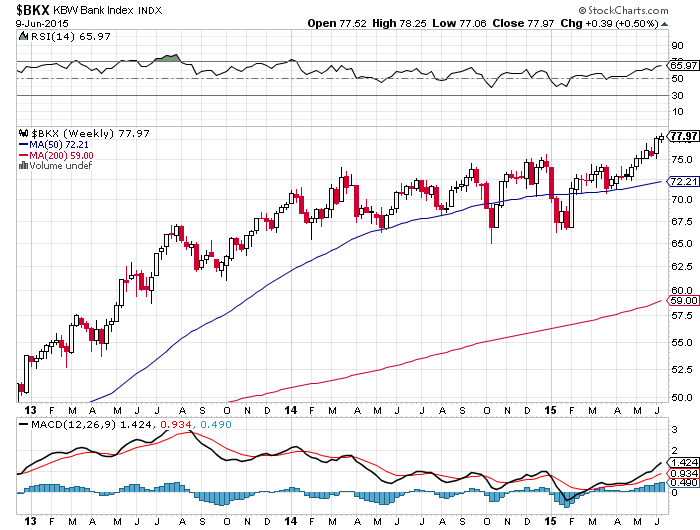
BKX Bank Stocks
The KBW Bank Index is up 0,86% right now. Trading at 77,96 which is up 0,66 points. That`s much better than the bottom at 18,62 on March 6, 2009, but down since the top at 118,06 on May 18, 2007.

Technically speaking, the index is breaking the resistance, and the bank stocks are increasing, while the precious metal is declining. Gold is still in a bearish territory and the price is still below $1,200 an ounce.

What`s going on? Higher rates is good for the banks because they can charge more for loans and earn more because of bigger profits on the spreads between loan rates and deposits. Buoyant outlook for the U.S economy in the second half of 2015, and the expected interest rate hikes blows up the banking index.

In the predictions for 2015 I talked about the interest rate to start to increase in 15 – 18 months, and that should be next year. I also talked about how it will start, and it is predicted to see that the rates will go up slowly.

Banks will benefit from a stronger economy and higher interest rates. The legendary investor Warren Buffett seems to see something in the banks earnings, which reflects more than their current stock valuations.

Warren Buffet and his company Berkshire Hathaway (BRK-A) has added much more to its holdings of Wells Fargo (WFC) and U.S Bancorp (USB), and the banks seems to have taken its reputation back since the financial scandals a few years ago.

Citibank is upgraded to buy by Goldman and the New York-based firm is showing progress in increasing earnings and returning capital to shareholders. Citibank is the only firm in the KBW index that is trading below tangible book value, but that will probably end soon.

Investors are keeping a close eye on bank stocks, especially money center banks, since the Fed has indicated a rise in the interest rate. Their key focus is Bank of America, because they will earn on the rise in interest rates.

If the rates increase 1% it is estimated that Bank of America will increase their earning by a whopping 20%.

Rising dollar means a strong economy, and stronger dollar and rising interest rates is bearish for gold, but the precious metal can go up in a rising interest rate environment, but only if an inflation problem is implied by the rise in yields.

To measure that, you can look at the spread between inflation protected U.S Treasury bonds (TIPS) and unprotected long-term bonds (TLT). The rise in yields (drop in T bonds) is due to rising concerns about inflation.

280,000 new jobs was added and that was better than expected (estimate of 226,000) in May, which created a steeper yield curve. Long-term interest rates increased more than short-term interest rates.

Rising bank stocks are signaling economic recovery.

Bank stocks are increasing because they earn money. If not, a flattering yield curve would squeeze bank net interest margins and profits, and investors would run from the banks.

IMF and the Fed said that they don`t know when to rise the interest rate. They will wait for the coming data and so should you.


Click the link below and check out the Fan Fund

https://www.eventbrite.com/e/fan-fund-tickets-15580655159


Disclaimer: The views expressed in this article are those of the author and may not reflect those of Shiny bull. The author has made every effort to ensure accuracy of information provided; however, neither Shiny bull nor the author can guarantee such accuracy. This article is strictly for informational purposes only. It is not a solicitation to make any exchange in precious metal products, commodities, securities or other financial instruments. Shiny bull and the author of this article do not accept culpability for losses and/ or damages arising from the use of this publication. UA-63539824-1.

Leave a comment

Filed under Politics