
Tag Archives: Jobs

Will AI Destroy Capitalism? What Marx Predicted, and Why It Feels Relevant Today

Artificial intelligence is advancing so fast that some economists, technologists, and futurists believe we are heading toward a historic breaking point. Predictions range from 300 million jobs being automated to AI systems replacing everything from lawyers and teachers to software developers and journalists.

This raises a fundamental question:

If AI takes over most labor, where will people get money from, and can capitalism survive?

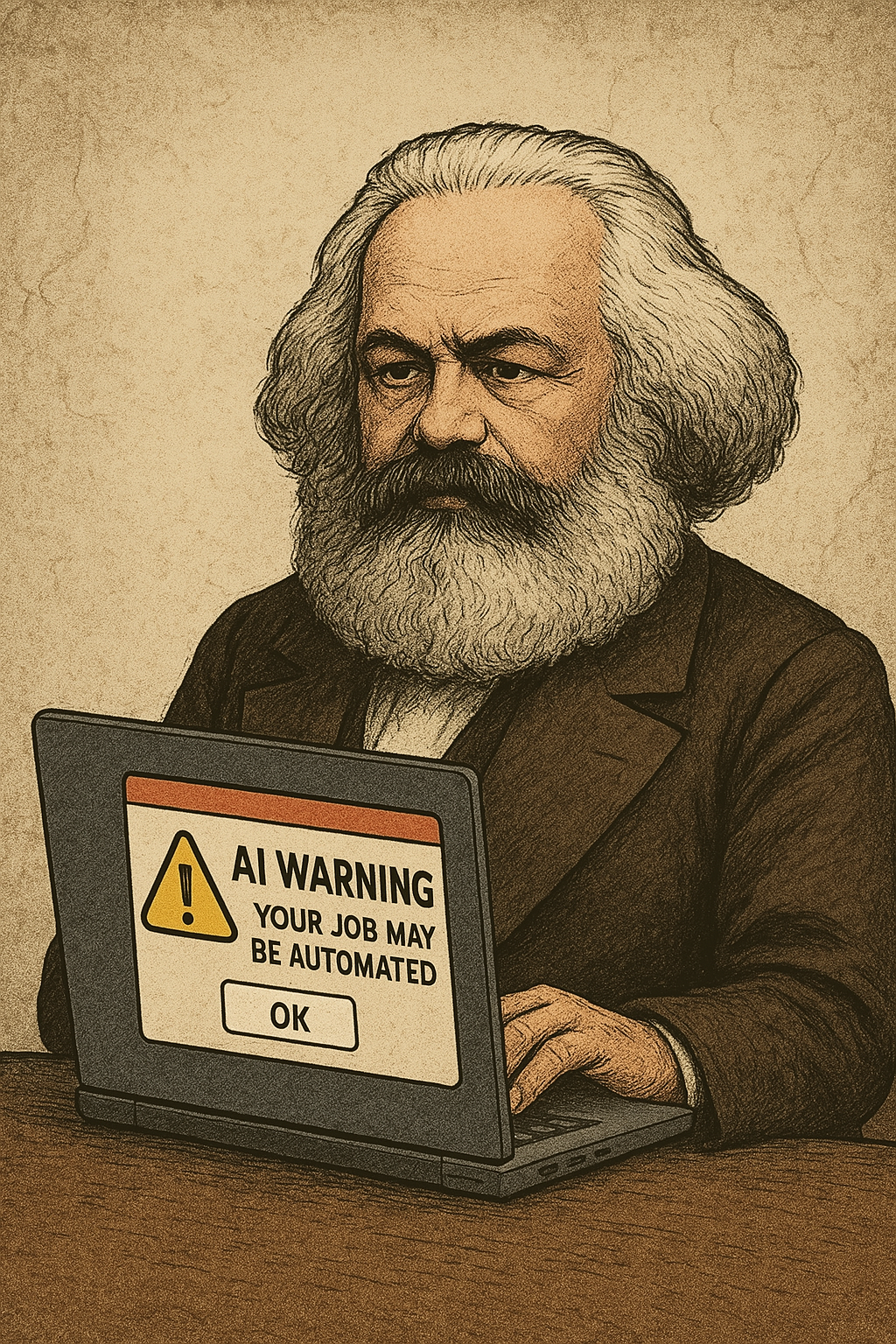
Interestingly, this debate echoes ideas written more than 150 years ago by Karl Marx, who warned that capitalism might ultimately be undermined by its own technological progress. Today, his predictions are being pulled back into the spotlight.

This article breaks down what Marx said, what AI is doing, and what the future of labor, and money, might look like.
1. What Marx Actually Predicted

Karl Marx believed capitalism had a built-in conflict:
the drive to replace human workers with machines.

He argued two key points:

A) The “Tendency of the Rate of Profit to Fall”

Marx said that profit comes from human labor.
But capitalists constantly try to replace human labor with machines because machines:

  • don’t get tired
  • don’t strike
  • don’t demand wages or rights

The more companies automate, the fewer workers they need.

But the paradox is:

If you replace too many workers, you remove the source of profit — human labor.

This, Marx believed, would eventually destabilize capitalism from within.

B) Automation makes workers “superfluous”

Marx predicted a future where technology becomes so advanced that:

  • masses of workers become unnecessary
  • unemployment grows
  • inequality rises
  • social tensions explode

For most of history, this sounded theoretical.
Today, with AI able to perform cognitive work, Marx suddenly feels more contemporary than ever.

2. The AI Shock: Why This Time Is Different

In the past, automation replaced muscle:

  • factory robots
  • tractors
  • machinery

Those technologies eliminated many physical jobs but created others.

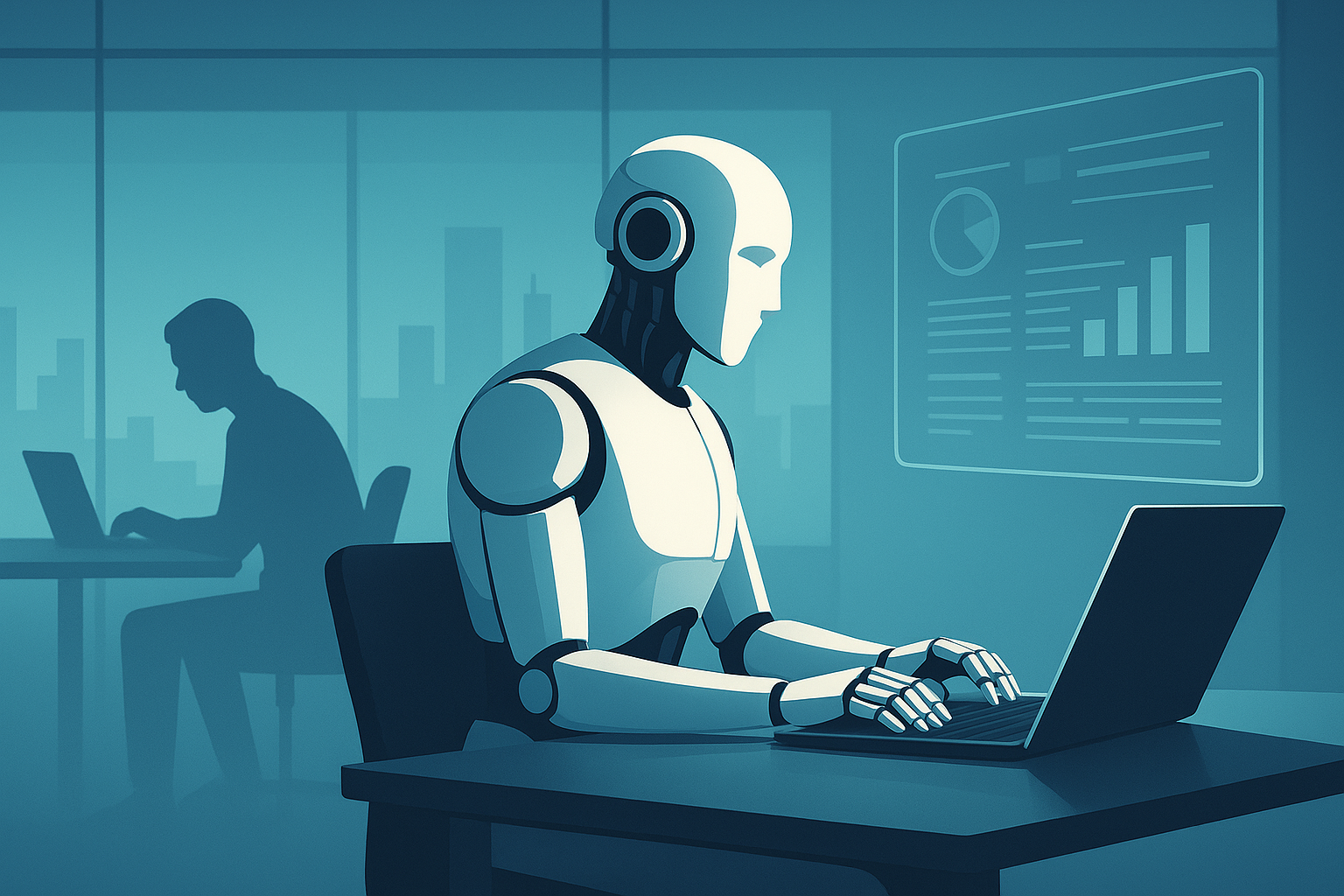
AI replaces the brain:

  • analysts
  • accountants
  • teachers
  • programmers
  • designers
  • writers
  • marketers
  • customer support
  • even medical diagnosis

White-collar workers, once considered “safe”, are now at risk.

Reports from groups like Goldman Sachs estimate that 300–800 million jobs worldwide could be automated in the coming years.

For capitalism, this is enormous.
Capitalism is built on two pillars:

  1. Labor → creates value
  2. Wages → let people buy things

If AI replaces too much labor, wages disappear, and the system loses its customers.

This is what worries economists.

3. The Core Economic Problem: No Jobs = No Money = No Capitalism

Here’s the simple logic:

  • Companies automate work → fewer workers
  • Fewer workers → less income
  • Less income → less spending
  • Less spending → companies lose customers
  • Companies lose customers → profits fall
  • Profits fall → economic system breaks

Capitalism needs consumers.
Consumers need wages.
Wages come from labor.
Labor is disappearing.

This is the exact contradiction Marx warned about.

4. What Happens to Society if AI Wipes Out Jobs?

Three major scenarios are being discussed in global economic circles:

A) Capitalism survives but transforms

Governments introduce:

  • Universal Basic Income (UBI)
  • AI and robot taxes
  • redistribution policies
  • national “AI wealth funds”
  • profit-sharing models

This keeps consumers alive even without traditional jobs.

B) Extreme inequality + political instability

If nothing is done:

  • wealth concentrates into a few tech giants
  • middle class collapses
  • consumer markets shrink
  • social unrest rises
  • governments face pressure for reform or revolution

This is the scenario many analysts fear.

C) A transition to “post-capitalism”

This idea doesn’t mean communism. Instead, it means a system where:

  • machines produce most wealth
  • humans work less or not at all
  • value is redistributed through society
  • the wage-labor system becomes obsolete

Some predict a peaceful shift.
Others see a turbulent transition.

5. Will New Jobs Replace the Old Ones?

Historically, technological revolutions created more jobs than they destroyed.

But AI is different for three reasons:

  1. It automates thinking, not just physical effort
  2. New jobs may require skills most people don’t have
  3. AI learns faster than humans can retrain

For the first time, technology is competing with humans in creativity, reasoning, and decision-making.

This makes the future less predictable than any previous industrial revolution.

6. Will AI Destroy Capitalism?

There are three main schools of thought:

1) AI will reshape capitalism, not kill it

The system adapts by creating safety nets like UBI, or by shifting focus to new industries.

2) AI will create “hyper-capitalism”

A handful of mega-corporations control all the AI models and extract enormous profits, leading to an extreme concentration of power.

3) AI will push us beyond capitalism

If machines produce nearly all value, the traditional logic of:

work → wages → consumption

falls apart.

In that case, capitalism as we know it would need to evolve or be replaced.

7. The Short Answer

If AI eliminates hundreds of millions of jobs and nothing is done, capitalism collapses because consumers vanish.

If governments and companies adapt, we enter a new economic era. Perhaps capitalism 2.0.

Marx didn’t predict AI, but he did predict the danger of a system that depends on labor while simultaneously trying to eliminate it. That contradiction is now the central question of the coming decade.

In the end, nobody truly knows where this collision between AI, labor, and capitalism will lead. Some predict unprecedented prosperity, others foresee economic collapse, and many warn that the transition itself may be chaotic.

Even politicians in several countries have started telling people to “buckle up,” hinting that families should keep basic supplies like food and water on hand. Not because disaster is guaranteed, but because the pace of disruption is now faster than society’s ability to adapt.

One thing is sure: we are crossing a threshold into unknown territory, where the old rules may no longer apply. The question is not whether change is coming, but how prepared we are for the world on the other side.

Disclaimer: The views expressed in this article are those of the author and may not reflect those of Shinybull.com. The author has made every effort to ensure the accuracy of the information provided; however, neither Shinybull.com nor the author can guarantee the accuracy of this information. This article is strictly for informational purposes only. It is not a solicitation to make any exchange in precious metal products, commodities, securities, or other financial instruments. Shinybull.com and the author of this article do not accept culpability for losses and/ or damages arising from the use of this publication.
Leave a comment

Filed under Politics

Jobs Will Become “Optional”

When Elon Musk took the stage at the U.S.–Saudi Arabia Investment Forum, he delivered one of his boldest predictions yet:
In 10 to 20 years, having a job may no longer be necessary. It may simply be a choice.

This statement didn’t come out of nowhere. It reflects Musk’s long-standing view that rapid progress in artificial intelligence and humanoid robotics, especially projects like Tesla’s Optimus robot, will fundamentally transform the global job market.

But what does “optional work” actually mean? What happens to CEOs, creativity, money, and everyday life in such a world?


Let’s break it all down.

What Exactly Did Elon Musk Say?

At the forum, Musk explained that technological progress will push society into an era where:

  • Most jobs are automated
  • Human labor is no longer required for economic survival
  • People will work only if they want to, not because they must.

He said that future “jobs” might feel more like hobbies, similar to playing a sport or a video game.

He also suggested that money itself could become less relevant:

“Money will stop being significant. The real constraints will be physical resources like energy and mass.”

Musk compared future work to gardening:
You can grow vegetables yourself, even though it’s easier to buy them at a store. You do it because you enjoy it, not because you must.
That’s his vision for the job market. A world where work is done for passion, not necessity.

A World Where Work Is Optional: What Would That Look Like?

If Musk is right, then the next two decades could reshape society in five significant ways:

1. Automation Takes Over Routine Work

Humanoid robots and advanced AI systems will be capable of doing nearly all physical and cognitive labor.
Everything from manufacturing to accounting to logistics could be automated.

2. Creativity Becomes the New Currency

When machines handle all basic tasks, the only irreplaceable human skill will be imagination.
Art, innovation, design, storytelling, and leadership will matter more than ever.

3. New Purpose Beyond Employment

If people no longer need to work for survival, society must redefine purpose, identity, and meaning.
Work will become a hobby, a passion project, or a personal mission.

4. The CEO Role Will Transform

Future CEOs may lead companies where the entire workforce is digital or robotic.
Their role shifts from:

  • personnel management
    to
  • vision-setting, ethics, coordination, and long-term strategy.

CEOs become more like chief philosophers and architects of systems than traditional managers.

5. Economic Models Must Evolve

If work becomes optional, new systems must support human welfare:

  • universal basic income
  • shared ownership of AI systems
  • new forms of value distribution
  • new definitions of wealth

This brings us to Musk’s most controversial idea:
A future where money itself becomes less meaningful.

Musk’s Claim: Money Could Become “Irrelevant”

This may sound like science fiction, but Musk is pointing toward a post-scarcity economic model:

  • AI and robotics produce unlimited goods and services
  • Energy becomes cheap due to breakthroughs in solar, batteries, and possibly fusion
  • Productivity skyrockets far beyond what human labor can achieve
  • The cost of producing essentials approaches zero

In that world, your livelihood isn’t tied to your paycheck.
Wealth isn’t about dollars. It’s about access to resources and control over energy, materials, and computing power.

Musk referenced Iain M. Banks’ Culture novels as inspiration:
a society where scarcity is gone, AI handles most functions, and humans focus on exploration, creativity, and self-development.

Will This Actually Happen?

Experts disagree. Some believe Musk’s timeline (10–20 years) is too optimistic.
Others argue that AI progress is moving faster than expected, and he may even be conservative.

What’s clear is this:

  • Jobs will change
  • Many roles will disappear
  • New creative and emotional roles will emerge
  • The global economic structure will need deep reform
  • The concept of the “CEO” will adapt dramatically

Whether Musk’s vision becomes reality or remains a theoretical future, the direction is unmistakable:
AI will reshape human work more than any technology in history.

Disclaimer: The views expressed in this article are those of the author and may not reflect those of Shinybull.com. The author has made every effort to ensure the accuracy of the information provided; however, neither Shinybull.com nor the author can guarantee the accuracy of this information. This article is strictly for informational purposes only. It is not a solicitation to make any exchange in precious metal products, commodities, securities, or other financial instruments. Shinybull.com and the author of this article do not accept culpability for losses and/ or damages arising from the use of this publication.

Leave a comment

Filed under Curiosity

Biden will discuss spending with top lawmakers this week

Trump cutted taxes and MSM said he was crazy. It is the republicans job to have as low taxes as possible. It is their policy. The same cannot be said about the democrats.The Biden administration will discuss spending with top lawmakers this week, and republicans think it sounds scary.

Biden wants to increase the taxes and that can have an impact on businesses and money makers. On top of that we also have inflation, which is also a hidden tax. Add higher interest rate on top of that. Bill Clinton did much of the same in the 90`s and as long as I can remember, it went well. But this time is probably different with covid-19 and lockdown.

Investors expected more than 1 million jobs in april, but only 266 thousand is what the Biden administration saw come in. They also expected unemployment rate at 5,8% but it jumped to 6,1% and all this was a big, big, big surprise to the market, and investors sent the market down on Monday.

Things have changed in the White House, and Maria asked Mr Mulvaney when was the last time the government gave $300 to people on a permanent basis. «If you pay people not to work, they are not going to work,» Mulvaney said.

To contact the author: post@shinybull.com

Disclaimer: The views expressed in this article are those of the author and may not reflect those of Shinybull.com. The author has made every effort to ensure the accuracy of the information provided; however, neither Shinybull.com nor the author can guarantee such accuracy. This article is strictly for informational purposes only. It is not a solicitation to make any exchange in precious metal products, commodities, securities, or other financial instruments. Shinybull.com and the author of this article do not accept culpability for losses and/ or damages arising from the use of this publication.

Leave a comment

Filed under Politics