Tag Archives: Growth

Economists expected slower growth, but these numbers indicate that the U.S. economy continues to perform well

YouTubers are full of negativity. Recession is near! Be ready! This is scary! Sell your stocks! The economy is bad! Well, everything isn`t good, but the growth in the U.S. is still very good. Just take a look at the numbers.

More good news came out earlier today. The U.S. job market in October 2024 has shown surprising strength, with 254,000 new jobs added in September. Far exceeding expectations. This strong growth brings the unemployment rate down to 4.1% (which is relatively low historically), and hourly wages are growing at an annual rate of 4%.

Economists expected slower growth, but these numbers indicate that the U.S. economy continues to perform well, and there’s optimism about avoiding a recession. However, voter sentiment still lags, as many remain concerned about inflation and the broader economic outlook

Not only the U.S. stock market is going up. Take a look at the China Stock Market. The China Stock Market has gone down and sideways for about 18 months but took back that downturn within a couple of weeks. This is amazing.

The recent surge in China’s stock market over the past two weeks is likely driven by several factors, including improved investor sentiment, government stimulus measures, and better-than-expected economic data. China’s government has implemented policies to stabilize the property sector, cut interest rates, and support industries, encouraging domestic investment.

Additionally, optimism about easing geopolitical tensions and a potential economic rebound is fueling this upward momentum. However, concerns remain about long-term growth and regulatory uncertainties, which could influence future market performance.

But China is not alone. ECB is doing the same. BOJ is doing the same, and so is the FED among many others. New money is coming into the stock market, and the stock market continues to climb higher.

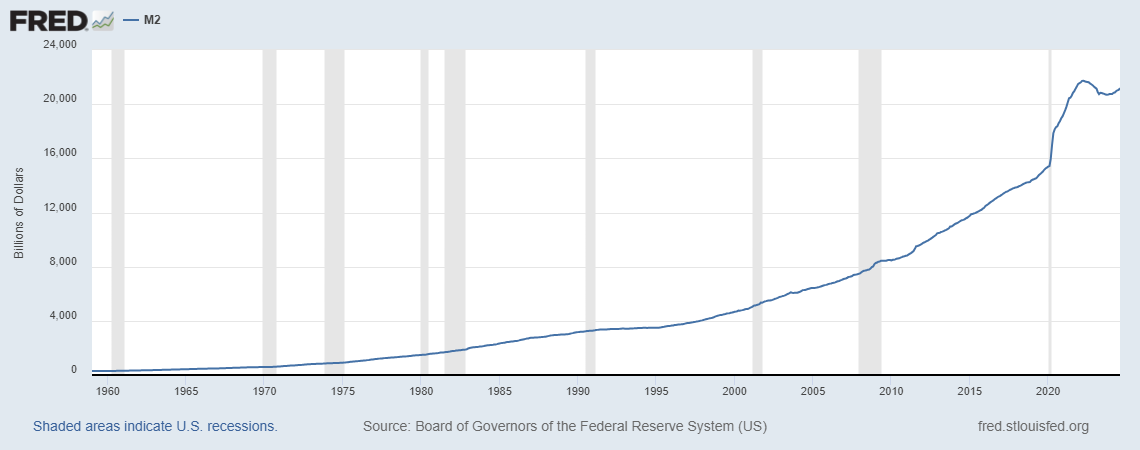
The massive printing of $21.17 trillion by the U.S. and other central banks, mainly in response to crises like the pandemic, significantly increased liquidity in the global financial system. This money printing was aimed at stimulating economies, propping up financial markets, and providing emergency relief. However, it also led to inflationary pressures as too much money chased too few goods.

The excess liquidity fueled asset bubbles raised debt levels and forced central banks to later tighten policies to combat the resultant inflation. Balancing liquidity while avoiding hyperinflation remains challenging.

The U.S. most recently engaged in significant money printing during the COVID-19 pandemic, particularly in 2020 and 2021, through measures such as the Federal Reserve’s Quantitative Easing (QE) program.

As of July 2024, the M1 money supply (monthly supply) in the United States stood at approximately 18 trillion dollars, marking a significant decrease from the previous year. This decline followed a notable contraction in the M1 money supply during the latter half of 2022 and the first six months of 2023.

The Fed injected trillions of dollars into the economy by purchasing government bonds and mortgage-backed securities to maintain liquidity, lower interest rates, and stimulate growth. By mid-2021, the Fed had expanded its balance sheet by over $4 trillion. However, exact figures for ongoing or current printing efforts are often adjusted depending on economic conditions.

Disclaimer: The views expressed in this article are those of the author and may not reflect those of Shinybull.com. The author has made every effort to ensure the accuracy of the information provided; however, neither Shinybull.com nor the author can guarantee such accuracy. This article is strictly for informational purposes only. It is not a solicitation to make any exchange in precious metal products, commodities, securities, or other financial instruments. Shinybull.com and the author of this article do not accept culpability for losses and/ or damages arising from the use of this publication.

Leave a comment

Filed under Politics, Stock market

The U.S. economy is in a relatively healthy state in 2024

Nearly everybody is talking about a recession. Everything will collapse they say. Let me tell you what recession is. It is a period of temporary economic decline during which trade and industrial activity are reduced, generally identified by a fall in GDP in two successive quarters.

The U.S. economy is far from a recession. Not even near.

The U.S. economy grew at an annualized rate of 3,0% in the second quarter of 2024. This robust growth exceeded earlier estimates of around 2,4%. The key drivers behind this stronger-than-expected growth were increases in consumer spending, particularly on durable goods, and services, and business investments in equipment, and structures. Additionally, private inventory investment provided a significant boost to GDP.

While the growth is positive, it`s not without some areas of weakness. This 3,0% growth signals resilience in the U.S. economy despite challenges such as elevated interest rates, and inflation, which have been moderating but still present pressures on households purchasing power. Residential fixed investment, which includes housing construction, continued to decline.

The growth in Q2 reflects a strong performance compared to previous quarters, suggesting that the U.S. economy is in a relatively healthy state in 2024. So, while growth is solid, there are still headwinds related to inflation and specific sectors of the economy like housing.

Disclaimer: The views expressed in this article are those of the author and may not reflect those of Shinybull.com. The author has made every effort to ensure the accuracy of the information provided; however, neither Shinybull.com nor the author can guarantee such accuracy. This article is strictly for informational purposes only. It is not a solicitation to make any exchange in precious metal products, commodities, securities, or other financial instruments. Shinybull.com and the author of this article do not accept culpability for losses and/ or damages arising from the use of this publication.

Leave a comment

Filed under Stock market

Productivity isn`t everything, but in the long run it is almost everything

I want to follow up my article from yesterday. It`s about Germany which has a huge problem with GDP at -0,1. Aging population. Lack of innovation, investments, R&D, and growth. But Germany is not the only country with problems like that.

Many countries in the world have the same problems. But there is a great solution to this problem, and Paul Krugman wrote about it in his book, «The Age of Diminished Expectations.» He said; «Productivity isn`t everything, but in the long run it is almost everything.»

Productivity is a foundation of prosperity, and the only way a country can raise its standard of living sustainably is to produce more with existing or fewer resources. You cannot do that without improving productivity. It`s that simple, Gita Bhatt wrote in an article at IMF.

We know that productivity must play a more important role in driving sustained growth as our societies age. But there`s no consensus on how to reverse the broad slowdown in productivity growth seen across almost all countries over the past 20 years.

Especially vexing is the sluggish growth of what economists call total factor productivity. A way of measuring how efficiently businesses turn capital and labor into output. The part that basically captures innovation and technology.

Slower gains in total factor productivity account for more than half the deceleration in economic growth since the global financial crisis, IMF-analysis shows. Another decade of weak productivity growth could seriously erode living standards and threaten financial and social stability.

Small companies can drive productivity gains, writes the University of Chicago`s Ufuk Akcigit. He shows how small firms are more innovative relative to their size, suggesting that they use R&D resources more efficiently.

As companies grow and dominate their markets, they often shift to protecting their market position, rather than fostering innovation, he said.

Policies matter too. Measures should encourage more effective reallocation of resources away from low-productivity firms and support smaller businesses and start-ups. Not just large incumbents. This could include targeted tax credits, grants for early-stage innovation, workforce retraining, and policies that encourage competition and reduce barriers to entry for new players.

Understanding productivity growth more fully is crucial because it plays such an outsize role in economic growth, which, as Daniel Susskind of King`s College London writes; also demands a renewed approach to help improve people`s lives.

Ultimately, as Nobel laureate Edmund Phelps writes; a productive society should allow people to enjoy «mass flourishing» from the grassroots up.

Disclaimer: The views expressed in this article are those of the author and may not reflect those of Shinybull.com. The author has made every effort to ensure the accuracy of the information provided; however, neither Shinybull.com nor the author can guarantee such accuracy. This article is strictly for informational purposes only. It is not a solicitation to make any exchange in precious metal products, commodities, securities, or other financial instruments. Shinybull.com and the author of this article do not accept culpability for losses and/ or damages arising from the use of this publication.
Leave a comment

Filed under Politics

Germany enjoyed the so-called «Wirtschaftswunder,» (economic miracle) but that has come to an end

For decades, Germany was synonymous with economic strength. Ever since World War II, it enjoyed the so-called «Wirtschaftswunder,» or economic miracle that followed the postwar recovery, which blessed Germany with almost four decades of high growth.

High growth thanks to German engineering, and manufacturing industries. The economic growth eventually slowed down, but Germany had established itself as the industrial heart of Europe, fueled by exports of products with large margins like cars machinery, and chemicals.

Companies like Volkswagen, BMW, Siemens, and BASF became global leaders with German products seen as pinnacles of quality and reliability. As a result of all that, people in Germany enjoyed high salaries, and high quality of life.

Their economic model was built on a few key pillars; strong manufacturing base. A highly skilled workforce, commitment to quality, and very strong exports. But this has come to an end. Last year, Germany was the only G-7 economy to shrink. It`s also the group`s slowest-growing economy with a growth to GDP at -0.1%.

It goes up and down. Down -0,5, up 0,1, down, 0,1, up 0,2, down -0,4, up 0,2, and then down again to -0,1.

Picture: Old economy vs New economies

Germany, long considered the economic engine of Europe, is currently facing significant challenges, leading to concerns that its economy may be stalling or «broken.» What in the world is happening in Germany, and what are the key factors that are affecting their economy right now?

It`s an energy crisis. Germany was dependent on Russian Gas. Germany relied heavily on Russian natural gas before the war in Ukraine. The subsequent sanctions and supply disruptions have led to a severe energy crisis, pushing up prices and harming energy-intensive industries like chemicals, manufacturing, and heavy machinery.

They also have a green transition challenge. Germany is trying to transition to renewable energy, but the shift away from nuclear and coal has left the country vulnerable during this energy crunch. This has increased costs for businesses and households, causing slower growth.

Germany`s economy is heavily reliant on exports, especially in industries like automotive and machinery. Global demand has softened, and supply chain disruptions from the COVID-19 pandemic continue to affect production.

The German auto industry, in particular, has been slow to transition to electric vehicles compared to competitors like Tesla, and Chinese manufacturers. This lag is putting pressure on a key pillar of the country`s economy.

Germany`s economy narrowly avoided recession in early 2023, but growth remains sluggish. High inflation and low consumer spending have contributed to weak economic activity. The combination of rising wages, energy prices, and inflationary pressures has increased production costs, leading to reduced profitability for businesses.

On top of that, you have an aging population. Germany`s population is aging rapidly, and the working-age population is shrinking. This is leading to labor shortages in key sectors and higher social welfare costs, creating long-term economic challenges.

In addition; they have migration struggles. While the country has relied on immigration to fill gaps in the labor market, recent shifts in public sentiment and policy restrictions have made it harder to sustain this approach.

Their biggest companies have been there for about 100 years, but there is a shift in the market. Germany has been criticized for lagging behind in digitalization and innovation, particularly in fields like AI and tech start-ups. This is reducing its competitiveness in the global economy.

Another problem is Germany`s heavily regulated business environment and complex bureaucracy. This can stifle innovation and make it harder for new businesses to scale up.

Like many others, Germany has trade challenges and the global demand is weak. As the global economy faces uncertainty, especially with China`s slowing growth, demand for Germany`s exports has dropped.

Germany`s economic model has long been dependent on strong export markets, so this is a major issue!

At least; EU Tension. Economic divergence within the European Union, especially between northern, and southern European economies, adds another layer of complexity, affecting Germany`s trade relations within the bloc.

It all started in France. Yellow Vest protesters went to the streets for months and years and protested against higher oil prices, electricity bills, and expensive toll stations. Their standard of living was shrinking.

This happened at a time when Donald Trump was cutting taxes and made the best economy in the U.S. ever. People in France asked for a Trump-like figure, but everything has gone straight up since then, and now we see severe problems in Germany and other places.

Picture: Yellow Vest protesters against high oil prices and low standard of living

This is happening at a time were productivity in the U.S. is great. Germany`s productivity is down -0,1%, while the productivity in the U.S. is up 3%. They are the best. They are at the top of the list! Even better than China! And the stock market goes up. Wow!

Germany`s economy is not «broken,» but it is facing severe challenges. Energy costs, inflation, global demand weakness, and structural issues in key industries like manufacturing are causing slower growth.

Long-term concerns like demographic changes and lagging investment in innovation also threaten future competitiveness. While these challenges are significant, Germany has strong economic fundamentals and could recover with strategic reforms and investments.

However, the current climate is tough, and the country is at a critical point in addressing these issues. Germany is in trouble.

Disclaimer: The views expressed in this article are those of the author and may not reflect those of Shinybull.com. The author has made every effort to ensure the accuracy of the information provided; however, neither Shinybull.com nor the author can guarantee such accuracy. This article is strictly for informational purposes only. It is not a solicitation to make any exchange in precious metal products, commodities, securities, or other financial instruments. Shinybull.com and the author of this article do not accept culpability for losses and/ or damages arising from the use of this publication.

Leave a comment

Filed under Politics

The war on successful people

There is no doubt that Trump created growth and jobs. But that was before the virus came in and destroyed the growth. Now, there is a different mindset in the White House. The Biden administration wants to increase the taxes.

The democrats tax hike plan is to increase the taxes on top individual of 39,6%. Top corporate rate will jump to 26,5% and 3% surtax on income over $5 million. This is a typical socialist agenda among socialists.

We know from history that Communism doesn`t work. We know that socialism isn`t Communism, but it`s Communism light if you will. Cutting the head of successful antrepreneurs has never worked in the long run.

Photo by Karolina Grabowska on Pexels.com

What people and socialists around the world should understand is that you are dependent of creative antrepreneurs. They are the reason why you have so much wealth and health right now. They gave you a luxury car, a smart phone and lots of internet of things.

They created products a lot of people around the world demanded. That demand was great business for the antrepreneurs and their businesses, and that is were the money to the socialists comes from. You cannot run a country without socialism, but you are dead without capitalism which comes first.

Tax foundation president Scott Hodge said the Biden tax plan will shrink the size of the economy by 1%. It will also cost the economy about 165,000 jobs. Shrink wages and capital stock. So, it will fewer jobs and the growth will be slower.

The tax on induviduals in New York will increase over 60% and that will make many people to leave Manhatten and flee to for example Florida were they treat people much better than any other places in the U.S.

Corporations will do the same. They will run as fast as they can to other places with a better tax plan. We also know from history that places with rich people and big corporations will have bigger growth than places with higher taxes and slower growth.

A research study found that about 51% of the economic burden on the corporate income tax falls on workers through lower wages. We saw the opposite happened under Trump. Growth went up and so did the wages.

The groups that are most harmed by the tax hike are women, low-skilled workers and younger workers The most marginal workers in the workforce.

So what we`re going to see from raising corporate taxes is a shrinkage of those kinds of jobs for the most vulnerable people in America.

House Democrats aim to raise a $2 trillion in tax revenue, and that is a very agressive tax plan.

To contact the author: post@shinybull.com

Disclaimer: The views expressed in this article are those of the author and may not reflect those of Shinybull.com. The author has made every effort to ensure the accuracy of the information provided; however, neither Shinybull.com nor the author can guarantee such accuracy. This article is strictly for informational purposes only. It is not a solicitation to make any exchange in precious metal products, commodities, securities, or other financial instruments. Shinybull.com and the author of this article do not accept culpability for losses and/ or damages arising from the use of this publication.

Leave a comment

Filed under Politics