Tag Archives: China

The Stasi Surveillance is the most repressive and oppressive surveillance system ever operated

Many people around the world do not want a surveillance society, but the truth is that it has never been easier to follow different people 24/7/365. Many are looking to Communist China, and its tactics and impact on society.

But surveillance isn`t something new. The Nazis did it. So did the Communists in East Germany. The Nazis had Gestapo, while the Communists had Stasi, and Stasi is the official name for Ministerium fur Staatsicherheit (German: «Ministry for State Security»).

Stasi was a secret police agency of the German Democratic Republic (East Germany). Furthermore; the Stasi was one of the most hated and feared institutions of the East German communist government. It all started after World War II: in 1950, and it lasted until the end in 1990 (after the fall of the Berlin wall in 1989).

Photo by PhotoMIX Company on Pexels.com

The difference between Gestapo and Stasi is that Gestapo had 40,000 officials watching a country of 80 million, while the Stasi employed 102,000 to control only 17 million. One might add that the Nazi terror lasted only twelve years, whereas the Stasi had four decades in which to perfect its machinery of oppression, espionage, and international terrorism and subversion.

By at least one estimate, the Stasi maintained greater surveillance over its own people than any secret police force in history.

The Stasi employed one secret policeman for every 166 East Germans. By comparison, the Gestapo deployed one secret policeman per 2,000 people.

Stasi agents infiltrated and undermined West Germany`s government and spy agencies.

The Stasi was much worse than the Gestapo, if you consider only the oppression of its own people, according to Simon Wiesnthal of Vienna, Austria, who has been hunting Nazi criminals for half a century. But, why was the Stasi so extremely good?

Many of the techniques used by the Stasi had actually been pioneered by the Nazis and in particular the Gestapo. They relied heavily on information-gathering and intelligence in order to create an atmosphere of fear and to get citizens to denounce one another. It worked extremely successfully. But, why did they do it? What was the goal of the Stasi?

The goal was to destroy secretly the self-confidence of people, for example by damaging their reputation, organizing failures in their work, and destroying their personal relationships. Considering this, East Germany was a very modern dictatorship. The Stasi didn`t try to arrest every dissident.

They had many different tactics, including questioning, repeated stop, and searches, strange noises on telephone lines, and conspicuous visits to the workplace so that bosses and colleagues were aware of the police interest.

The Stasi steamed open letters, copied them, filed them, and sent them on. They went into homes when people were out and bugged them. They tapped into the phone infrastructure of the building, maintained contacts and occasionally cooperated with West German terrorists.

The Stasi`s function was similar to the KGB, serving as a means of maintaining state authority. This was accomplished primarily through the use of a network of civilian informants. KGB also invited the Stasi to establish operational bases in Moscow and Leningrad to monitor visiting East German tourists.

The Stasi also acted as a proxy for KGB to conduct activities in other Eastern Bloc countries, such as Poland, where the Soviets were despised.

Due to their close ties with Soviet intelligence services, Mielke referred to the Stasi officers as «Chekists». In 1978, Mielke formally granted KGB officers in East Germany the same rights and powers that they enjoyed in the Soviet Union.

Between 1950 and 1989, the Stasi employed a total of 274,000 people in an effort to root out the class enemy. In 1989, the Stasi employed 91,015 people full-time, including 2,000 fully employed unofficial collaborators, 13,073 soldiers and 2,232 officers of the GDR army, along with 173,081 unofficial informants inside GDR, and 1,553 informants in West Germany.

Regular commissioned Stasi officers were recruited from conscripts who had been honorably discharged from their 18 months’ compulsory military service, had been members of the SED, had had a high level of participation in the Party`s youth wing`s activities, and had been Stasi informers during their service in the Military.

The candidates were then made to sit through several tests and exams, which identified their intellectual capacity to be an officer and their political reliability. University graduates who had completed their military service did not need to take these tests and exams.

They then attended a two-year officer training program at the Stasi college (Hochschule) in Potsdam.

By 1995, some 174,000 inoffizielle Mitarbeiter (Ims) Stasi informants had been identified, almost 2,5% of East Germany`s population between the ages of 18 and 60. 10,000 Ims were under 18 years of age.

From the volume of material destroyed in the final days of the regime, the office of the Federal Commissioner for the Stasi Records (BstU) believes that there could have been as many as 500,000 informers.

A former Stasi colonel who served in the counterintelligence directorate estimated that the figure could be as high as 2 million if occasional informants were included.

Full-time officers were posted to all major industrial plants (the extent of any surveillance largely dependent on how valuable a product was to the economy), and one tenant in every apartment building was designed as a watchdog reporting to an area representative of the Volkspolizei (Vopo).

Spies reported every relative or friend who stayed the night at another`s apartment. Tiny holes were drilled in apartment and hotel room walls through which Stasi agents filmed citizens with special video cameras.

Schools, universities, and hospitals were extensively infiltrated.

A large number of Stasi informants were tram conductors, janitors, doctors, nurses, and teachers. Mielke believed that the best informants were those whose jobs entailed frequent contact with the public.

In some cases, spouses even spied on each other.

The roles of informants ranged from those already in some way involved in state security (such as the police and the armed services) to those in the dissident movements (such as in the arts and the Protestant Church).

Information gathered about the latter groups was frequently used to divide or discredit members. Informants were made to feel important, given material or social incentives, and were imbued with a sense of adventure, and only around 7,7%, according to official figures, were coerced into cooperating.

The Stasi had files on everyone. They spied on almost every aspect of East German`s daily lives, and they carried out international espionage. It kept files on about 5,6 million people and amassed an enormous archive. The archive holds 111 kilometers of files in total.

The Stasi was the official state security service of East Germany, the German Democratic-Republican in short the GDR. The Stasi`s motto was «Schild und Schwert der Partei» (Shield and Sword of the Party).

«The Party» was the ruling Socialist Unity Party of Germany.

The Stasi perfected the technique of psychological harassment of perceived enemies known as Zersetzung, which is a term borrowed from chemistry that literally means «decomposition». Chemical decomposition means chemical breakdown.

For example, the stability of a chemical compound is eventually limited when exposed to extreme environmental conditions such as heat, radiation, humidity, or the acidity of a solvent. Because of this chemical decomposition is often an undesired chemical reaction.

The goal was to paralyze people, and it could do so because it had access to so much personal information and to so many institutions.

By the 1970s, the Stasi had decided that the methods of overt persecution that had been employed up to that time, such as arrest and torture, were too crude and obvious. Such forms of oppression were drawing significant international condemnation.

It was realized that psychological harassment was far less likely to be recognized for what it was, so its victims, and their supporters, were less likely to be provoked into active resistance, given that they would often not be aware of the source of their problems, or even its exact nature.

International condemnation could also be avoided.

Zersetzung (decomposition) was designed to side-track and «switch off» perceived enemies so that they would lose the will to continue any «inappropriate» activities.

Anyone who was judged to display politically, culturally or religiously incorrect attitudes could be viewed as a «hostile-negative» force and targeted with Zersetzung methods.

For this reason members of the Church, writers, artists, and members further developed in a «creative and differentiated» manner based upon the specific person being targeted i.e. They were tailored based on the target`s psychology and life situation.

Tactics employed under Zersetzung usually involved the disruption of the victim`s private or family life.

This often included psychological attacks, such as breaking into their home and subtly manipulating the contents, in a form of gaslighting i.e. Moving furniture around, altering the timing of an alarm, removing pictures from walls, or replacing one variety of tea with another, etc.

Other practices include property damage, sabotage of cars, travel bans, career sabotage, administering purposely incorrect medical treatment, smear campaigns which could include subversion, wiretapping, bugging, mysterious phone calls or unnecessary deliveries, even including sending a vibrator to a target`s wife.

Increasing degrees of unemployment and social isolation could and frequently did occur due to the negative psychological, physical, and social ramifications of being targeted.

USUALLY, VICTIMS HAD NO IDEA THAT THE STASI WERE RESPONSIBLE.

The victims didn`t know what was happening. They were confused, and everybody around the target could watch as he or she crumbled under the relentless pressure of state harassment. Zersetzung was designed by the Stasi, and it was a form of psychological harassment to wreak havoc on an individual, without any need to arrest or torture the target.

Many thought that they were losing their minds, and mental breakdowns and suicide were sometimes the results. There is ongoing debate as to the extent if at all, to which weaponized directed energy devices, such as X-ray transmitters, were also used against victims.

A direct-energy weapon (DEW) is a ranged weapon that damages its target with highly focused energy without a solid projectile, including lasers, microwaves, particle beams, and sound beams. Potential applications of this technology include weapons that target personnel, missiles, vehicles, and optical devices.

The main goal was to give the victims a lot of pain because that was much better than putting them in prison and torturing them. One of the symptoms was called the Havana syndrome. It was a syndrome of medical symptoms reported by US personnel in Havana, Cuba, and other locations, suspected by the National Academies of Sciences, Engineering, and Medicine to be caused by microwave energy.

Some common bio-effects of non-lethal electromagnetic weapons include difficulty breathing, disorientation, nausea, pain, vertigo, and other systemic discomfort.

Interference with breathing poses the most significant, potentially lethal results. Light and repetitive visual signals can include epileptic seizures. Bection and motion sickness can also occur.

After German reunification, revelations of the Stati`s international activities were publicized, such as its military training of the West German Red Army Faction. Stasi experts also helped train the secret police organization of Mengistu Haile Mariam in Ethiopia.

They helped Fidel Castro`s regime in Cuba. Stasi officers helped in the initial training and indoctrination of Egyptian State Security organizations under the Nassar regime. They helped to create secret police forces in the People`s Republic of Angola, the People`s Republic of Mozambique, and the People`s Republic of Yemen.

The Stasi organized and extensively trained Syrian intelligence services under the regime of Hafez al-Assad. They also helped to set up Idi Amin`s secret service. They helped the President of Ghana.

Documents in the Stasi archives state that the KGB ordered Bulgarian agents to assassinate Pope John Paul II, who was known for his criticism of human rights in the Eastern Bloc, and the Stasi was asked to help with covering up traces.

The Stasi in 1972, also made plans to assist the Ministry of Public Security (Vietnam) in improving its intelligence work during the Vietnam War.

That was then, but how is it now? We must ask ourselves how our own society is built. The Stasi had a system for monitoring telephone conversations, but if they could do it in the 70s, what can be happening even today? What about social media, emails, smartphones, and computers.

A lot of people believe that China`s social system is scary. But that system is not only about China. It`s in many other countries in Europe and America. They have surveillance cameras, face recognition, and the requirements to always praise the government. It sounds like an Orwellian nightmare come true. Or a Stasi system of surveillance.

China`s social credit system affects freedom of speech, resulting in censorship and self-censorship, ultimately silencing any form of opposition. But this is not only about China. The web itself is a surveillance machine. As it stands today, you are what you click.

Once you`re logged on to your computer and have access to the internet, the system will see what you are doing, and you will be tracked by your browser, by third parties, by cookies, and by almost all the sites you are logging into.

The data you give the third party for free is aggregated and a profile about you is being created. Most of the information you give away for free is being used for targeted advertisements. But it could well be used to create a so-called Social Credit System.

Once all the data is collected, the profile is created, and it can be very difficult to change your own profile. Your profile of yours will lead to real-life consequences.

In addition, China has set up more than 100 so-called overseas police stations across the globe to monitor, harass, and in some cases repatriate Chinese citizens living in exile, using bilateral security arrangements struck with countries in Europe and Africa to gain widespread presence internationally, according to CNN.

The State Security Ministry is the principal civilian intelligence, security, and secret police agency of the People`s Republic of China, responsible for counterintelligence, foreign intelligence, and political security. The MSS is active in industrial espionage and adept at cyber espionage.

A document from the US Department of Justice described the agency as being like a combination of the Central Intelligence Agency (CIA), and the Federal Bureau of Investigation (FBI).

Many foreign analysts describe the Communist «Part-State» and its security agencies as being left without a real ideology, relying only on repression and the stoking of Chinese nationalism, more recent works, however, highlight the increasing importance of Marxism-Leninism in the worldview, internal culture and self-image of the CCP security apparatus; Vladimir Lenin and Mao Zedong remain the central influences, although classical Chinese thinkers such as Sun Tzu are also studied.

1,412 billion live in China. How many agents do they have? Only 87 million live in Iran, and they have its own Islamic Revolutionary Guard Corps to protect the priests at the top. It is a multi-service primary branch of the Iranian Armed Forces. Active personnel last year was 210,000, while 60,000 was paramilitary forces.

According to BBC, the UK is preparing to formally declare that Iran`s Islamic Revolutionary Guard Corps (IRGC) is a terrorist organization. It follows a similar decision made by the US in 2019. After a popular antigovernment protest in Iran, the number of people killed by security forces has increased.

The state of human rights in the Islamic Republic of Iran has been criticized by Iranians and international human rights activists.

The Stasi was one of the most hated and feared institutions of the East German communist government. Nor is CCP so popular. Iran`s Revolutionary Guard is also unpopular. The funniest thing is that they are all funded by «the people».

Disclaimer: The views expressed in this article are those of the author and may not reflect those of Shinybull.com. The author has made every effort to ensure the accuracy of the information provided; however, neither Shinybull.com nor the author can guarantee such accuracy. This article is strictly for informational purposes only. It is not a solicitation to make any exchange in precious metal products, commodities, securities, or other financial instruments. Shinybull.com and the author of this article do not accept culpability for losses and/ or damages arising from the use of this publication.
Leave a comment

Filed under Politics

If the US continues to go down the wrong path, there will be irretrievable consequences for the China-US relations and the US will have to pay an unbearable price

The Russia-Ukraine conflict is very similar to the Chinese-Taiwan conflict. NATO and the EU in Ukraine are a big threat to Russia. The same can be said about Taiwan. NATO in Taiwan will be a threat to China. So, this is the next big problem for the United States.

The tension is rising, and China is building up its military bases and have 14 warplanes in Taiwan`s air-defense zone.

President Biden said yesterday in a speech in Tokyo that he vows to intervene militarily if China invades Taiwan. «We have a commitment to do that,» Biden said. But that is not an official U.S policy. Is Biden trying to change U.S policy?

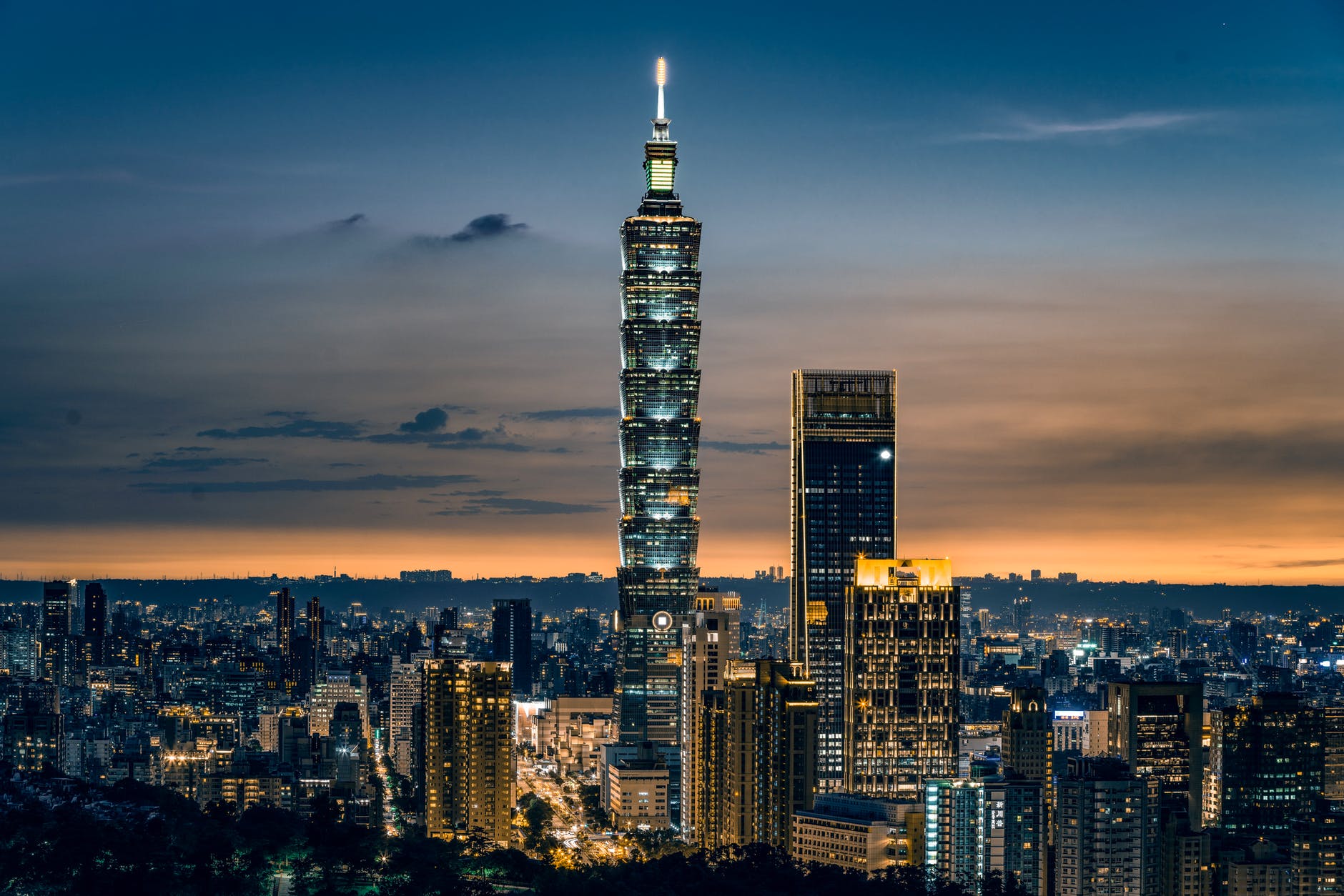
Photo by u674eu6602u8ed2 on Pexels.com

The U.S officials walked back Biden`s comments quite quickly and said this after his speech: «As the President said, our policy has not changed. He reiterated our One China policy and our commitment to peace and stability across the Taiwan Strait. He also reiterated our commitment under the Taiwan Relations Act to provide Taiwan with the military means to defend itself.»

The Taiwan Relations Act obligates the U.S to enable Taiwan to maintain a sufficient self-defense capability, and maintain the capacity of the U.S to resist any resort to force. But despite U.S weapons sales to Taiwan, the U.S has been ambiguous about whether it would intervene militarily, and the U.S acknowledges that all Chinese on both sides of the Taiwan Strait maintain that there is one China, and Taiwan is a part of China, as Biden reiterated yesterday.

In a speech in Japan yesterday, president Biden said; «We agree with the one-China policy. We have signed on to it and all the attendant agreements are made from there. But the idea that it can be taken by force, will dislocate the entire region and be another action similar to what happened in Ukraine. And so it`s a burden that is even stronger.»

China`s reaction to President Biden`s comments on Taiwan came very quickly: «China will take firm actions to safeguard its sovereignty and security interests. We mean what we say.»

What China wants is reunification. So, China is right now threatening Taiwan militarily.

The U.S policy dates back to December 15, 1978, when Jimmy Carter restored relations with Beijing and ended formal ties with Taipei (capital of Taiwan). Taiwan is a big chip-maker, and National Security Adviser Jake Sullivan said intense economic talks with Taiwan will take place in the weeks to come.

Chinese Foreign Ministry Spokesman, Wang Wenbin said this yesterday:

«The US has been racking its brains to play with words when it comes to the one-China principle. I want to remind the US side that no forces, the US included, can hold back the Chinese people’s endeavor to reunify the nation. Also, no forces, the US included, can change the fate of the “Taiwan independence” forces who are doomed to fail. 

Reneging on its promise on the Taiwan question, the US has obscured and hollowed out the one-China principle, and publicly or stealthily incited and endorsed “Taiwan independence” separatist activities. If the US continues to go down the wrong path, there will be irretrievable consequences for the China-US relations and the US will have to pay unbearable price.

Our stern warning to the US: There is but one China in the world, Taiwan is part of China’s territory and the government of the People’s Republic of China is the sole legal government representing the whole of China. This is a consensus of the international community and a commitment made by the US to China.

The one-China principle is unshakable, China’s sovereignty and territorial integrity cannot be violated and the red line of avoiding creating “two Chinas” and “one China, one Taiwan” must not be crossed. 

China has full confidence and capability and is fully prepared to firmly stem the “Taiwan independence” separatist activities, foil all external interference and resolutely uphold its sovereignty and territorial integrity. I’d like to advise the US to listen to a well-known Chinese song with these lyrics: “For our friends, we have fine wine. For jackals or wolves, we welcome with shotguns.”

Disclaimer: The views expressed in this article are those of the author and may not reflect those of Shinybull.com. The author has made every effort to ensure the accuracy of the information provided; however, neither Shinybull.com nor the author can guarantee such accuracy. This article is strictly for informational purposes only. It is not a solicitation to make any exchange in precious metal products, commodities, securities, or other financial instruments. Shinybull.com and the author of this article do not accept culpability for losses and/ or damages arising from the use of this publication.
Leave a comment

Filed under Politics

Economic globalization is the trend of the times. Though countercurrents are sure to exist in a river, none could stop it from flowing to the sea

World Economic Forum (WEF) started its annual meeting yesterday, and it will continue till Thursday this week. This is the first global in-person leadership event since the start of the Covid-19 pandemic, and this time their theme is; «Working Together, and restoring Trust.»

But the annual meeting has never been confronted with so many unprecedented global issues as it is now in 2022. The WEF`s annual meeting is coming at a crucial time. The most crucial in its 50-year history.

The world is recovering from a global pandemic, struggling with a war in Ukraine, and facing huge challenges from climate change. On top of that, monkeypox is coming, and so are inflation and famine.

One of the topics is globalization, and as we all know, globalization is dead right now. But, I think it`s only set on «pause.»

Chinese President Xi Jinping visited WEF in 2017, and on his first trip he said; «Whether you like it or not, the global economy is a big ocean that you cannot escape from.»

This time, in 2022, Xi said; «Economic globalization is the trend of the times. Though countercurrents are sure to exist in a river, none could stop it from flowing to the sea.»

Xi is also the founder of the Belt and Road Initiative (BRI), which is the 21st Century Maritime Silk Road. The Silk Road has always been important to the trade in the world. It was an ancient trade route that linked the Western world with the Middle East and Asia.

It was a major conduit for trade between the Roman Empire and China and later between medieval European kingdoms and China.

Established when the Han Dynasty in China officially opened trade with the West in 130 B.C., the Sild Road routes remained in use until 1453 A.D., when the Ottoman Empire boycotted trade with China and closed them.

Although it`s been nearly 600 years since the Silk Road has been used for international trade, the routes had a lasting impact on commerce, culture, and history that resonates even today.

I find it very interesting to see that Venetian explorer Marco Polo famously used the Silk Road to travel from Italy to China, which was then under the control of the Mongolian Empire, where they arrived in 1275.

Notably, they did not travel by boat, but rather by camel following overland routes. They arrived at Xanadu, the lavish summer palace of the Mongolian emperor Kublai Khan. (You can see the film about that relationship on Netflix. I think you will like it a lot).

In all, the explorer spent 24 years in Asia, working in Kublai Khan`s court, perhaps as a tax collector.

Marco Polo returned to Venice, again via the Silk Road routes, in 1295, just as the Mongolian Empire was in decline. His journeys across the Silk Road became the basis for his book, «The Travels of Marco Polo,” which gave Europeans a better understanding of Asian commerce and culture.

Khan`s Empire is gone. So are the Roman and the Ottoman Empire. Some historians say the start of the British Empire started around the 1490s, while others say the early 1600`s, but it all ended in the years after World War 2, with most of Britain`s colonies ruling themselves independently by the late 1960s. But what about the American Empire?

A New World Order started after World War 2, and the U.S became the leading Empire in the World. Now, we are all facing a revolution. A New World Order. Again. Globalization is dead, but it will come back, because as Xi said: «Economic globalization is the trend of the times. Though countercurrents are sure to exist in a river, none could stop it from flowing to the sea.»

On Friday, the S&P 500 briefly fell into a bear market, and the inflation in the UK hit a 40-year high in April. We are into a vicious cycle, and the WEF`s Chief Economists Outlook has warned of lower economic activity, higher inflation, lower real wages, and greater food insecurity globally in 2022.

They warn that this could have devastating human consequences as the global economy fragments.

As Saadia Zahidi, Head of the Centre for New Economy and Society and a Managing Director at the World Economic Forum explained:

«We are at the cusp of a vicious cycle that could impact societies for years. The pandemic and war have fragmented the global economy and created far-reaching consequences that risk wiping out the gains of the last thirty years.

Leaders face difficult choices and trade-offs domestically when it comes to debt, inflation, and investment. Yet business and government leaders must also recognize the absolute necessity of global cooperation to prevent economic misery for millions around the world.

The WEF`s Annual Meeting this week will provide a starting point for such collaboration.»

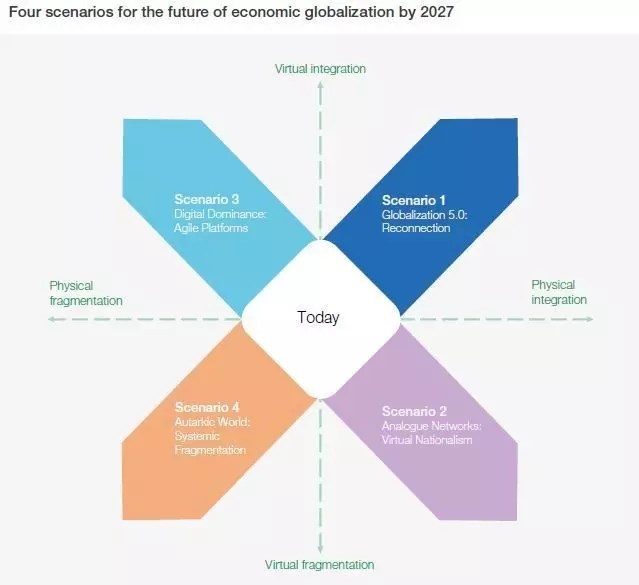
Four Futures for economic Globalization: Scenarios and their implications:

Globalization has created significant opportunities and lifted millions out of poverty, while also driving inequality and economic disruption. With many countries turning inward in search of new strategies to increase security and resilience, the convergence of physical and virtual forms of economic globalization is no longer a given.

As the traditional drivers of globalization have reached a critical juncture, we are entering a new phase of increased economic volatility, polarization, and structural reset of the global system. Ever-accelerating digitalization, however, means that the rivalry between global centers is rapidly expanding from the physical to virtual space, where competition over the control of technology and information networks is growing. How different economic centers of gravity will choose between physical and virtual integration, fragmentation or isolation will shape the fate of economic globalization in the years to come.

This White Paper outlines how the nature of globalization may shift as economic powers choose between fragmentation or isolation in both physical and virtual integration. The report calls for “no-regret actions” by policymakers: global cooperation on the climate crisis; investment in human capital to prepare populations for a range of economic futures, and returning to developing resilience through greater economic integration, knowledge-sharing, and diversification.

Globalization is at crossroads. It`s changing, but it isn`t ending.

Disclaimer: The views expressed in this article are those of the author and may not reflect those of Shinybull.com. The author has made every effort to ensure the accuracy of the information provided; however, neither Shinybull.com nor the author can guarantee such accuracy. This article is strictly for informational purposes only. It is not a solicitation to make any exchange in precious metal products, commodities, securities, or other financial instruments. Shinybull.com and the author of this article do not accept culpability for losses and/ or damages arising from the use of this publication.

Leave a comment

Filed under Politics

From Unipolar world to Multipolar world

Do you remember when Vladimir Putin invited many world leaders to Russia`s annual Victory Day parade in Red Square on May 9, 2015? Do you remember that all the western leaders were boycotting that event because of the crisis in Ukraine?

Vladimir Putin said at that time that the U.S is trying to create a «unipolar world». Putin and Russia have used an address commemorating the 70th anniversary of victory over Nazi Germany to accuse the U.S of attempting to dominate the world.

I wrote an article about it on June 3, 2015, and you can read that article here. Cuba`s Fidel Castro shares Putin`s worldview. He released a new book called «Cold War – A warning for a unipolar world» on September 1, 2003. Castro said; «To endure the global struggle between the superpowers is bad. To live under the total hegemony of one of them is worse».

Photo by Pixabay on Pexels.com

That`s exactly what the war in Ukraine is about. A world order. World dominance. But Putin stopped this big dream, which means we will go from a Unipolar world to a Multipolar world.

The U.S President, Barack Obama, and Germany`s Angela Merkel didn`t come. Neither did other Western leaders like UK`s Prime Minister David Cameron and French President Francois Hollande. Moscow has increasingly appeared to pivot away from Europe and focus more on developing relations with China, I wrote in the article at that time in 2015.

The Chinese leader, Xi Jinping, was the most high-profile guest on the podium next to Putin. Other presidents in attendance included India`s Pranab Mukherjee, Presiden Abdel Fatah al-Sisi of Egypt, Raul Castro of Cuba, Nicolas Maduro of Venezuela, Robert Mugabe of Zimbabwe, and Jacob Zuma of South Africa.

«The boycott illustrates the depth and breadth of the chasm now separating Russia and the West,» said Dmitri Trenin, head of the Carnegie Moscow Center.

But what is Putin trying to say when he claims that the U.S is trying to create a «Unipolar World?»

Unipolarity in international politics is a distribution of power in which one state exercises most of the cultural, economic, and military influence. Unipolarity is an interstate system and not an Empire. Unipolarity implies the existence of many juridically equal non-states, something that an empire denies.

Unipolarity is anarchical. Anarchy results from the incomplete power preponderance of the Unipole. Kenneth Waltz, argues that great power cannot «exert a positive control everywhere in the world.» Therefore, relatively weaker countries have the freedom to pursue policy preferences independent of the Unipol.

Unipolar systems possess only one great power and face no competition. If a competitor emerges, the international system is no longer unipolar. Kenneth Waltz maintains that the United States is the only «pole» to possess global interests.

So, here we are. We knew at that time that Russia appeared to pivot away from Europe and focus more on developing relations with China.

Russia in bed with China, India, and Africa means a new world order, and that coalition is powerful. Keep in mind that 50% of the world population lives in China and India alone. In terms of business; that is a huge market.

The unipolar world has come to an end.

The modern international order, system, and relations developed after the end of the Thirty Years’ War in 1618 – 1648, and the conclusion of the Westphalia Treaty in 1648. Raymond Aaron studied international relations and he said: «I call the international system a set of political entities that maintain constant relations and can be involved in a large-scale war».

It`s all a part of an evolution, and there are four types of structural organization of the international system: the Westphalian system (1648-1789) as a system of classical European balance, the Vienna system (1814-1914) the system of European concert, the Versailles-Washington system (1919-1939) with the main conquest, the League of Nations and the Yalta-Potsdam system (1945-1991), the crown of which is the creation of the United Nations.

There are three types of world order: unipolar, bipolar, and multipolar. The unipolar world order presupposes the domination of a single super-power that is ahead of all other states by its combined power.

The bipolar world order is transformed into a multipolar one when economic and military power comparable to the power of the two states is reached by other powers. In an equilibrium system, several large states maintain roughly the same influence on the course of the events, restricting each other`s excessive claims.

At the beginning of the twentieth century, the world was multipolar, but by the middle of the century, two World Wars and many smaller conflicts had created a bipolar model.

With the end of the cold war and the collapse of the Soviet Union, bipolarity was replaced by unipolarity. The United States began to play a major role. But that has come to an end.

Recent facts and events show that the United States cannot cope with the role of being the only pole in the current world order. They were unable to balance forces in the Middle East. Neither with their troops nor with the support of groups that tried to seize power. Therefore; the troops withdraw from the war in Afghanistan.

The old world order is gone forever. Now, the world has entered a period of uncertainty and increased risks, exacerbated by the inability of the United States and its allies to solve the global problems of our time.

Former Barack Obama adviser, President of the Council on Foreign Relations Richard Haas introduced the concept of a world without states or a multipolar world in his book «A World in Disarray: America Foreign Policy and the Crisis of the Old Order.»

Nations must be prepared to surrender independence to world structures. The unipolar system has ended, and International relations in the 21st century will determine the situation of polarity. The power would be blurred rather than concentrated, and the importance of nation-States would diminish as non-state actors strengthened.

A multipolar system complicates diplomatic activity. it`s not just that they’re more actors in the polar world. It lacks the predictable fixed structures and systems of relations that characterize unipolar, bipolar, and multipolar structures.

The multipolar system will be difficult and dangerous, and international relations are undergoing a powerful transformation in the 21st century that changes the nature, structure, and essence of the international order.

A formation of a new model of international relations will be very painful and costly, and the entire world order will have to go through an era of turbulence. We had the pandemic. Now, we have a war, but there is more pain to come. There will be more economic and social hardships and it`s time for more world chaos.

The British philosopher and sociologist Sigmund Bauman said: «No one can consider themselves truly indispensable. Even the most privileged status can be temporary and suddenly change».

Disclaimer: The views expressed in this article are those of the author and may not reflect those of Shinybull.com. The author has made every effort to ensure the accuracy of the information provided; however, neither Shinybull.com nor the author can guarantee such accuracy. This article is strictly for informational purposes only. It is not a solicitation to make any exchange in precious metal products, commodities, securities, or other financial instruments. Shinybull.com and the author of this article do not accept culpability for losses and/ or damages arising from the use of this publication.

Leave a comment

Filed under Politics

The US/NATO bombing of Yugoslavia in 1999 was a culprit for torpedoing world order

Thursday this week marks the 23rd anniversary of NATO`s bombing of the Federal Republic of Yugoslavia, which began on March 24, 1999, and lasted 78 days, Serbian media reported.

The European security crisis began in 1999 when US/Nato started to bomb Yugoslavia, and that was then erosion of all foundations of the world order, according to Kremlin spokesman Dmitry Peskov in an interview with Russian Tass.

«Back then, these bombs in addition to killing civilians started destroying the system of international relations. It was exactly then that NATO (and when we say «NATO», we mean «Americans») started to bomb the foundation of the world order, which led to the European security crisis, which we are living through today», the spokesman underscored.

Photo by Pixabay on Pexels.com

This is exactly in line with what I have said in my recent articles. Putin`s war in Ukraine has many sides. Putin is attacking the European globalists, and globalization is dead.

Peskov pointed out that this crisis primarily involves the European continent. Russia and other states are located, most of which are currently unfriendly towards Moscow. «The very Americans, who instigated all this, they suffer from this crisis much less, we must understand it well», he added.

Serbia was attacked as responsible for the humanitarian catastrophe in Kosovo, and the immediate cause was the events in Racak and the failure of negotiations on Kosovo`s future status in Rambouillet and Paris, according to Novinite.

NATO’s air operation began at 7.45 p.m. on 24 March 1999. Nineteen NATO countries began bombing ships in the Adriatic and four air bases in Italy. First, the air defenses and other Yugoslav military sites in Pristina, Batajnica, Belgrade, Mladenovac, and elsewhere were bombed.

According to the Serbian Ministry of Defense, 2,500 civilians were killed during the NATO airstrike, including 89 children and 1,031 members of the army and police. 6,000 civilians were injured, including 2,700 children and 5,173 soldiers and police, and 25 are still missing.

Serbian President Aleksandar Vucic said last night that there was no justification for NATO aggression in 1999 but that if he had been in Slobodan Milosevic’s place, he would have acted differently, Politika reported.

In a few days, I would have stopped it, either by resigning or something else. 78 days is too long to cripple a country that had no chance to defend itself and wait for someone else to help us, but we knew that no one would,” Vucic said in an interview with RTV.

The president noted that Russia at the time, led by Boris Yeltsin, was weak. Vucic also pointed out that the one who leads the country must take care of how to save his people.

I am now looking at the conflict in Eastern Europe and wondering why some people are not thinking well about the consequences”, Vucic said.

Serbian President Aleksander Ucic said in an interview on March 24; «“Now, after 23 years, one can see with clarity how despicable, ill-judged, unlawful and immoral this operation by 19 NATO countries was” and how “ridiculous, even stupid, to hear them now blaming Russia for its so-called aggression against Ukraine”, adding that “the morals, principles, and values they constantly talk about do not exist at all”. Does China have any comments?

Wang Wenbin is a Chinese politician diplomat, the spokesperson of the Ministry of Foreign Affairs, deputy director of the Foreign Ministry Information Department, and a member of the Chinese Communist Party (CCP). He had a speech and said this on CCTV:

«On March 24, 1999, US-led NATO forces blatantly bypassed the UN Security Council and began the 78-day incessant bombing of the Federal Republic of Yugoslavia, a sovereign country, in grave violation of relevant international conventions and basic norms governing international relations.

In 12,000 strikes, over 10,000 tonnes of explosives were dropped and more than 3,000 missiles fired, targeting everything from medical facilities to ancient cultural relics, residential buildings, and schools.

Thousands of innocent civilians including three Chinese journalists were killed. During the bombing campaign, NATO even used depleted uranium bombs prohibited by international conventions, causing long-term damage to Serbia’s environment and people’s health.

The people of Serbia will not forget NATO’s aggression, nor will the people of China and the rest of the world.

NATO is convening a summit on Ukraine on the 23rd anniversary of its bombing of the Federal Republic of Yugoslavia. I wonder if the US and other NATO members have asked themselves:

What is the root cause of the Ukraine crisis?

What responsibility should the US and NATO assume?

Before reflecting on their crimes against the people in countries like Serbia, Iraq , and Afghanistan, the US and NATO have neither right nor authority to judge others.

Born out of the Cold War, NATO serves no other purpose than war. It has never contributed to the peace and security of our world and will never do so. All those who truly love peace and are committed to advancing peace will resolutely reject NATO’s continued expansion».

Disclaimer: The views expressed in this article are those of the author and may not reflect those of Shinybull.com. The author has made every effort to ensure the accuracy of the information provided; however, neither Shinybull.com nor the author can guarantee such accuracy. This article is strictly for informational purposes only. It is not a solicitation to make any exchange in precious metal products, commodities, securities, or other financial instruments. Shinybull.com and the author of this article do not accept culpability for losses and/ or damages arising from the use of this publication.
Leave a comment

Filed under Politics