
Top 10 Economic Predicions for 2015

What`s next in the stock market next year? What about commodities, the dollar, Japan, China and Europe? Let`s take a look at Nariman Behravesh`s (Chief Economist at IHS) predictions for 2015. He expects global growth to pick up to 3 percent from an estimated 2,7 this year.

IHS outlined its top 10 economic predictions that make up its global outlook:

1. U.S. economy will power ahead
The world’s largest economy will continue to outperform its peers, driven by strengthening domestic demand, specifically consumer spending. The dynamics underpinning consumer spending—which accounts for 70 percent of gross domestic product (GDP)—remain very positive, including strong jobs growth, improved household finances and low gas prices. The economy will grow in the 2.5 to 3 percent range, IHS predicts.

2. Euro zone’s struggle to continue
The euro zone will continue to struggle with a weak labor market, but the combination of low oil prices, a weaker euro, reduced fiscal headwinds, easing sovereign debt woes, and an accommodative monetary policy will help lift growth. Expect a very modest acceleration of growth 1.4 percent in 2015 from 0.8 percent this year, says IHS.

3. Japan to emerge from recession
After suffering through its fourth recession in six years, the Japanese economy will rebound in 2015, albeit only to around 1 percent. The Bank of Japan’s (BOJ) easing and additional government stimulus, combined with lower energy prices, will push growth back into positive territory.

4. China will keep slowing
Further support from both monetary and fiscal policy won’t be enough to prevent growth from weakening further to 6.5 percent next year, says IHS. While poor by China’s standards, these growth rates are the envy of all major economies.

5. EMs: a mixed bag
Most emerging economies will see better growth in 2015, thanks to cheaper oil, a boost in global liquidity, and an acceleration in U.S. and European growth. Emerging Europe, Latin America, the Middle East and North Africa, and Sub-Saharan Africa will see the largest growth increases. Russia, however, will be a weak spot, reeling from the triple whammy of sanctions, plunging oil prices, and capital flight, says IHS.

6. Commodities slide to extend
Oil prices have plunged around 40 percent since the summer amid feeble global demand compounded by strong supply growth.
China remains key to the demand-side story, IHS says, noting that a further softening of growth will likely translate into another round of price declines. It forecasts commodity prices will slide 10 percent on average next year.

7. Disinflation threat
Disinflationary forces are the strongest in the developed world with commodity prices falling and global growth anemic. The exceptions are emerging markets, such as Russia, that have experienced sharp drops in their exchange rates and, as a result, a spike in inflation.

8. Fed will be the first to hike rates
The Federal Reserve, Bank of England, and Bank of Canada will start hiking rates in 2015—in June, August, and October, respectively, says IHS, barring a significant softening in inflation. In contrast, the European Central Bank (ECB), BOJ and People’s Bank of China are on track to either cut interest rates further and/or provide more liquidity via asset purchases and other means.

9. Dollar will remain king
The U.S. dollar will continue to strength on strong growth prospects and expectations for Fed rate hikes.
Meanwhile, anticipated additional stimulus by the ECB and BOJ means that both the euro and yen will continue depreciating in 2015. Euro-dollar will fall to $1.15–1.20 by autumn 2015, while dollar-yen will trade in a range of 120–125 next year.

10. Perennial downside risks easing
The global recovery has been plagued by a multitude of “curses” during the past few years, including high public- and private-sector debt levels that have necessitated deleveraging by households corporates and governments, says IHS. But these obstacles to growth are easing in some countries, notably the U.S and U.K., which explains their better-than-average performance.


Disclaimer: The views expressed in this article are those of the author and may not reflect those of Shiny bull. The author has made every effort to ensure accuracy of information provided; however, neither Shiny bull nor the author can guarantee such accuracy. This article is strictly for informational purposes only. It is not a solicitation to make any exchange in precious metal products, commodities, securities or other financial instruments. Shiny bull and the author of this article do not accept culpability for losses and/ or damages arising from the use of this publication.
Leave a comment

Filed under Commodities, Emerging markets, Stock market

The hottest stock market in the world

The stocks in Shanghai rebounded today, up +2,93% after a big drop yesterday. It was a global sell-off yesterday too, and many blame Shanghai for that. Others say Greece was the problem. The U.S stock market was about flat, but we saw a bigger drop in Europe, because Europe is the problem right now.

SSE

Shanghai index

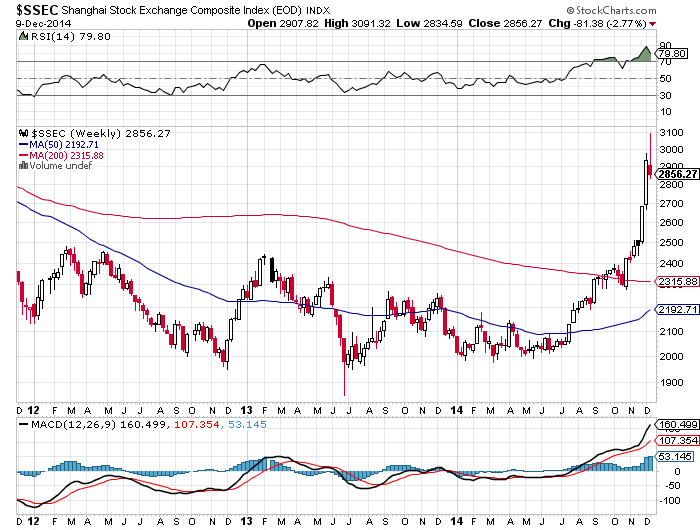
The sell-off in Shanghai yesterday was huge, but necessary. Take a look at the index above. Shanghai have skyrocketed and a drop above five percent is healthy. I can`t hide the truth that Shanghai is the worlds hottest stock market right now.

The Shanghai stock market is up 35% for the year and the correction yesterday is the sharpest correction in five years, led by financials and energy. The Shanghai Index was extremely overbought. The Hang Seng China Enterprises Index of Chinese stocks listed in Hong Kong also fell 4,6 percent.

Investors are optimistic about the prospects for further monetary stimulus to the economy and the valuation to the projected earnings had reached the top and peaked at the highest level since July 2011.

The authorities said the growth target for next year will be 7%, and that`s down from this year`s 7,3%. This is probably one of the triggers for the market correction yesterday, but I don`t think that is enough to alter investors bullish view of the Chinese stock market in the future.

The biggest loser yesterday was financial and energy stocks, but falling oil prices is bad for oil-exporting countries and company stocks around the world, but not for China. Oil-importing countries like China will benefit from the falling oil prices.

Take a look at the technical analysis of both Shanghai and S&P 500. Shanghai peaked in October 12, 2007, at 5,903. Now it is trading just below 3,000, which means this is probably just the beginning of a new bullish trend.  S&P 500 is at the all time high.

Some people see opportunities after a correction like yesterday, but others are full of fear. Shanghai is up 2,93% today.


Disclaimer: The views expressed in this article are those of the author and may not reflect those of Shiny bull. The author has made every effort to ensure accuracy of information provided; however, neither Shiny bull nor the author can guarantee such accuracy. This article is strictly for informational purposes only. It is not a solicitation to make any exchange in precious metal products, commodities, securities or other financial instruments. Shiny bull and the author of this article do not accept culpability for losses and/ or damages arising from the use of this publication.

Leave a comment

Filed under Emerging markets

M&A continues

All sectors was in a red territory yesterday, but only one of them was up. The biggest loser was energy and the winner was the heath care sector. So far in 2014, the biggest loser is the energy sector, while the health care sector is the winner. This is just what I expected it to be in 2014. Read my article titled; health-care bull, dated January 8, 2014.

The takeover boom is not over yet, and 2014 will be the best in many years. Lawyers working with advice on takeovers say they`ve got a robust pipeline of deals in the works. Some of their works is delayed, so December will be busier than usual.

Health care stocks soared in 2014 and next year is shaping up to be another great year for these stocks.

The shares of Cubist Pharmaceuticals Inc rose 35% yesterday, and the reason is that pharmaceutical giant Merck (MRK) want to acquire its smaller peer for $102 per share. Included the debt, the deal is valued at $8,4 billion. This deal will strengthen Merck`s leadership position in the hospital acute care market.

Two of Cubist Pharmaceutical`s three commercial products focus on treating difficult-to-fight infections, and the firm`s reputation has become a «superbug» specialist in a business that has overlooked such infections until fairly recently.

The deal will be financed primarily by the issuance of about $9,5 billion in new debt, and Merck expect the deal to add about $1 billion in annual revenue. Cubist Pharmaceutical`s drugs should become significantly accretive to Merck`s EPS from 2016.

I wrote about M&A activity last year. Read my article titled M&A (merger and acquisition), December 13, 2013. First of all; it is very lucrative for companies to buy now when the interest rates are historically low, and I think this will continue until the Fed makes a jump on the interest rate.

If you look at 2013, the S&P 500 was up about 30%, and that was a good sign of a healthy stock market. Credit markets was also good with higher leverage levels. About 18,000 Private Equity Firms were also looking for liquidity given strong prevailing market conditions, in addition to increased corporate cash and finite-lived private equity capital reserves. All this factors have led to high degree of M&A activity in 2014, but what about 2015?

Predicting the future is risky business, but what are you gonna do if you don`t belive in something?

By tracking global sell-side mandates and deals reaching the due-dilligence phase of a transaction, it is possible to forecast future deal levels. If you look at the deal volume reported by Thomson Reuters, you can indicate future changes in the numbers of announced M&A transactions.

The latest Q3 data this year will forecast Q1 2015, and that suggests sustained momentum in M&A activity through 2015. Deal volume is expected to go up, and hot sectors will be entertainment, media, consumer, manufacturing and telecommunication. The most active sectors are expected to be energy and technology.

A forecast is based on facts today, but as you may know everything can change tomorrow. A change in macroeconomic or political conditions or even a change in the financial markets will change the whole picture and that can happen overnight.


Disclaimer: The views expressed in this article are those of the author and may not reflect those of Shiny bull. The author has made every effort to ensure accuracy of information provided; however, neither Shiny bull nor the author can guarantee such accuracy. This article is strictly for informational purposes only. It is not a solicitation to make any exchange in precious metal products, commodities, securities or other financial instruments. Shiny bull and the author of this article do not accept culpability for losses and/ or damages arising from the use of this publication.

Leave a comment

Filed under Stock market, Stocks

Azul and Virgin America IPO

Azul SA is Brazil`s third-biggest airline after TAM and GOL, founded by David Neelman, who also founded JetBlue Airways Corp (JBLU.O). They may become No. 1 as Azul could offer about 3,000 more seats than their biggest competitors. Azul has a 15,9% market share and is the fastest growing airline in Brazil based on passenger kilometers flown, according to the National Civil Aviation Agency. Azul had $1,64 billion (4,2 billion reais) in revenue for the fist nine months in 2014.

Azul

Neelman left JetBlue Airways Corp in 2008 to launch the Brazilian carrier, which is his fourth airline startup.

David Neelman`s family is American, but he was born in Brazil and has Brazilian citizenship. That`s important, because Brazilian law forbids majority foreign ownership of airlines.

Azul SA revived plans for an IPO in Sao Paulo and New York. According to the U.S SEC filing, Azul plans to list referred shares on the Level 2 chapter of the Sao Paulo Stock Exchange, and American depositary shares on the New York Stock Exchange. It doesn`t say when the IPO will take place.

So far, they expect the IPO will be worth around $1 billion. Neelman owns 67% of voting shares and 4,58% of outstanding preferred shares. The private equity firms TPG Growth, Weston Presidio, Grupo Bozano, and Gàveo Investimentos, which is owned by J.P. Morgan, also own stakes in Azul Airline. The shareholders in Azul may sell an unspecified portion of their shares as part of the offering.

According to Azul`s prospectus, the money raised will be used to finance expansion plans and to pay down debt. They plan to buy 38 Airbus A320neo jets and lease 25 more. They have also begun international service with the first flight connecting Brazil and the U.S. In April, they announced plans to start flights to southern Florida early next year, followed by flights to New York, using a dozen leased wide-body jets, first A330-200 and then A350-900 aircraft.

Azul`s president Antonoaldo Neves said they are going to grow the cake, not steel from their competitors. He also said there`s no reason the market can`t double. Brazil`s airline association has said domestic demand is expected to rise to about 200 million passengers by 2020. That`s up 100%.

The IPO comes during a periode with few Brazilian offerings, as the equity issuance market stagnated this year as the economy slipped into a technical recession in the first half of 2014. The falling petroleum prices is helping airline stocks around the world, so the timing could be good. (Read my article “Airlines hammered”, October 14, 2014).

Sir Richard Branson know that. Delta (DAL) and JetBlue (JBLU) are both up over 50% this year. He`s low-cost airline Virgin America (VA) made an impressive debut on Nasdaq. The stock jumped 30,43% to close at $30 on November 2014. Virgin America raised $307 million through the offering.

Virgin America is the U.S offshoot of Branson`s London-based Virgin Group. Branson, through VX Holdings LP, own 24,8% stake after the IPO. The biggest shareholder with 32,8% is the Hedge fund Cyrus Capital Partners LP.

Virgin America has had a troubled time ever since its launch in 2007, and witnessed profits for the first time in 2013. Third quarter profits climbed about 24% buoyed by an increase in passenger traffic and higher fare rates. Revenue was up 4,7%, totaling $405,5 million.

Take note that Virgin America is the only U.S airline company to have gone public since another low-cost carrier, Spirit Airlines went public in 2011. Can Virgin America win this battle with their Wi-Fi service and comfortable leather seats? Will a hip airline work on Wall Street?

Anyway, it`s gonna be hard for Virgin America to fight with big players like American Airlines, Delta Airlines and United Airlines. It`s not going to be easy for Azul either, but investors will not ignore their growth in the future. Nor Azul and Virgin`s competitors.


Disclaimer: The views expressed in this article are those of the author and may not reflect those of Shiny bull. The author has made every effort to ensure accuracy of information provided; however, neither Shiny bull nor the author can guarantee such accuracy. This article is strictly for informational purposes only. It is not a solicitation to make any exchange in precious metal products, commodities, securities or other financial instruments. Shiny bull and the author of this article do not accept culpability for losses and/ or damages arising from the use of this publication.

Leave a comment

Filed under IPO, Stocks

Cyber Monday Sales – Biggest E-Commerce day ever!

Cyber Monday is a marketing term for the Monday after the Thanksgiving holiday in the U.S. The term «Cyber Monday» was created by marketing companies to persuade people to shop online. It all started on November 28, 2005.

Cyber Monday online sales grew to a record $2,68 billion, compared to last year`s $2,29 billion. However, the average order value was $124, down slightly from last year`s $128.

Online sales on Monday climbed to a new record high, and the sales came in at $2,68 billion, and that is the best online spending day ever. It is also the first to surpass $2 billion in sales.

The weekend after Thanksgiving was popular for online shopping too. The sale was up 26% compared to the same time last year. It seems like this online shopping will continue to post new historical highs, and that reflects the ongoing strength of online shopping.

IBM says that the online sales jumped only 8,5% this year compared to last on Cyber Monday. This is less than last year when online sales jumped more than 20% by its measure.

Some belive it`s a change in shopping behavior and not a lack of consumer demand. It is a larger shift toward online buying as mobile phones spur the practice known as «showrooming». People tend to go to the store to see the products and buy them, or a similar product online. Price is a very important trigger here. Why spend some time to go to the shop if the price is lower online?

Cyber Monday is the busiest U.S online shopping day of the year, and that title is held since 2010. Walmart said it received the most online orders in its history on Cyber Monday. Mobile made up about 70% of the traffic to its website between Thanksgiving and Cyber Monday.

This is called Cyber Monday, so how is the online marketing? Is it working?

Social Media did very little to boost sales this year driving only 1,5% of sales. According to IBM, Facebook referrals drove an average of $109,94 per order compared to $100,24 for Pinterest. Facebook referrals converted online sales at more than twice the rate of Pinterest.

What really works better is e-mail marketing which was the primary driver of sales on both Black Friday and Cyber Monday beating the usual winner; search. Companies sent out 11% fewer e-mails this time, but the e-mails were more targeted.


Disclaimer: The views expressed in this article are those of the author and may not reflect those of Shiny bull. The author has made every effort to ensure accuracy of information provided; however, neither Shiny bull nor the author can guarantee such accuracy. This article is strictly for informational purposes only. It is not a solicitation to make any exchange in precious metal products, commodities, securities or other financial instruments. Shiny bull and the author of this article do not accept culpability for losses and/ or damages arising from the use of this publication.

Leave a comment

Filed under Stocks, Uncategorized