
Category Archives: Stock market

Sell in May and Go Away

«Sell in May and Go Away» is a seasonal market timing strategy based upon the premise that stocks have historically performed better in the Winter months than in the Summer months. The idea of selling in the month of May is rooted in The Halloween Indicator, which points to historically higher returns in the six-month period from November 1 through April 30.

shinybull_for_sitesite-7

Mutual fund investors buys and sells based upon their own unique investment objectives like time horizon, financial goals and risk/reward. Their investment decisions is never made on the basis of patterns.

Their sell strategy is not a type of guessing game that rely more on luck than on skill. They sell in may (if they need to) like any other months, so it’s no different in may than any other months. Historically, the stock market is bad from May 1 to October 31, so some investors are buying in that time frame, because the stock prices are lower.

You shouldn`t listen to investors saying «Sell in May and go away». The popular adage «Sell in May and go away» proved to be wrong this year. It was wrong for Indian stocks as the benchmark Sensex gained a whopping 1,800 point and that is the best monthly gain in recent times.

Indian stocks scaled new record highs in May this year, with the benchmark index Sensex rising above 25,000. It rise on new hopes of economic revival as Narendra Modi became the new Prime Minister.

The 30-scrip Sensex gained 1,799.54 points to end at 24,217.34 in May, breaking the May jinx. Is it always like this in India in May? No, it gained 24,53 points in May last year. In May 2012, the stock market dropped 6%. In 2011 and 2010, the Indian stock market fell about 2,5%.

The BSE Sensex touched a record high on 25,375.63 on May 16 this year. This is the day the results for the general election gave Bharatiya janata Party (BJP) a clear mandate. BJP coming into power with full majority has enthused markets.

BJP and Modi is not the only reason why the Indian markets are in an euphoria. Overseas investors have pumped in about Rs 34,000 core in the stock market in India in May. But how is it in the U.S market right now?

It’s the same. New record highs in both S&P 500 and the DOW. The S&P 500 ended Friday up 3,5 points, to 1923,57. The DOW ended up 19 points, at 16717.17, and this is all time high. S&P 500 ended the month in May up +2,10%, while the DOW was up 0.82% in May.

It was a great month for investors in May, and it seems to be little fear in the market, as the VIX (fear index) is at its lows of the year. I think we can blame the FED for the bull market we see right now. QE is the reason for all this.

Some people do not belive in the Summer months and think it is bad for long-term stock investments. People like this usually sells in May and then wait until the Autumn before they buy stocks again.

This is wrong. The summer offers just as many trading opportunities as the rest of the year. Some professional traders are more active during the summer, because the can take advantage of specific markets that are more actively traded during the summer.

Take a look at the commodities and more specific on summer products like corn and wheat. Products like this is more active during the summer because the agricultural industry is very active, like crops and growing and so on.

To sum up; Stick to your own investment objectives and don`t listen to the media noise out there. The decision to buy or sell is a matter of understanding your own purposes for investing.

Reports today:
08:10 a.m EST Treasury Sec Lew Speaks
10:00 a.m EST ISM Manufacturing PMI

Disclaimer: The views expressed in this article are those of the author and may not reflect those of Shiny bull. The author has made every effort to ensure accuracy of information provided; however, neither Shiny bull nor the author can guarantee such accuracy. This article is strictly for informational purposes only. It is not a solicitation to make any exchange in precious metal products, commodities, securities or other financial instruments. Shiny bull and the author of this article do not accept culpability for losses and/ or damages arising from the use of this publication.


Leave a comment

Filed under Commodities, Stock market

What is a stock split?


You probably know that Google had a stock split a while ago, and now, Apple is headed for the same on June 9. But what is a stock split and is it good or bad for the stockholders? Let`s take a closer look at a stock split and what it is.


A stock split is a corporate action in which a company divides its existing shares into multiple shares. The number of shares outstanding increases by a specific multiple, the total dollar value of the shares remains the same compared to pre-split amounts, because the split did not add any real value.

Apple

The most common split ratio is 2-for-1. This is called «forward stock split», which means that the stockholder will have two shares for every share held earlier. Apple have a 7-for-1 split, but there are number of «groups» impacted by the split.


Let`s take an example: Company A has 10 million shares outstanding and the stock price is $100. The Company A`s market cap is $1 billion. But the board of directors want to split the stock 2-for-1. The new number of stocks will double to 20 million, but the market cap is still $1 billion, as the stock price drops down to $50. Market cap is unchanged.


So, what is the point of doing that? They might have other things to do. Well, first of all, a split is usually undertaken when the stock price is quite high, making it pricey for investors to acquire a standard board lot of 100 shares.


If Company A`s price per share was $100 each, you would need to pay $10,000 to own 100 shares. If the share price was only half of that ($50), then you need to pay $5,000 for 100 shares. Second, the more shares a company have, the greater the liquidity for the stock, which facilitates trading and may narrow the bid-ask spread.


As you can see, the market cap is unchanged, but a split can often results in renewed investor interest, and that can have a positive impact on the stock price. Stock splits in blue chips companies like for example Apple and Google are a great way for the average investor to accumulate an increasing number of shares.


Many of the best companies routinely exceed the price level at which they had previously split their stock, causing them to undergo a stock split yet again. I have been following Amazon.com since its start in late 90`s.


I see three splits in the Amazon.com stock split history database. The first split for Amazon took place on June 02, 1998. This was a classical 2-for-1 split. It means for each share of Amazon owned presplit, you now owned 2 shares. For example; a 1000 share position pre-split, became a 2000 position following the split.


The second Amazon split took place on January 05, 1999. This was a 3-for-1 split. For each share of Amazon owned pre-split, you now owned 3 shares. For example; a 2000 share position pre-split, became a 6000 position following the split.


The third split took place on September 02, 1999. This was a classical 2-for-1 split, meaning for each share of Amazon owned pre-split, you now owned 2 shares. For example; a 6000 share position pre-split, became a 12000 position following the split. I remember all the splits very good.


It was exiting and it was in the beginning of a new era in the tech stock history. Keep in mind that when they split the stocks, the market cap is the same, but the number of stocks is changed, which means you own more shares, but the shares are valued at a lower price per share. Very often, we that a lower price for a stock can attract a wider range of buyers. And here is the interesting thing; when the stock price goes down, the demand for the stock is increasing. This means of course that the market cap will rise which is good for the company.


As always in the stock market; you can`t only look at only one metrics. You have to look at the underlying fundamentals of the business. Looking at the history of Amazon, an original position size of 1000 shares would have turned into 12000 shares today.


Google made its split because they want more control over the company and shares. You have different share classes in Google, and all of them have different prices. You can see Google, Google A and Google C when you search for the stock.


Many investors are wondering if Apple`s split will mark a peak in its shares as both Google and MasterCard declined after its two share classes split. You can`t compare Apple`s split to Google`s split, because of its different share classes, as one of which had no voting rights, so each class really became its own separate trading vehicle.


Right after the split in Google, the shares declined, but that was because of a poor earnings report and not because of the A class shares in Google. I just wonder if Apple will move into the Dow after this split?


Apple has three splits in the Apple stock split history. The first one took place on June 16, 1987. This was a 2-for-1 split. The second split took place on June 21, 2000. Also a 2-for-1 split, and the second split took place in February 28, 2005, with a 2-for-1 split. Apple`s 7-for-1 split is approaching and will take place on June 9, 2014.


Other key dates:


The record date: June 2, 2014 – determines which shareholders are entitled to receive additional shares due to the split.


The split date: June 6, 2014 – shareholders are due split shares after the close of business on this date.


The Ex date: June 9, 2014 – the date determined by Nasdaq when Apple common shares will trade at the new split-adjusted price.


This split means that six additional shares of stock are issued for each share in existence on the Record date, June 2, 2014. The number of shares outstanding will be multiplied by seven and earnings per share will be divided by seven.


Reports today:


08:30 a.m EST Core Durable Goods Orders m/m

08:30 a.m EST Durable Goods Orders m/m

09:00 a.m EST S&P/CS Composite-20 HPI y/y

09:00 a.m EST HPI m/m

09:30 a.m EST ECB President Draghi Speaks

10:00 a.m EST CB Consumer Confidence


Disclaimer: The views expressed in this article are those of the author and may not reflect those of Shiny bull. The author has made every effort to ensure accuracy of information provided; however, neither Shiny bull nor the author can guarantee such accuracy. This article is strictly for informational purposes only. It is not a solicitation to make any exchange in precious metal products, commodities, securities or other financial instruments. Shiny bull and the author of this article do not accept culpability for losses and/ or damages arising from the use of this publication.

 

Leave a comment

Filed under Stock market, Stocks

Interest-rate cut in the Euro Zone


Japan`s Nikkei index rose to a 7-week high today, up +0,97%. Yen retreated against the dollar and a record high for Wall Street helped the Asian stocks on upbeat U.S housing data. The broader Topix advanced 1,2% to 1,194,69.


European stocks are also up today, helped by Italy`s Prime Minister Matteo Renzi. FTSE MIB outperform after Italy`s Prime Minister`s centre-left Democratic Party`s reform were endorsed by a strong showing in European elections.

ECB

A big surprise for many nervous «Sell in may and go away»-investors on friday. The U.S indices increased with the DOW up +0,38% to 16,606,27, Nasdaq +0,76% to 4,185,81, and S&P 500 +0,42% to 1,900,53.


ECB`s President Mario Draghi says the policy makers are watching the market closely and once they see low inflation they will be ready to take some action. Draghi said they are looking for a negative spiral to take hold between low inflation, falling inflation expectations and credit.


«We are not resigned to allowing inflation to remain too low for too long», Draghi said today. He is trying to guide the euro area through a fragile economic recovery that remains threatened by subdued pricing power.


Next ECB meeting is June 5 and they are now working on a package including interest-rate cuts and liquidity injections. Many investors will wait for the next ECB meeting and the lower the interest-rate is, the bigger the problem in the economy is. You are tough if you buy stocks now.


Reports today:


04:00 a.m EST ECB President Draghi Speaks

All Day Bank holiday


Disclaimer: The views expressed in this article are those of the author and may not reflect those of Shiny bull. The author has made every effort to ensure accuracy of information provided; however, neither Shiny bull nor the author can guarantee such accuracy. This article is strictly for informational purposes only. It is not a solicitation to make any exchange in precious metal products, commodities, securities or other financial instruments. Shiny bull and the author of this article do not accept culpability for losses and/ or damages arising from the use of this publication.


Leave a comment

Filed under Quantitative Easing, Stock market

Inflation and interest rate

What a rally in Asia today! Japan`s Nikkei is up +2,11% to 14,338. Hang Seng is up +0,51% and ASX 200 is up +1,02%. It was a great rally in the U.S yesterday too. The Dow was up +0,97%, S&P 500 +0,81% and Nasdaq +0,85%. Great!

Why this rally now? The investors like the good news from China. The China manufacturing data is good, and that will have a positive impact on Europe. The message from the Fed minutes is also good. They say that there will be no rate increase soon.

Asian stocks rose to set for the biggest gain in three months, after minutes showed Federal Reserve policy makers see muted risk of inflation from continued U.S stimulus. Fed`s policy makers said continued stimulus to push unemployment lower doesn`t risk sparking an undesirable jump in the inflation rate.

money2

Policy makers are watching progress toward their goal of full employment as they consider the timing of the first interest-rate increase since 2006. The Fed has said the benchmark rate will stay low for a «considerabe time». They ended its bond-purchase program that set to wind down by late this year.

The Fed have earlier said that they will keep the interest rate low at least as long as the jobless rate is below 6,5% and the outlook for inflation didn`t exceed 2,5%. Is that really possible? Let`s take a look at Japan. They have printed more money than U.S.

Japan`s inflation peaked out in the middle of the 70`s, but the real problems started in 1989. Japan`s Nikkei Index hit its all time high on December 29, 1989, during the peak of the Japanese asset price bubble. It reached an intra-day high of 38,957 before closing at 38,915,87.

700px-Nikkei_225(1970-).svg

(Picture: Japan`s Nikkei Index)

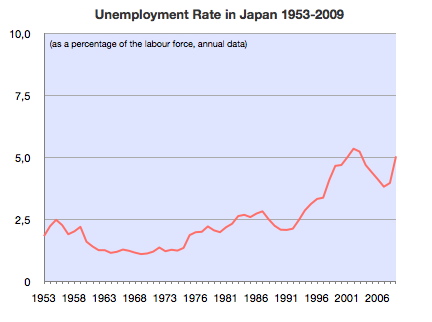
The bubble burst, and the Nikkei stock index plummeted and lost nearly all these gains, closing at 7,054,98 on March 10, 2009. That is 81,9% below its peak twenty years earlier. The unemployment rate increased, but stopped at 5%. Now, Japan`s unemployment is down to 3,6% (April, 2014).

Unemployment_Rate_of_Japan_1953-2009

(Picture: Unemployment rate in Japan 1953 – 2009)


Japan`s inflation rate is stable, and that is strange. Normally when you print a lot of money, inflation rate are increasing and it becomes extremely difficult to reduce it. If you look at the Japan`s inflation rate, it is stable.

The inflation rate in Japan was recorded at 1,60% in March of 2014. It had an all time high of 25% in February of 1976, and a record low of -2,52% in October of 2009. Japan`s inflation rate is in black on the picture below:

japan-inflation-cpi and US inflation compared

(Picture: Japan and U.S inflation rate – compared)


The most important categories in the CPI (Consumer Price Index) are Food (25% of total weight). Housing (21%), Transport and communications accounts for 14%. Culture and recreation (11,5%), Fuel, light and water charges for 7%. Medical care (4,3%), clothes and footwear (4%), Furniture and household utensils, Education and Miscellaneous goods and services account for the remaining.

Central banks around the world will try to sustain an inflation rate of 2 – 3%. The purchasing power is falling if the prices of goods and services is rising. Central banks attempt to stop severe inflation, along with severe deflation. They will keep the excessive growth of prices to a minimum. Inflation plays a large role in the Fed`s decisions regarding interest rates.

So far so good!


Reports today:

08:30 a.m EST unemployment Claims
09:45 a.m EST Flash manufacturing PMI
10:00 a.m EST Existing Home Sales


Disclaimer: The views expressed in this article are those of the author and may not reflect those of Shiny bull. The author has made every effort to ensure accuracy of information provided; however, neither Shiny bull nor the author can guarantee such accuracy. This article is strictly for informational purposes only. It is not a solicitation to make any exchange in precious metal products, commodities, securities or other financial instruments. Shiny bull and the author of this article do not accept culpability for losses and/ or damages arising from the use of this publication.
Leave a comment

Filed under Emerging markets, Quantitative Easing, Stock market

Mobile ad opportunity

Vodafone`s (VOD) FY EBITDA dropped 5,4%. Their revenue also slipped 1,9% to £43,6 billion. Net profit attributable to shareholders soared to £59,25 billion from £413 million in 2013, boosted by the sale of their 45% stake in Verizone Wireless for $130 billion.

Vodafone logo

Organic service revenue declined 3,8% in Q4. Adjusted operating profit dropped 37% to £7,67 billion, mainly due to a much lower contribution from Verizone Wireless before it was sold. Vodafone expects FY 2015 EBITDA to drop to £11,5 billion.

CEO Vittorio Colao say Vodafone`s emerging markets businesses have performed strongly. In Europe, the company continues to face competitive. Vodafone declared a final dividend of 7,47 pence a share, giving total dividends of 11 pence, up 8%.

Vodafone is the world`s second-largest mobile network operator and the Pan-European FTSEurofirst 300 Indes slipped today as Vodafone fell 4% after reporting huge impairment costs. Vodafone was the biggest faller on the FTSEurofirst 300 today.

The underlying profit continuing to move in the wrong direction and it seems to be very expensive to be in this competitive markets. AT&T bought Direct-TV to diversify and continue to grow its business.

100px-AT&T_logo.svg

This makes AT&T strong, and Verizone, Sprint and T-Mobile should watch out, as AT&T has more leverage right now. Direct TV`s coverage map can reach 99% of households. Their mentions that cost savings will exceed $1,6 billion.

AT&T now have the ability to price itself lower than other competitors. AT&T`s CEO belive the deal will go through regulators in light of recent trends in telecom and communications. AT&T bought out Direct TV for $95 per share ($48,5 billion).

It`s probably better to be on the other side. Facebook are earning money on their direct ad mobile advertising. Now, Yahoo have the ability to do the same as Facebook. Yahoo is down -16,2% so far in 2014.

y_mobile

The Alibaba IPO can give Yahoo a huge opportunity as they have a potential in Yahoo`s mobile advertising. They can acquire mobile advertising firms like Millennial Media or AOL. This is what made Facebook a big growth company.

Yahoo have Yahoo Weather, Yahoo Finance and Tumblr. They have about 360 million global users and this amount of users can make Yahoo grow with a new mobile ad platform. Yahoo have the ability to buy Millennial Media cheap.

Anyway; Yahoo`s stake in Alibaba will give them a lot of cash, and you all know that Cash is King! Money is just a piece of paper. It ain`t worth something. Just the thing you can buy with the cash. So what is money? It`s just tools, and you need the tools to reach your goals.

Yahoo have a huge opportunity during the Alibaba IPO, and they can be a great growth company if they are doing the right things now. Yahoo have been on the market for a long time, and money will not be the biggest problem for them now. They need a great idea. Mobile ads can be one of them.

Read my article about Ymobile on March 28, 2014.

Reports today:
08:30 a.m EST FOMC Member Plosser speaks
08:30 a.m EST FOMC Member Dudley speaks

 
Disclaimer: The views expressed in this article are those of the author and may not reflect those of Shiny bull. The author has made every effort to ensure accuracy of information provided; however, neither Shiny bull nor the author can guarantee such accuracy. This article is strictly for informational purposes only. It is not a solicitation to make any exchange in precious metal products, commodities, securities or other financial instruments. Shiny bull and the author of this article do not accept culpability for losses and/ or damages arising from the use of this publication.

Leave a comment

Filed under Stock market, Stocks