Category Archives: Politics

The FED`s “Adverse Scenario” and the major shift in the economy

The stock market has been in a euphoric rally since Donald Trump won the election in November last year. This is something that Janet Yellen and the FED has monitored. Not only that. They also monitored strong economic data which have strengthened the case for a rate hike.

As you may know, the FED raised the rates a few days ago, and normally after a rate hike, the stock market drops. Thats the case right now, but the market didnt fall much. Janet Yellen said the FED will continue to raise the rates. What will happen then?

The FED came out with Scenarios for annual stress test required under the Dodd-Frank Act Stress Testing Rules and the Capital Plan Rule on February 10, 2017. It is just a forecast; an Armageddon forecast, which is called «Adverse Scenario» Report, and the scenarios are not forecasts of the FED.

The adverse and severely adverse scenarios describe hypothetical sets of conditions designed to assess the strength of banking organizations and their resilience to adverse economic environments. The baseline scenario follows a profile similar to the average projections from a survey of economic forecasters.

We must be prepared for higher long-term interest rates. What is that suppose to mean? First of all; that is good for banks with retail customers, simply because retail customers usually have checking accounts with zero interest on them.

So, if the rates rise, the spread in the banks rise simply because the banks will make more on their lending. About 2,000 banks has disappeared the last seven years, which means the competition among the rest is not that big anymore.

We can also see a steeper yield curve and regionally concentrated episodes of deflation. More pronounced in Japan, but less severe in the Euro zone and Asia and absent in the UK and US.

This is the major shifts we will see in the FED`s «Adverse Scenario» for 2017, and U.S banks will be stress-tested again. The apocalyptic scenario means that the level of U.S real GDP will decline in the first quarter of this year.

The US economy advanced an annualized 1,9 percent on quarter in the three months of 2016, slowing from a 3,5 percent growth in the previous period and matching earlier estimates. Consumer spending rose faster than anticipated while business investment was revised lower. Last year, the GDP expanded 1,6 percent, which is the lowest since 2011.

Check out next GDP number at 2017-03-30 at 12:30 PM.

In the scenario, the unemployment rate increases to 10 percent, by the third quarter of 2018, and short-term treasury rates fall and remain near zero. House prices will also decline by about 25 – 35 percent, through the first quarter of 2019, and so will equity prices.

In the same scenario, we will se a slowdown in Asia, severe recessions and the dollar will appreciate against euro, the pound sterling and the currencies of developing Asia.

I think the next big think to look at now is the election in France. If Le Pen and the populist wins, it can turn things upside down, and start a new international crisis. Until then, trade in small caps are profitable when rates rise, and higher rates doesn`t stop tech stocks like Alphabet, Apple and Amazon from surging. This is the bull market that everyone hates.


Disclaimer: The views expressed in this article are those of the author and may not reflect those of Shiny bull. The author has made every effort to ensure accuracy of information provided; however, neither Shiny bull nor the author can guarantee such accuracy. This article is strictly for informational purposes only. It is not a solicitation to make any exchange in precious metal products, commodities, securities or other financial instruments. Shiny bull and the author of this article do not accept culpability for losses and/ or damages arising from the use of this publication.
Leave a comment

Filed under Politics, Stock market

Hyper inflation of 231,150,888,87 percent in July

Janet Yellen and the FED raised the rates and its expected to see them raise the rates at least a couple of times before the end of this year. In addition; they are planning to raise the rates three times next year. Wow. What about the inflation? Let`s take a look at Japan, Venezuela and Zimbabwe.

Nikkei reach its all-time high on December 29th 1989. The stock market plummeted and did never come back. Japan started to grow after world war II and was among the first in the world to use robots in the 70s and 80s.

Japan used robots especially in the auto and techno industry. The optimism went to be a huge euphoria og Nikkei reached 38.957.44 and ended the day at 38.915.87 on December 29th 1989. As you may know; Japan started to «print» money. But what happened to the inflation?

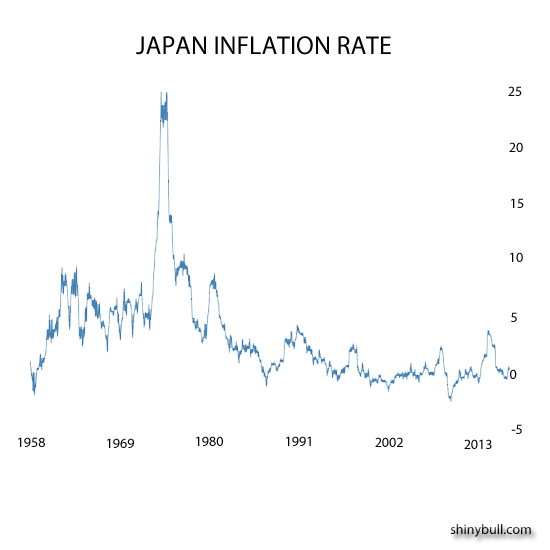
As you can see from the chart above, Japans inflation increased the early 90s and then it started to decline again. You can see from the chart that it went up again in the late 90`s, but not for a long time. It drops every time it goes up.

Consumer prices increased 0,4 percent YoY in January this year. Transportation cost posted the first annual gain since March of 2015 and prices went up faster for clothing and footwear and recreation and culture.

Inflation rate reached an all-time high of 24,9 percent in February of 1974 and a record low of -2,5 percent in October of 2009. It`s a different and more scary story in Venezuela.

It`s not getting better in Venezuela and it goes from bad to extremely bad right now. What in the world is going on? Venezuela has the highest inflation rate in the world right now. Economic turmoil in Venezuela has made the bolivar go straight up to heaven.

Some analysts say it could reach 2000 percent in 2017. No, I`m not kidding; 2000 percent. President Nicolàs Maduro who is elected after the death of socialist firebrand Hugo Chàvez explained the shock move by accusing US-backed «mafias» of conspiring to destabilize his country’s economy by hoarding bank notes.

Take a good look at the chart above. Consumer prices in Venezuela jumped 800 percent YoY in 2016, following a 180,9 percent rise in 2015. It is the highest inflation rate on record after the slump in oil prices led to a severe recession and food shortages.

Venezuela reached an all-time high of 800 percent in December of 2016 and a record low of 3,22 percent in February of 1973. You think 800 percent is much? Take a look at Zimbabwe.

The worst of the inflation occurred in 2008, leading to the abandonment of the currency. The peak month of hyperinflation occurred in mid-November 2008 with a rate estimated at 79,600,000% per month. That is what I call hyper-inflation.

This resulted in US$1 becoming equivalent to the staggering sum of Z$2,621,228. The rate went up 585,84 percent in 2005. 1,281,11 percent in 2006 and 66,212,3 percent in 2007. And then it exploded; Up 231,150,888,87 percent in July of 2008. Wow.

Hyper-inflation like that mean that the price can jump when you are sitting on the bus. That can be problematic for some customers but also for business owners.

Any Zimbabwean dollars acquired needed to be exchanged for foreign currency on the parallel market immediately, or the holder would suffer a significant loss of value.

For example, a mini-bus driver charged riders in Zimbabwean dollars, but different rates throughout the day. The evening commute was highest-priced. He sometimes exchanged money three times a day, not in banks but in back office rooms and parking lots.

Lack of confidence in government to practice fiscal restraint feeds on itself. In Zimbabwe, neither the issuance of banknotes of higher denominations nor proclamation of new currency regimes led holders of the currency to expect that the new money would be more stable than the old.

Remedies announced by the government never included a believable basis for monetary stability. Thus, one reason the currency continued to lose value, causing hyperinflation, is that so many people expected it to.

What about a hyper-inflation in the U.S? Is it possible? What can go wrong, and what will happen? I will write more about that later on this week.


Disclaimer: The views expressed in this article are those of the author and may not reflect those of Shiny bull. The author has made every effort to ensure accuracy of information provided; however, neither Shiny bull nor the author can guarantee such accuracy. This article is strictly for informational purposes only. It is not a solicitation to make any exchange in precious metal products, commodities, securities or other financial instruments. Shiny bull and the author of this article do not accept culpability for losses and/ or damages arising from the use of this publication.

Leave a comment

Filed under Politics, Stock market

The Ides of March and the European Union

Dont forget March 15, and what happened 44 BC. The founder of the Roman Republic, Julius Caesar was assassinated and killed by members of the Roman Senate. It is the worlds most famous political murders.

The problem was that they didn`t know what to do after Caesars death, so they went from a republican system of government and became an empire. This is actual today. The democracy is under attack.


It should be understood that the Optimate and the Populare were not political parties in conflict with each other but, rather, political ideologies which many people shifted toward and from, regardless of class in society.

Caesar was assassinated by a group of rebellious senators, and a new civil war broke out. The constitutional government of the Republic was never fully restored, and the Roman Empire began. Rome finally became an empire at the end of the 1th century BC.

British historian Edward Gibbon argued in The History of the Decline and Fall of the Roman Empire» (1776) that the Romans had become decadent, they had lost civic virtue.

Glen W. Bowersock has remarked; “We have been obsessed with the fall: it has been valued as an archetype for every perceived decline, and, hence, as a symbol for our own fears.” It remains one of the greatest historical questions, and has a tradition rich in scholarly interest.

Europe has since the fall of Rome been, not only Euro Zone, but Danger Zone. Are you able to count all the wars in Europe since the fall of Rome? I wrote about the Revolution of 1848 on May 6th last year. We now see many similarities in Europe today.

The Revolution of 1848 was also known as the Spring of Nations or Springtime of the Peoples. It was a series of political upheavals throughout Europe in 1848. It remains the most widespread revolutionary wave in European history.

The revolution was essentially democratic in nature, with the aim of removing the old feudal structure and creating independent national states. Over 50 countries were affected, and important factors were widespread dissatisfaction with political leadership and the upspring of nationalism to name a few.

Now, it is 2017, and many of the same things going on. Political turmoil, Populism and Nationalism.

Britain voted to leave the European Union last summer, and Netherland can be the next country to follow. But how?

The blond populist Geert Wilders must win the election in Netherland. He is the anti-Islam leader of the Dutch far-right Party for Freedom (PVV) and he is riding high on a wave of populism. Geert Wilders has pledged to close the Netherlands’ borders, shut down mosques and leave the euro and EU if he gets into power.

Wilder`s problem is that no one is willing to form a coalition with him, and that will result in a political mess after the election. There are very few, if any parties, that will go into Parliament with him.

A triumph for Wilders would emboden French voters to back far-right Presidential candidate Marine Le Penn in elections beginning next month. Le Penn will also withdraw France from the Eurozone, and that would be a big threat to the euro.

Latest polls tell us that Mark Rutte will win and Wilders will get about 19 out of 150 seats in Netherland. In France, Le Penn leads the first poll, but she is widely expected to lose in the second round.

We are living in a critical moment right now.


Disclaimer: The views expressed in this article are those of the author and may not reflect those of Shiny bull. The author has made every effort to ensure accuracy of information provided; however, neither Shiny bull nor the author can guarantee such accuracy. This article is strictly for informational purposes only. It is not a solicitation to make any exchange in precious metal products, commodities, securities or other financial instruments. Shiny bull and the author of this article do not accept culpability for losses and/ or damages arising from the use of this publication.

Leave a comment

Filed under Politics

Banks are in focus this week and ECB could change its forward guidance

The FED is expected to increase the short-term interest rate by 25 basis points this week. If the FED does not raise rates at he March FOMC meeting, it will be a big surprise for many investors. Two things to look for is unemployment and inflation.

The FED is not the only one to have a look at the rates this month. BOJ and ECB is also looking at the rate. All this is headed for an exiting week.


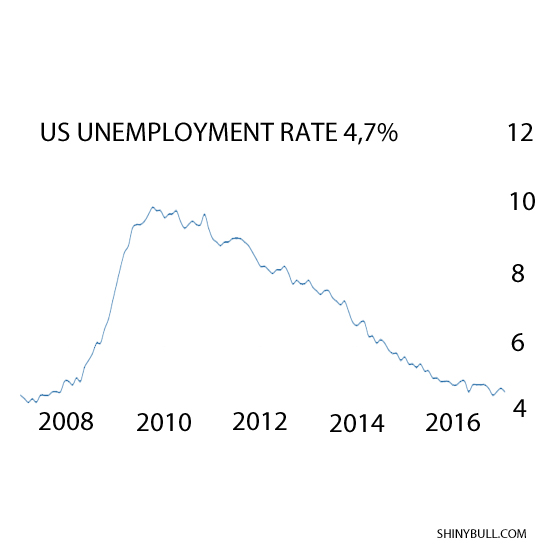
The U.S unemployment rate fell to 4,7 percent last month which is in line with market expectations. Labor force participation rate increased by 0,1 percentage point to 63 percent, and the number of unemployment persons was almost unchanged at 7,5 million.

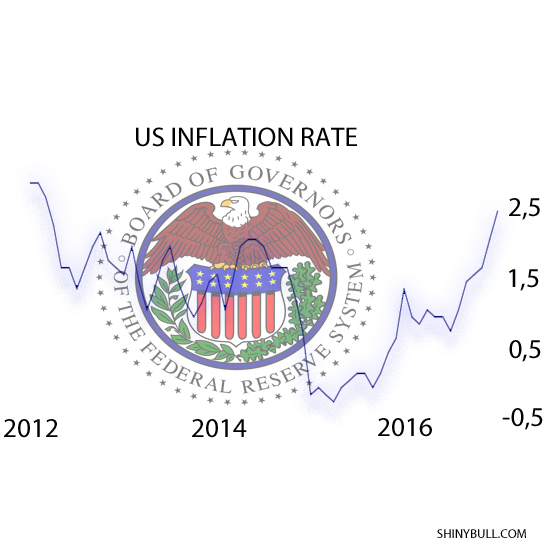
Inflation rate is at near 5-year high of 2,5 percent, which is the highest since March of 2012. The inflation rate accelerated for the sixth consecutive month, mainly boosted by gasoline prices. Energy prices jumped 10,8 percent YoY and food prices declined 0,2 percent.


Watch out for inflation in February 2017 on Wednesday 15 at 12:30 PM. forecast is 2,5%.

Mario Draghi and ECB discussed whether rates can rise before QE ends. A big surprise for many analysts. Why are they doing that? The fact is that they are not satisfied with negative interest rates. This negative rates is squeezing banks’ profit margins because they are not matching the cost, and that will make if difficult for banks to lend to households and companies.

BNP Paribas has predicted the deposit rate will be increased this September, and QE is intended to run until at least the end of 2017. Some people said at least mid-2018. Anyway; analysts will scrutinize the ECB statement on Thursday to look for any changes.

BOJ will have an Interest rate decision on Thursday 16th at 03:00 AM. Forecast is -0,1 percent, which is the same as its January 2017 meeting. In January, policymakers also decided to maintain its 10-years government bond yield target around zero percent.

Economic growth forecast is 1,5 percent for 2017 fiscal year from an earlier projection of a 1,3 percent growth.

Banks are in focus this week and ECB could change its forward guidance.


trump100_b


Disclaimer: The views expressed in this article are those of the author and may not reflect those of Shiny bull. The author has made every effort to ensure accuracy of information provided; however, neither Shiny bull nor the author can guarantee such accuracy. This article is strictly for informational purposes only. It is not a solicitation to make any exchange in precious metal products, commodities, securities or other financial instruments. Shiny bull and the author of this article do not accept culpability for losses and/ or damages arising from the use of this publication.

Leave a comment

Filed under Politics, Quantitative Easing

FOMC will evaluate whether employment and inflation are continuing to evolve in line with their expectations

What a Trump rally. The market has added $3 trillion in value since his election during the congressional address. It`s strange to see the stock market go straight up while MSM is looking in the opposite direction.

The investor sentiment has not been this high since 1987. Consumer Confidence climbed to the highest level since 2001, and all this is good news for the economy. People have been in “heaven” since the Nov 8 election of Donald Trump.

What about Fed Chair Janet Yellen? Is a rate hike on the table?


Consumer confidence is important because people`s spending accounts for about 70 percent of the U.S economic activity. The Commerce Department reported that the U.S economy grew at a sluggish 1,9 percent from October through December. Consumer spending expanded 3 percent annual rate.

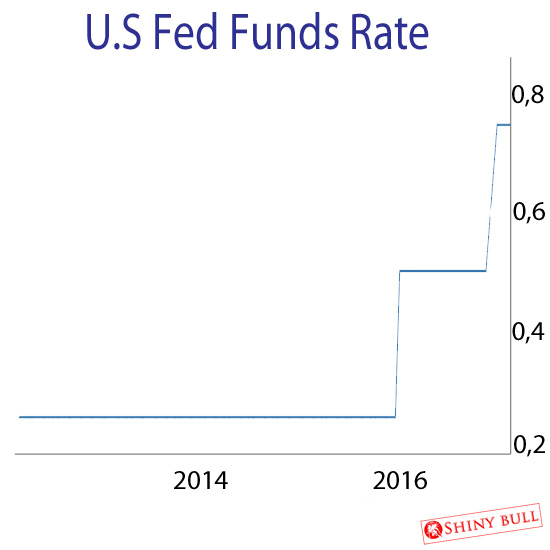
The Fed kept the target range for its federal funds steady at 0,5 percent to 0,75 percent during its February 2017 meeting. It was in line with market expectations and following a 25bps hike in December.

Interest Rate in the United States saw a record low of 0,25 percent in December of 2008, but reached an all-time high of 20 percent in March of 1980.

Two things will be very important for Fed Chair Janet Yellen at the March meeting: employment and inflation.

The recovery since the adverse shocks in recent years are now looking good, and economic developments since mid-2016 have reinforced the Committee`s confidence and on the way to reach their goals.

The unemployment rate came in at 4,8 percent in January, so the job gains is quite solid, and in line with the median FOMC participants’ estimates of its longer-run normal level. The committee currently accesses that the risk to the outlook are roughly balanced.

The job market is strong and inflation is rising toward Yellen`s target. The median assessment of FOMC participants as of last December was that a cumulative 3/4 percentage point increase in the target range for the federal funds rate would likely be appropriate over the course of this year.

In light of current economic conditions, such an increase would be consistent with the Committee`s expectations that it will raise the target range for the federal funds rate at a gradual pace and would bring the real federal funds rate close to some estimates of this current neutral level.

Janet Yellen will increase the federal funds rate based on the economic date that comes in, and the committee will evaluate whether employment and inflation are continuing to evolve in line with their expectations.

I don`t think Monetary policy is sustainable in the long run. Therefore; we will probably see a shift from monetary to fiscal policy. Say goodby to Yellen and hello to Trump.


trump100_b


Disclaimer: The views expressed in this article are those of the author and may not reflect those of Shiny bull. The author has made every effort to ensure accuracy of information provided; however, neither Shiny bull nor the author can guarantee such accuracy. This article is strictly for informational purposes only. It is not a solicitation to make any exchange in precious metal products, commodities, securities or other financial instruments. Shiny bull and the author of this article do not accept culpability for losses and/ or damages arising from the use of this publication.
Leave a comment

Filed under Politics