Category Archives: Emerging markets

Outrageous Predictions 2016

It`s time for some predictions for 2016, and Saxo Bank is out with their own predictions and they are outrageous. “Outrageous Predictions” are “Outrageous Predictions”. Very bold. They are outrageous, expecting next year’s El Niño to be the strongest ever. Oil making a drastic return to $100 a barrel, and EURUSD to skyrocket back to 1,23 to name a few.

Steen Jakobsen, Chief Economist at Saxo Bank, commented: “We are nearing the end of the paradigm paralysis that has dominated the policy response to the global financial crisis. Quantitative easing and other forms of intervention have failed. China is transitioning, and geopolitical tensions are as complex as ever. The marginal cost of money is rising, and so is volatility and uncertainty. It is against this backdrop we have set this year’s predictions.”


Predictions 2016
Saxo Bank’s Outrageous Predictions 2016

  1. EURUSD direction? It’s 1.23…
    Europe is running a massive current account surplus and its weaker inflation should, in macroeconomic logic, mean a stronger currency, not a weaker one. The race to the bottom has gone full circle, meaning we are back to a weaker US dollar again as the direct outcome of US interest rates policy.
  2. Russia’s rouble rises 20% by end-2016
    By the end of 2016, a surge in oil demand and the Fed raising rates at an inappropriately slow pace causes the Russian rouble to rise some 20% versus the US dollar/euro basket in 2016.
  3. Silicon Valley’s unicorns brought back down to earth
    2016 will resemble 2000 in Silicon Valley with more startups delaying monetization and tangible business models in exchange for adding users and trying to achieve critical mass.
  4. Olympics to turbo-charge EM’s Brazil-led recovery
    Stabilisation, investment spending on the Olympics, and modest reforms will see sentiment rebound in Brazil, with EM exports helped by cheaper local currencies. The result: EM equities to have a great year – outperforming bonds and other equities.
  5. Democrats retain presidency, retake Congress in 2016 landslide
    The Republican Party goes from strength to dramatic weakness as the rifts from an internal struggle on its future direction play out. This leads to a landslide victory for the Democratic Party as they successfully execute a get-out-the-vote campaign with Millennials coming out in droves having been frustrated by the political stalemate and weak job prospects of the last eight years.
  6. OPEC turmoil triggers brief return to $100/b oil
    OPEC’s crude oil basket price drops to the lowest since 2009 and unease among weaker as well as wealthier members of the cartel over the supply-and-rule strategy continues to grow. The long-awaited sign of an accelerated slowdown in non-OPEC production finally begins to flicker. Suitably buoyed, OPEC catches the market on the hop with a downward adjustment in output. The price mounts a quick recovery with investors scrambling to re-enter the market to the long side – once again bringing $100/barrel prices onto the horizon.
  7. Silver breaks golden shackles to rally 33%
    2016 will see a renewed confidence in silver. The political drive towards reducing carbon dioxide emissions by supporting renewable energy will add to increased industrial demand for the metal, given its use in solar cells. As such, silver will rally by a third, leaving other metals behind.
  8. Aggressive Fed sees meltdown in global corporate bonds
    Late 2016 will see Fed chief Janet Yellen embark down a hawkish path with a series of aggressive rate hikes, triggering a huge selloff in all major bond markets as yields start to rise. As the portions of bank and broker balance sheets allotted to bond trading and market making have almost disappeared, one of the vital parts of a functioning market is simply not there. This realisation sinks in too late and the entire buy-side flee into a panic selling one-way street, as highly advanced risk models lurch into a symmetric red alert.
  9. El Niño sparks inflation surge
    Next year’s El Niño will be the strongest on record and will cause moisture deficits in many areas of southeast Asia and droughts in Australia. Lower yields across agricultural commodities will curb supply at a time when demand is still increasing on the back of global economic expansion. The outcome will be a 40% surge in the Bloomberg Agriculture Spot Index, adding some much-needed inflationary pressure.
  10. Inequality has last laugh on luxury
    Faced with rising inequality and unemployment of over 10%, Europe is considering the introduction of a basic universal income to ensure that all citizens can afford to meet their basic needs. In a more egalitarian society where other values are promoted, demand for luxury goods decreases sharply – the sector collapses.


shinybull_site_logo-7

Disclaimer: The views expressed in this article are those of the author and may not reflect those of Shiny bull. The author has made every effort to ensure accuracy of information provided; however, neither Shiny bull nor the author can guarantee such accuracy. This article is strictly for informational purposes only. It is not a solicitation to make any exchange in precious metal products, commodities, securities or other financial instruments. Shiny bull and the author of this article do not accept culpability for losses and/ or damages arising from the use of this publication. UA-63539824-1.

Leave a comment

Filed under Commodities, Emerging markets, Stock market

Will the Fed raise rates on Thursday?

Do you belive the Fed will hike on Thursday?

If so, you are among economists and strategists that belive so, but traders are betting strongly against it, and that alone is enough to wait at least one month before liftoff, according to Morgan Stanley.

CME FedWatch tool says the probability is at just 21 percent, and Morgan Stanley said its readings on trading show a 30 percent probability that «overstated the chance» of a rate rise.

Lessons learned in 1994 that reverberated into 1999 and 2004 will prelude a rate hike until the futures market prices one in. In 1999 and 2004, the central bank waited for market expectations to exceed 50 percent before moving, learning a lesson from 1994 when it tightened.

CNBC said there is one good reason the Federal Reserve won`t vote to raise interest rates, and that`s History. So, what is all this about?

percentage

Rates have been near zero since the recession, and the Fed have delayed its first-rate hike since 2006. But why is the interest rate so low? See it like this; The lower the rates, the more problems it is in the economy.

When the economy is strong and everything is okay, interest rates are hiked in order to curb inflation, but when we face tough times, the Fed will cut rates to encourage lending and inject money into the economy.

Investors can predict what the Fed (or other central banks) will do by looking at economic indicators such as;

Retail Sales: Consumer spending
The Consumer Price Index (CPI): Inflation, and
Non-farm Payrolls: Employment levels

If these indicators improve and the economy is doing well, rates will be raised, but if the improvement is small, it will be maintained. Drops in these indicators can mean a rate cut in order to encourage borrowing.

Other indicators to foreshadow changes in the economy is building permits, average weekly hours, new orders and the spread between 10-year Treasuries and the Federal Funds Rate, which is published every month by The Conference Board.

Raising rates will have an impact on the markets. Raising interest rates will cause the dollar to appreciate over the Euro, which means the pair EUR/USD will decline, which is good for the U.S dollar.

If Chairwoman Janet Yellen sends out a dowish signal on Thursday, it may help to boost stocks and undermine the dollar. Investors will pay less attention to gold and allocate more of their capital into equities.

A hawkish message, including a rate increase, may help unpin the dollar and undermine stocks and gold. So, the upside will be limited for gold in both scenarios, unless we see a massive selloff in equities and the dollar.

Changes in monetary policy will ultimately cause currency exchange rates to change, and paying close attention to the news and analyzing the actions of the Fed (in this case) is vital for forex traders.

The interest rates impact currencies because the greater the rate of return, the greater the interest accrued on currency invested and the higher the profit. So how can you profit on it? The strategy is very simple, but also very risky. You can simply borrow currencies with a lower interest rate in order to buy currencies that have a higher interest rate, and this strategy is known as carry trade.

The shift in interest rate represent a monetary policy-based response as a result of economic indicators that assess the health of the economy. Most importantly; they possess the power to move the market immediately. So, how healthy is the U.S economy?

Nonfarm Payrolls is up: 215K
May, June Revisions: 14K
Unemployment Rate: 5,3%
Avg. Hourly Wages: 0,2%
Labor Force Participation: 62,6%
Consumer Price Index: -0,1%

A key measure of inflation dropped 0,1% last month for the first time since January due to sliding gasoline costs, and this is something for the FOMC (Federal Open Market Committee) on its policy meeting Wednesday and Thursday this week.

Central bank leaders have said they want to be confident inflation is heading toward their 2 percent target. Low inflation is a sign of economic weakness, and raising rates too soon risks harming the economic expansion.

IMF (International Monetary Fund) and the World Bank have asked the Fed to delay its first-rate hike since 2006.

The world`s financial watchdog is the BIS (the Bank of International Settlement) and are considered the «bank of central banks». BIS has warned that a Fed rate hike could have a huge effect on the global economy and particularly in emerging markets.

According to a BIS report, much of the global financial system remains anchored to U.S borrowing rates, and a rate hike at home tends to have an impact on higher rates in other economies. The enormous amount of debt in the emerging markets has the potential to move the markets even with a small rate hike.

Everybody knows that sooner or later, a rate hike might be necessary. No matter the results in the financial markets will be. Some belive the Fed will hold off on raising rates until December.

I really look forward to Janet Yellen`s speech on Thursday at 2 p.m. Washington time.


shinybull_site_logo-7


Click the link below and check out the Fan Fund

https://www.eventbrite.com/e/fan-fund-tickets-15580655159


Disclaimer: The views expressed in this article are those of the author and may not reflect those of Shiny bull. The author has made every effort to ensure accuracy of information provided; however, neither Shiny bull nor the author can guarantee such accuracy. This article is strictly for informational purposes only. It is not a solicitation to make any exchange in precious metal products, commodities, securities or other financial instruments. Shiny bull and the author of this article do not accept culpability for losses and/ or damages arising from the use of this publication. UA-63539824-1.

Leave a comment

Filed under Commodities, Emerging markets, Politics, Stock market

When will China be the world`s largest economy?

The U.S is still the largest economy in the world, followed by China. But China is growing much faster than the U.S, and China`s GDP will grow twice as much as its size today and much faster than the U.S.

China will close its gap with the U.S by 2030.

Largest economies in 2030

Not only the U.S will be far less dominant, but some of the largest European economies will also lose to several emerging markets that will skyrocket into the new economic order. This is what we will see in the next fifteen year, according to the U.S Department of Agriculture.

As you can see from the chart above, the gray bar represents the $16,8 trillion gross domestic product projected for 2015. The green bar show you how much bigger the economy is expected to be the next fifteen years.

China and India will grow fast. India is raked eights this year but India will climb past Brazil, France, Germany, Japan and the U.K. according to IMF (International Monetary Fund), India will have the largest workforce in the world within the next fifteen years.

Take a look at Japan.

Despite their QE programs in Japan, they will not grow much the next fifteen years, and that will push the country down on this ranking list made by USDA which is only estimates. It`s interesting to see because Japan was so big until the bubble burst in the early 1990`s.

So, Japan will not be the growth story the next decade, but where is the growth in addition to China and India? Africa is looking great, and Uganda are among the best. They will climb 18 spots and will be ranked at 91.

The fastest growing countries in the world right now is China, followed by Philippines, Kenya and India. Emerging markets in Asia and Africa will be at the top of global growth projections over the next two years.

The world is expected to grow 3,2 percent in 2015 and 3,7 percent in 2016. The Euro zone is expected to expand just 1,1 percent, as ECB`s President Mario Draghi deals with a fragile Greece and embarks on a bond-purchase program to stimulate the Euro-zone`s growth.

China, India, Philippines, Indonesia and Kenya will grow more than 5 percent this year and make up about 16 percent of the global GDP together. Africa`s largest economy, Nigeria, is projected to expand 4,9 percent this year, and Kenya about 6 percent despite their high unemployment rate. China will slow to 7 percent this year, but they are still the fastest growing G-20 nation.

Asia and Africa will dominate the global growth in 2015.

U.S growth this year is expecting to be about 3 percent even as the dollar soars to its highest level in more than a decade.


Click the link below and check out the Fan Fund

https://www.eventbrite.com/e/fan-fund-tickets-15580655159


Disclaimer: The views expressed in this article are those of the author and may not reflect those of Shiny bull. The author has made every effort to ensure accuracy of information provided; however, neither Shiny bull nor the author can guarantee such accuracy. This article is strictly for informational purposes only. It is not a solicitation to make any exchange in precious metal products, commodities, securities or other financial instruments. Shiny bull and the author of this article do not accept culpability for losses and/ or damages arising from the use of this publication.

Leave a comment

Filed under Emerging markets

What`s up with Euro, Dollar and Gold?

Gold is still in a bearish market and the precious metal is declining and hit a 3,5 month low today. At the same time we can see a strong rally in the U.S dollar, hitting a twelve years high. Gold is trading at $1,147,70.

The U.S dollar is soaring and the Euro is plummeting. When the U.S dollar hits a new twelve years high, the Euro hits a twelve-year low. Some analysts are betting that the euro can sink to the same level as the U.S dollar.

Stack of $100 bills

The euro started to fall sharply last summer when the ECB president Mario Draghi laid the groundwork for QE, but the euro has fallen even sharper since the €60 billion-a-month bond-buying programme started on monday this week.

The U.S dollar started the rally at the same time last summer, boosted by strong hints from the Fed that it could start to raise interest rates later this year. EUR/USD is trading at $1,0545 on Wednesday, and that is below $1,06 for the first time since April 2003.

Mario Draghi said cheaper borrowing costs for some eurozone countries suggested that QE – which tends to drive up the value of bonds, and thus depress their yields (which moves in the opposite direction), was already having an effect.

Some analysts have questioned whether the ECB will be able to find sufficient bonds to buy to hit its monthly target. German 10-year bond yields hit a record low of 0,2% on Wednesday. Other Eurozone countries bond yields are also at or near record lows.

The German bond yields at record lows is mainly due to safe-heaven demand from investors, while the other European country bond yields falling is due to the ECB`s plans to buy sovereign bonds as part of its QE of it monetary policy.

A strong dollar is good for the U.S consumers. They can buy cheap things from Europe and Asia, and at the same they have low gas prices. It sounds like party to me. One dollar now buys almost 16 pesos.

The Turkish lira, the Mexican peso, hit an all-time low to the dollar. The Indonesia rupiah hit a 17-year low of 13,1 to the dollar. The Norwegian krone hit a 13-year low and the Brazilian real just hit a 10-year low to the dollar.

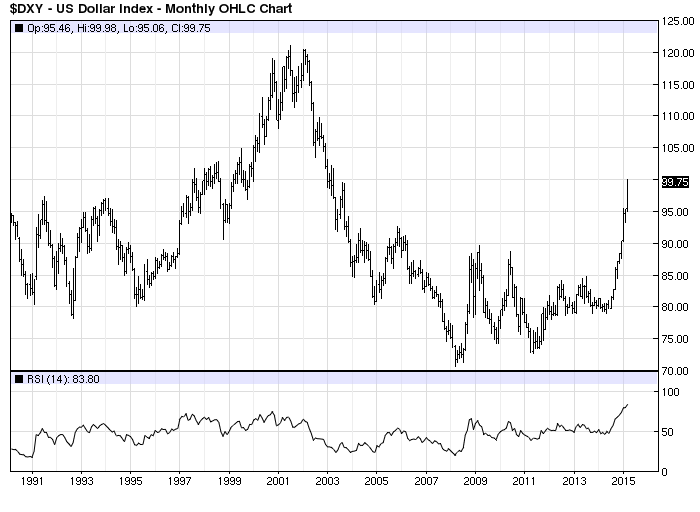
The broad Dollar Index (DXY) has now wopped by 23 percent since last summer. That`s the most aggressive rise in more than 34 years! Some of the indicators is more overbought now than at any point in modern history.

DXY 25 yr

(Picture: DXY Index)

As you can see from the chart in RSI, it is overbought. More than we were at the depths of the 2008 credit crisis. That crises caused an immense flight to safety rally in the buck, along with the biggest rally in U.S Treasury prices ever. DXY`s previous close is 99,68.

The dollar rally is now broadly pressuring emerging markets, hurting commodity prices, and undermining the profits of multinational U.S corporations. As the dollar increase, commodities and emerging markets cry.

The problem is that the dollar rally is getting out of control!


Click the link below and check out the Fan Fund

https://www.eventbrite.com/e/fan-fund-tickets-15580655159


Disclaimer: The views expressed in this article are those of the author and may not reflect those of Shiny bull. The author has made every effort to ensure accuracy of information provided; however, neither Shiny bull nor the author can guarantee such accuracy. This article is strictly for informational purposes only. It is not a solicitation to make any exchange in precious metal products, commodities, securities or other financial instruments. Shiny bull and the author of this article do not accept culpability for losses and/ or damages arising from the use of this publication.

Leave a comment

Filed under Commodities, Emerging markets, Quantitative Easing

Top 10 Economic Predicions for 2015

What`s next in the stock market next year? What about commodities, the dollar, Japan, China and Europe? Let`s take a look at Nariman Behravesh`s (Chief Economist at IHS) predictions for 2015. He expects global growth to pick up to 3 percent from an estimated 2,7 this year.

IHS outlined its top 10 economic predictions that make up its global outlook:

1. U.S. economy will power ahead
The world’s largest economy will continue to outperform its peers, driven by strengthening domestic demand, specifically consumer spending. The dynamics underpinning consumer spending—which accounts for 70 percent of gross domestic product (GDP)—remain very positive, including strong jobs growth, improved household finances and low gas prices. The economy will grow in the 2.5 to 3 percent range, IHS predicts.

2. Euro zone’s struggle to continue
The euro zone will continue to struggle with a weak labor market, but the combination of low oil prices, a weaker euro, reduced fiscal headwinds, easing sovereign debt woes, and an accommodative monetary policy will help lift growth. Expect a very modest acceleration of growth 1.4 percent in 2015 from 0.8 percent this year, says IHS.

3. Japan to emerge from recession
After suffering through its fourth recession in six years, the Japanese economy will rebound in 2015, albeit only to around 1 percent. The Bank of Japan’s (BOJ) easing and additional government stimulus, combined with lower energy prices, will push growth back into positive territory.

4. China will keep slowing
Further support from both monetary and fiscal policy won’t be enough to prevent growth from weakening further to 6.5 percent next year, says IHS. While poor by China’s standards, these growth rates are the envy of all major economies.

5. EMs: a mixed bag
Most emerging economies will see better growth in 2015, thanks to cheaper oil, a boost in global liquidity, and an acceleration in U.S. and European growth. Emerging Europe, Latin America, the Middle East and North Africa, and Sub-Saharan Africa will see the largest growth increases. Russia, however, will be a weak spot, reeling from the triple whammy of sanctions, plunging oil prices, and capital flight, says IHS.

6. Commodities slide to extend
Oil prices have plunged around 40 percent since the summer amid feeble global demand compounded by strong supply growth.
China remains key to the demand-side story, IHS says, noting that a further softening of growth will likely translate into another round of price declines. It forecasts commodity prices will slide 10 percent on average next year.

7. Disinflation threat
Disinflationary forces are the strongest in the developed world with commodity prices falling and global growth anemic. The exceptions are emerging markets, such as Russia, that have experienced sharp drops in their exchange rates and, as a result, a spike in inflation.

8. Fed will be the first to hike rates
The Federal Reserve, Bank of England, and Bank of Canada will start hiking rates in 2015—in June, August, and October, respectively, says IHS, barring a significant softening in inflation. In contrast, the European Central Bank (ECB), BOJ and People’s Bank of China are on track to either cut interest rates further and/or provide more liquidity via asset purchases and other means.

9. Dollar will remain king
The U.S. dollar will continue to strength on strong growth prospects and expectations for Fed rate hikes.
Meanwhile, anticipated additional stimulus by the ECB and BOJ means that both the euro and yen will continue depreciating in 2015. Euro-dollar will fall to $1.15–1.20 by autumn 2015, while dollar-yen will trade in a range of 120–125 next year.

10. Perennial downside risks easing
The global recovery has been plagued by a multitude of “curses” during the past few years, including high public- and private-sector debt levels that have necessitated deleveraging by households corporates and governments, says IHS. But these obstacles to growth are easing in some countries, notably the U.S and U.K., which explains their better-than-average performance.


Disclaimer: The views expressed in this article are those of the author and may not reflect those of Shiny bull. The author has made every effort to ensure accuracy of information provided; however, neither Shiny bull nor the author can guarantee such accuracy. This article is strictly for informational purposes only. It is not a solicitation to make any exchange in precious metal products, commodities, securities or other financial instruments. Shiny bull and the author of this article do not accept culpability for losses and/ or damages arising from the use of this publication.

Leave a comment

Filed under Commodities, Emerging markets, Stock market