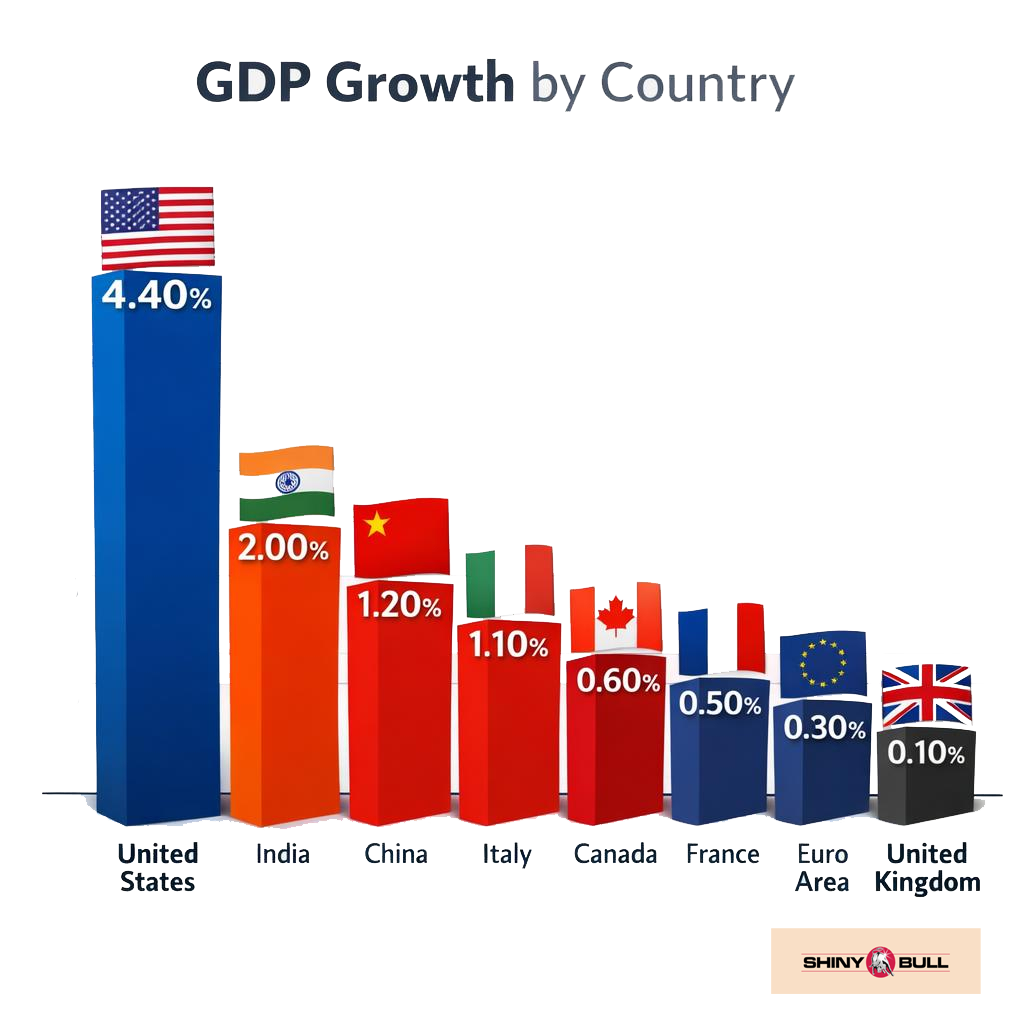
When we look at GDP growth, one thing becomes very clear: the United States is in a league of its own. With growth at 4.4 percent, the U.S. economy is running far ahead of other major economies.
India comes in second — but at less than half the U.S. rate. China, once the global engine of growth, is now barely above one percent. Europe paints a much weaker picture: the euro area, France, and the UK are hovering near stagnation. Italy does a bit better, but still far behind the U.S.
The takeaway is simple: global growth is no longer evenly distributed. The world is increasingly dependent on one dominant economic engine — the United States.
Trumponomics, Taxes, and Tariffs
This dominance is not accidental. Trumponomics — including tax cuts, deregulation, and strategic trade measures — has been designed to strengthen domestic growth. Lower taxes have incentivized investment, increased consumption, and created a multiplier effect across multiple sectors. Simply put: lower taxes mean more growth.
Tariffs have also contributed, protecting key industries and encouraging reshoring. While not the main driver of GDP growth, they amplify the effect of pro-growth policies, keeping production and capital inside the United States.
Crypto and Blockchain: America’s Catalyst
Digital infrastructure, crypto, and blockchain have emerged as powerful catalysts for U.S. economic dominance. While crypto-related activity still represents only a small fraction of U.S. GDP today, it facilitates faster capital flows, scalable services, and innovative financial systems.
Blockchain doesn’t drive the economy on its own — but it reinforces American economic advantage and positions the U.S. to maintain its lead as digital systems expand.
Blockchains are the future, not just for finance, but for the infrastructure of value itself. And America is at the forefront.
Innovation vs. Bureaucracy
A key driver behind continued U.S. economic growth is innovation—particularly in advanced manufacturing and energy technology. Companies like Tesla, led by Elon Musk, have played a pioneering role by pushing battery technology to a new level, giving the U.S. a clear competitive advantage in electric vehicles and energy storage.
In contrast, Europe—and Germany in particular—has been slowed by regulatory complexity and bureaucratic inertia. While innovation in the U.S. is often enabled by speed, scale, and risk-taking, European industry must navigate dense layers of regulation, approval processes, and political compromise.
For Germany, whose economy is deeply tied to the automotive sector, this loss of momentum has broader consequences. And as Germany remains the economic locomotive of the EU, the effects of slower innovation are amplified across Europe—raising the question of whether regulation has begun to outweigh competitiveness.
One Engine, Many Passengers
Put it all together: Trumponomics, smart policy, tariffs, and innovative digital infrastructure. The result? America continues to dominate while Europe struggles with stagnation, and China slows. Emerging markets chase momentum.
Growth today in the United States comes not from soil or oil alone, but from systems designed to turn value into profit. Lower taxes, strategic policy, and innovation create a self-reinforcing cycle — one that keeps the U.S. in the driver’s seat.
Oil once defined power. Today, code, capital, and blockchain define it. And in that world, the United States still owns the refinery.
Disclaimer: The views expressed in this article are those of the author and may not reflect those of Shinybull.com. The author has made every effort to ensure the accuracy of the information provided; however, neither Shinybull.com nor the author can guarantee the accuracy of this information. This article is strictly for informational purposes only. It is not a solicitation to make any exchange in precious metal products, commodities, securities, or other financial instruments. Shinybull.com and the author of this article do not accept culpability for losses and/ or damages arising from the use of this publication.
I want to follow up my article from yesterday. It`s about Germany which has a huge problem with GDP at -0,1. Aging population. Lack of innovation, investments, R&D, and growth. But Germany is not the only country with problems like that.
Many countries in the world have the same problems. But there is a great solution to this problem, and Paul Krugman wrote about it in his book, «The Age of Diminished Expectations.» He said; «Productivity isn`t everything, but in the long run it is almost everything.»
Productivity is a foundation of prosperity, and the only way a country can raise its standard of living sustainably is to produce more with existing or fewer resources. You cannot do that without improving productivity. It`s that simple, Gita Bhatt wrote in an article at IMF.
We know that productivity must play a more important role in driving sustained growth as our societies age. But there`s no consensus on how to reverse the broad slowdown in productivity growth seen across almost all countries over the past 20 years.
Especially vexing is the sluggish growth of what economists call total factor productivity. A way of measuring how efficiently businesses turn capital and labor into output. The part that basically captures innovation and technology.
Slower gains in total factor productivity account for more than half the deceleration in economic growth since the global financial crisis, IMF-analysis shows. Another decade of weak productivity growth could seriously erode living standards and threaten financial and social stability.
Small companies can drive productivity gains, writes the University of Chicago`s Ufuk Akcigit. He shows how small firms are more innovative relative to their size, suggesting that they use R&D resources more efficiently.
As companies grow and dominate their markets, they often shift to protecting their market position, rather than fostering innovation, he said.
Policies matter too. Measures should encourage more effective reallocation of resources away from low-productivity firms and support smaller businesses and start-ups. Not just large incumbents. This could include targeted tax credits, grants for early-stage innovation, workforce retraining, and policies that encourage competition and reduce barriers to entry for new players.
Understanding productivity growth more fully is crucial because it plays such an outsize role in economic growth, which, as Daniel Susskind of King`s College London writes; also demands a renewed approach to help improve people`s lives.
Ultimately, as Nobel laureate Edmund Phelps writes; a productive society should allow people to enjoy «mass flourishing» from the grassroots up.
Disclaimer: The views expressed in this article are those of the author and may not reflect those of Shinybull.com. The author has made every effort to ensure the accuracy of the information provided; however, neither Shinybull.com nor the author can guarantee such accuracy. This article is strictly for informational purposes only. It is not a solicitation to make any exchange in precious metal products, commodities, securities, or other financial instruments. Shinybull.com and the author of this article do not accept culpability for losses and/ or damages arising from the use of this publication.
For decades, Germany was synonymous with economic strength. Ever since World War II, it enjoyed the so-called «Wirtschaftswunder,» or economic miracle that followed the postwar recovery, which blessed Germany with almost four decades of high growth.
High growth thanks to German engineering, and manufacturing industries. The economic growth eventually slowed down, but Germany had established itself as the industrial heart of Europe, fueled by exports of products with large margins like cars machinery, and chemicals.
Companies like Volkswagen, BMW, Siemens, and BASF became global leaders with German products seen as pinnacles of quality and reliability. As a result of all that, people in Germany enjoyed high salaries, and high quality of life.
Their economic model was built on a few key pillars; strong manufacturing base. A highly skilled workforce, commitment to quality, and very strong exports. But this has come to an end. Last year, Germany was the only G-7 economy to shrink. It`s also the group`s slowest-growing economy with a growth to GDP at -0.1%.
It goes up and down. Down -0,5, up 0,1, down, 0,1, up 0,2, down -0,4, up 0,2, and then down again to -0,1.
Picture: Old economy vs New economies
Germany, long considered the economic engine of Europe, is currently facing significant challenges, leading to concerns that its economy may be stalling or «broken.» What in the world is happening in Germany, and what are the key factors that are affecting their economy right now?
It`s an energy crisis. Germany was dependent on Russian Gas. Germany relied heavily on Russian natural gas before the war in Ukraine. The subsequent sanctions and supply disruptions have led to a severe energy crisis, pushing up prices and harming energy-intensive industries like chemicals, manufacturing, and heavy machinery.
They also have a green transition challenge. Germany is trying to transition to renewable energy, but the shift away from nuclear and coal has left the country vulnerable during this energy crunch. This has increased costs for businesses and households, causing slower growth.
Germany`s economy is heavily reliant on exports, especially in industries like automotive and machinery. Global demand has softened, and supply chain disruptions from the COVID-19 pandemic continue to affect production.
The German auto industry, in particular, has been slow to transition to electric vehicles compared to competitors like Tesla, and Chinese manufacturers. This lag is putting pressure on a key pillar of the country`s economy.
Germany`s economy narrowly avoided recession in early 2023, but growth remains sluggish. High inflation and low consumer spending have contributed to weak economic activity. The combination of rising wages, energy prices, and inflationary pressures has increased production costs, leading to reduced profitability for businesses.
On top of that, you have an aging population. Germany`s population is aging rapidly, and the working-age population is shrinking. This is leading to labor shortages in key sectors and higher social welfare costs, creating long-term economic challenges.
In addition; they have migration struggles. While the country has relied on immigration to fill gaps in the labor market, recent shifts in public sentiment and policy restrictions have made it harder to sustain this approach.
Their biggest companies have been there for about 100 years, but there is a shift in the market. Germany has been criticized for lagging behind in digitalization and innovation, particularly in fields like AI and tech start-ups. This is reducing its competitiveness in the global economy.
Another problem is Germany`s heavily regulated business environment and complex bureaucracy. This can stifle innovation and make it harder for new businesses to scale up.
Like many others, Germany has trade challenges and the global demand is weak. As the global economy faces uncertainty, especially with China`s slowing growth, demand for Germany`s exports has dropped.
Germany`s economic model has long been dependent on strong export markets, so this is a major issue!
At least; EU Tension. Economic divergence within the European Union, especially between northern, and southern European economies, adds another layer of complexity, affecting Germany`s trade relations within the bloc.
It all started in France. Yellow Vest protesters went to the streets for months and years and protested against higher oil prices, electricity bills, and expensive toll stations. Their standard of living was shrinking.
This happened at a time when Donald Trump was cutting taxes and made the best economy in the U.S. ever. People in France asked for a Trump-like figure, but everything has gone straight up since then, and now we see severe problems in Germany and other places.
Picture: Yellow Vest protesters against high oil prices and low standard of living
This is happening at a time were productivity in the U.S. is great. Germany`s productivity is down -0,1%, while the productivity in the U.S. is up 3%. They are the best. They are at the top of the list! Even better than China! And the stock market goes up. Wow!
Germany`s economy is not «broken,» but it is facing severe challenges. Energy costs, inflation, global demand weakness, and structural issues in key industries like manufacturing are causing slower growth.
Long-term concerns like demographic changes and lagging investment in innovation also threaten future competitiveness. While these challenges are significant, Germany has strong economic fundamentals and could recover with strategic reforms and investments.
However, the current climate is tough, and the country is at a critical point in addressing these issues. Germany is in trouble.
Disclaimer: The views expressed in this article are those of the author and may not reflect those of Shinybull.com. The author has made every effort to ensure the accuracy of the information provided; however, neither Shinybull.com nor the author can guarantee such accuracy. This article is strictly for informational purposes only. It is not a solicitation to make any exchange in precious metal products, commodities, securities, or other financial instruments. Shinybull.com and the author of this article do not accept culpability for losses and/ or damages arising from the use of this publication.
Many people around the world do not want a surveillance society, but the truth is that it has never been easier to follow different people 24/7/365. Many are looking to Communist China, and its tactics and impact on society.
But surveillance isn`t something new. The Nazis did it. So did the Communists in East Germany. The Nazis had Gestapo, while the Communists had Stasi, and Stasi is the official name for Ministerium fur Staatsicherheit (German: «Ministry for State Security»).
Stasi was a secret police agency of the German Democratic Republic (East Germany). Furthermore; the Stasi was one of the most hated and feared institutions of the East German communist government. It all started after World War II: in 1950, and it lasted until the end in 1990 (after the fall of the Berlin wall in 1989).
The difference between Gestapo and Stasi is that Gestapo had 40,000 officials watching a country of 80 million, while the Stasi employed 102,000 to control only 17 million. One might add that the Nazi terror lasted only twelve years, whereas the Stasi had four decades in which to perfect its machinery of oppression, espionage, and international terrorism and subversion.
By at least one estimate, the Stasi maintained greater surveillance over its own people than any secret police force in history.
The Stasi employed one secret policeman for every 166 East Germans. By comparison, the Gestapo deployed one secret policeman per 2,000 people.
Stasi agents infiltrated and undermined West Germany`s government and spy agencies.
The Stasi was much worse than the Gestapo, if you consider only the oppression of its own people, according to Simon Wiesnthal of Vienna, Austria, who has been hunting Nazi criminals for half a century. But, why was the Stasi so extremely good?
Many of the techniques used by the Stasi had actually been pioneered by the Nazis and in particular the Gestapo. They relied heavily on information-gathering and intelligence in order to create an atmosphere of fear and to get citizens to denounce one another. It worked extremely successfully. But, why did they do it? What was the goal of the Stasi?
The goal was to destroy secretly the self-confidence of people, for example by damaging their reputation, organizing failures in their work, and destroying their personal relationships. Considering this, East Germany was a very modern dictatorship. The Stasi didn`t try to arrest every dissident.
They had many different tactics, including questioning, repeated stop, and searches, strange noises on telephone lines, and conspicuous visits to the workplace so that bosses and colleagues were aware of the police interest.
The Stasi steamed open letters, copied them, filed them, and sent them on. They went into homes when people were out and bugged them. They tapped into the phone infrastructure of the building, maintained contacts and occasionally cooperated with West German terrorists.
The Stasi`s function was similar to the KGB, serving as a means of maintaining state authority. This was accomplished primarily through the use of a network of civilian informants. KGB also invited the Stasi to establish operational bases in Moscow and Leningrad to monitor visiting East German tourists.
The Stasi also acted as a proxy for KGB to conduct activities in other Eastern Bloc countries, such as Poland, where the Soviets were despised.
Due to their close ties with Soviet intelligence services, Mielke referred to the Stasi officers as «Chekists». In 1978, Mielke formally granted KGB officers in East Germany the same rights and powers that they enjoyed in the Soviet Union.
Between 1950 and 1989, the Stasi employed a total of 274,000 people in an effort to root out the class enemy. In 1989, the Stasi employed 91,015 people full-time, including 2,000 fully employed unofficial collaborators, 13,073 soldiers and 2,232 officers of the GDR army, along with 173,081 unofficial informants inside GDR, and 1,553 informants in West Germany.
Regular commissioned Stasi officers were recruited from conscripts who had been honorably discharged from their 18 months’ compulsory military service, had been members of the SED, had had a high level of participation in the Party`s youth wing`s activities, and had been Stasi informers during their service in the Military.
The candidates were then made to sit through several tests and exams, which identified their intellectual capacity to be an officer and their political reliability. University graduates who had completed their military service did not need to take these tests and exams.
They then attended a two-year officer training program at the Stasi college (Hochschule) in Potsdam.
By 1995, some 174,000 inoffizielle Mitarbeiter (Ims) Stasi informants had been identified, almost 2,5% of East Germany`s population between the ages of 18 and 60. 10,000 Ims were under 18 years of age.
From the volume of material destroyed in the final days of the regime, the office of the Federal Commissioner for the Stasi Records (BstU) believes that there could have been as many as 500,000 informers.
A former Stasi colonel who served in the counterintelligence directorate estimated that the figure could be as high as 2 million if occasional informants were included.
Full-time officers were posted to all major industrial plants (the extent of any surveillance largely dependent on how valuable a product was to the economy), and one tenant in every apartment building was designed as a watchdog reporting to an area representative of the Volkspolizei (Vopo).
Spies reported every relative or friend who stayed the night at another`s apartment. Tiny holes were drilled in apartment and hotel room walls through which Stasi agents filmed citizens with special video cameras.
Schools, universities, and hospitals were extensively infiltrated.
A large number of Stasi informants were tram conductors, janitors, doctors, nurses, and teachers. Mielke believed that the best informants were those whose jobs entailed frequent contact with the public.
In some cases, spouses even spied on each other.
The roles of informants ranged from those already in some way involved in state security (such as the police and the armed services) to those in the dissident movements (such as in the arts and the Protestant Church).
Information gathered about the latter groups was frequently used to divide or discredit members. Informants were made to feel important, given material or social incentives, and were imbued with a sense of adventure, and only around 7,7%, according to official figures, were coerced into cooperating.
The Stasi had files on everyone. They spied on almost every aspect of East German`s daily lives, and they carried out international espionage. It kept files on about 5,6 million people and amassed an enormous archive. The archive holds 111 kilometers of files in total.
The Stasi was the official state security service of East Germany, the German Democratic-Republican in short the GDR. The Stasi`s motto was «Schild und Schwert der Partei» (Shield and Sword of the Party).
«The Party» was the ruling Socialist Unity Party of Germany.
The Stasi perfected the technique of psychological harassment of perceived enemies known as Zersetzung, which is a term borrowed from chemistry that literally means «decomposition». Chemical decomposition means chemical breakdown.
For example, the stability of a chemical compound is eventually limited when exposed to extreme environmental conditions such as heat, radiation, humidity, or the acidity of a solvent. Because of this chemical decomposition is often an undesired chemical reaction.
The goal was to paralyze people, and it could do so because it had access to so much personal information and to so many institutions.
By the 1970s, the Stasi had decided that the methods of overt persecution that had been employed up to that time, such as arrest and torture, were too crude and obvious. Such forms of oppression were drawing significant international condemnation.
It was realized that psychological harassment was far less likely to be recognized for what it was, so its victims, and their supporters, were less likely to be provoked into active resistance, given that they would often not be aware of the source of their problems, or even its exact nature.
International condemnation could also be avoided.
Zersetzung (decomposition) was designed to side-track and «switch off» perceived enemies so that they would lose the will to continue any «inappropriate» activities.
Anyone who was judged to display politically, culturally or religiously incorrect attitudes could be viewed as a «hostile-negative» force and targeted with Zersetzung methods.
For this reason members of the Church, writers, artists, and members further developed in a «creative and differentiated» manner based upon the specific person being targeted i.e. They were tailored based on the target`s psychology and life situation.
Tactics employed under Zersetzung usually involved the disruption of the victim`s private or family life.
This often included psychological attacks, such as breaking into their home and subtly manipulating the contents, in a form of gaslighting i.e. Moving furniture around, altering the timing of an alarm, removing pictures from walls, or replacing one variety of tea with another, etc.
Other practices include property damage, sabotage of cars, travel bans, career sabotage, administering purposely incorrect medical treatment, smear campaigns which could include subversion, wiretapping, bugging, mysterious phone calls or unnecessary deliveries, even including sending a vibrator to a target`s wife.
Increasing degrees of unemployment and social isolation could and frequently did occur due to the negative psychological, physical, and social ramifications of being targeted.
USUALLY, VICTIMS HAD NO IDEA THAT THE STASI WERE RESPONSIBLE.
The victims didn`t know what was happening. They were confused, and everybody around the target could watch as he or she crumbled under the relentless pressure of state harassment. Zersetzung was designed by the Stasi, and it was a form of psychological harassment to wreak havoc on an individual, without any need to arrest or torture the target.
Many thought that they were losing their minds, and mental breakdowns and suicide were sometimes the results. There is ongoing debate as to the extent if at all, to which weaponized directed energy devices, such as X-ray transmitters, were also used against victims.
A direct-energy weapon (DEW) is a ranged weapon that damages its target with highly focused energy without a solid projectile, including lasers, microwaves, particle beams, and sound beams. Potential applications of this technology include weapons that target personnel, missiles, vehicles, and optical devices.
The main goal was to give the victims a lot of pain because that was much better than putting them in prison and torturing them. One of the symptoms was called the Havana syndrome. It was a syndrome of medical symptoms reported by US personnel in Havana, Cuba, and other locations, suspected by the National Academies of Sciences, Engineering, and Medicine to be caused by microwave energy.
Some common bio-effects of non-lethal electromagnetic weapons include difficulty breathing, disorientation, nausea, pain, vertigo, and other systemic discomfort.
Interference with breathing poses the most significant, potentially lethal results. Light and repetitive visual signals can include epileptic seizures. Bection and motion sickness can also occur.
After German reunification, revelations of the Stati`s international activities were publicized, such as its military training of the West German Red Army Faction. Stasi experts also helped train the secret police organization of Mengistu Haile Mariam in Ethiopia.
They helped Fidel Castro`s regime in Cuba. Stasi officers helped in the initial training and indoctrination of Egyptian State Security organizations under the Nassar regime. They helped to create secret police forces in the People`s Republic of Angola, the People`s Republic of Mozambique, and the People`s Republic of Yemen.
The Stasi organized and extensively trained Syrian intelligence services under the regime of Hafez al-Assad. They also helped to set up Idi Amin`s secret service. They helped the President of Ghana.
Documents in the Stasi archives state that the KGB ordered Bulgarian agents to assassinate Pope John Paul II, who was known for his criticism of human rights in the Eastern Bloc, and the Stasi was asked to help with covering up traces.
The Stasi in 1972, also made plans to assist the Ministry of Public Security (Vietnam) in improving its intelligence work during the Vietnam War.
That was then, but how is it now? We must ask ourselves how our own society is built. The Stasi had a system for monitoring telephone conversations, but if they could do it in the 70s, what can be happening even today? What about social media, emails, smartphones, and computers.
A lot of people believe that China`s social system is scary. But that system is not only about China. It`s in many other countries in Europe and America. They have surveillance cameras, face recognition, and the requirements to always praise the government. It sounds like an Orwellian nightmare come true. Or a Stasi system of surveillance.
China`s social credit system affects freedom of speech, resulting in censorship and self-censorship, ultimately silencing any form of opposition. But this is not only about China. The web itself is a surveillance machine. As it stands today, you are what you click.
Once you`re logged on to your computer and have access to the internet, the system will see what you are doing, and you will be tracked by your browser, by third parties, by cookies, and by almost all the sites you are logging into.
The data you give the third party for free is aggregated and a profile about you is being created. Most of the information you give away for free is being used for targeted advertisements. But it could well be used to create a so-called Social Credit System.
Once all the data is collected, the profile is created, and it can be very difficult to change your own profile. Your profile of yours will lead to real-life consequences.
In addition, China has set up more than 100 so-called overseas police stations across the globe to monitor, harass, and in some cases repatriate Chinese citizens living in exile, using bilateral security arrangements struck with countries in Europe and Africa to gain widespread presence internationally, according to CNN.
The State Security Ministry is the principal civilian intelligence, security, and secret police agency of the People`s Republic of China, responsible for counterintelligence, foreign intelligence, and political security. The MSS is active in industrial espionage and adept at cyber espionage.
A document from the US Department of Justice described the agency as being like a combination of the Central Intelligence Agency (CIA), and the Federal Bureau of Investigation (FBI).
Many foreign analysts describe the Communist «Part-State» and its security agencies as being left without a real ideology, relying only on repression and the stoking of Chinese nationalism, more recent works, however, highlight the increasing importance of Marxism-Leninism in the worldview, internal culture and self-image of the CCP security apparatus; Vladimir Lenin and Mao Zedong remain the central influences, although classical Chinese thinkers such as Sun Tzu are also studied.
1,412 billion live in China. How many agents do they have? Only 87 million live in Iran, and they have its own Islamic Revolutionary Guard Corps to protect the priests at the top. It is a multi-service primary branch of the Iranian Armed Forces. Active personnel last year was 210,000, while 60,000 was paramilitary forces.
According to BBC, the UK is preparing to formally declare that Iran`s Islamic Revolutionary Guard Corps (IRGC) is a terrorist organization. It follows a similar decision made by the US in 2019. After a popular antigovernment protest in Iran, the number of people killed by security forces has increased.
The state of human rights in the Islamic Republic of Iran has been criticized by Iranians and international human rights activists.
The Stasi was one of the most hated and feared institutions of the East German communist government. Nor is CCP so popular. Iran`s Revolutionary Guard is also unpopular. The funniest thing is that they are all funded by «the people».
Disclaimer: The views expressed in this article are those of the author and may not reflect those of Shinybull.com. The author has made every effort to ensure the accuracy of the information provided; however, neither Shinybull.com nor the author can guarantee such accuracy. This article is strictly for informational purposes only. It is not a solicitation to make any exchange in precious metal products, commodities, securities, or other financial instruments. Shinybull.com and the author of this article do not accept culpability for losses and/ or damages arising from the use of this publication.
The conflict between Russia and Ukraine is a complex crisis, but the answer lies in history. Who knows that Kiyv once was more powerful than Moscow? It was also a time when Ukraine and America were adversaries.
Neanderthal settlement in Ukraine is also seen in the Moldova archaeological sites (43,000 – 45,000 BC) which includes a dwelling constructed from mammoth bones. The territory is also considered to be the likely location for the human domestication of the horse.
So, there is no doubt that Ukraine is something special. But what is it? Alexandr Solzhenitsyn criticized the Allies for not opening a new front against Nazi Germany in the west earlier in World War II. This resulted in Soviet domination and control of the nations of Eastern Europe.
Solzhenitsyn claimed the Western democracies apparently cared little about how many died in the East, as long as they could end the war quickly and painlessly for themselves in the West. In 1978, he called the United States «Dechristianized» and mired boorish consumerism. Wow, that`s a long time ago, and we have the same going on even today.
He also accused the Western news media of left-wing bias (Wow! Really?), of violating the privacy of celebrities, and of filling up the «immortal souls» of their readers with celebrity gossip and other «vain talk».
He also said that the West erred in thinking that the whole world should embrace this as a model. While faulting Soviet society for rejecting basic human rights and the rule of law, he also critiqued the West for being too legalistic.
«A society which is based on the letter of the law and never reaches any higher is taking very scarce advantage of the high level of human possibilities.»
Solzhenitsyn also argued that the West erred in «denying (Russian culture`s) autonomous character and therefore never understood it».
Solzhenitsyn was also critical of NATO`s eastward expansion towards Russia`s borders. In 2006, Solzhenitsyn accused NATO of trying to bring Russia under its control; he claimed this was visible because of its «ideological support for the «color revolutions» and the paradoxical forcing of North Atlantic interests on Central Asia».
(Worldwide media use the term color revolution to describe various protest movements and accompanying attempted or successful change of governments that took place in several countries such as former Soviet Union. Russia, China, and Vietnam share the view that color revolutions are the «product of machinations by the U.S and other Western powers» and pose a vital threat to their public and national security).
In a 2006 interview with Der Spiegel, he stated «This was especially painful in the case of Ukraine, a country whose closeness to Russia is defined by literally millions of family ties among our peoples, relatives living on different sides of the national border. At one fell stroke, these families could be torn apart by a new dividing line, the border of a military bloc.»
He gave a speech in Washington D.C, on 30 June 1975 in which he mentioned how the system created by the Bolsheviks in 1917 caused dozens of problems in the Soviet Union. He described how this system was responsible for the Holodomor.
It was a system that, in time of peace, artificially created a famine, causing 6 million people to die in Ukraine in 1932 and 1933. He added: «they died on the very edge of Europe. And Europe didn`t even notice it. The world didn`t even notice it! 6 million people»
In 2008, he said that, while the famine in Ukraine was both artificial and caused by the state, it was no different than the Russian famine of 1921. he expressed the belief that both famines were caused by the systematic armed robbery of the harvests from both Russian and Ukrainian peasants by Bolshevik units, which were under orders from the Politburo to bring back food for the starving urban population centers while refusing for ideological reasons to permit any private sale of food supplies in the cities or to give any payment to the peasants in return for the food that was seized.
Solzhenitsyn further alleged that the theory that the Holodomor was a genocide that only victimized the Ukrainian people was created decades later by believers in an anti-Russian form of extreme Ukrainian nationalism.
He also cautioned that the ultranationalist’s claims risked being accepted without question in the West due to widespread ignorance and misunderstanding thereof both Russian and Ukrainian history.
The Holodomor means; «to kill by starvation».
It is also known as the Terror-famine, or the Great Famine, which was a famine in Soviet Ukraine from 1932 to 1933 that killed millions of Ukrainians. The term Holodomor emphasizes the famine`s man-made and allegedly intentional aspects such as rejection of outside aid, confiscation of all household foodstuffs, and restriction of population movement.
As part of the wider Soviet famine which affected the major grain-producing areas of the country, millions of inhabitants of Ukraine, the majority of whom were ethnic Ukrainians, died of starvation in a peacetime catastrophe unprecedented in the history of Ukraine.
Since 2006, the Holodomor has been recognized by Ukraine and 15 other countries as a genocide of the Ukrainian people carried out by the Soviet government.
Whether the Holodomor was genocide is still the subject of academic debate, as are the causes of the famine and intentionality of the deaths. Some scholars believe that the famine was planned by Joseph Stalin to eliminate a Ukrainian independence movement. Others suggest that the man-made famine was a consequence of Soviet industrialization.
According to Elazar Barkan, Elizabeth A. Cole, and Kai Stuve, there is a competition among victims in constructing a «Ukrainian Holocaust», stating that since the 1990`s Holodomor has been adopted by anti-communists due to its similarity to the Holocaust in an attempt to promote the narrative that the Soviet Communists killed 10 million Ukrainians, while the Nazis only killed 6 million Jews.
They stated that Holodomor was «introduced and popularized by the Ukrainian diaspora in North America before Ukraine became independent» and that «the term «Holocaust» is not explained at all.»
According to them, this has been used to create a «victimized national narrative» and «compete with the Jewish narrative in order to obscure the «dark sides» of Ukraine`s national history and to counter accusations that their fathers collaborated with the Germans.
Holodomor translated from Ukrainian means «death by hunger», «killing by hunger», «killing by starvation», or sometimes «murder by hunger or starvation.»
It is a compound of the Ukrainian holod, «hunger», and mor, «plague». The expression moryty holodom means «to inflict death by hunger.»
The Ukrainian verb moryty means «to poison, to drive to exhaustion, or to torment.» The perfective form of moryty is zamoity, «kill or drive to death by hunger, exhausting work.»
In English, the Holodomor has also been referred to as the artificial famine, famine-genocide, terror famine, and terror-genocide.
Holodomor is now an entry in the modern, two-volume dictionary of the Ukrainian language, published in 2004, described as «artificial by hunger, organized on a vast scale by a criminal regime against a country`s population.
On 24 February, EU leaders met at a special summit convened following Russia`s aggression against Ukraine. They agreed on further sanctions against Russia that target; the financial sector, the energy, and transport sectors, dual-use goods, export control and export financing, visa policy, and additional sanctions against Russian individuals.
Like Trudeau in Canada, the EU will freeze Russian assets and probably cut off SWIFT for now.
There is no doubt that ordinary innocent people will be attacked and suffer, and in the long run, we`re talking about starvation. Or «killing by starvation.» Is this Holodomor 2,0?
Disclaimer: The views expressed in this article are those of the author and may not reflect those of Shinybull.com. The author has made every effort to ensure the accuracy of the information provided; however, neither Shinybull.com nor the author can guarantee such accuracy. This article is strictly for informational purposes only. It is not a solicitation to make any exchange in precious metal products, commodities, securities, or other financial instruments. Shinybull.com and the author of this article do not accept culpability for losses and/ or damages arising from the use of this publication.








 Ket Garden
 Business, Politics, Finans