
How to identify the trend in the market

Do you know where we are in the stock market right now? Is it cheap or is it expensive? We are near the all time high. What is the next? A stock market crash? A correction, or a consolidation? Where do we find answers to all those questions?

Indu

As an investor you need to read the map. You need to identify facts and not make any assumptions or any forecast. You can`t belive or “feel like” in the stock market. That`s why traders trade what they see, not what they think.

It is dangerous if investors and traders begin to assume. Predicting the market is a difficult, if not impossible, game. Reading the markets is an empirical science. Investors and traders with success in the markets requires serious study and analysis that is fraught with success and failures.

Failure is painful and should be looked upon as learning experiences. Technical analysis is an art form and the eye grows keener with practice. Success is the trading market is a great thing, but don`t get to smug about it. Study both successes and failures with an eye to the future.

It`s a great thing to identify the primary trend and then catch the big moves. Two thing drives the market: the fact and the psychology. The market tends to go much longer than expected (what we see right now) and much deeper as expected.

You have to understand that the markets are influenced by emotions and prone to over-react both up and down. Therefore; you have to concentrate on identification and following: identify the trend and then follow the trend and the trend is in place until proved otherwise.

This is when the trend will end, it is proved otherwise.

I will do it as easy as possible and show you a basic method of how you can identify the trend. This can be a good starting point for you to develop analysis guidelines that you are comfortable with and understand.

The first step to identify the primary trend is to identify the individual trend of the Dow Jones Industrial average (DJIA) and Dow Jones Transportation Average (DJTA), individually. Use peak and trough analysis in order to ascertain the identity of the trend.

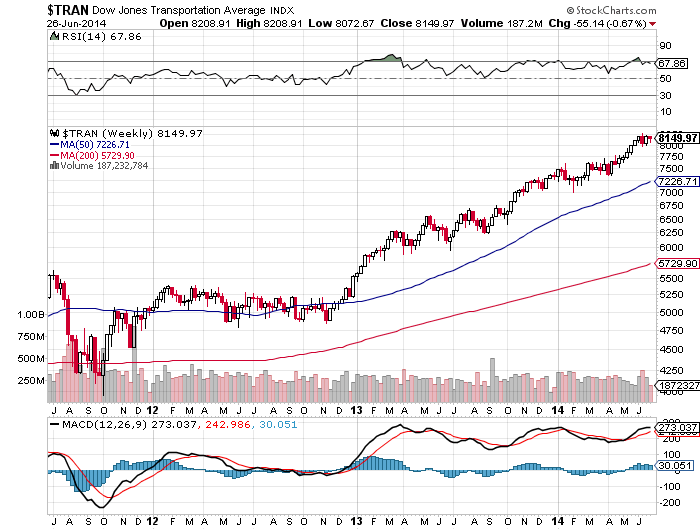
An Uptrend is defined by prices that form a series of rising peaks and rising troughs. In the chart you will then see higher highs and higher lows.

A Downtrend is defined by prices that form a series of declining peaks and declining troughs. In the chart you will then see lower highs and lower lows.

Once the trend has been identified, it is assumed valid until proved otherwise. A downtrend is considered valid until a higher low forms, and the ensuing advance off of the higher low surpasses the previous reaction high.

Below is a chart of the Dow Jones Transportation Average. I printed out the chart yesterday june 26, 2014. As you can see, in 2012 there was a consolidation period, and in 2013, and so far in 2014, it is all in an uptrend, but where is the top? Where is the peak?
Tran

After a peak, a series of lower lows and lower highs will be formed to make a downtrend. In the downtrend we will then see a bounce back and have a secondary rally. After a downtrend, you have to look for high volume days, like high volume washout days. High volume days signal that a possible change is looming. Alone, a high volume washout day is not a buy signal, but rather an indication to monitor price action a little closer.

If you see a higher low later on, it is too early to call it a change in the trend. The change of a trend is not confirmed until the previous reaction high is surpassed. It need to cross the trend line to call it a change in the trend.
An uptrend is considered in place until a lower low forms and the ensuing decline exceeds the previous low. You can see the uptrend in the Dow Jones Industrial average chart below. You can see a series of higher highs, and higher lows.

Bears jumping in on the top can sit on top for a long time with more all-time-highs to come, but professional traders and fund managers do this to make an insurance for their portfolio, because it is impossible to predict a new change in the trend.

Indu

All you have to do is to catch the big moves. To do this, use weekly charts to establish reaction highs and lows. But weekly charts may not portray the details you need. One possible solution is to apply a short moving average to the price plot. A 5-day moving average could be applied to smooth the price series and still allow for the details.

What I am talking about is not a science. It is just ment to offer insights and guidelines from which to begin careful study of the market movements and price action. Look at the charts, read the map and catch the big moves.

Reports today:
09:55 a.m EST Revised UoM Consumer Sentiment
09:55 a.m EST Revised UoM Inflation Expectations

Disclaimer: The views expressed in this article are those of the author and may not reflect those of Shiny bull. The author has made every effort to ensure accuracy of information provided; however, neither Shiny bull nor the author can guarantee such accuracy. This article is strictly for informational purposes only. It is not a solicitation to make any exchange in precious metal products, commodities, securities or other financial instruments. Shiny bull and the author of this article do not accept culpability for losses and/ or damages arising from the use of this publication.

Leave a comment

Filed under Stock market

GoPro IPO today

It`s headed for the largest consumer-electronics debut in 23 years today, as GoPro, the video-camera maker is going public. So far, the company has been privately held, but now it is open for the public.

white-edition

The latest consumer-electronics IPO was in 2011. Headphonemaker Skullcandy Inc raised $189 million in their debut. We had another deal in the same sector when another headphone company called Beats ElectronicsLLC agreed to a $3 billion buyout by Apple Inc.

GoPro plans to sell as much as $427 million stocks in the IPO today, and that would mark the largest consumer-electronics IPO since Duracell`s debut in 1991. They raised $433 million at that time, and Procter & GambleCo bought the company six years later.

GoPro will raise $427 million by offering 17,8 million shares (50% insider) at $24, the high-end of the $21 – $24 range. At the IPO price, GoPro will have a fully diluted market cap of $3,5 billion and an enterprise value of $3,3 billion.

GoPro will list on the NASDAQ and their trading symbol will be GPRO. Barclays, City and J.P. Morgan acted as joint bookrunners on the deal, and analysts at the bank expect the deal to value it at about 25 times projected earnings.

If the price of GoPro is $24, the company would have a richer price/earnings ratio than Apple Inc, which trades at about 13 times analysts 2015 profit forecast. Garmin Ltd trades at 20 times.

The bull market in initial public offerings rolls on, and so far in 2014, there have been 144 U.S IPO`s, raising $30 billion. This puts the IPO market on pace for the busiest year since 2000, both by dollar volume and number of deals.

The question mark now is whether the GoPro`s shares are being priced appropriately.

Reports today:
08:30 a.m EST Unemployment Claims
08:30 a.m EST Core PCE Price Index
08:30 a.m EST Personal Spending


Disclaimer: The views expressed in this article are those of the author and may not reflect those of Shiny bull. The author has made every effort to ensure accuracy of information provided; however, neither Shiny bull nor the author can guarantee such accuracy. This article is strictly for informational purposes only. It is not a solicitation to make any exchange in precious metal products, commodities, securities or other financial instruments. Shiny bull and the author of this article do not accept culpability for losses and/ or damages arising from the use of this publication.

Leave a comment

Filed under Stocks

Will Uber win and Yellow Taxi Car lose?

Uber is probably one of the most attractive companies out there for would be investors. They raised $1,2 billion in funding and are valued at $17 billion. Unfortunately, Uber shares are out of reach for most as the on demand car-sharing app remains a privately held company.

Uber logo

How can investors profit on that? It seems like investors are betting on Uber`s success. Take a look at Medallion Financial Corp, as the short interest has skyrocket from about 400,000 at the end of 2013 to 1,300,000 at the end of last month.

Medallion Financial Corp is a company that specializes in financing loans used to purchase taxi medallions. Uber is trying to make those taxi licenses worthless by creating its own private fleet of drivers and bypassing the medallion system entirely.

Medallion Financial has had a slowly but steadily declining earnings since 2012, and the short interest in their stock has increased by about 245%, and the stock price has been falling 17%, which is a bad sign.

Uber is one of several leading the vanguard of the sharing economy. The sharing economy is also called collaborative consumption. It is the socioeconomic model in which a pool of individuals all benefit from gaining access to physical assets without actually needing to own the underlying assets, which are often prohibitively expensive.

Property rights are still clearly defined in collaborative consumption models. A renter resulting in a more efficient allocation of the asset pool. Up until recently, matching a potential passenger with a driver looking to make a few bucks was nearly impossible logistically on a large-scale. Smartphones apps like Uber and Airbnb have made the process simple by acting as mobile accessible hubs for the efficient allocation of these resource pools.

Medallion Financial Corp may be the most obvious victim of Uber`s rise, but there are other potential losers later down the road as well. If Uber reach their goal with their success as a worldwide phenomenon, the rental car business may suffer as well. Uber is less expensive, and already cheaper than many city-regulated taxis and will become more competitive with car rental costs.

Avis Budget Group is the second largest publicly traded rental car company in the U.S, and the one which acquired car sharing company Zipcar in March this year for about $500 million. Zipcar is similar to Uber in the sense that it enables car-sharing.

The difference is that Zipcar owns its own fleet of cars, while Uber does not. That means much lower costs, and lower risk for Uber. Uber drivers provide their own car to become a driver, which is why Uber has a much cheaper cost structure than the other companies. Uber just takes a small commission for each ride for matching drivers with paying customers.

The largest publicly traded car rental company in the U.S is Hertz, and Enterprise is the largest car rental chain in the country, but it is privately held. Hertz is growing and its revenue is up by over 20% in the past four quarters, but in March they had a dip in the sales growth by 10% and a significant drop in earnings.

For all I know, Uber is planning an IPO anytime soon. We don`t know how fast Uber is growing as the financial information is not publicly available, because they are still a private company, but it seems like investors are placing their bets on Uber as a winner and the traditional yellow taxi cab companies as losers.

Reports today:
08:30 a.m EST Core Durable Goods Orders
08:30 a.m EST Final GDP
08:30 a.m EST Durable Goods Orders
10:30 a.m EST Crude Oil Inventories

Disclaimer: The views expressed in this article are those of the author and may not reflect those of Shiny bull. The author has made every effort to ensure accuracy of information provided; however, neither Shiny bull nor the author can guarantee such accuracy. This article is strictly for informational purposes only. It is not a solicitation to make any exchange in precious metal products, commodities, securities or other financial instruments. Shiny bull and the author of this article do not accept culpability for losses and/ or damages arising from the use of this publication.
Leave a comment

Filed under Stocks

On-demand streaming music service in the future


Amazon Prime Music is an on-demand subscription service similar to the market leader Spotify, Rhapsody, Deezer and the company now owned by Apple; Beats Music. This is only a few among the free music streaming services out there. They all differs from Pandora, which operates a radio-like offering supported by ads. Pandora has the biggest audience, but you can`t pick the precise song you like. You can stream whatever you like on the other one, so long as they has it.

Deezer

Deezer

Deezer is founded by Daniel Marhely in 2006. The first version was called Blogmusik, but they did not have agreements with the record labels, so it was shut down in April 2007. Deezer is a web-based music streaming service.

You can listen to music content from record labels including Sony, EMI, Warner Music Group and Universal Music Group. Deezer is created in Paris, France. They currently has 30 million licensed tracks in its library. In addition; they has over 30,000 radio channels and 16 million monthly active users, and 5 million paid subscribers. The service is available in 182 countries.

Amazon.com Inc is an American international electronic commerce company founded by Jeff Bezos in July 1994. The company name was Cadabra at the beginning, but changed to Amazon.com in 1995, because Bezos thought it sounded too much like cadaver.

1994 is early in the internet era. I can remember I sent my fist mail and chatted for the first time in 1994. It was a very special time, but now many things have changed. Amazon.com started as an online bookstore, but soon diversified, selling DVD`s, VHS`s, CD`s video and MP3 download/streaming, software, video games, electronics, apparel, furniture, food, toys and jewelry.

They also produces consumer electronics, notably the Fire Phone, Amazon Kindle e-book reader and the Kindle Fire tablet computer, and is a major provider of cloud computing services. The company continue to grow and are now out with a new product; Prime Music.

amazon-prime_music

Prime Music

Prime Music is a streaming service included in a Prime subscription. Amazon like to say that Prime Music has «unlimited, ad-free streaming» and a catalogue of «over a million songs». So? People using for example Spotify knows that their catalogue have well over 20 million songs. That`s more than twenty times the songs from Prime Music.

If you look at the Billboard Hot 100 list, only one out of ten is on Prime Music. So, nine out of ten is not available via Prime Music streaming. Why should people start to use Prime Music instead of Spotify? I don`t think subscribers to Spotify or Pandora fans will switch to Prime Music and their competitors shouldn`t be too scared of the new competitor.

You are paying for the service, via your subscription fee, which is $99, plus all of those purchases you`re making at Amazon. But it still sorta feels free. The «free» two-day shipping isn`t really free either. It`s a flat prepaid payment of $99 for a year`s worth of shipping.

Amazon is using a tactic out of the storied cable TV bundle playbook. A package includes 100, 200, or sometimes more than 700 more options. If you pay $99 per month it sounds like a lot. If the customers spend much time on the membership they will probably be tempted into making purchases, and they will feel that a Prime membership is an absolute essential.

YouTube-logo-full_color

Youtube


Google-owned Youtube is deleting indie bands music videos over contractual disputes ahead of a streaming music service launch. Youtube is removing videos from independent acts because their labels could not come to an agreement on Youtube`s revamped royalty terms.

The deals with those independent labels have been a sticking point in the development of Youtube`s subscription-based music service, which was originally expected to launch early this year. The reason is that Youtube was trying to strong-arm smaller labels into accepting non-negotiable terms that would offer smaller payouts than their competitors like Spotify and Deezer.

Youtube has reached deals with about 90 percent of the music industry, including the three major U.S labels. Their new on-demand paid streaming service is expected to allow users to more easily organize songs by album and listen to songs via Youtube while using other mobile apps and download songs for offline listening. Youtube will launch a paid service for streaming music over the currently free channel.

They already has music service called Play All Access, with a subscription of $9,99 per month which was launched in May last year. This service allows you to listen to any song, artist or album you like without any ads. In addition; you have the ability to create your own radio station by selection a song, genre of music, artist or album. Videos distributed by Vevo on Youtube will remain as part of the company`s free service.

Universal, Sony Music Entertainment and Warner Music Group have signed up for Youtube`s new music streaming service, which is expected to launch in a few week. The price for the service is not released yet.

Who will win this war? The one with the biggest catalogue and the lowest price. People don`t care where they are listening to the music. It will remain the same song on all channels. Some of them can differentiate themselves to create packages like Amazon.

The most important thing is that the artist and producers are making money on it. If not, the music industry will die.


Reports today:

08:05 a.m EST FOMC Member Plosser Speaks

09:00 a.m EST S&P/CS Composite-20 HPI y/y

10:00 a.m EST CB Consumer Confidence

10:00 a.m EST New Home Sales


Disclaimer: The views expressed in this article are those of the author and may not reflect those of Shiny bull. The author has made every effort to ensure accuracy of information provided; however, neither Shiny bull nor the author can guarantee such accuracy. This article is strictly for informational purposes only. It is not a solicitation to make any exchange in precious metal products, commodities, securities or other financial instruments. Shiny bull and the author of this article do not accept culpability for losses and/ or damages arising from the use of this publication.


Leave a comment

Filed under Stocks

Black Gold is up on Iraqi war

Brent traded at its highest level since September as militants in Iraq seized more territory and President Barrack Obama warned that the crises may spill over into other countries. Fighters from the Islamic State in Iraq and the Levant took control of Iraq`s border crossing with Jordan and Syria.

Black gold

Iraq pumped 3,3 million barrels a day last month. Saudi Arabia is the largest producer in the 12-member Organization of Petroleum Exporting Countries. U.S Secretary of State John Kerry arrived in Baghdad to try to get political leaders to set aside sectarian divisions and confront the growing threat.

John Kerry will spend the day meeting with Prime Minister Nouri al-Maliki, as well as ministers and party leaders. But why do the U.S and John Kerry spend so much time and money on this case? Kerry said at a press conference that they want a government in Baghdad «that is prepared to represent all of the people of Iraq, that is prepared to be inclusive and share power».

The U.S didn`t invade Iraq to stop and evil tyrant and spread democracy. There were no weapons of mass destructions, and all of the terrorists that had been in Afghanistan fled to Pakistan. Not Iraq. The U.S went to Iraq for oil.

Back then, the U.S oil production was falling, but now it is rising. From 1970 to 2008, oil production fell from 9,6 million barrels per day to just 5 million barrels per day. Michael Simmons cast doubt on the actual size of Saudi Arabia`s reserves in his book from 2005, so it was not only the U.S either. M. King Hubbard`s «Peak oil» theory and breakneck emerging market growth, explain even more what happened in Iraq.

Vice President Dick Cheney had previously been the CEO of Halliburton, and made about $40 billion from the Iraq war. All this makes it hard to belive that the U.S was not in Iraq for the oil. But, did the U.S get all the oil? Nope.

Iraq is the second largest producer in OPEC and the country`s oil production hit 3,25 million barrels per day last year. A level not seen since before 1990, but the U.S oil imports from Iraq are actually down.

The U.S imported 725,000 barrels per day from Iraq in 1999, but now it is only 340,000 barrels a day. So, if Iraq is producing more oil than it has in decades, where is all the oil going? The oil is going to China.

China`s crude imports from Iraq increased by 31% year-over-year to about 600,000 barrels per day in the first four months of 2014, and that`s twice as much as the U.S import from Iraq. Up from almost nothing a decade ago.

Iraq`s oil production is expected to reach 8 million barrels by 2035, and that`s not all: they forecast that 80% of Iraqi production would go to China. Some investors say that Baghdad to Beijing is the new Silk Road of the global oil trade.

China National Petroleum Corp (CNPC) has invested $4 billion in the Iraqi oil industry. They produced 299 million barrels from the country last year. Almost one-third of its overseas output. PetroChina and Sinopec have invested billions of dollars in Iraq as well, acquiring stakes in some of the country`s largest oil fields. So, why do the U.S and John Kerry spend so much time and money to try to stabilize Iraq?
The U.S came uninvited and the American people don`t want to be there, nor do the Iraqi people want the American people to be there. The U.S has sacrificed much so far; 4,500 dead American soldiers and about 120,000 dead Iraqi civilians. About $800 billion in upfront costs, with additional $1 trillion in military pensions, disability payments and debt service. Is it worth it?

Saddam could have stopped the mess in Iraq, but he is dead. The U.S killed him. Now, the Sunnis, the Shiite, and the Kurds can do it all alone. There is nothing America can do to bring two warring Islamic factions together or redeem its credibility. If someone should spend time and money on this mess, it should be China.

Reports today:
09:45 a.m EST Flash Manufacturing PMI
10:00 a.m EST Existing Home Sales

Disclaimer: The views expressed in this article are those of the author and may not reflect those of Shiny bull. The author has made every effort to ensure accuracy of information provided; however, neither Shiny bull nor the author can guarantee such accuracy. This article is strictly for informational purposes only. It is not a solicitation to make any exchange in precious metal products, commodities, securities or other financial instruments. Shiny bull and the author of this article do not accept culpability for losses and/ or damages arising from the use of this publication.

Leave a comment

Filed under Commodities, Emerging markets, Stock market