Broken people break others. Can society heal by punishing… or by forgiving?When the one who destroys is themselves destroyed — what does that say about us all?
In the wake of horrific crimes, society often faces a fundamental question: Should justice focus solely on punishment — or is there still room for forgiveness?
The recent case of Tyler Robinson, who may face the death penalty or even execution by firing squad, has reignited this debate. Many argue that the harshest penalties are necessary to deter future crimes — that without serious consequences, there is little to lose, and therefore little reason for criminals to refrain from committing crimes. Harsh punishment, they say, is the only language that some will understand.
And yet, history gives us a radically different perspective.
(Picture: Jesus said; «Father, forgive them, for they know not what they do.» – Luke 23:34, while being crucified. It represents an act of extreme mercy and forgiveness, where Jesus intercedes for the people responsible for his suffering and death, including the soldiers, religious leaders, and the crowd who mocked him).
In 1981, Pope John Paul II was shot and critically wounded by Mehmet Ali Ağca, a terrorist from Turkey. Against all expectations, the Pope survived. But what shocked the world even more was what he did later: He visited his would-be assassin in prison, spoke with him privately, and forgave him.
John Paul’s forgiveness did not erase the crime. Ağca still had to serve many years in prison. But the Pope’s act sent a powerful message: Forgiveness does not mean removing justice — it means choosing mercy in the midst of justice.
This raises a haunting question about Robinson’s case: What if someone close to the victims were to forgive him? It would not mean he walks free. It would not mean society abandons justice. But it would show that even in the face of darkness, the human heart can choose light.
At the same time, we must dare to face an uncomfortable truth: Those who kill are often deeply broken. Healthy minds do not commit such acts. Those who destroy are often themselves destroyed — products of trauma, neglect, and a world that failed to heal them. In this sense, every such tragedy is not just about one person, but a mirror of the society that shaped them.
Because in any society, the dynamics of human relationships follow a simple truth: 1. Those who are treated well often become well. 2. Those who are treated badly often become bad. So simple — and yet so profound. We are all in the same boat.
Justice protects society. Forgiveness heals souls. But prevention and compassion may heal society itself.
“Forgive, and you will be forgiven.” — Jesus (Luke 6:37)
And maybe one day, we will learn: To heal the world, we must first heal each other.
Disclaimer: The views expressed in this article are those of the author and may not reflect those of Shinybull.com. The author has made every effort to ensure the accuracy of the information provided; however, neither Shinybull.com nor the author can guarantee the accuracy of this information. This article is strictly for informational purposes only. It is not a solicitation to make any exchange in precious metal products, commodities, securities, or other financial instruments. Shinybull.com and the author of this article do not accept culpability for losses and/ or damages arising from the use of this publication.
Jimmy Kimmel’s mocking remarks about Donald Trump’s grief after Charlie Kirk’s assassination have ignited a firestorm. But this is about more than one comedian — it’s about how freedom of speech has turned into a demand for emotional performance, and how public debate is losing sight of responsibility.
When Jimmy Kimmel joked that Donald Trump’s grief “is not how an adult grieves the murder of someone he calls a friend. This is how a four-year-old mourns a goldfish,” the audience laughed, but the backlash came fast and hard. Kimmel was swiftly pulled off the air, and for many, this marked a turning point.
Critics argued that his remarks were cruel, mocking genuine human grief over the murder of a public figure. Supporters defended him, claiming it was just a joke and was protected under freedom of speech.
But this controversy goes deeper than a single comment. It highlights how the concept of freedom of speech is being stretched, sometimes misused, as a shield for abuse, ridicule, and dehumanization.
Freedom of speech is not a license to abuse
I wrote an article about Freedom of speech seven years ago, and I feel that I have a responsibility to repeat myself because this is so important. This is what I wrote: “Freedom of speech is NOT a license to abuse — it is a responsibility.”
Concepts of freedom of speech can be found in early human rights documents. England’s Bill of Rights (1680) legally established the constitutional right of freedom of speech in Parliament, which is still in effect.
The Declaration of the Rights of Man and of the Citizen, adopted during the French Revolution in 1789, specifically affirmed freedom of speech as an inalienable right. Article 11 states:
“The free communication of ideas and opinions is one of the most precious of the rights of man. Every citizen may, accordingly, speak, write, and print with freedom, but shall be responsible for such abuses of this freedom as shall be defined by law.”
This principle is crucial. Freedom of speech was never meant to protect cruelty, slander, or targeted emotional harm. It was meant to protect debate, dissent, and the free exchange of ideas. Rights come with duties. Speech comes with consequences.
A pattern of public shaming
This is not the first time the media have been accused of demanding emotional performances and punishing anyone who doesn’t meet the script.
When Princess Diana died in 1997, Queen Elizabeth was heavily criticized by the press for not showing enough visible grief. Headlines branded her as cold and emotionless, forcing her to make a public display of mourning just to silence the criticism.
The same pattern can be seen now: If you don’t grieve the “right way,” or if someone mocks how you grieve, it becomes a public scandal. Public emotions are staged, judged, and weaponized. And comedians, who once pushed boundaries, now risk being used as tools in that system. (Is this part of the Matrix system I wrote about in my previous article?).
The line between humor and harm
Comedy has always been about testing limits. But there’s a difference between punching up and punching down, between provoking thought and ridiculing someone’s suffering.
Mocking grief is not clever social commentary. It’s cruelty. And when it becomes normalized, it contributes to a culture where empathy is seen as weakness and cruelty is seen as courage.
Freedom of speech should protect the right to speak the truth, not the right to hurt for entertainment.
A responsibility, not a weapon
This is the lesson the Kimmel controversy should teach us. Speech is powerful. It shapes societies, moves crowds, inspires revolutions, or sparks hatred.
We must remember: Freedom of speech is not just a right. It is a responsibility. Because if freedom becomes a weapon, it will eventually destroy the very societies built to protect it.
“We’re not just standing at a crossroad. We’re standing on the threshold of a new era. Those who dare to seize the future will shape it. Those who hesitate will live in the shadow of those who didn’t.”
Disclaimer: The views expressed in this article are those of the author and may not reflect those of Shinybull.com. The author has made every effort to ensure the accuracy of the information provided; however, neither Shinybull.com nor the author can guarantee the accuracy of this information. This article is strictly for informational purposes only. It is not a solicitation to make any exchange in precious metal products, commodities, securities, or other financial instruments. Shinybull.com and the author of this article do not accept culpability for losses and/ or damages arising from the use of this publication.
Donald J. Trump is the next U.S. President. However, the election has significant historical elements, given the polarization and the unique political landscape surrounding both candidates. This election marks the first time a former U.S. President has won a non-consecutive second term since Grover Cleveland in 1892.
This is also the first time since 2004 that a Republican has won the popular vote. The GOP nominee`s stunning political comeback came with a high margin of victory. Not only that. At 78, Trump will also become the oldest person elected to the country`s highest office.
The intense division and high voter turnout are also notable, showing a heightened level of public engagement. 63 million voted for Trump in 2016, but this time, as of writing, more than 70 million voted for him.
Trump won more votes in nearly all of the country, and he got support from Hispanic voters, black voters, working-class heroes, and a lot of young people. This is in line with what we also see in Europe. Young voters reject the leftist policy.
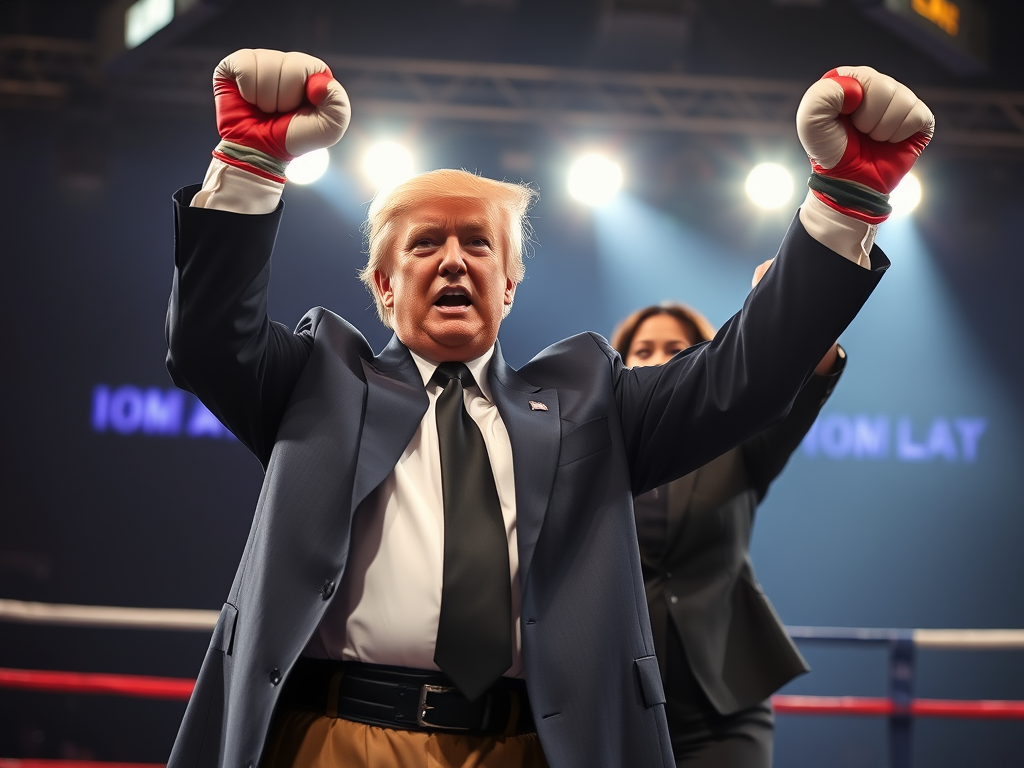
Picture: Fighter Donald Trump won big over Kamala Harris, Fight, fight, fight!
On Wednesday, Kamala Harris gave a speech, and she said that many people in the U.S. feel like the U.S. is entering a dark time. I hope that is not the case, Harris said. The media is also telling us that everything is dark now. Young people want to move to another country, legacy media is telling us.
But, wait a minute. What in the world is going on here? People on the left side, including legacy media are negative and live in darkness. It seems like they don`t believe in the future. But what about the next president? He cannot be in the same camp. Can he? No way.
Trump claimed victory at around 2.30 a.m., pledging to usher in a «golden age» for the United States of America, and «Make America Great Again.» (keep in mind that the stock market and the crypto market went straight up on Wednesday. Investors love Trump! A big win for capitalism).
Not only that. Furthermore, Trump said: «This is a movement like nobody`s ever seen before and, frankly, this was, I believe, the greatest political movement of all time. There`s never been anything like this in the history.»
We must remember that millions of people have rejected the leftists, and there must be a reason for that. This is not only happening in the U.S. but also in Europe. Elon Musk is one of them. He used to be on the left side politically, but now, he is a Republican. And he is not alone.
What makes me so angry is all the BS we hear from the leftists and the legacy media. Let`s take a look at Kamala`s speech today. For example, she said:
«A fundamental principle of American democracy is that when we lose an election, we accept the results. That principle, as much as any other, distinguishes democracy from monarchy or tyranny. And anyone who seeks the public trust must honor it.»
Let me remind you all of something nobody is talking about anymore. The Russia collusion. When Donald J. Trump won the election in 2016, the leftists, and the legacy media, claimed Trump and his campaign might have coordinated with Russian efforts to interfere in the U.S. election.
While several individuals associated with Trump`s campaign were investigated for potential ties to Russian operatives, Mueller`s final report did NOT establish sufficient evidence that the Trump campaign knowingly coordinated with Russian interference efforts.
The report did, however, detail numerous contacts between Trump campaign officials and Russian nationals, which raised ethical and legal concerns.
The investigation remains a significant and divisive topic, as its findings impacted U.S. political dynamics, the public’s trust in institutions, and discussions around election security.
We can all see how the leftists and the legacy media are hiding this. They started it all in 2016, and it has had a huge impact on voters. People on the left side are destroying their own party. And this is exactly what we all face now. The Democrats have lost credibility, and need to work hard to come back on track again. Voters can see it, and they are NOT stupid.
On top of that. Many people on the left and certain political figures claimed that Donald J. Trump`s victory in the 2016 election was illegitimate. Can you believe that?
These claims were based primarily on the interference of Russia in the 2016 election, as detailed in the Mueller Report, and the fact that Trump won the Electoral College while losing the popular vote by nearly 3 million votes.
But it doesn`t stop here. We can all see how many people on the left side always attack people on the right side. Right after the U.S. election in 2016, the leftists started a campaign called
#NotMyPresident.
Following the election, many of Trump`s opponents used the hashtag #NotMyPresident, especially among liberal and left-wing groups, to express their rejection of his presidency, arguing that he did not win the election fairly.
But this, time Donald J. Trump won BIG! And that makes it difficult to deny the results. Therefore, Kamala Harris said in the speech on Wednesday: «Now, I know folks are feeling and experiencing a range of emotions right now. I get it. But we must accept the results of this election».
Yes, Kamala Harris. That`s right. More than 70 million voted for Trump and they aren`t stupid.
Let me finish this article by telling you what a democracy is:
Democracy is a system of government in which power is vested in the people, who rule either directly or through freely elected representatives. The core principle is that citizens have the right to participate in decision-making, typically through voting in elections, ensuring that the government reflects the will of the people.
The U.S. is often categorized as a democracy, but the United States is more often accurately defined as a constitutional federal republic. So, the United States is often described as both a democracy and a constitutional federal republic.
The U.S. is a federal republic, which means that it is made up of states that share sovereignty with a central government. The Constitution serves as the foundational legal framework that defines the structure of the government and the rights of the people.
The «Constitutional» part signifies the importance of these legal documents in limiting governmental power and protecting individual rights.
In essence, while the U.S. is a democracy in the sense that people vote and have a role in governance, it is also a constitutional federal republic because of the distribution of power between federal and state governments, and the rule of law established by the Constitution.
Finally, Abraham Lincoln said a democracy is «of the people, by the people, for the people.» The word democracy comes from the Greek words «demos,» meaning people, and «Kratos,» meaning power. So, democracy can be thought of as «the power of the people.»
It is a way of governing that depends on the will of the people. More than 70 million voted for Trump, and this is how a democracy works—it is the will of the people. Congratulations!
Disclaimer: The views expressed in this article are those of the author and may not reflect those of Shinybull.com. The author has made every effort to ensure the accuracy of the information provided; however, neither Shinybull.com nor the author can guarantee such accuracy. This article is strictly for informational purposes only. It is not a solicitation to make any exchange in precious metal products, commodities, securities, or other financial instruments. Shinybull.com and the author of this article do not accept culpability for losses and/ or damages arising from the use of this publication.
You all know that Legacy Media attacked Donald Trump, and continue to do it. But what the Legacy Media and all other people on the left side actually have done is completely wrong. And if you don`t react to the bad things they have done, you have to look at yourself in the mirror.
I`m serious folks. I`m not a doctor or a psychiatrist, but what we have witnessed is bullying. And that has become a really big problem in the West. Yes, not only in America but in the West. If you don`t like the bullying and want to change it, you must look at yourself in the mirror.
And if you want to change the world, you need to start with yourself, because it all starts within. That`s how easy this is.
Dr. Phil knows this much better than me because he has studied people for about 45 years. And he knows what he is talking about. But is he speaking up? Oh, yes he is. He gave a speech in Madison Square Garden a few days ago, and he talked about bullying.
Dr. Phil doesn`t like or agree with everything that Donald Trump does or says. Nor do I. Who does that? But Dr. Phil didn`t stand up for Trump. «Lord knows he doesn`t need me to stand up for him,» he said in the speech.
Just take a look at what the rude mob has done to Trump. «He`s tough as an old army boot. He`s got lots of enemies, different groups that are scared, and between them, they have impeached him, indicted him, raided him, railroaded him, shot him, and sued him. And where is he?
He is still standing. He just keeps on coming because he loves this country too, Dr. Phil said.
Dr. Phil had a speech at a Trump rally because he was standing up for the people who have declared their support for Donald Trump, or they got found out, or they want to do it but they`re too intimidated.
Intimidated? Yes, because you all know what happens when somebody in this country says, hey, I`m going to vote Republican, I`m going to vote Donald J. Trump?
As Dr. Phil said, they get canceled, intimidated, marginalized, excluded or even fired or boycotted. And you know what that means? In short, that adds up to being bullied!
And here comes the best part. Dr. Phil said, «Now we`re talking about something I know a hell lot about. Now you`re in my wheelhouse, buddy. I may not be an expert in politics, but I am an expert about bullying!»
Bullying is when you seek to harm somebody, you seek to intimidate, coerce, cause distress, fear, or risk to their well-being, and it can be physical, verbal, relational, or cyberbullying.
And it`s always wrong when you bully somebody. And that`s what`s going on.»
«Now, let me tell you what the critics are going to say when they hear me talking about this. They’re going to say, well, now wait a minute, come on. Isn’t Trump a bully? And let me tell you why the answer to that question is no.
Because to be a bully, there has to be an imbalance of power. And when there’s not, it’s just called a debate.
And he’s just better at it than anybody else. It’s called debating. It’s called arguing. It’s just – even name-calling. But it’s not bullying unless there’s an imbalance of power. And whoever he talks to, they’ve got a microphone, they got on their big-boy pants, they got a stage, they got everything else. He’s just better at it,» Dr. Phil added.
«And the same thing is true. When the Democrats or Harris call him fascist, Hitler, racist, misogynist, or a crook, is that bullying? Well, not really. It’s ugly. But with the First Amendment, which we all want to keep, there’s no imbalance of power, so it’s not bullying.
It’s just like when he does. It may not be the best use of energy, but when you attack civilians, when you attack a citizen and you use the power of the internet, you use mob mentality, you incite people to gang up and cause boycotts, then it’s beyond ugly.
And that’s what’s happening in this country right now, and that’s not OK. There is an imbalance of power there, and it’s time that every one of us close ranks. We have to stop this now,» Dr. Phil said in the speech.
And Dr.Phil is right. But this is not only a problem in the U.S.; we see it all over the West. Like I said earlier in this article, it all starts within. Take a look at yourself in the mirror.
Legacy Media is the worst bully machine we have in this society, and it`s disgusting to see how they have treated Trump for years. Absolutely disgusting. We also have to remember what Karma is. If you bully someone, the shit will sooner or later come back to you.
What comes around, goes around!
I don`t care much about politics and politicians, but I really care about bullying. Take action now. Look in the mirror, and change the world. Start today!
Disclaimer: The views expressed in this article are those of the author and may not reflect those of Shinybull.com. The author has made every effort to ensure the accuracy of the information provided; however, neither Shinybull.com nor the author can guarantee such accuracy. This article is strictly for informational purposes only. It is not a solicitation to make any exchange in precious metal products, commodities, securities, or other financial instruments. Shinybull.com and the author of this article do not accept culpability for losses and/ or damages arising from the use of this publication.
The Korean Peninsula was inhabited as early as the Lower Paleolithic period. Its first kingdom was noted in Chinese records in the early 7th century BCE. The succeeding Korean Empire (1897 – 1910) was annexed in 1910 into the Empire of Japan.
Japanese rule ended following Japan`s surrender in World War II, after which Korea was divided into two zones: a northern zone, which was occupied by the Soviet Union, and a southern zone, which was occupied by the United States.
After negotiations on reunification failed, the southern zone became the Republic of Korea in August 1948, while the northern zone became the communist Democratic People`s Republic of Korea the following month.
In 1950, a North Korean invasion began the Korean War, which ended in 1953 after extensive fighting involving the American-led United Nations Command and the People`s Volunteer Army from China with Soviet assistance.
The war left 3 million Koreans dead and the economy in ruins.
The May 16 coup of 1961 led by Park Chung Hee put an end to the Second Republic, signaling the start of the Third Republic in 1963.
South Korea`s devastated economy began to soar under Park`s leadership, recording one of the fastest rises in average GDP per capita.
Despite lacking natural resources, the nation rapidly developed to become one of the Four Asian Tigers based on international trade and economic globalization, integrating itself within the world economy with export-oriented industrialization.
The Fourth Republic was established after the October Restoration of 1972, in which Park wielded absolute power.
The Yushin Constitution declared that the president could suspend basic human rights, and appoint a third of the parliament.
Suppression of the opposition and human rights abuse by the government became more severe in this period
South Korea has since then had a huge economic success. They have big companies like Samsung (which is the biggest company in South Korea), LG Energy Solution, Hyundai, and Kia to name a few.
On top of that, they also have BTS which is a boyband from South Korea. According to the Hyundai Research Institute, BTS was estimated to generate around $3,6 billion annually for the South Korean economy.
In some years, their direct and indirect contribution has been as high as $4,6 billion, which is comparable to major multinational corporations. BTS has been estimated to contribute around 0,3% to 0,5% of South Korea`s GDP in recent years.
This is a remarkable figure for a single music group, considering the country`s GDP was around $1,63 trillion in 2020.
South Korea`s economic success is well known all around the world, and they has become an economic powerhouse. But right now, it seems like their economic model is running out of steam. The economy has been slowing for years. It has basically stopped.
The economy in South Korea is on the way to be like Japan. What in the world is going on?
It all started in the 1950`s. Their economic growth was 10%, and it reached the top in the 1980`s. Then it began to slow. Growth in the 90`s declined to around 7%. Ten years later, the growth went down to 4%. In 2010, their growth was only 3%.
But something has happened in the last five years. The growth has been slowing year by year. This is what’s happening with the economy as they get richer. It happens in all rich countries. But, in South Korea, it seems like this is not temporary. It seems to be a new normal.
Bank of Kora (BOK) has warned that South Korea`s economy may enter negative territory in the next decade. The country is on a declining trajectory. Unless this is going to change, the next generation will be worse off than their parents.
But, how is it possible that a successful country like South Korea with so many high-tech companies can decline like this? Well, it has its own explanation. We need to look at their economic model, and how it came to be, and how it operates today.
The core of the South Korean economy is made up of something called «Chaebols». «Chae» stands for wealth or property, while «Bol» stands for clan or group.
«Chaebols» refers to large, family-owned business conglomerates in South Korea that wield significant influence over the country`s economy.
The influence of chaebols is often cited as a contributing factor to some of South Korea`s economic challenges, but they are not the sole reason for any economic decline. Several factors, including chaebols’ dominance, are at play when examining South Korea`s economic issues.
This is what we see in the U.S., but also in many other places in the West. They blame big corporations, wealthy entrepreneurs, and investors.
It is the concentration of economic power. Chaebols control a large portion of South Korea`s economy, leading to less competition. Their dominance can stifle small and medium-sized enterprises (SMEs), limiting innovation and growth in other sectors.
Chaebols have also been involved in corruption scandals, often using their power to influence political decisions. This has led to inefficiency in governance and public discontent, undermining economic reforms.
Over-reliance on Export-driven Growth is also considered to be a challenge. Chaebols are heavily focused on industries like electronics, shipbuilding, and automobiles, which are export-driven. This makes the South Korean economy vulnerable to global economic shifts and trade disputes, especially in a world where the diversification of industries is increasingly important.
They also face succession and corporate governance issues. Since chaebols are family-controlled, they often face challenges with leadership transitions between generations. This can lead to inefficiencies and financial mismanagement within these conglomerates.
Strong and independent entrepreneurs have made the wealth you and I have today. They have created products that made our lives better, and their companies have grown to be multi-billion corporations. If this is a problem for countries around the world, well, what can we say? If so, this is not the only reason why the growth is slowing.
We see the same going on in South Korea as well as in Japan and many other places. Broader factors are leading to economic challenges, and one of them is the aging population. South Korea has one of the lowest birth rates in the world, leading to a shrinking working-age population.
This demographic challenge puts pressure on economic growth and social welfare systems. This is not only happening in Japan and South Korea. It`s happening in many other places around the world.
We also have a global economic slowdown. South Korea`s heavy reliance on exports means it is susceptible to the global economic downturn. Trade tensions, especially between the U.S., and China, impact South Korea`s major industries.
On top of all that, we have technological disruption. Even though chaebols have driven much of South Korea`s technological advancements, their scale makes them slow to adapt to new digital trends and innovations compared to more agile startups.
So, what is South Korea doing to address these issues? The South Korean government has been working to implement reforms aimed at reducing chaebols’ influence, promoting transparency, encouraging innovation, and supporting small and medium enterprises (SMEs).
While chaebols have contributed significantly to South Korea`s rapid industrialization and growth, their outsized role can create imbalances in the economy, making reforms crucial for long-term, sustainable growth.
In conclusion, while chaebols are not the sole cause of South Korea`s economic challenges, their dominance and related issues do play a role in creating an environment that can hinder broader economic diversification and reform. As we can clearly see, successful entrepreneurs and large corporations can be both beneficial and problematic for an economy.
Unfortunately, we very often see that successful entrepreneurs are attacked. Especially by socialists. But we have to ask ourselves what we should do without them? Because they are the ones that are creating wealth in the long run. No socialism without capitalism. The socialists need money for the welfare system, and that money comes from entrepreneurs who make goods and services.
Entrepreneurs drive innovation, create new industries, and develop new technologies that can improve productivity. Successful businesses, especially startups, can grow into larger companies, and boost economic growth.
Large corporations provide millions of jobs and stimulate related industries (e.g., supply chains, and service providers). For example, companies like Apple Amazon, or South Korea`s Samsung employ a large global workforce and indirectly create additional jobs in the ecosystem surrounding their businesses.
We can see time and time again, that entrepreneurs are often the source of disruptive innovation, bringing new products and services to the market. Successful entrepreneurs can help transform entire industries.
Large corporations often have the resources to invest in research and development (R&D), leading to technological advancements. For example, tech giants like Google and Microsoft invest heavily in artificial intelligence, cloud computing, and other areas that push technological boundaries.
Multinational corporations make a country more competitive on the global stage. For example, South Korea`s chaebols (Samsung, Hyundai) or the U.S. tech giants, like Google and Apple, enhance their countries’ global influence. They also attract foreign investment and contribute to the trade balance through exports.
Successful entrepreneurs and large corporations are not inherently bad for the economy. In fact, they can drive growth, innovation, and global competitiveness. However, their dominance can lead to economic and social imbalances that harm the broader population if left unchecked. Balancing their power with fair regulations, competition, and equitable policies can be essential for sustainable economic development.
Disclaimer: The views expressed in this article are those of the author and may not reflect those of Shinybull.com. The author has made every effort to ensure the accuracy of the information provided; however, neither Shinybull.com nor the author can guarantee such accuracy. This article is strictly for informational purposes only. It is not a solicitation to make any exchange in precious metal products, commodities, securities, or other financial instruments. Shinybull.com and the author of this article do not accept culpability for losses and/ or damages arising from the use of this publication.






 Ket Garden
 Business, Politics, Finans