Tag Archives: Renewable energy

Germany enjoyed the so-called «Wirtschaftswunder,» (economic miracle) but that has come to an end

For decades, Germany was synonymous with economic strength. Ever since World War II, it enjoyed the so-called «Wirtschaftswunder,» or economic miracle that followed the postwar recovery, which blessed Germany with almost four decades of high growth.

High growth thanks to German engineering, and manufacturing industries. The economic growth eventually slowed down, but Germany had established itself as the industrial heart of Europe, fueled by exports of products with large margins like cars machinery, and chemicals.

Companies like Volkswagen, BMW, Siemens, and BASF became global leaders with German products seen as pinnacles of quality and reliability. As a result of all that, people in Germany enjoyed high salaries, and high quality of life.

Their economic model was built on a few key pillars; strong manufacturing base. A highly skilled workforce, commitment to quality, and very strong exports. But this has come to an end. Last year, Germany was the only G-7 economy to shrink. It`s also the group`s slowest-growing economy with a growth to GDP at -0.1%.

It goes up and down. Down -0,5, up 0,1, down, 0,1, up 0,2, down -0,4, up 0,2, and then down again to -0,1.

Picture: Old economy vs New economies

Germany, long considered the economic engine of Europe, is currently facing significant challenges, leading to concerns that its economy may be stalling or «broken.» What in the world is happening in Germany, and what are the key factors that are affecting their economy right now?

It`s an energy crisis. Germany was dependent on Russian Gas. Germany relied heavily on Russian natural gas before the war in Ukraine. The subsequent sanctions and supply disruptions have led to a severe energy crisis, pushing up prices and harming energy-intensive industries like chemicals, manufacturing, and heavy machinery.

They also have a green transition challenge. Germany is trying to transition to renewable energy, but the shift away from nuclear and coal has left the country vulnerable during this energy crunch. This has increased costs for businesses and households, causing slower growth.

Germany`s economy is heavily reliant on exports, especially in industries like automotive and machinery. Global demand has softened, and supply chain disruptions from the COVID-19 pandemic continue to affect production.

The German auto industry, in particular, has been slow to transition to electric vehicles compared to competitors like Tesla, and Chinese manufacturers. This lag is putting pressure on a key pillar of the country`s economy.

Germany`s economy narrowly avoided recession in early 2023, but growth remains sluggish. High inflation and low consumer spending have contributed to weak economic activity. The combination of rising wages, energy prices, and inflationary pressures has increased production costs, leading to reduced profitability for businesses.

On top of that, you have an aging population. Germany`s population is aging rapidly, and the working-age population is shrinking. This is leading to labor shortages in key sectors and higher social welfare costs, creating long-term economic challenges.

In addition; they have migration struggles. While the country has relied on immigration to fill gaps in the labor market, recent shifts in public sentiment and policy restrictions have made it harder to sustain this approach.

Their biggest companies have been there for about 100 years, but there is a shift in the market. Germany has been criticized for lagging behind in digitalization and innovation, particularly in fields like AI and tech start-ups. This is reducing its competitiveness in the global economy.

Another problem is Germany`s heavily regulated business environment and complex bureaucracy. This can stifle innovation and make it harder for new businesses to scale up.

Like many others, Germany has trade challenges and the global demand is weak. As the global economy faces uncertainty, especially with China`s slowing growth, demand for Germany`s exports has dropped.

Germany`s economic model has long been dependent on strong export markets, so this is a major issue!

At least; EU Tension. Economic divergence within the European Union, especially between northern, and southern European economies, adds another layer of complexity, affecting Germany`s trade relations within the bloc.

It all started in France. Yellow Vest protesters went to the streets for months and years and protested against higher oil prices, electricity bills, and expensive toll stations. Their standard of living was shrinking.

This happened at a time when Donald Trump was cutting taxes and made the best economy in the U.S. ever. People in France asked for a Trump-like figure, but everything has gone straight up since then, and now we see severe problems in Germany and other places.

Picture: Yellow Vest protesters against high oil prices and low standard of living

This is happening at a time were productivity in the U.S. is great. Germany`s productivity is down -0,1%, while the productivity in the U.S. is up 3%. They are the best. They are at the top of the list! Even better than China! And the stock market goes up. Wow!

Germany`s economy is not «broken,» but it is facing severe challenges. Energy costs, inflation, global demand weakness, and structural issues in key industries like manufacturing are causing slower growth.

Long-term concerns like demographic changes and lagging investment in innovation also threaten future competitiveness. While these challenges are significant, Germany has strong economic fundamentals and could recover with strategic reforms and investments.

However, the current climate is tough, and the country is at a critical point in addressing these issues. Germany is in trouble.

Disclaimer: The views expressed in this article are those of the author and may not reflect those of Shinybull.com. The author has made every effort to ensure the accuracy of the information provided; however, neither Shinybull.com nor the author can guarantee such accuracy. This article is strictly for informational purposes only. It is not a solicitation to make any exchange in precious metal products, commodities, securities, or other financial instruments. Shinybull.com and the author of this article do not accept culpability for losses and/ or damages arising from the use of this publication.
Leave a comment

Filed under Politics

President Donald Trump will impose duties of as much as 30% on solar panels made abroad

Globalization is the word. All the world leaders in the Swiss ski resort of Davos are talking about it. And most of the worlds political and corporate elite defend globalization. But President Trump did something on Monday that some other leaders dont like.

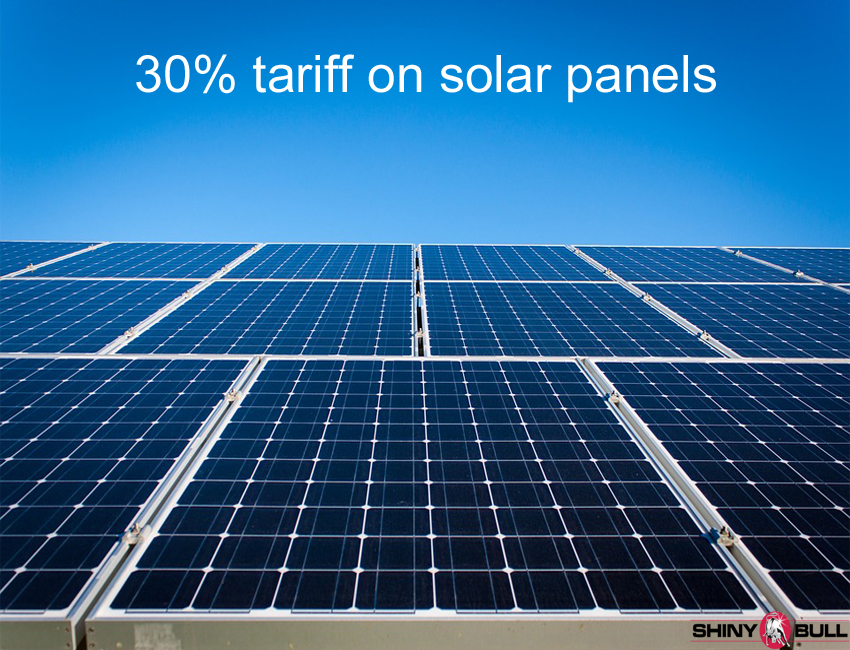
He slapped 30% tariff on imported solar panels and washing machines, and that is his first step towards his campaign promise to get tough on China. Critics say that this step can slow down a fast-growing industry and destroy thousands of domestic manufacturing jobs.

President Emmanuel Macron will have speech in the Swiss ski resort of Davos on Wednesday. One of the most important things he will talk about is Globalization. On Friday, Mr Trump will also have a speech in Davos, and he will talk about his «America first» strategy.

Why in the world is Mr Trump doing this if it is bad for the solar industry and its jobs? Relax. This is not a new case and we have heard about this in many years. Former President Barrack Obama did the same in 2012.

In May, 2012, the Obama administration called for hefty tariffs on Chinese-made solar panels and cells. They were arguing China has been illegally «dumping» under-priced products on the U.S market.

In December 2014, The Commerce Department began closing a chapter in a protracted trade conflict with China over solar equipments, approving a collection of steep tariffs on importers from Taiwan and China.

They found that the companies were selling products below the cost of manufacture. On top of that they found that the Chinese companies were benefiting from unfair subsidies from their government.

The department announced anti-dumping duties of up to about 80% on imports made in China, and rates up to about 30% on imports of solar cells made in Taiwan. Some experts in the solar industry say this tariff will return to fair trade.

This is what all this is about: fair trade. This trade conflict has its roots in a flood of inexpensive Chinese solar products. This Chinese strategy pushed many American manufacturers out of business because of their reduced prices on solar panels.

Leaders are split over the case, and this long-simmering conflict has now ended with a 30% tax on Chinese solar panels. Mr Trump has promised to boost manufacturing jobs by cracking down on Chinese imports. It will create jobs and build or expand factories on U.S soil.

President Trump is doing this because he will defend American workers. He will defend American farmers and their ranchers. He will also defend all other businesses. He will «Make Amerian Great Again.»

Some people do not agree with Mr Trump. They said yesterday that Trump`s decision will kill American manufacturing jobs, not create them.

The Solar Energy Association has projected tens of thousands of job losses in the $28 billion industry.

Disclaimer: The views expressed in this article are those of the author and may not reflect those of Shiny bull. The author has made every effort to ensure accuracy of information provided; however, neither Shiny bull nor the author can guarantee such accuracy. This article is strictly for informational purposes only. It is not a solicitation to make any exchange in precious metal products, commodities, securities or other financial instruments. Shiny bull and the author of this article do not accept culpability for losses and/ or damages arising from the use of this publication.

———————————————–advertisement——————————————————-

Polo Shirt

High quality Polo shirt with Shinybull logo. This version is made from breathable 100% cotton. Short sleeves and ribbed armbands.

$125.00

Polo Shirt

High quality Polo shirt with Shinybull logo. This version is made from breathable 100% cotton. Short sleeves and ribbed armbands.

$125.00

Leave a comment

Filed under Energy, Politics

The focus is on US Oil production, which, as anticipated in earlier forecasts, is rising strong

Crude Oil has been trading flat for about 12 months now. Since June 2016, WTI Crude Oil has traded at around $50, but now it is in a bearish downtrend. Investors are conserned, shorting and selling oil with both hands.

Immediate concerns about stubbornly high stocks due to rising global production are pressing oil prices, which have fallen to levels not seen since the OPEC ministerial meeting at the end of November.

According to IEA`s report, in April, total OECD stocks increased by more than the seasonal norm. For the year-to-date, they have actually grown by 360 kb/d. Their provisional monthly data for May suggests that OECD stocks might, overall, be little changed, but recent US weekly data suggests that rising domestic production, high imports, low exports, and weaker gasoline demand, have combined to send stocks higher.

The implied market deficit in 2Q17 was 0,7 mb/d but now this has narrowed to 0,5 mb/d. The reason for this are a reduction in demand growth, mainly because of weaker Chinese and European data, and an increase in global supply.

Based on our current numbers, assuming stable OPEC production, market deficits should be significant in 2H17, although adverse changes to demand and supply data can erode prospective stock draws.

The focus is on US production, which, as anticipated in earlier forecasts, is rising strong.

For 2017, IEA expect US supply to grow by 430 kb/d and the year will end with production there 920 kb/d higher than at the end of 2016. IEA`s first look at 2018 suggests that US crude production will grow year-on-year by 780 kb/d.

Such is the dynamism of this extraordinary, very diverse industry it is possible that growth will be faster.

In 2018, IEA expect non-OPEC production to grow by 1,5 mb/d, which is slightly more than the expected increase in global demand.

While OPEC countries collectively have broadly implemented their cuts, some members have been less than holy diligent. Iraq has achieved a compliance rate of only 55% so far this year, and Venezuela and the UAE are laggards.

Two OPEC members not included in the deal have recently seen increases in production: Libya`s output has reached nearly 800 kb/d, a level not seen since 2014, and Nigeria has announced the lifting of force majeure for Forcados exports, potentially making available to the market more than 200 kb/d.

If Libya and Nigeria continue to grow their output these extra barrels dilute the value of OPEC`s output accord and contribute to delaying the re-balancing of the market.

The currency used to express re-balancing is the five-year average level of oil stocks. OECD stocks are currently 292 mb above this level. Indeed, based on the outlook for 2017 and 2018, stocks might not fall to the desired level until close to March 2018. IEA have regularly counselled that patience is required on the part of those looking for the re-balancing of the oil market.

Their message is; «Whatever it takes» might be the mantra, but the current form of «whatever» is not having as quick an impact as expected.

What about the demand for Renewable Energy?


Disclaimer: The views expressed in this article are those of the author and may not reflect those of Shiny bull. The author has made every effort to ensure accuracy of information provided; however, neither Shiny bull nor the author can guarantee such accuracy. This article is strictly for informational purposes only. It is not a solicitation to make any exchange in precious metal products, commodities, securities or other financial instruments. Shiny bull and the author of this article do not accept culpability for losses and/ or damages arising from the use of this publication.

Leave a comment

Filed under Energy

Google puts more money in SolarCity

Solar City was founded in July 2006 by brothers Peter and CEO Lyndon Rive, based on a suggestion for a solar company concept from their cousin, Elon Musk, who is the chairman and helped start the company.

The company designs, finance and installs solar energy systems, performs energy efficiency audits and retrofits and builds charging stations for electric vehicles. SolarCity had more than 6312 employees as of December 2014.

SolrCity logo

SolarCity has grown in recent years to meet the rapidly growing installation of solar photovoltaic systems in the United States. The overall U.S market has grown from 440 MW of solar panels installed in 2009 to 3,300 megawatts in 2012, and it is expected to grow rapidly.

In October last year, SolarCity announced it would be offering up to $200 million in solar bonds to launch a new online website to buy the debt, the first registered public offering of such bonds in the United States.

«Corporations are starting to realize the importance of using clean energy», CEO Lyndon Rive said. Historically the companies that have financed solar deployment have been the big financial institutions, but now it seems to be a shift in the market were tech companies are getting into the market and helping to transform a dirty infrastructure to a clean infrastructure.

SolarCity partners with banks, large corporations and the asset-backed market to create project finance funds to finance its lease and PPA (Power Purchanse Agreement) options. SolarCity`s financing partners have included Bank of America, Merrill Lynch, Citi, Morgan Stanley, National Bank of Arizona and U.S Bancorp, among others.

Among SolarCity`s more well known financing partnership was a $280 million fund created with Google to finance residential solar installations in June 2011. The Google Fund was the largest fund of its kind in the U.S, and Google`s largest investment in clean energy.

I wrote about Apple in my recent article that it is spending $848 million on a massive solar farm to power its corporate offices and California stores. Google continues to invest in renewable energy and they announced today that they have invested $300 million in a $750 million SolarCity fund to finance residential solar projects.

This is Google`s second investment in SolarCity.

Renewable energy principal at Google, Siddharth Mundra said today; «We’re happy to support SolarCity’s mission to help families reduce their carbon footprint and energy costs. It`s good for the environment, good for families and also makes good business sense.»

Rive said their biggest competitor is the customer not doing anything with the clean energy and just sticking with the monopoly.

SolarCity installs the systems at no charge to customers and then charges the residents slightly less per month for the energy than they pay their traditional utility, and their new fund will be used to cover the cost of installing solar systems on homes in 15 states in the U.S.

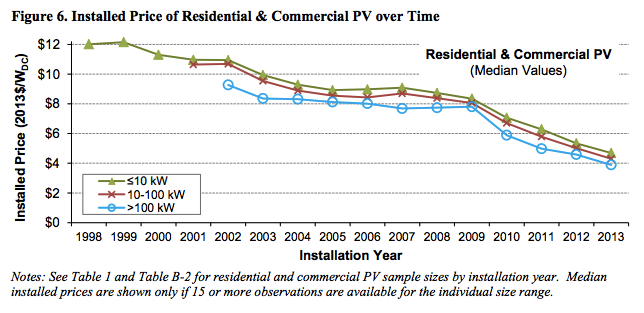
Solar panels are still a niche product, but the cost of solar rooftop systems has been plummeting in recent years. Take a look at the chart below:

solar_price

In their newly report they said that they have reduced installation costs from $2,19 per watt to $2,09. Its net loss of $1,47 per share was a little bit wider that the estimates of $1,27. Q1 EPS loss forecast for a net loss of $1,75 to $1,65 was worse than current expectations. They added a grand total of $3 billion in future contract payments throughout the entirety of 2014.

The stock is down -38,7% last 12 month, but only 1,5% so far in 2015. The 5 billion valuation company traded down -0,34% today. The short interest have been massive since March 2013. From two to twenty million, but seems like it peaked at the end of last year.

Solar power is growing fast and the older energy companies are trying to stop it, and many utilities are now pushing for reforms that would slow the breakneck growth of rooftop solar. American Legislative Exchenge Council are pushing to get rid of solar subsidies.

A study from Lawrence Berkeley National Laboratory argues that this solar business could soon put utilities in dire straits. If rooftop solar were to grab 10 percent of the market over the next decade, utility earnings could decline as much as 41 percent.

You can quick and easy replace a taxi driver with a robot, but I assume it will be difficult to set in a robot instead of a human to install a solar panel.

This sector can push the unemployment rate further down if the demand for the solar panels goes up.


Click the link below and check out the Fan Fund

https://www.eventbrite.com/e/fan-fund-tickets-15580655159


Disclaimer: The views expressed in this article are those of the author and may not reflect those of Shiny bull. The author has made every effort to ensure accuracy of information provided; however, neither Shiny bull nor the author can guarantee such accuracy. This article is strictly for informational purposes only. It is not a solicitation to make any exchange in precious metal products, commodities, securities or other financial instruments. Shiny bull and the author of this article do not accept culpability for losses and/ or damages arising from the use of this publication.

Leave a comment

Filed under Stocks

Renewable energy is the future

The crude oil is back above 50, up over 3% today. A great bounce for oil stocks as well, and it can go back up to about $70 – $75 a barrel, but this can be temporarily. The demand and supply look like the same as it was in 1986, boss Bob Dudley (BP) said to Bloomberg today.

Technically it seems like the oil price has peaked and that a hundred years old oil rally is over, but it all depends on what happens in the world. After the oil slumped in 1986, it came back again during the Iraqi war in 1990, but I don`t hope a new war will turn the price up again this time.

Yesterday I talked about Apple which is the best luxury brand in China right now. Apple is also the biggest company in the world. This is simply because they are selling Internet of things (IoT). It will be the biggest sector ever. It will become about 40 times bigger than internet. But what about the energy sector?

crude-oil

Oil have been the black gold for decades and ExxonMobil (XOM) have been the worlds biggest company before Apple took that place. The biggest oil companies like ExxonMobil, PetroBras (PBR) and total (TOT) are still big, but at some point they will end up writing off tens of billions of dollars worth of standard assets in their oil fields.

The plunge in the price of oil is more than Opec`s attempt to bankrupt U.S oil shale drillers and to destabilize the petro-economies of rivals Iran and Russia. It`s gonna take some time to fill up the world with battery driven cars, but we will also see a new era for solar and wind energy.

This world need to prevent catastrophic climate change, and that`s why we need to act now. Climate change today is fundamentally a development issue, not a pollution problem.

The new shift will probably take place in a few years from now and alternative energy will go through a «phase change» from fringe to mainstream. It`s still early in the stage, and that`s why you don`t hear about it in the media anymore.

It will be a sharp shift and standard assets of coal, oil and natural gas will turn the global economy up side down. First Solar (FSLR) can be one of the biggest in the solar sector and many others are ready. Look at Denmark. They gets 40% of their electricity from wind, while Texas gets 30%.

This is just piece of cake compared to what we will see in the future, when 5 cent/kilowatt-hour solar becomes standard pricing around the world. I wrote about Solar City in January 2014. They are a little bit bigger than First Solar, and I belive in that company in the long run. Up +11% on monday.

What goes up, must come down. Right now it seems like the oil price is moving up again, but once the market starts to discount the end of the fossil fuel era, the crash is just around the corner, and big oil companies like ExxonMobil will lose more than half their current value.

It is when the solar prices is cheaper than fossil fuels it will overwhelm the markets, and that will be a revolution in the making. A technological phase change from oil to solar. From oil to solar and wind power, and that`s gonna overwhelm the energy markets.

The energy movement will be massive. It is when prices goes down to about 4 – 5 cents/kwh the new shift will come, but it may take some time.

Solar-Wind is an owner of 184,6MW of solar and wind projects assets, and they has set a $19 – $21 price range for its 8,7 million shares IPO. Ticker is set to be SLWD. This is a valuation of $200 million. The YieldCo planed cash distributions of $26 million ($1,30/share) in 2015.

TerraForm`s (TERP) successful IPO could bode well for Sol-Wind. The SunEdison YieldCo remains up 30% from its $25 IPO price in spite of the huge selloff seen in solar stocks in recent months.

TAN Guggenheim

If you`re not familiar with stock picking, I suggest you look at Guggenheim Solar ETF (TAN). As you can see from the chart above, there has been a big selloff in the solar sector, but this sector will come back again, but it is very early right now. TAN is up +4,79% so far today.

The Prime Minister in India, Narendra Modi reiterated plans for the country to install as much as 100 gigawatts of photovoltaic capacity by 2022. President Obama stated that the U.S will stand ready to speed this advancement with additional financing. China has 33,4 gigawatts installed. They are undergoing a photovoltaic expansion that targets 100 gigawatt capacity by 2020.

Personally, I love clean and renewable energy!

Green energy is the future.


Click the link below and check out our Fan Fund

https://www.eventbrite.com/e/fan-fund-tickets-15580655159


Disclaimer: The views expressed in this article are those of the author and may not reflect those of Shiny bull. The author has made every effort to ensure accuracy of information provided; however, neither Shiny bull nor the author can guarantee such accuracy. This article is strictly for informational purposes only. It is not a solicitation to make any exchange in precious metal products, commodities, securities or other financial instruments. Shiny bull and the author of this article do not accept culpability for losses and/ or damages arising from the use of this publication.


Leave a comment

Filed under Energy