Tag Archives: Innovation

This Is Not a Global Recovery. It’s an American One

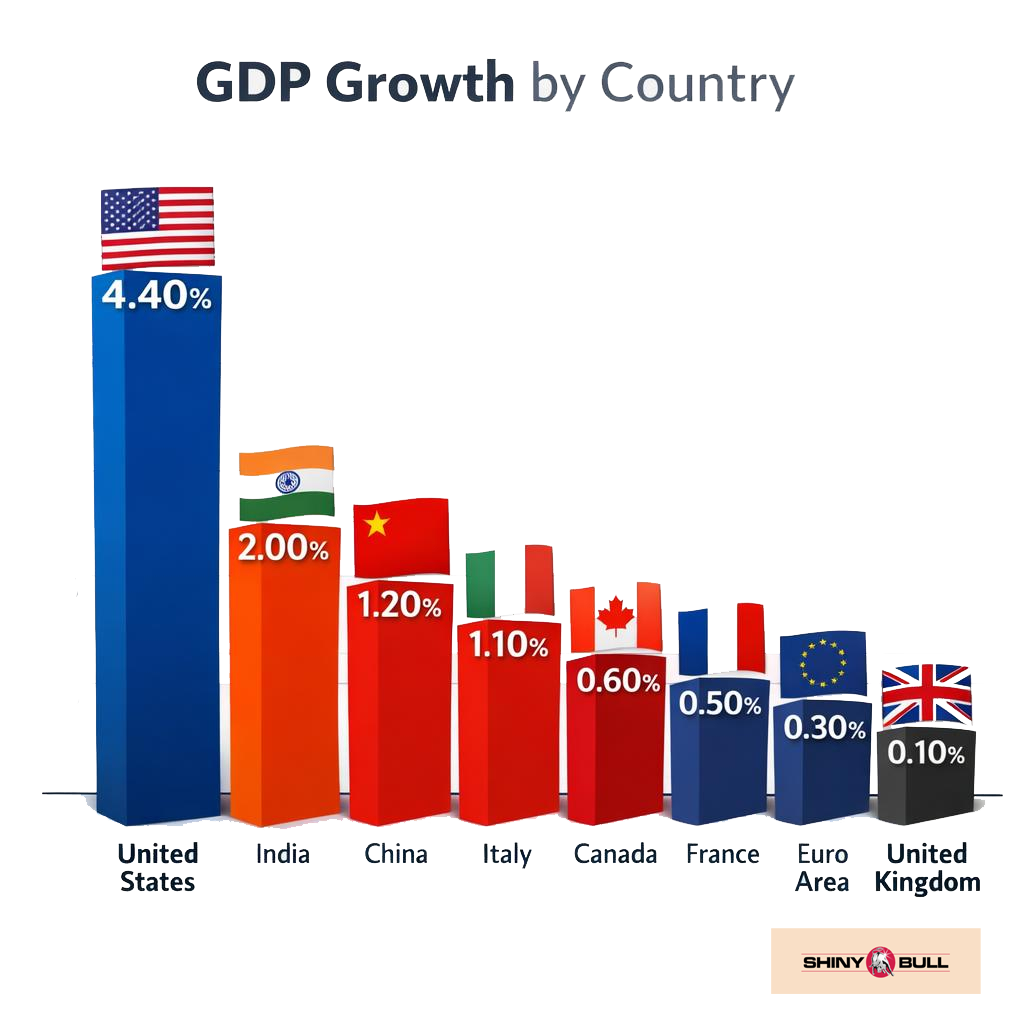
When we look at GDP growth, one thing becomes very clear: the United States is in a league of its own. With growth at 4.4 percent, the U.S. economy is running far ahead of other major economies.

India comes in second — but at less than half the U.S. rate. China, once the global engine of growth, is now barely above one percent. Europe paints a much weaker picture: the euro area, France, and the UK are hovering near stagnation. Italy does a bit better, but still far behind the U.S.

The takeaway is simple: global growth is no longer evenly distributed. The world is increasingly dependent on one dominant economic engine — the United States.

Trumponomics, Taxes, and Tariffs

This dominance is not accidental. Trumponomics — including tax cuts, deregulation, and strategic trade measures — has been designed to strengthen domestic growth. Lower taxes have incentivized investment, increased consumption, and created a multiplier effect across multiple sectors. Simply put: lower taxes mean more growth.

Tariffs have also contributed, protecting key industries and encouraging reshoring. While not the main driver of GDP growth, they amplify the effect of pro-growth policies, keeping production and capital inside the United States.

Crypto and Blockchain: America’s Catalyst

Digital infrastructure, crypto, and blockchain have emerged as powerful catalysts for U.S. economic dominance. While crypto-related activity still represents only a small fraction of U.S. GDP today, it facilitates faster capital flows, scalable services, and innovative financial systems.

Blockchain doesn’t drive the economy on its own — but it reinforces American economic advantage and positions the U.S. to maintain its lead as digital systems expand.

Blockchains are the future, not just for finance, but for the infrastructure of value itself. And America is at the forefront.

Innovation vs. Bureaucracy

A key driver behind continued U.S. economic growth is innovation—particularly in advanced manufacturing and energy technology. Companies like Tesla, led by Elon Musk, have played a pioneering role by pushing battery technology to a new level, giving the U.S. a clear competitive advantage in electric vehicles and energy storage.

In contrast, Europe—and Germany in particular—has been slowed by regulatory complexity and bureaucratic inertia. While innovation in the U.S. is often enabled by speed, scale, and risk-taking, European industry must navigate dense layers of regulation, approval processes, and political compromise.

For Germany, whose economy is deeply tied to the automotive sector, this loss of momentum has broader consequences. And as Germany remains the economic locomotive of the EU, the effects of slower innovation are amplified across Europe—raising the question of whether regulation has begun to outweigh competitiveness.

One Engine, Many Passengers

Put it all together: Trumponomics, smart policy, tariffs, and innovative digital infrastructure. The result? America continues to dominate while Europe struggles with stagnation, and China slows. Emerging markets chase momentum.

Growth today in the United States comes not from soil or oil alone, but from systems designed to turn value into profit. Lower taxes, strategic policy, and innovation create a self-reinforcing cycle — one that keeps the U.S. in the driver’s seat.

Oil once defined power. Today, code, capital, and blockchain define it. And in that world, the United States still owns the refinery.

Disclaimer: The views expressed in this article are those of the author and may not reflect those of Shinybull.com. The author has made every effort to ensure the accuracy of the information provided; however, neither Shinybull.com nor the author can guarantee the accuracy of this information. This article is strictly for informational purposes only. It is not a solicitation to make any exchange in precious metal products, commodities, securities, or other financial instruments. Shinybull.com and the author of this article do not accept culpability for losses and/ or damages arising from the use of this publication.

Leave a comment

Filed under Politics

When State Overreach Meets Economic Reality: Lessons from Venezuela to Scandinavia

Recently, reports have emerged that former Venezuelan President Nicolás Maduro was captured by the Trump administration. While controversial from an international law perspective, this event highlights a deeper truth: the people of Venezuela were dissatisfied with their leadership, and Maduro’s governance clearly failed to meet the country’s needs.

Venezuela was once one of the richest countries in Latin America, largely due to its oil wealth. In the mid-20th century, Venezuela enjoyed high per capita income, robust infrastructure, and a thriving economy. But over time, the state increasingly intervened in the economy. Hugo Chávez and later Maduro implemented policies that undermined private enterprise, replaced skilled professionals in the oil industry with political appointees, and took control of private businesses.

The result was a collapse in production, hyperinflation, and widespread shortages. Here we see the central lesson: state overreach and mismanagement can destroy even the richest economies if it replaces incentive-driven entrepreneurship with central planning.

A striking historical parallel can be found in Sweden before 1990. Sweden was among the wealthiest countries in the world, but extreme taxes and heavy regulation prompted many successful entrepreneurs, like Ingvar Kamprad of IKEA and H&M’s founders, to relocate abroad. The country faced stagnant productivity and capital flight. By the early 1990s, Sweden was forced to liberalize its economy—cutting taxes, promoting competition, and allowing private enterprise to flourish again. Today, Sweden thrives because it balanced state welfare with market freedom.

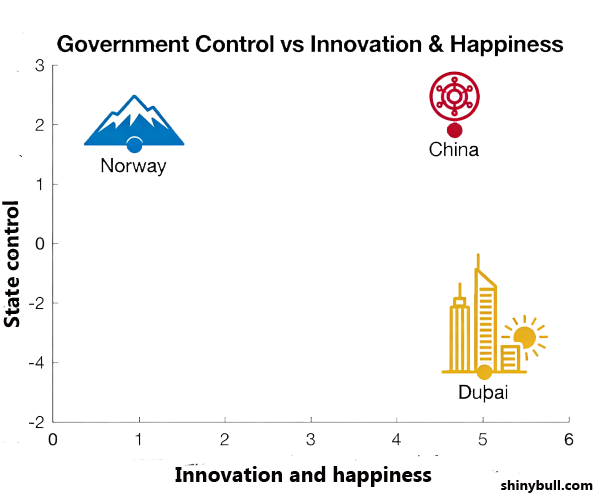
This situation is not unique to Sweden. Norway now faces a similar challenge, as many wealthy individuals relocate to countries like Switzerland, seeking lower taxes and more favorable conditions for capital and innovation. The lesson is clear: overburdening taxes and excessive state control can drive away the very people and resources that sustain growth.

Beyond Scandinavia, China illustrates a different form of state intervention. While nominally communist, China has prospered because it maintained market incentives and became the “factory of the world.” Similarly, East Germany under the Cold War lacked both natural resources and market-driven productivity. Even with state support from the Soviet Union, the system could not generate sustainable wealth. Had East Germany possessed major natural resources or been a manufacturing powerhouse, it might have prolonged stability, but the lack of institutional and economic freedom would still have limited growth.

The pattern is consistent across history: states cannot create wealth—only individuals and businesses can. The state can protect property, enforce contracts, and provide social safety nets, but replacing entrepreneurship and market signals with centralized control often leads to stagnation, collapse, or both. A striking modern example is Spotify, a private, market-driven company founded in 2006.

By 2024, Spotify generated over €15.6 billion in revenue and reached profitability for the first time, with more than 675 million active users worldwide. Impressively, Spotify’s market capitalization has topped €100 billion — rivaling the valuation of Equinor, Norway’s state-owned energy giant. This contrast highlights a central economic truth: value creation tends to emerge where innovation and market forces are free to operate, not solely where the state dominates. Sweden’s reform after 1990, China’s pragmatic blend of central authority and market incentives, and Venezuela’s tragedy all confirm this principle.

As the world grapples with economic uncertainty, demographic changes, and resource limitations, the key takeaway is simple: growth and innovation thrive when incentives are clear, markets function, and the state sets the rules rather than dictates the outcomes. Heavy-handed state intervention may appear morally satisfying, but history demonstrates that it usually comes at the cost of long-term prosperity.

Disclaimer: The views expressed in this article are those of the author and may not reflect those of Shinybull.com. The author has made every effort to ensure the accuracy of the information provided; however, neither Shinybull.com nor the author can guarantee the accuracy of this information. This article is strictly for informational purposes only. It is not a solicitation to make any exchange in precious metal products, commodities, securities, or other financial instruments. Shinybull.com and the author of this article do not accept culpability for losses and/ or damages arising from the use of this publication.

Leave a comment

Filed under Politics

World Economic Forum 2026 Kicks Off in Davos — and Donald Trump Leads Record U.S. Delegation

Davos, Switzerland — January 19, 2026
The annual World Economic Forum (WEF) gathering in the Swiss Alps begins this Monday under the theme “A Spirit of Dialogue.” Leaders from governments, business, civil society and science will convene through January 23 to confront what organizers call the most pressing global challenges of our time: geopolitical instability, economic fragmentation, technological disruption and climate change.

This year’s meeting is poised to be one of the most unpredictable yet — largely because U.S. President Donald Trump is attending in person and will lead the largest-ever American delegation to Davos.

Trump Returns to Davos with a Big Team

Trump’s presence is notable not only for its scale but also for its political symbolism. His administration will be accompanied by several Cabinet members and senior officials — including the Secretary of State, Treasury Secretary, Commerce Secretary, trade representatives, and top White House aides — marking a record-size U.S. contingent.

Last time Trump engaged with the forum, his participation was virtual and aired amid controversy. This year’s in-person return is expected to attract rock-star style attention and intense scrutiny from global leaders, the media and activists.

A “Spirit of Dialogue” Amid Global Tensions

The forum’s theme emphasizes cooperation and conversation in a world marked by deepening geopolitical fault lines. Amid economic competition, rising tariffs and shifting alliances, WEF organizers are pushing dialogue as essential for progress.

But Trump’s trademark slogan, “America First,” poses a direct challenge to the forum’s ethos of multilateral cooperation. Allies and competitors alike will be watching to see how — and if — Trump’s policies can align with broader global ambitions for cooperation, especially on trade, security and technology.

Key Issues on the Agenda

While WEF is traditionally focused on economic strategy and global collaboration, this year’s agenda is exceptionally crowded:

  • Geopolitical and security challenges: Ukraine remains a central topic, with talks planned involving U.S. officials and Ukrainian representatives about peace frameworks and reconstruction support.
  • Economic fragmentation: A recent WEF risk survey found that economic confrontation — including tariffs and trade tensions — has overtaken armed conflict as a top risk to global stability.
  • Artificial Intelligence: Discussions about how to govern and deploy AI responsibly are expected to be key, with tech leaders from companies such as Microsoft and Nvidia attending.
  • Business and innovation: With roughly 3,000 participants and about 850 CEOs from top global companies, business and investment outlooks will be central to many discussions.

Trump’s Global Footprint Heading into Davos

Trump’s foreign policy moves over the past year — from threats of tariffs over Greenland to confrontations with Iran and Venezuela — have reshaped parts of the international agenda. European leaders are preparing for high-stakes talks with the U.S., including possible retaliatory measures tied to trade tensions that are already threatening transatlantic unity.

Although climate and “woke” cultural topics were reportedly de-emphasized in programming after negotiations with U.S. officials, the core business of the forum — economic cooperation and innovation — remains indispensable.

A Pivotal Moment for Global Order

This year’s Davos is widely perceived as a test of whether global leaders can adapt the old world order to 21st-century challenges — or whether a fundamentally new framework for cooperation will emerge. With Trump’s America firmly in the spotlight and AI and economic confrontation rising as cross-cutting issues, the balance between national interests and collective global action will be under intense scrutiny.

As the world’s eyes turn to the Swiss Alps, the question is no longer whether dialogue will take place — but whether it can translate into real solutions.

Disclaimer: The views expressed in this article are those of the author and may not reflect those of Shinybull.com. The author has made every effort to ensure the accuracy of the information provided; however, neither Shinybull.com nor the author can guarantee the accuracy of this information. This article is strictly for informational purposes only. It is not a solicitation to make any exchange in precious metal products, commodities, securities, or other financial instruments. Shinybull.com and the author of this article do not accept culpability for losses and/ or damages arising from the use of this publication.

Leave a comment

Filed under Politics

Kamala Harris lied and said Trump will hike the taxes

Vice President Kamala Harris said in a speech at the DNC convention, that Donald Trump doesn`t fight for the middle class people. She said he is fighting for himself, and his rich friends. Instead of a Trump tax hike, we will pass a middle-class tax cut, she said.

When did Trump say he is planning a tax hike? Never. Trump and the Republicans stand for the opposite. They want to cut taxes and it is their core values. It is the Democrats that want to increase the taxes.

Harris’ economic proposal is 28% corporate tax. 44,6% capital gains tax. 25% tax on unrealized gains. Price controls. No tax on tips, and up to $6K Child tax credit.

Many people do not understand politics, and they don`t know the difference between left and right. They don`t understand the difference between the Democrats and Republicans.

The Democrats on the left side want to steal as much money as they can from people. Republicans do the opposite, and tax cuts are very important to Republicans.

Tax cuts are a significant priority for Republicans in the U.S. Tax policy has been a central issue for the Republican Party for many decades, with tax cuts often being at the forefront of their economic agenda. Here are a few key reasons why tax cuts are important to Republicans:

LIMITED GOVERNMENT: Tax cuts are seen as a way to limit the size and scoop of government. By reducing the amount of revenue the government collects, Republicans aim to curb government spending and encourage more efficient use of resources.

SUPPLY-SIDE ECONOMICS: This economic theory, often associated with Republican policy, suggests that lower taxes lead to increased production, investment, and innovation, which in turn can boost overall economic activity and eventually increase government revenue despite the lower tax rates.

INDIVIDUAL FREEDOM: Many Republicans believe that individuals should have the freedom to spend and invest their money as they see fit, rather than having the government take a larger share through taxation. Tax cuts are seen as a way to enhance personal liberty by reducing government intervention in people`s financial lives.

POLITICAL IDENTITY: Tax cuts have become a core part of the Republican Party`s identity. Prominent Republican leaders, such as Ronald Reagan and George W. Bush, have implemented significant tax cuts during their administrations, reinforcing the party`s commitment to this issue.

Harris said she want to cut taxes, and you can see thousands of people at the DNC convention agree with her, but this is a Republican policy. Saying that Trump will hike taxes is a BIG LIE.

You can also see that nearly all the Democrats Freedom banners, but this is a Republican agenda. They are stealing everything that Trump and the Republicans stands for. Why? They don`t have their own agenda. They don`t have a clear vision for the future. This is embarrassing.

Tax cuts are a cornerstone of Republican economic philosophy, reflecting their broader goals of promoting economic growth, limiting government, and enhancing individual freedom.

Disclaimer: The views expressed in this article are those of the author and may not reflect those of Shinybull.com. The author has made every effort to ensure the accuracy of the information provided; however, neither Shinybull.com nor the author can guarantee such accuracy. This article is strictly for informational purposes only. It is not a solicitation to make any exchange in precious metal products, commodities, securities, or other financial instruments. Shinybull.com and the author of this article do not accept culpability for losses and/ or damages arising from the use of this publication.

Leave a comment

Filed under Politics

India`s Prime Minister Narendra Modi is doing something right and they can surpass China very soon

Theresa May is negotiating with the European Union and investors are concerned about a hard landing on these Brexit deals. It`s difficult to know exactly the outcome of the Brexit deal but what we do know is that the British economy grew 1,7% YoY in the second quarter of 2017.

Not so much compared to Chinas 6,9% growth, which is the best G20 country followed by India at 5,7%. Britains economy fell from 2,0% to 1,7% and that is the opposite direction of India`s growth. Can India grow by a greater margin than China this year?


According to IMF, Indias economy will grow by a greater margin than China in 2017. Not only that. Indias innovation growth rate is expected to rise significantly over the next 15 years, placing it ahead of Russia and close to surpassing China, according to a new report.

China is the leading nation in terms of innovation among BRICS countries, but India`s Prime Minister Narendra Modi must be doing something right. India is set to see a surge in innovation and could surpass China by the end of the next decade.

According to Chinas Science Technology Exchange Center, Indias innovation growth rate is expected to rise significantly over the next 15 years, placing it ahead of Russia.

India`s economy is expected to grow by 7,2% in 2017, according to IMF. A new study highlights the growth that can be expected in intellectual advances, such as science and technology, which are often perceived as indicators of future growth.

It`s BRICS Innovation Competitiveness Report 2017 predicted that the innovation competitiveness of India would see a significant rise with its growth rate probably surpassing China between 2025 – 2030.

What is India`s Prime Minister Narendra Modi actually doing right? He has been taking notable steps forward in innovation, supported by a reform agenda.

Government schemes such as Digital India, which expands the countrys online infrastructure, and StartUp India, which promotes financial backing for entrepreneurs, have been unveiled to boost the countrys innovation and technology sectors.

India`s growing information technology and scientific expertise have also helped turn it into an increasingly dominant outsourcing hub.

So far, China is still the leader in terms of innovation competitiveness among BRICS nations, followed by Russia, South Africa, Brazil and India.

Europe is struggling to follow. Ireland is the best country with its 6,10% growth, followed by Romania with 5,9% growth and Estonia with 5,7% growth YoY.

At the bottom in Europe we find Norway with only 0,20% growth, Macedonia by its 0% and at the very bottom Liechtenstein with negative -1,9% growth.

Monaco, Liechtenstein and Luxemburg are the richest countries in the world measured by GDP per capita.


Disclaimer: The views expressed in this article are those of the author and may not reflect those of Shiny bull. The author has made every effort to ensure accuracy of information provided; however, neither Shiny bull nor the author can guarantee such accuracy. This article is strictly for informational purposes only. It is not a solicitation to make any exchange in precious metal products, commodities, securities or other financial instruments. Shiny bull and the author of this article do not accept culpability for losses and/ or damages arising from the use of this publication.

Leave a comment

Filed under Emerging markets