
Tag Archives: IMF

Sell your shares in Zimbabwe before April 1

Chinas GDP growth were 14% a few years ago, but now the worlds second-largest economy is lowering the growth target to about 6,5% – 7% in 2016. 7% is still very good, but the economy is slowing down faster than expected.

The economic growth is slowing while China`s Central government budget deficit as a percentage of GDP is growing. The target is 3% in 2016, and China will continue to be a global economic engine. But what is the next China?

It can be Africa which is a hot commodity, but some investors are in doubt. They think it is unstable and unsafe. Some claims it is so much violence in Kenya, but the infrastructure in Kenya makes it a worthy long-term investment.

Africa

Africa is a growing economy with a huge and young population. It has so far been a daunting place to start and run a company there. Very often, it is expensive to start a new business in Africa.

Bank loans come with double-digit interest rates. The electricity grid is sub-par and diesel generators cost a fortune, but many thing are getting better according to the World Bank.

There is a lot of reform happening in Africa right now.

The World Bank publishes a parallel ranking of the countries that have pushed through the most business-friendly reforms. Five African countries are on the top-10 list, which is Kenya, Mauritania, Senegal, Benin and Uganda.

Botswana is the least corrupt country in Africa which is an important factor for entrepreneurs and their investors. This is a country that rely heavily on revenues from the diamond trade to fuel its growth.

Rwanda is an economic success story. Many years of reforms have made it much more easy to open and run a business, and it is far easier to get credit there. Only one country is better and that is Mauritius.

It has commercial links to India, China and the east coast of Africa. Mauritius is often on top of the ranking list for competitiveness and ease of doing business due to its liberal approach to regulation and taxation. What about Zimbabwe?

Zimbabwe

Zimbabwe had rough days, particularly between 2005 and 2008, were hyperinflation decimated the economy. The Central Bank issued currency with expiration dates of six months, effectively longer than the actual life of the currency.

The American dollar replaced the Zimbabwean dollar as the country`s main currency, and now Zimbabwe has started to retiring it’s almost worthless local currency in favor of the U.S dollar.

35 quadrillion Zimbabwean dollars are equal to US $1.

Monthly inflation rate hit 3,5 million percent eight years ago, and prices doubled every 25 hours. Zimbabwe has the second-worst hyperinflation in history, behind post-war Hungary.

It all started in 2000, when Mugabe changed his economic policy and implemented land reform. Mugabe granted farmland owned by white citizens to indigenous black Zimbabweans. They turned from an agriculture exporter to an importer, which resulted  in 94 percent unemployment rate and hyperinflation.

Zimbabwe is known for its mineral resources. It has the world`s second largest deposit of chrome and platinum after South Africa, and President Robert Mugabe wants to take over all diamond operations.

Zimbabwes leader since 1987, Robert Mugabe eager to nationalize Zimbabwes diamond industry, and news from Zimbabwe leaves little to be desired about the small former British colony.

He says the country`s wealth had been looted by the existing miners.

“The state will now own all the diamonds in the country. Companies that have been mining diamonds have robbed us of our wealth. That is why we have now said the state must have a monopoly,” said Mugabe in an interview with the state broadcaster earlier this month.

Foreign investor also need to hurry up and sell their shares to blacks or close before April 1st.

Companies owned by foreigners face closure unless they sell or give up 51% of their shares to black Zimbabweans by April 1, said indigenization Minister Patrick Zhuwao.

“Comply by that date or close shop, comply by that date or face the full wrath of the law,” Bloomberg quotes Zhuwao, who is also President Robert Mugabe`s nephew.

IMF asked the Mugabe administration to clarify Zimbabwe`s policy on black empowerment. Zimbabwe has agreed to major reforms including compensation for evicted white farmers.

President Mugabe is known for evicting white farmers. In 2010, the Guardian reported that Mugabe used land reforms to reward his allies rather than ordinary black Zimbabweans. The newspaper`s sources reported Mugabe and his supporters owned about 40% of the land seized from white farmers.

The white farmers received no compensations after being evicted.

«If white settlers just took the land from us without paying for it, we can, in a similar way, just take it from them without paying for it,» said Mugabe.

 

sb-star

Disclaimer: The views expressed in this article are those of the author and may not reflect those of Shiny bull. The author has made every effort to ensure accuracy of information provided; however, neither Shiny bull nor the author can guarantee such accuracy. This article is strictly for informational purposes only. It is not a solicitation to make any exchange in precious metal products, commodities, securities or other financial instruments. Shiny bull and the author of this article do not accept culpability for losses and/ or damages arising from the use of this publication.
Leave a comment

Filed under Commodities, Emerging markets, Politics, Stock market

Bank Stocks and Interest Rates

The IMF (International Monetary Fund) predicted the U.S economy would grow only 2,5% in 2015, and that`s down from their previous prediction at 3,1%. IMF urged the Fed (The Federal Reserve) to wait until first half of next year to start raising short-term interest rates.

The U.S central bank has kept its key benchmark rate at a record low near zero since December 2008, and the IMF said the Fed should wait for more signs of improvement. What they will look for is «greater signs of wage or price inflation».

IMF Managing Director Christine Lagarde said «The economy would be better off with a rate hike in early 2016», and Fed Chair Janet L. Yellen said she expects to begin raising rates by the end of the year, while some economist speculate that the Fed will start raising rates in September. They both know much better than me that deflation is more dangerous than inflation, and deflation is what they are fighting against and not inflation.

Many are bullish on bank stocks.


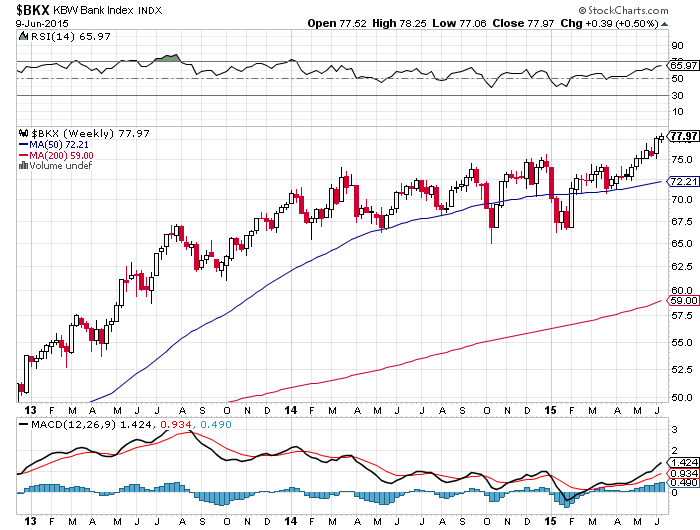
BKX Bank Stocks
The KBW Bank Index is up 0,86% right now. Trading at 77,96 which is up 0,66 points. That`s much better than the bottom at 18,62 on March 6, 2009, but down since the top at 118,06 on May 18, 2007.

Technically speaking, the index is breaking the resistance, and the bank stocks are increasing, while the precious metal is declining. Gold is still in a bearish territory and the price is still below $1,200 an ounce.

What`s going on? Higher rates is good for the banks because they can charge more for loans and earn more because of bigger profits on the spreads between loan rates and deposits. Buoyant outlook for the U.S economy in the second half of 2015, and the expected interest rate hikes blows up the banking index.

In the predictions for 2015 I talked about the interest rate to start to increase in 15 – 18 months, and that should be next year. I also talked about how it will start, and it is predicted to see that the rates will go up slowly.

Banks will benefit from a stronger economy and higher interest rates. The legendary investor Warren Buffett seems to see something in the banks earnings, which reflects more than their current stock valuations.

Warren Buffet and his company Berkshire Hathaway (BRK-A) has added much more to its holdings of Wells Fargo (WFC) and U.S Bancorp (USB), and the banks seems to have taken its reputation back since the financial scandals a few years ago.

Citibank is upgraded to buy by Goldman and the New York-based firm is showing progress in increasing earnings and returning capital to shareholders. Citibank is the only firm in the KBW index that is trading below tangible book value, but that will probably end soon.

Investors are keeping a close eye on bank stocks, especially money center banks, since the Fed has indicated a rise in the interest rate. Their key focus is Bank of America, because they will earn on the rise in interest rates.

If the rates increase 1% it is estimated that Bank of America will increase their earning by a whopping 20%.

Rising dollar means a strong economy, and stronger dollar and rising interest rates is bearish for gold, but the precious metal can go up in a rising interest rate environment, but only if an inflation problem is implied by the rise in yields.

To measure that, you can look at the spread between inflation protected U.S Treasury bonds (TIPS) and unprotected long-term bonds (TLT). The rise in yields (drop in T bonds) is due to rising concerns about inflation.

280,000 new jobs was added and that was better than expected (estimate of 226,000) in May, which created a steeper yield curve. Long-term interest rates increased more than short-term interest rates.

Rising bank stocks are signaling economic recovery.

Bank stocks are increasing because they earn money. If not, a flattering yield curve would squeeze bank net interest margins and profits, and investors would run from the banks.

IMF and the Fed said that they don`t know when to rise the interest rate. They will wait for the coming data and so should you.


Click the link below and check out the Fan Fund

https://www.eventbrite.com/e/fan-fund-tickets-15580655159


Disclaimer: The views expressed in this article are those of the author and may not reflect those of Shiny bull. The author has made every effort to ensure accuracy of information provided; however, neither Shiny bull nor the author can guarantee such accuracy. This article is strictly for informational purposes only. It is not a solicitation to make any exchange in precious metal products, commodities, securities or other financial instruments. Shiny bull and the author of this article do not accept culpability for losses and/ or damages arising from the use of this publication. UA-63539824-1.

Leave a comment

Filed under Politics

The Greek bailout drama intensifies

Greece is in trouble, and tomorrow is the day were many things can happen. The media has talked about the debt in Greece for a long time now, and the media tells you that Greece has a $339 million payment due to the IMF tomorrow.

But what if they don`t have money?

The Finance Minister in Greece, Yanis Varoufakis has pointed out that they will not pay if a restructured deal can`t be reached with their creditors. What is this Greek debt drama compared to a San Andreas earthquake disaster movie? Have a look at the film below. It is the European Debt crisis visualized.


The Greek civilization is considered by historians as the first one in the history of mankind. It was a highly developed community, and their lifestyle and inventions indicated a high sense of order and aesthetics.

The ancient Greeks were very keen on sports. The great athletic contest called the Olympic games (OL) began in 776 BC, which marked the beginning of the rise of the Greek civilization. The government was usually unstable due to the tyranny of the aristocrats.

I have been in Greece once and it is a beautiful country. The ancient age of Greek civilization saw the birth of great philosophers like Pluto, Socrates, and the great emperor, Alexander. War with other civilizations began in 490 BC, and now they are in trouble again. Money trouble. They have a huge debt, and need to pay their lenders.

If they pay, they will not be in heaven for a long time, because this will be followed by another 1,2 billion euro debt payment over the next two weeks. In addition; Greek finance ministers have already said that they will not pay these payment without restructuring its debt either.

But it will not stop here. The final Greek drama will probably play out until July, so don`t open your champagne yet. More drama is yet to come.

Greece`s Prime Minister Alexis Tsipras said early this morning after late-night talks with senior EU Official that they were close to a deal with their creditors and that Athens would make a payment due to IMF tomorrow.

Some have said creditors and left-wing Greek government had drafted their own, different, version of a possible accord. Facing bankruptcy, Tsipras` government has been resisting creditors` demand for bigger cuts in pension payments and bigger sales tax increases to generate higher budget surpluses before interest payments that would let it to pay off debts.

I`m not so worried about IMF, because missing a payment is not a big deal in global financial circles. Many creditors have waited with their payments to IMF like Cuba, Honduras and Sudan to name a few.

But if they don`t pay to the ECB later on this summer, then you have to wake up! Central bankers can be very unfriendly if they don`t pay their 3,5 billion euro debt payment it owes the European Central Bank. Watch out for that.

In addition; ECB will stop its emergency lending to Greek banks, and that is a $88 billion dollar lifeline that is keeping them alive right now. People know all that, and that`s why they pulled 800 million euro out of Greek banks a few days ago.

Government debt as a percent of GDP is used by investors to measure a country’s ability to make future payments on its debt, thus affecting the country borrowing costs and government bond yields. Greece recorded a Government Debt to GDP of 177,10 percent in 2014, and that`s all time high.

To put this in perspective: Japan`s debt to GDP is 227,20. USA; 101,53. Euro Area; 91,90. Spain; 97,7. Italy; 132,10. UK; 89,4. Cyprus; 107,5. Ireland; 109,7. Portugal; 130,2. Singapore; 105,5. Lebanon; 145,9.

Libya; 6,10!

I`m not worried about Greece in the short term because they have a lot of values in their balance sheet, which means it will take some time before the real big test is coming. The debt is sustainable, because their debt cost is estimated to 2,6% of GDP, so what is the justification for writing down Greece`s debt? The problem is not the debt, but the Eurozone`s bailout condition. Money is almost free and the (nominal) interest rates are low, and no principal is due until 2022.

EU`s fiscal compact, which requires governments with debts of more than 60% of GDP to reduce the excess by one twentieth a year makes it more difficult, and that`s a tall order with Greece`s debt wich is 177,10% of GDP. What they need is less restrictive bailout conditions and relaxation of the fiscal compact rules.

Prime Minister Alexis Tsipras wrote an open letter to the German people, published in Handelsblatt on January 13, 2015;

 
In 2010, the Greek state ceased to be able to service its debt. Unfortunately, European officials decided to pretend that this problem could be overcome by means of the largest loan in history on condition of fiscal austerity that would, with mathematical precision, shrink the national income from which both new and old loans must be paid. An insolvency problem was thus dealt with as if it were a case of illiquidity.
In other words, Europe adopted the tactics of the least reputable bankers who refuse to acknowledge bad loans, preferring to grant new ones to the insolvent entity so as to pretend that the original loan is performing while extending the bankruptcy into the future. Nothing more than common sense was required to see that the application of the ‘extend and pretend’ tactic would lead my country to a tragic state. That instead of Greece’s stabilization, Europe was creating the circumstances for a self-reinforcing crisis that undermines the foundations of Europe itself.
My party, and I personally, disagreed fiercely with the May 2010 loan agreement not because you, the citizens of Germany, did not give us enough money but because you gave us much, much more than you should have and our government accepted far, far more than it had a right to. Money that would, in any case, neither help the people of Greece (as it was being thrown into the black hole of an unsustainable debt) nor prevent the ballooning of Greek government debt, at great expense to the Greek and German taxpayer.


You can wrap $1 bills around the earth 1,471 times with Greece`s debt amount. The unempoyment rate is still high at 25,6%, and the depression will continue.


Click the link below and check out the Fan Fund

https://www.eventbrite.com/e/fan-fund-tickets-15580655159


Disclaimer: The views expressed in this article are those of the author and may not reflect those of Shiny bull. The author has made every effort to ensure accuracy of information provided; however, neither Shiny bull nor the author can guarantee such accuracy. This article is strictly for informational purposes only. It is not a solicitation to make any exchange in precious metal products, commodities, securities or other financial instruments. Shiny bull and the author of this article do not accept culpability for losses and/ or damages arising from the use of this publication. UA-63539824-1.

Leave a comment

Filed under Politics

AIIB will provide financial and ideological competition to the Washington institutions

The world is changing, and so is it in the banking industry. The Obama administration are concerned about the new superpower in the banking sector. It`s called AIIB, and the Obama administration has tried to stop other contries from investing in the new bank.

The reason why they have tried to stop AIIB, is because they are afraid that AIIB would undermine the power of the U.S dominated World Bank and the International Monetary Fund (IMF) in the emerging markets. So, what is AIIB, and should you be worried?

AIIB stand for The Asian infrastructure Investment Bank. It is an international financial institution proposed by the government of China. The purpose of the multilateral development bank is to provide finance to infrastructure projects in the Asia region.


AIIBMap.svg

(Picture: Prospective Founding Members (PFMs) of AIIB (2015-04-15 UTC+8 12:00:00)

  Blue dark: PFM which signed the memorandum to build AIIB
  Blue light: Approved as PFM of AIIB
  Green dark: Applying to become an ordinary member of AIIB
  Yellow: Application under consideration
  Red dark: No commitment to participate or rejected
  Grey: Uncommitted


The Bank`s foundation is built on the lessons of experience of existing MDB`s and the private sector. It`s modus operandi will be lean, clean and green; lean, with a small efficient management team and highly skilled staff.

Clean; an ethical organisation with zero tolerance for corruption; and green; an institution built on respect for the environment. The AIIB will put in place strong policies on governance, accountability, financial, procurement and environmental and social frameworks.

The AIIB, a modern knowledge-based institution, will focus on the development of infrastructure and other productive sectors in Asia, including energy and power, transportation and telecommunications, rural infrastructure and agriculture development, water supply and sanitation, environmental protection, urban development and logistics, etc. The operational strategy and priority areas of engagement may be revised or further refined by its governing boards in the future as circumstances may warrant.

AII B is regarded by some as a rival for the IMF, the World Bank and the Asian Development Bank (ADB), which are regarded as dominated by developed countries like the United States. The United Nations has addressed the launch of AIIB as «scaling up financing for sustainable development» for the concern of Global Economic Governance.

The United States officials have expressed concerns about whether the AIIB would have high standards of governance, and whether it would have environmental and social safeguards. The United States is reported to have used diplomatic pressure to try and prevent key allies, such as Australia, from joining the bank, and expressed disappointment when others, such as Britain joined.

As of April 15, 2015, almost all Asian countries and most major countries outside Asia had joined the AIIB, except the US, Japan (which dominated the ADB) and Canada. North Korea`s and Taiwan`s applications for Prospective Founding Member (PFM) were rejected.

The bank was launched at a ceremony in Beijing in October 2014. The Articles of Agreement (AOA) would be finalized and open for signature by PFM`s from June 2015. The AOA is expected to enter into force and AIIB to be fully established by the end of 2015. As of April 15, 2015 there are 57 PFM`s.

The World Bank and IMF which is dominated by Washington-based bureaucrats have had an ideological monopoly in the lending market since 1945. It all started in 1944, with the Bretton Woods Agreement.

Bretton Woods set up the World Bank and IMF duo, and provided subsidized competition to the merchant banks. This resulted in a situation were the merchant banks was driven out of the development lending business.

Lending to developing countries was carried out by the private sector before the World War II, notably by the London merchant banks. All this resulted in an attractive diversity of development banking approaches.

The problem for the recipients was that the people often got bad advice because there was only one source of long-term development capital. In the last decade, the landscape has been dotted with renewable energy projects.

Infrastructure is popular among development bankers, but it is very expensive. Huge amounts of money have been wasted over the past 70 years in attempting to develop poor countries on the basis of non-market fashionable theories from the rich West.

Africa became much poorer rather than richer from 1960 to 2000. The rest of the world became much richer, and IMF and World Bank cannot be blamed for that. The money funneled through them was both wasted and left recipient countries with often unbearable burdens of foreign debt.

The bombs the West have dropped in many Asian countries didn`t help either, and many of those countries will participate in the new bank AIIB. Some of them is Laos, Cambodia and Vietnam to name a few. Poor countries need money. Not bombs.

AIIB will provide financial and ideological competition to the Washington institutions.

This new model with Asian countries having a choice of funding sources (without Washington) will be beneficial, and the decisions will probably be free of the current Western «political correctness» doctrines.

It will be expensive and the new project will probably face huge losses to the institution concerned, but with India and Britain among its shareholders the new project will surely be one of its most benign manifestations. The multilateral development bank approach to developing poor countries has been proved over 70 years without any big success. Will AIIB change that?

It`s better with money and growth than bombs. The world can`t be held together by bombs and alliances.


Click the link below and check out the Fan Fund

https://www.eventbrite.com/e/fan-fund-tickets-15580655159


Disclaimer: The views expressed in this article are those of the author and may not reflect those of Shiny bull. The author has made every effort to ensure accuracy of information provided; however, neither Shiny bull nor the author can guarantee such accuracy. This article is strictly for informational purposes only. It is not a solicitation to make any exchange in precious metal products, commodities, securities or other financial instruments. Shiny bull and the author of this article do not accept culpability for losses and/ or damages arising from the use of this publication.

Leave a comment

Filed under Politics

Where is the gold?

Gold is very difficult to predict. Who knows how much gold USA have at the moment? Russia wanted to know for some time ago, but didn`t have access. What about China? How much gold do they have?

This is a big mystery right now.

Last time we heard something from China was back in April 2009, when they said that it owned 1,054 metric tons (mt) of gold. That is only 1% of its official foreign reserves, but it makes China the world`s sixth largest holder of official gold reserves, after the U.S, IMF, Germany, Italy and France.

What about the U.S? Do they have any gold left at all? Wait and see, because IMF (International Monetary Fund) will probably reveal the secret later this year.

Some gold is missing and where is it?

Gold_reserve_changes_1993-2014

(Picture: Change in US Gold Reserves 1993 – 2014)


It can be stored in different banks in China who have licenses to store them, and their gold stocks are not publicly disclosed. Second, it can be «on loan» to jewelry factories located around Shenzhen. This is how they did it in 2013 when the price of gold dropped 28 percent.

IMF and China are negotiating to have yuan or renminbi to be part of the IMF`s menetary reserve denominator. The Special Drawing Rights (SDR). I think that the IMF will come out with some news very soon that will make some investors nervous.

If China want to be a part of the elite club (Dollar, yen, pound and euro), they need to reveal how much gold they have as part of their reserves, and that is very important information investors have been wondering in many years.

Some people guess that China has about 3,000 mt, while others say 6,000 mt. China has replaced India as the world`s largest consumer of gold. They are the biggest importer, and the world`s biggest producer. One way to figure it out is to look at their trade data, domestic gold and numbers from China Gold Association.

As of March 2015, The biggest gold holder are the U.S with 8,133,5 tons. Nr. 2 is Germany with 3,384,2 and Nr. 3 is IMF with 2,814 tons of gold. Central banks stands for 17,2% of the world gold holdings. Investment (bars, coins) stands for 19,26%, while jewellery stands for 49,2%, according to United States Geological Survey (2011).


Us_gold_reserves

(Picture: US gold reserves and gold price)


The Federal Reserve hold the U.S gold, if they still has some left, but some gold lovers belive that the gold once backed the U.S currency is long gone. The gold has not been audited since 1953. But why are gold so important to China?

China want the world to see a stable renminbi, which means they need to back their balance sheet by gold than other fiat currencies. This is more actual now than never before, because all the central banks are «printing» money like crazy, making it unstable.

China`s currency renminbi is following the U.S dollar, but if their currency becomes a free-floating currency that will change. They will no longer follow the U.S dollar and their currency will not move on news from the Federal Reserve policy.

Renminbi has already surpassed the euro to become the second most used currency in international trade. China`s goal is probably to have all its trade settled in their own currency. As it stands now, every time the U.S dollar moves so does renminbi.

China`s GDP Growth rate expanded to a record low of 1,30 percent in the first quarter of 2015 over the previous quarter, according to the National Bureau of Statistics of China. China`s GDP annual Growth rate expanded 7 percent in the first quarter of 2015.

I expect more stimulus from China in 2015 despite better than expected results in Q4. The deflationary pressure persists and the slowdown in the estate market is expected to continue. China have more than enough to think about.

The higher the dollar goes, the lower renminbi goes. That`s good for the U.S consumers because they can buy cheap from China, but what about the rest of the world. What about Europe? Of course they will not buy so much anymore, because the prices are in dollar.

China`s export will drop and that`s not China`s goal. This is probably why they want more control over their currency? And here is where the gold comes in. What are China thinking about gold and their own currency? IMF will probably give us the answer very soon?

If everything goes to plan, China will reveal its gold holdings later this year and that will move the markets. The first IMF meeting will take place now in May and the second meeting later this year. The gold price will move up or down, but it depends on the news.

The financial system of the West CAN be destroyed overnight. It will be very expensive if the gold goes up. Can we afford it?

Next meeting is in Q4 2015.


Click the link below and check out the Fan Fund

https://www.eventbrite.com/e/fan-fund-tickets-15580655159


Disclaimer: The views expressed in this article are those of the author and may not reflect those of Shiny bull. The author has made every effort to ensure accuracy of information provided; however, neither Shiny bull nor the author can guarantee such accuracy. This article is strictly for informational purposes only. It is not a solicitation to make any exchange in precious metal products, commodities, securities or other financial instruments. Shiny bull and the author of this article do not accept culpability for losses and/ or damages arising from the use of this publication.

Leave a comment

Filed under Commodities