
Tag Archives: ECB

The balance sheet assets of the six major central banks is up about 240%

All the worlds central banks are printing money like never before, and this is for the first time in history. The balance sheet assets of the six major central banks have just hit a new all-time record high of $17,3 trillion. Thats up from $4,987 trillion in May 2006.

People`s Bank of China (PBOC) has the largest balance sheet with total assets of $5,0 trillion, followed by the Federal Reserve with $4,4 trillion.
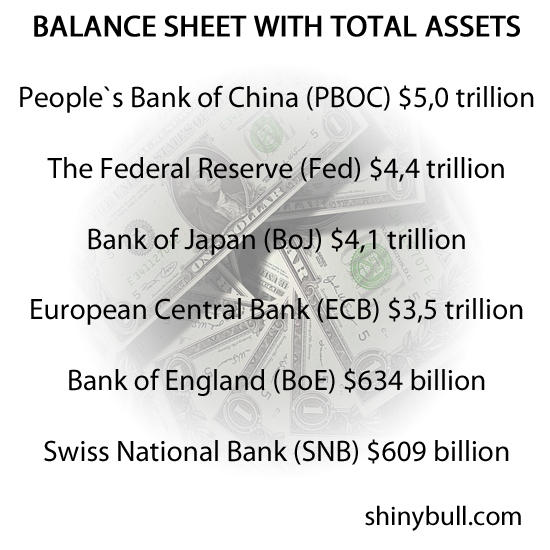


balancesheet


The SNB is at the bottom of the chart above, but it has the largest balance sheet as a percentage of GDP, with it currently up to 88,4% of GDP vs. 20% of GDP in May 2006.

The BoJ`s balance sheet is equal to 70% of GDP vs. 25% of GDP in May 2006.

The PBOC`s balance sheet is equal to 53% of GDP vs. 56% of GDP in May 2006

The Fed`s balance sheet is equal to 25% of GDP vs 6% of GDP in May 2006

The ECB`s balance sheet is equal to 25% of GDP vs. 13% of GDP in May 2006

The BoE`s balance sheet is equal to 22% of GDP vs. 6% of GDP in May 2006

The total assets of the world`s six major central banks is equal to 36% of their combined GDP, a new all-time record high vs. Only 14% of their combined GDP in May 2006, and well above the nine median of 26%!

Trumps goal is massive growth, and IMF in January raised its economic growth forecasts to 2,3% in 2017 and 2,5% in 2018, thanks to Donald Trumps plans to cut taxes and boost infrastructure spending. The World Bank will follow IMF with similar forecasts.

Trump`s bold plan is to create 25 million new American jobs in the next decade, which means it will only take 2% annual growth of the workforce to hit that target. Data shows us that 25 million jobs have never been created in a 10 year timeframe.

A 2% growth rate over 10 year will generate 25 million jobs, which means if the economic growth rate hits 2,5% it would take about 8 years. If the growth rate goes up to 3% per year it will take about 6 years. If the rate goes higher, Trump can reach his goal during his first period as a President.

I do not agree with Trump`s immigrant policy, but there is a drawback here; If Trump want to reach his goal, he need immigrants, because the number of people who are working dropped 3,7% over the past 10 years, and some of the reasons for that is the baby boomers demographic shift.

Janet Yellen also said she consider to hike the rates because the economy is improving. The Fed want to proceed with «normalizing» monetary policy, which means they want to have room to ease in case of a future shock.

President Donald Trump can help them to solve their fiscal policy by cutting tax rates and spend more money on infrastructure. At the same time, he need to keep the lid on federal spending. Will Donald Trump succeed? Betting against him have so far been a bad decision.

 

trump100_b


Disclaimer: The views expressed in this article are those of the author and may not reflect those of Shiny bull. The author has made every effort to ensure accuracy of information provided; however, neither Shiny bull nor the author can guarantee such accuracy. This article is strictly for informational purposes only. It is not a solicitation to make any exchange in precious metal products, commodities, securities or other financial instruments. Shiny bull and the author of this article do not accept culpability for losses and/ or damages arising from the use of this publication.


Leave a comment

Filed under Politics, Quantitative Easing

Britain OUT of the European Union

The day today is historic. The British people voted for a BREXIT! The pound plummeted and Prime minister David Cameron resigns. The British people backed “Brexit” and leave by 52%.

What a day!

The pound plummeted 7 percent  on its worst day on record. Thats nearly twice as much as the big drop on 1992s Black Wednesday when the currency dropped 4,1 percent.


brex


But what`s wrong with a weaker pound? A lower pound will help the British exporters which means exporters will be more competitive and sell more not only to european countries but to the rest of the world.

On the other side, prices can start to increase and it will be more expensive for the British people, and that will be a challenge for BOE`s inflation target.

Britain is still in Europe and will always be, but Brexit means they are out of the European Union system. That`s something different.

Prime Minister David Cameron will step down in October, and what the new Prime Minister must do is to negotiate with EU and other european countries and cooperate in EEA (European Free Trade Assosiation).

They are still a country in Europe but what they want is their own sovereignty and more control over their own currency.

Just take a look at Greece. After joining EU they have been in a very difficult situation, and they can’t print their own currency because of the Euro, so only that is making it difficult for them.

This is still early on stage one but you can already see that the pound have turned up again, and that`s how it will be. The turmoil will continue.

I think that BOE have a lot of things to do right now. They will do everything they can to keep the market in balance. This will also spread to the FED and ECB.

For all I know BOE have already added liquidity to the markets and Draghi and ECB will probably follow.

June 23 will be our independence day, Farage said.

JUNE 23, 2016, WILL NEVER BE FORGOTTEN!


BRIT


Disclaimer: The views expressed in this article are those of the author and may not reflect those of Shiny bull. The author has made every effort to ensure accuracy of information provided; however, neither Shiny bull nor the author can guarantee such accuracy. This article is strictly for informational purposes only. It is not a solicitation to make any exchange in precious metal products, commodities, securities or other financial instruments. Shiny bull and the author of this article do not accept culpability for losses and/ or damages arising from the use of this publication.


Leave a comment

Filed under Politics

Very important week

Next week will be exiting. The earnings season is at the end and investors focus now will be on a flood of data coming in. It all starts on monday March 14 were the Bank of Japan will announce its policies.

Bank of Japan Gov. Haruhiko Kuroda is in a special situation. Just like ECBs Mario Draghi, he talked about his «bazooka» and said he wanted to do whatever it takes to get Japans economy back on track to a stable growth.

debt

The answer so far is negative interest rate, and they started charging commercial banks 0,1% interest on some reserves last month. That lowered the borrowing cost, but on the other hand, it made some confusion about the effects on Japan`s savers.

Haruhiko Kuroda has been called to parliament for questioning many times and more than any other central bank chief during the same period. Japanese 10-year Government Bonds traded at -0,20% for the first time in history and dropped farther into negative territory.

Negative rate is also seen in Sweden, Denmark and Switzerland. Sweden`s goal is to raise the inflation. The goal in Denmark and Switzerland is to prevent the currency to raise too much.

Negative rates can be the new normal because none of them turn this situation into a strong economic growth. So, What about America?

All eyes will be on Federal Reserve Chair Janet Yellen and the Federal Open Market Committee (FOMC). The FOMC meeting will kick off on Tuesday 15, and the Fed`s interest rate decision is the highlight on Wednesday 16, with the 2 p.m ET announcement followed by a 2,30 press conference with Fed Chair Janet Yellen.

According to Wall Street Journal`s Jon Hilsenrath who is the mouthpiece of the Fed, the central bank will hold off raising rates this month, but will leave the door open for a hike in April or June this year.

U.S Consumer prices went up 1,4% YoY in January of 2016, and the inflation rate accelerated for the fourth straight month which is very impressive. CPI for February 2016 is scheduled to be released on Wednesday 16.

The European Central Bank (ECB) followed BOJ, and increased QE by 20 billion euros per month on thursday. Not only that. They also lowered interest rates, which is an unexpectedly strong move. The ECB increased its monthly bond buying from 60 to 80 billion euros and drove commercial deposit rates from -0,30% to -0,40% and cut a main refinance rate from 0,05% to 0,00%.

As you may know, many people are very angry. Not only in Europe, but also in America. The middle class is wiped out and businessman Donald Trump knows that. He doesn`t like what he see and want to do something about it; Make America great again.

The battle for the White House continues, and next week`s Ohio and Florida primaries would give Donald Trump the knockout blow necessary to capture the GOP nomination. Anti-Trump groups are spending millions of dollar on TV ads to attack him. Is that enough to stop him? If not, it will be a short way left to the White House.

Very important week.


sbnews

Disclaimer: The views expressed in this article are those of the author and may not reflect those of Shiny bull. The author has made every effort to ensure accuracy of information provided; however, neither Shiny bull nor the author can guarantee such accuracy. This article is strictly for informational purposes only. It is not a solicitation to make any exchange in precious metal products, commodities, securities or other financial instruments. Shiny bull and the author of this article do not accept culpability for losses and/ or damages arising from the use of this publication.

Leave a comment

Filed under Politics, Quantitative Easing, Stock market

The Greek bailout drama intensifies

Greece is in trouble, and tomorrow is the day were many things can happen. The media has talked about the debt in Greece for a long time now, and the media tells you that Greece has a $339 million payment due to the IMF tomorrow.

But what if they don`t have money?

The Finance Minister in Greece, Yanis Varoufakis has pointed out that they will not pay if a restructured deal can`t be reached with their creditors. What is this Greek debt drama compared to a San Andreas earthquake disaster movie? Have a look at the film below. It is the European Debt crisis visualized.


The Greek civilization is considered by historians as the first one in the history of mankind. It was a highly developed community, and their lifestyle and inventions indicated a high sense of order and aesthetics.

The ancient Greeks were very keen on sports. The great athletic contest called the Olympic games (OL) began in 776 BC, which marked the beginning of the rise of the Greek civilization. The government was usually unstable due to the tyranny of the aristocrats.

I have been in Greece once and it is a beautiful country. The ancient age of Greek civilization saw the birth of great philosophers like Pluto, Socrates, and the great emperor, Alexander. War with other civilizations began in 490 BC, and now they are in trouble again. Money trouble. They have a huge debt, and need to pay their lenders.

If they pay, they will not be in heaven for a long time, because this will be followed by another 1,2 billion euro debt payment over the next two weeks. In addition; Greek finance ministers have already said that they will not pay these payment without restructuring its debt either.

But it will not stop here. The final Greek drama will probably play out until July, so don`t open your champagne yet. More drama is yet to come.

Greece`s Prime Minister Alexis Tsipras said early this morning after late-night talks with senior EU Official that they were close to a deal with their creditors and that Athens would make a payment due to IMF tomorrow.

Some have said creditors and left-wing Greek government had drafted their own, different, version of a possible accord. Facing bankruptcy, Tsipras` government has been resisting creditors` demand for bigger cuts in pension payments and bigger sales tax increases to generate higher budget surpluses before interest payments that would let it to pay off debts.

I`m not so worried about IMF, because missing a payment is not a big deal in global financial circles. Many creditors have waited with their payments to IMF like Cuba, Honduras and Sudan to name a few.

But if they don`t pay to the ECB later on this summer, then you have to wake up! Central bankers can be very unfriendly if they don`t pay their 3,5 billion euro debt payment it owes the European Central Bank. Watch out for that.

In addition; ECB will stop its emergency lending to Greek banks, and that is a $88 billion dollar lifeline that is keeping them alive right now. People know all that, and that`s why they pulled 800 million euro out of Greek banks a few days ago.

Government debt as a percent of GDP is used by investors to measure a country’s ability to make future payments on its debt, thus affecting the country borrowing costs and government bond yields. Greece recorded a Government Debt to GDP of 177,10 percent in 2014, and that`s all time high.

To put this in perspective: Japan`s debt to GDP is 227,20. USA; 101,53. Euro Area; 91,90. Spain; 97,7. Italy; 132,10. UK; 89,4. Cyprus; 107,5. Ireland; 109,7. Portugal; 130,2. Singapore; 105,5. Lebanon; 145,9.

Libya; 6,10!

I`m not worried about Greece in the short term because they have a lot of values in their balance sheet, which means it will take some time before the real big test is coming. The debt is sustainable, because their debt cost is estimated to 2,6% of GDP, so what is the justification for writing down Greece`s debt? The problem is not the debt, but the Eurozone`s bailout condition. Money is almost free and the (nominal) interest rates are low, and no principal is due until 2022.

EU`s fiscal compact, which requires governments with debts of more than 60% of GDP to reduce the excess by one twentieth a year makes it more difficult, and that`s a tall order with Greece`s debt wich is 177,10% of GDP. What they need is less restrictive bailout conditions and relaxation of the fiscal compact rules.

Prime Minister Alexis Tsipras wrote an open letter to the German people, published in Handelsblatt on January 13, 2015;

 
In 2010, the Greek state ceased to be able to service its debt. Unfortunately, European officials decided to pretend that this problem could be overcome by means of the largest loan in history on condition of fiscal austerity that would, with mathematical precision, shrink the national income from which both new and old loans must be paid. An insolvency problem was thus dealt with as if it were a case of illiquidity.
In other words, Europe adopted the tactics of the least reputable bankers who refuse to acknowledge bad loans, preferring to grant new ones to the insolvent entity so as to pretend that the original loan is performing while extending the bankruptcy into the future. Nothing more than common sense was required to see that the application of the ‘extend and pretend’ tactic would lead my country to a tragic state. That instead of Greece’s stabilization, Europe was creating the circumstances for a self-reinforcing crisis that undermines the foundations of Europe itself.
My party, and I personally, disagreed fiercely with the May 2010 loan agreement not because you, the citizens of Germany, did not give us enough money but because you gave us much, much more than you should have and our government accepted far, far more than it had a right to. Money that would, in any case, neither help the people of Greece (as it was being thrown into the black hole of an unsustainable debt) nor prevent the ballooning of Greek government debt, at great expense to the Greek and German taxpayer.


You can wrap $1 bills around the earth 1,471 times with Greece`s debt amount. The unempoyment rate is still high at 25,6%, and the depression will continue.


Click the link below and check out the Fan Fund

https://www.eventbrite.com/e/fan-fund-tickets-15580655159


Disclaimer: The views expressed in this article are those of the author and may not reflect those of Shiny bull. The author has made every effort to ensure accuracy of information provided; however, neither Shiny bull nor the author can guarantee such accuracy. This article is strictly for informational purposes only. It is not a solicitation to make any exchange in precious metal products, commodities, securities or other financial instruments. Shiny bull and the author of this article do not accept culpability for losses and/ or damages arising from the use of this publication. UA-63539824-1.

Leave a comment

Filed under Politics

Where is the bottom in Europe and Euro

Many analysts are so positive and belive Europe`s financial crisis is over. ECB`s Precident Mario Draghi started to pump a lot of money into the market and will continue to do that until next year. The Euro has plummeted, trading at 1,07, and many think that this is the bottom.

I see different things in my TA.

Euro symbol

First of all; The inflation rate is still -0,1 percent, and that mean deflation, which is not a good thing. The figure is skewed due to the size of Germany`s economy. Actually, things are worse in other Euro areas. Take a look at this;

Finland -0,1
France -0,1
Greece -2,1
Ireland -0,6
Italy -0,09
Poland -1,5
Spain -0,7
Switzerland -0,9

This is deflation, and this is not a growth story like Venezuela which had an inflation rate of 68,5 (!) in December 2014. How is it going on with the buying power in Europe right now? Falling prices is good for the unemployed people in Europe, because their buying power is weak.

But how many are unemployed in Europe right now? The unemployment rate in the Euro Area is 11,30, but once again; it`s even worse in some areas in Europe. Worst is Greece with an unemployment rate of 25,70. This is worse than Nigeria (23,90), and South Africa (24,30).

Spain 23,7
Italy 12,7
France 10,4
Finland 10,1
Ireland 10,0
Poland 11,7

Unemployment rate in the U.S is 5,50 right now, and that`s much better than it was a year ago. The unemployment rate in the Euro Area is better than earlier this year (11,40), but it`s still very high and not low enough to claim that the reversal is underway. Again; the numbers are skewed due to Germany`s low unemployment rate of 4,8 percent.

Youth unemployment rate is 22,90 in the Euro Area, which means about 5 million Europeans under the age of 25 are unemployed. This is a big problem. Take a look at the Youth unemployment rate numbers below;

Finland 21,4
France 24,7
Greece 51,2
Ireland 21,6
Italy 42,6
Poland 20,8
Spain 50,7
United Kingdom 15,9

Youth unemployment rate in the U.S is 12,3, but what is that compared to Greece or Spain with their 51,2 and 50,7 percent youth unemployment? Can you belive that? More than half of the teenagers at the age of 25 or below is unemployed in Greece and Spain.

It`s very expensive for a country to have a lot of unemployed people.

Severe austerity measures continue to this day and they are hollowing out Europe`s economic growth. Just take a look at the numbers. Before the Greek crisis flared up, their debt to GDP stood at 113 percent, but today their debt to GDP is amazing 174,9 percent.

Debt to GDP in Euro Areas is 90,9, but take a look at the other countries in Europe;

Italy 132,1
Ireland 123,3
France 92,2
Finland 59,3
Germany 79,0
Spain 97,7

To compare; Debt to GDP in the U.S is 101,53. In Japan 227,2 to name a few. You can imagine how Europe`s debt is after ECB`s QE program is finnish?

All the austerity measures that Europe has implemented have done nothing to reduce debt levels. Instead, they are hurting the people of Europe, and the economic growth is far away from the truth.

There is NO evidence Europe`s economy is improving, and when you look at the numbers you know that this is gonna take a long time to recover, and I`m not talking about a few weeks, a couple of months or three. But I know there are a lot of them who belive so.

The Euro is trading at 1,07 and its long-term uptrend line is broken and minor cyclical support is declining. If you follow TA, you can see that the Euro can go down to about 0,75. Good news will make the opposite trend.

The Euro can go down to 0,35 but I dont`t think it will go that low. It will be complete chaos in Europe once the currency falls back to its 2001 low of 0,80. Analysts at Morgan Stanley say the euro is undervalued by about 20%, and fair value should be about $1,32, they said.

The Euro Area is in trouble and Greece is running out of money, and the future of the common currency itself is in peril, because some investors is worried that one member`s exit could trigger an unpredictable unraveling.

Analysts at investment bank Morgan Stanley say the euro should be worth $1,59 based on Germany`s strength, and it ought to be $1,09 for Greece. So, Greece is closer to haveing a fair value than Germany. This valuation should trigger the question of who should leave the eurozone. Greece? Germany? Others?

The euro has never been less popular with the international community. Bearish bets have reached a record. People hate the euro, and that is not only because the protester Josephine Witt showered Mario Draghi with confetti.

Average yield on German government debt fell below zero for the first time today. Lending to Germany for ten years will earn you just 0,088 percent in yield. That`s nothing. Investors will soon be paying for owning a 10-year German bond.

Why should you own euros invested in negative-yielding securities when dollars generate positive returns? And how popular will euro be if we face a Grexit?

«Without deep economic reform or further relief, S&P expects Greece`s debt, other financial commitments to be unsustainable,» the rating company Standard & Poor`s Corp said.

The recovery in the U.S has been slow. Now Europe is next with QE. It didn`t work in Japan. Will it work in Europe?


Click the link below and check out the Fan Fund

https://www.eventbrite.com/e/fan-fund-tickets-15580655159


Disclaimer: The views expressed in this article are those of the author and may not reflect those of Shiny bull. The author has made every effort to ensure accuracy of information provided; however, neither Shiny bull nor the author can guarantee such accuracy. This article is strictly for informational purposes only. It is not a solicitation to make any exchange in precious metal products, commodities, securities or other financial instruments. Shiny bull and the author of this article do not accept culpability for losses and/ or damages arising from the use of this publication.

Leave a comment

Filed under Quantitative Easing