Money for nothing

Hot dog is a product and you can buy it on the street. But it has a price. What if the price is $10? Or what about $5? What if I say $1? Does it sound better if I say I will pay you for every hot dog you buy? Anyway, that`s a great deal for you, and so is it for the money. It`s a product you can buy.

I can lend you some money, but what is the rate of interest? What if I say 10%? That`s a great deal for me. How about zero? Or even better, what if you can lend money from me, and at the end of the loan I pay you interest, just like a negative rate of interest. Is it fair?

Stack of $100 bills

Sorry buddy, but I`m not stupid. Of course I won`t pay you for a hot dog or money. I don`t know someone who will either. Do you know someone who would lend money for nothing? Or worse; who will lend money and get back less than the loan amount? No one I know.

People in Europe are looking for deals like this right now.

ECB`s QE is meant to reinvigorate Europe`s lethargic economies and prevent deflation. They started a bond-buying program on monday and investors knew that. They were positioned.

Germany issued 5-year bonds two weeks ago with negative interest rate, and they are not alone. Germany are joining a growing club of other countries in Europe who have done exactly the same. It may sound stupid, but investors do this because they want to make quick profit from it.

Investors was smart enough to think that ECB would buy German government bonds when they started the QE program on monday. But there is one problem; Germany runs a nearly balanced budget.

It means that they don`t issue many net new bonds. It might sell new bonds to replace those that mature, but investors already own those bonds. ECB came into the market as a new buyer and there weren`t any net new bonds.

The key question is this; price.

This is why investors was loading up before ECB`s bond-buying program. When Germany issued 5-year bonds, investors loaded up and waited for ECB to buy with both hands. The ECB must pay whatever price the market will bear to buy bonds. So what is the price?

Institutional buyers have been front-running the ECB program, and many of them have no intention of holding the bonds to maturity so the negative interest rate was of little consequence. As ECB work to devalue the euro, investors are repositioning themselves in stronger currencies, like the Swiss franc.

Since they want exposure to the stronger currency, they`re willing to pay negative interest rate on Swiss bonds.

Germany can afford to charge negative interest rates because of demand for their bonds from the ECB and the German Central Bank (the Bundesbank).

Non-euro countries like Switzerland are charging negative rates because they don`t want the hot money flowing into their currency. This is spilling over into the equity markets.

Private companies like Apple have started cashing in on the good, low and negative-interest rate deal for borrowers.

Apple have issued bonds in currencies like the Swiss franc because their cost of capital is so much cheaper than it would be in U.S dollars.

Apple issued bonds maturing in nine years at 0,375 percent interest and bonds maturing in 15 years at 0,75 percent.

Apple saved itself roughly 1,75 percent per year in interest by issuing bonds denominated in Swiss francs. 10-year U.S Treasury bonds yield is about 2,03 percent and 20-year bonds yield is 2,33 percent.

That`s not the whole story. Apple will use the money it raised to buy back shares and that will reduce the outstanding numbers of shares. With growing revenue and earnings, it can drive the stock price higher.

There is a risk in here, but in Apple`s case I don`t think they will struggle with this bet. They sold less than $1 billion in bonds, and has about $175 billion in cash stashed around the world, and the U.S dollar will remain strong.

Apple is a great example of how QE programs can drive interest rates lower and push the stock prices higher. Central banks are driving the markets.


Click the link below and check out the Fan Fund

https://www.eventbrite.com/e/fan-fund-tickets-15580655159


Disclaimer: The views expressed in this article are those of the author and may not reflect those of Shiny bull. The author has made every effort to ensure accuracy of information provided; however, neither Shiny bull nor the author can guarantee such accuracy. This article is strictly for informational purposes only. It is not a solicitation to make any exchange in precious metal products, commodities, securities or other financial instruments. Shiny bull and the author of this article do not accept culpability for losses and/ or damages arising from the use of this publication.
Leave a comment

Filed under Politics, Quantitative Easing

What`s up with Euro, Dollar and Gold?

Gold is still in a bearish market and the precious metal is declining and hit a 3,5 month low today. At the same time we can see a strong rally in the U.S dollar, hitting a twelve years high. Gold is trading at $1,147,70.

The U.S dollar is soaring and the Euro is plummeting. When the U.S dollar hits a new twelve years high, the Euro hits a twelve-year low. Some analysts are betting that the euro can sink to the same level as the U.S dollar.

Stack of $100 bills

The euro started to fall sharply last summer when the ECB president Mario Draghi laid the groundwork for QE, but the euro has fallen even sharper since the €60 billion-a-month bond-buying programme started on monday this week.

The U.S dollar started the rally at the same time last summer, boosted by strong hints from the Fed that it could start to raise interest rates later this year. EUR/USD is trading at $1,0545 on Wednesday, and that is below $1,06 for the first time since April 2003.

Mario Draghi said cheaper borrowing costs for some eurozone countries suggested that QE – which tends to drive up the value of bonds, and thus depress their yields (which moves in the opposite direction), was already having an effect.

Some analysts have questioned whether the ECB will be able to find sufficient bonds to buy to hit its monthly target. German 10-year bond yields hit a record low of 0,2% on Wednesday. Other Eurozone countries bond yields are also at or near record lows.

The German bond yields at record lows is mainly due to safe-heaven demand from investors, while the other European country bond yields falling is due to the ECB`s plans to buy sovereign bonds as part of its QE of it monetary policy.

A strong dollar is good for the U.S consumers. They can buy cheap things from Europe and Asia, and at the same they have low gas prices. It sounds like party to me. One dollar now buys almost 16 pesos.

The Turkish lira, the Mexican peso, hit an all-time low to the dollar. The Indonesia rupiah hit a 17-year low of 13,1 to the dollar. The Norwegian krone hit a 13-year low and the Brazilian real just hit a 10-year low to the dollar.

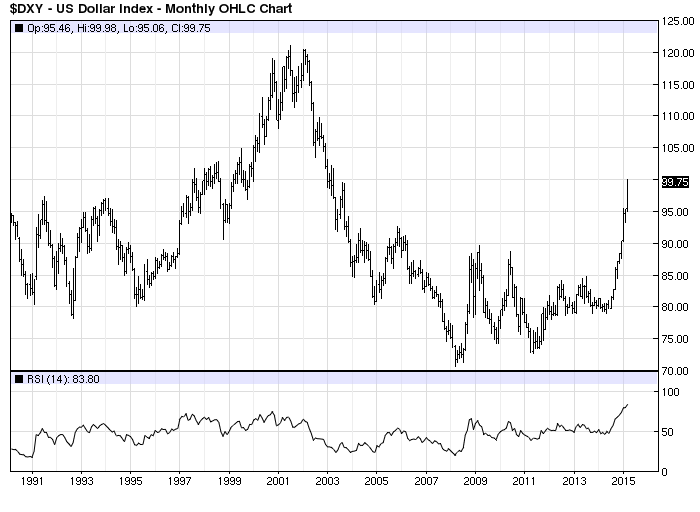
The broad Dollar Index (DXY) has now wopped by 23 percent since last summer. That`s the most aggressive rise in more than 34 years! Some of the indicators is more overbought now than at any point in modern history.

DXY 25 yr

(Picture: DXY Index)

As you can see from the chart in RSI, it is overbought. More than we were at the depths of the 2008 credit crisis. That crises caused an immense flight to safety rally in the buck, along with the biggest rally in U.S Treasury prices ever. DXY`s previous close is 99,68.

The dollar rally is now broadly pressuring emerging markets, hurting commodity prices, and undermining the profits of multinational U.S corporations. As the dollar increase, commodities and emerging markets cry.

The problem is that the dollar rally is getting out of control!


Click the link below and check out the Fan Fund

https://www.eventbrite.com/e/fan-fund-tickets-15580655159


Disclaimer: The views expressed in this article are those of the author and may not reflect those of Shiny bull. The author has made every effort to ensure accuracy of information provided; however, neither Shiny bull nor the author can guarantee such accuracy. This article is strictly for informational purposes only. It is not a solicitation to make any exchange in precious metal products, commodities, securities or other financial instruments. Shiny bull and the author of this article do not accept culpability for losses and/ or damages arising from the use of this publication.
Leave a comment

Filed under Commodities, Emerging markets, Quantitative Easing

Koenigsegg`s new model Agera RS

Geneva International Motor Show runs from 5th – 15th March 2015, and the world`s biggest names in automotive excellence show off their latest machines. Many supercars will be showed in all their glories and Koenigsegg is one of them.

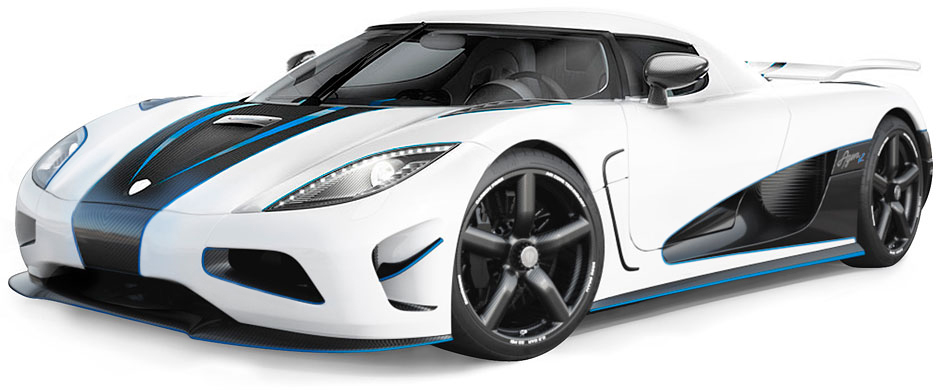
Koenigsegg managed to take the press by surprise by announcing the debut of a new model at 85th International Motor Show. The new model is Agera RS, which is more exclusive and faster than the Agera S model.

KoenigseggAgera-launch

(Picture: Koenigsegg Agera RS)

Christian Erland Harald von Koenigsegg is the founder of the Swedish high-performance automotive manufacturer Koenigsegg Automotive AB. He is born July 2, 1972, and he is running the company with his wife Halldora von Koenigsegg.

They are both active in the company`s management. Christian von Koenigsegg is a descendant of the mediatized German House of Königsegg.

Koenigsegg models try to make maximum comfort and straight-line speed. It uses a transversely-mounted shock-absorber that connects the two rear wheels, as well as independent suspension systems for each wheel.

Another innovation that the company is pursuing is free valve technology. This is a technology that uses electronics and air-pressure to actuate intake and exhaust valves with very high precision and unlimited control of timing.

Instead of the traditional camshaft technology for their cars, allowing for engines to be much more efficient by reducing weight and size of engines, while making each cylinder able to be controlled independently, allowing for more complete combustion. Although it is still in the research and development phase.

Koenigsegg is perfecting their cars by making them lighter, faster and in many other ways. They came out with their new model Agera in 2010, which is a mid-engined sports car. The name Agera comes from the Swedish verb ‘agera’ which means «to act» or «to take action».

It was named Hypercar of the Year in 2010 by Top Gear magazine.

In early development the car was fitted with a 4.7-litre V8 engine with twin fixed-vane turbos, but it was replaced with a 5.0-litre twin turbocharged V8 engine for the production version of the car, which produces 940 hp (701 kW) at 6900 rpm and 1.100 N m (810 Ib-ft) of torque at 4000 rpm.

Total weight of the engine is only 197 kg (434 Ib) thanks to a carbon fiber intake manifold and the aluminium construction. The transmission is a 7-speed dual clutch with paddle shifters. It is the first dual clutch transmission to feature only one input shaft.

The second clutch slows down the input shaft during up shifts in order to reduce the time it takes to synchronize the next gear, resulting in faster shift times. Most notably, the transmission weighs only 81 kg (179 Ib).

Top speed for the production model is above 420 km/h (260 mph), and the engine goes from 0 – 300 km/h in 14,53 seconds.

World record is set on September 2, 2011. Agera R goes from 0 – 300 – 0 mph in 24,96 seconds.


Click the link below and check out the Fan Fund

https://www.eventbrite.com/e/fan-fund-tickets-15580655159


Disclaimer: The views expressed in this article are those of the author and may not reflect those of Shiny bull. The author has made every effort to ensure accuracy of information provided; however, neither Shiny bull nor the author can guarantee such accuracy. This article is strictly for informational purposes only. It is not a solicitation to make any exchange in precious metal products, commodities, securities or other financial instruments. Shiny bull and the author of this article do not accept culpability for losses and/ or damages arising from the use of this publication.
Leave a comment

Filed under Uncategorized

What is cyclical stocks?

You can`t win a football match if you`re not offensive, but at the same time you can lose if you are too offensive. You also have to think defensive, which mean you must have a strategy. Just like playing chess and many other games. You can`t succeed with only one tactic.

Who haven`t been too offensive when playing chess? You just saw how you could do it forward without thinking defense.

This is just how you need to think in the stock market too, but in the stock market we are talking about cyclical and non-cyclical stocks. You know that you shouldn`t have all your eggs in one basket.

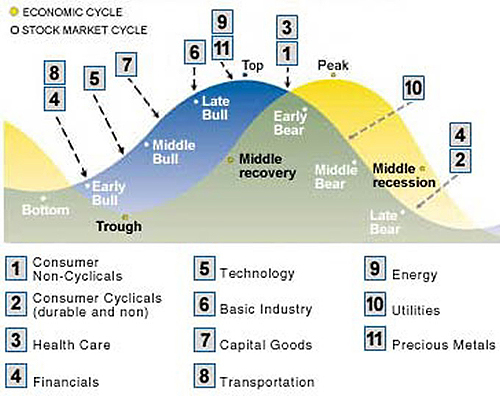
stock-labels2015

(Companies that are in the housing, airline, and steel sectors are examples of cyclical stocks)

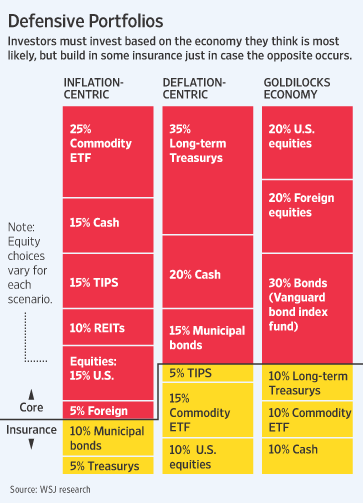
Your portfolio need to be balanced which means you must have a mix of both offensive and defensive stocks. A mix of small caps growth stocks and value stocks, which is diversified by size and industry. In addition; mix different stocks, cash, treasurys and bonds.

You cannot control the cycles of the economy, and it is vital to know how different companies and their industry are in relationship to the economy. That`s why it is important to know the fundamental difference between cyclical and non-cyclical stocks.

If you search for the non-cyclical companies you can better identify where it`s best to put your money when the economy, growth and the stock markets starts to decline. The difference between Cyclical and non-cyclical stocks is that cyclical stocks is more volatile, and move up and down with the cycle. Non-cyclical stocks show little movement relative to the cycle.

Non-cyclical stocks tend to outperform the market when the economy slows down. The defensive stocks experience profit regardless of economic gyrations because they produce goods and services we always need.

Stock Labels Defensive

(Non-cyclical stocks are in the food, beverage, drug and pet food industries)

This is companies that sell food, gas, power and water, because this is something people need no matter where the economy and the stock markets go. People spend the money they have on what is necessary, and that`s not luxury cars, but water, power and food.

When the economy turns sour you need to avoid stocks cyclical industries that follow the cycle. People can`t afford to buy luxury cars. They can`t afford to take the family to a fine dining for an expensive meal. Other cyclical industries are steel, travel and construction. They produce things we can live without when money is tight.

When the economy starts to decline, the cyclical stocks will be hit the hardest, and that`s why it is important to play defensive and look for non-cyclical stocks that produce things you can`t live without.

A great example is utilities which can help you to avoid losses while the cyclical stocks will suffer. In tough times there is not so much money for building projects, but people will still buy power, food, milk and water.

Keep in mind that utility companies grow conservatively and they are not going to skyrocket when the economy is increasing again. Pick the right companies with great dividends in the right industries in relationship to the shift in the cycle. It can help keep your money safe.


Click the link below and check out the Fan Fund

https://www.eventbrite.com/e/fan-fund-tickets-15580655159


Disclaimer: The views expressed in this article are those of the author and may not reflect those of Shiny bull. The author has made every effort to ensure accuracy of information provided; however, neither Shiny bull nor the author can guarantee such accuracy. This article is strictly for informational purposes only. It is not a solicitation to make any exchange in precious metal products, commodities, securities or other financial instruments. Shiny bull and the author of this article do not accept culpability for losses and/ or damages arising from the use of this publication.
Leave a comment

Filed under Stock market, Stocks

Inflation and Gold

Investors buy gold because they think that gold is a hedge against inflation. The value of the paper currency falls in terms of the goods and services that it can buy and inflation goes in the opposite direction; up.

Investors love gold when inflation is high and as you may know, gold has a direct relationship with inflation. So when inflation goes up so does the demand for gold. Imminent hyper inflation was expected during the QE program, but that is not the reality right now.

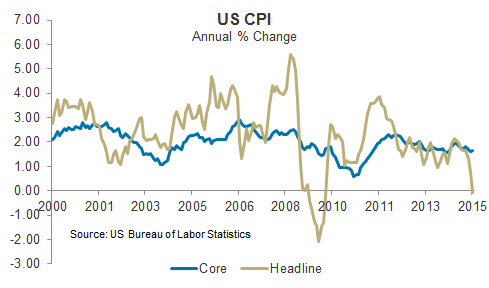
You can track inflation using the Consumer Price Index (CPI). This index measures how the price of a basket of consumer goods and services changes. CPI will give you a picture of the increase in the level of prices.

us cpi

This data is released by the U.S Bureau of Labor statistics on a monthly basis. U.S inflation rate is -0,09%, (released Feb 26, 2015), compared to 0,76% in December and 1,58% last year. This is lower than the long-term average of 3,32%. Down -111,8%.

Inflation fell in January for a third straight month as U.S consumers continued to spend less on gas, food prices flattened and as costs retreated for new vehicles,used cars and trucks, household furnishings and operations, airline fares, alcohol and tobacco. U.S inflation turned negative for the first time since 2009.

The CPI measures what American pays for everything from cloths, airline tickets, fruits and vegetables to cars. Declines were again led by energy as prices at the pump tumbled about 19%. Gasoline prices have plunged 35% over the past 12 months.

A slower pace of inflation means consumers can buy more with their money, but a sustained decline over and extended period (deflation), can wreak havoc on an economy. Falling energy prices are beginning to filter down into other areas.

Core US inflation advanced 1,6% over the last 12 months, and the core 12-month reading is the benchmark inflation figure monitored by the Federal Open Market Committee (FOMC) as it helps in deciding where to set the key interests rate.

«We think inflation is going to move lower before it moves higher. Declining oil prices have had a very major influence,» Fed Chairwoman Janet Yellen said in a testimony.

The current level remains below the Fed`s 2% annual inflation target. In written remarks read to Congress, Janet Yellen stated:

“The Committee expects inflation to decline further in the near term before rising gradually toward 2 percent over the medium term as the labor market improves further and the transitory effects of lower energy prices and other factors dissipate, but we will continue to monitor inflation developments closely.”

Consumer Price Index data for February inflation and the annual period is scheduled for release on March 24, 2015.


Click the link below and check out the Fan Fund

https://www.eventbrite.com/e/fan-fund-tickets-15580655159


Disclaimer: The views expressed in this article are those of the author and may not reflect those of Shiny bull. The author has made every effort to ensure accuracy of information provided; however, neither Shiny bull nor the author can guarantee such accuracy. This article is strictly for informational purposes only. It is not a solicitation to make any exchange in precious metal products, commodities, securities or other financial instruments. Shiny bull and the author of this article do not accept culpability for losses and/ or damages arising from the use of this publication.

Leave a comment

Filed under Commodities, Politics, Quantitative Easing