Category Archives: Politics

The Greek bailout drama intensifies

Greece is in trouble, and tomorrow is the day were many things can happen. The media has talked about the debt in Greece for a long time now, and the media tells you that Greece has a $339 million payment due to the IMF tomorrow.

But what if they don`t have money?

The Finance Minister in Greece, Yanis Varoufakis has pointed out that they will not pay if a restructured deal can`t be reached with their creditors. What is this Greek debt drama compared to a San Andreas earthquake disaster movie? Have a look at the film below. It is the European Debt crisis visualized.


The Greek civilization is considered by historians as the first one in the history of mankind. It was a highly developed community, and their lifestyle and inventions indicated a high sense of order and aesthetics.

The ancient Greeks were very keen on sports. The great athletic contest called the Olympic games (OL) began in 776 BC, which marked the beginning of the rise of the Greek civilization. The government was usually unstable due to the tyranny of the aristocrats.

I have been in Greece once and it is a beautiful country. The ancient age of Greek civilization saw the birth of great philosophers like Pluto, Socrates, and the great emperor, Alexander. War with other civilizations began in 490 BC, and now they are in trouble again. Money trouble. They have a huge debt, and need to pay their lenders.

If they pay, they will not be in heaven for a long time, because this will be followed by another 1,2 billion euro debt payment over the next two weeks. In addition; Greek finance ministers have already said that they will not pay these payment without restructuring its debt either.

But it will not stop here. The final Greek drama will probably play out until July, so don`t open your champagne yet. More drama is yet to come.

Greece`s Prime Minister Alexis Tsipras said early this morning after late-night talks with senior EU Official that they were close to a deal with their creditors and that Athens would make a payment due to IMF tomorrow.

Some have said creditors and left-wing Greek government had drafted their own, different, version of a possible accord. Facing bankruptcy, Tsipras` government has been resisting creditors` demand for bigger cuts in pension payments and bigger sales tax increases to generate higher budget surpluses before interest payments that would let it to pay off debts.

I`m not so worried about IMF, because missing a payment is not a big deal in global financial circles. Many creditors have waited with their payments to IMF like Cuba, Honduras and Sudan to name a few.

But if they don`t pay to the ECB later on this summer, then you have to wake up! Central bankers can be very unfriendly if they don`t pay their 3,5 billion euro debt payment it owes the European Central Bank. Watch out for that.

In addition; ECB will stop its emergency lending to Greek banks, and that is a $88 billion dollar lifeline that is keeping them alive right now. People know all that, and that`s why they pulled 800 million euro out of Greek banks a few days ago.

Government debt as a percent of GDP is used by investors to measure a country’s ability to make future payments on its debt, thus affecting the country borrowing costs and government bond yields. Greece recorded a Government Debt to GDP of 177,10 percent in 2014, and that`s all time high.

To put this in perspective: Japan`s debt to GDP is 227,20. USA; 101,53. Euro Area; 91,90. Spain; 97,7. Italy; 132,10. UK; 89,4. Cyprus; 107,5. Ireland; 109,7. Portugal; 130,2. Singapore; 105,5. Lebanon; 145,9.

Libya; 6,10!

I`m not worried about Greece in the short term because they have a lot of values in their balance sheet, which means it will take some time before the real big test is coming. The debt is sustainable, because their debt cost is estimated to 2,6% of GDP, so what is the justification for writing down Greece`s debt? The problem is not the debt, but the Eurozone`s bailout condition. Money is almost free and the (nominal) interest rates are low, and no principal is due until 2022.

EU`s fiscal compact, which requires governments with debts of more than 60% of GDP to reduce the excess by one twentieth a year makes it more difficult, and that`s a tall order with Greece`s debt wich is 177,10% of GDP. What they need is less restrictive bailout conditions and relaxation of the fiscal compact rules.

Prime Minister Alexis Tsipras wrote an open letter to the German people, published in Handelsblatt on January 13, 2015;

 
In 2010, the Greek state ceased to be able to service its debt. Unfortunately, European officials decided to pretend that this problem could be overcome by means of the largest loan in history on condition of fiscal austerity that would, with mathematical precision, shrink the national income from which both new and old loans must be paid. An insolvency problem was thus dealt with as if it were a case of illiquidity.
In other words, Europe adopted the tactics of the least reputable bankers who refuse to acknowledge bad loans, preferring to grant new ones to the insolvent entity so as to pretend that the original loan is performing while extending the bankruptcy into the future. Nothing more than common sense was required to see that the application of the ‘extend and pretend’ tactic would lead my country to a tragic state. That instead of Greece’s stabilization, Europe was creating the circumstances for a self-reinforcing crisis that undermines the foundations of Europe itself.
My party, and I personally, disagreed fiercely with the May 2010 loan agreement not because you, the citizens of Germany, did not give us enough money but because you gave us much, much more than you should have and our government accepted far, far more than it had a right to. Money that would, in any case, neither help the people of Greece (as it was being thrown into the black hole of an unsustainable debt) nor prevent the ballooning of Greek government debt, at great expense to the Greek and German taxpayer.


You can wrap $1 bills around the earth 1,471 times with Greece`s debt amount. The unempoyment rate is still high at 25,6%, and the depression will continue.


Click the link below and check out the Fan Fund

https://www.eventbrite.com/e/fan-fund-tickets-15580655159


Disclaimer: The views expressed in this article are those of the author and may not reflect those of Shiny bull. The author has made every effort to ensure accuracy of information provided; however, neither Shiny bull nor the author can guarantee such accuracy. This article is strictly for informational purposes only. It is not a solicitation to make any exchange in precious metal products, commodities, securities or other financial instruments. Shiny bull and the author of this article do not accept culpability for losses and/ or damages arising from the use of this publication. UA-63539824-1.

Leave a comment

Filed under Politics

Putin said that the U.S is trying to create a “Unipolar World”

Three weeks ago, Vladimir Putin said that the U.S is trying to create a «unipolar world». Putin and Russia has used an address commemorating the 70th anniversary of victory over Nazi Germany to accuse the U.S of attempting to dominate the world.

Putin invited many world leaders to Russia`s annual Victory Day parade in Red Square on May 9, 2015, but this year it was boycotted by western leaders over the continuing crisis in Ukraine. «Unipolar World» is a phrase that is often used by Russia to criticise the U.S for purportedly attempting to dominate world affairs.

Putin is not alone. Fidel Castro released his new book «Cold War – A warning for a unipolar world» in September 1, 2003. He said: “To endure the global struggle between the superpowers is bad. To live under the total hegemony of one of them is worse.”

Cold war book


The U.S President, Barack Obama and Germany`s Angela Merkel didn`t come. Neither did other Western leaders like UK`s Prime Minister David Cameron and French President Francois Hollande. Moscow has increasingly appeared to pivot away from Europe and focus more on developing relations with China.

The Chinese leader, Xi Jinping, was the most high-profile guest on the podium next to Putin. Other presidents in attendance included India`s Pranab Mukherjee, Presiden Abdel Fatah al-Sisi of Egypt, Raul Costro of Cuba, Nicolas Maduro of Venezuea, Robert Mugabe of Zimbabwe and Jacob Zuma of South Africa.

«The boycott illustrates the depth and breadth of the chasm now separating Russia and the West,» said Dmitri Trenin, head of the Carnegie Moscow Center.

Russia used the parade to show for the fist time a RS-24 Yars ICBM launcher, which Moscow has said described as a response to U.S and NATO anti-missile system.

More than 70% of Russians say a close family member was killed during the World War II, making Victory Day an emotional symbol of unity for the nation. The Soviet Union lost about 27 million soldiers and civilians, and that`s more than any other country.

Xi said that when this victory is celebrated it`s not «for hating some states» but to «establish peace on this planet together».

But what is Putin trying to say when he claims that the U.S is trying to create «Unipolar World?»

Unipolarity in international politics is a distribution of power in which one state exercises most of the cultural, economic, and military influence. Unipolarity is an interstate system and not an Empire. Unipolarity implies the existence of many juridically equal non-states, something that an empire denies.

Unipolarity is anarchical. Anarchy results from the incomplete power preponderance of the unipole. Kenneth Waltz, argues that a great power cannot «exert a positive control everywhere in the world.» Therefore, relatively weaker countries have the freedom to pursue policy preferences independent of the unipole.

Unipolar systems posses only one great power and face no competition. If a competitor emerges, the international system is no longer unipolar. Kenneth Waltz maintain that the United States is the only «pole» to possess global interests.

The first thinker to anticipate both the unipoar and the American Primacy seems to be the Chinese Philosopher, Kàng Yu-wei. (Alexis de Tocqueville in the mid-Nineteenth century had expected the bipolar world centered on America and Russia but had not advanced beyond bipolarity).

In 1885, Kàng Yu-wei published his One World Philosophy, where he based his vision on the evidence of political expansion which began in the immemorial past and went in his days on. He concludes:

“Finally, the present Powers of the world were formed. This process of coalescing and forming fewer, larger units has all taken place among the 10,000 countries over several thousand years. The progression from dispersion to union among men, and the principle whereby the world is gradually proceeding from being partitioned off to being opened up, is a spontaneous working of the Way of Heaven (or Nature) and human affairs.”

No factor, he believed, in the long run could resist the “laws of empires”.

K’ang Yu-wei projects the culmination of the ongoing world unification with the final confrontation between the United States and Germany: “Some day America will take in all the states of the American continent and Germany will take in all the states of Europe. This will hasten the world along the road to One World.”

K’ang Yu-wei belonged to a civilization, which experienced the millennia-long unipolar order. He knew how in his civilization it emerged and several times reemerged. Naturally, his theory is very realist, deep, and developed relatively to his Western contemporaries convinced in the universality of the balance of power or, at most, having abstract ideas of the Parliament of Men and the Federation of the World.

The first Western scientist who drew a hypothesis of the forthcoming unipolar world order and the American primacy seems to be the French Demographer, George Vacher de Lapouge, with his L`Avenir des Aryens published in 1901.

Similarly to K’ang Yu-wei, he outlined the logistic growth of empires from the Bronze Age till his days, when “six states govern… three-quarters of the globe,” and concluded:

“The moment is close when the struggle for the domination of the world is going to take place.”

Vacher de Lapouge did not bet on Washington and Berlin in the final contest for world domination like K’ang Yu-wei. Similarly to Tocqueville, he guessed the Cold War contenders correctly but he went one step further. He estimated the chances of the United States as favorite in the final confrontation:

“The reign of Europe is over, well over… The future of France seems less certain but it is unnecessary to become illusioned… I do not believe by the way that Germany might count for a much longer future… We could… envisage… the possibility that England and her immense Empire comes to surrender to the United States. The latter… is the true adversary of Russia in the great struggle to come… I also believe that the United States is appealed to triumph. Otherwise, the universe would be Russian.”.

The vision of Vacher de Lapouge from 1901 was born out. The United States is the only country in the early 21st century that possesses the ability to project military power on a global scale, providing it full command of the global commons.

With no viable challenger on the horizon in the short-term, the current distribution of power overwhelmingly favors the United States, making the world order it set out to construct in 1945 more robust.

The question that remains for international relations theorists is how long this “unipolar moment” will last. One theory of the world order claims that persistent bipolar and multipolar orders passed their event horizon and onward unipolarity will only be interrupted by very rare “multipolar moments,” albeit not necessarily under the American primacy.


Click the link below and check out the Fan Fund

https://www.eventbrite.com/e/fan-fund-tickets-15580655159


Disclaimer: The views expressed in this article are those of the author and may not reflect those of Shiny bull. The author has made every effort to ensure accuracy of information provided; however, neither Shiny bull nor the author can guarantee such accuracy. This article is strictly for informational purposes only. It is not a solicitation to make any exchange in precious metal products, commodities, securities or other financial instruments. Shiny bull and the author of this article do not accept culpability for losses and/ or damages arising from the use of this publication. UA-63539824-1.
Leave a comment

Filed under Politics

Investments in the South China Sea are at risk

There is a lot of fish, oil and gas in The South China Sea, but who are the real owner of the sea?

China has claimed for years that about 90% of the South China Sea is their own territory. A document from 1940 stated that the sea is China`s. China and The Association of Southeast Asian Nations (ASEAN) agreed to start negotiating with each other before any move in 2001.

China want the territory and have started to build islands on the sea and claiming them as their own. They can do that because they have one simple strategy; ignore the law. People with Asian trade interest doesn`t like that. Neither do Indonesia, Brunei, Philippines, Malaysia and Vietnam.

Investors in that area should consider to get out as soon as possible.


SouthChinaSea

(Picture: South China Sea)
The South China Sea is a marginal sea that is part of the Pacific Ocean, encompassing an area from the Singapore and Malacca Straits to the Strait of Taiwan of around 3,500,000 square kilometers (1,400,000 sq mi).

The area`s importance largely results from one-third of the world`s shipping transiting through its waters, and that it is believed to hold oil and gas reserves beneath its seabed. The sea and its mostly uninhabited islands are subject to competing claims of sovereignty by several countries.

South China Sea is the dominant term used in English for the sea, and the name in most European languages is equivalent, but it is sometimes called by different names in China`s neighboring countries, often reflecting historical claims to hegemony over the sea.

The English name is a result of early European interest in the sea as a route from Europe and South Asia to the trading opportunities of China. In the sixteenth century Portuguese sailors called it the China Sea (Mar da China).

The majority of the sea came under Japanese naval control during World War II following the military acquisition of many surrounding South East Asian territories in 1941.

The South China Sea contains over 250 small islands, atolls, cays, shoals, reefs and sandbars. The region has proven oil reserves of around 1,2 km3 (7,7 billion barrels) with an estimate of 4,5 km 3 (28 billion barrels) in total.

Natural gas reserves are estimated to total around 7,500 km3 (266 trillion cubic feet). A 2013 report by the U.S Energy Information Administration raised the total estimated oil reserves to 11 billion barrels. In 2014 China began to drill for oil in waters disputed with Vietnam.

Several countries have made competing territorial claims over the South China Sea. Such disputes have been regarded as Asia`s most potentially dangerous point of conflict.

Both, People`s Republic of China (PRC) and the Republic of China (ROC, commonly known as Taiwan) claim almost the entire body as their own, demarcating their claims within what is known as the nine-dotted line, which claims overlap with virtually every other country in the region.


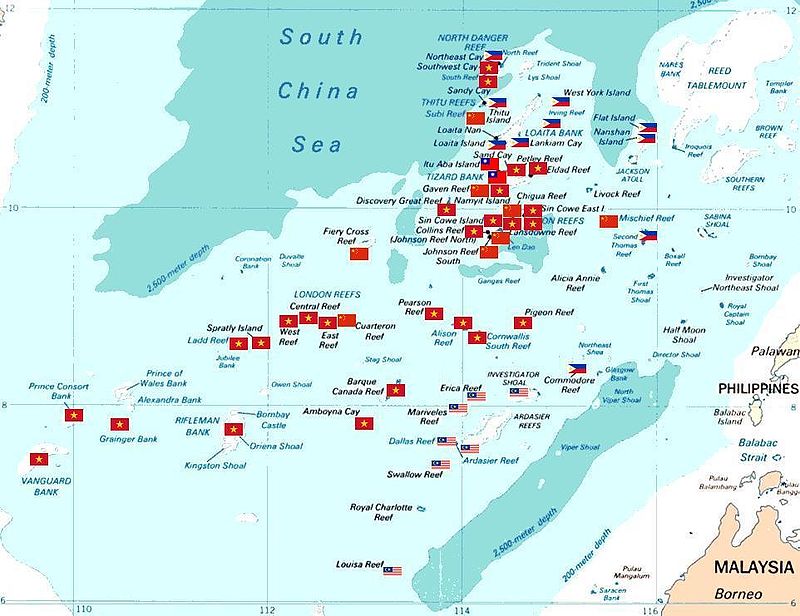
Spratly_with_flags

(Picture: Map of various coutries occupying the Spratly Islands)


China and Vietnam have both been vigorous in prosecuting their claims. China (various governments) and South Vietnam each controlled part of the Paracel Island before 1974. A brief conflict in 1974 resulted in 17 soldiers being killed, and China has controlled the whole of Paracel since then. Seventy Vietnamese sailors were killed just south of Chigua Reef in March 1988.

In July 2010, US Secretary of State Hillary Clinton called for the Peoples Republic of China to resolve the territorial dispute. China responded by demanding the US keep out of the issue. In January 2013, The Philippines government said it will take China to a UN tribunal under the auspices of the United Nations Convention on the Law of the Sea, to challenge its claims in the South China Sea.

In May 2014, China established an oil rig near the Paracel Islands, leading to multiple incidents between Vietnamese and Chinese ships. Now, China has started building two military air strips on Subi Reef and Fiery Cross Reef.

«China has convinced itself that it is the rightful owner of almost the entire sea» author Bill Hayton said, which is the author of the book The South China Sea.

China want to be the owners of the islands because that will be the first step of owning 1,4 million square miles of sea, which is full of fish, oil and gas. The value of the natural resources in the sea gives the potential for disagreement and a conflict over territory in the South China Sea.

International Law under the United Nations Convention of the Law of the Sea, says a country can only own an area of a sea if it owns the land adjacent to it. A country that owns an island can claims 12 nautical miles of seabed around it, and has the rights to the resources (but not the territory) up to 200 nautical miles around it.

The Bush administration didn`t do much, but Obama was forced to take a stronger stance on the contested territory last friday. The Pentagon is discussing sending warships in the region.

Investments in the South China Sea are at risk.


Click the link below and check out the Fan Fund

https://www.eventbrite.com/e/fan-fund-tickets-15580655159


Disclaimer: The views expressed in this article are those of the author and may not reflect those of Shiny bull. The author has made every effort to ensure accuracy of information provided; however, neither Shiny bull nor the author can guarantee such accuracy. This article is strictly for informational purposes only. It is not a solicitation to make any exchange in precious metal products, commodities, securities or other financial instruments. Shiny bull and the author of this article do not accept culpability for losses and/ or damages arising from the use of this publication. UA-63539824-1.

Leave a comment

Filed under Politics

What is the most dangerous war?

The new film San Andreas cracked well over $60M mark internationally this weekend to help boost its worldwide come to $118,5M, just in front of its China bow tomorrow. This is business for Warner Bros./Village Roadshow.

The film which stars Dwayne «The Rock» Johnson, knocked last week`s top film Tomorrowland, which debuted with $40,7M. Earthquake disaster movie San Andreas has topped the US box office over the weekend, allaying fears that audiences in quake-prone regions would avoid seeing it.

It is registered a little earthquake in Northern California about three hours ago, but it was just a little one (2,4). The biggest today is seen in North of Svalbard (5,1). A magnitude -7,8 earthquake struck off the southern coast of Japan on Saturday, shaking buildings in Tokyo and interrupting subway service, but causing no major damage or injuries.

If you haven`t seen the film yet, take a look at the official trailer below.


What`s worse than the nature being angry like an earthquake or a volcano? What about an asteroid? We are in big trouble if one of these giant rocks ends up on a collision course with Earth. What about a war? A World War III? Made by human beings.

We can solve a problem by diplomatic solution, but we can`t deal with an asteroid. We can`t deal with a volcano. Neither an earthquake.

We can stop a World War III, but not a big rock from space.

Former NSA intelligence analyst John Schindler said last week that a senior NATO official told him that the world would «probably be at war» sometime this summer. He is not alone to say so. The investor legend George Soros warned that we «are on the threshold of a Third World War.»

John Schindler`s tweet was retweeted more than 1,000 times, but no one in the media covered it. Soros said in remarks at a Bretton Woods conference at the World Bank that a trigger for a global military conflict can start as China`s economy slows down.

«If there is a military conflict between China and an alley of the U.S, like Japan, it is not an exaggeration to say we could be on the threshold of a Third World War. It could spread to the Middle East, then Europe and Africa.»

Soros called on the U.S to make a «major concession» and allow China`s currency to join the International Monetary Fund`s basket of currencies. Yuan will then be a rival to the dollar as a global reserve currency.

If so, China would have to make similar major concessions to reform its economy, such as accepting the rule of law, and an agreement along these lines will be difficult to achieve, but the alternative is a brutal war, Soros said.

«Without it, there is a real danger that China will align itself with Russia politically and military, and then the threat of third world war becomes real, so it is worth trying.»

This comes in a time when Europe engages in some of its biggest ever war games near Russia. If the War starts, it will be multi faceted and poses risks to markets. Modern warfare would involve many facets including cyber warfare and currency war.

Around a million asteroids are located between Mars and Jupiter in the «asteroid belt.» The craters on the Moon were formed by asteroids and some think it was an asteroid that wiped out the dinosaurs. The human beings survived. What can wipe out the humans on this planet?

«If we`re lucky it won`t be nuclear,» Schindler said in his tweet last week.


Click the link below and check out the Fan Fund

https://www.eventbrite.com/e/fan-fund-tickets-15580655159


Disclaimer: The views expressed in this article are those of the author and may not reflect those of Shiny bull. The author has made every effort to ensure accuracy of information provided; however, neither Shiny bull nor the author can guarantee such accuracy. This article is strictly for informational purposes only. It is not a solicitation to make any exchange in precious metal products, commodities, securities or other financial instruments. Shiny bull and the author of this article do not accept culpability for losses and/ or damages arising from the use of this publication. UA-63539824-1.

Leave a comment

Filed under Politics

The Education Revolution is here

Tesla`s CEO Elon Musk is a father of five. He started a school for his own children. Enrollment stands for 14 right now and will increase to about 20 in September. It is an educational revolution going on.

Have a listen to the interview below. Elon Mush said in the interview that he hated going to school when he was a kid. It was torture, he told his interviewer on Chinese TV.


On January 1st, 2015, John Moravec sent out a document with the title: «Manifesto 15». «We are at a time in history that is ripe for worldwide rethinking of, and rapid change in, education.» He said that the current system of education is a dinosaur, and must change and is already changing.

Buckminister Fuller wrote: «You never change things by fighting the existing reality. To change something, build a new model that makes the existing model obsolete.»

The National Education Association made a broader attempt to foster educational excellence with its Seven Cardinal Principles of Secondary Education in 1918. These were;

1. Health
2. Command of fundamental processes (reading and writing – oral and written expression – and arithmetic
3. Worthy home membership (fostering strong family bonds)
4. Vocation
5. citizenship
6. Worthy use of leisure time (to teach that it should enrich one`s life, not hinder it)
7. Ethical character

This is 97 years ago, and the big test came through the Great Depression. Many of the school programs in the U.S saw severe cuts, and the U.S school system experienced many shifts over the next decades.

A progressive reform known as Open Education started in the 1960`s and 1970`s. The idea was that the students should learn «their own way». In 1983, a report was titled; «A Nation at Risk: The Imperative for Educational Reform.»

The Encyclopedia of Education described how the report “found a ‘rising tide of mediocrity’ that threatened the nation’s future.” It felt that the nation “had engaged in unthinking, unilateral educational disarmament.”

Previous President in the U.S, George H.W. Bush tried to change the source of American education in 1989. He set a number of ambitious goals to be accomplished by 2000. Some of the goals was to increase the high school graduation rate to at least 90%, that U.S pupils would lead the world in science and mathematics, and that all schools would be free from violence and drugs.

By the early 21st century, desperation birthed the largest attempt yet by the federal government to overhaul education: the No Child Left Behind Act (NCLB). George W. Bush said if a public school did not perform well on designed tests, it risked losing some of its federal funding, but over a decade later, the desired results have not materialized.

No matter what they do, America has never been able to achieve widespread, lasting success. It`s time for an education revolution.

Educators all over the world face the problem of keeping up with the times. Rapidly changing technology introduces a towering question educators must ask: «Will the knowledge we are teaching now be obsolete in five years?»

The European commissioner for Education, Culture, Multilingualism and Youth, Androulla Vassiliou said: «Today`s young people are the most educated in the whole of European history and yet they find it hard to get steady work after graduation in spite of the two million unfilled vacancies across Europe.»

“Education can provide some answers. The crisis has revealed serious weaknesses in Europe’s educational systems. Indeed, it has sharpened what we expect from our education systems.
“Our goal is to make graduates more deployable, foster entrepreneurship and stimulate innovation. By combining entrepreneurship education and interaction with business, students can develop the practical skills, knowledge and attitudes that allow them to innovate…There is a lot at stake. Today, more than ever, it is education that can deliver social progress.

When we invest in education, we commit ourselves to the development of our citizens and the future welfare of our society.
“The health of a society depends on the quality of the education it imparts to its citizens.”
Consider: Europe has essentially achieved the UN goal of “Universal Primary Education.” Despite this success, it still grapples with failures in its school systems. Something more is obviously missing.

If you saw the interview above, you probably heard that Elon Mush said if you want to teach children how engines work, you wouldn`t want to first teach them all about wrenches and screwdrivers.

You would show them the engine, and ask how they would take it apart. Then a very important thing happens, which is that the relevance of the tools becomes apparent, he told the Chinese interviewer.

Musk said that his children love going to school now. So much that they really think vacations is too long.

That`s exactly how it should be.


Click the link below and check out the Fan Fund

https://www.eventbrite.com/e/fan-fund-tickets-15580655159


Disclaimer: The views expressed in this article are those of the author and may not reflect those of Shiny bull. The author has made every effort to ensure accuracy of information provided; however, neither Shiny bull nor the author can guarantee such accuracy. This article is strictly for informational purposes only. It is not a solicitation to make any exchange in precious metal products, commodities, securities or other financial instruments. Shiny bull and the author of this article do not accept culpability for losses and/ or damages arising from the use of this publication. UA-63539824-1.

Leave a comment

Filed under Politics