
Category Archives: Commodities

Inflation and Gold

Investors buy gold because they think that gold is a hedge against inflation. The value of the paper currency falls in terms of the goods and services that it can buy and inflation goes in the opposite direction; up.

Investors love gold when inflation is high and as you may know, gold has a direct relationship with inflation. So when inflation goes up so does the demand for gold. Imminent hyper inflation was expected during the QE program, but that is not the reality right now.

You can track inflation using the Consumer Price Index (CPI). This index measures how the price of a basket of consumer goods and services changes. CPI will give you a picture of the increase in the level of prices.
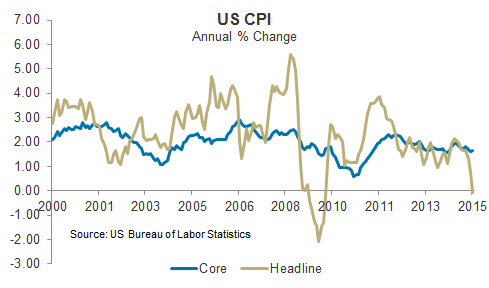
us cpi

This data is released by the U.S Bureau of Labor statistics on a monthly basis. U.S inflation rate is -0,09%, (released Feb 26, 2015), compared to 0,76% in December and 1,58% last year. This is lower than the long-term average of 3,32%. Down -111,8%.

Inflation fell in January for a third straight month as U.S consumers continued to spend less on gas, food prices flattened and as costs retreated for new vehicles,used cars and trucks, household furnishings and operations, airline fares, alcohol and tobacco. U.S inflation turned negative for the first time since 2009.

The CPI measures what American pays for everything from cloths, airline tickets, fruits and vegetables to cars. Declines were again led by energy as prices at the pump tumbled about 19%. Gasoline prices have plunged 35% over the past 12 months.

A slower pace of inflation means consumers can buy more with their money, but a sustained decline over and extended period (deflation), can wreak havoc on an economy. Falling energy prices are beginning to filter down into other areas.

Core US inflation advanced 1,6% over the last 12 months, and the core 12-month reading is the benchmark inflation figure monitored by the Federal Open Market Committee (FOMC) as it helps in deciding where to set the key interests rate.

«We think inflation is going to move lower before it moves higher. Declining oil prices have had a very major influence,» Fed Chairwoman Janet Yellen said in a testimony.

The current level remains below the Fed`s 2% annual inflation target. In written remarks read to Congress, Janet Yellen stated:

“The Committee expects inflation to decline further in the near term before rising gradually toward 2 percent over the medium term as the labor market improves further and the transitory effects of lower energy prices and other factors dissipate, but we will continue to monitor inflation developments closely.”

Consumer Price Index data for February inflation and the annual period is scheduled for release on March 24, 2015.


Click the link below and check out the Fan Fund

https://www.eventbrite.com/e/fan-fund-tickets-15580655159


Disclaimer: The views expressed in this article are those of the author and may not reflect those of Shiny bull. The author has made every effort to ensure accuracy of information provided; however, neither Shiny bull nor the author can guarantee such accuracy. This article is strictly for informational purposes only. It is not a solicitation to make any exchange in precious metal products, commodities, securities or other financial instruments. Shiny bull and the author of this article do not accept culpability for losses and/ or damages arising from the use of this publication.

Leave a comment

Filed under Commodities, Politics, Quantitative Easing

Cautious Stock Market Investors

U.S markets will be closed today in observance of the Martin Luther King Jr holiday. Some markets will be open like futures, but I will stay away from the market today because of the lack of volume and liquidity.

I will follow oil and gold prices and all the commodity traders should keep in mind that Crude Oil inventories will be released on Thursday at 11:00am, instead of the normal Wednesday 10:30 am release due to Monday`s holiday.

Gold is on the move and can go up about 25%, and the precious metal is the best performing asset class so far this year. It`s golden days for day traders. Take a look at the oil price. It`s like roller coaster, jumping up and down, and oil had the biggest gain in 2 1/2 years, ending the trading session of friday 5,82% higher.

The reason why the stock market didn`t follow the oil price on friday can be the disappointing retail sales report in early trading on friday. Retail sales dropped 0,9% vs a 2% forecast. The S&P ended Friday with a 27 point gain, and ended the week 25 points lower. That`s down 1,24% for the week.

The Dow saw triple digit profits on Friday with a 191 point gain, and it closed at 17511,57, wrapping up the week with a 226 point loss. Friday`s Preliminary Consumer Confidence report was a beacon of hope for the bulls. The report not only beat expectations. That`s the highest level in 11 years!

A number of questions marks seem to have investors leaning back on their heals this year. This is; plummeting oil prices, geopolitical turmoil and continued divergence between the world`s major economies like Japan, China, U.S and the Euro zone.

All the investors eyes are on the world`s central banks. The Davos meeting later on this week will be interesting, and the ECB is expected to deliver a stimulus package later this month. Investors will wait for definitive word from the ECB regarding its widely anticipated stimulus plan.

Bond market rose across the board as interest rates dropped lower, with the 10-year Treasury rate falling below 2%. The downtrend in rates is not good, and is a symptom of deflationary pressures which is worse than inflation. Plummeting energy prices are adding fuel to the fire.

The U.S dollar continued its bullish climb last week, putting downward pressure on the commodity sector as a whole. This trend can last awhile longer.

Investors are cautions and it seems everyone is a bit hesitant to commit to new, bullish positions until some questions are resolved. I will wait for a clearer trend to emerge and 1,200 in small-cap stocks need to break before I call the bullish trend in equities alive.


Disclaimer: The views expressed in this article are those of the author and may not reflect those of Shiny bull. The author has made every effort to ensure accuracy of information provided; however, neither Shiny bull nor the author can guarantee such accuracy. This article is strictly for informational purposes only. It is not a solicitation to make any exchange in precious metal products, commodities, securities or other financial instruments. Shiny bull and the author of this article do not accept culpability for losses and/ or damages arising from the use of this publication.

Leave a comment

Filed under Commodities, Quantitative Easing, Stock market

Top 10 Economic Predicions for 2015

What`s next in the stock market next year? What about commodities, the dollar, Japan, China and Europe? Let`s take a look at Nariman Behravesh`s (Chief Economist at IHS) predictions for 2015. He expects global growth to pick up to 3 percent from an estimated 2,7 this year.

IHS outlined its top 10 economic predictions that make up its global outlook:

1. U.S. economy will power ahead
The world’s largest economy will continue to outperform its peers, driven by strengthening domestic demand, specifically consumer spending. The dynamics underpinning consumer spending—which accounts for 70 percent of gross domestic product (GDP)—remain very positive, including strong jobs growth, improved household finances and low gas prices. The economy will grow in the 2.5 to 3 percent range, IHS predicts.

2. Euro zone’s struggle to continue
The euro zone will continue to struggle with a weak labor market, but the combination of low oil prices, a weaker euro, reduced fiscal headwinds, easing sovereign debt woes, and an accommodative monetary policy will help lift growth. Expect a very modest acceleration of growth 1.4 percent in 2015 from 0.8 percent this year, says IHS.

3. Japan to emerge from recession
After suffering through its fourth recession in six years, the Japanese economy will rebound in 2015, albeit only to around 1 percent. The Bank of Japan’s (BOJ) easing and additional government stimulus, combined with lower energy prices, will push growth back into positive territory.

4. China will keep slowing
Further support from both monetary and fiscal policy won’t be enough to prevent growth from weakening further to 6.5 percent next year, says IHS. While poor by China’s standards, these growth rates are the envy of all major economies.

5. EMs: a mixed bag
Most emerging economies will see better growth in 2015, thanks to cheaper oil, a boost in global liquidity, and an acceleration in U.S. and European growth. Emerging Europe, Latin America, the Middle East and North Africa, and Sub-Saharan Africa will see the largest growth increases. Russia, however, will be a weak spot, reeling from the triple whammy of sanctions, plunging oil prices, and capital flight, says IHS.

6. Commodities slide to extend
Oil prices have plunged around 40 percent since the summer amid feeble global demand compounded by strong supply growth.
China remains key to the demand-side story, IHS says, noting that a further softening of growth will likely translate into another round of price declines. It forecasts commodity prices will slide 10 percent on average next year.

7. Disinflation threat
Disinflationary forces are the strongest in the developed world with commodity prices falling and global growth anemic. The exceptions are emerging markets, such as Russia, that have experienced sharp drops in their exchange rates and, as a result, a spike in inflation.

8. Fed will be the first to hike rates
The Federal Reserve, Bank of England, and Bank of Canada will start hiking rates in 2015—in June, August, and October, respectively, says IHS, barring a significant softening in inflation. In contrast, the European Central Bank (ECB), BOJ and People’s Bank of China are on track to either cut interest rates further and/or provide more liquidity via asset purchases and other means.

9. Dollar will remain king
The U.S. dollar will continue to strength on strong growth prospects and expectations for Fed rate hikes.
Meanwhile, anticipated additional stimulus by the ECB and BOJ means that both the euro and yen will continue depreciating in 2015. Euro-dollar will fall to $1.15–1.20 by autumn 2015, while dollar-yen will trade in a range of 120–125 next year.

10. Perennial downside risks easing
The global recovery has been plagued by a multitude of “curses” during the past few years, including high public- and private-sector debt levels that have necessitated deleveraging by households corporates and governments, says IHS. But these obstacles to growth are easing in some countries, notably the U.S and U.K., which explains their better-than-average performance.


Disclaimer: The views expressed in this article are those of the author and may not reflect those of Shiny bull. The author has made every effort to ensure accuracy of information provided; however, neither Shiny bull nor the author can guarantee such accuracy. This article is strictly for informational purposes only. It is not a solicitation to make any exchange in precious metal products, commodities, securities or other financial instruments. Shiny bull and the author of this article do not accept culpability for losses and/ or damages arising from the use of this publication.

Leave a comment

Filed under Commodities, Emerging markets, Stock market

Switzerland said no to Gold

The central banks are holding the gold prices up, and without their buying power the prices would probably trade lower, so the central banks are one of the greatest demand components for the gold prices.

Gold

Yesterday, Switzerland could boost the gold price, but they didn`t. Switzerland had a referendum yesterday, and voters rejected a referendum requiring the Swiss National Bank to hold 20% of its 520 bullion franc balance sheet in Gold. Switzerland already have the worlds highest amount of bullion per capita.

If they voted yes, they would have to purchase at least 1,500 metric tons of gold over the next five years, and could have helped the gold price to skyrocket. Two third of the population in Switzerland voted no, and with lower oil prices, and imminent raising rates in the U.S, the demand for gold is declining as a hedge against inflation.

There was some support for the gold right before the vote, and there is some pressure on gold now. Right now, the gold is trading at $1,171,00 and is down followed by silver which is plummeting at the moment. The outlook for gold is not looking good right now, and signs of dangerous deflation have also made the gold less attractive.

Gold is also a reliable safety net that a country can have against an impending crises or a currency meltdown, but that is not the scenario right now, because the U.S dollar is increasing. The U.S dollar has been your safe heaven for months, not the gold which I talked about months ago.

The investor sentiment is negative and gold prices are once again headed for the trading area at $1,150, which is a support level that have been in focus for a while now.

It shouldn`t be like that, because what we see now is massive quantitative easing, Ebola, turmoil in the Middle East and rebellion in Ukraine. This is normally enough to make the gold prices to skyrocket, but not this time.

The question is when the gold price will start to climb, not if. Unfortunately, I don`t think that the price will increase next week or in the near future. I like gold, but I can`t hide the fact that the gold has been in a bear market for years.

We are at levels putting many producers in a dangerous zone which is below break-even. We know the demand for gold is there. Huge demand from China and India, but more important is to look at the supply.

You buy gold when there`s less supply than demand. You buy gold when the U.S dollar and other currencies are doomed to lose value due to inflation. You buy gold when the money printing machine is heating up, and you buy gold when the debt is increasing.

This is the key. Take a look at the supply, and you know that this will change in the future. It is the opposite of what we see in the oil market right now. The oil shale revolution added billion of barrels of supply to the oil market that have pushed the oil prices down.

The supply in the gold market will not increase. Many gold miners will face problems when the gold price is declining and it is too expensive to start a new mine which cost hundreds of millions. I will look for bold bullion, gold ETF and quality gold stocks as a solid play in the future. Bearish in a short-term, bullish in a long run.


Disclaimer: The views expressed in this article are those of the author and may not reflect those of Shiny bull. The author has made every effort to ensure accuracy of information provided; however, neither Shiny bull nor the author can guarantee such accuracy. This article is strictly for informational purposes only. It is not a solicitation to make any exchange in precious metal products, commodities, securities or other financial instruments. Shiny bull and the author of this article do not accept culpability for losses and/ or damages arising from the use of this publication.

Leave a comment

Filed under Commodities

OPEC meeting in Vienna on thursday

OPEC is having a very important meeting on thursday and that can move the oil markets. The 12-member group is bickering over who should cut oil output, and by how much in order to pump up the prices. The meeting in Vienna is the groups most watched session in many years.

gspen

The U.S oil shale revolution is a game changer. (Read my article titled; American shale revolution – from January 27, 2014). The oil supply have increased and the oil prices is declining, and that have opened up the market. Countries that once had to submit to OPEC`s prices can now look for other suppliers. The oil king is about to lose.

China has for a long time been at the mercy of OPEC for twenty years, and the economic giant imports about 7 million barrels of oil per day, while the U.S imports about 8 million barrels of oil per day.

China`s demand for oil will continue to increase as its population is growing and so are the demand for oil-related items such as cars, plane traffic and motorcycles. As the U.S oil shale production makes the country more self-reliant, China has become more important to OPEC.

OPEC has a monopoly on the market and China pay about 10% more for the oil than the market price. As the oil prices plunge, many other suppliers in other countries will vie to undercut that monopoly. OPEC is slowly losing its second biggest customer as China now can pursue oil from countries outside of OPEC such as Brazil, Venezuela, Colombia and some countries in Africa.

This is just the beginning. China bought a lot of oil from Colombia this year, and China Petroleum and Chemical Corp (SNP) processed oil from Brazil`s Ostra field for the first time earlier this year. OPEC`s shipment to China fell 11% and the average cost per barrel was 10% lower.

China`s oil production and oil refining companies will benefit from the changing import sources. They`re already bumping up their refining capacity and shooting for a 20% increase in the next 5 years, and there`s a little doubt that China will purchase more crude oil from Russia as the West deepens their economic sanctions. The sanctions on Russia have led to increase China`s purchases from its communist brethren by about 60% in September.

WTIC

The energy sector is the worst performing sector in the S&P 500 this year, but the shift started years ago, so what we see today should not be a surprise for some one. It started in 2008 when Crude oil peaked at $147 a barrel, but the oil price have plummeted to about $73 a barrel now.

The energy sector has been the leading sector since 2000, but today its the worst performing sector beaten by the health care sector. I talked about the health care sector at the beginning of this year and I said I expected that sector to be a great investment opportunity.

Read my article from January 8, 2014, titled; Health-care bull. I told you to keep an eye on the health-care sector. I also said that the oil price is a risky bet, and that the oil price can plunge and Opec can face huge problems.


Disclaimer: The views expressed in this article are those of the author and may not reflect those of Shiny bull. The author has made every effort to ensure accuracy of information provided; however, neither Shiny bull nor the author can guarantee such accuracy. This article is strictly for informational purposes only. It is not a solicitation to make any exchange in precious metal products, commodities, securities or other financial instruments. Shiny bull and the author of this article do not accept culpability for losses and/ or damages arising from the use of this publication.

Leave a comment

Filed under Commodities