Tag Archives: Mario Draghi

Mario`s Bazooka!

Europe is in trouble and the problem (one of them) is deflation. From December 2013 to December 2014 the inflation was -0,2%. ECB`s goal is like the FED`s; about 2%. The European Central Bank announced today that it will fight against deflation and recession by «printing more money».

Many people don`t know that the Central Banks are not printing money like they use to think; printing paper money. But others say «printing money» to make ordinary people understand what they are talking about.
ECB

Central banks have a tool to control growth and that is lowering or raising the interest rate. When the interest rate is low, people will spend more money which is good for the economy. Spending is also better than saving.

When interest rate is as low as it right now, the central banks need to do something. The tools they use is to «print more money», and that is quantitative easing QE. But does it help the economy? According to Obama in a speech yesterday; it does.

The banks use this money to buy bonds from investors such as pension funds and private investors that will use this «new» money. This again will increase the amount of money in the financial system, which is encouraging financial institutions to lend more to businesses and individuals. The goal is to allow them to invest and spend more and that will hopefully increase the growth.

QE makes the prices of government bonds to go up and reduces the yield paid out to investors, which means investors have to pay more to get the same income. This is why some pension scheme deficits have increased sharply in resent years.

It is Greek elections on Sunday, and ECB bond-buying could support confidence in troubled Euro zone members and prevent any fallout from Greek politics affecting other countries. Some said the Greeks are poised to reject the EU-imposed cost-cutting and vote for Syriza, which rejects the fiscal crackdown. The ECB will buy bonds from Italy and Germany and that will prevent them from selling their bonds if the economic situation in Greece worsens. Draghi said today that they can continue to print money the next 30 years. No one knows that this program will work.

QE was first used by the Bank of Japan (BOJ) to fight domestic deflation. BOJ had for many years claimed that QE is not effective and rejected its use for monetary policy. BOJ hade maintained short-term interest rates at close to zero since 1999.

During their QE, the BOJ flooded commercial banks with excess liquidity to promote private lending, leaving them with large stocks of excess reserves and therefore little risk of a liquidity shortage. The BOJ accomplished this by buying more government bonds than would be required to set the interest rate to zero. It later also bought asset-backet securities and equities and extended the terms of its commercial paper-purchasing operation.

Since the financial crises of 2007-2008, similar policies have been used by the United States, the United Kingdom and the Euro zone. QE was used by these countries because their risk-free short-term nominal interest rate were either at or close to zero.

ECB will start their € 1,1 trillion QE program in march. They will start buying 60bn euros of chiefly government debt each month. That includes rebundled private debt, asset-backet (public and privaate) securities and covered bonds worth about 10 billion euros on top of the roughly 50 billion euros in state bonds.

They will spend (as they signalled in 2009) € 60bn euroes each month until September next year. The Euro dropped down to an 11 year low against the strong dollar. The pair is now trading at $1,14.

Mario Draghi has delivered a bigger bazooka than investors were expecting, and the stock market in Europe, Asia and U.S skyrocketed today. Bull!

By the way; Denmark`s Central Bank followed the ECB today by cutting its main deposit rate again. This time to negative -0,35%. They had already lowered that rate to negative -0,2% from negative -0,05% on Monday this week.


Disclaimer: The views expressed in this article are those of the author and may not reflect those of Shiny bull. The author has made every effort to ensure accuracy of information provided; however, neither Shiny bull nor the author can guarantee such accuracy. This article is strictly for informational purposes only. It is not a solicitation to make any exchange in precious metal products, commodities, securities or other financial instruments. Shiny bull and the author of this article do not accept culpability for losses and/ or damages arising from the use of this publication.

Leave a comment

Filed under Quantitative Easing

Other predictions for 2015

Spending a few minutes reading the headlines today can make you feel bad. It feels like the world is on fire. Ebola, ISIS, Ukraine and some extremely currency movements. In a world like that, the U.S is seen as a safe harbor and the greenbacks is the safest, most reliable currency on the planet right now.

2015b

We witnessed a fantastic corporate earnings season, which was one of the best in the last decade. It is still a lot of work on jobs and housing, but the economy is well underway. How is it gonna be in the markets next year? No one knows, but there is a lot predictions out there. I will refer from two different investors today. One is positive and one is negative. Let`s take a look at the positive first;

No doubt, there is a market shift ahead, but it isn`t what you think it is. Based on different analysis, many indicators shows us that next year will be another fantastic year in the stock market. It will be another year to make money and the bull market will continue.

The bull market will not be what we have seen so far. It`s not gonna be another broad market rally like the rally we`ve seen the last few years. Stock picking will still be important, as there is a lot of stocks you should sell in 2015.

What you should buy is high-quality stocks with great fundamentals. You should buy one type of stocks next year.

Look at the truth about the economy. It took seven years to finally rebound from the Great Recession, and here are some key reasons why some investors expect the economy to keep charging ahead next year;

Fist of all; the oil shale revolution. According to the International Energy agency, the U.S will become the world`s leading oil producer next year. The energy boom will create jobs and lowering the gas and utility costs for consumers. That`s good news for the economy next year.

In addition; there will be low-interest rates. It may rise in the next 12 months, but the Fed will manage that rise slowly, which means it will remain ultra-low by historical standards, and that`s also good news for M&A activities, stock buybacks and cheap corporate borrowing that fuels stock prices, and business expansion.

Consumers are more positive to the economy and consumer confidence soared in October. Household net worth is back above 2007 levels, and consumer spending are rising at a moderate clip.

It looks safe in the U.S compared to the rest of the world. England`s housing market is collapsing. The Euro zone is on a brink to a deflationary disaster. Germany`s economy is deteriorating, and the growth has stalled in the once-hot BRICS. The U.S economy is surging. GDP was much stronger than expected 3,5% in Q3.

Chairwoman Janet Yellen has made it clear she intends to do whatever it takes to keep the economy and job growth strong. We survived the end of the Fed`s QE program and that was just one of the weapons in her arsenal.

The other one I talked about is negative. He expect the stock market to crash any time soon. It did in 1929, 1987, 2000 and 2008. The next crash will be next year he says. The bull market we have had over the past years is one of the longest, and most generous bull markets in history.

But, no bull markets lasts forever he says, and this one has about run its course. If you look at key long-term measures, U.S stocks are about 80% overvalued he says. There have been only five times when stocks have been more than 50% overvalued, and that is 1853, 1906, 1929, 1969 and 1999.

He said that each one of those years marked the peak of a massive, once-in-a-generation stock-market bubble. Only two of those bubbles were bigger than today`s, and that was in 1929 and 1999. This is the end of the line for this bull market he says.

You have to be sceptical about everything you read and it is very important to make up your own mind. I have heard about a 1929-stock-market-crash in ten years now. Many talked about a stock market crash all months this year. Same people talked about it in 2013 and 2012, but what we saw was a strong bull market.

But I can promise you one thing; one day they will have right!


Disclaimer: The views expressed in this article are those of the author and may not reflect those of Shiny bull. The author has made every effort to ensure accuracy of information provided; however, neither Shiny bull nor the author can guarantee such accuracy. This article is strictly for informational purposes only. It is not a solicitation to make any exchange in precious metal products, commodities, securities or other financial instruments. Shiny bull and the author of this article do not accept culpability for losses and/ or damages arising from the use of this publication.
Leave a comment

Filed under Stock market

Strong Jobs report is on the way

Mario Draghi is the man. What a stock rally  yesterday, and all this thanks to one single man: Mario Draghi from the ECB (European Central Bank). He started to cut all three rates, and said he will also start a new QE program if necessary.


All this is done because they want action in the markets. As you know, there are millions of people in the EuroZone which is unemployeed. It`s not good for the economy because their buying power remain weak.


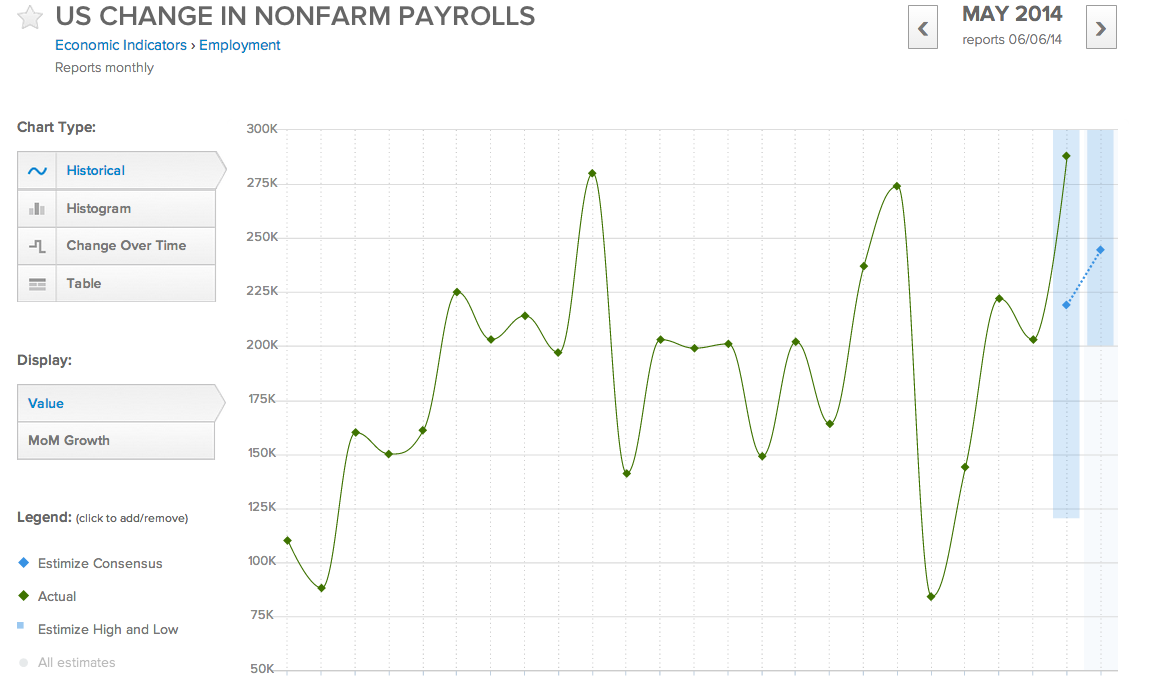
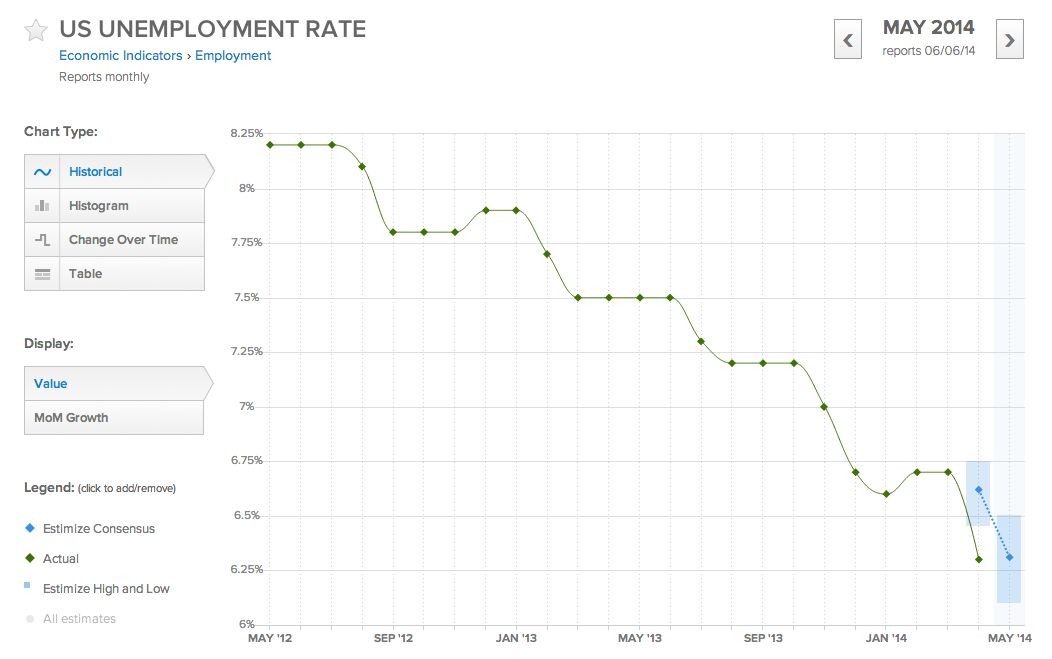
But what about the U.S? Later today, we will se important reports about Nonfarm Payrolls and Unemployment rate. All investors are waiting for those reports at 8.30 a.m. This is very important news, so what can we expect?


Several surprisingly healthy economic indicators reported within the past month including auto sales figures and the most recent jobs numbers indicate that commerce may be picking up. The really big question that will be answered later today is whether growth in the laber market kept up its pace through May.

Nonfarm1


According to AutoData, the car sales spiked to an annualized rate of 16,8 million units in May. This is the fastest rate of growth seen in the auto market in 7 years! GM doubled sales growth and reported a 12,6% gain compared to estimated 6,4%.


The automotive data is encouraging, but the nonfarm payrolls change is the indicator investors really keep a close watch on later today. The change in nonfarm payrolls may be the most influential economic indicator (other than perhaps GDP) because it`s reflective of two key factors for the national economy.


The jobs number tells us both about the strength of corporations and their willingness to spend cash to expand their businesses. It also gives insight into the number of newly added employees which may bolster consumer spending with their freshly minted paychecks.


Todays jobs report also contains supplementary information about employee earnings levels and the unemployment rate, which isn`t considered to be as clear of a signal because it is positively influenced when job-seekers drop of out the labor force in what is known as the discouraged worker effect.


The U.S change in nonfarm payrolls unexpectedly climbed from 203k jobs added in March to 288k in April. The markets around the world rallied after those news. Later today we will see the May jobs data.

Unemployment rate2


On todays report Morningstar has the nonfarm payrolls change consensus at 220k jobs added while the consensus from Estimize is 10% higher at 243k. Morningstar also indicate that the unemployment rate may rise slightly to 6,4% while Estimize are forecasting that unemployment will remain unchanged at 6,3%.


The Estimize community is expecting the number of jobs added in May to be considerably less than the number added in April, but the community is still optimistic that the labor market will outperform predictions from the majority of economists.


All eyes on the Labor Department`s report today at 8.30 AM EST.


Reports today:

08:30 a.m        Nonfarm Payrolls

08:30 a.m        Unemployment Rate


Disclaimer: The views expressed in this article are those of the author and may not reflect those of Shiny bull. The author has made every effort to ensure accuracy of information provided; however, neither Shiny bull nor the author can guarantee such accuracy. This article is strictly for informational purposes only. It is not a solicitation to make any exchange in precious metal products, commodities, securities or other financial instruments. Shiny bull and the author of this article do not accept culpability for losses and/ or damages arising from the use of this publication.

Leave a comment

Filed under Stock market

Negative Interest Rate in Europe?

The Fed have printed a lot of money, just like Japan have done for years. Now, Europe are thinking of doing the same. ECB is about to join Fed in the money printing scam. Mario Draghi will speak later today, and what can we expect?

ECB

We can see negative interest rate in Europe. Do you really know what that means? It means that you are losing your money if they are in the bank. It means that it is more attractive to put your money under the mattress. Can you belive that?

Many expect that the ECB will cut its deposit rate from zero to negative. The benchmark rate will probably also be reduced to a record low at 0,1%. If so, ECB will be the first major central bank to introduce a negative rate.

The problem for ECB and Draghi is the deflation. Their inflation goal is around 2%, but the inflation remain below 1%, and it has slowed to 0,5% last month. In March, ECB said it won`t return toward its goal until the end of 2016.

Draghi said earlier this year that large-scale asset purchases would be justified if the medium-term outlook for inflation worsens. The ECB and Bank of England have called on regulators to ease rules on asset-backed securities in Europe. That would provide a broader range of funding options for companies and create assets the ECB could buy to supply liquidity.

Rate is the Central banks tools. The lower the rate is, the bigger the problems are. What is the bank signaling if they cut the rate? It says you need to spend your money. Do not put in the bank. That`s all it is about; consumer spending. That what`s makes the world go around. A very simple concept.

European stocks are little changed before the ECB meeting today. Stoxx Europe 600 Index trading near a six-year high. U.S stock-index futures and Asian shares were also little changed. Many have waited for the news today. Will Mario Draghi shock the markets? Let`s wait and see.

Reports today:
07:45 a.m. EUR Minimum Bid Rate
08:30 a.m. EUR ECB Press Conference
08:30 a.m. USD Unemployment Claims
01:30 p.m USD FOMC Member Kocherlakota Speaks


Disclaimer: The views expressed in this article are those of the author and may not reflect those of Shiny bull. The author has made every effort to ensure accuracy of information provided; however, neither Shiny bull nor the author can guarantee such accuracy. This article is strictly for informational purposes only. It is not a solicitation to make any exchange in precious metal products, commodities, securities or other financial instruments. Shiny bull and the author of this article do not accept culpability for losses and/ or damages arising from the use of this publication.

Leave a comment

Filed under Stock market