Tag Archives: Economy

This Is Not a Global Recovery. It’s an American One

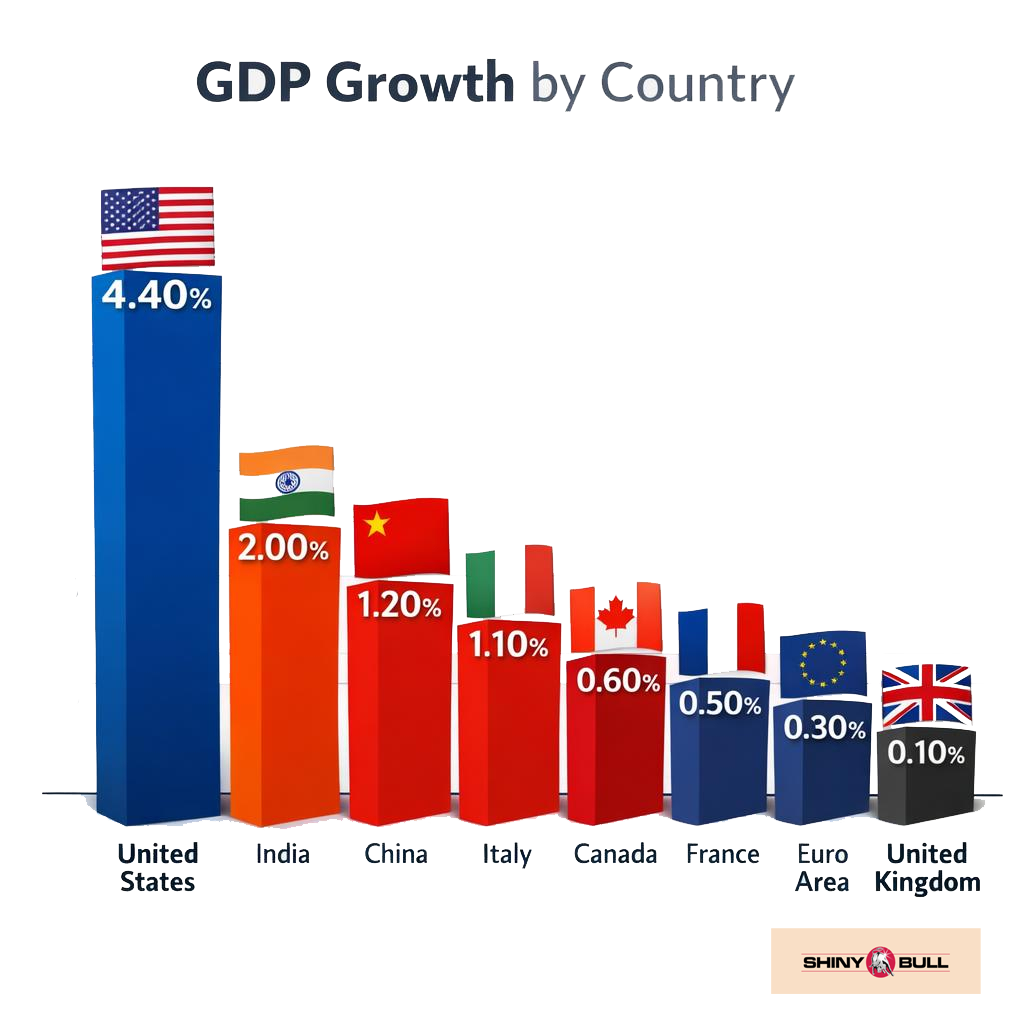
When we look at GDP growth, one thing becomes very clear: the United States is in a league of its own. With growth at 4.4 percent, the U.S. economy is running far ahead of other major economies.

India comes in second — but at less than half the U.S. rate. China, once the global engine of growth, is now barely above one percent. Europe paints a much weaker picture: the euro area, France, and the UK are hovering near stagnation. Italy does a bit better, but still far behind the U.S.

The takeaway is simple: global growth is no longer evenly distributed. The world is increasingly dependent on one dominant economic engine — the United States.

Trumponomics, Taxes, and Tariffs

This dominance is not accidental. Trumponomics — including tax cuts, deregulation, and strategic trade measures — has been designed to strengthen domestic growth. Lower taxes have incentivized investment, increased consumption, and created a multiplier effect across multiple sectors. Simply put: lower taxes mean more growth.

Tariffs have also contributed, protecting key industries and encouraging reshoring. While not the main driver of GDP growth, they amplify the effect of pro-growth policies, keeping production and capital inside the United States.

Crypto and Blockchain: America’s Catalyst

Digital infrastructure, crypto, and blockchain have emerged as powerful catalysts for U.S. economic dominance. While crypto-related activity still represents only a small fraction of U.S. GDP today, it facilitates faster capital flows, scalable services, and innovative financial systems.

Blockchain doesn’t drive the economy on its own — but it reinforces American economic advantage and positions the U.S. to maintain its lead as digital systems expand.

Blockchains are the future, not just for finance, but for the infrastructure of value itself. And America is at the forefront.

Innovation vs. Bureaucracy

A key driver behind continued U.S. economic growth is innovation—particularly in advanced manufacturing and energy technology. Companies like Tesla, led by Elon Musk, have played a pioneering role by pushing battery technology to a new level, giving the U.S. a clear competitive advantage in electric vehicles and energy storage.

In contrast, Europe—and Germany in particular—has been slowed by regulatory complexity and bureaucratic inertia. While innovation in the U.S. is often enabled by speed, scale, and risk-taking, European industry must navigate dense layers of regulation, approval processes, and political compromise.

For Germany, whose economy is deeply tied to the automotive sector, this loss of momentum has broader consequences. And as Germany remains the economic locomotive of the EU, the effects of slower innovation are amplified across Europe—raising the question of whether regulation has begun to outweigh competitiveness.

One Engine, Many Passengers

Put it all together: Trumponomics, smart policy, tariffs, and innovative digital infrastructure. The result? America continues to dominate while Europe struggles with stagnation, and China slows. Emerging markets chase momentum.

Growth today in the United States comes not from soil or oil alone, but from systems designed to turn value into profit. Lower taxes, strategic policy, and innovation create a self-reinforcing cycle — one that keeps the U.S. in the driver’s seat.

Oil once defined power. Today, code, capital, and blockchain define it. And in that world, the United States still owns the refinery.

Disclaimer: The views expressed in this article are those of the author and may not reflect those of Shinybull.com. The author has made every effort to ensure the accuracy of the information provided; however, neither Shinybull.com nor the author can guarantee the accuracy of this information. This article is strictly for informational purposes only. It is not a solicitation to make any exchange in precious metal products, commodities, securities, or other financial instruments. Shinybull.com and the author of this article do not accept culpability for losses and/ or damages arising from the use of this publication.

Leave a comment

Filed under Politics

World Economic Forum 2026 Kicks Off in Davos — and Donald Trump Leads Record U.S. Delegation

Davos, Switzerland — January 19, 2026
The annual World Economic Forum (WEF) gathering in the Swiss Alps begins this Monday under the theme “A Spirit of Dialogue.” Leaders from governments, business, civil society and science will convene through January 23 to confront what organizers call the most pressing global challenges of our time: geopolitical instability, economic fragmentation, technological disruption and climate change.

This year’s meeting is poised to be one of the most unpredictable yet — largely because U.S. President Donald Trump is attending in person and will lead the largest-ever American delegation to Davos.

Trump Returns to Davos with a Big Team

Trump’s presence is notable not only for its scale but also for its political symbolism. His administration will be accompanied by several Cabinet members and senior officials — including the Secretary of State, Treasury Secretary, Commerce Secretary, trade representatives, and top White House aides — marking a record-size U.S. contingent.

Last time Trump engaged with the forum, his participation was virtual and aired amid controversy. This year’s in-person return is expected to attract rock-star style attention and intense scrutiny from global leaders, the media and activists.

A “Spirit of Dialogue” Amid Global Tensions

The forum’s theme emphasizes cooperation and conversation in a world marked by deepening geopolitical fault lines. Amid economic competition, rising tariffs and shifting alliances, WEF organizers are pushing dialogue as essential for progress.

But Trump’s trademark slogan, “America First,” poses a direct challenge to the forum’s ethos of multilateral cooperation. Allies and competitors alike will be watching to see how — and if — Trump’s policies can align with broader global ambitions for cooperation, especially on trade, security and technology.

Key Issues on the Agenda

While WEF is traditionally focused on economic strategy and global collaboration, this year’s agenda is exceptionally crowded:

  • Geopolitical and security challenges: Ukraine remains a central topic, with talks planned involving U.S. officials and Ukrainian representatives about peace frameworks and reconstruction support.
  • Economic fragmentation: A recent WEF risk survey found that economic confrontation — including tariffs and trade tensions — has overtaken armed conflict as a top risk to global stability.
  • Artificial Intelligence: Discussions about how to govern and deploy AI responsibly are expected to be key, with tech leaders from companies such as Microsoft and Nvidia attending.
  • Business and innovation: With roughly 3,000 participants and about 850 CEOs from top global companies, business and investment outlooks will be central to many discussions.

Trump’s Global Footprint Heading into Davos

Trump’s foreign policy moves over the past year — from threats of tariffs over Greenland to confrontations with Iran and Venezuela — have reshaped parts of the international agenda. European leaders are preparing for high-stakes talks with the U.S., including possible retaliatory measures tied to trade tensions that are already threatening transatlantic unity.

Although climate and “woke” cultural topics were reportedly de-emphasized in programming after negotiations with U.S. officials, the core business of the forum — economic cooperation and innovation — remains indispensable.

A Pivotal Moment for Global Order

This year’s Davos is widely perceived as a test of whether global leaders can adapt the old world order to 21st-century challenges — or whether a fundamentally new framework for cooperation will emerge. With Trump’s America firmly in the spotlight and AI and economic confrontation rising as cross-cutting issues, the balance between national interests and collective global action will be under intense scrutiny.

As the world’s eyes turn to the Swiss Alps, the question is no longer whether dialogue will take place — but whether it can translate into real solutions.

Disclaimer: The views expressed in this article are those of the author and may not reflect those of Shinybull.com. The author has made every effort to ensure the accuracy of the information provided; however, neither Shinybull.com nor the author can guarantee the accuracy of this information. This article is strictly for informational purposes only. It is not a solicitation to make any exchange in precious metal products, commodities, securities, or other financial instruments. Shinybull.com and the author of this article do not accept culpability for losses and/ or damages arising from the use of this publication.

Leave a comment

Filed under Politics

Financial dissatisfaction hits a 50-year high in the United States of America

President Joe Biden tweeted this on Monday: «At the time I took office about 16 months ago, the economy had stalled and COVID was out of control. Today, thanks to the economic plan and the vaccination plan that my Administration put into action, America has achieved the most robust recovery in modern history.»

At the same time, we see that 83% of Americans describe the state of the economy as poor or not so good, according to a poll by Wall Street Journal. Biden`s poll numbers are also below those of Donald Trump. Not only that.

Another poll shows that 35% of Americans are not satisfied with their financial situation, which is the worst result in 50 years.

Photo by cottonbro on Pexels.com

Biden often said that Trump was the worst president in history and an existential threat to the nation`s democracy. I wonder what he is saying about himself right now? It must be a bitter pill for an anti-Trump politician like Biden to be outclassed by the 45th president.

On April 2, Biden`s approval rating was 40% while Trump`s was at 50% the same day in 2018. Instead of gaslighting voters, Biden should clean up the messes and fix the inflation asap.

Trump`s vision was lower taxes, but president Joe Biden turned that upside down. People are paying more tax under Biden, than under Trump. On top of that, people must pay more money for their products, which is a hidden tax and makes people`s money less valuable.

Higher gas prices are good for oil companies but very bad for people and the economy. In the long run, it could kill the economy, and today, gas prices in the U.S hit a new record high of $4,91 a gallon (average price). In California, the price is $6,37 a gallon. People don`t like it, but Biden says everything is fine.

Something must be wrong here because there is a huge disconnect between president Biden and the people. And that isn`t good for the democrats at all. If this continues, GOP can win big in the mid-term election in November.

Another poll shows that the GOP is in the best midterm position in 80 years (2 pts lead), according to CNN.

Not even Liberal Media is ignoring Biden`s crisis anymore. They are also lukewarm on his potential second term.

Earlier today, Biden tweeted this: «The fact is America is in a stronger economic position today than just about any other country in the world. Independent experts have even projected that the U.S economy could grow faster than China`s economy this year. That hasn`t happened since 1976».

People`s lives are worse under Biden than under Trump. But people voted for Biden. They asked for it. They got what they asked for. Higher taxes, and inflation. President Joe Biden is the most popular president in U.S history. He got more votes than Obama and Clinton.

On the day he was inaugurated, Biden said; «Today, we celebrate the triumph not of a candidate, but of cause, the cause of democracy. The will of the people has been heard and the will of the people has been heeded.»

The love for Joe Biden was huge in the Hate Trump Media, on the day Biden was inaugurated. «The reason Biden has to do this is that he`s just so incredibly popular,» Don Lemon said on CNN at that time. «The lights from Lincoln Memorial were like Joe Biden`s arms stretching out to all American,» CNN said.

Axios said at that time in January 2021, Biden is charting an economic policy that was visible to the left of Bill Clinton and Barrack Obama. Biden proposed a $1,9 trillion economic stimulus plan and a $15 minimum wage at that time, and employers, employees, and economists warned it will kill millions of jobs.

We are living in times with a lot of challenges, and more trouble is on the way. Famine is probably the most serious one. Chairman and Chief Executive of JPMorgan Chase & Co, Jamie Dimon, said a few days ago that we all must brace for U.S economic «hurricane» due to inflation. Earlier he said storm clouds looming over the U.S economy, but he has changed the rhetoric.

Right now, it`s kind of sunny, and things are doing fine, but the hurricane is right out there down the road coming our way, Dimon said. We just don`t know if it`s a minor one or Superstorm Sandy, he added.

The Fed is under pressure with inflation that is more than three times its 2% target, and that has caused a jump in the cost of living for Americans. It faces the difficult task of dampening demand enough to curb inflation while not causing a recession.

Dimon urged the Fed to take forceful measures to avoid tipping the world`s biggest economy into a recession.

Disclaimer: The views expressed in this article are those of the author and may not reflect those of Shinybull.com. The author has made every effort to ensure the accuracy of the information provided; however, neither Shinybull.com nor the author can guarantee such accuracy. This article is strictly for informational purposes only. It is not a solicitation to make any exchange in precious metal products, commodities, securities, or other financial instruments. Shinybull.com and the author of this article do not accept culpability for losses and/ or damages arising from the use of this publication.

Leave a comment

Filed under Politics

Trumponomics is working and Nasdaq is up about 50% since his inauguration

What president Donald Trump have done to the U.S economy is a miracle, and people are chanting USA. President Trump`s approval rating has hit the highest point in his presidency, according to a new poll by the Washington Post and ABC News.

47% of registered voters approve of Trump`s work inside the White House. In comparison, Barrack Obama`s approval rating during the same time in his first term was 46%. Nasdaq is up nearly 50% since Trump`s inauguration. The Dow is up about 36% while S&P is up about 32%. This is amazing.

Former Reagan advisor Art Laffer said the approval rating shouldn`t be 44% but 94%. The reason for that is the booming economy. Trump is a business man and know how it is to be an entrepreneur. So, he made a lot reforms and cutted the taxes and now we see the U.S economy booming like never before.

Trump said if the U.S had lower interest rates, they would be like a rocket ship. The Dow could be 10,000 points higher if it wasn`t for the Fed, Trump said.

Disclaimer: The views expressed in this article are those of the author and may not reflect those of Shiny bull. The author has made every effort to ensure accuracy of information provided; however, neither Shiny bull nor the author can guarantee such accuracy. This article is strictly for informational purposes only. It is not a solicitation to make any exchange in precious metal products, commodities, securities or other financial instruments. Shiny bull and the author of this article do not accept culpability for losses and/ or damages arising from the use of this publication.

Leave a comment

Filed under Uncategorized