Spend your Easter holiday to read about the World`s greatest leader here at shinybull.com. It is a long story, so take your time. This story is from the April 1, 2015 issue of Fortune. Enjoy!
Category Archives: Politics
Money for nothing
Hot dog is a product and you can buy it on the street. But it has a price. What if the price is $10? Or what about $5? What if I say $1? Does it sound better if I say I will pay you for every hot dog you buy? Anyway, that`s a great deal for you, and so is it for the money. It`s a product you can buy.
I can lend you some money, but what is the rate of interest? What if I say 10%? That`s a great deal for me. How about zero? Or even better, what if you can lend money from me, and at the end of the loan I pay you interest, just like a negative rate of interest. Is it fair?

Sorry buddy, but I`m not stupid. Of course I won`t pay you for a hot dog or money. I don`t know someone who will either. Do you know someone who would lend money for nothing? Or worse; who will lend money and get back less than the loan amount? No one I know.
People in Europe are looking for deals like this right now.
ECB`s QE is meant to reinvigorate Europe`s lethargic economies and prevent deflation. They started a bond-buying program on monday and investors knew that. They were positioned.
Germany issued 5-year bonds two weeks ago with negative interest rate, and they are not alone. Germany are joining a growing club of other countries in Europe who have done exactly the same. It may sound stupid, but investors do this because they want to make quick profit from it.
Investors was smart enough to think that ECB would buy German government bonds when they started the QE program on monday. But there is one problem; Germany runs a nearly balanced budget.
It means that they don`t issue many net new bonds. It might sell new bonds to replace those that mature, but investors already own those bonds. ECB came into the market as a new buyer and there weren`t any net new bonds.
The key question is this; price.
This is why investors was loading up before ECB`s bond-buying program. When Germany issued 5-year bonds, investors loaded up and waited for ECB to buy with both hands. The ECB must pay whatever price the market will bear to buy bonds. So what is the price?
Institutional buyers have been front-running the ECB program, and many of them have no intention of holding the bonds to maturity so the negative interest rate was of little consequence. As ECB work to devalue the euro, investors are repositioning themselves in stronger currencies, like the Swiss franc.
Since they want exposure to the stronger currency, they`re willing to pay negative interest rate on Swiss bonds.
Germany can afford to charge negative interest rates because of demand for their bonds from the ECB and the German Central Bank (the Bundesbank).
Non-euro countries like Switzerland are charging negative rates because they don`t want the hot money flowing into their currency. This is spilling over into the equity markets.
Private companies like Apple have started cashing in on the good, low and negative-interest rate deal for borrowers.
Apple have issued bonds in currencies like the Swiss franc because their cost of capital is so much cheaper than it would be in U.S dollars.
Apple issued bonds maturing in nine years at 0,375 percent interest and bonds maturing in 15 years at 0,75 percent.
Apple saved itself roughly 1,75 percent per year in interest by issuing bonds denominated in Swiss francs. 10-year U.S Treasury bonds yield is about 2,03 percent and 20-year bonds yield is 2,33 percent.
That`s not the whole story. Apple will use the money it raised to buy back shares and that will reduce the outstanding numbers of shares. With growing revenue and earnings, it can drive the stock price higher.
There is a risk in here, but in Apple`s case I don`t think they will struggle with this bet. They sold less than $1 billion in bonds, and has about $175 billion in cash stashed around the world, and the U.S dollar will remain strong.
Apple is a great example of how QE programs can drive interest rates lower and push the stock prices higher. Central banks are driving the markets.
Click the link below and check out the Fan Fund
https://www.eventbrite.com/e/fan-fund-tickets-15580655159
Disclaimer: The views expressed in this article are those of the author and may not reflect those of Shiny bull. The author has made every effort to ensure accuracy of information provided; however, neither Shiny bull nor the author can guarantee such accuracy. This article is strictly for informational purposes only. It is not a solicitation to make any exchange in precious metal products, commodities, securities or other financial instruments. Shiny bull and the author of this article do not accept culpability for losses and/ or damages arising from the use of this publication.
Filed under Politics, Quantitative Easing
Inflation and Gold
Investors buy gold because they think that gold is a hedge against inflation. The value of the paper currency falls in terms of the goods and services that it can buy and inflation goes in the opposite direction; up.
Investors love gold when inflation is high and as you may know, gold has a direct relationship with inflation. So when inflation goes up so does the demand for gold. Imminent hyper inflation was expected during the QE program, but that is not the reality right now.
You can track inflation using the Consumer Price Index (CPI). This index measures how the price of a basket of consumer goods and services changes. CPI will give you a picture of the increase in the level of prices.
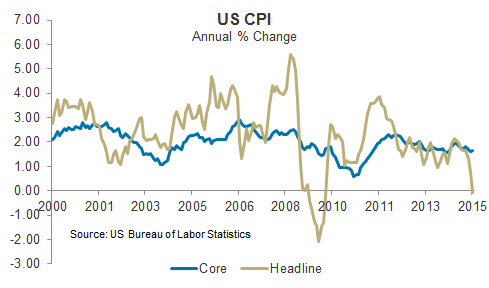
This data is released by the U.S Bureau of Labor statistics on a monthly basis. U.S inflation rate is -0,09%, (released Feb 26, 2015), compared to 0,76% in December and 1,58% last year. This is lower than the long-term average of 3,32%. Down -111,8%.
Inflation fell in January for a third straight month as U.S consumers continued to spend less on gas, food prices flattened and as costs retreated for new vehicles,used cars and trucks, household furnishings and operations, airline fares, alcohol and tobacco. U.S inflation turned negative for the first time since 2009.
The CPI measures what American pays for everything from cloths, airline tickets, fruits and vegetables to cars. Declines were again led by energy as prices at the pump tumbled about 19%. Gasoline prices have plunged 35% over the past 12 months.
A slower pace of inflation means consumers can buy more with their money, but a sustained decline over and extended period (deflation), can wreak havoc on an economy. Falling energy prices are beginning to filter down into other areas.
Core US inflation advanced 1,6% over the last 12 months, and the core 12-month reading is the benchmark inflation figure monitored by the Federal Open Market Committee (FOMC) as it helps in deciding where to set the key interests rate.
«We think inflation is going to move lower before it moves higher. Declining oil prices have had a very major influence,» Fed Chairwoman Janet Yellen said in a testimony.
The current level remains below the Fed`s 2% annual inflation target. In written remarks read to Congress, Janet Yellen stated:
“The Committee expects inflation to decline further in the near term before rising gradually toward 2 percent over the medium term as the labor market improves further and the transitory effects of lower energy prices and other factors dissipate, but we will continue to monitor inflation developments closely.”
Consumer Price Index data for February inflation and the annual period is scheduled for release on March 24, 2015.
Click the link below and check out the Fan Fund
https://www.eventbrite.com/e/fan-fund-tickets-15580655159
Disclaimer: The views expressed in this article are those of the author and may not reflect those of Shiny bull. The author has made every effort to ensure accuracy of information provided; however, neither Shiny bull nor the author can guarantee such accuracy. This article is strictly for informational purposes only. It is not a solicitation to make any exchange in precious metal products, commodities, securities or other financial instruments. Shiny bull and the author of this article do not accept culpability for losses and/ or damages arising from the use of this publication.
Filed under Commodities, Politics, Quantitative Easing
Who will win the currency war?
Let`s face it; there is a war out there. Not World War I or World War II, but a currency war that started five years ago. Who was the winner in WWI? And who was the winner in WWII? And who do you think will win the currency war that is going on now?
This currency war is also known as competitive devaluation. Countries compete against each other to achieve a relatively low exchange rate for their own currency. As the price to buy a particular currency falls so too does the real price of exports from the country. Imports become more expensive.
(Picture: U.S Dollar)
Employees in domestic industry will face a boost in demand for their products and services from both domestic and foreign markets, but the price will increase for imports and that can harm citizens` purchasing power, and that in turn can lead to a reduction in peoples standard of living.
The problem is when all the central banks are doing the same and this situation can lead to a general decline in international trade, which can harm all countries.
The world`s biggest financial center Singapore is the latest to take part of this currency war. The Singapore dollar tumbled to a four-year low against the US dollar after the Monetary Authority unexpectedly stymied currency appreciation.
Singapore is a compact financial center, uses exchange rates instead of lending rates to control its currency, as it is a very trade-oriented economy. The bank also reduced its inflation target, forecasting a negative 0,5 percent in consumer prices for 2015.
The reserve Bank of India also decided to cut reserve rates by 25 basis points to lower the inflation, they may again lower its lending rate next week. India, Japan and Russia have all seen a drop in the value of their currencies. Nine countries eased policy in January alone.
What is their goal? Their goal is to weaken their currency and gain an economic edge.
Japan is still «printing» money and ECB announced a week ago a €1,14 trillion quantitative easing plan and that sent the euro down to an 11-year low. The Swiss National Bank took precautions a week before that by removing the peg between the Swiss franc and the euro, and that sent the currency soaring 15 percent in a few seconds.
A negative interest rate of 0,25% a year on deposits means putting Swiss francs in a bank account will cost you 0,25% more than keeping them under the mattress. The plunge in the Russian ruble this year is down about 50% against the U.S dollar.
Check out the Japanese yen, which is down 25% over the past two years. It`s down about 20% against the U.S dollar since the summer. It is cheaper to buy a new iPhone in Tokyo and have it shipped over than it is to buy one in the U.S.
A cheap renminbi was a cornerstone in the Chinese industrial revolution, but renminbi has increased about 20% in the past four years because of the plunge in the yen. A weaker yen is good for Japanese jobs and industry because it makes foreign imports more expensive in Japan, while making Japanese exports cheaper abroad.
They all want to make their own currency cheap to boost exports and inflation.
But how can someone win if everyone is weaken their own currency against everyone else?
If you are familiar with fx trading, you know that if you buy one currency, you sell another at the same time, for example EUR/USD. If euro goes down, USD goes up, but both can`t go up or down at the same time. Here is the point.
Everyone can`t win and some of them have to lose, but who?
The U.S dollar have so far been a safe heaven and is getting stronger every day. So far, a great winner. Yen and Euro have been big losers. The U.S dollar soared while others plunged. This is expensive for U.S exporters, and Fed will probably do something very soon to fight back. This is a zero-sum game.
For the first time in history, all the worlds central banks are «printing money» as all the countries have generally preferred to maintain a high value for their currency. Countries have generally allowed market forces to work, or have participated in systems of managed exchanges rates. An exception occurred when currency war broke out in the 1930`s. As countries abandoned the Gold standard during the Great Depression, they used currency devaluations to stimulate their economies.
Since this effectively pushes unemployment overseas, trading partners quickly retaliated with their own devaluations. The period is considering to have been an adverse situation for all concerned, as unpredictable changes in exchange rates reduced overall international trade.
According to economist Richard N. Cooper, a substantial devaluation is one of the most «traumatic» policies a government can adopt (1971). It almost always resulted in crises of outrage and calls for the government to be replaced. A strong currency was commonly seen as a mark of prestige, while devaluation was associated with weak governments.
President Barrack Obama has defended the QE program, saying it would help the U.S economy to grow, which is good for the rest of the world. ECB will start their new QE program in a few weeks and if the economy improves in order to avoid inflation, there may be a promise to destroy any newly created money.
A reason for preferring devaluation common among emerging economies is that maintaining a relatively low exchange rate helps them build up foreign exchange reserves, which can protect against future financial crises.
The battle goes on between the Fed and the rest of the world`s foreign central banks. It`s war.
Disclaimer: The views expressed in this article are those of the author and may not reflect those of Shiny bull. The author has made every effort to ensure accuracy of information provided; however, neither Shiny bull nor the author can guarantee such accuracy. This article is strictly for informational purposes only. It is not a solicitation to make any exchange in precious metal products, commodities, securities or other financial instruments. Shiny bull and the author of this article do not accept culpability for losses and/ or damages arising from the use of this publication.
Filed under Politics, Quantitative Easing
Holocaust Memorial Day
Today it is 70 years since the Holocaust (the catastrophe). Six million Jews were killed by the Nazi regime and its collaborators. An additional five million non-Jewish victims of Nazi mass murders are included by some historians bringing the total to approximately eleven million. This is humanity at its worst!
From 1941 to 1945 Jews were targeted and methodically murdered in a genocide, the largest in modern history, and part of a broader aggregate of acts of oppression and killings of various ethnic and political groups in Europe by the Nazis.
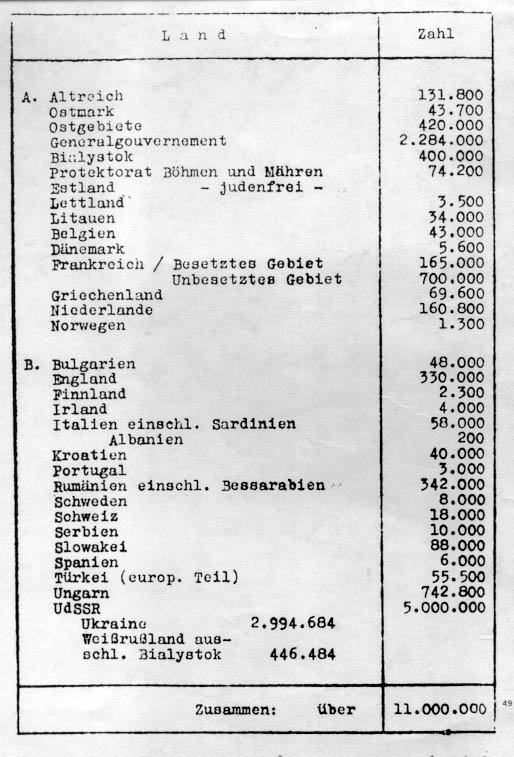
(Picture: List of Jewish populations by country used at the Wannsee Conference in 1942)
Every arm of Germany`s bureaucracy was involved in the logistics of the genocide, turning the Third Reich into «a genocidal state». Non-Jewish victims of broader Nazi crimes include Gypsies, Poles, communists, homosexuals, Soviet POW`s and the mentally and physically disabled.
A network of 42,500 facilities in Germany and German-occupied territories were used to concentrate, confine, and kill Jews and other victims. Between 100,000 and 500,000 were direct participants in the planning and execution of the Holocaust.
Nazism is the ideology and practice of the German Nazi Party and state. It is sometimes applied to other far-right groups. Usually characterised as a form of fascism that incorporates scientific racism and antisemitism. The full name of Hitler`s party was Nationalsozialistische Deutsche Arbeiterpartei (National Socialist German Workers` Party; NSDAP).
Nazism subscribed to theories of racial hierarchy and social Darwinism. Germanic people were depicted as true «Aryans» and the «master race». Opposed to both capitalism and Marxism, it aimed to overcome social divisions, with all parts of a homogeneous society seeking national unity, and what it viewed as historically German territory as well as additional lands for expansion.
The term «National Socialism» arose out of attempts to create a national redefinition of «socialism», as an alternative to both internationalist Marxist socialism and free market capitalism.
The Nazi Party was founded as the pan-German nationalist and antisemitic German Workers` Party on 5 January 1919. By the early 1920`s, Adolf Hitler assumed control of the organisation.
The National Socialist Program, adopted in 1920, called for a united Greater Germany that would deny citizenship to Jews or those of Jewish descent, while also supporting land reform and the nationalisation of some industries.
In Mein Kampf (1924), Hitler outlined his antisemitism and anti-communism at the heart of his political philosophy, as well as his disdain for parliamentary democracy and his belief in Germany`s right to territorial expansion. Nazism is neither left- nor right-wing, but syncretic.
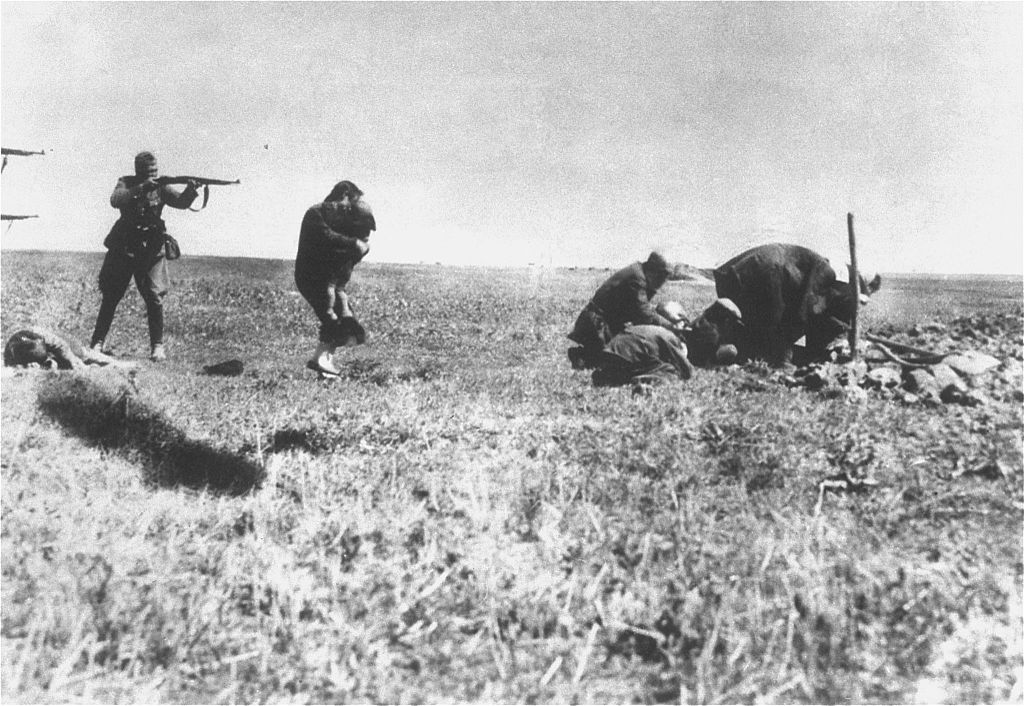
(Picture: Executions of Jews by German army mobile killing units (Einsatzgruppen) near Ivanhorod, now Ukraine. The photo was mailed from the Eastern Front to Germany and intercepted by a member of the Polish resistance)
The concept of the Aryan race, which the Nazis promoted, stems from racial theories asserting that Europeans are the descendants of Indo-Iranian settlers, people of ancient India and ancient persia. Johann Gottfried Herder argued that the Germanic peoples held close racial connections with the ancient Indians and anciant Persians, who he claimed were advanced people possessing a great capacity for wisdom, nobility, restraint, and science.
A French racial theorist and aristocrat, blamed the fall of the ancien regime in France on racial degeneracy caused by racial intermixing, which he argued destroyed the purity of the Aryan race, a term which he reserved only for Germanic people. Gobineau`s theories, which attracted a strong following in Germany, emphasised the existence of an irreconcilable polarity between Aryan (Germanic) and Jewish cultures.
Nazism`s racial policy positions may have developed from the views of important biologists of the 19th century, including French biologist Jean-Baptiste Lamarck, through Ernst Haeckel`s idealist version of Lamrckism and the father of genetics German botanist Gregor Mendel. Haeckel`s book was banned in the bookstore by the Nazi party.
Chamberlain`s work (1899) praised Germanic people for their creativity and idealism while asserting that the Germanic spirit was threatened by a «Jewish» spirit of selfishness and materialism. Chamberlain met Hitler in 1923, whom he admired as a leader of the rebirth of the free spirit.
In Germany, the idea of Jews economically exploiting Germans became prominent upon the fundation of Germany, due to the ascendance of many wealthy Jews into prominent positions upon the unification of Germany in 1871.
Empirical evidence demonstrates that from 1871 to the early 20th century, that German Jews were overrepresented in Germany`s upper and middle classes, while they were underrepresented in Germany`s lower class and particularly in the field of work of agricultural and industrial labour.
German Jewish financiers and bankers played a key role in fostering Germany`s economic growth from the 1871 to 1913, and such Jewish financiers and bankers benefited enormously from this boom, in 1908 amongst the twenty-nine wealthiest German families with aggregate fortunes of up to 55 million marks at the time, five of which were Jewish, and the Rothschild were the second wealthiest German family.
The predominance of Jews in German`s banking, commerce, and industry sectors in this time period was very high with consideration to Jews being estimated to have accounted for 1 percent of the population of Germany.
This overrepresentation of Jewish in these areas created resentment by non-Jewish Germans during periods of economic crisis such as in response to the 1873 stock market crash that resulted in a severe depression.
The 1873 stock market crash and ensuing depression resulted in a spate of attacks on alleged Jewish economic dominance in Germany, and antisemitism surged.
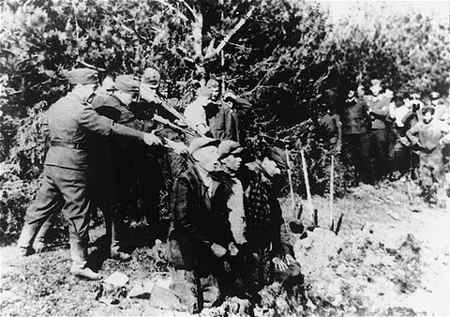
(Picture: Einsatzgruppe A; members execute Jews on the outskirts of Kovno, 1941-1942)
The Protocols of the Elders of Zion (1912) was an antisemitic forgery created by the police of the Russian Empire. Antisemitic believed it was real, and the Protocol became widely popular after World War I.
The Protocol claimed that there was a secret international Jewish conspiracy to take over the world. Alfred Rosenberg introduced the protocol to Hitler, and from 1920 onward, Hitler focused his attacks on claiming that Judaism and Marxism were directly connected; that Jews and Bolsheviks were one and the same, and that Marxism was a Jewish ideology. Hitler believed that the Protocols were authentic.
Johann Gottlieb Fichte accused Jews in Germany of having been, and inevitably continuing to be, a «state within a state» that threatened German national unity. Fichte promoted two options to address this: the fist was the creation of a Jewish state in Palestine to impel the Jews to leave Europe.
The other option was violence against Jews, saying that the goal would be «….to cut off all their heads in one night, and set new ones on their shoulders, which should not contain a single Jewish idea».
Tsarist exiles flooded into Munich and Berlin and spread theories about a worldwide Jewish Bolshevik conspiracy. Hitler`s own antisemitism was deepened and intensified by extensive conversations with Fyodor Vinberg, a Russo-German member of the organisation called Aufbau Vereinigung composed of White Russian emigres.
The Nazis argued that capitalism damages nations due to international finance, the economic dominance of big business, and Jewish influences. This Nazi propaganda was spread to the working class as anti-capitalism.
Hitler said in 1927: «We are socialists, we are enemies of today`s capitalistic economic system for the exploitation of the economically weak, with its unfair salaries, with its unseemly evaluation of a human being according to wealth and property instead of responsibility and performance, and we are determined to destroy this system under all conditions.»
Hitler told a party leader in 1934; «The economic system of our day is the creation of the Jews». He also told Benito Mussolini that «Capitalism had run its course». He argued that the only means to maintain economic security was to have direct control over resources rather than being forced to rely on world trade. He claimed that war to gain such resources was the only means to surpass the failing capitalist economic system.
Joseph Goebbels claimed in his diary in the 1920`s that if he were to pick between Bolshevism and capitalism, he said «in final analysis», «it would be better for us to go down with Bolshevism than live in eternal slavery under capitalism.»
The author Oswald Spengler published his book «The decline of the West» in 1918. According to Spengler, the Western world is ending and we are witnessing the last season – «winter time», of the Faustian civiliation. Western Man is proud but tragic figure because, while he strives and creates, he secretly knows the actual goal will never be reached, he said.
We are all different and unique and a society that has no room for difference has no room for humanity. You can’t build a society on hate!
This is insane!
Disclaimer: The views expressed in this article are those of the author and may not reflect those of Shiny bull. The author has made every effort to ensure accuracy of information provided; however, neither Shiny bull nor the author can guarantee such accuracy. This article is strictly for informational purposes only. It is not a solicitation to make any exchange in precious metal products, commodities, securities or other financial instruments. Shiny bull and the author of this article do not accept culpability for losses and/ or damages arising from the use of this publication.
Filed under Politics
 Ket Garden
 Business, Politics, Finans