Zohran Mamdani, the democratic socialist who made history as New York City’s first Muslim mayor, delivered a fiery victory speech last night — one that mixed idealism, populism, and defiance in equal measure. His words echoed the labor struggles of the past while speaking directly to working-class New Yorkers today.
He began with a quote from Eugene Debs:
“The sun may have set over our city this evening, but I can see the dawn of a better day for humanity.”
From there, Mamdani’s message was clear: power was no longer reserved for the wealthy and well-connected.
“Tonight, against all odds, we have grasped it. The future is in our hands.”
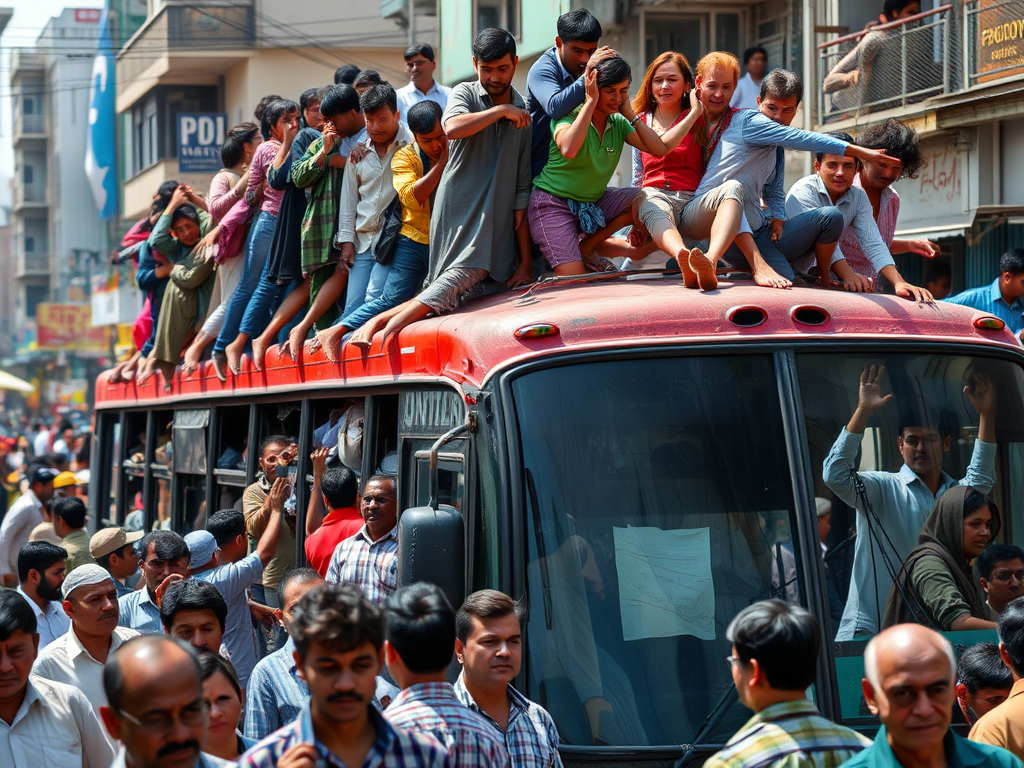
Picture: Fast and Free buses in New York City
Throughout his speech, Mamdani painted a vivid portrait of the “new New York” — one built by the city’s diverse working people.
“I speak of Yemeni bodega owners and Mexican abuelas. Senegalese taxi drivers and Uzbek nurses. Trinidadian line cooks and Ethiopian aunties… This city is your city, and this democracy is yours too.”
He connected his campaign to real faces and stories: Wesley, a hospital worker commuting two hours from Pennsylvania; a woman on the Bx33 who said she no longer loved New York; and Richard, the taxi driver he once joined in a 15-day hunger strike.
“My brother, we are in City Hall now,” Mamdani declared — a line that electrified the crowd.
Then came the emotional centerpiece of the speech — a rallying cry that tied hope to transformation:
“We chose hope together. Hope over tyranny. Hope over big money and small ideas. Hope over despair. Tonight, we have stepped out from the old into the new.”
He went on to outline what that “new age” would look like:
“Central to that vision will be the most ambitious agenda to tackle the cost-of-living crisis that this city has seen since the days of Fiorello La Guardia — an agenda that will freeze the rents for more than 2 million rent-stabilized tenants, make buses fast and free, and deliver universal childcare across our city. This new age will be one of relentless improvements. We will hire thousands more teachers. We will cut waste from a bloated bureaucracy.”
He also promised a new approach to safety and justice:
“We will work with police officers to reduce crime and create a department of community safety that tackles the mental health crisis and homelessness crisis head-on. In this new age we make for ourselves, we will refuse to allow those who traffic in division and hate to pit us against one another.”
Mamdani warned against the forces of distraction and division:
“They want the people to fight amongst ourselves so that we remain distracted from the work of remaking a long-broken system.”
His agenda was sweeping: freezing rents, free buses, universal childcare, and stronger unions. He vowed to hold both landlords and billionaires to account — calling out Donald Trump by name several times.
“We will stand alongside unions and expand labor protections because we know, just as Donald Trump does, that when working people have ironclad rights, the bosses who seek to extort them become very small indeed.”
As the crowd cheered, Mamdani tied his personal story to the city’s identity:
“New York will remain a city of immigrants — built by immigrants, powered by immigrants, and, as of tonight, led by an immigrant. I am young. I am Muslim. I am a democratic socialist. And I refuse to apologize for any of this.”
The closing lines were pure optimism:
“Together, New York, we’re going to freeze the rent. Together, New York, we’re going to make buses fast and free. Together, New York, we’re going to deliver universal childcare.”
A Speech of Hope and a Hint of Overreach
Wow. It’s hard to deny the power and passion behind Mamdani’s words. His call for “hope over tyranny” and “hope over big money” struck a chord in a city long divided by inequality. Yet, his repeated attacks on Donald Trump made it sound as if Trump himself were the root of all problems. He’s not. Trump exists because of the problems — economic, social, and political — that stretch far beyond New York.
Still, Mamdani’s vision of a city that “shines again” is bold and contagious. Fast and free buses? Frozen rents? Universal childcare? That’s impressive, no doubt. But it also raises the question — if everything becomes free, what about a free lunch?
A Dream Worth Testing
Whether his promises are realistic or merely rhetorical remains to be seen. Mamdani has set the bar sky-high — and with it, expectations from the same working people he vowed to serve. History has shown that idealism can ignite movements, but it’s delivery that defines leadership. For now, though, his message has done what great speeches do best: it made people believe again — not just in politics, but in possibility.
Disclaimer: The views expressed in this article are those of the author and may not reflect those of Shinybull.com. The author has made every effort to ensure the accuracy of the information provided; however, neither Shinybull.com nor the author can guarantee the accuracy of this information. This article is strictly for informational purposes only. It is not a solicitation to make any exchange in precious metal products, commodities, securities, or other financial instruments. Shinybull.com and the author of this article do not accept culpability for losses and/ or damages arising from the use of this publication.
Zohran Mamdani is the next New York City Mayor. He is a muslim, anti-Trump, Anti-capitalist, and will make free buses for the people in New York. At the same time, he will tax the rich. Trump moved out of New York long ago. So do many other wealthy people in New York.
Not only that. More than 1 million Orthodox Jews have escaped New York. Maybe we will see more jews escape New York as a muslim is their new Mayor. Time will show. But, there is no doubt; A massive storm is coming! Put your steel helmet on and fasten your seatbelt.
On the other hand, what we see today is not something new. This is how the system works. It goes, and then it goes down again, and again, and again. The crisis in New York has nothing to do with the Mayor. This is happening all over in the West. It is the system. Not the Mayor.
The Returning Storm: Capitalism’s Crisis & the Echoes of 1848
We hear it again and again: that the system is failing large numbers of people. The working class is struggling, costs are skyrocketing, and the ladder of opportunity seems broken. That’s why many vote for socialists: they look at the system not as a solution, but as the problem. But why does capitalism still persist when it doesn’t work for everyone?
Karl Marx saw it clearly: capitalism is built on the exploitation of workers (the proletariat) by those who own and control the means of production (the bourgeoisie). The extraction of surplus value, alienation of labour, cycles of boom and bust, and rising inequality. He argued that all of it spells eventual collapse, ushering in a socialist revolution.
Maybe what we’re witnessing now is not a violent revolution with barricades and guillotines, but a democratic and social one: a shift in consciousness, a call for new economic arrangements.
A Story That Shows What’s Wrong
Imagine an old woman in Spain who has lived in her apartment for seventy years. Her home is her past, her memories, her identity. Now, an American hedge fund buys the building. Her rent shoots up far beyond what her pension covers. She’s told: “Move out or pay the price.”
What kind of capitalism is this? Where the place you’ve lived your entire life, the neighbourhood you know, becomes a profit asset to someone else, and you, the tenant, are simply a cost-to-be-cut or revenue-to-be-raised.
This isn’t small-scale displacement; it’s systemic.
According to research, private equity firms now own a significant share of the U.S. housing stock, and their business model often involves raising rents, cutting maintenance, and treating homes as profit centres.
When individuals who’ve paid their dues, who’ve worked and saved, are pushed aside so someone else can “monetize” their roof, the legitimacy of the system is damaged.
1848 and the Warning from History
Nine years ago, I wrote an article about the French Revolution, and I need to get back to that story once again. Back in February 1848 in France, the blueprint of revolt was laid bare. The monarchy of Louis Philippe, once hailed as a “Citizen King,” had drifted away from the people. Wages collapsed, food prices soared, and despair turned to anger. When the government repressed the protests, Paris erupted in barricades. The king fled, and a second French Republic was proclaimed.
The lesson is clear: when a system fails the many and protects the few, the many find a voice. When inequality is visible, persistent, and reinforced by institutions that claim neutrality, resistance builds. The revolution of 1848 was not just about a king dying. It was about legitimacy dissolving.
So, Why Do We Still Have Capitalism?
Because it works. For some. Because markets deliver dynamism, innovation, and wealth. If measured for the few. Because institutions decide the rules and often shield the winners. Because alternatives are messy, unproven, and intimidating for those who benefit now.
Yet the crisis is also structural. The logic of profit demands cost-cutting, evictions, rent hikes, financialization of housing, and commodification of basic needs. When a woman who’s lived somewhere for 70 years is priced out overnight, that’s not a bug. It’s a feature of the system.
Are We on the Edge of a New Revolution?
Perhaps. Not in the storm-and-fury sense, but in the long, accumulating demand for change. When politicians like Zohran Mamdani win with promises of free buses, rent freezes, and groceries for all, the message is: the old order is brittle. The working class has been squeezed too long. The vote is a signal.
But the storm won’t vanish just with promises. The funding model matters. The rents, taxes, business flight, and investment flows. All these determine whether change can be real or become another wave of disappointment.
The Elderly Woman and the Bigger Question
When you see her story. 70 years of life, on a fixed income, facing eviction because of global capital chasing returns, you understand what’s at stake. It’s not just housing. It’s dignity. It’s the promise of stability. It’s the belief that society isn’t only for the rich.
And when capitalism no longer delivers that promise for large swathes of people, then the logic of Marx begins to look less like ideology and more like prophecy.
In 1848 they overthrew a king. In 2025 they may overthrow the illusion. The illusion that capitalism still works for everyone.
The storm is coming
It might be messy. It might be uncomfortable. But history shows us that when systems stop working for most people, change happens. So ask yourself:
Are we watching the death of the promise of capitalism as we knew it? Or are we witnessing its evolution — into something fairer, more inclusive, more human?
Closing thought
In 1848, they forced the king to abdicate. Today, maybe we don’t need to kill a king. We need to kill the illusion that this system works for everyone. Change isn’t coming tomorrow. It’s already knocking at the door.
Disclaimer: The views expressed in this article are those of the author and may not reflect those of Shinybull.com. The author has made every effort to ensure the accuracy of the information provided; however, neither Shinybull.com nor the author can guarantee the accuracy of this information. This article is strictly for informational purposes only. It is not a solicitation to make any exchange in precious metal products, commodities, securities, or other financial instruments. Shinybull.com and the author of this article do not accept culpability for losses and/ or damages arising from the use of this publication.

 Ket Garden
 Business, Politics, Finans