
Tag Archives: QE

Understanding Gold

Gold and silver are complicated assets to price, because prices depend on the valuation of other assets and on differences between U.S data and the rest of the world. Stocks and currencies depend on fundamental data, but for gold and silver it is more complicated. The gold and silver prices express the strength of the global economy vs the expectations of real interest rates in the U.S.

Gold

Understanding the gold and silver prices is the key to unlocking the mystery of fiat money. Do you remember the collapse in Russia in 1999, South East Asia in 1997, and Brazilian and other South American currency crises from 1992 to 1994? Many lost all their savings, because of the collapse of their governments currencies.

Gold cannot suffer such a collapse in value because gold cannot be created by any government at will. That`s why the governments would like to convince the populace that it should disregard gold as a monetary asset and embrace its fiat currencies.

All previous experiments with fiat currencies ended in disaster. Our history books are littered with examples of empires that were built on hard work and destroyed by a devaluation of their currency. But this time is different. Central banks are doing the same thing at the same time; printing money. So, you have to look at the dollar compared to other currencies.

Understanding the gold and silver prices is the key to unlocking the mystery of fiat money. Compared to the prices in the past, the gold price should be $2,500, $4,000, $7,000 or even $14,000, but it isn`t. It is declining.

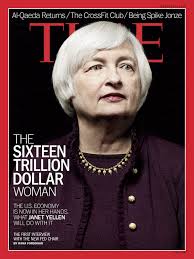
Fed successor Janet Yellen said (November 2013); «I don`t think anybody has a very good model of what makes gold prices go up and down.» Fed Chairman Ben Bernanke told (July 2013) Congress he doesn`t pretend to understand gold prices. Nobody does.

Gold and Silver are correlated to copper, oil price, Chinese investments and to global money supply and inflation. Higher supply of U.S oil and slower growth weakened the oil price and also the gold and silver price. Copper and oil got under pressure by the slowing Chinese real estate investments.

Chinese law to disallows to buy a second home, helped to calm these investments along with high interest rates.

The main driver for high gold prices in the «gold bubble» during the end of 1970`s was driven by U.S inflation, but what now as the emerging markets achieve half of global GDP? It will be difficult to view the gold price related to U.S inflation now. Falling food and energy prices in Europe are an indicator of weak EM.

Central banks in EM reduced their dollar share and bought gold between 2010 and 2012. India holds 10% of reserves in gold, while China holds 1,7% and Brazil only 0,5%. Countries with current account deficit (India: 10% Central bank gold holdings), Belarus (30%) and Egypt (25%), prefer gold to stabilize their currency.

Western central banks still stick with the former IMF rule not to buy gold any more.

The gold share is very high for many European countries, while it is still low in EM central banks. Central banks of Germany, Italy and France are all three with 70% gold holdings, and they could all build up their reserves during the Bretton Woods era.

All other countries fixed their N currencies against 1 currency, the U.S dollar, in the Bretton Woods system. The Fed was obliged to exchange on ounce of gold into $35 U.S dollar. (N:1 currency system). President Nixon closed this cheap gold at $35 window in 1971.

Gold lost its status with flexible exchange rates, and the IMF demonization of gold policy even urged central banks to sell their gold. Central banks in Switzerland and the UK followed these calls, and the Fed is still the leasing central bank in an implicit N:1 system of central banks (Bretton Woods II).

Quantitative easing makes the gold rise and the dollar to weakens, because private investors and some central banks move out of the dollar and into gold. If the U.S employment falls, then the dollar appreciates which is about to happened now. EM will be more expensive and with lower oil prices the U.S trade deficits diminishes.

U.S funds will find treasuries more attractive relative to gold and silver and normally when the real interest rates is high, the gold price is weak and vice verse. When the U.S economy improves the gold price falls, and the chances of a Fed Funds rate hike increase, but that`s far in the future.

The gold price moved upward together with oil prices and wages during the 1970`s inflation expectations. Wages is playing a role as an underlying factor for interest rates and the gold price. At that time, Fed Chairman Volcker hiked interest rates so that unions stopped higher wage demands, new supply (North-sea oil) suppressed the oil price and the incomes of EM, while the global growth was sluggish.

Fed Chairman Volcker destroyed the gold price by keeping inflation (and company margins) under control and the stock price rose again. Now wages is declining (wage share of GDP) and the company margins are increasing. The gold price have dropped sharply in a few days and are trading below its 1,200 support level. It can go down to 1,000 and below.

A report published by the World Gold Council «China`s gold market: progress and prospects» suggests that the demand for gold will increase by 20%, from 1,132 tonnes per year to at least 1,350 tonnes by 2017. It was a record level of Chinese demand for gold in 2013, and 2014 is suggested to see consolidation, the succeeding years are likely to see sustained growth.

The market began liberalising in the late 1990s, and China is the number one producer and consumer of gold. It is expected to see the market to continue to expand, irrespective of short-term blips in the economy.

Mr. Greenspan said gold is a good place to put money these days given its value as a currency outside of the policies conducted by government. Gold is down 1/3 since it’s all time high of $1,921,50 in September 6, 2011. On October 29, he told the Council of Foreign Relations that the Fed`s $4 trillion balance sheet is a «pile of tinder, but hasn`t been lit.» Once the central banks stop «sitting on» their reserves, said tinder will ignite «inflation will eventually have to rise,» and in turn, «gold will move higher, measurably so.» (Fxsteet.com).

Gold is a hedge against inflation, and not against times of crises. Right now, the problem is not inflation, but the opposite; something worse called; deflation. Gold can go down while inflation increases, as they did from 1980 to 2000. It`s difficult to understand the setting of the gold price, so I will continue to look at the technical analysis. Gold is still  in a bearish market.


Disclaimer: The views expressed in this article are those of the author and may not reflect those of Shiny bull. The author has made every effort to ensure accuracy of information provided; however, neither Shiny bull nor the author can guarantee such accuracy. This article is strictly for informational purposes only. It is not a solicitation to make any exchange in precious metal products, commodities, securities or other financial instruments. Shiny bull and the author of this article do not accept culpability for losses and/ or damages arising from the use of this publication.
Leave a comment

Filed under Commodities

Consolidation since March

It was a good day for U.S stocks on friday. The Dow up +0,27%, S&P 500 +0,37% and Nasdaq +0,52%. Japan`s Nikkei is down today -0,64%, while Hang Seng is almost flat -0,04%. Copper is up +0,75% today, while Silver advance +1,14%. Gold is up +0,61%,Crude Oil (brent) is up +0,33%.

European stocks are in a red territory so far today. Stoxx 50 -0,57%, FTSE 100 -0,32%, CAC 40 -0,17% and DAX is down -0,35% so far today. Investors are waiting for the next Governing Council meeting on June 5 in Frankfurt.

It is expected that ECB (European Central Bank) will ease policy. The reason why this is expected is mostly because of what`s been saying in May 8 meeting. Draghi said that policy makers are «dissatisfied» with the inflation outlook and «confortable with acting next time».

Some speculate that it will cut the benchmark rate by 10 basis points to 0,15%, and the deposit rate, which is at zero. Denmark ended its experiment with negative rates last month. ECB`s inflation goal is just under 2%, but the inflation is below 1%.

The inflation has been below 1% since october and the Euro is strong. The currency has risen more than 7% against the dollar since early July 2013. The Euro climbed as high as $1,3993 on May 8, right after Draghi spoke. EUR is now trading at $1,3719.

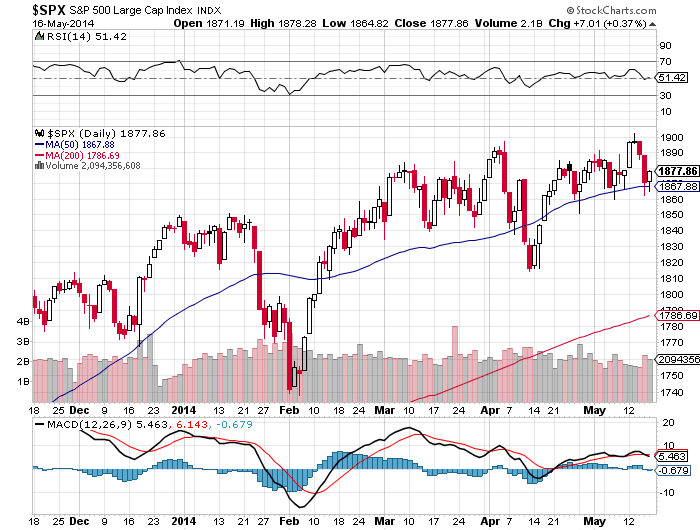
Take a look at S&P 500 Large Cap Index.

SPX 19.05.2014

Many bulls and bears are frustrated. They are both waiting for the index to move, but the SPX have been in a consolidation for many weeks and months now. It all started in Mars this year. Investors are not waiting for consolidation, but rather correction. That`s why they are frustrated. The SPX is flirting with 50MA, which is at 1867,88.

Disclaimer: The views expressed in this article are those of the author and may not reflect those of Shiny bull. The author has made every effort to ensure accuracy of information provided; however, neither Shiny bull nor the author can guarantee such accuracy. This article is strictly for informational purposes only. It is not a solicitation to make any exchange in precious metal products, commodities, securities or other financial instruments. Shiny bull and the author of this article do not accept culpability for losses and/ or damages arising from the use of this publication.
Leave a comment

Filed under Quantitative Easing, Stock market

QE in Europe

The dollar rose against major rivals yesterday and investors now wait for employment data later today. The Euro fell yesterday after ECB`s President Mario Draghi said the bank has discussed QE at the last meeting.

The ECB also made no change to interest rate or monetary policy, leaving its key lending rate at 0,25%. Draghi said they would use unconventional measures to fight falling inflation. The mechanics of a hypothetical bond-buying program weren`t hashed out, he said.

The target for inflation rate in Europe is just under 2% in the medium term. Inflation should pick up in April because of the Easter holiday. If Draghi is right, they will probably not do something in May, so the first real opportunity for some action is in June.

Mario Draghi and ECB hope the Easter Bunny will bring an uptick in inflation in April! I hope so too. Usually we see a volatility around service prices in the months around Easter. Draghi expect the inflation to be low in 2015, and push back toward levels closer to 2% toward the end of 2016.

We saw what happened to Japan in 1989. Nikkei topped out on December 29, 1989, during the peak of the Japanese asset price bubble. The ultra-day high was 38,957,44. It grow sixfold during the decade, and lost nearly all these gains.

On March 10, 2009, Nikkei closed at 7,054,98. That is 81,9% below its peak in 1989. Take a look at the chart below. Japan has printed so much money, but have never recovered. The value of the stocks is declining, and Japan`s public debt will be 242% of GDP in 2014.

Nikkei 225

(Chart: Nikkei Index)

Japan`s debt-to-GDP ratio is higher than any country in Europe and more than twice the OECD average. OECD expect Japan`s gross general government debt-to-GDP ration will increase to 231% in 2014.

How is it in the PIIGS country`s? Greece: 166%, Italy: 140%, Ireland: 123%, Portugal: 139% and Spain: 91%. The U.S national debt is now: $17,565,900,000,000. Take a look at this link: http://www.usdebtclock.org/

So, what are you doing if your debt is higher than your income? Paying the debt by another debt? No way! Debt is like drugs. You need more and more and more, and at the end, it will go terribly wrong. Japan had deflation for about 15 years.

Nonfarm Payrolls and Unemployment rate will be reported later on today. Millions are unemployed and this cannot continue. Mark Twain once said: «The lack of money is the root of all evil».

U.S is not Japan. U.S is not half the way either, but will the debt clock stop in the future? Tighter Fed policy will boost economy, according to UBS AG. The expectation for rising rates may prove helpful. This is positive thoughts.

Reports today:

08:30 a.m EST Nonfarm Payrolls
08:30 a.m EST Unemployment Rate

Disclaimer: The views expressed in this article are those of the author and may not reflect those of Shiny bull. The author has made every effort to ensure accuracy of information provided; however, neither Shiny bull nor the author can guarantee such accuracy. This article is strictly for informational purposes only. It is not a solicitation to make any exchange in precious metal products, commodities, securities or other financial instruments. Shiny bull and the author of this article do not accept culpability for losses and/ or damages arising from the use of this publication.
 

Leave a comment

Filed under Stock market

FED raise rates

Silver dropped -2,60%, while gold is down -1,01% after the news from Fed Chair Janet Yellen. Oil and Copper is also down today. Janpan`s Nikkei 225 is down -1,65% to 14,224 points. Hang Seng is also down together with the rest of Asia.

Janet Yellen

(Picture: Fed Chair Janet Yellen)

The U.S indices traded down yesterday too and Europe is also in a red territory. Most investors don`t know what to do right now. It seems to be a red opening in the U.S later today. This is all reactions on the FOMC meeting yesterday.

The Fed will probably end its massive bond-buying program this fall and probably start raising interest rates around 6 months later. This comment sent stocks and bonds tumbling. We will see a more aggressive path toward higher interest rates than anticipated she said yesterday.

The Federal Reserve has held the interest rate near zero since late 2008. They have pumped trillions into the markets with its bond purchases. All this because they tried to foster a stronger recovery. Despite the QE program, the growth has been very slow.

The change in its rate hike guidance did not mark a shift in its intentions and they will wait a «considerable time» after shuttering its asset purchase program before pushing borrowing costs higher. «Considerable time» means about 6 months.

But, as Janet Yellen said: «It depends – what the statement is saying is it depends what conditions are like».

Most people don`t know it, but the best period of economic growth in all U.S history was without a central bank. Do U.S really need Federal Reserve? They created the markets crash in 1929, and so far the FED has been a disastrous.

The FED started about 100 years ago, and since then the dollar has lost more than 96% of its value. The size of the U.S national debt is more than 5000 times larger. The Fed`s «debt-based» financial system has trapped the U.S, and are on the verge of the greatest financial crises in history.

Congress could have shut down the FED long time ago. I HATE DEBT!

Reports today:

08:30 AM ET Unemployment Claims
10:00 AM ET Existing Home Sales
10:00 AM ET Philly Fed Manufacturing Index
10:00 AM ET CB Leading Index m/m
04:00 PM ET Bank Stress Test Results

Disclaimer: The views expressed in this article are those of the author and may not reflect those of Shiny bull. The author has made every effort to ensure accuracy of information provided; however, neither Shiny bull nor the author can guarantee such accuracy. This article is strictly for informational purposes only. It is not a solicitation to make any exchange in precious metal products, commodities, securities or other financial instruments. Shiny bull and the author of this article do not accept culpability for losses and/ or damages arising from the use of this publication.

Leave a comment

Filed under Quantitative Easing, Stock market

BIG Apple

The stock markets are sliding down but this is not the end of the world. There ain`t no doubt; the bear is here! Yesterday Nasdaq tumbled -1,08%, while Apple plummeted -7,7% in after hour trading. Dow slid -0,3%.

This is how it probably will be in the stock market now. Up and down, or what we call a volatile market. That`s why it is so important to know about stock picking. How to pick the right stocks, and that`s why I wrote about it last week.

In my opinion; U.S stocks is not cheap, so it is important to know what to do before any decision is made. The European stocks is twice as cheap as the U.S stocks. How is it going with Apple?

Apple reports yesterday:

iphone sales is $32,5B (+6% vs 17% in FQ4).

ipad sales is $11,5B (+7% vs -13%).

Mac sales is $6,4B (+16% vs -15%).

iTunes/software/services revenue is 4,4B (+19%).

iPod sales is only $973M (-55%).

78% of Apple`s cash/investment balance ($159B) is offshore. The iPhone sales is up +40% in Japan. Sales in China is up 20%. Europe is flat, while Americas sales is only +1%. Tim Cook didn`t say much about buybacks in face of Carl Icahn`s ongoing campaign. $7,8B was returned via dividends/buybacks. Apple need to release something new now, and I am not talking about a bigger screen or a different color. I am talking about innovation. Come On Apple: “think different”.

Revenue: $57,59B

FQ1 EPS: $14,50

Expects FQ2 revenue of $42 – $44B.

How is the inflation? It is rising, but it is difficult to see it. Some people expect inflation and some expect deflation. Both camps see increase in general prices like visible money and credit prices. Hyperinflation is expected, but deflation is probably the biggest problem in the future in the long run. I think Janet Yellen will push the QE-button if the deflation ghost is here. As you can see; despite the QE programs, the growth is so far very slow.

If the Fed starts its tapering, how will that affects the emerging markets? Half of the global GDP comes from the emerging markets, and that moves the other markets in the rest of the world.

It seems like money is on the way back to emerging markets as the Fed announces their tapering. Let`s wait for the FOMC statements later on this week.

Reports today: Core DurableGoods at 8:30am, S&P/CS Composite at 9:00am, CB Consumer Confidence at 10:00am.

Apple

Disclaimer: The views expressed in this article are those of the author and may not reflect those of Shiny bull. The author has made every effort to ensure accuracy of information provided; however, neither Shiny bull nor the author can guarantee such accuracy. This article is strictly for informational purposes only. It is not a solicitation to make any exchange in precious metal products, commodities, securities or other financial instruments. Shiny bull and the author of this article do not accept culpability for losses and/ or damages arising from the use of this publication

Leave a comment

Filed under Commodities, Stock market