
Tag Archives: Money printing

Economists expected slower growth, but these numbers indicate that the U.S. economy continues to perform well

YouTubers are full of negativity. Recession is near! Be ready! This is scary! Sell your stocks! The economy is bad! Well, everything isn`t good, but the growth in the U.S. is still very good. Just take a look at the numbers.

More good news came out earlier today. The U.S. job market in October 2024 has shown surprising strength, with 254,000 new jobs added in September. Far exceeding expectations. This strong growth brings the unemployment rate down to 4.1% (which is relatively low historically), and hourly wages are growing at an annual rate of 4%.

Economists expected slower growth, but these numbers indicate that the U.S. economy continues to perform well, and there’s optimism about avoiding a recession. However, voter sentiment still lags, as many remain concerned about inflation and the broader economic outlook

Not only the U.S. stock market is going up. Take a look at the China Stock Market. The China Stock Market has gone down and sideways for about 18 months but took back that downturn within a couple of weeks. This is amazing.

The recent surge in China’s stock market over the past two weeks is likely driven by several factors, including improved investor sentiment, government stimulus measures, and better-than-expected economic data. China’s government has implemented policies to stabilize the property sector, cut interest rates, and support industries, encouraging domestic investment.

Additionally, optimism about easing geopolitical tensions and a potential economic rebound is fueling this upward momentum. However, concerns remain about long-term growth and regulatory uncertainties, which could influence future market performance.

But China is not alone. ECB is doing the same. BOJ is doing the same, and so is the FED among many others. New money is coming into the stock market, and the stock market continues to climb higher.
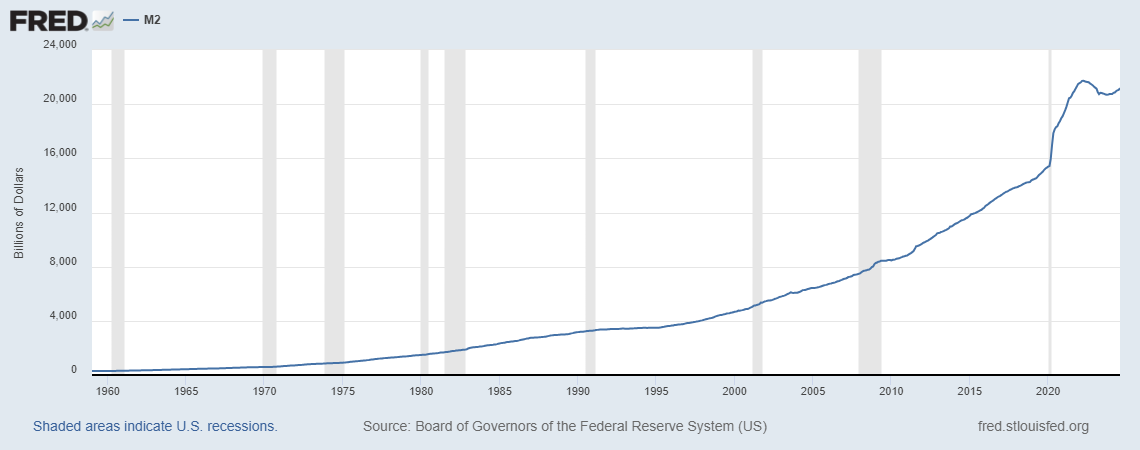
The massive printing of $21.17 trillion by the U.S. and other central banks, mainly in response to crises like the pandemic, significantly increased liquidity in the global financial system. This money printing was aimed at stimulating economies, propping up financial markets, and providing emergency relief. However, it also led to inflationary pressures as too much money chased too few goods.

The excess liquidity fueled asset bubbles raised debt levels and forced central banks to later tighten policies to combat the resultant inflation. Balancing liquidity while avoiding hyperinflation remains challenging.

The U.S. most recently engaged in significant money printing during the COVID-19 pandemic, particularly in 2020 and 2021, through measures such as the Federal Reserve’s Quantitative Easing (QE) program.

As of July 2024, the M1 money supply (monthly supply) in the United States stood at approximately 18 trillion dollars, marking a significant decrease from the previous year. This decline followed a notable contraction in the M1 money supply during the latter half of 2022 and the first six months of 2023.

The Fed injected trillions of dollars into the economy by purchasing government bonds and mortgage-backed securities to maintain liquidity, lower interest rates, and stimulate growth. By mid-2021, the Fed had expanded its balance sheet by over $4 trillion. However, exact figures for ongoing or current printing efforts are often adjusted depending on economic conditions.

Disclaimer: The views expressed in this article are those of the author and may not reflect those of Shinybull.com. The author has made every effort to ensure the accuracy of the information provided; however, neither Shinybull.com nor the author can guarantee such accuracy. This article is strictly for informational purposes only. It is not a solicitation to make any exchange in precious metal products, commodities, securities, or other financial instruments. Shinybull.com and the author of this article do not accept culpability for losses and/ or damages arising from the use of this publication.

Leave a comment

Filed under Politics, Stock market

Who will win the currency war?

Let`s face it; there is a war out there. Not World War I or World War II, but a currency war that started five years ago. Who was the winner in WWI? And who was the winner in WWII? And who do you think will win the currency war that is going on now?

This currency war is also known as competitive devaluation. Countries compete against each other to achieve a relatively low exchange rate for their own currency. As the price to buy a particular currency falls so too does the real price of exports from the country. Imports become more expensive.

Stack of $100 bills

(Picture: U.S Dollar)

Employees in domestic industry will face a boost in demand for their products and services from both domestic and foreign markets, but the price will increase for imports and that can harm citizens` purchasing power, and that in turn can lead to a reduction in peoples standard of living.

The problem is when all the central banks are doing the same and this situation can lead to a general decline in international trade, which can harm all countries.

The world`s biggest financial center Singapore is the latest to take part of this currency war. The Singapore dollar tumbled to a four-year low against the US dollar after the Monetary Authority unexpectedly stymied currency appreciation.

Singapore is a compact financial center, uses exchange rates instead of lending rates to control its currency, as it is a very trade-oriented economy. The bank also reduced its inflation target, forecasting a negative 0,5 percent in consumer prices for 2015.

The reserve Bank of India also decided to cut reserve rates by 25 basis points to lower the inflation, they may again lower its lending rate next week. India, Japan and Russia have all seen a drop in the value of their currencies. Nine countries eased policy in January alone.

What is their goal? Their goal is to weaken their currency and gain an economic edge.

Japan is still «printing» money and ECB announced a week ago a €1,14 trillion quantitative easing plan and that sent the euro down to an 11-year low. The Swiss National Bank took precautions a week before that by removing the peg between the Swiss franc and the euro, and that sent the currency soaring 15 percent in a few seconds.

A negative interest rate of 0,25% a year on deposits means putting Swiss francs in a bank account will cost you 0,25% more than keeping them under the mattress. The plunge in the Russian ruble this year is down about 50% against the U.S dollar.

Check out the Japanese yen, which is down 25% over the past two years. It`s down about 20% against the U.S dollar since the summer. It is cheaper to buy a new iPhone in Tokyo and have it shipped over than it is to buy one in the U.S.

A cheap renminbi was a cornerstone in the Chinese industrial revolution, but renminbi has increased about 20% in the past four years because of the plunge in the yen. A weaker yen is good for Japanese jobs and industry because it makes foreign imports more expensive in Japan, while making Japanese exports cheaper abroad.

They all want to make their own currency cheap to boost exports and inflation.

But how can someone win if everyone is weaken their own currency against everyone else?

If you are familiar with fx trading, you know that if you buy one currency, you sell another at the same time, for example EUR/USD. If euro goes down, USD goes up, but both can`t go up or down at the same time. Here is the point.

Everyone can`t win and some of them have to lose, but who?

The U.S dollar have so far been a safe heaven and is getting stronger every day. So far, a great winner. Yen and Euro have been big losers. The U.S dollar soared while others plunged. This is expensive for U.S exporters, and Fed will probably do something very soon to fight back. This is a zero-sum game.

For the first time in history, all the worlds central banks are «printing money» as all the countries have generally preferred to maintain a high value for their currency. Countries have generally allowed market forces to work, or have participated in systems of managed exchanges rates. An exception occurred when currency war broke out in the 1930`s. As countries abandoned the Gold standard during the Great Depression, they used currency devaluations to stimulate their economies.

Since this effectively pushes unemployment overseas, trading partners quickly retaliated with their own devaluations. The period is considering to have been an adverse situation for all concerned, as unpredictable changes in exchange rates reduced overall international trade.

According to economist Richard N. Cooper, a substantial devaluation is one of the most «traumatic» policies a government can adopt (1971). It almost always resulted in crises of outrage and calls for the government to be replaced. A strong currency was commonly seen as a mark of prestige, while devaluation was associated with weak governments.

President Barrack Obama has defended the QE program, saying it would help the U.S economy to grow, which is good for the rest of the world. ECB will start their new QE program in a few weeks and if the economy improves in order to avoid inflation, there may be a promise to destroy any newly created money.

A reason for preferring devaluation common among emerging economies is that maintaining a relatively low exchange rate helps them build up foreign exchange reserves, which can protect against future financial crises.

The battle goes on between the Fed and the rest of the world`s foreign central banks. It`s war.


Disclaimer: The views expressed in this article are those of the author and may not reflect those of Shiny bull. The author has made every effort to ensure accuracy of information provided; however, neither Shiny bull nor the author can guarantee such accuracy. This article is strictly for informational purposes only. It is not a solicitation to make any exchange in precious metal products, commodities, securities or other financial instruments. Shiny bull and the author of this article do not accept culpability for losses and/ or damages arising from the use of this publication.

Leave a comment

Filed under Politics, Quantitative Easing