Category Archives: Uncategorized

Why not print more money?

Let`s print more money and solve the debt problem. That sounds great, but unfortunately, it isn`t so easy as that. We will not be wealthier if we print more money. That is difficult to understand, and why is it like that?

money2

If we print more money, prices will increase and that`s what we call inflation. Let`s suppose the United States printed a lot of money and gave it to everyone in the country. People would pay debt or save the money, but most of them will be spent on different things.

Today, I belive most of them would run to the shops and buy iPhone 6 or the latest version of Xbox. But this would be a problem for both Apple and Microsoft, because the demand will increase. They will simply not have enough products to sell to the market, which means the prices will go up, which means a massive inflation, and our money is devalued.

If Apple and Microsoft increase the production to meet the demand in the market, it will be a problem for the factories too, because their capacity is limited. If the demand increase, the production will also increase, so the prices goes up at the retailer, Apple and factory.

The cost per-unit will rise because of the rise in labor cost at the factory. A rise in cost at the factory rises the price of the product in the shop. All this because of an increase in the demand for the product.

Wages are prices. An hourly wage is the price a man charges for an hour of labor. It`s not possible to stay at the same level if employees work overtime. This is added cost. In some industries it will be a problem to have increased demand, and some will need to hire extra labor. Extra labor will increase wages.

Do you think employees will work more or less if you gave them a lot of money? Labor market pressures requires wages to increase, which means the cost per unit must increase as well. Retailers must raise prices or simply run out of product.

Inflation is when the supply of money goes up and the supply of goods goes down. At the same time, the demand for money goes down, and the demand for goods goes up. Inflation can be avoided, if the factors I mentioned is in balance. It`s all about the balance between the supply of money, and the supply of goods.

Look at Japan. They have printed more money than the U.S, but inflation and interest rates is stable and it has been like this for about 25 years now. They must be doing something right to control the supply and demand of money and goods. All this is theory. Fed Chair Janet Yellen is now warning investors, telling them that the interest rates will start to increase. Many investors are waiting for an imminent hyperinflation. Normally, when the stock market goes down, the interest rate goes up. They are going in the opposite directions.

People think that printing more money will give them more wealth, but that`s not true. If we all have more money, we will not be more wealthy, because more money does nothing to increase the amount of wealth or more «things» in this world.

Why is it like that? It is because the same number of people are looking for the same amount of «things», and that on average will not make people wealthier than before.


Disclaimer: The views expressed in this article are those of the author and may not reflect those of Shiny bull. The author has made every effort to ensure accuracy of information provided; however, neither Shiny bull nor the author can guarantee such accuracy. This article is strictly for informational purposes only. It is not a solicitation to make any exchange in precious metal products, commodities, securities or other financial instruments. Shiny bull and the author of this article do not accept culpability for losses and/ or damages arising from the use of this publication.

Leave a comment

Filed under Quantitative Easing, Uncategorized

The Internet of Things (IoT)

I`ve always said to myself; «you don`t need things», but new things are coming in every day, week and month, and they all end up in the basement. I can tell you a little secret; my basement is packed! What am I gonna do with all the things I have down there?

Well, I can start a museum. In six days, I will have a new phone and that is a brand new iPhone 6. But, what about iPhone 1.2.3.4. and 5? And what about all the flat TV screens I have down there? And so many laptops. Computers, harddisc`s, old PC screens and my first iPod?

IoT2

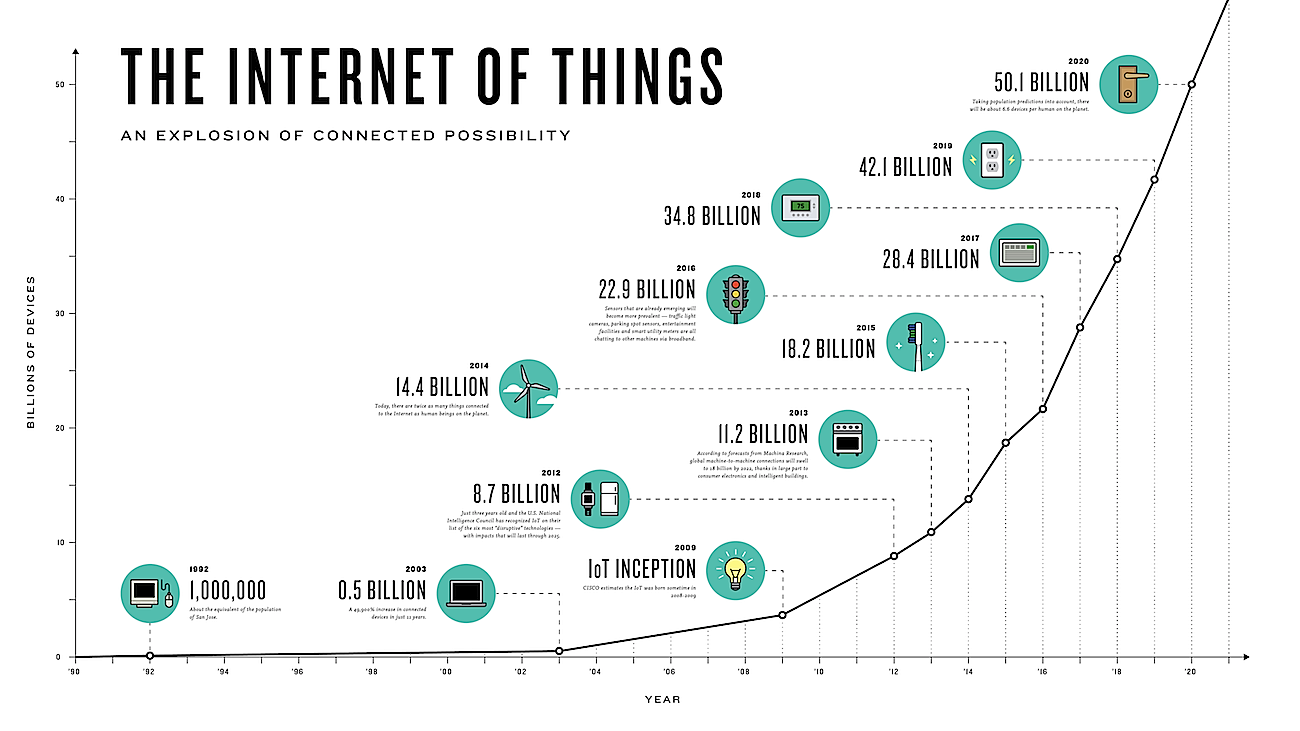
All this is a part of an evolution. The big business today is The Internet of Things (IoT) and that is a vision. Most of the people have smart phones, but now everything will be smart things. We will be surrounded with smart phones, smart cars, clothes, homes, offices, streets and cities.

What is the concept Internet of Things (IoT)?

The Internet of Things (IoT) refers to the interconnection of uniquely identifiable embedded computing-like devices within the existing Internet infrastructure. IoT is expected to offer advanced connectivity of devices, systems and services that goes beyond machine-to-machine communications (M2M) and covers a variety of protocols, domains, and applications.

IoT can refer to a wide variety of devices such as heart monitoring implants, biochip transporters on farm animals, automobiles with built-in sensors, or field operation devices that assist fire-fighters in search and rescue. Current market examples include smart thermostat systems and washer/dryers that utilize wifi for remote monitoring.

This is big business. According to Gartner, there will be nearly 26 million devices on the Internet of Things by 2020. ABI Research estimates that more than 30 billion devices will be wireless connected to the Internet of Things (Internet of Everything) by 2020.

Per a recent survey and study done by Pew Research Internet Project, a large majority of the technology experts and engaged Internet users who responded (83 percent) agreed with the notion that the Internet/Cloud of Things and embedded and wearable computing will have widespread and beneficial effects by 2025.

It is, as such, clear that the IoT will consist of a very large number of devices being connected to the Internet.

Ambient intelligence and autonomous control are not part of the original concept of the Internet of Things. Ambient intelligence and autonomous control do not necessarily require Internet structures, either. However, there is a shift in research to integrate the concepts of the Internet of Things and autonomous control.
In the future the Internet of Things may be a non-deterministic and open network in which auto-organized or intelligent entities (Web services, SOA components), virtual objects (avatars) will be interoperable and able to act independently (pursuing their own objectives or shared ones) depending on the context, circumstances or environments.
Embedded intelligence presents an “AI-oriented” perspective of Internet of Things, which can be more clearly defined as: leveraging the capacity to collect and analyze the digital traces left by people when interacting with widely deployed smart things to discover the knowledge about human life, environment interaction, as well as social connection/behavior.

Physical objects will be connected to the internet and be able to identify themselves to other devices. The physical world is becoming one big information system. This is all great innovation with big opportunities, but it can also be a big mistake.

MIT professor Alex Pentland has written extensively about privacy, data ownership and data control. George Orwell was not creative enough when he wrote «1984».


Reports today:

10.00 a.m   USD   Factory Orders

02.00 p.m   USD   Beige book


Disclaimer: The views expressed in this article are those of the author and may not reflect those of Shiny bull. The author has made every effort to ensure accuracy of information provided; however, neither Shiny bull nor the author can guarantee such accuracy. This article is strictly for informational purposes only. It is not a solicitation to make any exchange in precious metal products, commodities, securities or other financial instruments. Shiny bull and the author of this article do not accept culpability for losses and/ or damages arising from the use of this publication.

Leave a comment

Filed under Uncategorized

Summertime!


Thank god it`s friday! Thank god it`s summertime! Shinybull will take a break and enjoy the summer, and this summer will be awesome. There is only 8 teams left in the World Cup, and later today half of them will fight. First out is Germany against France. Later today we will see Brasil against Colombia.

world cup


The quarter-final in Fortaleza between Brazil and Colombia is more like a match between Brazil`s Neymar, who has driven Brazil forward with four goals, and Colombia`s biggest star and goal-getter Rodriguez.

I will miss two big players from both teams. Colombia have cruised to the quarter-finals despite the heartbraking loss of Radamel Falcao. One of Brazil`s biggest hero Luiz Gustavo leaves a hole in the quarter-final against Colombia today as he have two yellow cards.

During four games, Gustavo ran more than a marathon. He ran 46,1 km and 6km more than Nymar. More surprisingly; Gustavo ran 16,3 km with the ball at his feet. He also recovered the ball 34 times, and that is the fourth highest total in the World Cup so far.

It is easy to understand why Brazil`s coach Luiz Felipe Scolari and the Brazilians are fretting so much about how to replace him. Scolari have an idea of bringing in Maicon for Dani Alves to make the team`s right side more robust. The playmaker James Rodriguez will need attention while Brazil will have to handle Colombia`s taste for exploring the flanks, something even more tempting when up against Brazil`s full-backs. Scolari consider to switch to a 3-5-2 formation.

Colombia have won just two of their 25 previous games against Brazil and have never defeated them on Brazilian soil. Brazil are unbeaten in 41 successive home matches. James Rodriguez has scored in each of his last six appearances for Colombia. It`s all set up for a great match today.

TETRRF-00024113-001

What will the trading activity be today as we have two big soccer matches on the screen, in addition to a BBQ party and celebrating 4th of July? The story starts in 1775 as people in New England started their fight against the British for their independence.

Then on July 2, 1776, the Congress secretly started its voting for independence from Britain. After that on July 4, 1776 Declaration of Independence was published. But on July 8, 1776 the first public reading of the Declaration of Independence was done. Declaration of Independence was then signed on August 2, 1776.

The first Independence Day was celebrated with parade show, games, guns fires, bells, bonfires throughout the United States. By that time, till 1791 the term Independence Day was not used. But it`s more to come.

TdF

Tour de France starts tomorrow, and I really look forward to the next three-weeks with Tour de France on the screen. The big question is; Will Team Sky win for the third time in a row? Last time the winner was Chris Froom. In 2012, the winner was the British Bradley Wiggins. Both from team Sky.

Alberto Contador seems to be in good shape, and we will probably see some wildcards we didn`t think about. It all begins tomorrow with a road stage from Leeds to Harrogate, while the peleton remains in Yorkshire the following day with a stage from York to Sheffield.

The third and final British leg of the 2014 Tour will be between Cambridge and London on July 7, before the riders proceeds to France via Eurostar. Defending champion Chris Froome will start along with Vincenzo Nibali (Astana), Alberto Contador (Saxo Bank) and Alejandro Valverde (Movistar). However there is no place for Team Sky`s 2012 race winner Bradley Wiggins.

Peter Sagan (Cannondale), Marcel Kittel (Argos Shimano) and Mark Cavendish (Omega Pharma Quickstep), are expected to fight it out for the green points jersey. I expect Alexander Kristoff (Katusha) to be an outsider. Alexander`s stepfather got him interested in cycling rather than soccer. Wow!  It`s headed for a great summer!

Disclaimer: The views expressed in this article are those of the author and may not reflect those of Shiny bull. The author has made every effort to ensure accuracy of information provided; however, neither Shiny bull nor the author can guarantee such accuracy. This article is strictly for informational purposes only. It is not a solicitation to make any exchange in precious metal products, commodities, securities or other financial instruments. Shiny bull and the author of this article do not accept culpability for losses and/ or damages arising from the use of this publication.


Leave a comment

Filed under Uncategorized

Who is Sergey Brin?

Sergey Mikhaylovich Brin is an American business magnate and computer scientist who, with Larry Page co-founded Google, which is one of the most profitable Internet companies. As of June 2014, his personal wealth was estimated to be $30 billion, and together, Brin and Page own about 16 percent of Google.

sergeybrin

(Picture: Sergey Brin, Google Inc)


Brin was born in Moscow in the Soviet Union to Russian Jewish parents, Michael Brin and Eugenia Brin, both graduates of Moscow State University. His father is a mathematics professor at the University of Maryland, and his mother a researcher at NASA`s Goddard Space Flight Center.

The economist newspaper referred to Brin as an «Enlightenment Man», and someone who belive that «knowledge is always good, and certainly always better than ignorance», a philosophy that is summed up by Google`s motto «Organize the world`s information and make it universally accessible and usesful» and «Don`t be evil».

When Brin was 6 years (1976) old, his family felt compelled to emigrate to the United States. Sergey`s father has earlier told that he was «forced to abandon his dream of becoming an astronomer even before he reached college».

He claims Communist Party heads barred Jews from upper professional ranks by denying them entry to universities, as Jews excluded from the physics departments in particular. Michael Brin therefore changed his major to mathematics where he received nearly straight A`s.

He said; «Nobody would even consider me for graduate school because I was Jewish. At Moscow State University, Brin said, Jews were required to take their entrance exams in different rooms from non-Jewish applicants and they were marked on a harsher scale.

In 1977, after his father returned from a mathematics conference in Warsaw, Poland, he announced that it was tome for the family to emigrate. «We cannot stay here anymore», he told his wife and mother. At the conference, he was able to «mingle freely with colleagues from the United States, France, England and Germany and discovered that his intellectual brethren in the West were not «monsters». He said; «I was the only one in the family who decided it was really important to leave».

Sergey`s mother was less willing to leave their home in Moscow, where they had spent their entire lives, but the decision ultimately came down to Sergey. In May 1979, they were granted their official exit visas and were allowed to leave the country. «I know the hard times that my parents went through their and am very thankful that I was brought to the States», Sergey said in an interview in October 2000.

A few weeks before Sergey`s 17th birthday (1990), his father led a group og high school math students, including Sergey, on a two-week exchange program to the Soviet Union. As Brin recalls, the trip awakened his childhood fear of authority and he remembered that «his first impulse on confronting Soviet oppression had been to throw pebbles at a police car».

On the second day of the trip, while the group toured a sanatorium in the countryside near Moscow, Brin took his father aside, looked him in the eye and said; «Thank you for taking us all out of Russia.»

Brin attended grade school at Paint Branch Montessori School in Adelphi, Maryland, but he received further education at home; his father, a professor in the department of mathematics at the University of Maryland, encouraged him to learn mathematics.

He attended Eleanor Roosevelt High School in Greenbelt, Maryland. In 1990, Brin enrolled in the University of Maryland to study computer science and mathematics, where he received his Bachelor of science in May 1993 with honors.

Brin began his graduate study in computer science at Stanford University on a graduate fellowship from the National Science Foundation. In 1993, he interned at Wolfram Research, who were the developers of Mathematica. As of 2008, he is on leave from his PhD studies at Stanford.

He met Larry Page at Stanford. Brin jokingly said; «We`re both kind of obnoxious». They seemed to disagree on most subjects, but after spending time together, they became intellectual soul-mates and close friends. Together, the pair authored a paper titled «The Anatomy of a Large-Scale Hypertextual Web Search Engine».

They both realized they had succeeded in creating a superior engine for searching the web and suspended their PhD studies to work more on their system. Mark Malseed, the co-founder of «The Google story», wrote; «Soliciting funds from faculty members, family and friends, Brin and Page scraped together enough to buy some servers and rent that famous garage in Menlo Park.

Sun Microsystems co-founder Andy Bechtolsheim wrote a $100,000 check to Google Inc, but the problem was that Google Inc did not yet exist. The company hadn`t yet been incorporated. For two weeks, as they handled the paperwork, the young men had nowhere to deposit the money.

Google logo

The Economist magazine describes Brin`s approach to life, like Page`s, as based on a vision summed up by Google`s motto; «of making all the world`s information universally accessible and useful».

Others have compared their vision to the impact of Johannes Gutenberg, the inventor of modern printing:

In 1440, Johannes Gutenberg introduced Europe to the mechanical printing press, printing Bibles for mass consumption. The technology allowed for books and manuscripts – originally replicated by hand – to be printed at a much faster rate, thus spreading knowledge and helping to usher in the European Renaissance. Google has done a similar job.

The authors of «The Google Story» wrote; «Not since Gutenberg…has any new invention empowered individuals, and transformed access to information, as profoundly as Google. Also not long after the two «cooked up their new engine for web searches, they began thinking about information that is today beyond the web», such as digitizing books, and expanding health information.

Sergey Brin married biotech analyst and entrepreneur Anne Wojcicki in the Bahamas in May 2007. She has an active interest in health information, and they have brainstormed with leading researchers about the human genome project. Brin instinctively regards genetics as a database and computing problem. So does his wife, who co-founded the firm, http://www.23andme.com, which lets people analyze and compare their own genetic makeup (consisting of 23 pairs of chromosomes).

Together they have a son, born in December 2008, and a daughter, born in late 2011. In August 2013, it was announced Brin and Anne were living separately. Brin`s mother, Eugenia, has been diagnosed with Parkinson`s disease.

Brin used the services of 23andme and discovered that although Parkinson`s is generally not hereditary, both he and his mother possess a mutation of the LRRK2 gene (G2019S) that puts the likelihood of him developing Parkinson`s in later years between 20 and 80 percent.

An editorial in The Economist magazine states that «Mr Brin regards his mutation of LRRK2 as a bug in his personal code, and thus as no different from the bugs in computer code that Google`s engineers fix every day. By helping himself, he can therefore help others as well. He consider himself lucky, but Mr. Brin was making a much bigger point. Isn`t knowledge always good, and certainly always better than ignorance?

Sergey Brin is an investor in Tesla Motors, which has developed the Tesla Roadster, a 244-mile (393 km) range battery electric vehicle as well as the Tesla Model S, a 265-mile (426 km) range battery electric vehicle.

In 2008, he invested $4,5 million in Space Adventures, the Virginia-based space tourism company. Space Adventures, the only company that sends tourists to space, has sent five of the so far. He and Page are also trying to help solve the world`s energy and climate problems at Google philanthropic arm Google.org, which invests in the alternative energy industry to find wider sources of renewable energy.

Brin was also involved in the Google driverless car project, and in September 2012, at the signing of the California Driverless Vehicle Bill, Brin predicted that within five years, robotic cars will be available to the general public. Wow, we will wait for that car. What a great story!

Disclaimer: The views expressed in this article are those of the author and may not reflect those of Shiny bull. The author has made every effort to ensure accuracy of information provided; however, neither Shiny bull nor the author can guarantee such accuracy. This article is strictly for informational purposes only. It is not a solicitation to make any exchange in precious metal products, commodities, securities or other financial instruments. Shiny bull and the author of this article do not accept culpability for losses and/ or damages arising from the use of this publication.


 

Leave a comment

Filed under Uncategorized

Why transportation is so important


Many times the activity begin in the Rail Average before the Industrial Average. Before the economic activity began, raw materials will have to be moved from the suppliers to manufacturers. Before the automotive companies could increase production, more steel need to be transported. An increase in activity among the rail stocks would foreshadow an increase in business activity for the industrial stocks. You can also foreshadow an economic downturn.

tran 27 june

(Chart: Dow Jones Transportation Average)

The internet has changed the economy and is more different from hundred years ago, and the makeup of the DJTA has changed to favor the airlines. There is still credibility in using DJTA to confirm movements in the DJIA. Transport stocks are much more dependent on the economic environment than the average stock and will likely foreshadow economic growth.


Energy and labor cost from a large portion of expenses, The airline business is cyclical and revenues are highly susceptible to economic changes. Airline companies typically carry above average levels of debt and will be more vulnerable to changes in interest rates.


To reflect the added risks above airline stocks have traditionally sold significantly below market multiples. If the PE for the S&P 500 is 28, the average airline might sell for only 8-10 times earnings.


Airline companies bear the burden of all interest rates, energy costs and labor costs, but are still likely to act as a leading indicator of the general economic environment. Airlines biggest fear should however be that people will stop flying in airplanes.


That`s why I`m following airplane and shipping stocks all the time. It gives me a sign of a new activity in the economy or a real slowdown in the economy. As you can see on the chart above, the activity is great, which is good for the transportation stocks.


Reports today:

09:45 a.m EST Chicago PMI

10:00 a.m EST Pending Home Sales m/m


Disclaimer: The views expressed in this article are those of the author and may not reflect those of Shiny bull. The author has made every effort to ensure accuracy of information provided; however, neither Shiny bull nor the author can guarantee such accuracy. This article is strictly for informational purposes only. It is not a solicitation to make any exchange in precious metal products, commodities, securities or other financial instruments. Shiny bull and the author of this article do not accept culpability for losses and/ or damages arising from the use of this publication.
 

Leave a comment

Filed under Uncategorized