
Category Archives: Uncategorized

YouTube is dominant in the music streaming market and a new case for the European Commission

Consumer behaviour is very important for the music industry and a new research by IFPI contains key findings on changing consumer behaviour and provides valuable insights on the «value gap», which is the music industry`s most pressing priority.

«The value gap» is the massive mismatch between the growing consumption of music worldwide and the disproportionately small revenues that are returned to rights holders. It is caused by a market distortion allowing some major digital services to circumvent the normal rules of music licensing.

This denies musicians, artists, composers and investors fair compensation for their work; lowers investment in and diversity of new music; and skews competition among digital services. IFPI sees today`s proposal as a good first step in the process.

musicstreaming


Notably, the proposal confirms that user uploaded content services that promote and monetize music should be covered by the same copyright rules as other on-demand services.

Commenting on the proposal, IFPI Chief Executive, Frances Moore said:

«The music industry has transformed itself in recent years, licensing hundreds of services, widening choices for consumers and investing in new, creative ways to bring artists to a global audience.

But to achieve sustainable growth, the music sector needs a level playing field.

This means creating an environment where copyright rules are correctly applied so that creators and producers can be confident to invest and license. It also means allowing digital services to compete on fair terms and enabling consumers to enjoy access to diverse sources of licensed music.

«Today`s proposal is a good first step towards creating a better and fairer licensing environment in Europe. Importantly, it confirms that user uploaded content services such as YouTube, which are the largest source of on-demand music, should not be able to operate outside normal licensing rules.

However, there is a lot more to do to make this a workable proposal. We look forward to working on this in the coming months with the Parliament and Member States.»

The music consumer behaviour is changing, and this is the key report highlights:

  • Paid audio streaming is growing: 71% of internet users aged 16-64 access licensed music. Paid audio streaming services are growing in popularity, especially among under 25`s. One-third of 16-24 year old now pay for an audio streaming service.
  • YouTube is the most used music service: 82% of all YouTube visitors use it for music. More people use YouTube to consume music they already know than to discover new content.
  • Copyright infringement remains a significant problem: more than one-third (35%) of internet users access unlicensed music content. infringement is changing, with half (49%) of 16-24 year olds using stream ripping services to download music.
  • Young people are highly engaged with music: with 82% of 13-15 year-old listening to licensed music and the majority willing to pay for music.
  • Smartphones are moving towards replacing computers as the most used device for music consumption; especially in developing countries. Users of paid audio streaming services are particularly likely to listen to music on a smart phone.

Commenting on the report, Frances Moore, CEO, IFPI said:

«There are many positives for the music industry in this research: streaming services have revolutionised the experience of the music consumer, with growing numbers paying for audio streaming services;

listeners are responding to the benefits offered by on-the-go, on-demand access to music by moving more and more to the world of mobile, especially in emerging markets; and young fans are showing passion and engagement with music.

«Record companies, and the investment they make in music, are at the heart of this change. That investment is all the more important in the digital world, driving the creation of new music and helping artists connect with their fans.

«There are also key insights informing the policy debate on musics «value gap», the biggest problem for todays music sector. The research highlights the dominant position amongst music services of YouTube, as well as the fact that the site is used by consumers primarily to access music they know, on-demand.

Yet YouTube can get away without remunerating fairly artists and producers by hiding behind ‘safe harbour’ laws that were never designed for services that actively engage with and make available music enjoyed by the vast majority of its users.»

YouTube use a loophole in international copyright laws. The pay much lower licensing fees the music industry than services such as Spotify and Apple Music. YouTube considers itself a hosting platform rather than a content distributing platform.

This is a practice that has repeatedly been dismissed as unfair by record companies and competitors. YouTube say it is mostly a promotional platform for artists and record companies.

Spotify is twice as big as Apple Music. Spotify has 40 million paid subscribers, while Apple music has «only» 4 million. Spotify has 100 million of total listeners while Apple Music has 78 million.

To put that in perspective; YouTube doesn`t have any paid subscribers, but they are more than 8 times bigger than Spotify with its listeners.

asphalt

Disclaimer: The views expressed in this article are those of the author and may not reflect those of Shiny bull. The author has made every effort to ensure accuracy of information provided; however, neither Shiny bull nor the author can guarantee such accuracy. This article is strictly for informational purposes only. It is not a solicitation to make any exchange in precious metal products, commodities, securities or other financial instruments. Shiny bull and the author of this article do not accept culpability for losses and/ or damages arising from the use of this publication.


Leave a comment

Filed under Uncategorized

The Federal Reserve

bb


asphalt

Disclaimer: The views expressed in this article are those of the author and may not reflect those of Shiny bull. The author has made every effort to ensure accuracy of information provided; however, neither Shiny bull nor the author can guarantee such accuracy. This article is strictly for informational purposes only. It is not a solicitation to make any exchange in precious metal products, commodities, securities or other financial instruments. Shiny bull and the author of this article do not accept culpability for losses and/ or damages arising from the use of this publication.

Leave a comment

Filed under Uncategorized

Olympic Games starts in Brazil while the GDP is declining

The Olympic Games starts today and will last until 21 August 2016, and the host is Rio de Janeiro. A beautiful place on earth, but if you ask some people there, they have another view. They are against it.

Hundreds of demonstrators demonstrated earlier on Friday, and blocked roads in Copacabana. They protested against the government and the cost of hosting the event. Nothing has obviously changed since last time I wrote about Brazil during the World Cup in 2014.


ol2016

People were angry at that time and so is it now. They feel angry because they belive the Brazilian government should spend money on other things than World Cup and now Olympic Games. Brazil still have serious problems with crime.

Brazil still has above-average levels of violent crime and particularly high levels of gun violence and homicide. WHO estimated the number of 32 deaths per 100,000 inhabitants, which is one of the highest rates of international homicide of the world.

There are differences between the crime rates in the Brazilian states. While in Sao Paulo the homicide rate registered in 2013 was 10,8 deaths per 100,000 inhabitants, in Alagoas it was 64,7 homicides per 100,000 inhabitants.

Brazil also has high level of incarceration and the third largest prison population in the world (behind only China and the United States), with an estimated total of approximately 700,000 prisoners around the country (June 2014), an increase of about 300% compared to the index registered in 1992.

Brazil is the largest country in both South America and Latin America. As the world`s fifth-largest country by both area and population, it is the largest country to have Portuguese.

Brazil was inhabited by numerous tribal nations prior to the landing on 1500 of explorer Pedro Alvares Cabral, who claimed the area for the Portuguese Empire. Brazil remained a Portuguese colony until 1808, when the capital of the empire was transferred from Lisbon to Rio de Janeiro.

In 1815, the colony was elevated to the rank of kingdom upon the formation of the United Kingdom of Portugal, Brazil and the Algarves. Independence was achieved in 1822 with the creation of the Empire of Brazil, a unitary state governed under a constitutional monarchy and a parliamentary system.

The ratification of the first constitution in 1824 led to the formation of a bicameral legislature, now called the National Congress. The country became a presidential republic in 1889 following a military coup dètat.

An authoritarian military junta came to power in 1964 and ruled until 1985, after which civilian governance resumed. Brazil`s current constitution, formulated in 1988, defines it as a democratic federal republic.

The federation is composed of the union of the Federal District, the 26 states, and the 5,570 municipalities.

(PPP) as of 2015. A member of the BRICS group, Brazil until 2010 had one of the world`s fastest growing economies, with its economic reforms giving the country new international recognition and influence.

Brazils national development bank plays an important role for the countrys economic growth.

The country has been the largest producer of coffee for the last 150 years.


GDP-Brazil


Now, things have turned upside down, and it has been a sharp and quick drop for the Brazilian economy and for Ms Dilma Rousseff. Brazil`s economic woes started in 2011, when China began to decelerate and Brazilian commodities began losing value.

Brazil`s GDP YoY is -5,40%, and their Interest rate is 14,25% with a jobless rate of 11,30%.

There is something strange here.

Argentina and Venezuela is not far away from Brazil, and if we scrutinize the numbers we can see that they have something in common. The Interest rate and Inflation rate is very high.

In Brazil, the Interest rate is 14,25%, but in Venezuela, the Interest rate is 21,36%. In Argentina; 30,25%. Not only that. Take a look at the Inflation rate; in Argentina it is 40,50%, but in Venezuela it is 180,90%. Can you belive that? The Inflation rate in Venezuela is 180,90%! Wow.

Its not so bad for the growth in Argentina, but Venezuela is in same boat as Brazil when it comes to growth. GDP in Brazil is -5,40% and in Venezuela it is -7,10%. Argentinas GDP YoY is 0,49%. Not much, but they`re on the right side.

By comparison; Chinas GDP is 6,70%, and Indias GDP is 7,90%.

It went wrong for both Brazil and Venezuela, but this can also happen in your country. Remember that.


asphalt

Disclaimer: The views expressed in this article are those of the author and may not reflect those of Shiny bull. The author has made every effort to ensure accuracy of information provided; however, neither Shiny bull nor the author can guarantee such accuracy. This article is strictly for informational purposes only. It is not a solicitation to make any exchange in precious metal products, commodities, securities or other financial instruments. Shiny bull and the author of this article do not accept culpability for losses and/ or damages arising from the use of this publication.

Leave a comment

Filed under Politics, Uncategorized

Banks & Guns

banksandguns

Leave a comment

by | July 15, 2016 · 10:56 pm

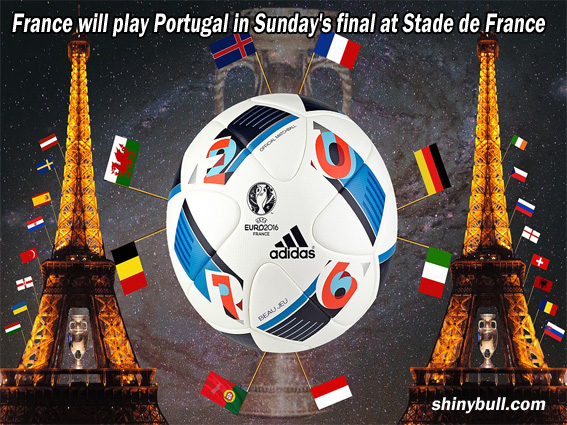
Portugal and France will compete in the UEFA EURO 2016 final on Sunday

Portugal and France will compete in the UEFA EURO 2016 final in Saint Denis on Sunday. Host France beat world champions Germany to reach UEFA EURO 2016 final, and they will have the chance to emulate their 1984 European champions after two assured Anoine Griezmann finishes earned a semi-final win in Marseille and ended Germany`s hopes of adding the European crown to the world title they lifted two years ago.


france-final


asphalt

Disclaimer: The views expressed in this article are those of the author and may not reflect those of Shiny bull. The author has made every effort to ensure accuracy of information provided; however, neither Shiny bull nor the author can guarantee such accuracy. This article is strictly for informational purposes only. It is not a solicitation to make any exchange in precious metal products, commodities, securities or other financial instruments. Shiny bull and the author of this article do not accept culpability for losses and/ or damages arising from the use of this publication.
Leave a comment

Filed under Uncategorized