
Category Archives: Quantitative Easing

Cautious Stock Market Investors

U.S markets will be closed today in observance of the Martin Luther King Jr holiday. Some markets will be open like futures, but I will stay away from the market today because of the lack of volume and liquidity.

I will follow oil and gold prices and all the commodity traders should keep in mind that Crude Oil inventories will be released on Thursday at 11:00am, instead of the normal Wednesday 10:30 am release due to Monday`s holiday.

Gold is on the move and can go up about 25%, and the precious metal is the best performing asset class so far this year. It`s golden days for day traders. Take a look at the oil price. It`s like roller coaster, jumping up and down, and oil had the biggest gain in 2 1/2 years, ending the trading session of friday 5,82% higher.

The reason why the stock market didn`t follow the oil price on friday can be the disappointing retail sales report in early trading on friday. Retail sales dropped 0,9% vs a 2% forecast. The S&P ended Friday with a 27 point gain, and ended the week 25 points lower. That`s down 1,24% for the week.

The Dow saw triple digit profits on Friday with a 191 point gain, and it closed at 17511,57, wrapping up the week with a 226 point loss. Friday`s Preliminary Consumer Confidence report was a beacon of hope for the bulls. The report not only beat expectations. That`s the highest level in 11 years!

A number of questions marks seem to have investors leaning back on their heals this year. This is; plummeting oil prices, geopolitical turmoil and continued divergence between the world`s major economies like Japan, China, U.S and the Euro zone.

All the investors eyes are on the world`s central banks. The Davos meeting later on this week will be interesting, and the ECB is expected to deliver a stimulus package later this month. Investors will wait for definitive word from the ECB regarding its widely anticipated stimulus plan.

Bond market rose across the board as interest rates dropped lower, with the 10-year Treasury rate falling below 2%. The downtrend in rates is not good, and is a symptom of deflationary pressures which is worse than inflation. Plummeting energy prices are adding fuel to the fire.

The U.S dollar continued its bullish climb last week, putting downward pressure on the commodity sector as a whole. This trend can last awhile longer.

Investors are cautions and it seems everyone is a bit hesitant to commit to new, bullish positions until some questions are resolved. I will wait for a clearer trend to emerge and 1,200 in small-cap stocks need to break before I call the bullish trend in equities alive.


Disclaimer: The views expressed in this article are those of the author and may not reflect those of Shiny bull. The author has made every effort to ensure accuracy of information provided; however, neither Shiny bull nor the author can guarantee such accuracy. This article is strictly for informational purposes only. It is not a solicitation to make any exchange in precious metal products, commodities, securities or other financial instruments. Shiny bull and the author of this article do not accept culpability for losses and/ or damages arising from the use of this publication.

Leave a comment

Filed under Commodities, Quantitative Easing, Stock market

Is this the end of QE?

Two things are important right now. Earnings and the Fed. 80% of the S&P companies that have reported earnings have beaten estimates, according to Bloomberg. The catalyst for last week`s 4% rally was the reported earnings, and will continue to be the catalyst this week for any move in the market.

Todays FOMC Statement and Fed Funds rate decision will also play a big role in the market this week. Interest rate is very important in the stock market, and the big question for investors now is when the Fed will start to raise the interest rates. Any hint or insight will likely stir the markets.

Fed Chair Janet Yellen is worried about the low inflation, and the inflation gauge has fallen short of the Fed`s 2% target. The risk of deflation may weight against raising interest rates too soon.

Prices as measured by the personal consumption expenditures index rose 1,5% from a year earlier in August, and oil prices is something Fed has no control over. As you may know, the oil prices has dropped over 20% so far this year.

Many investors expect the Fed to end its third round of asset purchases today, while others say the central bank should consider a delay in ending QE in light of the falling inflation. It is possible for the Fed to reduce the monthly purchases by $10 billion and leave the final $5 billion reduction for December.

The Fed will still hold a record $4,48 trillion balance sheet accumulated during QE 3 despite an end of QE today. That will limit the supply of securities and keep the yield lower as their borrowing cost is limited.

Market volatility and sign of slowing global growth will make the Fed to act with caution, and it`s expected to see the interest rate to near zero for a «considerable time» after bond buying ends. Fed`s benchmark rate has remained at zero to 0,25% since December 2008, but it is expected to see the rate to increase in mid-2015.

FOMC`s next meeting is in December.


Disclaimer: The views expressed in this article are those of the author and may not reflect those of Shiny bull. The author has made every effort to ensure accuracy of information provided; however, neither Shiny bull nor the author can guarantee such accuracy. This article is strictly for informational purposes only. It is not a solicitation to make any exchange in precious metal products, commodities, securities or other financial instruments. Shiny bull and the author of this article do not accept culpability for losses and/ or damages arising from the use of this publication.

Leave a comment

Filed under Quantitative Easing

Why not print more money?

Let`s print more money and solve the debt problem. That sounds great, but unfortunately, it isn`t so easy as that. We will not be wealthier if we print more money. That is difficult to understand, and why is it like that?

money2

If we print more money, prices will increase and that`s what we call inflation. Let`s suppose the United States printed a lot of money and gave it to everyone in the country. People would pay debt or save the money, but most of them will be spent on different things.

Today, I belive most of them would run to the shops and buy iPhone 6 or the latest version of Xbox. But this would be a problem for both Apple and Microsoft, because the demand will increase. They will simply not have enough products to sell to the market, which means the prices will go up, which means a massive inflation, and our money is devalued.

If Apple and Microsoft increase the production to meet the demand in the market, it will be a problem for the factories too, because their capacity is limited. If the demand increase, the production will also increase, so the prices goes up at the retailer, Apple and factory.

The cost per-unit will rise because of the rise in labor cost at the factory. A rise in cost at the factory rises the price of the product in the shop. All this because of an increase in the demand for the product.

Wages are prices. An hourly wage is the price a man charges for an hour of labor. It`s not possible to stay at the same level if employees work overtime. This is added cost. In some industries it will be a problem to have increased demand, and some will need to hire extra labor. Extra labor will increase wages.

Do you think employees will work more or less if you gave them a lot of money? Labor market pressures requires wages to increase, which means the cost per unit must increase as well. Retailers must raise prices or simply run out of product.

Inflation is when the supply of money goes up and the supply of goods goes down. At the same time, the demand for money goes down, and the demand for goods goes up. Inflation can be avoided, if the factors I mentioned is in balance. It`s all about the balance between the supply of money, and the supply of goods.

Look at Japan. They have printed more money than the U.S, but inflation and interest rates is stable and it has been like this for about 25 years now. They must be doing something right to control the supply and demand of money and goods. All this is theory. Fed Chair Janet Yellen is now warning investors, telling them that the interest rates will start to increase. Many investors are waiting for an imminent hyperinflation. Normally, when the stock market goes down, the interest rate goes up. They are going in the opposite directions.

People think that printing more money will give them more wealth, but that`s not true. If we all have more money, we will not be more wealthy, because more money does nothing to increase the amount of wealth or more «things» in this world.

Why is it like that? It is because the same number of people are looking for the same amount of «things», and that on average will not make people wealthier than before.


Disclaimer: The views expressed in this article are those of the author and may not reflect those of Shiny bull. The author has made every effort to ensure accuracy of information provided; however, neither Shiny bull nor the author can guarantee such accuracy. This article is strictly for informational purposes only. It is not a solicitation to make any exchange in precious metal products, commodities, securities or other financial instruments. Shiny bull and the author of this article do not accept culpability for losses and/ or damages arising from the use of this publication.
Leave a comment

Filed under Quantitative Easing, Uncategorized

Interest-rate cut in the Euro Zone


Japan`s Nikkei index rose to a 7-week high today, up +0,97%. Yen retreated against the dollar and a record high for Wall Street helped the Asian stocks on upbeat U.S housing data. The broader Topix advanced 1,2% to 1,194,69.


European stocks are also up today, helped by Italy`s Prime Minister Matteo Renzi. FTSE MIB outperform after Italy`s Prime Minister`s centre-left Democratic Party`s reform were endorsed by a strong showing in European elections.

ECB

A big surprise for many nervous «Sell in may and go away»-investors on friday. The U.S indices increased with the DOW up +0,38% to 16,606,27, Nasdaq +0,76% to 4,185,81, and S&P 500 +0,42% to 1,900,53.


ECB`s President Mario Draghi says the policy makers are watching the market closely and once they see low inflation they will be ready to take some action. Draghi said they are looking for a negative spiral to take hold between low inflation, falling inflation expectations and credit.


«We are not resigned to allowing inflation to remain too low for too long», Draghi said today. He is trying to guide the euro area through a fragile economic recovery that remains threatened by subdued pricing power.


Next ECB meeting is June 5 and they are now working on a package including interest-rate cuts and liquidity injections. Many investors will wait for the next ECB meeting and the lower the interest-rate is, the bigger the problem in the economy is. You are tough if you buy stocks now.


Reports today:


04:00 a.m EST ECB President Draghi Speaks

All Day Bank holiday


Disclaimer: The views expressed in this article are those of the author and may not reflect those of Shiny bull. The author has made every effort to ensure accuracy of information provided; however, neither Shiny bull nor the author can guarantee such accuracy. This article is strictly for informational purposes only. It is not a solicitation to make any exchange in precious metal products, commodities, securities or other financial instruments. Shiny bull and the author of this article do not accept culpability for losses and/ or damages arising from the use of this publication.


Leave a comment

Filed under Quantitative Easing, Stock market

Inflation and interest rate

What a rally in Asia today! Japan`s Nikkei is up +2,11% to 14,338. Hang Seng is up +0,51% and ASX 200 is up +1,02%. It was a great rally in the U.S yesterday too. The Dow was up +0,97%, S&P 500 +0,81% and Nasdaq +0,85%. Great!

Why this rally now? The investors like the good news from China. The China manufacturing data is good, and that will have a positive impact on Europe. The message from the Fed minutes is also good. They say that there will be no rate increase soon.

Asian stocks rose to set for the biggest gain in three months, after minutes showed Federal Reserve policy makers see muted risk of inflation from continued U.S stimulus. Fed`s policy makers said continued stimulus to push unemployment lower doesn`t risk sparking an undesirable jump in the inflation rate.

money2

Policy makers are watching progress toward their goal of full employment as they consider the timing of the first interest-rate increase since 2006. The Fed has said the benchmark rate will stay low for a «considerabe time». They ended its bond-purchase program that set to wind down by late this year.

The Fed have earlier said that they will keep the interest rate low at least as long as the jobless rate is below 6,5% and the outlook for inflation didn`t exceed 2,5%. Is that really possible? Let`s take a look at Japan. They have printed more money than U.S.

Japan`s inflation peaked out in the middle of the 70`s, but the real problems started in 1989. Japan`s Nikkei Index hit its all time high on December 29, 1989, during the peak of the Japanese asset price bubble. It reached an intra-day high of 38,957 before closing at 38,915,87.

700px-Nikkei_225(1970-).svg

(Picture: Japan`s Nikkei Index)

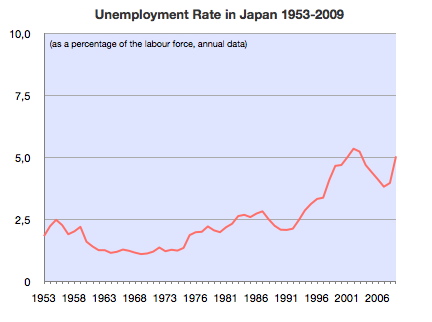
The bubble burst, and the Nikkei stock index plummeted and lost nearly all these gains, closing at 7,054,98 on March 10, 2009. That is 81,9% below its peak twenty years earlier. The unemployment rate increased, but stopped at 5%. Now, Japan`s unemployment is down to 3,6% (April, 2014).

Unemployment_Rate_of_Japan_1953-2009

(Picture: Unemployment rate in Japan 1953 – 2009)


Japan`s inflation rate is stable, and that is strange. Normally when you print a lot of money, inflation rate are increasing and it becomes extremely difficult to reduce it. If you look at the Japan`s inflation rate, it is stable.

The inflation rate in Japan was recorded at 1,60% in March of 2014. It had an all time high of 25% in February of 1976, and a record low of -2,52% in October of 2009. Japan`s inflation rate is in black on the picture below:

japan-inflation-cpi and US inflation compared

(Picture: Japan and U.S inflation rate – compared)


The most important categories in the CPI (Consumer Price Index) are Food (25% of total weight). Housing (21%), Transport and communications accounts for 14%. Culture and recreation (11,5%), Fuel, light and water charges for 7%. Medical care (4,3%), clothes and footwear (4%), Furniture and household utensils, Education and Miscellaneous goods and services account for the remaining.

Central banks around the world will try to sustain an inflation rate of 2 – 3%. The purchasing power is falling if the prices of goods and services is rising. Central banks attempt to stop severe inflation, along with severe deflation. They will keep the excessive growth of prices to a minimum. Inflation plays a large role in the Fed`s decisions regarding interest rates.

So far so good!


Reports today:

08:30 a.m EST unemployment Claims
09:45 a.m EST Flash manufacturing PMI
10:00 a.m EST Existing Home Sales


Disclaimer: The views expressed in this article are those of the author and may not reflect those of Shiny bull. The author has made every effort to ensure accuracy of information provided; however, neither Shiny bull nor the author can guarantee such accuracy. This article is strictly for informational purposes only. It is not a solicitation to make any exchange in precious metal products, commodities, securities or other financial instruments. Shiny bull and the author of this article do not accept culpability for losses and/ or damages arising from the use of this publication.

Leave a comment

Filed under Emerging markets, Quantitative Easing, Stock market